Chapter Three
Preferences
Rationality in Economics
Behavioral Postulate:
A decisionmaker always chooses its
most preferred alternative from its
set of available alternatives.
So to model choice we must model
decisionmakers’ preferences.
Preference Relations
Comparing two different consumption
bundles, x and y:
– strict preference: x is more preferred
than is y.
– weak preference: x is as at least as
preferred as is y.
– indifference: x is exactly as preferred
as is y.
Preference Relations
Strict preference, weak preference
and indifference are all preference
relations.
Particularly, they are ordinal
relations; i.e. they state only the
order in which bundles are
preferred.
Preference Relations



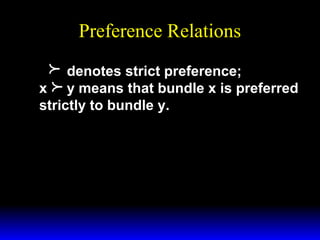
denotes strict preference;
x y means that bundle x is preferred
strictly to bundle y.
Preference Relations



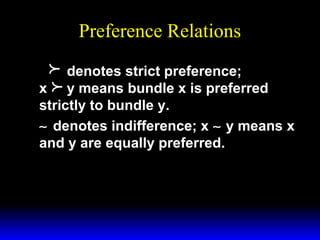
denotes strict preference;
x y means bundle x is preferred
strictly to bundle y.
∟ denotes indifference; x ∟ y means x
and y are equally preferred.
Preference Relations



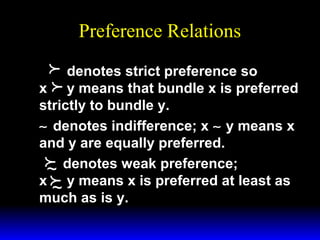
denotes strict preference so
x y means that bundle x is preferred
strictly to bundle y.
∟ denotes indifference; x ∟ y means x
and y are equally preferred.
 denotes weak preference;
~
x  y means x is preferred at least as
~ as is y.
much
Preference Relations
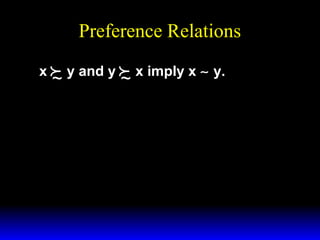
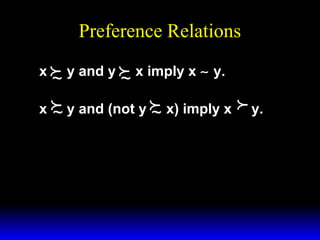
x  y and y  x imply x ∟ y.

~

~
Preference Relations
x  y and y  x imply x ∟ y.



~
~
x  y and (not y  x) imply x
~
~

y.
Assumptions about Preference
Relations
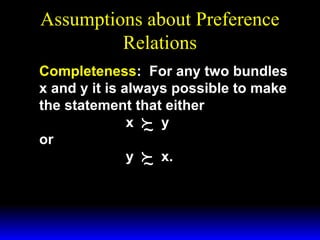
Completeness: For any two bundles
x and y it is always possible to make
the statement that either
x  y
~
or
y  x.

~
Assumptions about Preference
Relations
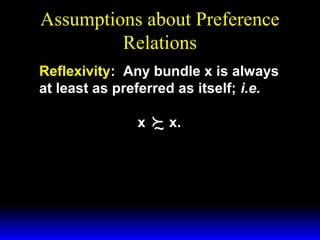
Reflexivity: Any bundle x is always
at least as preferred as itself; i.e.
x

 x.
~
Assumptions about Preference
Relations
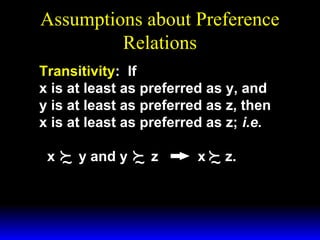
Transitivity: If
x is at least as preferred as y, and
y is at least as preferred as z, then
x is at least as preferred as z; i.e.
x


~

y and y


~

z

x  z.

~
Indifference Curves
Take a reference bundle x’. The set
of all bundles equally preferred to x’
is the indifference curve containing
x’; the set of all bundles y ∼ x’.
Since an indifference “curve” is not
always a curve a better name might
be an indifference “set”.
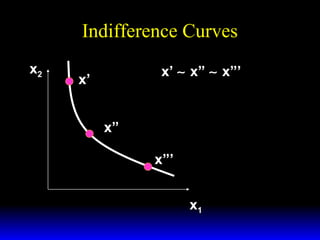
Indifference Curves
x2

x’ ∼ x” ∼ x”’

x’
x”

x”’
x1
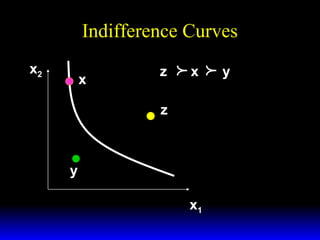
Indifference Curves


x

z

x

z

y
x1



x2

y
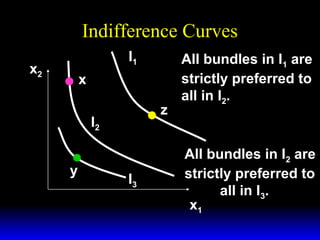
Indifference Curves
I1

x2

x
z

I2
y

I3

All bundles in I1 are
strictly preferred to
all in I2.

All bundles in I2 are
strictly preferred to
all in I3.
x1
Indifference Curves
x2

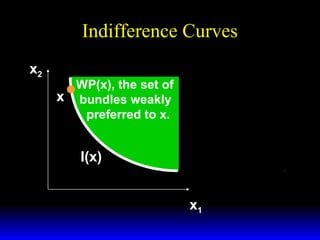
WP(x), the set of
x bundles weakly
preferred to x.

I(x)

I(x’)
x1
Indifference Curves
x2

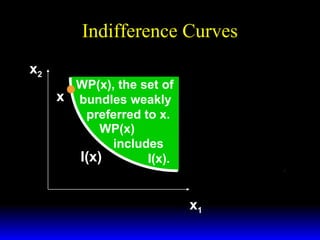
WP(x), the set of
x bundles weakly
preferred to x.
WP(x)
includes
I(x)
I(x).

x1
Indifference Curves
x2

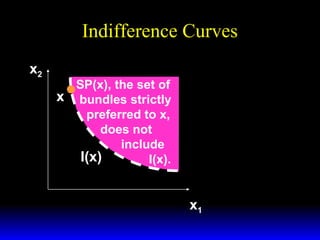
SP(x), the set of
x bundles strictly
preferred to x,
does not
include
I(x)
I(x).

x1
Indifference Curves Cannot
Intersect
x2

I1

I2

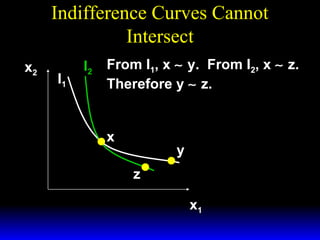
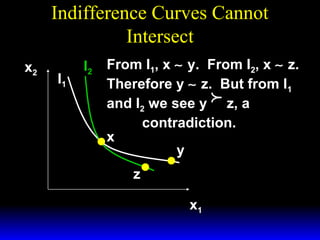
From I1, x ∟ y. From I2, x ∟ z.
Therefore y ∟ z.
x

y
z
x1
Indifference Curves Cannot
Intersect
I1

I2

From I1, x ∟ y. From I2, x ∟ z.
Therefore y ∟ z. But from I1
and I2 we see y z, a
contradiction.
x
y



x2

z
x1
Slopes of Indifference Curves
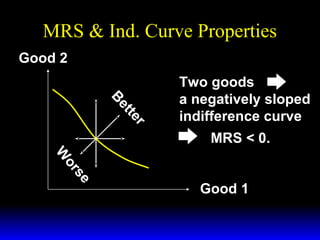
When more of a commodity is always
preferred, the commodity is a good.
If every commodity is a good then
indifference curves are negatively
sloped.
Slopes of Indifference Curves
Good 2
Be
tte
r
W
or
se

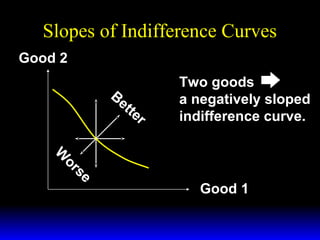
Two goods
a negatively sloped
indifference curve.

Good 1
Slopes of Indifference Curves
If less of a commodity is always
preferred then the commodity is a
bad.
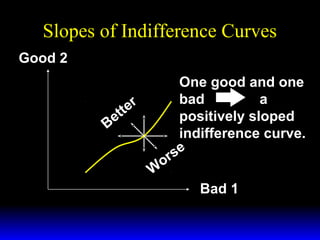
Slopes of Indifference Curves
Good 2
One good and one
bad
a
r
te
positively sloped
et
B
indifference curve.
se
or
W
Bad 1
Extreme Cases of Indifference
Curves; Perfect Substitutes
If a consumer always regards units
of commodities 1 and 2 as
equivalent, then the commodities are
perfect substitutes and only the total
amount of the two commodities in
bundles determines their preference
rank-order.
Extreme Cases of Indifference
Curves; Perfect Substitutes
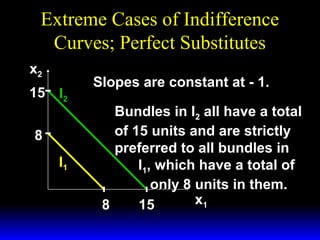
x2
15 I2
8
I1

Slopes are constant at - 1.
Bundles in I2 all have a total
of 15 units and are strictly
preferred to all bundles in
I1, which have a total of
only 8 units in them.
x1
8
15
Extreme Cases of Indifference
Curves; Perfect Complements
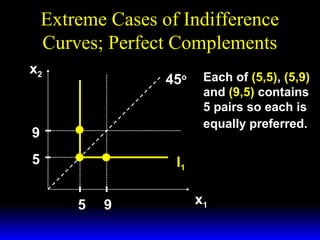
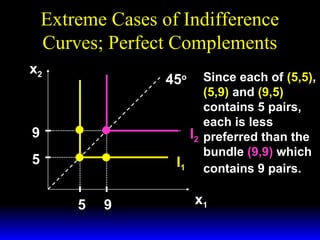
If a consumer always consumes
commodities 1 and 2 in fixed
proportion (e.g. one-to-one), then the
commodities are perfect
complements and only the number of
pairs of units of the two commodities
determines the preference rank-order
of bundles.
Extreme Cases of Indifference
Curves; Perfect Complements
x2

45o

9
5

Each of (5,5), (5,9)
and (9,5) contains
5 pairs so each is
equally preferred.

I1
5

9

x1
Extreme Cases of Indifference
Curves; Perfect Complements
x2

Since each of (5,5),
(5,9) and (9,5)
contains 5 pairs,
each is less
I2 preferred than the
bundle (9,9) which
I1 contains 9 pairs.

45o

9
5
5

9

x1
Preferences Exhibiting Satiation
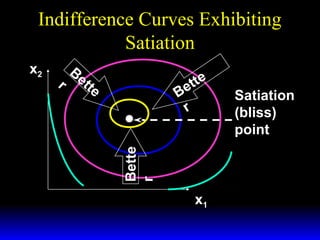
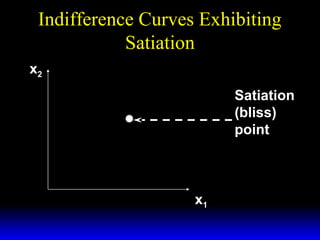
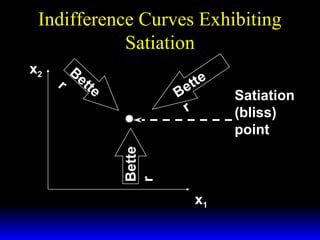
A bundle strictly preferred to any
other is a satiation point or a bliss
point.
What do indifference curves look like
for preferences exhibiting satiation?
Indifference Curves Exhibiting
Satiation
x2
Satiation
(bliss)
point

x1
Indifference Curves Exhibiting
Satiation
Be
r tte

tte
e
B
r

Bette
r

x2

x1

Satiation
(bliss)
point
Indifference Curves Exhibiting
Satiation
Be
r tte

tte
e
B
r

Bette
r

x2

x1

Satiation
(bliss)
point
Indifference Curves for Discrete
Commodities
A commodity is infinitely divisible if
it can be acquired in any quantity;
e.g. water or cheese.
A commodity is discrete if it comes
in unit lumps of 1, 2, 3, … and so on;
e.g. aircraft, ships and refrigerators.
Indifference Curves for Discrete
Commodities
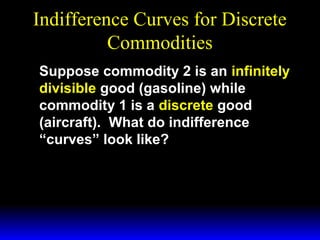
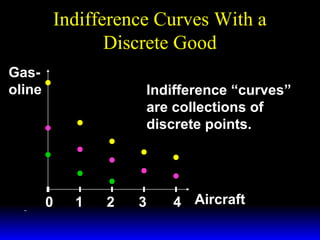
Suppose commodity 2 is an infinitely
divisible good (gasoline) while
commodity 1 is a discrete good
(aircraft). What do indifference
“curves” look like?
Indifference Curves With a
Discrete Good
Gasoline

Indifference “curves”
are collections of
discrete points.

0

1

2

3

4 Aircraft
Well-Behaved Preferences
A preference relation is “wellbehaved” if it is
– monotonic and convex.
Monotonicity: More of any
commodity is always preferred (i.e.
no satiation and every commodity is
a good).
Well-Behaved Preferences
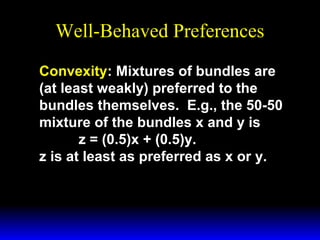
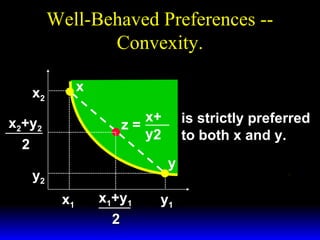
Convexity: Mixtures of bundles are
(at least weakly) preferred to the
bundles themselves. E.g., the 50-50
mixture of the bundles x and y is
z = (0.5)x + (0.5)y.
z is at least as preferred as x or y.
Well-Behaved Preferences -Convexity.
x

x2

x+
z=
y2

x2+y2
2

is strictly preferred
to both x and y.
y

y2
x1

x1+y1
2

y1
Well-Behaved Preferences -Convexity.

x

x2

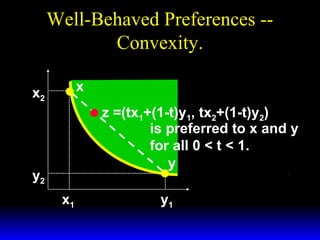
z =(tx1+(1-t)y1, tx2+(1-t)y2)
is preferred to x and y
for all 0 < t < 1.
y

y2
x1

y1
Well-Behaved Preferences -Convexity.
x

x2

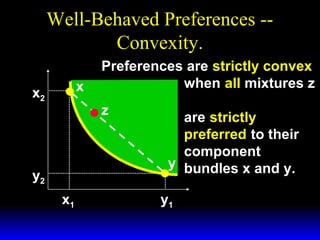
Preferences are strictly convex
when all mixtures z
z

y2
x1

are strictly
preferred to their
component
y bundles x and y.
y1
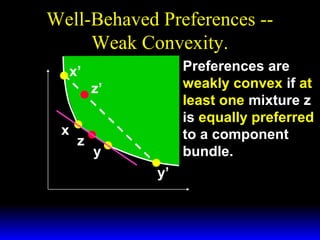
Well-Behaved Preferences -Weak Convexity.
Preferences are
weakly convex if at
least one mixture z
is equally preferred
to a component
bundle.

x’
z’
x

z

y
y’
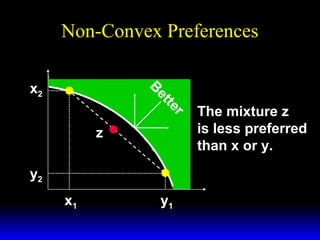
Non-Convex Preferences
B

x2

te
et
r

z
y2
x1

y1

The mixture z
is less preferred
than x or y.
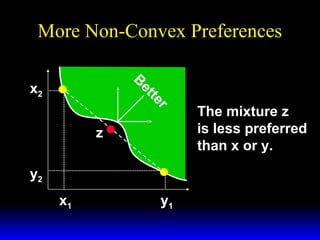
More Non-Convex Preferences
B
et

x2

r
te

z
y2
x1

y1

The mixture z
is less preferred
than x or y.
Slopes of Indifference Curves
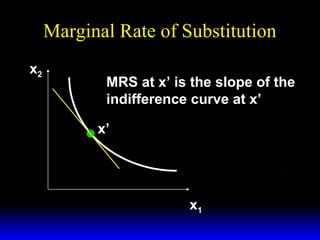
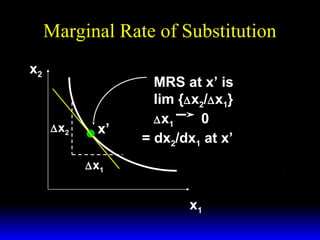
The slope of an indifference curve is
its marginal rate-of-substitution
(MRS).
How can a MRS be calculated?
Marginal Rate of Substitution
x2

MRS at x’ is the slope of the
indifference curve at x’
x’

x1
Marginal Rate of Substitution
x2

∆ x2

x’

MRS at x’ is
lim {∆ x2/∆ x1}
∆ x1
0
= dx2/dx1 at x’

∆ x1

x1
Marginal Rate of Substitution
x2

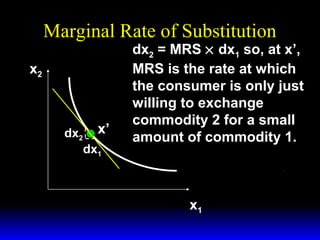
dx2 x’
dx1

dx2 = MRS × dx1 so, at x’,
MRS is the rate at which
the consumer is only just
willing to exchange
commodity 2 for a small
amount of commodity 1.

x1
MRS & Ind. Curve Properties
Good 2
r
er
tte
ett
Be
B

Two goods
a negatively sloped
indifference curve
MRS < 0.

se
se
or
or
W
W

Good 1
MRS & Ind. Curve Properties
Good 2
er
tt
e
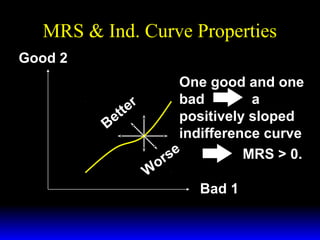
B

One good and one
bad
a
positively sloped
indifference curve
MRS > 0.
se
r
o
W
Bad 1
MRS & Ind. Curve Properties
Good 2
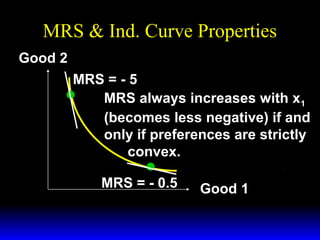
MRS = - 5
MRS always increases with x1
(becomes less negative) if and
only if preferences are strictly
convex.
MRS = - 0.5

Good 1
MRS & Ind. Curve Properties
x2

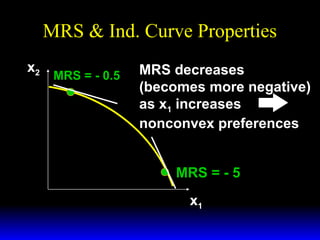
MRS = - 0.5

MRS decreases
(becomes more negative)
as x1 increases
nonconvex preferences
MRS = - 5
x1
MRS & Ind. Curve Properties
x2

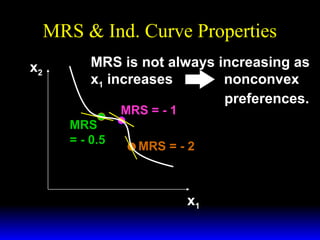
MRS is not always increasing as
x1 increases
nonconvex
preferences.
MRS = - 1

MRS
= - 0.5

MRS = - 2

x1

Ch3