Chapter 3
Sensation and Perception


                  This multimedia product and its content are protected under
                  copyright law. The following are prohibited by law:
                  Any public performance or display, including transmission of
                  any image over a network.
                  Preparation of any derivative work, including the extraction, in
                  whole or in part, of any images.
                  Any rental, lease or lending of the program.


         Copyright © 2008 Allyn & Bacon
Chapter 3 Overview
   The process of sensation
   Vision
   Hearing
   Smell and taste
   The skin senses
   Balance and movement
   Influences on perception
   Principles of perception
   Unusual perceptual experiences

                   Copyright © 2008 Allyn & Bacon
The Process of Sensation

   Sensation is the process through
    which the senses pick up visual,
    auditory, and other sensory stimuli
    and transmit them to the brain
   Perception is the process by which
    the brain actively organizes and
    interprets sensory information

                 Copyright © 2008 Allyn & Bacon
What is the difference between
the absolute threshold and the
difference threshold?
   What is the softest sound you can hear and
    the dimmest light you can see?
   How much must the volume be turned up or
    down for you to notice a difference in the
    loudness of music?
   Researchers in sensory psychology have
    performed many experiments to answer
    these kinds of questions


                   Copyright © 2008 Allyn & Bacon
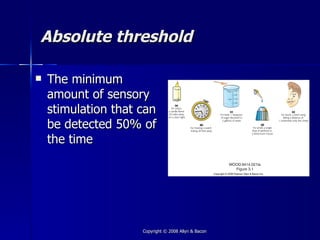
Absolute threshold

   The minimum
    amount of sensory
    stimulation that can
    be detected 50% of
    the time


                     Copyright © 2008 Allyn & Bacon
Difference threshold

   The smallest increase or decrease in a
    physical stimulus required to produce a
    difference in sensation that is noticeable
    50% of the time
   Just noticeable difference (JND) is the
    smallest change in sensation that a person
    is able to detect 50% of the time


                    Copyright © 2008 Allyn & Bacon
Weber’s Law

   The JND for all senses depends on a
    proportion or percentage of stimulus change
    rather than on a fixed amount of change
    – A 2% change is needed for a JND in a weight
      you are holding
          a 1 lb difference is needed for a JND in a 50 lb weight
          a 2 lb difference is needed for a JND in a 100 lb weight
    – Only a 0.33% change is needed for a JND in the
      pitch of a sound
    – Weber’s law best applies to people with average
      sensitivities and to stimuli that are not too
      strong or weak
                           Copyright © 2008 Allyn & Bacon
How does transduction enable the
brain to receive sensory
information?
   Sensory receptors are highly specialized cells in
    the sense organs that detect and respond to one
    type of sensory stimuli and transduce (convert) the
    stimuli into neural impulses
   Transduction is the process through which
    sensory receptors convert sensory stimulation into
    neural impulses
   Sensory adaptation is the process in which
    sensory receptors grow accustomed to constant,
    unchanging levels of stimuli over time
    – e.g., Smokers grow accustomed to smell of cigarettes


                         Copyright © 2008 Allyn & Bacon
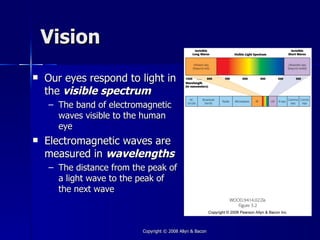
Vision
   Our eyes respond to light in
    the visible spectrum
    – The band of electromagnetic
      waves visible to the human
      eye
   Electromagnetic waves are
    measured in wavelengths
    – The distance from the peak of
      a light wave to the peak of
      the next wave


                          Copyright © 2008 Allyn & Bacon
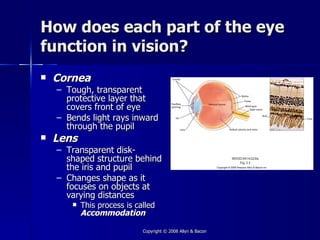
How does each part of the eye
function in vision?
   Cornea
    – Tough, transparent
      protective layer that
      covers front of eye
    – Bends light rays inward
      through the pupil
   Lens
    – Transparent disk-
      shaped structure behind
      the iris and pupil
    – Changes shape as it
      focuses on objects at
      varying distances
          This process is called
           Accommodation

                             Copyright © 2008 Allyn & Bacon
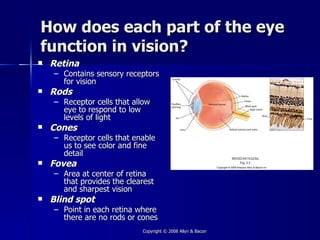
How does each part of the eye
function in vision?
   Retina
    – Contains sensory receptors
      for vision
   Rods
    – Receptor cells that allow
      eye to respond to low
      levels of light
   Cones
    – Receptor cells that enable
      us to see color and fine
      detail
   Fovea
    – Area at center of retina
      that provides the clearest
      and sharpest vision
   Blind spot
    – Point in each retina where
      there are no rods or cones
                            Copyright © 2008 Allyn & Bacon
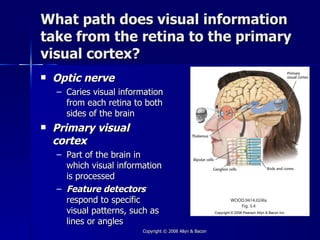
What path does visual information
take from the retina to the primary
visual cortex?
   Optic nerve
    – Caries visual information
      from each retina to both
      sides of the brain
   Primary visual
    cortex
    – Part of the brain in
      which visual information
      is processed
    – Feature detectors
      respond to specific
      visual patterns, such as
      lines or angles
                         Copyright © 2008 Allyn & Bacon
How do we detect the difference
between one color and another?

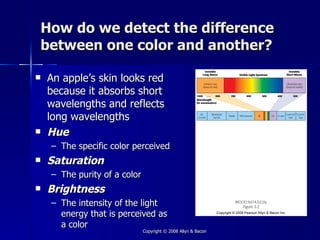
   An apple’s skin looks red
    because it absorbs short
    wavelengths and reflects
    long wavelengths
   Hue
    – The specific color perceived
   Saturation
    – The purity of a color
   Brightness
    – The intensity of the light
      energy that is perceived as
      a color
                              Copyright © 2008 Allyn & Bacon
What two major theories
attempt to explain color vision?
   Trichromatic Theory
    – Three types of cones in the retina each make a
      maximal response to one of three colors- blue,
      green, or red
   Opponent-Process Theory
    – Three kinds of cells respond by increasing or
      decreasing their rate of firing when different
      colors are present
          Red/green cells
          Yellow/blue cells
          White/black cells
                          Copyright © 2008 Allyn & Bacon
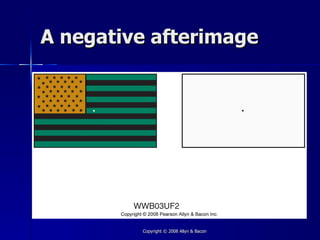
A negative afterimage


         Copyright © 2008 Allyn & Bacon
Hearing

   Sound requires a medium, such as air
    or water, through which to move
   First demonstrated by Robert Boyle in
    1660
    – Watch in a jar experiment


                   Copyright © 2008 Allyn & Bacon
What determines the pitch and
loudness of sound, and how is each
quality measured?
   Frequency
    – The number of cycles completed by a sound wave in one
      second
    – Determines the pitch of a sound
    – Frequency is measured in hertz (Hz)
   Amplitude
    – The loudness of sound
    – Amplitude is measured in decibels (dB)
   Timbre
    – The distinctive quality of a sound that distinguishes it from
      other sounds of the same pitch and loudness
    – Example: A piano and guitar sound different when playing
      the same note
                          Copyright © 2008 Allyn & Bacon
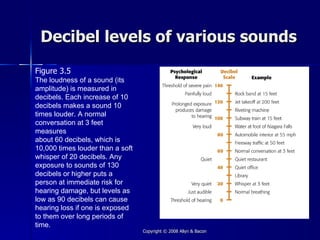
Decibel levels of various sounds
Figure 3.5
The loudness of a sound (its
amplitude) is measured in
decibels. Each increase of 10
decibels makes a sound 10
times louder. A normal
conversation at 3 feet
measures
about 60 decibels, which is
10,000 times louder than a soft
whisper of 20 decibels. Any
exposure to sounds of 130
decibels or higher puts a
person at immediate risk for
hearing damage, but levels as
low as 90 decibels can cause
hearing loss if one is exposed
to them over long periods of
time.
                                  Copyright © 2008 Allyn & Bacon
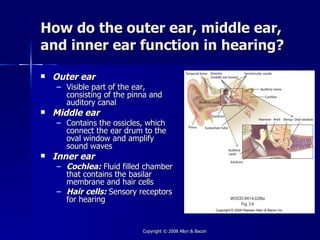
How do the outer ear, middle ear,
and inner ear function in hearing?

   Outer ear
    – Visible part of the ear,
      consisting of the pinna and
      auditory canal
   Middle ear
    – Contains the ossicles, which
      connect the ear drum to the
      oval window and amplify
      sound waves
   Inner ear
    – Cochlea: Fluid filled chamber
      that contains the basilar
      membrane and hair cells
    – Hair cells: Sensory receptors
      for hearing


                           Copyright © 2008 Allyn & Bacon
What two major theories
attempt to explain hearing?
   Place theory
    – Each individual pitch is determined by the
      particular location along the basilar membrane
      of the cochlea that vibrates the most
    – Provides a good explanation of how we hear
      sounds with frequencies higher than 1000 Hz
   Frequency theory
    – Hair cell receptors vibrate the same number of
      times per second as the wave sounds that reach
      them
    – Provides a good explanation of how we hear
      low-frequency sounds
                      Copyright © 2008 Allyn & Bacon
Smell and Taste

   Olfaction
    – The sense of smell
   Gustation
    – The sense of taste


                   Copyright © 2008 Allyn & Bacon
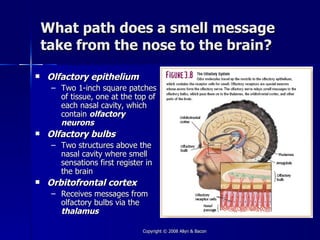
What path does a smell message
    take from the nose to the brain?

   Olfactory epithelium
     – Two 1-inch square patches
       of tissue, one at the top of
       each nasal cavity, which
       contain olfactory
       neurons
   Olfactory bulbs
     – Two structures above the
       nasal cavity where smell
       sensations first register in
       the brain
   Orbitofrontal cortex
     – Receives messages from
       olfactory bulbs via the
       thalamus

                                Copyright © 2008 Allyn & Bacon
What are the primary taste
sensations, and how are they
detected?
   Traditionally, four primary taste sensations
    have been recognized
    –   Sweet
    –   Sour
    –   Salty
    –   Bitter
   Recent research suggests that there is a
    fifth taste sensation
    – Umami
    – This sensation is triggered by glutamate


                      Copyright © 2008 Allyn & Bacon
What are the primary taste
sensations, and how are they
detected?


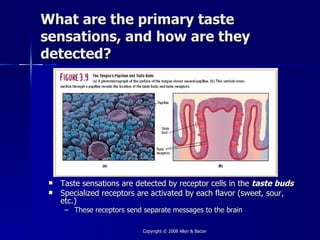
    Taste sensations are detected by receptor cells in the taste buds
    Specialized receptors are activated by each flavor (sweet, sour,
     etc.)
      – These receptors send separate messages to the brain

                             Copyright © 2008 Allyn & Bacon
The Skin Senses

   Include the senses of touch and pain
   These senses are critical for survival


                  Copyright © 2008 Allyn & Bacon
How does the skin provide
sensory information?
   When an object touches and depresses the
    skin it stimulates receptors in the skin
   These receptors send messages through
    nerve connections to the spinal cord,
    through the brainstem and midbrain, and to
    the somatosensory cortex
   Areas on the skin vary in sensitivity to
    touch, as measured by the two-point
    threshold
    – Areas with greater sensitivity are more densely
      packed with touch receptors

                      Copyright © 2008 Allyn & Bacon
What is the function of pain, and how is
pain influenced by psychological factors,
culture, and endorphins?
   Pain serves as an early warning system for many
    potentially deadly situations
   Pain can be influenced by several psychological
    factors
    –   Focusing attention elsewhere reduces pain
    –   Placebo effect reduces pain
    –   Negative thoughts increase pain
    –   Some cultures encourage individuals to suppress, or
        exaggerate, emotional reaction to pain
   Endorphins are the body’s natural painkillers
    – They block pain and produce a sense of well-being


                          Copyright © 2008 Allyn & Bacon
Balance and Movement

   The kinesthetic and vestibular
    senses provide information about
    where the parts of the body are and
    where the body is located relative to
    the physical environment


                  Copyright © 2008 Allyn & Bacon
What kinds of information do the
kinesthetic and vestibular senses
provide?
   The kinesthetic sense provides
    information about the position of body parts
    in relation to each other and the movement
    of the entire body or its parts
   This information is detected by receptors in
    the joints, ligaments, and muscles


                    Copyright © 2008 Allyn & Bacon
What kinds of information do the
kinesthetic and vestibular senses
provide?


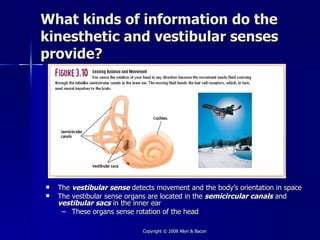
   The vestibular sense detects movement and the body’s orientation in space
   The vestibular sense organs are located in the semicircular canals and
    vestibular sacs in the inner ear
     – These organs sense rotation of the head

                             Copyright © 2008 Allyn & Bacon
Influences on Perception

   Perception is the process through
    which the brain assigns meaning to
    sensations
   Perception is influenced by a number
    of factors, including
    – Attention
    – Prior knowledge
    – Cross-modal perception

                  Copyright © 2008 Allyn & Bacon
What is gained and what is lost
in the process of attention?
   Attention is the process of sorting through
    sensations and selecting some of them for further
    processing
   When attention is focused on some sensations,
    others are missed altogether or misperceived
    – Inattentional blindness occurs when attention is
      shifted from one object to another and we fail to notice
      changes in objects not receiving direct attention
    – The cocktail party phenomenon shows that we focus
      attention on information that is personally meaningful


                         Copyright © 2008 Allyn & Bacon
How does prior knowledge
influence perception?
   Bottom-up processing
    – Information processing in which individual bits of
      data are combined until a complete perception is
      formed
   Top-down processing
    – Information processing in which previous
      experience and knowledge are applied to
      recognize the whole of a perception
    – Perceptual set is an expectation of what will
      be perceived that can affect what is perceived

                      Copyright © 2008 Allyn & Bacon
How does information from
multiple sources aid perception?

   Cross modal perception
    – The process by which the brain integrates
      information from more than one sense
    – Cross modal perception is used to process
      complex stimuli such as speech


                     Copyright © 2008 Allyn & Bacon
Principles of Perception

   A few principles govern perceptions in
    all humans


                  Copyright © 2008 Allyn & Bacon
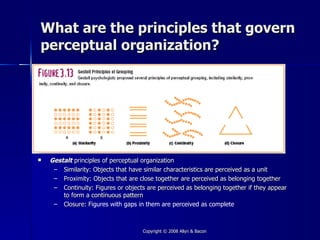
What are the principles that govern
perceptual organization?


   Gestalt principles of perceptual organization
     – Similarity: Objects that have similar characteristics are perceived as a unit
     – Proximity: Objects that are close together are perceived as belonging together
     – Continuity: Figures or objects are perceived as belonging together if they appear
        to form a continuous pattern
     – Closure: Figures with gaps in them are perceived as complete
                  F


                                    Copyright © 2008 Allyn & Bacon
What are some of the binocular
and monocular depth cues?
   Depth perception
    – The ability to perceive the visual world in three
      dimensions and to judge distances accurately
   Binocular depth cues depend on both
    eyes working together
    – Convergence
    – Binocular disparity
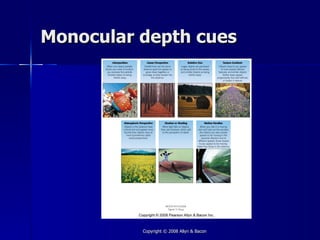
   Monocular depth cues can be perceived
    by one eye alone

                      Copyright © 2008 Allyn & Bacon
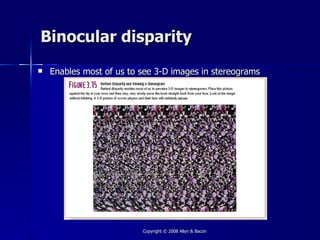
Binocular disparity
   Enables most of us to see 3-D images in stereograms


                          Copyright © 2008 Allyn & Bacon
Monocular depth cues


          Copyright © 2008 Allyn & Bacon
How does the brain perceive
motion?
   The brain perceives real motion by
    comparing the movement of images
    across the retina to reference points
    that it assumes to be stable
   Autokinetic illusion
    – An unmoving light in a dark room appears
      to move
        Your eyes are moving, not the light
        In the dark, the brain has no stable reference
         point to determine what is moving
                      Copyright © 2008 Allyn & Bacon
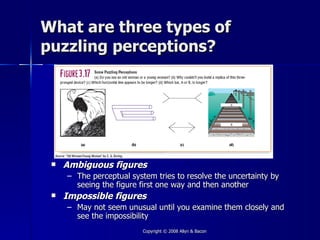
What are three types of
puzzling perceptions?


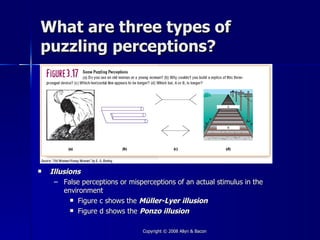
    Ambiguous figures
     – The perceptual system tries to resolve the uncertainty by
       seeing the figure first one way and then another
    Impossible figures
     – May not seem unusual until you examine them closely and
       see the impossibility
                          Copyright © 2008 Allyn & Bacon
What are three types of
puzzling perceptions?


   Illusions
     – False perceptions or misperceptions of an actual stimulus in the
        environment
           Figure c shows the Müller-Lyer illusion

           Figure d shows the Ponzo illusion


                                 Copyright © 2008 Allyn & Bacon
Unusual Perceptual
Experiences
   Subliminal perception
    – The capacity to perceive and respond to
      stimuli that are presented below the
      threshold of awareness
   Extrasensory perception (ESP)
    – Gaining information about objects,
      events, or another person’s thoughts
      through means other than known sensory
      channels

                   Copyright © 2008 Allyn & Bacon
In what ways does subliminal
perception influence behavior?
   Research suggests that subliminal
    information can influence behavior to
    some degree
    – But it appears to be ineffective at
      persuading people to buy products or
      vote in certain ways


                   Copyright © 2008 Allyn & Bacon
What have studies of ESP
shown?
   Some studies have suggested that ESP
    exists
   But, in almost all cases, attempts to
    replicate these studies have failed
    – So most psychologists remain skeptical
      about existence of ESP


                   Copyright © 2008 Allyn & Bacon

Chapter 3

  • 1.
    Chapter 3 Sensation andPerception This multimedia product and its content are protected under copyright law. The following are prohibited by law: Any public performance or display, including transmission of any image over a network. Preparation of any derivative work, including the extraction, in whole or in part, of any images. Any rental, lease or lending of the program. Copyright © 2008 Allyn & Bacon
  • 2.
    Chapter 3 Overview  The process of sensation  Vision  Hearing  Smell and taste  The skin senses  Balance and movement  Influences on perception  Principles of perception  Unusual perceptual experiences Copyright © 2008 Allyn & Bacon
  • 3.
    The Process ofSensation  Sensation is the process through which the senses pick up visual, auditory, and other sensory stimuli and transmit them to the brain  Perception is the process by which the brain actively organizes and interprets sensory information Copyright © 2008 Allyn & Bacon
  • 4.
    What is thedifference between the absolute threshold and the difference threshold?  What is the softest sound you can hear and the dimmest light you can see?  How much must the volume be turned up or down for you to notice a difference in the loudness of music?  Researchers in sensory psychology have performed many experiments to answer these kinds of questions Copyright © 2008 Allyn & Bacon
  • 5.
    Absolute threshold  The minimum amount of sensory stimulation that can be detected 50% of the time Copyright © 2008 Allyn & Bacon
  • 6.
    Difference threshold  The smallest increase or decrease in a physical stimulus required to produce a difference in sensation that is noticeable 50% of the time  Just noticeable difference (JND) is the smallest change in sensation that a person is able to detect 50% of the time Copyright © 2008 Allyn & Bacon
  • 7.
    Weber’s Law  The JND for all senses depends on a proportion or percentage of stimulus change rather than on a fixed amount of change – A 2% change is needed for a JND in a weight you are holding  a 1 lb difference is needed for a JND in a 50 lb weight  a 2 lb difference is needed for a JND in a 100 lb weight – Only a 0.33% change is needed for a JND in the pitch of a sound – Weber’s law best applies to people with average sensitivities and to stimuli that are not too strong or weak Copyright © 2008 Allyn & Bacon
  • 8.
    How does transductionenable the brain to receive sensory information?  Sensory receptors are highly specialized cells in the sense organs that detect and respond to one type of sensory stimuli and transduce (convert) the stimuli into neural impulses  Transduction is the process through which sensory receptors convert sensory stimulation into neural impulses  Sensory adaptation is the process in which sensory receptors grow accustomed to constant, unchanging levels of stimuli over time – e.g., Smokers grow accustomed to smell of cigarettes Copyright © 2008 Allyn & Bacon
  • 9.
    Vision  Our eyes respond to light in the visible spectrum – The band of electromagnetic waves visible to the human eye  Electromagnetic waves are measured in wavelengths – The distance from the peak of a light wave to the peak of the next wave Copyright © 2008 Allyn & Bacon
  • 10.
    How does eachpart of the eye function in vision?  Cornea – Tough, transparent protective layer that covers front of eye – Bends light rays inward through the pupil  Lens – Transparent disk- shaped structure behind the iris and pupil – Changes shape as it focuses on objects at varying distances  This process is called Accommodation Copyright © 2008 Allyn & Bacon
  • 11.
    How does eachpart of the eye function in vision?  Retina – Contains sensory receptors for vision  Rods – Receptor cells that allow eye to respond to low levels of light  Cones – Receptor cells that enable us to see color and fine detail  Fovea – Area at center of retina that provides the clearest and sharpest vision  Blind spot – Point in each retina where there are no rods or cones Copyright © 2008 Allyn & Bacon
  • 12.
    What path doesvisual information take from the retina to the primary visual cortex?  Optic nerve – Caries visual information from each retina to both sides of the brain  Primary visual cortex – Part of the brain in which visual information is processed – Feature detectors respond to specific visual patterns, such as lines or angles Copyright © 2008 Allyn & Bacon
  • 13.
    How do wedetect the difference between one color and another?  An apple’s skin looks red because it absorbs short wavelengths and reflects long wavelengths  Hue – The specific color perceived  Saturation – The purity of a color  Brightness – The intensity of the light energy that is perceived as a color Copyright © 2008 Allyn & Bacon
  • 14.
    What two majortheories attempt to explain color vision?  Trichromatic Theory – Three types of cones in the retina each make a maximal response to one of three colors- blue, green, or red  Opponent-Process Theory – Three kinds of cells respond by increasing or decreasing their rate of firing when different colors are present  Red/green cells  Yellow/blue cells  White/black cells Copyright © 2008 Allyn & Bacon
  • 15.
    A negative afterimage Copyright © 2008 Allyn & Bacon
  • 16.
    Hearing  Sound requires a medium, such as air or water, through which to move  First demonstrated by Robert Boyle in 1660 – Watch in a jar experiment Copyright © 2008 Allyn & Bacon
  • 17.
    What determines thepitch and loudness of sound, and how is each quality measured?  Frequency – The number of cycles completed by a sound wave in one second – Determines the pitch of a sound – Frequency is measured in hertz (Hz)  Amplitude – The loudness of sound – Amplitude is measured in decibels (dB)  Timbre – The distinctive quality of a sound that distinguishes it from other sounds of the same pitch and loudness – Example: A piano and guitar sound different when playing the same note Copyright © 2008 Allyn & Bacon
  • 18.
    Decibel levels ofvarious sounds Figure 3.5 The loudness of a sound (its amplitude) is measured in decibels. Each increase of 10 decibels makes a sound 10 times louder. A normal conversation at 3 feet measures about 60 decibels, which is 10,000 times louder than a soft whisper of 20 decibels. Any exposure to sounds of 130 decibels or higher puts a person at immediate risk for hearing damage, but levels as low as 90 decibels can cause hearing loss if one is exposed to them over long periods of time. Copyright © 2008 Allyn & Bacon
  • 19.
    How do theouter ear, middle ear, and inner ear function in hearing?  Outer ear – Visible part of the ear, consisting of the pinna and auditory canal  Middle ear – Contains the ossicles, which connect the ear drum to the oval window and amplify sound waves  Inner ear – Cochlea: Fluid filled chamber that contains the basilar membrane and hair cells – Hair cells: Sensory receptors for hearing Copyright © 2008 Allyn & Bacon
  • 20.
    What two majortheories attempt to explain hearing?  Place theory – Each individual pitch is determined by the particular location along the basilar membrane of the cochlea that vibrates the most – Provides a good explanation of how we hear sounds with frequencies higher than 1000 Hz  Frequency theory – Hair cell receptors vibrate the same number of times per second as the wave sounds that reach them – Provides a good explanation of how we hear low-frequency sounds Copyright © 2008 Allyn & Bacon
  • 21.
    Smell and Taste  Olfaction – The sense of smell  Gustation – The sense of taste Copyright © 2008 Allyn & Bacon
  • 22.
    What path doesa smell message take from the nose to the brain?  Olfactory epithelium – Two 1-inch square patches of tissue, one at the top of each nasal cavity, which contain olfactory neurons  Olfactory bulbs – Two structures above the nasal cavity where smell sensations first register in the brain  Orbitofrontal cortex – Receives messages from olfactory bulbs via the thalamus Copyright © 2008 Allyn & Bacon
  • 23.
    What are theprimary taste sensations, and how are they detected?  Traditionally, four primary taste sensations have been recognized – Sweet – Sour – Salty – Bitter  Recent research suggests that there is a fifth taste sensation – Umami – This sensation is triggered by glutamate Copyright © 2008 Allyn & Bacon
  • 24.
    What are theprimary taste sensations, and how are they detected?  Taste sensations are detected by receptor cells in the taste buds  Specialized receptors are activated by each flavor (sweet, sour, etc.) – These receptors send separate messages to the brain Copyright © 2008 Allyn & Bacon
  • 25.
    The Skin Senses  Include the senses of touch and pain  These senses are critical for survival Copyright © 2008 Allyn & Bacon
  • 26.
    How does theskin provide sensory information?  When an object touches and depresses the skin it stimulates receptors in the skin  These receptors send messages through nerve connections to the spinal cord, through the brainstem and midbrain, and to the somatosensory cortex  Areas on the skin vary in sensitivity to touch, as measured by the two-point threshold – Areas with greater sensitivity are more densely packed with touch receptors Copyright © 2008 Allyn & Bacon
  • 27.
    What is thefunction of pain, and how is pain influenced by psychological factors, culture, and endorphins?  Pain serves as an early warning system for many potentially deadly situations  Pain can be influenced by several psychological factors – Focusing attention elsewhere reduces pain – Placebo effect reduces pain – Negative thoughts increase pain – Some cultures encourage individuals to suppress, or exaggerate, emotional reaction to pain  Endorphins are the body’s natural painkillers – They block pain and produce a sense of well-being Copyright © 2008 Allyn & Bacon
  • 28.
    Balance and Movement  The kinesthetic and vestibular senses provide information about where the parts of the body are and where the body is located relative to the physical environment Copyright © 2008 Allyn & Bacon
  • 29.
    What kinds ofinformation do the kinesthetic and vestibular senses provide?  The kinesthetic sense provides information about the position of body parts in relation to each other and the movement of the entire body or its parts  This information is detected by receptors in the joints, ligaments, and muscles Copyright © 2008 Allyn & Bacon
  • 30.
    What kinds ofinformation do the kinesthetic and vestibular senses provide?  The vestibular sense detects movement and the body’s orientation in space  The vestibular sense organs are located in the semicircular canals and vestibular sacs in the inner ear – These organs sense rotation of the head Copyright © 2008 Allyn & Bacon
  • 31.
    Influences on Perception  Perception is the process through which the brain assigns meaning to sensations  Perception is influenced by a number of factors, including – Attention – Prior knowledge – Cross-modal perception Copyright © 2008 Allyn & Bacon
  • 32.
    What is gainedand what is lost in the process of attention?  Attention is the process of sorting through sensations and selecting some of them for further processing  When attention is focused on some sensations, others are missed altogether or misperceived – Inattentional blindness occurs when attention is shifted from one object to another and we fail to notice changes in objects not receiving direct attention – The cocktail party phenomenon shows that we focus attention on information that is personally meaningful Copyright © 2008 Allyn & Bacon
  • 33.
    How does priorknowledge influence perception?  Bottom-up processing – Information processing in which individual bits of data are combined until a complete perception is formed  Top-down processing – Information processing in which previous experience and knowledge are applied to recognize the whole of a perception – Perceptual set is an expectation of what will be perceived that can affect what is perceived Copyright © 2008 Allyn & Bacon
  • 34.
    How does informationfrom multiple sources aid perception?  Cross modal perception – The process by which the brain integrates information from more than one sense – Cross modal perception is used to process complex stimuli such as speech Copyright © 2008 Allyn & Bacon
  • 35.
    Principles of Perception  A few principles govern perceptions in all humans Copyright © 2008 Allyn & Bacon
  • 36.
    What are theprinciples that govern perceptual organization?  Gestalt principles of perceptual organization – Similarity: Objects that have similar characteristics are perceived as a unit – Proximity: Objects that are close together are perceived as belonging together – Continuity: Figures or objects are perceived as belonging together if they appear to form a continuous pattern – Closure: Figures with gaps in them are perceived as complete F Copyright © 2008 Allyn & Bacon
  • 37.
    What are someof the binocular and monocular depth cues?  Depth perception – The ability to perceive the visual world in three dimensions and to judge distances accurately  Binocular depth cues depend on both eyes working together – Convergence – Binocular disparity  Monocular depth cues can be perceived by one eye alone Copyright © 2008 Allyn & Bacon
  • 38.
    Binocular disparity  Enables most of us to see 3-D images in stereograms Copyright © 2008 Allyn & Bacon
  • 39.
    Monocular depth cues Copyright © 2008 Allyn & Bacon
  • 40.
    How does thebrain perceive motion?  The brain perceives real motion by comparing the movement of images across the retina to reference points that it assumes to be stable  Autokinetic illusion – An unmoving light in a dark room appears to move  Your eyes are moving, not the light  In the dark, the brain has no stable reference point to determine what is moving Copyright © 2008 Allyn & Bacon
  • 41.
    What are threetypes of puzzling perceptions?  Ambiguous figures – The perceptual system tries to resolve the uncertainty by seeing the figure first one way and then another  Impossible figures – May not seem unusual until you examine them closely and see the impossibility Copyright © 2008 Allyn & Bacon
  • 42.
    What are threetypes of puzzling perceptions?  Illusions – False perceptions or misperceptions of an actual stimulus in the environment  Figure c shows the Müller-Lyer illusion  Figure d shows the Ponzo illusion Copyright © 2008 Allyn & Bacon
  • 43.
    Unusual Perceptual Experiences  Subliminal perception – The capacity to perceive and respond to stimuli that are presented below the threshold of awareness  Extrasensory perception (ESP) – Gaining information about objects, events, or another person’s thoughts through means other than known sensory channels Copyright © 2008 Allyn & Bacon
  • 44.
    In what waysdoes subliminal perception influence behavior?  Research suggests that subliminal information can influence behavior to some degree – But it appears to be ineffective at persuading people to buy products or vote in certain ways Copyright © 2008 Allyn & Bacon
  • 45.
    What have studiesof ESP shown?  Some studies have suggested that ESP exists  But, in almost all cases, attempts to replicate these studies have failed – So most psychologists remain skeptical about existence of ESP Copyright © 2008 Allyn & Bacon