Iona College Operations Management MBA-540 Jerry Fjermestad
Operations Management Operations Strategy for Competitive Advantage Chapter 2
Outline Global Company Profile: Komatsu Identifying Missions and Strategies Mission Strategy Achieving Competitive Advantage Through Operations Competing on Differentiation Competing on Cost Competing on Response
Outline - continued Ten Strategic OM decisions Issues in Operations Strategy Research Preconditions Dynamics Strategy Development and Implementation Identify Critical Success Factors Build and Staff the Organization Integrate OM with Other Activities
Learning Objectives When you complete this chapter, you should be able to :  Identify or Define : Mission Strategy Ten Decisions of OM Describe or Explain : Specific approaches used by OM to achieve strategic concepts Differentiation Low Cost Response
Komatsu Strategies 1960s - licensed design and technology from others; improved quality 1970s - became global enterprise and built export markets aided by increasing value of yen 1980s - joint ventures with Dresser, and manufacturing outside Japan 1990s - used the latest technology to improve quality and drive down costs; focused on electronic engine controls 2000s - increased European presence through ownership and joint ventures
Komatsu Strategies Each strategy established in light of: threats and opportunities in the environment strengths and weaknesses of the organization (related to environment)
Mission Mission - where are you going? Organization’s purpose for being Provides boundaries & focus Answers ‘How can we satisfy people’s needs?’ Expressed in published statement © 1995 Corel Corp.
Sample Mission - Circle K As a service company, our mission is to:   Satisfy our customers’ immediate needs and wants by providing them with a wide variety of goods and services at multiple locations.
Sample Mission - Merck The mission of Merck is to provide society with superior products and services - innovations and solutions that improve the quality of life and satisfy customer needs - to provide employees with meaningful work and advancement opportunities and investors with a superior rate of return
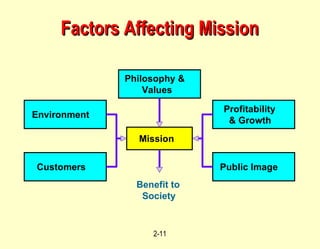
Factors Affecting Mission Mission Philosophy & Values Profitability & Growth Environment Customers Public Image Benefit to Society
Mission/Strategy Mission -  where you are going Strategy -  how you are going to get there
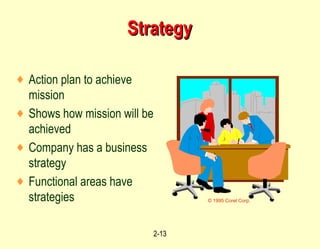
Strategy Action plan to achieve mission Shows how mission will be achieved Company has a business strategy Functional areas have strategies  © 1995 Corel Corp.
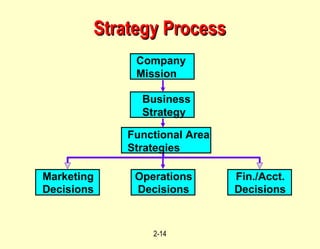
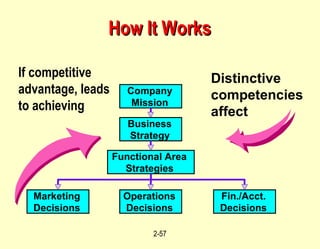
Strategy Process Marketing Decisions Operations Decisions Fin./Acct. Decisions Company Mission Business Strategy Functional Area Functional Area Strategies
Competitive Advantage Through: Differentiation Cost leadership Quick response better, cheaper, more responsive
Competing on Differentiation Uniqueness - can go beyond both the physical characteristics and service attributes to encompass everything that impacts customer’s perception of value
Competing on Cost Maximum  value  as perceived by  customer Does  not  imply low value or low quality
Competing on Response Flexible Reliable Rapid Requires  institutionalization within the firm  of the ability to respond
Competing On Any Basis Probably requires the institutionalization within the firm of the ability to change, to adapt
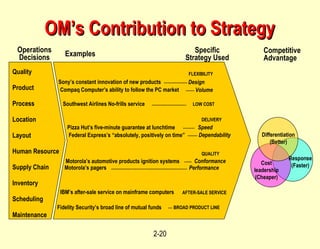
OM’s Contribution to Strategy Quality Product Process Location Layout Human Resource Supply Chain Inventory Scheduling Maintenance Compaq Computer’s ability to follow the PC market Differentiation (Better) Response (Faster) Cost leadership (Cheaper) Southwest Airlines No-frills service Sony’s constant innovation of new products Pizza Hut’s five-minute guarantee at lunchtime Federal Express’s “absolutely, positively on time” Motorola’s automotive products ignition systems Motorola’s pagers IBM’s after-sale service on mainframe computers Fidelity Security’s broad line of mutual funds FLEXIBILITY Design Volume LOW COST DELIVERY Speed Dependability QUALITY Conformance Performance AFTER-SALE SERVICE BROAD PRODUCT LINE Operations Decisions Examples Specific Strategy Used Competitive Advantage
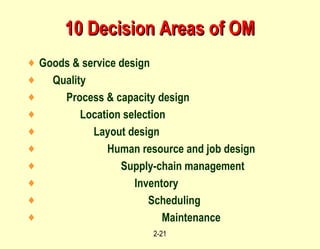
10 Decision Areas of OM Goods & service design  Quality  Process & capacity design Location selection Layout design Human resource and job design Supply-chain management Inventory Scheduling Maintenance
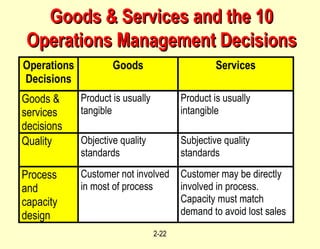
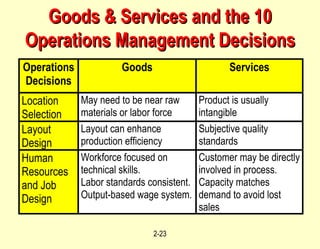
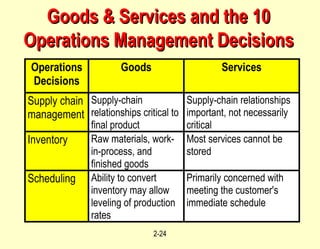
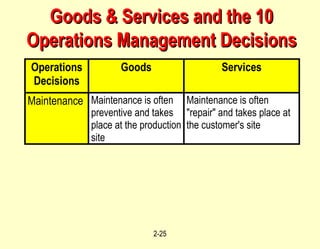
Goods & Services and the 10 Operations Management Decisions
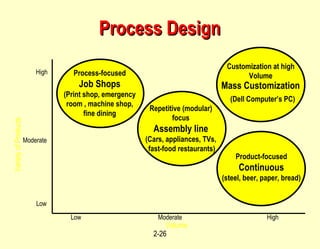
Process Design Process-focused Job Shops (Print shop, emergency room , machine shop, fine dining Repetitive (modular) focus Assembly line (Cars, appliances, TVs, fast-food restaurants) Product-focused Continuous (steel, beer, paper, bread) Mass Customization Customization at high Volume (Dell Computer’s PC) Low  Moderate  High Volume High Moderate Low Variety of Products
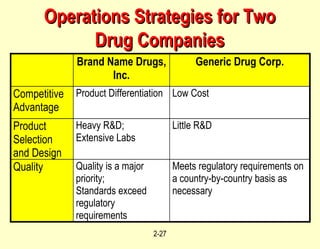
Operations Strategies for Two Drug Companies
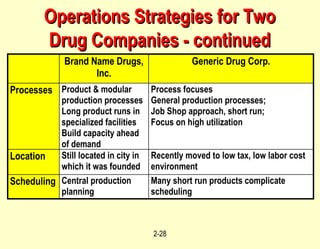
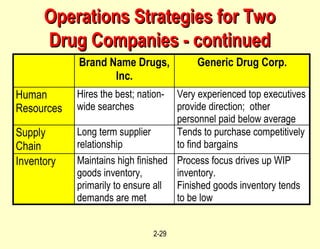
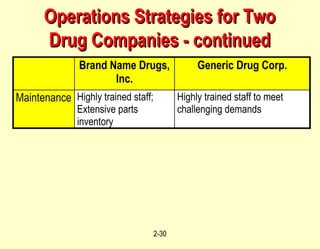
Operations Strategies for Two Drug Companies - continued
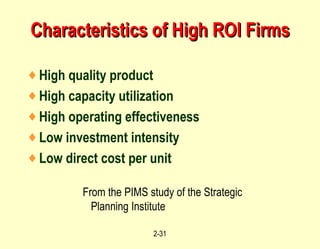
Characteristics of High ROI Firms High quality product  High capacity utilization High operating effectiveness Low investment intensity Low direct cost per unit From the PIMS study of the Strategic  Planning Institute
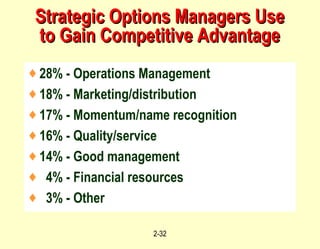
Strategic Options Managers Use to Gain Competitive Advantage 28% - Operations Management 18% - Marketing/distribution 17% - Momentum/name recognition 16% - Quality/service 14% - Good management 4% - Financial resources 3% - Other
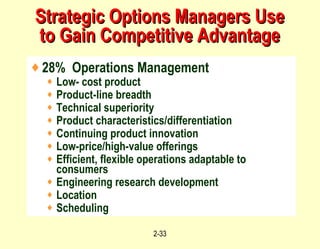
Strategic Options Managers Use to Gain Competitive Advantage 28%  Operations Management Low- cost product Product-line breadth Technical superiority Product characteristics/differentiation Continuing product innovation Low-price/high-value offerings Efficient, flexible operations adaptable to consumers Engineering research development Location Scheduling
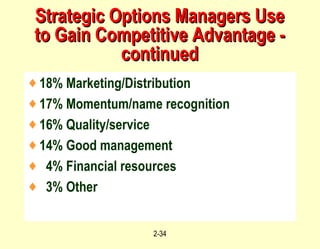
Strategic Options Managers Use to Gain Competitive Advantage - continued 18% Marketing/Distribution 17% Momentum/name recognition 16% Quality/service 14% Good management 4% Financial resources 3% Other
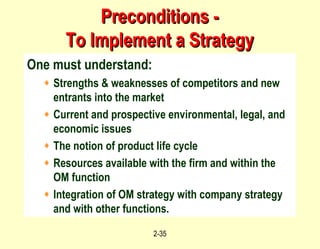
Preconditions - To Implement a Strategy One must understand: Strengths & weaknesses of competitors and new entrants into the market Current and prospective environmental, legal, and economic issues The notion of product life cycle Resources available with the firm and within the OM function Integration of OM strategy with company strategy and with other functions.
Impetus for Strategy Change Changes in the organization Stages in the product life cycle Changes in the environment
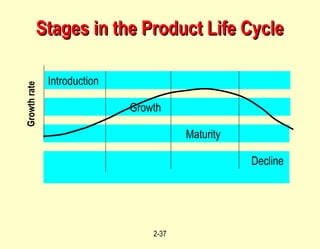
Stages in the Product Life Cycle Introduction Growth Maturity  Decline  Growth rate
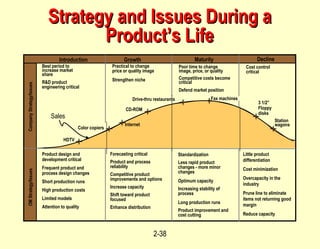
Strategy and Issues During a Product’s Life Introduction Growth Maturity Decline Standardization Less rapid product changes - more minor changes Optimum capacity Increasing stability of process Long production runs Product improvement and cost cutting Little product differentiation Cost minimization Overcapacity in the industry Prune line to eliminate items not returning good margin Reduce capacity Forecasting critical Product and process reliability Competitive product improvements and options Increase capacity Shift toward product focused Enhance distribution Product design and development critical Frequent product and process design changes Short production runs High production costs Limited models Attention to quality Best period to increase market share R&D product engineering critical Practical to change price or quality image Strengthen niche Cost control critical Poor time to change image, price, or quality Competitive costs become critical Defend market position OM Strategy/Issues Company Strategy/Issues HDTV CD-ROM Color copiers Drive-thru restaurants Fax machines Station wagons Sales 3 1/2” Floppy disks Internet
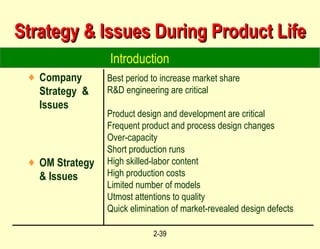
Strategy & Issues During Product Life Company Strategy  & Issues OM Strategy  & Issues Best period to increase market share R&D engineering are critical Product design and development are critical Frequent product and process design changes Over-capacity Short production runs High skilled-labor content High production costs Limited number of models Utmost attentions to quality Quick elimination of market-revealed design defects Introduction
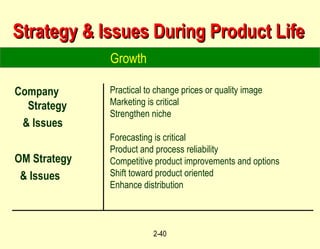
Strategy & Issues During Product Life Company Strategy & Issues OM Strategy & Issues Practical to change prices or quality image Marketing is critical Strengthen niche Forecasting is critical Product and process reliability Competitive product improvements and options Shift toward product oriented Enhance distribution Growth
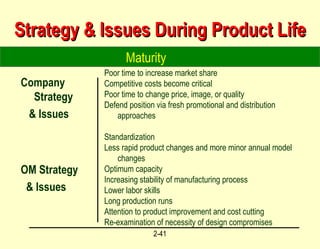
Strategy & Issues During Product Life Company Strategy & Issues OM Strategy & Issues Poor time to increase market share Competitive costs become critical Poor time to change price, image, or quality Defend position via fresh promotional and distribution approaches Standardization Less rapid product changes and more minor annual model changes Optimum capacity Increasing stability of manufacturing process Lower labor skills Long production runs Attention to product improvement and cost cutting Re-examination of necessity of design compromises   Maturity
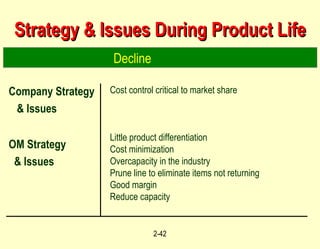
Strategy & Issues During Product Life Company Strategy & Issues OM Strategy & Issues Cost control critical to market share Little product differentiation Cost minimization Overcapacity in the industry Prune line to eliminate items not returning Good margin Reduce capacity Decline
Strategy Development and Implementation Identify critical success factors Build and staff the organization
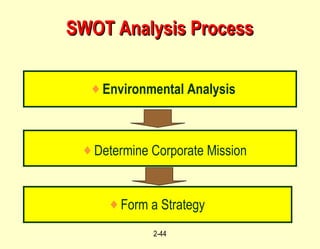
SWOT Analysis Process Environmental Analysis Determine Corporate Mission Form a Strategy
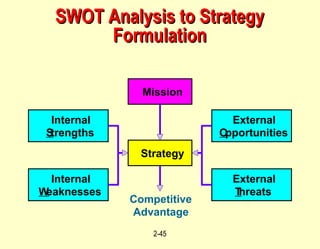
SWOT Analysis to Strategy Formulation Strategy Mission External O pportunities Internal S trengths Internal W eaknesses External T hreats Competitive Advantage
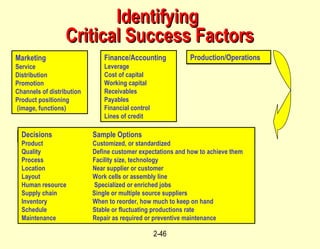
Identifying  Critical Success Factors Decisions Sample Options Product Customized, or standardized Quality Define customer expectations and how to achieve them Process Facility size, technology Location Near supplier or customer Layout Work cells or assembly line Human resource  Specialized or enriched jobs Supply chain   Single or multiple source suppliers Inventory When to reorder, how much to keep on hand Schedule Stable or fluctuating productions rate Maintenance  Repair as required or preventive maintenance Marketing Service Distribution Promotion Channels of distribution Product positioning (image, functions) Finance/Accounting Leverage Cost of capital Working capital Receivables Payables Financial control Lines of credit Production/Operations
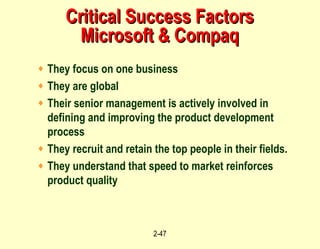
Critical Success Factors Microsoft & Compaq They focus on one business They are global Their senior management is actively involved in defining and improving the product development process They recruit and retain the top people in their fields. They understand that speed to market reinforces product quality
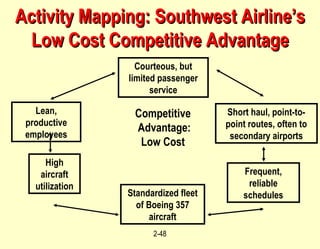
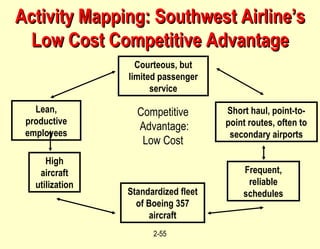
Activity Mapping: Southwest Airline’s Low Cost Competitive Advantage Courteous, but limited passenger service Lean, productive employees Short haul, point-to-point routes, often to secondary airports High aircraft utilization Standardized fleet of Boeing 357 aircraft Frequent, reliable schedules Competitive Advantage: Low Cost
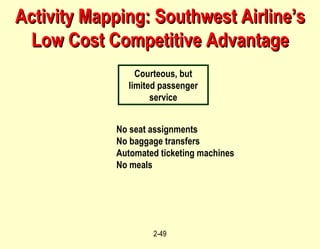
Activity Mapping: Southwest Airline’s Low Cost Competitive Advantage Courteous, but limited passenger service No seat assignments No baggage transfers Automated ticketing machines No meals
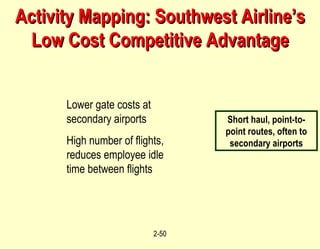
Activity Mapping: Southwest Airline’s Low Cost Competitive Advantage Short haul, point-to-point routes, often to secondary airports Lower gate costs at secondary airports High number of flights, reduces employee idle time between flights
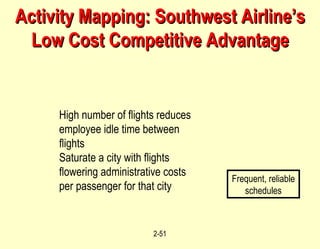
Activity Mapping: Southwest Airline’s Low Cost Competitive Advantage Frequent, reliable schedules High number of flights reduces employee idle time between flights Saturate a city with flights flowering administrative costs per passenger for that city
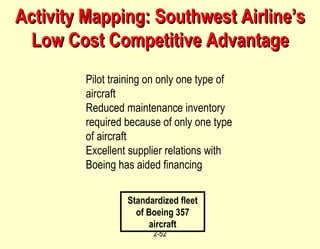
Activity Mapping: Southwest Airline’s Low Cost Competitive Advantage Standardized fleet of Boeing 357 aircraft Pilot training on only one type of aircraft Reduced maintenance inventory required because of only one type of aircraft Excellent supplier relations with Boeing has aided financing
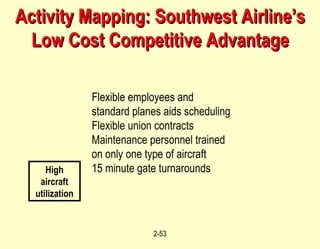
Activity Mapping: Southwest Airline’s Low Cost Competitive Advantage High aircraft utilization Flexible employees and standard planes aids scheduling Flexible union contracts Maintenance personnel trained on only one type of aircraft 15 minute gate turnarounds
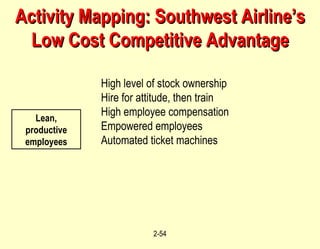
Activity Mapping: Southwest Airline’s Low Cost Competitive Advantage Lean, productive employees High level of stock ownership Hire for attitude, then train High employee compensation Empowered employees Automated ticket machines
Activity Mapping: Southwest Airline’s Low Cost Competitive Advantage Courteous, but limited passenger service Lean, productive employees Short haul, point-to-point routes, often to secondary airports High aircraft utilization Standardized fleet of Boeing 357 aircraft Frequent, reliable schedules Competitive Advantage: Low Cost
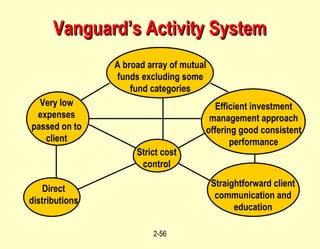
Vanguard’s Activity System A broad array of mutual funds excluding some fund categories Efficient investment management approach offering good consistent performance Straightforward client communication and education Strict cost control Direct distributions Very low expenses passed on to client
How It Works Company Mission Business Strategy Functional Area Strategies Marketing Decisions Operations Decisions Fin./Acct. Decisions If competitive advantage, leads to achieving Distinctive competencies affect

Ch02

  • 1.
    Iona College OperationsManagement MBA-540 Jerry Fjermestad
  • 2.
    Operations Management OperationsStrategy for Competitive Advantage Chapter 2
  • 3.
    Outline Global CompanyProfile: Komatsu Identifying Missions and Strategies Mission Strategy Achieving Competitive Advantage Through Operations Competing on Differentiation Competing on Cost Competing on Response
  • 4.
    Outline - continuedTen Strategic OM decisions Issues in Operations Strategy Research Preconditions Dynamics Strategy Development and Implementation Identify Critical Success Factors Build and Staff the Organization Integrate OM with Other Activities
  • 5.
    Learning Objectives Whenyou complete this chapter, you should be able to : Identify or Define : Mission Strategy Ten Decisions of OM Describe or Explain : Specific approaches used by OM to achieve strategic concepts Differentiation Low Cost Response
  • 6.
    Komatsu Strategies 1960s- licensed design and technology from others; improved quality 1970s - became global enterprise and built export markets aided by increasing value of yen 1980s - joint ventures with Dresser, and manufacturing outside Japan 1990s - used the latest technology to improve quality and drive down costs; focused on electronic engine controls 2000s - increased European presence through ownership and joint ventures
  • 7.
    Komatsu Strategies Eachstrategy established in light of: threats and opportunities in the environment strengths and weaknesses of the organization (related to environment)
  • 8.
    Mission Mission -where are you going? Organization’s purpose for being Provides boundaries & focus Answers ‘How can we satisfy people’s needs?’ Expressed in published statement © 1995 Corel Corp.
  • 9.
    Sample Mission -Circle K As a service company, our mission is to: Satisfy our customers’ immediate needs and wants by providing them with a wide variety of goods and services at multiple locations.
  • 10.
    Sample Mission -Merck The mission of Merck is to provide society with superior products and services - innovations and solutions that improve the quality of life and satisfy customer needs - to provide employees with meaningful work and advancement opportunities and investors with a superior rate of return
  • 11.
    Factors Affecting MissionMission Philosophy & Values Profitability & Growth Environment Customers Public Image Benefit to Society
  • 12.
    Mission/Strategy Mission - where you are going Strategy - how you are going to get there
  • 13.
    Strategy Action planto achieve mission Shows how mission will be achieved Company has a business strategy Functional areas have strategies © 1995 Corel Corp.
  • 14.
    Strategy Process MarketingDecisions Operations Decisions Fin./Acct. Decisions Company Mission Business Strategy Functional Area Functional Area Strategies
  • 15.
    Competitive Advantage Through:Differentiation Cost leadership Quick response better, cheaper, more responsive
  • 16.
    Competing on DifferentiationUniqueness - can go beyond both the physical characteristics and service attributes to encompass everything that impacts customer’s perception of value
  • 17.
    Competing on CostMaximum value as perceived by customer Does not imply low value or low quality
  • 18.
    Competing on ResponseFlexible Reliable Rapid Requires institutionalization within the firm of the ability to respond
  • 19.
    Competing On AnyBasis Probably requires the institutionalization within the firm of the ability to change, to adapt
  • 20.
    OM’s Contribution toStrategy Quality Product Process Location Layout Human Resource Supply Chain Inventory Scheduling Maintenance Compaq Computer’s ability to follow the PC market Differentiation (Better) Response (Faster) Cost leadership (Cheaper) Southwest Airlines No-frills service Sony’s constant innovation of new products Pizza Hut’s five-minute guarantee at lunchtime Federal Express’s “absolutely, positively on time” Motorola’s automotive products ignition systems Motorola’s pagers IBM’s after-sale service on mainframe computers Fidelity Security’s broad line of mutual funds FLEXIBILITY Design Volume LOW COST DELIVERY Speed Dependability QUALITY Conformance Performance AFTER-SALE SERVICE BROAD PRODUCT LINE Operations Decisions Examples Specific Strategy Used Competitive Advantage
  • 21.
    10 Decision Areasof OM Goods & service design Quality Process & capacity design Location selection Layout design Human resource and job design Supply-chain management Inventory Scheduling Maintenance
  • 22.
    Goods & Servicesand the 10 Operations Management Decisions
  • 23.
    Goods & Servicesand the 10 Operations Management Decisions
  • 24.
    Goods & Servicesand the 10 Operations Management Decisions
  • 25.
    Goods & Servicesand the 10 Operations Management Decisions
  • 26.
    Process Design Process-focusedJob Shops (Print shop, emergency room , machine shop, fine dining Repetitive (modular) focus Assembly line (Cars, appliances, TVs, fast-food restaurants) Product-focused Continuous (steel, beer, paper, bread) Mass Customization Customization at high Volume (Dell Computer’s PC) Low Moderate High Volume High Moderate Low Variety of Products
  • 27.
    Operations Strategies forTwo Drug Companies
  • 28.
    Operations Strategies forTwo Drug Companies - continued
  • 29.
    Operations Strategies forTwo Drug Companies - continued
  • 30.
    Operations Strategies forTwo Drug Companies - continued
  • 31.
    Characteristics of HighROI Firms High quality product High capacity utilization High operating effectiveness Low investment intensity Low direct cost per unit From the PIMS study of the Strategic Planning Institute
  • 32.
    Strategic Options ManagersUse to Gain Competitive Advantage 28% - Operations Management 18% - Marketing/distribution 17% - Momentum/name recognition 16% - Quality/service 14% - Good management 4% - Financial resources 3% - Other
  • 33.
    Strategic Options ManagersUse to Gain Competitive Advantage 28% Operations Management Low- cost product Product-line breadth Technical superiority Product characteristics/differentiation Continuing product innovation Low-price/high-value offerings Efficient, flexible operations adaptable to consumers Engineering research development Location Scheduling
  • 34.
    Strategic Options ManagersUse to Gain Competitive Advantage - continued 18% Marketing/Distribution 17% Momentum/name recognition 16% Quality/service 14% Good management 4% Financial resources 3% Other
  • 35.
    Preconditions - ToImplement a Strategy One must understand: Strengths & weaknesses of competitors and new entrants into the market Current and prospective environmental, legal, and economic issues The notion of product life cycle Resources available with the firm and within the OM function Integration of OM strategy with company strategy and with other functions.
  • 36.
    Impetus for StrategyChange Changes in the organization Stages in the product life cycle Changes in the environment
  • 37.
    Stages in theProduct Life Cycle Introduction Growth Maturity Decline Growth rate
  • 38.
    Strategy and IssuesDuring a Product’s Life Introduction Growth Maturity Decline Standardization Less rapid product changes - more minor changes Optimum capacity Increasing stability of process Long production runs Product improvement and cost cutting Little product differentiation Cost minimization Overcapacity in the industry Prune line to eliminate items not returning good margin Reduce capacity Forecasting critical Product and process reliability Competitive product improvements and options Increase capacity Shift toward product focused Enhance distribution Product design and development critical Frequent product and process design changes Short production runs High production costs Limited models Attention to quality Best period to increase market share R&D product engineering critical Practical to change price or quality image Strengthen niche Cost control critical Poor time to change image, price, or quality Competitive costs become critical Defend market position OM Strategy/Issues Company Strategy/Issues HDTV CD-ROM Color copiers Drive-thru restaurants Fax machines Station wagons Sales 3 1/2” Floppy disks Internet
  • 39.
    Strategy & IssuesDuring Product Life Company Strategy & Issues OM Strategy & Issues Best period to increase market share R&D engineering are critical Product design and development are critical Frequent product and process design changes Over-capacity Short production runs High skilled-labor content High production costs Limited number of models Utmost attentions to quality Quick elimination of market-revealed design defects Introduction
  • 40.
    Strategy & IssuesDuring Product Life Company Strategy & Issues OM Strategy & Issues Practical to change prices or quality image Marketing is critical Strengthen niche Forecasting is critical Product and process reliability Competitive product improvements and options Shift toward product oriented Enhance distribution Growth
  • 41.
    Strategy & IssuesDuring Product Life Company Strategy & Issues OM Strategy & Issues Poor time to increase market share Competitive costs become critical Poor time to change price, image, or quality Defend position via fresh promotional and distribution approaches Standardization Less rapid product changes and more minor annual model changes Optimum capacity Increasing stability of manufacturing process Lower labor skills Long production runs Attention to product improvement and cost cutting Re-examination of necessity of design compromises Maturity
  • 42.
    Strategy & IssuesDuring Product Life Company Strategy & Issues OM Strategy & Issues Cost control critical to market share Little product differentiation Cost minimization Overcapacity in the industry Prune line to eliminate items not returning Good margin Reduce capacity Decline
  • 43.
    Strategy Development andImplementation Identify critical success factors Build and staff the organization
  • 44.
    SWOT Analysis ProcessEnvironmental Analysis Determine Corporate Mission Form a Strategy
  • 45.
    SWOT Analysis toStrategy Formulation Strategy Mission External O pportunities Internal S trengths Internal W eaknesses External T hreats Competitive Advantage
  • 46.
    Identifying CriticalSuccess Factors Decisions Sample Options Product Customized, or standardized Quality Define customer expectations and how to achieve them Process Facility size, technology Location Near supplier or customer Layout Work cells or assembly line Human resource Specialized or enriched jobs Supply chain Single or multiple source suppliers Inventory When to reorder, how much to keep on hand Schedule Stable or fluctuating productions rate Maintenance Repair as required or preventive maintenance Marketing Service Distribution Promotion Channels of distribution Product positioning (image, functions) Finance/Accounting Leverage Cost of capital Working capital Receivables Payables Financial control Lines of credit Production/Operations
  • 47.
    Critical Success FactorsMicrosoft & Compaq They focus on one business They are global Their senior management is actively involved in defining and improving the product development process They recruit and retain the top people in their fields. They understand that speed to market reinforces product quality
  • 48.
    Activity Mapping: SouthwestAirline’s Low Cost Competitive Advantage Courteous, but limited passenger service Lean, productive employees Short haul, point-to-point routes, often to secondary airports High aircraft utilization Standardized fleet of Boeing 357 aircraft Frequent, reliable schedules Competitive Advantage: Low Cost
  • 49.
    Activity Mapping: SouthwestAirline’s Low Cost Competitive Advantage Courteous, but limited passenger service No seat assignments No baggage transfers Automated ticketing machines No meals
  • 50.
    Activity Mapping: SouthwestAirline’s Low Cost Competitive Advantage Short haul, point-to-point routes, often to secondary airports Lower gate costs at secondary airports High number of flights, reduces employee idle time between flights
  • 51.
    Activity Mapping: SouthwestAirline’s Low Cost Competitive Advantage Frequent, reliable schedules High number of flights reduces employee idle time between flights Saturate a city with flights flowering administrative costs per passenger for that city
  • 52.
    Activity Mapping: SouthwestAirline’s Low Cost Competitive Advantage Standardized fleet of Boeing 357 aircraft Pilot training on only one type of aircraft Reduced maintenance inventory required because of only one type of aircraft Excellent supplier relations with Boeing has aided financing
  • 53.
    Activity Mapping: SouthwestAirline’s Low Cost Competitive Advantage High aircraft utilization Flexible employees and standard planes aids scheduling Flexible union contracts Maintenance personnel trained on only one type of aircraft 15 minute gate turnarounds
  • 54.
    Activity Mapping: SouthwestAirline’s Low Cost Competitive Advantage Lean, productive employees High level of stock ownership Hire for attitude, then train High employee compensation Empowered employees Automated ticket machines
  • 55.
    Activity Mapping: SouthwestAirline’s Low Cost Competitive Advantage Courteous, but limited passenger service Lean, productive employees Short haul, point-to-point routes, often to secondary airports High aircraft utilization Standardized fleet of Boeing 357 aircraft Frequent, reliable schedules Competitive Advantage: Low Cost
  • 56.
    Vanguard’s Activity SystemA broad array of mutual funds excluding some fund categories Efficient investment management approach offering good consistent performance Straightforward client communication and education Strict cost control Direct distributions Very low expenses passed on to client
  • 57.
    How It WorksCompany Mission Business Strategy Functional Area Strategies Marketing Decisions Operations Decisions Fin./Acct. Decisions If competitive advantage, leads to achieving Distinctive competencies affect

Editor's Notes

  • #7 One of the first things you might point out is that Komatsu is not a recent arrival in the market place. They are pursuing strategies begun in the 1960s. You might contrast this with the somewhat shorter time perspectives held by many U.S. firms. Other topics the students might find helpful to discuss include: 1. Why did Komatsu decide to become a global enterprise so much earlier than manufacturers (e.g., Caterpillar, John Deere, and Ingersoll-Rand)) in the U.S.? 2. Komatsu’s present focus on engine controls which, among other things, benefits the environment. 3. How can new technology be used to drive down costs and improve quality?
  • #8 One of the first things you might point out is that Komatsu is not a recent arrival in the market place. They are pursuing strategies begun in the 1960s. You might contrast this with the somewhat shorter time perspectives held by many U.S. firms. Other topics the students might find helpful to discuss include: 1. Why did Komatsu decide to become a global enterprise so much earlier than manufacturers (e.g., Caterpillar, John Deere, and Ingersoll-Rand)) in the U.S.? 2. Komatsu’s present focus on engine controls which, among other things, benefits the environment. 3. How can new technology be used to drive down costs and improve quality?
  • #9 You might ask students to prepare for class by visiting several company web sites, and, for each company: locating the company mission, and printing a copy of the mission to bring to class. The students should also be asked to, if possible, determine the strategy used by the company to achieve its avowed mission. You might even ask that a student finding a mission statement that they believe of special interest, bring a copy of the statement on a transparency. You might begin the class by asking students why a company’s mission is so important. Does it really convey important information, or is it, as some cynics might claim, simply an expression of wishful thinking? Among other benefits, the mission provides an “umbrella” under which decisions should be made. This may be especially useful for a global enterprise. If the students have obtained the mission statements of companies with which they are familiar, you might ask if their perception of the company suggests that it is fulfilling it published mission. If the answer is “No,” ask what suggests otherwise.
  • #10 Assuming that students have brought to class with them copies of the missions of several companies, ask that they compare those to this mission statement of Circle K.
  • #11 Ask the students to compare the mission of Circle K with this of Merck (and with those they have located). What does the recognition of employees and investors signify? Is it reasonable to suggest that employees and investors should be recognized in all mission statements? Does such recognition have any significance with regard to employee working conditions, corporate decision making, or corporate attitude toward risk?
  • #12 One can obviously discuss the impact of each of these factors on a company mission. An alternative is to have each student take a company mission and identify the connection to each of the factors. In particular, ask students if the connection is uni- or bi-directional, i.e., “The environment within which a company operates may impact its mission, can the mission also impact the environment?”
  • #13 The distinction between mission and strategy probably requires some discussion. The best approach might be to ask students, who have obtained the mission statements of companies with which they are familiar, to discuss their perception of the company strategy. There may also be companies which publish a statement of strategy as well their mission on their web site.
  • #15 This slide can be used to frame a discussion of the process of developing strategies. If so, the steps of Environmental and SWOT Analysis should be expanded. You might also ask the students “Whose responsibility is Strategy Planning?” Is participation in this process restricted to upper level management, or does it involve all levels of employees? Might one have different expectations for the answer to this question for a particular company ( Circle K as opposed to Merck)? The contrast between strategy planning for all levels of the organization at once, versus strategy planing for the organization as a whole, with subsequent “rolldown” to lower levels might be discussed.
  • #16 This slide simply opens the discussion on the several modes of competing.
  • #17 Ask students for examples of companies competing on the basis of differentiation. If they cannot identify any, you can fall back on a discussion of McDonalds, Burger King, and Wendys. Ask the students to identify the differences between the three franchises.
  • #18 One of the major points to be made here is that “competing on cost” does not necessarily mean “having the lowest cost: There is also the notion of value, and in particular, value defined by the customer . There are some drivers who will argue that Volvo competes on cost suggesting that Volvos are “low cost” for a vehicle with such “demonstrated” safety benefits and long life expectancy.
  • #19 Most students readily acknowledge that competing on the basis of response involves the notion of quickness or speed, so the discussion should probably concentrate on the other three elements. The concept of and need for “institutionalization” will likely require significant discussion. Here you might point out that “response” is seldom the prerogative of any, single, individual - appropriate response is often the outcome of the work of many.
  • #20 You might point out that businesses now operate in a very rapidly changing environment - and that these changes are often in fundamental characteristics of the environment, e.g., use of the world-wide web is enabling some very fundamental changes in the way in which firms do business. Competing on any basis (differentiation, cost, or response) requires the ability to adapt to these changes on a firm-wide basis, not as individuals..
  • #21 Students can be asked to add to the list of examples shown in this slide. You might also ask students whether OM can contribute in similar ways in all industries.
  • #22 This slide simply introduces the 10 decisions. You may not wish to do more than “define” the decision area and give one or two examples.
  • #27 This slide can be used to introduce the process design options, and help students begin to understand the conditions of volume and variety under which they are most useful. Student should be asked to provide and discuss examples.
  • #32 This is the first of several slides portraying the results of some fairly recent research. You might point out that these are necessary conditions, perhaps not sufficient.
  • #33 If one argues that the quality/service categories really belong in OM, the total for OM reaches 44%.
  • #34 A second study: 248 business were asked to rate thirty two categories. The more general results are given in the next slide
  • #36 Make the point here that this is a minimum set of “necessary” issues which must be understood. Understanding these alone does not guarantee success. If you have not done it before, here is where you can begin to prod students into looking at the true complexity faced by the operations manager.,
  • #37 You might begin here to raise the notion that change in strategy is not optional - but must occur when any other factor(s) change(s). The Japanese have come to view strategy as being continually adaptive. The next slide lists the stages in the product life cycle. The several slides following that elaborate on strategic issues over the product life cycle.
  • #38 The purpose of this slide is simply to introduce the stages of the product life cycle and provide time for the instructor to present brief definitions. A context for further elaboration is provided by the following four slides. The fifth enables a useful summary.
  • #39 This slide can be useful in summarizing strategy changes over the lifecycle of the product.
  • #40 As you discuss the product life cycle, it may be helpful to ask students to identify products they believe to currently be in the stage under discussion. Ask them what evidence they have to support their conclusions.
  • #45 This slide can be used to frame a discussion of SWOT analysis. Students should be asked what types of questions might be appropriate at each stage.
  • #46 This slide frames the individual elements of the SWOT analysis process. The notion that SWOT must look at both internal and external issues can be raised here. It may also be worthwhile stressing that the Internal analysis must be: 1. A critical analysis with an honest, open-minded assessment, not politically driven 2. An assessment of strengths and weaknesses in light of the specific corporate mission.
  • #47 This slide introduces the notion of Critical Success Factors. Many students seem to perceive Critical Success Factor analysis as an “easy” process. It may help to ask your students to develop a list of critical success factors for a business with which they are familiar. (If all else fails, ask them to develop the critical success factors for the college or university they attend.) Once they have identified a number of factors (the number depending on the time available), make them go back and justify the importance of each factor. As they are in the process of justification, ask “What happens if the business fails to adequately address this factor?” At this point, begin to help them differentiate between factors which will result in sub-optimal performance and those which will result in outright failure. In many colleges/universities, for example, offering a top quality program may not be necessary, while ensuring that each graduate has a job offer upon graduation may be.
  • #48 This slide has been placed at this point in the sequence (after students have identified critical success factors for a business with which they are familiar) primarily as a “reward” so that they may confirm their learning. It also, in light of the progress of both Microsoft and Compaq, makes a good discussion piece. If students have not learned well, they may argue for example, that it is essential for Microsoft and Compaq to produce products of particularly high quality.
  • #58 This slide can be used to tie coverage of Chapter 2 together.