Financial Estimations and
Projections
Sameer Khirpurikar,
Ujjwal Goyal,
NPTI-14th Batch
Financial Estimations and Projections 1
2Financial Estimations and Projections
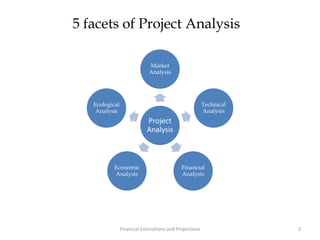
Project
Analysis
Market
Analysis
Technical
Analysis
Financial
Analysis
Economic
Analysis
Ecological
Analysis
5 facets of Project Analysis
Financial Analysis is the assessment of the viability, stability and profitability
of a business, sub-business or project.
It seeks to ascertain the financially viability of a project
It assures weather the proposed project is financially viable or not
Financial Analysis
3Financial Estimations and Projections
The aspects which have to be looked into while conducting financial analysis
are:
• Project Cost & Investment Outlay
• Means of Financing
• Capital Cost
• Projected Profitability
• Level of Risk
• Break-Even Point
• Cash flows of the project
• Investment worthwhileness
4Financial Estimations and Projections
Cost of Project
The cost of project represents the total of all items of outlay associated
with long-term fields.
It is the sum of the outlays on the following:
• Land and Site Development
• Buildings and Civil Works
• Plant and Machinery
• Technical know-how and Engineering Fees
• Expenses on Foreign Technicians and Training of Technicians Abroad
• Miscellaneous Fixed Assets
• Preliminary and Capital Issue Expenses
• Pre-operative Expenses:
• Provision for Contingencies:
• Margin Money for Working Capital
• Initial cash Losses
5Financial Estimations and Projections
1. Land and Site Development: The costs of land site development are-
- Cost of development
- Cost of compound wall and gates
2. Buildings and Civil Works: Building and civil works covers the
following-
- Buildings for the main plants and equipments
- Warehouse, Open yard facilities & Godowns
- Garage
- Sewers, drainage
6Financial Estimations and Projections
3. Plant and Machinery: The plant and machinery consists the following
costs-
i) Cost of Imported Machinery: This is the sum of
a) FOB (Freight on Board) Value
b) Imported duty
c) Clearing, loading and unloading charges.
ii) Cost of Indigenous Machinery: This consists of
a) FOR (Free On Rail) cost
b) Sales tax and other taxes
iii) Cost of Stores and Spares:
Provision of Escalation = (Latest rate of annual inflation to the plant
and machinery X (Length of the delivery period)
4. Technical and Engineering Fees: The technical know-how and
engineering fees for setting up the project is a component of the
project cost which is taken into account as cost of capital.
7Financial Estimations and Projections
5. Expenses on Foreign Technicians and Training of Technicians Abroad:
Expenses on foreign technicians like traveling, boarding and lodging are
considered as a cost of project.
6. Miscellaneous Fixed Assets: Fixed assets and machinery which are not part of
the direct manufacturing process may be referred to as miscellaneous fixed
assets. Like furniture, office machinery and equipment.
7. Preliminary and Capital Issue Expenses:
Preliminary expenses are-
- Identifying the project
- Market survey
- Articles of association
Capital Issue Expenses are-
- Underwriting commission
- Brokerage
- Stamp duty
8Financial Estimations and Projections
Financial Estimations and Projections 9
8. Pre-operative Expenses: These types of expenses are the following-
i) Establishment expenses ii) Traveling expenses
iii) Insurance charges iv) Mortgage expenses
v) Miscellaneous expenses
9. Provision for Contingencies: There are 2 procedures that are followed
for provision for contingencies. These are-
i) Divide the cost items into 2 categories
- Firm cost items
- Non-firm cost items
ii) Set the provision for contingencies at 5% to 10%.
10. Margin Money for Working Capital: Margin money for working capital is
an important element of the project cost which is provided by commercial
banks and trade creditors.
11. Initial cash Losses: Most of the projects incur cash losses in the initial years.
Failure to make a provision for such cash losses in the project cost affects
the liquidity position and impairs the operations.
Means of Finance
To meet the project cost, following are the means of finance:
• Share Capital
• Term Loans
• Debenture Capital
• Deferred Credit
• Incentive Sources
• Miscellaneous Sources
10Financial Estimations and Projections
To meet the cost of the project, the following means of finance are available-
1. Share Capital: Two types of share capitals are-
i) Equity capital, represents the contribution made by the owner’s of the
business and equity shareholders.
ii) Preference capital, represents the contribution made by preference
shareholders.
2. Term Loans: Term loans provided by financial institutions and commercial
banks. There are 2 types of term loans.
- Native Term Loans
- Foreign Currency Term Loans
3. Debenture Capital: There are 2 types of debenture capital. These are-
i) Non- convertible debentures, are straight debt instruments which
maturity period of 5 to 9 years.
ii) Convertible debentures, are debentures which are convertible wholly or
partly into equity shares.
11Financial Estimations and Projections
4. Deferred Credit: The credit which is provided by suppliers (for plant and
machinery) as a deferred credit facility is deferred credit.
5. Incentive Source: Government provides different types of incentives for
financing. These are-
- Tax exemption
- Capital subsidy
6. Miscellaneous Sources: Miscellaneous sources are-
- Unsecured loans
- Public deposits
- Leasing and hire purchase finance
12Financial Estimations and Projections
Estimates of Sales and
Production
In estimating sales revenues, the following considerations should be kept in
mind:
1. It is not advisable to assume a high capacity utilization level in the first year
of operation. It is sensible to assume that capacity utilization would be
some what low in the first year and rise there after gradually to reach the
maximum level in the third or fourth year of operation.
2. It is not necessary to make adjustments for stocks of finished goods.
3. The selling price considered should be the price realizable by the company
net of excise duty.
4. The selling price used may b the present selling price- it is generally
assumed that changes in selling price will be matched by proportionate
changes in cost of production.
13Financial Estimations and Projections
Cost of Production
The major components of cost of production are :
• Material cost
•Utilities cost
• Labor cost
• Factory overhead cost
14Financial Estimations and Projections
Materials : The most important element of cost , the material cost
comprises of the cost of raw materials, chemicals, components and
consumable stores required for production. It is a function of the
quantities in which these materials are required and the prices payable
for them.
Utilities : Utilities consist of power , water , and fuel. The requirements
of power , water, and fuel may be determined on the basis of norms
specified by the collaborators, consultants, etc or the consumption
standards in the industry, whichever is higher.
Labor : Labor cost is the cost of all manpower employed in the factory.
labor cost naturally is a function of the number of employees and the
rate of remuneration.
Factory Overhead : The expenses on repairs and maintenance, rent,
taxes, insurance on factory assets , and so on are collectively referred as
factory overhead.
15Financial Estimations and Projections
Working Capital Requirement
and Its Financing
In estimating the working capital requirement and planning for its financing,
the following pints have to be kept in mind:
• The working capital requirement consists of the following:
(i) Raw materials
(ii) Stocks of goods in process
(iii) Stocks of finished goods
(iv) Debtors
(v) Operating expenses
(vi) Consumable stores
16Financial Estimations and Projections
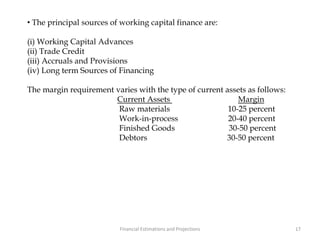
• The principal sources of working capital finance are:
(i) Working Capital Advances
(ii) Trade Credit
(iii) Accruals and Provisions
(iv) Long term Sources of Financing
The margin requirement varies with the type of current assets as follows:
Current Assets Margin
Raw materials 10-25 percent
Work-in-process 20-40 percent
Finished Goods 30-50 percent
Debtors 30-50 percent
17Financial Estimations and Projections
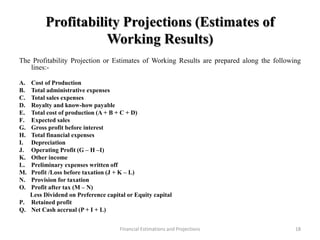
Profitability Projections (Estimates of
Working Results)
The Profitability Projection or Estimates of Working Results are prepared along the following
lines:-
A. Cost of Production
B. Total administrative expenses
C. Total sales expenses
D. Royalty and know-how payable
E. Total cost of production (A + B + C + D)
F. Expected sales
G. Gross profit before interest
H. Total financial expenses
I. Depreciation
J. Operating Profit (G – H –I)
K. Other income
L. Preliminary expenses written off
M. Profit /Loss before taxation (J + K – L)
N. Provision for taxation
O. Profit after tax (M – N)
Less Dividend on Preference capital or Equity capital
P. Retained profit
Q. Net Cash accrual (P + I + L)
Financial Estimations and Projections 18
Profitability Projection ( Continued…)
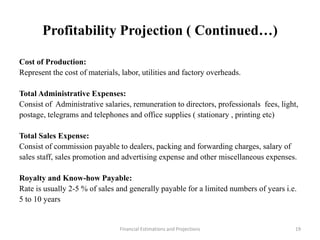
Cost of Production:
Represent the cost of materials, labor, utilities and factory overheads.
Total Administrative Expenses:
Consist of Administrative salaries, remuneration to directors, professionals fees, light,
postage, telegrams and telephones and office supplies ( stationary , printing etc)
Total Sales Expense:
Consist of commission payable to dealers, packing and forwarding charges, salary of
sales staff, sales promotion and advertising expense and other miscellaneous expenses.
Royalty and Know-how Payable:
Rate is usually 2-5 % of sales and generally payable for a limited numbers of years i.e.
5 to 10 years
Financial Estimations and Projections 19
Profitability Projection (Continued..)
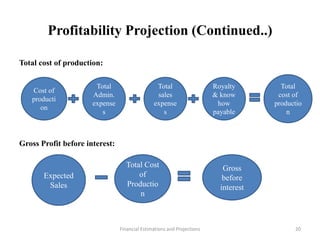
Total cost of production:
Gross Profit before interest:
Cost of
producti
on
Total
Admin.
expense
s
Total
sales
expense
s
Royalty
& know
how
payable
Total
cost of
productio
n
Expected
Sales
Total Cost
of
Productio
n
Gross
before
interest
Financial Estimations and Projections 20
Profitability Projection (Continued…)
Total Financial Expenses:-
It consist of interest on term loans, interest on bank borrowings, commitment charges
on term loans, and commission for bank guarantees etc.
Depreciation:-
It is an important factor, particularly for capital intensive projects. For financial
reporting purpose, the method of depreciation may be either the Written down value
(WDV) method or straight line method.
Other Income:
Income arising from transactions is not part of the normal operations of the firm. i.e.
sale of machinery, disposal of scrap etc.
Write off Preliminary Expenses:
5% of the cost of project or capital employed ,whichever is higher, can be amortized in
five equal annual installments.
Financial Estimations and Projections 21
Profitability Projection (Continued…)
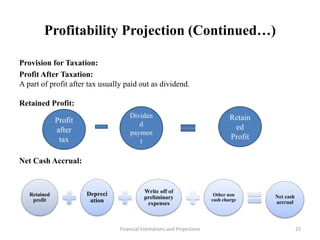
Provision for Taxation:
Profit After Taxation:
A part of profit after tax usually paid out as dividend.
Retained Profit:
Net Cash Accrual:
Profit
after
tax
Dividen
d
paymen
t
Retain
ed
Profit
Retained
profit
Depreci
ation
Write off of
preliminary
expenses
Other non
cash charge
Net cash
accrual
Financial Estimations and Projections 22
Projected Cash Flow Statement
The cash flow statement shows the movement of cash into and out of the firm and
its net impact on the cash balance within the firm.
Cash Flow Statement
Sources of fund
1. Share issue
2. Profit before taxation with interest added back
3. Depreciation provision for the year
4. Development rebate reserve
5. Increase in secured medium and long-term borrowings for the project
6. Other medium/long–term loans
7. Increase in unsecured loans and deposits
8. Increase in bank borrowings for working capital
9. Increase in liabilities for deferred payment to machinery suppliers
10. Sale of fixed assets
11. Sale of investments
12. Other income (Total A)
Financial Estimations and Projections 23
Projected Cash Flow Statement (Continued..)
Disposition of Funds
1. CAPEX for the project
2. Other normal CAPEX
3. Increase in Working capital
4. Decrease in secured medium long-term borrowings
5. Decrease in unsecured loans and deposits
6. Decrease in bank borrowings for working capital
7. Decrease in liabilities for deferred payments to machinery suppliers
8. Increase in investment in other companies
9. Interest on term loans
10. Interest on bank borrowings for working capital
11. Taxation
12. Dividends ( Equity/ Preference)
13. Other expenditure ( Total B)
• Opening balance of cash in hand and at bank
• Net surplus/deficit (A – B)
• Closing balance of cash in hand and at bank.
Financial Estimations and Projections 24
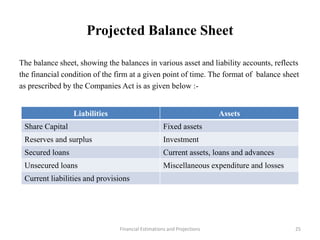
Projected Balance Sheet
The balance sheet, showing the balances in various asset and liability accounts, reflects
the financial condition of the firm at a given point of time. The format of balance sheet
as prescribed by the Companies Act is as given below :-
Liabilities Assets
Share Capital Fixed assets
Reserves and surplus Investment
Secured loans Current assets, loans and advances
Unsecured loans Miscellaneous expenditure and losses
Current liabilities and provisions
Financial Estimations and Projections 25
Multi-Year Projections
• It is a process wherein the financial projections are made over a longer time
frame.
• The Multi Year projection consist of projection about:-
1. Proposed Outlays and Financing.
2. Projected Revenues and costs.
3. Projected profit and loss statements.
4. Projected cash flow statements.
5. Projected Balance Sheets.
Financial Estimations and Projections 26

Financial Estimations and Projections

  • 1.
    Financial Estimations and Projections SameerKhirpurikar, Ujjwal Goyal, NPTI-14th Batch Financial Estimations and Projections 1
  • 2.
    2Financial Estimations andProjections Project Analysis Market Analysis Technical Analysis Financial Analysis Economic Analysis Ecological Analysis 5 facets of Project Analysis
  • 3.
    Financial Analysis isthe assessment of the viability, stability and profitability of a business, sub-business or project. It seeks to ascertain the financially viability of a project It assures weather the proposed project is financially viable or not Financial Analysis 3Financial Estimations and Projections
  • 4.
    The aspects whichhave to be looked into while conducting financial analysis are: • Project Cost & Investment Outlay • Means of Financing • Capital Cost • Projected Profitability • Level of Risk • Break-Even Point • Cash flows of the project • Investment worthwhileness 4Financial Estimations and Projections
  • 5.
    Cost of Project Thecost of project represents the total of all items of outlay associated with long-term fields. It is the sum of the outlays on the following: • Land and Site Development • Buildings and Civil Works • Plant and Machinery • Technical know-how and Engineering Fees • Expenses on Foreign Technicians and Training of Technicians Abroad • Miscellaneous Fixed Assets • Preliminary and Capital Issue Expenses • Pre-operative Expenses: • Provision for Contingencies: • Margin Money for Working Capital • Initial cash Losses 5Financial Estimations and Projections
  • 6.
    1. Land andSite Development: The costs of land site development are- - Cost of development - Cost of compound wall and gates 2. Buildings and Civil Works: Building and civil works covers the following- - Buildings for the main plants and equipments - Warehouse, Open yard facilities & Godowns - Garage - Sewers, drainage 6Financial Estimations and Projections
  • 7.
    3. Plant andMachinery: The plant and machinery consists the following costs- i) Cost of Imported Machinery: This is the sum of a) FOB (Freight on Board) Value b) Imported duty c) Clearing, loading and unloading charges. ii) Cost of Indigenous Machinery: This consists of a) FOR (Free On Rail) cost b) Sales tax and other taxes iii) Cost of Stores and Spares: Provision of Escalation = (Latest rate of annual inflation to the plant and machinery X (Length of the delivery period) 4. Technical and Engineering Fees: The technical know-how and engineering fees for setting up the project is a component of the project cost which is taken into account as cost of capital. 7Financial Estimations and Projections
  • 8.
    5. Expenses onForeign Technicians and Training of Technicians Abroad: Expenses on foreign technicians like traveling, boarding and lodging are considered as a cost of project. 6. Miscellaneous Fixed Assets: Fixed assets and machinery which are not part of the direct manufacturing process may be referred to as miscellaneous fixed assets. Like furniture, office machinery and equipment. 7. Preliminary and Capital Issue Expenses: Preliminary expenses are- - Identifying the project - Market survey - Articles of association Capital Issue Expenses are- - Underwriting commission - Brokerage - Stamp duty 8Financial Estimations and Projections
  • 9.
    Financial Estimations andProjections 9 8. Pre-operative Expenses: These types of expenses are the following- i) Establishment expenses ii) Traveling expenses iii) Insurance charges iv) Mortgage expenses v) Miscellaneous expenses 9. Provision for Contingencies: There are 2 procedures that are followed for provision for contingencies. These are- i) Divide the cost items into 2 categories - Firm cost items - Non-firm cost items ii) Set the provision for contingencies at 5% to 10%. 10. Margin Money for Working Capital: Margin money for working capital is an important element of the project cost which is provided by commercial banks and trade creditors. 11. Initial cash Losses: Most of the projects incur cash losses in the initial years. Failure to make a provision for such cash losses in the project cost affects the liquidity position and impairs the operations.
  • 10.
    Means of Finance Tomeet the project cost, following are the means of finance: • Share Capital • Term Loans • Debenture Capital • Deferred Credit • Incentive Sources • Miscellaneous Sources 10Financial Estimations and Projections
  • 11.
    To meet thecost of the project, the following means of finance are available- 1. Share Capital: Two types of share capitals are- i) Equity capital, represents the contribution made by the owner’s of the business and equity shareholders. ii) Preference capital, represents the contribution made by preference shareholders. 2. Term Loans: Term loans provided by financial institutions and commercial banks. There are 2 types of term loans. - Native Term Loans - Foreign Currency Term Loans 3. Debenture Capital: There are 2 types of debenture capital. These are- i) Non- convertible debentures, are straight debt instruments which maturity period of 5 to 9 years. ii) Convertible debentures, are debentures which are convertible wholly or partly into equity shares. 11Financial Estimations and Projections
  • 12.
    4. Deferred Credit:The credit which is provided by suppliers (for plant and machinery) as a deferred credit facility is deferred credit. 5. Incentive Source: Government provides different types of incentives for financing. These are- - Tax exemption - Capital subsidy 6. Miscellaneous Sources: Miscellaneous sources are- - Unsecured loans - Public deposits - Leasing and hire purchase finance 12Financial Estimations and Projections
  • 13.
    Estimates of Salesand Production In estimating sales revenues, the following considerations should be kept in mind: 1. It is not advisable to assume a high capacity utilization level in the first year of operation. It is sensible to assume that capacity utilization would be some what low in the first year and rise there after gradually to reach the maximum level in the third or fourth year of operation. 2. It is not necessary to make adjustments for stocks of finished goods. 3. The selling price considered should be the price realizable by the company net of excise duty. 4. The selling price used may b the present selling price- it is generally assumed that changes in selling price will be matched by proportionate changes in cost of production. 13Financial Estimations and Projections
  • 14.
    Cost of Production Themajor components of cost of production are : • Material cost •Utilities cost • Labor cost • Factory overhead cost 14Financial Estimations and Projections
  • 15.
    Materials : Themost important element of cost , the material cost comprises of the cost of raw materials, chemicals, components and consumable stores required for production. It is a function of the quantities in which these materials are required and the prices payable for them. Utilities : Utilities consist of power , water , and fuel. The requirements of power , water, and fuel may be determined on the basis of norms specified by the collaborators, consultants, etc or the consumption standards in the industry, whichever is higher. Labor : Labor cost is the cost of all manpower employed in the factory. labor cost naturally is a function of the number of employees and the rate of remuneration. Factory Overhead : The expenses on repairs and maintenance, rent, taxes, insurance on factory assets , and so on are collectively referred as factory overhead. 15Financial Estimations and Projections
  • 16.
    Working Capital Requirement andIts Financing In estimating the working capital requirement and planning for its financing, the following pints have to be kept in mind: • The working capital requirement consists of the following: (i) Raw materials (ii) Stocks of goods in process (iii) Stocks of finished goods (iv) Debtors (v) Operating expenses (vi) Consumable stores 16Financial Estimations and Projections
  • 17.
    • The principalsources of working capital finance are: (i) Working Capital Advances (ii) Trade Credit (iii) Accruals and Provisions (iv) Long term Sources of Financing The margin requirement varies with the type of current assets as follows: Current Assets Margin Raw materials 10-25 percent Work-in-process 20-40 percent Finished Goods 30-50 percent Debtors 30-50 percent 17Financial Estimations and Projections
  • 18.
    Profitability Projections (Estimatesof Working Results) The Profitability Projection or Estimates of Working Results are prepared along the following lines:- A. Cost of Production B. Total administrative expenses C. Total sales expenses D. Royalty and know-how payable E. Total cost of production (A + B + C + D) F. Expected sales G. Gross profit before interest H. Total financial expenses I. Depreciation J. Operating Profit (G – H –I) K. Other income L. Preliminary expenses written off M. Profit /Loss before taxation (J + K – L) N. Provision for taxation O. Profit after tax (M – N) Less Dividend on Preference capital or Equity capital P. Retained profit Q. Net Cash accrual (P + I + L) Financial Estimations and Projections 18
  • 19.
    Profitability Projection (Continued…) Cost of Production: Represent the cost of materials, labor, utilities and factory overheads. Total Administrative Expenses: Consist of Administrative salaries, remuneration to directors, professionals fees, light, postage, telegrams and telephones and office supplies ( stationary , printing etc) Total Sales Expense: Consist of commission payable to dealers, packing and forwarding charges, salary of sales staff, sales promotion and advertising expense and other miscellaneous expenses. Royalty and Know-how Payable: Rate is usually 2-5 % of sales and generally payable for a limited numbers of years i.e. 5 to 10 years Financial Estimations and Projections 19
  • 20.
    Profitability Projection (Continued..) Totalcost of production: Gross Profit before interest: Cost of producti on Total Admin. expense s Total sales expense s Royalty & know how payable Total cost of productio n Expected Sales Total Cost of Productio n Gross before interest Financial Estimations and Projections 20
  • 21.
    Profitability Projection (Continued…) TotalFinancial Expenses:- It consist of interest on term loans, interest on bank borrowings, commitment charges on term loans, and commission for bank guarantees etc. Depreciation:- It is an important factor, particularly for capital intensive projects. For financial reporting purpose, the method of depreciation may be either the Written down value (WDV) method or straight line method. Other Income: Income arising from transactions is not part of the normal operations of the firm. i.e. sale of machinery, disposal of scrap etc. Write off Preliminary Expenses: 5% of the cost of project or capital employed ,whichever is higher, can be amortized in five equal annual installments. Financial Estimations and Projections 21
  • 22.
    Profitability Projection (Continued…) Provisionfor Taxation: Profit After Taxation: A part of profit after tax usually paid out as dividend. Retained Profit: Net Cash Accrual: Profit after tax Dividen d paymen t Retain ed Profit Retained profit Depreci ation Write off of preliminary expenses Other non cash charge Net cash accrual Financial Estimations and Projections 22
  • 23.
    Projected Cash FlowStatement The cash flow statement shows the movement of cash into and out of the firm and its net impact on the cash balance within the firm. Cash Flow Statement Sources of fund 1. Share issue 2. Profit before taxation with interest added back 3. Depreciation provision for the year 4. Development rebate reserve 5. Increase in secured medium and long-term borrowings for the project 6. Other medium/long–term loans 7. Increase in unsecured loans and deposits 8. Increase in bank borrowings for working capital 9. Increase in liabilities for deferred payment to machinery suppliers 10. Sale of fixed assets 11. Sale of investments 12. Other income (Total A) Financial Estimations and Projections 23
  • 24.
    Projected Cash FlowStatement (Continued..) Disposition of Funds 1. CAPEX for the project 2. Other normal CAPEX 3. Increase in Working capital 4. Decrease in secured medium long-term borrowings 5. Decrease in unsecured loans and deposits 6. Decrease in bank borrowings for working capital 7. Decrease in liabilities for deferred payments to machinery suppliers 8. Increase in investment in other companies 9. Interest on term loans 10. Interest on bank borrowings for working capital 11. Taxation 12. Dividends ( Equity/ Preference) 13. Other expenditure ( Total B) • Opening balance of cash in hand and at bank • Net surplus/deficit (A – B) • Closing balance of cash in hand and at bank. Financial Estimations and Projections 24
  • 25.
    Projected Balance Sheet Thebalance sheet, showing the balances in various asset and liability accounts, reflects the financial condition of the firm at a given point of time. The format of balance sheet as prescribed by the Companies Act is as given below :- Liabilities Assets Share Capital Fixed assets Reserves and surplus Investment Secured loans Current assets, loans and advances Unsecured loans Miscellaneous expenditure and losses Current liabilities and provisions Financial Estimations and Projections 25
  • 26.
    Multi-Year Projections • Itis a process wherein the financial projections are made over a longer time frame. • The Multi Year projection consist of projection about:- 1. Proposed Outlays and Financing. 2. Projected Revenues and costs. 3. Projected profit and loss statements. 4. Projected cash flow statements. 5. Projected Balance Sheets. Financial Estimations and Projections 26