Compounds, Chemicals
Formulas, and Covalent Bonds
Chapter 8 Lesson 2
P275-282
Review
• Compounds are substances made up
of two of more different elements
• Compounds and the elements that
make them up often have different
properties
• Chemical bonds join atoms together.
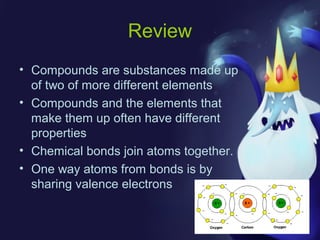
• One way atoms from bonds is by
sharing valence electrons
Covalent Bonds – Sharing
Electrons
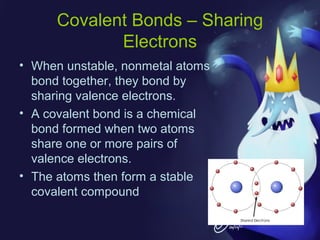
• When unstable, nonmetal atoms
bond together, they bond by
sharing valence electrons.
• A covalent bond is a chemical
bond formed when two atoms
share one or more pairs of
valence electrons.
• The atoms then form a stable
covalent compound
A Noble Gas Electron Arrangement
• An atoms with less than eight
valence electrons becomes
stable by forming chemical
bonds until it has eight valence
electrons.
• The most chemically stable state
for most atoms has the electron
configuration of a noble gas.
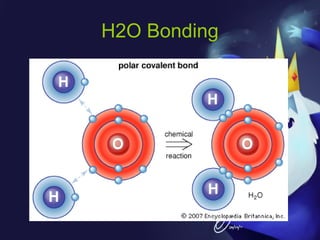
• Look at H2O
H2O Bonding
Shared Electrons
• If the oxygen atom and each hydrogen atom
share their unpaired valence electrons, they
can form two covalent bonds and become a
stable covalent compound.
• Each covalent bond contains two valence
electrons.
• Since these electrons are shared, they count
as valence electrons for both atoms in the
bond.
• In H2O, all three atoms combine sharing
valence electrons. We know the compound
is stable because all three atoms have eight
valence electrons.
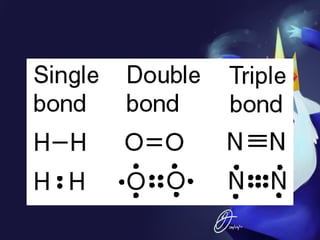
Double and Triple Covalent Bonds
• A single covalent bond exists when two
atoms share one pair of valence electrons.
• Double bonds exist when two atoms share
two pairs of valence electrons.
– Double bonds are stronger than single bonds

• Triple covalent bonds exist when two
atoms share three pairs of valence
electrons.
– Triple bonds are stronger than double bonds.
Covalent Compounds
• Covalent compounds usually
have low melting points and
low boiling points.
• They are usually gases or
liquids at room temperature,
but they can also be solids
• Covalent compounds are poor
conductors of thermal energy
and electricity
Molecules
• A molecule is a group of atoms held
together by covalent boning that acts
as an independent unit,
• Table sugar (C12H22O11) is a
covalent compound.
• One grain of sugar is made up of
trillions of sugar molecules.
• One molecule of sugar contains 12
carbon atoms, 22 hydrogen atoms,
and 11 oxygen atoms.
• The only way to break a molecule of
sugar would be to chemically
separate the atoms of C, H, and O.
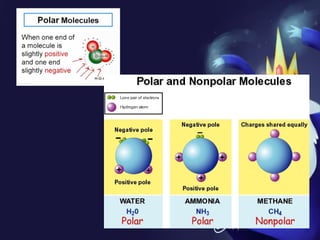
Water and Other Polar Molecules
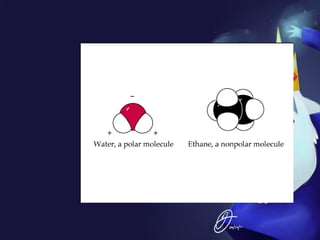
• In a covalent bond, one atom can attract the
shared electrons more strongly than the other
atoms can.
• Consider H2O
– The oxygen atom attracts the shared electrons
more strongly than each hydrogen atom does.
– As a result, the shared electrons are pulled closer
to the oxygen atom.
– Since electrons have a negative charge, the
oxygen atom has a partial negative charge.

• A molecule that has a partial positive end and
a partial negative end because of unequal
sharing of electrons is a polar molecule.
Dissolving Molecules
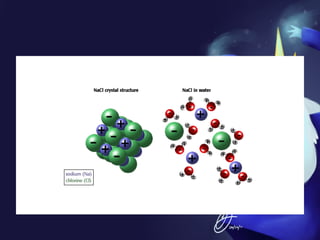
• The charges on a polar molecule affect its
properties.
• Sugar dissolves easily in water because
sugar and water are polar.
• The negative ends of a water molecule
pulls on the positive end of a sugar
molecule.
• Also, the positive end of a water molecule
pulls on the negative end of the sugar
molecule.
• This causes the sugar molecules to
separate from one another and mix with
the water molecules.
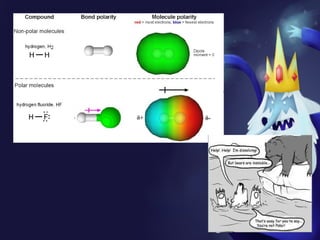
Nonpolar molecules
• A hydrogen molecule, H2, is a nonpolar
molecule.
• Hydrogen atoms are identical, their
attraction for a shared electron is equal.
• The carbon dioxide molecule, CO2, is also
nonpolar.
• A nonpolar compound will not easily
dissolve in a polar compound, but it will
dissolve easily in a nonpolar compound.
• Oil is an example of a nonpolar compound.
It will not dissolve in water.
Chemical Formulas and Molecular
Models
• A chemical formula is a group of chemical
symbols and numbers that represent the
elements and the number of atoms of each
element that make up a compound.
• Just as a recipe lists ingredients, a chemical
carbon dioxide is CO2. formula lists the
elements in a compound.
• For example, the chemical formula for
– CO2 is made up of carbon and oxygen atoms.
– The subscript, or small number after a chemical
symbol, shows the number of atoms of each
element in the compound.
– CO2 contains two atoms of oxygen bonded to
one atom of carbon.
•st as a recipe lists ingredients, a chemical formula lists the elements in a compound.
For exa

Chemical Formulas and Molecular
Models
• When parentheses (“()”) are used, any
subscript applies to all the elements inside
the parentheses.
• Example:
– Al2(SO4)3
• 2 Aluminum
• 3 Sulfur
• 12 Oxygen

Ch 8.2

  • 1.
    Compounds, Chemicals Formulas, andCovalent Bonds Chapter 8 Lesson 2 P275-282
  • 2.
    Review • Compounds aresubstances made up of two of more different elements • Compounds and the elements that make them up often have different properties • Chemical bonds join atoms together. • One way atoms from bonds is by sharing valence electrons
  • 3.
    Covalent Bonds –Sharing Electrons • When unstable, nonmetal atoms bond together, they bond by sharing valence electrons. • A covalent bond is a chemical bond formed when two atoms share one or more pairs of valence electrons. • The atoms then form a stable covalent compound
  • 4.
    A Noble GasElectron Arrangement • An atoms with less than eight valence electrons becomes stable by forming chemical bonds until it has eight valence electrons. • The most chemically stable state for most atoms has the electron configuration of a noble gas. • Look at H2O
  • 5.
  • 6.
    Shared Electrons • Ifthe oxygen atom and each hydrogen atom share their unpaired valence electrons, they can form two covalent bonds and become a stable covalent compound. • Each covalent bond contains two valence electrons. • Since these electrons are shared, they count as valence electrons for both atoms in the bond. • In H2O, all three atoms combine sharing valence electrons. We know the compound is stable because all three atoms have eight valence electrons.
  • 7.
    Double and TripleCovalent Bonds • A single covalent bond exists when two atoms share one pair of valence electrons. • Double bonds exist when two atoms share two pairs of valence electrons. – Double bonds are stronger than single bonds • Triple covalent bonds exist when two atoms share three pairs of valence electrons. – Triple bonds are stronger than double bonds.
  • 9.
    Covalent Compounds • Covalentcompounds usually have low melting points and low boiling points. • They are usually gases or liquids at room temperature, but they can also be solids • Covalent compounds are poor conductors of thermal energy and electricity
  • 10.
    Molecules • A moleculeis a group of atoms held together by covalent boning that acts as an independent unit, • Table sugar (C12H22O11) is a covalent compound. • One grain of sugar is made up of trillions of sugar molecules. • One molecule of sugar contains 12 carbon atoms, 22 hydrogen atoms, and 11 oxygen atoms. • The only way to break a molecule of sugar would be to chemically separate the atoms of C, H, and O.
  • 11.
    Water and OtherPolar Molecules • In a covalent bond, one atom can attract the shared electrons more strongly than the other atoms can. • Consider H2O – The oxygen atom attracts the shared electrons more strongly than each hydrogen atom does. – As a result, the shared electrons are pulled closer to the oxygen atom. – Since electrons have a negative charge, the oxygen atom has a partial negative charge. • A molecule that has a partial positive end and a partial negative end because of unequal sharing of electrons is a polar molecule.
  • 14.
    Dissolving Molecules • Thecharges on a polar molecule affect its properties. • Sugar dissolves easily in water because sugar and water are polar. • The negative ends of a water molecule pulls on the positive end of a sugar molecule. • Also, the positive end of a water molecule pulls on the negative end of the sugar molecule. • This causes the sugar molecules to separate from one another and mix with the water molecules.
  • 16.
    Nonpolar molecules • Ahydrogen molecule, H2, is a nonpolar molecule. • Hydrogen atoms are identical, their attraction for a shared electron is equal. • The carbon dioxide molecule, CO2, is also nonpolar. • A nonpolar compound will not easily dissolve in a polar compound, but it will dissolve easily in a nonpolar compound. • Oil is an example of a nonpolar compound. It will not dissolve in water.
  • 18.
    Chemical Formulas andMolecular Models • A chemical formula is a group of chemical symbols and numbers that represent the elements and the number of atoms of each element that make up a compound. • Just as a recipe lists ingredients, a chemical carbon dioxide is CO2. formula lists the elements in a compound. • For example, the chemical formula for – CO2 is made up of carbon and oxygen atoms. – The subscript, or small number after a chemical symbol, shows the number of atoms of each element in the compound. – CO2 contains two atoms of oxygen bonded to one atom of carbon.
  • 19.
    •st as arecipe lists ingredients, a chemical formula lists the elements in a compound. For exa Chemical Formulas and Molecular Models • When parentheses (“()”) are used, any subscript applies to all the elements inside the parentheses. • Example: – Al2(SO4)3 • 2 Aluminum • 3 Sulfur • 12 Oxygen