Manufacturing Account


                        1
Production Cost
Production cost
= Prime cost / Direct cost + Factory overhead
  expenses / Indirect cost


                                                2
1.       Direct materials
     •     Costs of the materials used during the period.
     •     Include the purchase price of the raw materials and
           the acquisition costs related to the purchase.
     •     Examples: Purchase of raw materials
                        Carriage inwards / freight charges
                        on raw materials


                                                             3
2.       Direct labour
     •     Wages paid to the people who are directly involved
           in the manufacturing process.
     •     Example: Direct labour, Direct wages, Factory
                     wages, Production wages,
                     Manufacturing wages


                                                            4
3.       Direct expenses
     •     They refer to the expenses paid according to each
           unit of production.
     •     Examples: Royalties


                                                               5
Factory Overhead Expenses / Indirect
Costs
 Cost incurred in the manufacturing process, but they
  cannot be traced directly to the goods being produced.
 Include indirect materials, indirect labour and indirect
  expenses.
 Examples:
      Indirect materials
       – Lubricants
       – Loose tools (opening balance + purchase – closing
         balance)
      Indirect labour
       – wages, salaries, bonus or commission to cleaners, crane
         drivers, foremen, supervisors and production managers.


                                                                   6
Indirect expenses related to the factory, machinery
and vehicles
 – Rent and rates
 – Depreciation
 – Insurance
 – Repairs and maintenance
 – Factory power / electricity
 – Internal transport
 – Loss on disposal


                                                      7
Work in Progress
 It refers to the semi-finished goods, which
  should be included in the cost of goods
  manufactured.


                                                8
Manufacturing Account
   It shows the production cost or transfer price of
    goods completed during the accounting period.
    1.   Direct materials
    2.   Direct labour
    3.   Direct expenses
    4.   Factory overhead expenses
    5.   Work in progress
    6.   Manufacturing profit / loss

                                                    9
Trading Account
 This account shows the gross profit or loss
  resulted from the trading of manufactured and
  other purchased goods.
 The account includes:
     Sales
     Cost of goods sold
      – Manufactured goods
      – Other goods

                                                  10
Profit and Loss Account
 Profit or loss of the whole business during the
  accounting period.
 Includes all the expenses and income related to
  the office and the running of the whole business
  such as:
     Gross profit / loss from the trading account
     Manufacturing profit / loss


                                                     11
Administration expenses
Selling and distribution expenses
Financial expenses
Increase / decrease in the provision for unrealized
profit
Net abnormal loss
 – cash misappropriated
 – losses of raw materials
 – losses of finished goods


                                                      12
 Some expenses are related to both the
  manufacturing process and the administration of
  the office such as:
     Rent and rates
     Electricity
     Insurance
     Depreciation on premises
     Motor vehicles
     Motor vehicles expenses

                                                13
 These expenses should be allocated to the
  factory and office and debited to the
  manufacturing account and the profit and loss
  account respectively.
 The bases of allocation are usually given in the
  examination questions.


                                                     14
Format of Manufacturing, Trading
   and Profit and loss account


                               15
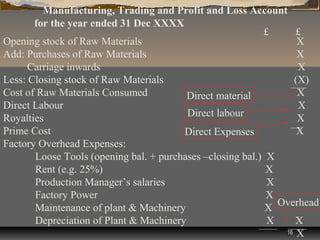
Manufacturing, Trading and Profit and Loss Account
       for the year ended 31 Dec XXXX
                                                           £      £
Opening stock of Raw Materials                                    X
Add: Purchases of Raw Materials                                   X
      Carriage inwards                                            X
Less: Closing stock of Raw Materials                             (X)
Cost of Raw Materials Consumed           Direct material          X
Direct Labour                                                     X
Royalties                                Direct labour            X
Prime Cost                              Direct Expenses           X
Factory Overhead Expenses:
       Loose Tools (opening bal. + purchases –closing bal.) X
       Rent (e.g. 25%)                                      X
       Production Manager’s salaries                        X
       Factory Power                                        X
       Maintenance of plant & Machinery                     X Overhead
       Depreciation of Plant & Machinery                    X     X
                                                               16 X
£      £
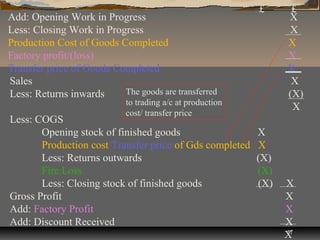
Add: Opening Work in Progress                                    X
Less: Closing Work in Progress                                   X
Production Cost of Goods Completed                               X
Factory profit/(loss)                                            X
Transfer price of Goods Completed                                X
Sales                                                             X
Less: Returns inwards     The goods are transferred              (X)
                            to trading a/c at production
                                                                  X
                            cost/ transfer price
Less: COGS
       Opening stock of finished goods                     X
       Production cost/Transfer price of Gds completed     X
       Less: Returns outwards                              (X)
       Fire Loss                                           (X)
       Less: Closing stock of finished goods               (X)   X
Gross Profit                                                     X
Add: Factory Profit                                              X
Add: Discount Received                                           X
                                                                 X
                                                                 17
£    £
Less: Expenses
       Carriage Outwards                 X
       Rent (e.g. 75%)                   X
       Discount allowed                  X
       Administration Expenses           X
       Distribution Expenses             X
       Selling Expenses                  X
       Depreciation of Delivery Van      X
       Provision for Unrealized Profit   X
       Fire Loss                         X   X
Net Profit                                   X


                                             18
Production Cost
        Vs.
   Transfer Price
of Goods Completed


                     19
Production cost Vs. Transfer price
 Stock of raw materials, work in progress and
  other finished goods are valued at cost.
 However, the stock of manufactured goods can
  be valued at production cost or the transfer price
  of goods completed.
 Provision of unrealized profit of on stock should
  be made if closing stock of manufactured goods
  is valued at transfer price.

                                                   20
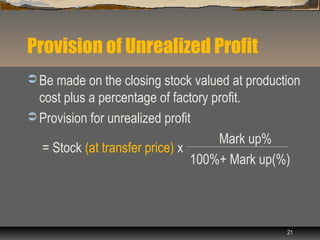
Provision of Unrealized Profit
 Be made on the closing stock valued at production
  cost plus a percentage of factory profit.
 Provision for unrealized profit

                                     Mark up%
   = Stock (at transfer price) x
                                 100%+ Mark up(%)


                                                21
Example 1


            22
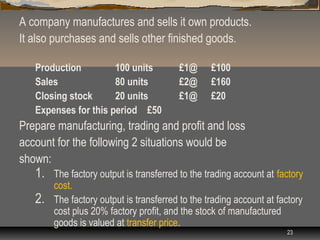
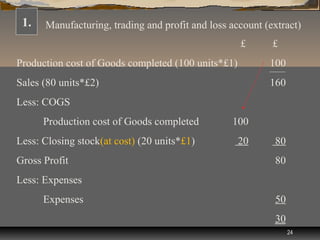
A company manufactures and sells it own products.
It also purchases and sells other finished goods.

   Production         100 units          £1@      £100
   Sales              80 units           £2@      £160
   Closing stock      20 units           £1@      £20
   Expenses for this period £50
Prepare manufacturing, trading and profit and loss
account for the following 2 situations would be
shown:
   1.   The factory output is transferred to the trading account at factory
        cost.
   2.   The factory output is transferred to the trading account at factory
        cost plus 20% factory profit, and the stock of manufactured
        goods is valued at transfer price.
                                                                      23
1.   Manufacturing, trading and profit and loss account (extract)
                                                    £      £
Production cost of Goods completed (100 units*£1)         100
Sales (80 units*£2)                                       160
Less: COGS
      Production cost of Goods completed         100
Less: Closing stock(at cost) (20 units*£1)          20     80
Gross Profit                                               80
Less: Expenses
      Expenses                                             50
                                                           30
                                                                24
2.
                                                     £       £
Production cost of Gd completed (100 units*£1)              100
Add: Manufacturing profit (100*0.2)                           20
Transfer price of Gds completed                             120
Sales (80 units*£2)                                         160
Less: Cost of goods sold
      Transfer price of Gd completed                  120
Less: Closing stock(at transfer price) (20+20*0.2) 24        96
Gross Profit                            Cost + profit        64
Add: Manufacturing profit                                    20
                                                             84
Less: Expenses
      Expenses                                         50
      Provision for unrealized profit (24*20/120)       4    54
Net Profit                                                   30
                                                                   25
Increase/ Decreased in Provision
of Unrealized Profit
   Accounting entries

      Increase in Provision     Decrease in Provision
 Dr Profit and Loss           Dr Provision for
 Cr Provision for                Unrealized Profit
    Unrealized Profit         Cr Profit and Loss


                                                        26
Example 2


            27
 Goods manufactured are to be transferred
  to sales department at factory cost plus
  20%.
                                    1994 1995 1996
                                      £      £     £
  Stock at 1 Jan (at transfer price) -     2,400 3,600
  Stock at 31 Dec (at transfer price)2,400 3,600 3,000

Prepare the provision for unrealized profit account, profit
and loss account and balance sheet respectively for the
three years
                                                              28
Provision for unrealized profit
 1994                       £    1994                            £
 Dec 31 Bal c/d
      (2400*20/120)       400 Dec 31 P/L                    400

               Profit and Loss account (extract)

                                                     94
                                                    £ £
Gross Profit                                            X


Less: Expenses
     Increase in provision for unrealized profit   400


                                                            29
Provision for unrealized profit
 1994                       £    1994                                  £
 Dec 31 Bal c/d
      (2400*20/120)       400 Dec 31 P/L                          400
 1995                              1995
  Dec 31 Bal c/d                    Jan 1 Bal b/d                 400
       (3600*20/120)         600   Dec 31 P/L                     200
                            600                                   600
               Profit and Loss account (extract)

                                                      94   95
                                                     £ £ £ £
Gross Profit                                             X    X


Less: Expenses
     Increase in provision for unrealized profit    400   200
                                                                  30
Provision for unrealized profit
1994                       £    1994                 £
Dec 31 Bal c/d
     (2400*20/120)       400 Dec 31 P/L         400
1995                           1995
 Dec 31 Bal c/d                 Jan 1 Bal b/d   400
      (3600*20/120)     600    Dec 31 P/L       200
                        600                     600
1996                           1996
Dec 31    P/L            100   Jan 1 bal b/d     600
Dec 31 Bal c/d
     (3000*20/120)      500
                        600                      600


                                                31
Profit and Loss account (extract)

                                                     94   95   96
                                                    £ £ £ £ £ £
Gross Profit                                            X    X    X
Add: Decrease in provision for unrealized profit                100

Less: Expenses
     Increase in provision for unrealized profit   400   200


                                                               32
Stock Loss


             33
Stock Loss
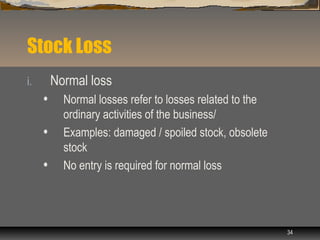
i.       Normal loss
     •     Normal losses refer to losses related to the
           ordinary activities of the business/
     •     Examples: damaged / spoiled stock, obsolete
           stock
     •     No entry is required for normal loss


                                                          34
ii.       Abnormal loss
      •     Abnormal losses refer to losses not related to the
            ordinary activities of the business.
      •     Examples: fire loss, burglary loss


                                                                 35
Accounting entries

   Loss of raw materials without an insurance claim
Dr Profit and Loss          With the total loss
Cr Manufacturing
  Loss of finished goods without an insurance claim
Dr Profit and Loss         With the total loss
Cr Trading


                                                      36
Loss of raw materials with an insurance claim
Dr Bank/Insurance Company   With the insurance claim
Dr Profit and Loss          With the net loss
Cr Manufacturing            With the total loss
    Loss of finished goods with an insurance claim
Dr Bank/Insurance Company   With the insurance claim
Dr Profit and Loss          With the net loss
Cr Trading                  With the total loss


                                                       37
Cheung Kong Enterprises
 Manufacturing, Trading and Profit and Loss Account for the year
                      ended 30 April 2004
Cost of raw materials consumed
Opening stock                                   160,000
Purchase                                      1,640,000

                                              1,800,000
Closing stock                                   200,000 1,600,000
Manufacturing wages                                         800,000

Prime cost                                                2,400,000


                                                             38
Prime cost                           2,400,000
Factory overheads
Manufacturing expenses     416,000
Depreciation               192,000   608,000
                                     3,008,000
Opening work in progress               126,000
                                      3,134,000
Closing work in progress                120,000

Cost of goods completed               3,014,000


                                                 39
40
41
42
43
44
45
46
47
48
49
Depreciation Total 2,400,000 x 10% = 240,000
Manufacturing                 80% = 192,000


Administration                10% = 24,000


Selling and distribution      10% = 24,000


                                               50

Manufacturing-account[1]

  • 1.
  • 2.
    Production Cost Production cost =Prime cost / Direct cost + Factory overhead expenses / Indirect cost 2
  • 3.
    1. Direct materials • Costs of the materials used during the period. • Include the purchase price of the raw materials and the acquisition costs related to the purchase. • Examples: Purchase of raw materials Carriage inwards / freight charges on raw materials 3
  • 4.
    2. Direct labour • Wages paid to the people who are directly involved in the manufacturing process. • Example: Direct labour, Direct wages, Factory wages, Production wages, Manufacturing wages 4
  • 5.
    3. Direct expenses • They refer to the expenses paid according to each unit of production. • Examples: Royalties 5
  • 6.
    Factory Overhead Expenses/ Indirect Costs  Cost incurred in the manufacturing process, but they cannot be traced directly to the goods being produced.  Include indirect materials, indirect labour and indirect expenses.  Examples: Indirect materials – Lubricants – Loose tools (opening balance + purchase – closing balance) Indirect labour – wages, salaries, bonus or commission to cleaners, crane drivers, foremen, supervisors and production managers. 6
  • 7.
    Indirect expenses relatedto the factory, machinery and vehicles – Rent and rates – Depreciation – Insurance – Repairs and maintenance – Factory power / electricity – Internal transport – Loss on disposal 7
  • 8.
    Work in Progress It refers to the semi-finished goods, which should be included in the cost of goods manufactured. 8
  • 9.
    Manufacturing Account  It shows the production cost or transfer price of goods completed during the accounting period. 1. Direct materials 2. Direct labour 3. Direct expenses 4. Factory overhead expenses 5. Work in progress 6. Manufacturing profit / loss 9
  • 10.
    Trading Account  Thisaccount shows the gross profit or loss resulted from the trading of manufactured and other purchased goods.  The account includes: Sales Cost of goods sold – Manufactured goods – Other goods 10
  • 11.
    Profit and LossAccount  Profit or loss of the whole business during the accounting period.  Includes all the expenses and income related to the office and the running of the whole business such as: Gross profit / loss from the trading account Manufacturing profit / loss 11
  • 12.
    Administration expenses Selling anddistribution expenses Financial expenses Increase / decrease in the provision for unrealized profit Net abnormal loss – cash misappropriated – losses of raw materials – losses of finished goods 12
  • 13.
     Some expensesare related to both the manufacturing process and the administration of the office such as: Rent and rates Electricity Insurance Depreciation on premises Motor vehicles Motor vehicles expenses 13
  • 14.
     These expensesshould be allocated to the factory and office and debited to the manufacturing account and the profit and loss account respectively.  The bases of allocation are usually given in the examination questions. 14
  • 15.
    Format of Manufacturing,Trading and Profit and loss account 15
  • 16.
    Manufacturing, Trading andProfit and Loss Account for the year ended 31 Dec XXXX £ £ Opening stock of Raw Materials X Add: Purchases of Raw Materials X Carriage inwards X Less: Closing stock of Raw Materials (X) Cost of Raw Materials Consumed Direct material X Direct Labour X Royalties Direct labour X Prime Cost Direct Expenses X Factory Overhead Expenses: Loose Tools (opening bal. + purchases –closing bal.) X Rent (e.g. 25%) X Production Manager’s salaries X Factory Power X Maintenance of plant & Machinery X Overhead Depreciation of Plant & Machinery X X 16 X
  • 17.
    £ £ Add: Opening Work in Progress X Less: Closing Work in Progress X Production Cost of Goods Completed X Factory profit/(loss) X Transfer price of Goods Completed X Sales X Less: Returns inwards The goods are transferred (X) to trading a/c at production X cost/ transfer price Less: COGS Opening stock of finished goods X Production cost/Transfer price of Gds completed X Less: Returns outwards (X) Fire Loss (X) Less: Closing stock of finished goods (X) X Gross Profit X Add: Factory Profit X Add: Discount Received X X 17
  • 18.
    £ £ Less: Expenses Carriage Outwards X Rent (e.g. 75%) X Discount allowed X Administration Expenses X Distribution Expenses X Selling Expenses X Depreciation of Delivery Van X Provision for Unrealized Profit X Fire Loss X X Net Profit X 18
  • 19.
    Production Cost Vs. Transfer Price of Goods Completed 19
  • 20.
    Production cost Vs.Transfer price  Stock of raw materials, work in progress and other finished goods are valued at cost.  However, the stock of manufactured goods can be valued at production cost or the transfer price of goods completed.  Provision of unrealized profit of on stock should be made if closing stock of manufactured goods is valued at transfer price. 20
  • 21.
    Provision of UnrealizedProfit  Be made on the closing stock valued at production cost plus a percentage of factory profit.  Provision for unrealized profit Mark up% = Stock (at transfer price) x 100%+ Mark up(%) 21
  • 22.
  • 23.
    A company manufacturesand sells it own products. It also purchases and sells other finished goods. Production 100 units £1@ £100 Sales 80 units £2@ £160 Closing stock 20 units £1@ £20 Expenses for this period £50 Prepare manufacturing, trading and profit and loss account for the following 2 situations would be shown: 1. The factory output is transferred to the trading account at factory cost. 2. The factory output is transferred to the trading account at factory cost plus 20% factory profit, and the stock of manufactured goods is valued at transfer price. 23
  • 24.
    1. Manufacturing, trading and profit and loss account (extract) £ £ Production cost of Goods completed (100 units*£1) 100 Sales (80 units*£2) 160 Less: COGS Production cost of Goods completed 100 Less: Closing stock(at cost) (20 units*£1) 20 80 Gross Profit 80 Less: Expenses Expenses 50 30 24
  • 25.
    2. £ £ Production cost of Gd completed (100 units*£1) 100 Add: Manufacturing profit (100*0.2) 20 Transfer price of Gds completed 120 Sales (80 units*£2) 160 Less: Cost of goods sold Transfer price of Gd completed 120 Less: Closing stock(at transfer price) (20+20*0.2) 24 96 Gross Profit Cost + profit 64 Add: Manufacturing profit 20 84 Less: Expenses Expenses 50 Provision for unrealized profit (24*20/120) 4 54 Net Profit 30 25
  • 26.
    Increase/ Decreased inProvision of Unrealized Profit Accounting entries Increase in Provision Decrease in Provision Dr Profit and Loss Dr Provision for Cr Provision for Unrealized Profit Unrealized Profit Cr Profit and Loss 26
  • 27.
  • 28.
     Goods manufacturedare to be transferred to sales department at factory cost plus 20%. 1994 1995 1996 £ £ £ Stock at 1 Jan (at transfer price) - 2,400 3,600 Stock at 31 Dec (at transfer price)2,400 3,600 3,000 Prepare the provision for unrealized profit account, profit and loss account and balance sheet respectively for the three years 28
  • 29.
    Provision for unrealizedprofit 1994 £ 1994 £ Dec 31 Bal c/d (2400*20/120) 400 Dec 31 P/L 400 Profit and Loss account (extract) 94 £ £ Gross Profit X Less: Expenses Increase in provision for unrealized profit 400 29
  • 30.
    Provision for unrealizedprofit 1994 £ 1994 £ Dec 31 Bal c/d (2400*20/120) 400 Dec 31 P/L 400 1995 1995 Dec 31 Bal c/d Jan 1 Bal b/d 400 (3600*20/120) 600 Dec 31 P/L 200 600 600 Profit and Loss account (extract) 94 95 £ £ £ £ Gross Profit X X Less: Expenses Increase in provision for unrealized profit 400 200 30
  • 31.
    Provision for unrealizedprofit 1994 £ 1994 £ Dec 31 Bal c/d (2400*20/120) 400 Dec 31 P/L 400 1995 1995 Dec 31 Bal c/d Jan 1 Bal b/d 400 (3600*20/120) 600 Dec 31 P/L 200 600 600 1996 1996 Dec 31 P/L 100 Jan 1 bal b/d 600 Dec 31 Bal c/d (3000*20/120) 500 600 600 31
  • 32.
    Profit and Lossaccount (extract) 94 95 96 £ £ £ £ £ £ Gross Profit X X X Add: Decrease in provision for unrealized profit 100 Less: Expenses Increase in provision for unrealized profit 400 200 32
  • 33.
  • 34.
    Stock Loss i. Normal loss • Normal losses refer to losses related to the ordinary activities of the business/ • Examples: damaged / spoiled stock, obsolete stock • No entry is required for normal loss 34
  • 35.
    ii. Abnormal loss • Abnormal losses refer to losses not related to the ordinary activities of the business. • Examples: fire loss, burglary loss 35
  • 36.
    Accounting entries Loss of raw materials without an insurance claim Dr Profit and Loss With the total loss Cr Manufacturing Loss of finished goods without an insurance claim Dr Profit and Loss With the total loss Cr Trading 36
  • 37.
    Loss of rawmaterials with an insurance claim Dr Bank/Insurance Company With the insurance claim Dr Profit and Loss With the net loss Cr Manufacturing With the total loss Loss of finished goods with an insurance claim Dr Bank/Insurance Company With the insurance claim Dr Profit and Loss With the net loss Cr Trading With the total loss 37
  • 38.
    Cheung Kong Enterprises Manufacturing, Trading and Profit and Loss Account for the year ended 30 April 2004 Cost of raw materials consumed Opening stock 160,000 Purchase 1,640,000 1,800,000 Closing stock 200,000 1,600,000 Manufacturing wages 800,000 Prime cost 2,400,000 38
  • 39.
    Prime cost 2,400,000 Factory overheads Manufacturing expenses 416,000 Depreciation 192,000 608,000 3,008,000 Opening work in progress 126,000 3,134,000 Closing work in progress 120,000 Cost of goods completed 3,014,000 39
  • 40.
  • 41.
  • 42.
  • 43.
  • 44.
  • 45.
  • 46.
  • 47.
  • 48.
  • 49.
  • 50.
    Depreciation Total 2,400,000x 10% = 240,000 Manufacturing 80% = 192,000 Administration 10% = 24,000 Selling and distribution 10% = 24,000 50