LABOUR
COSTING
1CHAPTER 3
Learning Objectives
Students should be able to:
O Differentiate between direct and
indirect labour.
O Calculate the remuneration of labour
using time based scheme and output
based scheme.
O Provide the advantages and
diisadvantages of each type of
remuneration.
2
Introduction
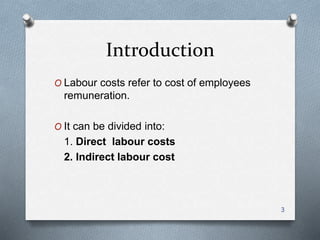
O Labour costs refer to cost of employees
remuneration.
O It can be divided into:
1. Direct labour costs
2. Indirect labour cost
3
Labour Cost
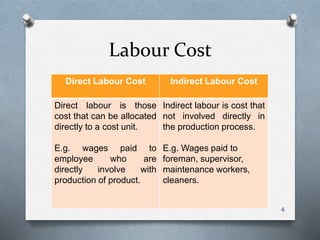
Direct Labour Cost Indirect Labour Cost
Direct labour is those
cost that can be allocated
directly to a cost unit.
E.g. wages paid to
employee who are
directly involve with
production of product.
Indirect labour is cost that
not involved directly in
the production process.
E.g. Wages paid to
foreman, supervisor,
maintenance workers,
cleaners.
4
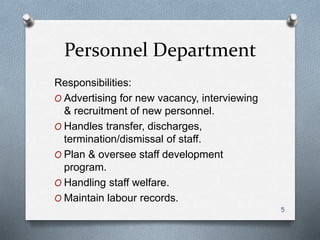
Personnel Department
Responsibilities:
O Advertising for new vacancy, interviewing
& recruitment of new personnel.
O Handles transfer, discharges,
termination/dismissal of staff.
O Plan & oversee staff development
program.
O Handling staff welfare.
O Maintain labour records.
5
Labour Records
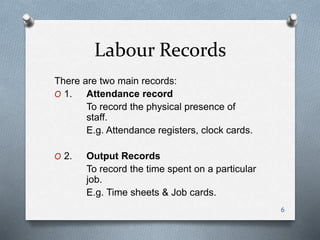
There are two main records:
O 1. Attendance record
To record the physical presence of
staff.
E.g. Attendance registers, clock cards.
O 2. Output Records
To record the time spent on a particular
job.
E.g. Time sheets & Job cards.
6
Labour Remuneration
Method 1
1. Time Based
Employee is paid on the basis of time worked.
Overtime/premium is paid for employee who is
working more than normal hours or work
overtime.
7
TIME BASED :
FORMULA TO REMEMBER
8
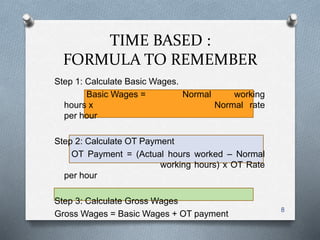
Step 1: Calculate Basic Wages.
Basic Wages = Normal working
hours x Normal rate
per hour
Step 2: Calculate OT Payment
OT Payment = (Actual hours worked – Normal
working hours) x OT Rate
per hour
Step 3: Calculate Gross Wages
Gross Wages = Basic Wages + OT payment
Calculation for Labour Wages
Using TIME BASED: Example 1
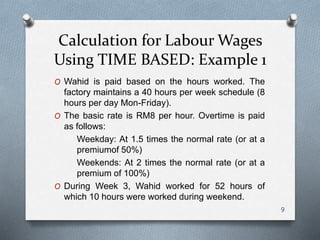
O Wahid is paid based on the hours worked. The
factory maintains a 40 hours per week schedule (8
hours per day Mon-Friday).
O The basic rate is RM8 per hour. Overtime is paid
as follows:
Weekday: At 1.5 times the normal rate (or at a
premiumof 50%)
Weekends: At 2 times the normal rate (or at a
premium of 100%)
O During Week 3, Wahid worked for 52 hours of
which 10 hours were worked during weekend.
9
Calculation for Labour Wages
Using TIME BASED: Example 1
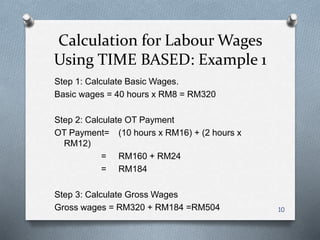
Step 1: Calculate Basic Wages.
Basic wages = 40 hours x RM8 = RM320
Step 2: Calculate OT Payment
OT Payment= (10 hours x RM16) + (2 hours x
RM12)
= RM160 + RM24
= RM184
Step 3: Calculate Gross Wages
Gross wages = RM320 + RM184 =RM504 10
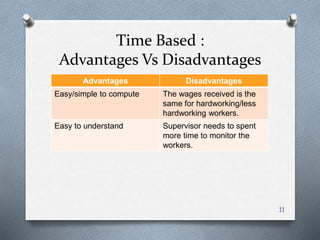
Time Based :
Advantages Vs Disadvantages
Advantages Disadvantages
Easy/simple to compute The wages received is the
same for hardworking/less
hardworking workers.
Easy to understand Supervisor needs to spent
more time to monitor the
workers.
11
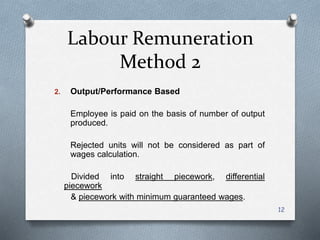
Labour Remuneration
Method 2
2. Output/Performance Based
Employee is paid on the basis of number of output
produced.
Rejected units will not be considered as part of
wages calculation.
Divided into straight piecework, differential
piecework
& piecework with minimum guaranteed wages.
12
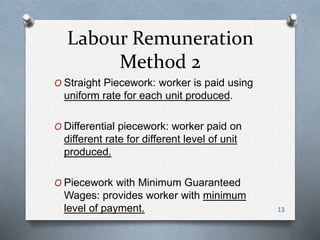
Labour Remuneration
Method 2
O Straight Piecework: worker is paid using
uniform rate for each unit produced.
O Differential piecework: worker paid on
different rate for different level of unit
produced.
O Piecework with Minimum Guaranteed
Wages: provides worker with minimum
level of payment. 13
Basic wages= (No. of unit produced – No. of unit
rejected) x Rate per unit.
OUTPUT BASED :
FORMULA TO REMEMBER
14
Step 1: Calculate basic wages.
Step 2: Compare basic wages with
minimum guaranteed wages
Step 3: Choose whichever is higher as the gross
wages.
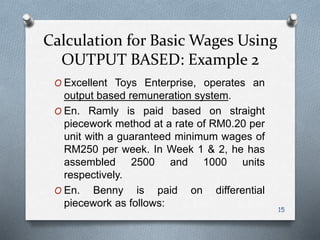
O Excellent Toys Enterprise, operates an
output based remuneration system.
O En. Ramly is paid based on straight
piecework method at a rate of RM0.20 per
unit with a guaranteed minimum wages of
RM250 per week. In Week 1 & 2, he has
assembled 2500 and 1000 units
respectively.
O En. Benny is paid on differential
piecework as follows:
15
Calculation for Basic Wages Using
OUTPUT BASED: Example 2
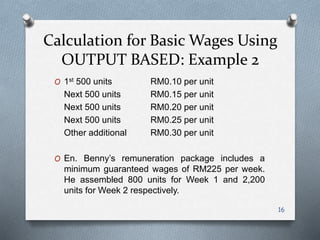
O 1st 500 units RM0.10 per unit
Next 500 units RM0.15 per unit
Next 500 units RM0.20 per unit
Next 500 units RM0.25 per unit
Other additional RM0.30 per unit
O En. Benny’s remuneration package includes a
minimum guaranteed wages of RM225 per week.
He assembled 800 units for Week 1 and 2,200
units for Week 2 respectively.
16
Calculation for Basic Wages Using
OUTPUT BASED: Example 2
Calculation for Basic Wages Using
OUTPUT BASED: Example 2
17
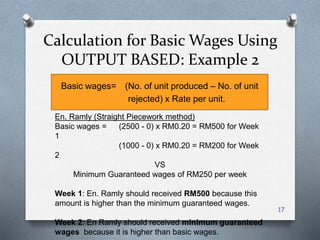
Basic wages= (No. of unit produced – No. of unit
rejected) x Rate per unit.
En. Ramly (Straight Piecework method)
Basic wages = (2500 - 0) x RM0.20 = RM500 for Week
1
(1000 - 0) x RM0.20 = RM200 for Week
2
VS
Minimum Guaranteed wages of RM250 per week
Week 1: En. Ramly should received RM500 because this
amount is higher than the minimum guaranteed wages.
Week 2: En Ramly should received minimum guaranteed
wages because it is higher than basic wages.
18
Calculation for Basic Wages Using
OUTPUT BASED: Example 2
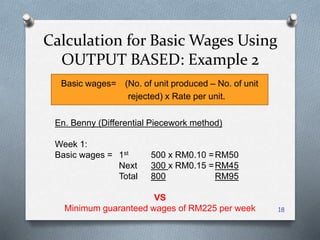
Basic wages= (No. of unit produced – No. of unit
rejected) x Rate per unit.
En. Benny (Differential Piecework method)
Week 1:
Basic wages = 1st 500 x RM0.10 =RM50
Next 300 x RM0.15 =RM45
Total 800 RM95
VS
Minimum guaranteed wages of RM225 per week
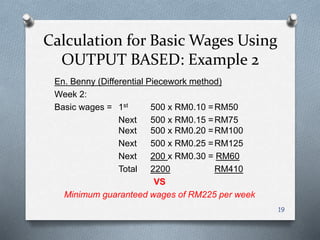
En. Benny (Differential Piecework method)
Week 2:
Basic wages = 1st 500 x RM0.10 =RM50
Next 500 x RM0.15 =RM75
Next 500 x RM0.20 =RM100
Next 500 x RM0.25 =RM125
Next 200 x RM0.30 = RM60
Total 2200 RM410
VS
Minimum guaranteed wages of RM225 per week
19
Calculation for Basic Wages Using
OUTPUT BASED: Example 2
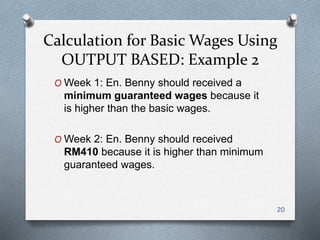
O Week 1: En. Benny should received a
minimum guaranteed wages because it
is higher than the basic wages.
O Week 2: En. Benny should received
RM410 because it is higher than minimum
guaranteed wages.
20
Calculation for Basic Wages Using
OUTPUT BASED: Example 2
Output Based:
Advantages Vs Disadvantages
Advantages Disadvantages
Easy to calculate Quality of work may be
compromised.
Easy to understand More wastage due to
mistakes made by workers.
More incentive for
hardworking workers.
Less hardworking workers
get less payment due to low
unit produced.
Less supervision is needed. Payments maybe unfair to
workers.
21

ACC 116 LABOUR COSTING

  • 1.
  • 2.
    Learning Objectives Students shouldbe able to: O Differentiate between direct and indirect labour. O Calculate the remuneration of labour using time based scheme and output based scheme. O Provide the advantages and diisadvantages of each type of remuneration. 2
  • 3.
    Introduction O Labour costsrefer to cost of employees remuneration. O It can be divided into: 1. Direct labour costs 2. Indirect labour cost 3
  • 4.
    Labour Cost Direct LabourCost Indirect Labour Cost Direct labour is those cost that can be allocated directly to a cost unit. E.g. wages paid to employee who are directly involve with production of product. Indirect labour is cost that not involved directly in the production process. E.g. Wages paid to foreman, supervisor, maintenance workers, cleaners. 4
  • 5.
    Personnel Department Responsibilities: O Advertisingfor new vacancy, interviewing & recruitment of new personnel. O Handles transfer, discharges, termination/dismissal of staff. O Plan & oversee staff development program. O Handling staff welfare. O Maintain labour records. 5
  • 6.
    Labour Records There aretwo main records: O 1. Attendance record To record the physical presence of staff. E.g. Attendance registers, clock cards. O 2. Output Records To record the time spent on a particular job. E.g. Time sheets & Job cards. 6
  • 7.
    Labour Remuneration Method 1 1.Time Based Employee is paid on the basis of time worked. Overtime/premium is paid for employee who is working more than normal hours or work overtime. 7
  • 8.
    TIME BASED : FORMULATO REMEMBER 8 Step 1: Calculate Basic Wages. Basic Wages = Normal working hours x Normal rate per hour Step 2: Calculate OT Payment OT Payment = (Actual hours worked – Normal working hours) x OT Rate per hour Step 3: Calculate Gross Wages Gross Wages = Basic Wages + OT payment
  • 9.
    Calculation for LabourWages Using TIME BASED: Example 1 O Wahid is paid based on the hours worked. The factory maintains a 40 hours per week schedule (8 hours per day Mon-Friday). O The basic rate is RM8 per hour. Overtime is paid as follows: Weekday: At 1.5 times the normal rate (or at a premiumof 50%) Weekends: At 2 times the normal rate (or at a premium of 100%) O During Week 3, Wahid worked for 52 hours of which 10 hours were worked during weekend. 9
  • 10.
    Calculation for LabourWages Using TIME BASED: Example 1 Step 1: Calculate Basic Wages. Basic wages = 40 hours x RM8 = RM320 Step 2: Calculate OT Payment OT Payment= (10 hours x RM16) + (2 hours x RM12) = RM160 + RM24 = RM184 Step 3: Calculate Gross Wages Gross wages = RM320 + RM184 =RM504 10
  • 11.
    Time Based : AdvantagesVs Disadvantages Advantages Disadvantages Easy/simple to compute The wages received is the same for hardworking/less hardworking workers. Easy to understand Supervisor needs to spent more time to monitor the workers. 11
  • 12.
    Labour Remuneration Method 2 2.Output/Performance Based Employee is paid on the basis of number of output produced. Rejected units will not be considered as part of wages calculation. Divided into straight piecework, differential piecework & piecework with minimum guaranteed wages. 12
  • 13.
    Labour Remuneration Method 2 OStraight Piecework: worker is paid using uniform rate for each unit produced. O Differential piecework: worker paid on different rate for different level of unit produced. O Piecework with Minimum Guaranteed Wages: provides worker with minimum level of payment. 13
  • 14.
    Basic wages= (No.of unit produced – No. of unit rejected) x Rate per unit. OUTPUT BASED : FORMULA TO REMEMBER 14 Step 1: Calculate basic wages. Step 2: Compare basic wages with minimum guaranteed wages Step 3: Choose whichever is higher as the gross wages.
  • 15.
    O Excellent ToysEnterprise, operates an output based remuneration system. O En. Ramly is paid based on straight piecework method at a rate of RM0.20 per unit with a guaranteed minimum wages of RM250 per week. In Week 1 & 2, he has assembled 2500 and 1000 units respectively. O En. Benny is paid on differential piecework as follows: 15 Calculation for Basic Wages Using OUTPUT BASED: Example 2
  • 16.
    O 1st 500units RM0.10 per unit Next 500 units RM0.15 per unit Next 500 units RM0.20 per unit Next 500 units RM0.25 per unit Other additional RM0.30 per unit O En. Benny’s remuneration package includes a minimum guaranteed wages of RM225 per week. He assembled 800 units for Week 1 and 2,200 units for Week 2 respectively. 16 Calculation for Basic Wages Using OUTPUT BASED: Example 2
  • 17.
    Calculation for BasicWages Using OUTPUT BASED: Example 2 17 Basic wages= (No. of unit produced – No. of unit rejected) x Rate per unit. En. Ramly (Straight Piecework method) Basic wages = (2500 - 0) x RM0.20 = RM500 for Week 1 (1000 - 0) x RM0.20 = RM200 for Week 2 VS Minimum Guaranteed wages of RM250 per week Week 1: En. Ramly should received RM500 because this amount is higher than the minimum guaranteed wages. Week 2: En Ramly should received minimum guaranteed wages because it is higher than basic wages.
  • 18.
    18 Calculation for BasicWages Using OUTPUT BASED: Example 2 Basic wages= (No. of unit produced – No. of unit rejected) x Rate per unit. En. Benny (Differential Piecework method) Week 1: Basic wages = 1st 500 x RM0.10 =RM50 Next 300 x RM0.15 =RM45 Total 800 RM95 VS Minimum guaranteed wages of RM225 per week
  • 19.
    En. Benny (DifferentialPiecework method) Week 2: Basic wages = 1st 500 x RM0.10 =RM50 Next 500 x RM0.15 =RM75 Next 500 x RM0.20 =RM100 Next 500 x RM0.25 =RM125 Next 200 x RM0.30 = RM60 Total 2200 RM410 VS Minimum guaranteed wages of RM225 per week 19 Calculation for Basic Wages Using OUTPUT BASED: Example 2
  • 20.
    O Week 1:En. Benny should received a minimum guaranteed wages because it is higher than the basic wages. O Week 2: En. Benny should received RM410 because it is higher than minimum guaranteed wages. 20 Calculation for Basic Wages Using OUTPUT BASED: Example 2
  • 21.
    Output Based: Advantages VsDisadvantages Advantages Disadvantages Easy to calculate Quality of work may be compromised. Easy to understand More wastage due to mistakes made by workers. More incentive for hardworking workers. Less hardworking workers get less payment due to low unit produced. Less supervision is needed. Payments maybe unfair to workers. 21