Capital Structure: Basic Concepts;
Limits to the Use of Debt
Presented by
Maksudul Huq Kanan
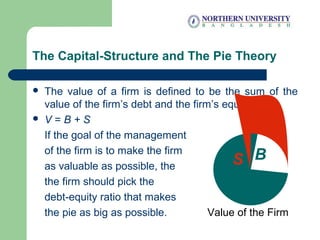
The Capital-Structure and The Pie Theory
 The value of a firm is defined to be the sum of the
value of the firm’s debt and the firm’s equity.
 V = B + S
If the goal of the management
of the firm is to make the firm
as valuable as possible, the
the firm should pick the
debt-equity ratio that makes
the pie as big as possible. Value of the Firm
S BS B
The Capital-Structure Question
There are really two important questions:
1. Why should the stockholders care about maximizing
firm value? Perhaps they should be interested in
strategies that maximize shareholder value.
2. What is the ratio of debt-to-equity that maximizes
the shareholder’s value?
As it turns out, changes in capital structure benefit
the stockholders if and only if the value of the firm
increases.
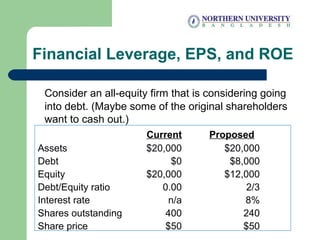
Financial Leverage, EPS, and ROE
Consider an all-equity firm that is considering going
into debt. (Maybe some of the original shareholders
want to cash out.)
Current Proposed
Assets $20,000 $20,000
Debt $0 $8,000
Equity $20,000 $12,000
Debt/Equity ratio 0.00 2/3
Interest rate n/a 8%
Shares outstanding 400 240
Share price $50 $50
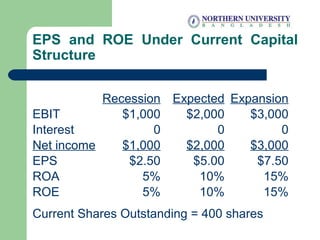
EPS and ROE Under Current Capital
Structure
Recession Expected Expansion
EBIT $1,000 $2,000 $3,000
Interest 0 0 0
Net income $1,000 $2,000 $3,000
EPS $2.50 $5.00 $7.50
ROA 5% 10% 15%
ROE 5% 10% 15%
Current Shares Outstanding = 400 shares
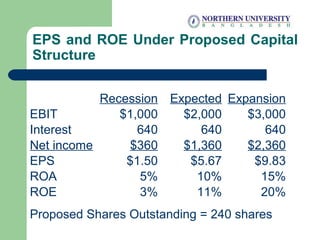
EPS and ROE Under Proposed Capital
Structure
Recession Expected Expansion
EBIT $1,000 $2,000 $3,000
Interest 640 640 640
Net income $360 $1,360 $2,360
EPS $1.50 $5.67 $9.83
ROA 5% 10% 15%
ROE 3% 11% 20%
Proposed Shares Outstanding = 240 shares
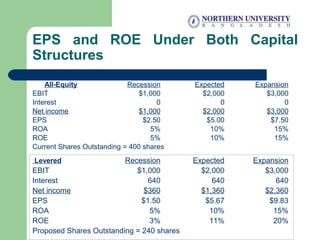
EPS and ROE Under Both Capital
Structures
All-Equity Recession Expected Expansion
EBIT $1,000 $2,000 $3,000
Interest 0 0 0
Net income $1,000 $2,000 $3,000
EPS $2.50 $5.00 $7.50
ROA 5% 10% 15%
ROE 5% 10% 15%
Current Shares Outstanding = 400 shares
Levered Recession Expected Expansion
EBIT $1,000 $2,000 $3,000
Interest 640 640 640
Net income $360 $1,360 $2,360
EPS $1.50 $5.67 $9.83
ROA 5% 10% 15%
ROE 3% 11% 20%
Proposed Shares Outstanding = 240 shares
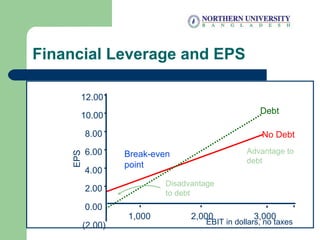
Financial Leverage and EPS
Debt
No Debt
Break-even
point
EBIT in dollars, no taxes
Advantage to
debt
Disadvantage
to debt
(2.00)
0.00
2.00
4.00
6.00
8.00
10.00
12.00
1,000 2,000 3,000
EPS
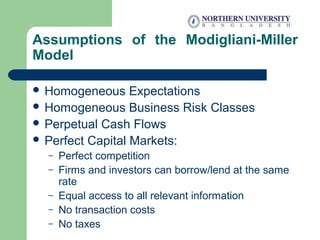
Assumptions of the Modigliani-Miller
Model
 Homogeneous Expectations
 Homogeneous Business Risk Classes
 Perpetual Cash Flows
 Perfect Capital Markets:
– Perfect competition
– Firms and investors can borrow/lend at the same
rate
– Equal access to all relevant information
– No transaction costs
– No taxes
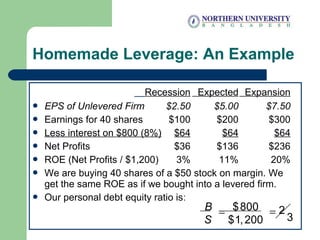
Homemade Leverage: An Example
Recession Expected Expansion
 EPS of Unlevered Firm $2.50 $5.00 $7.50
 Earnings for 40 shares $100 $200 $300
 Less interest on $800 (8%) $64 $64 $64
 Net Profits $36 $136 $236
 ROE (Net Profits / $1,200) 3% 11% 20%
 We are buying 40 shares of a $50 stock on margin. We
get the same ROE as if we bought into a levered firm.
 Our personal debt equity ratio is:
3
2
200,1$
800$ ==
S
B
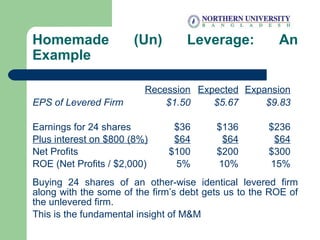
Homemade (Un) Leverage: An
Example
Recession Expected Expansion
EPS of Levered Firm $1.50 $5.67 $9.83
Earnings for 24 shares $36 $136 $236
Plus interest on $800 (8%) $64 $64 $64
Net Profits $100 $200 $300
ROE (Net Profits / $2,000) 5% 10% 15%
Buying 24 shares of an other-wise identical levered firm
along with the some of the firm’s debt gets us to the ROE of
the unlevered firm.
This is the fundamental insight of M&M
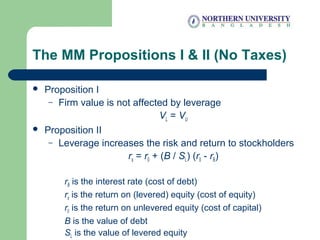
The MM Propositions I & II (No Taxes)
 Proposition I
– Firm value is not affected by leverage
VL = VU
 Proposition II
– Leverage increases the risk and return to stockholders
rs = r0 + (B / SL) (r0 - rB)
rB is the interest rate (cost of debt)
rs is the return on (levered) equity (cost of equity)
r0 is the return on unlevered equity (cost of capital)
B is the value of debt
SL is the value of levered equity
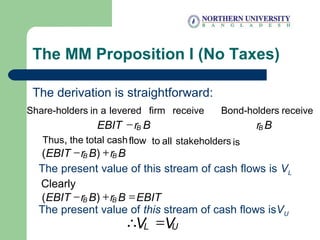
The MM Proposition I (No Taxes)
The derivation is straightforward:
UL VV =∴
BrEBIT B−
receivefirmleveredainShare-holders
BrB
receiveBond-holders
BrBrEBIT BB +− )(
isstakeholdersalltoflowcashtotaltheThus,
The present value of this stream of cash flows is VL
EBITBrBrEBIT BB =+− )(
Clearly
The present value of this stream of cash flows isVU
The MM Proposition II (No Taxes)
The derivation is straightforward:
SBWACC r
SB
S
r
SB
B
r ∗
+
+∗
+
= 0setThen rrWACC
=
0
rr
SB
S
r
SB
B
SB
=*
+
+∗
+ S
SB +
bysidesbothmultiply
0r
S
SB
r
SB
S
S
SB
r
SB
B
S
SB
SB
+
=*
+
∗
+
+*
+
∗
+
0r
S
SB
rr
S
B
SB
+
=+∗
00 rr
S
B
rr
S
B
SB
+=+∗ )( 00 BS rr
S
B
rr −+=
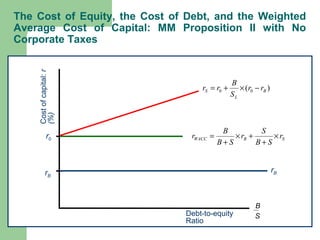
The Cost of Equity, the Cost of Debt, and the Weighted
Average Cost of Capital: MM Proposition II with No
Corporate Taxes
Debt-to-equity
Ratio
Costofcapital:r
(%)
r0
rB
SBWACC r
SB
S
r
SB
B
r ×
+
+×
+
=
)( 00 B
L
S rr
S
B
rr −×+=
rB
S
B
15-16
The MM Propositions I & II
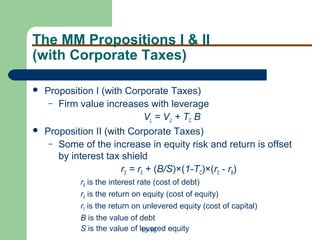
(with Corporate Taxes)
 Proposition I (with Corporate Taxes)
– Firm value increases with leverage
VL = VU + TC B
 Proposition II (with Corporate Taxes)
– Some of the increase in equity risk and return is offset
by interest tax shield
rS = r0 + (B/S)×(1-TC)×(r0 - rB)
rB is the interest rate (cost of debt)
rS is the return on equity (cost of equity)
r0 is the return on unlevered equity (cost of capital)
B is the value of debt
S is the value of levered equity
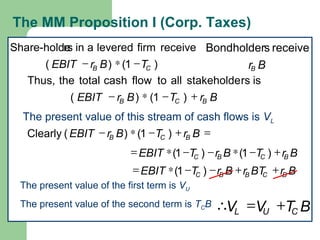
The MM Proposition I (Corp. Taxes)
BTVV CUL
+=∴
)1()(
receivefirmleveredainrsShare-holde
CB TBrEBIT −∗− BrB
receivesBondholder
BrTBrEBIT BCB
+−∗− )1()(
isrsstakeholdealltoflowcashtotaltheThus,
The present value of this stream of cash flows is VL
=+−∗− BrTBrEBIT BCB )1()(Clearly
The present value of the first term is VU
The present value of the second term is TCB
BrTBrTEBIT BCBC
+−∗−−∗= )1()1(
BrBTrBrTEBIT BCBBC
++−−∗= )1(
The MM Proposition II (Corp. Taxes)
Start with M&M Proposition I with taxes:
)()1( 00 BCS rrT
S
B
rr −∗−∗+=
BTVV CUL
+=
Since BSVL
+=
The cash flows from each side of the balance sheet must equal:
BCUBS BrTrVBrSr +=+ 0
BrTrTBSBrSr BCCBS
+−+=+ 0)]1([
Divide both sides by S
BCCBS rT
S
B
rT
S
B
r
S
B
r +−+=+ 0)]1(1[
BTVBS CU
+=+⇒
)1( CU TBSV −+=
Which quickly reduces to
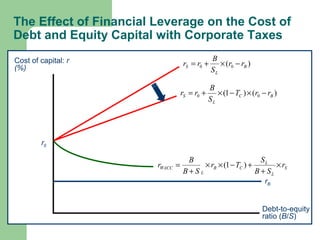
The Effect of Financial Leverage on the Cost of
Debt and Equity Capital with Corporate Taxes
rB
Debt-to-equity
ratio (B/S)
Cost of capital: r
(%)
r0
)()1( 00 BC
L
S rrT
S
B
rr −×−×+=
S
L
L
CB
L
WACC r
SB
S
Tr
SB
B
r ×
+
+−××
+
= )1(
)( 00 B
L
S rr
S
B
rr −×+=
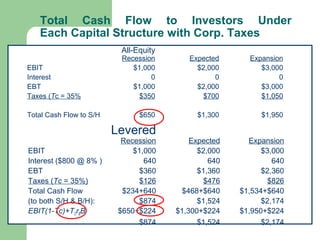
Total Cash Flow to Investors Under
Each Capital Structure with Corp. Taxes
All-Equity
Recession Expected Expansion
EBIT $1,000 $2,000 $3,000
Interest 0 0 0
EBT $1,000 $2,000 $3,000
Taxes (Tc = 35% $350 $700 $1,050
Total Cash Flow to S/H $650 $1,300 $1,950
Levered
Recession Expected Expansion
EBIT $1,000 $2,000 $3,000
Interest ($800 @ 8% ) 640 640 640
EBT $360 $1,360 $2,360
Taxes (Tc = 35%) $126 $476 $826
Total Cash Flow $234+640 $468+$640 $1,534+$640
(to both S/H & B/H): $874 $1,524 $2,174
EBIT(1-Tc)+TCrBB $650+$224 $1,300+$224 $1,950+$224
$874 $1,524 $2,174
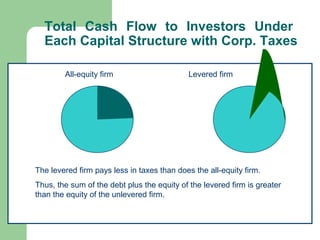
Total Cash Flow to Investors Under
Each Capital Structure with Corp. Taxes
S G S G
B
The levered firm pays less in taxes than does the all-equity firm.
Thus, the sum of the debt plus the equity of the levered firm is greater
than the equity of the unlevered firm.
All-equity firm Levered firm
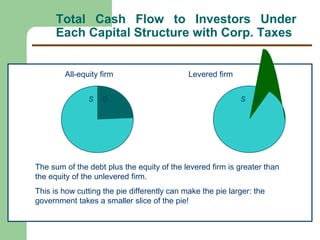
Total Cash Flow to Investors Under
Each Capital Structure with Corp. Taxes
B
The sum of the debt plus the equity of the levered firm is greater than
the equity of the unlevered firm.
This is how cutting the pie differently can make the pie larger: the
government takes a smaller slice of the pie!
S G S G
All-equity firm Levered firm
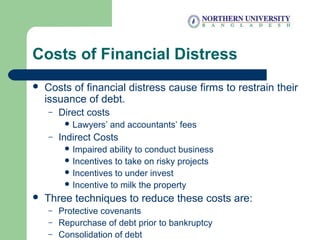
Costs of Financial Distress
 Costs of financial distress cause firms to restrain their
issuance of debt.
– Direct costs
 Lawyers’ and accountants’ fees
– Indirect Costs
 Impaired ability to conduct business
 Incentives to take on risky projects
 Incentives to under invest
 Incentive to milk the property
 Three techniques to reduce these costs are:
– Protective covenants
– Repurchase of debt prior to bankruptcy
– Consolidation of debt
Can Costs of Debt Be Reduced?
 Protective Covenants
 Debt Consolidation:
– If we minimize the number of parties, contracting
costs fall.
Protective Covenants
 Agreements to protect bondholders
 Negative covenant:
– Pay dividends beyond specified amount.
– Sell more senior debt & amount of new debt is limited.
– Refund existing bond issue with new bonds paying
lower interest rate.
– Buy another company’s bonds.
 Positive covenant:
– Use proceeds from sale of assets for other assets.
– Allow redemption in event of merger or spinoff.
– Maintain good condition of assets.
– Provide audited financial information.
Integration of Tax Effects
and Financial Distress Costs
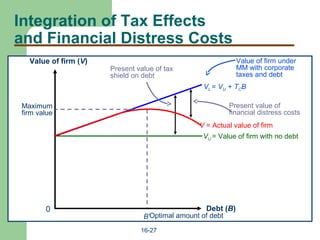
 There is a trade-off between the tax
advantage of debt and the costs of financial
distress.
 It is difficult to express this with a precise and
rigorous formula.
16-27
Integration of Tax Effects
and Financial Distress Costs
Debt (B)
Value of firm (V)
0
Present value of tax
shield on debt
Present value of
financial distress costs
Value of firm under
MM with corporate
taxes and debt
VL = VU + TCB
V = Actual value of firm
VU = Value of firm with no debt
B*
Maximum
firm value
Optimal amount of debt
The Pie Model Revisited
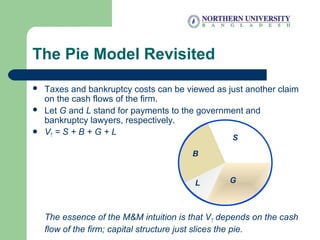
 Taxes and bankruptcy costs can be viewed as just another claim
on the cash flows of the firm.
 Let G and L stand for payments to the government and
bankruptcy lawyers, respectively.
 VT = S + B + G + L
The essence of the M&M intuition is that VT depends on the cash
flow of the firm; capital structure just slices the pie.
S
G
B
L
Signaling
 The firm’s capital structure is optimized where the
marginal subsidy to debt equals the marginal cost.
 Investors view debt as a signal of firm value.
– Firms with low anticipated profits will take on a low
level of debt.
– Firms with high anticipated profits will take on high
levels of debt.
 A manager that takes on more debt than is optimal in
order to fool investors will pay the cost in the long
run.
Shirking, Perquisites, and Bad Investments:
The Agency Cost of Equity
 An individual will work harder for a firm if he is one of the owners
than if he is one of the “hired help”.
 Who bears the burden of these agency costs?
 While managers may have motive to partake in perquisites, they
also need opportunity. Free cash flow provides this opportunity.
 The free cash flow hypothesis says that an increase in
dividends should benefit the stockholders by reducing the ability
of managers to pursue wasteful activities.
 The free cash flow hypothesis also argues that an increase in
debt will reduce the ability of managers to pursue wasteful
activities more effectively than dividend increases.
The Pecking-Order Theory
 Theory stating that firms prefer to issue debt rather
than equity if internal finance is insufficient.
– Rule 1
 Use internal financing first.
– Rule 2
 Issue debt next, equity last.
 The pecking-order Theory is at odds with the trade-
off theory:
– There is no target D/E ratio.
– Profitable firms use less debt.
– Companies like financial slack
Growth and the Debt-Equity Ratio
 Growth implies significant equity financing,
even in a world with low bankruptcy costs.
 Thus, high-growth firms will have lower debt
ratios than low-growth firms.
 Growth is an essential feature of the real
world; as a result, 100% debt financing is
sub-optimal.
Personal Taxes: The Miller Model
The Miller Model shows that the value of a levered
firm can be expressed in terms of an unlevered firm
as:
Where:
TS = personal tax rate on equity income
TB = personal tax rate on bond income
TC = corporate tax rate
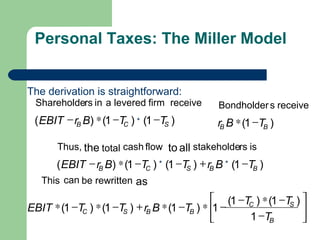
Personal Taxes: The Miller Model
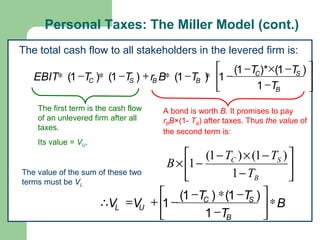
The derivation is straightforward:
)1()1()(
receivefirmleveredainrsShareholde
SCB TTBrEBIT −*−∗− )1(
receivesBondholder
BB TBr −∗
)1()1()1()(
isrsstakeholdealltoflowcashtotaltheThus,
BBSCB TBrTTBrEBIT −*+−*−∗−






−
−∗−
−∗−∗+−∗−∗
B
SC
BBSC
T
TT
TBrTTEBIT
1
)1()1(
1)1()1()1(
asrewrittenbecanThis
Personal Taxes: The Miller Model (cont.)






−
−×−
−∗−∗+−∗−∗
B
SC
BBSC
T
TT
TBrTTEBIT
1
)1()*1(
1)1()1()1(
The first term is the cash flow
of an unlevered firm after all
taxes.
Its value = VU.
A bond is worth B. It promises to pay
rBB×(1- TB) after taxes. Thus the value of
the second term is:






−
−×−
−×
B
SC
T
TT
B
1
)1()1(
1
The total cash flow to all stakeholders in the levered firm is:
The value of the sum of these two
terms must be VL
B
T
TT
VV
B
SC
UL
∗





−
−∗−
−+=∴
1
)1()1(
1
16-36
Personal Taxes: The Miller Model (cont.)
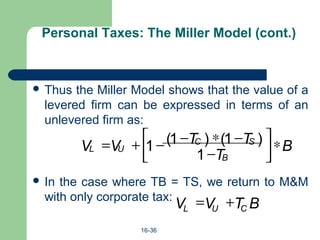
 Thus the Miller Model shows that the value of a
levered firm can be expressed in terms of an
unlevered firm as:
 In the case where TB = TS, we return to M&M
with only corporate tax:
B
T
TTVV
B
SC
UL ∗





−
−∗−−+=
1
)1()1(1
BTVV CUL
+=
Effect of Financial Leverage on Firm Value with Both
Corporate and Personal Taxes
Debt (B)
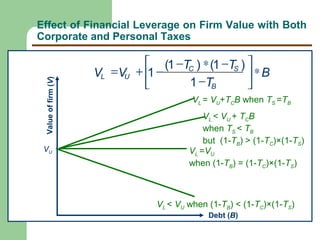
Valueoffirm(V)
VU
VL = VU+TCB when TS =TB
VL < VU + TCB
when TS < TB
but (1-TB) > (1-TC)×(1-TS)
VL =VU
when (1-TB) = (1-TC)×(1-TS)
VL < VU when (1-TB) < (1-TC)×(1-TS)
B
T
TT
VV
B
SC
UL
∗





−
−∗−
−+=
1
)1()1(
1
Integration of Personal and Corporate Tax Effects and
Financial Distress Costs and Agency Costs
Debt (B)
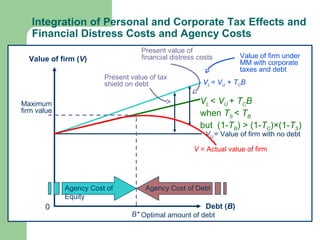
Value of firm (V)
0
Present value of tax
shield on debt
Present value of
financial distress costs Value of firm under
MM with corporate
taxes and debt
VL = VU + TCB
V = Actual value of firm
VU = Value of firm with no debt
B*
Maximum
firm value
Optimal amount of debt
VL < VU + TCB
when TS < TB
but (1-TB) > (1-TC)×(1-TS)
Agency Cost of
Equity
Agency Cost of Debt
How Firms Establish Capital Structure
 Most Corporations Have Low Debt-Asset Ratios.
 Changes in Financial Leverage Affect Firm Value.
– Stock price increases with increases in leverage
and vice-versa; this is consistent with M&M with
taxes.
– Another interpretation is that firms signal good news
when they lever up.
 There are Differences in Capital Structure Across
Industries.
 There is evidence that firms behave as if they had a
target Debt to Equity ratio.
Factors in Target D/E Ratio
 Taxes
– If corporate tax rates are higher than bondholder tax rates,
there is an advantage to debt.
 Types of Assets
– The costs of financial distress depend on the types of assets
the firm has.
 Uncertainty of Operating Income
– Even without debt, firms with uncertain operating income
have high probability of experiencing financial distress.
 Pecking Order and Financial Slack
– Theory stating that firms prefer to issue debt rather than
equity if internal finance is insufficient.
?
kanan3008@yahoo.com
Capital structure basic concepts

Capital structure basic concepts

  • 1.
    Capital Structure: BasicConcepts; Limits to the Use of Debt Presented by Maksudul Huq Kanan
  • 2.
    The Capital-Structure andThe Pie Theory  The value of a firm is defined to be the sum of the value of the firm’s debt and the firm’s equity.  V = B + S If the goal of the management of the firm is to make the firm as valuable as possible, the the firm should pick the debt-equity ratio that makes the pie as big as possible. Value of the Firm S BS B
  • 3.
    The Capital-Structure Question Thereare really two important questions: 1. Why should the stockholders care about maximizing firm value? Perhaps they should be interested in strategies that maximize shareholder value. 2. What is the ratio of debt-to-equity that maximizes the shareholder’s value? As it turns out, changes in capital structure benefit the stockholders if and only if the value of the firm increases.
  • 4.
    Financial Leverage, EPS,and ROE Consider an all-equity firm that is considering going into debt. (Maybe some of the original shareholders want to cash out.) Current Proposed Assets $20,000 $20,000 Debt $0 $8,000 Equity $20,000 $12,000 Debt/Equity ratio 0.00 2/3 Interest rate n/a 8% Shares outstanding 400 240 Share price $50 $50
  • 5.
    EPS and ROEUnder Current Capital Structure Recession Expected Expansion EBIT $1,000 $2,000 $3,000 Interest 0 0 0 Net income $1,000 $2,000 $3,000 EPS $2.50 $5.00 $7.50 ROA 5% 10% 15% ROE 5% 10% 15% Current Shares Outstanding = 400 shares
  • 6.
    EPS and ROEUnder Proposed Capital Structure Recession Expected Expansion EBIT $1,000 $2,000 $3,000 Interest 640 640 640 Net income $360 $1,360 $2,360 EPS $1.50 $5.67 $9.83 ROA 5% 10% 15% ROE 3% 11% 20% Proposed Shares Outstanding = 240 shares
  • 7.
    EPS and ROEUnder Both Capital Structures All-Equity Recession Expected Expansion EBIT $1,000 $2,000 $3,000 Interest 0 0 0 Net income $1,000 $2,000 $3,000 EPS $2.50 $5.00 $7.50 ROA 5% 10% 15% ROE 5% 10% 15% Current Shares Outstanding = 400 shares Levered Recession Expected Expansion EBIT $1,000 $2,000 $3,000 Interest 640 640 640 Net income $360 $1,360 $2,360 EPS $1.50 $5.67 $9.83 ROA 5% 10% 15% ROE 3% 11% 20% Proposed Shares Outstanding = 240 shares
  • 8.
    Financial Leverage andEPS Debt No Debt Break-even point EBIT in dollars, no taxes Advantage to debt Disadvantage to debt (2.00) 0.00 2.00 4.00 6.00 8.00 10.00 12.00 1,000 2,000 3,000 EPS
  • 9.
    Assumptions of theModigliani-Miller Model  Homogeneous Expectations  Homogeneous Business Risk Classes  Perpetual Cash Flows  Perfect Capital Markets: – Perfect competition – Firms and investors can borrow/lend at the same rate – Equal access to all relevant information – No transaction costs – No taxes
  • 10.
    Homemade Leverage: AnExample Recession Expected Expansion  EPS of Unlevered Firm $2.50 $5.00 $7.50  Earnings for 40 shares $100 $200 $300  Less interest on $800 (8%) $64 $64 $64  Net Profits $36 $136 $236  ROE (Net Profits / $1,200) 3% 11% 20%  We are buying 40 shares of a $50 stock on margin. We get the same ROE as if we bought into a levered firm.  Our personal debt equity ratio is: 3 2 200,1$ 800$ == S B
  • 11.
    Homemade (Un) Leverage:An Example Recession Expected Expansion EPS of Levered Firm $1.50 $5.67 $9.83 Earnings for 24 shares $36 $136 $236 Plus interest on $800 (8%) $64 $64 $64 Net Profits $100 $200 $300 ROE (Net Profits / $2,000) 5% 10% 15% Buying 24 shares of an other-wise identical levered firm along with the some of the firm’s debt gets us to the ROE of the unlevered firm. This is the fundamental insight of M&M
  • 12.
    The MM PropositionsI & II (No Taxes)  Proposition I – Firm value is not affected by leverage VL = VU  Proposition II – Leverage increases the risk and return to stockholders rs = r0 + (B / SL) (r0 - rB) rB is the interest rate (cost of debt) rs is the return on (levered) equity (cost of equity) r0 is the return on unlevered equity (cost of capital) B is the value of debt SL is the value of levered equity
  • 13.
    The MM PropositionI (No Taxes) The derivation is straightforward: UL VV =∴ BrEBIT B− receivefirmleveredainShare-holders BrB receiveBond-holders BrBrEBIT BB +− )( isstakeholdersalltoflowcashtotaltheThus, The present value of this stream of cash flows is VL EBITBrBrEBIT BB =+− )( Clearly The present value of this stream of cash flows isVU
  • 14.
    The MM PropositionII (No Taxes) The derivation is straightforward: SBWACC r SB S r SB B r ∗ + +∗ + = 0setThen rrWACC = 0 rr SB S r SB B SB =* + +∗ + S SB + bysidesbothmultiply 0r S SB r SB S S SB r SB B S SB SB + =* + ∗ + +* + ∗ + 0r S SB rr S B SB + =+∗ 00 rr S B rr S B SB +=+∗ )( 00 BS rr S B rr −+=
  • 15.
    The Cost ofEquity, the Cost of Debt, and the Weighted Average Cost of Capital: MM Proposition II with No Corporate Taxes Debt-to-equity Ratio Costofcapital:r (%) r0 rB SBWACC r SB S r SB B r × + +× + = )( 00 B L S rr S B rr −×+= rB S B
  • 16.
    15-16 The MM PropositionsI & II (with Corporate Taxes)  Proposition I (with Corporate Taxes) – Firm value increases with leverage VL = VU + TC B  Proposition II (with Corporate Taxes) – Some of the increase in equity risk and return is offset by interest tax shield rS = r0 + (B/S)×(1-TC)×(r0 - rB) rB is the interest rate (cost of debt) rS is the return on equity (cost of equity) r0 is the return on unlevered equity (cost of capital) B is the value of debt S is the value of levered equity
  • 17.
    The MM PropositionI (Corp. Taxes) BTVV CUL +=∴ )1()( receivefirmleveredainrsShare-holde CB TBrEBIT −∗− BrB receivesBondholder BrTBrEBIT BCB +−∗− )1()( isrsstakeholdealltoflowcashtotaltheThus, The present value of this stream of cash flows is VL =+−∗− BrTBrEBIT BCB )1()(Clearly The present value of the first term is VU The present value of the second term is TCB BrTBrTEBIT BCBC +−∗−−∗= )1()1( BrBTrBrTEBIT BCBBC ++−−∗= )1(
  • 18.
    The MM PropositionII (Corp. Taxes) Start with M&M Proposition I with taxes: )()1( 00 BCS rrT S B rr −∗−∗+= BTVV CUL += Since BSVL += The cash flows from each side of the balance sheet must equal: BCUBS BrTrVBrSr +=+ 0 BrTrTBSBrSr BCCBS +−+=+ 0)]1([ Divide both sides by S BCCBS rT S B rT S B r S B r +−+=+ 0)]1(1[ BTVBS CU +=+⇒ )1( CU TBSV −+= Which quickly reduces to
  • 19.
    The Effect ofFinancial Leverage on the Cost of Debt and Equity Capital with Corporate Taxes rB Debt-to-equity ratio (B/S) Cost of capital: r (%) r0 )()1( 00 BC L S rrT S B rr −×−×+= S L L CB L WACC r SB S Tr SB B r × + +−×× + = )1( )( 00 B L S rr S B rr −×+=
  • 20.
    Total Cash Flowto Investors Under Each Capital Structure with Corp. Taxes All-Equity Recession Expected Expansion EBIT $1,000 $2,000 $3,000 Interest 0 0 0 EBT $1,000 $2,000 $3,000 Taxes (Tc = 35% $350 $700 $1,050 Total Cash Flow to S/H $650 $1,300 $1,950 Levered Recession Expected Expansion EBIT $1,000 $2,000 $3,000 Interest ($800 @ 8% ) 640 640 640 EBT $360 $1,360 $2,360 Taxes (Tc = 35%) $126 $476 $826 Total Cash Flow $234+640 $468+$640 $1,534+$640 (to both S/H & B/H): $874 $1,524 $2,174 EBIT(1-Tc)+TCrBB $650+$224 $1,300+$224 $1,950+$224 $874 $1,524 $2,174
  • 21.
    Total Cash Flowto Investors Under Each Capital Structure with Corp. Taxes S G S G B The levered firm pays less in taxes than does the all-equity firm. Thus, the sum of the debt plus the equity of the levered firm is greater than the equity of the unlevered firm. All-equity firm Levered firm
  • 22.
    Total Cash Flowto Investors Under Each Capital Structure with Corp. Taxes B The sum of the debt plus the equity of the levered firm is greater than the equity of the unlevered firm. This is how cutting the pie differently can make the pie larger: the government takes a smaller slice of the pie! S G S G All-equity firm Levered firm
  • 23.
    Costs of FinancialDistress  Costs of financial distress cause firms to restrain their issuance of debt. – Direct costs  Lawyers’ and accountants’ fees – Indirect Costs  Impaired ability to conduct business  Incentives to take on risky projects  Incentives to under invest  Incentive to milk the property  Three techniques to reduce these costs are: – Protective covenants – Repurchase of debt prior to bankruptcy – Consolidation of debt
  • 24.
    Can Costs ofDebt Be Reduced?  Protective Covenants  Debt Consolidation: – If we minimize the number of parties, contracting costs fall.
  • 25.
    Protective Covenants  Agreementsto protect bondholders  Negative covenant: – Pay dividends beyond specified amount. – Sell more senior debt & amount of new debt is limited. – Refund existing bond issue with new bonds paying lower interest rate. – Buy another company’s bonds.  Positive covenant: – Use proceeds from sale of assets for other assets. – Allow redemption in event of merger or spinoff. – Maintain good condition of assets. – Provide audited financial information.
  • 26.
    Integration of TaxEffects and Financial Distress Costs  There is a trade-off between the tax advantage of debt and the costs of financial distress.  It is difficult to express this with a precise and rigorous formula.
  • 27.
    16-27 Integration of TaxEffects and Financial Distress Costs Debt (B) Value of firm (V) 0 Present value of tax shield on debt Present value of financial distress costs Value of firm under MM with corporate taxes and debt VL = VU + TCB V = Actual value of firm VU = Value of firm with no debt B* Maximum firm value Optimal amount of debt
  • 28.
    The Pie ModelRevisited  Taxes and bankruptcy costs can be viewed as just another claim on the cash flows of the firm.  Let G and L stand for payments to the government and bankruptcy lawyers, respectively.  VT = S + B + G + L The essence of the M&M intuition is that VT depends on the cash flow of the firm; capital structure just slices the pie. S G B L
  • 29.
    Signaling  The firm’scapital structure is optimized where the marginal subsidy to debt equals the marginal cost.  Investors view debt as a signal of firm value. – Firms with low anticipated profits will take on a low level of debt. – Firms with high anticipated profits will take on high levels of debt.  A manager that takes on more debt than is optimal in order to fool investors will pay the cost in the long run.
  • 30.
    Shirking, Perquisites, andBad Investments: The Agency Cost of Equity  An individual will work harder for a firm if he is one of the owners than if he is one of the “hired help”.  Who bears the burden of these agency costs?  While managers may have motive to partake in perquisites, they also need opportunity. Free cash flow provides this opportunity.  The free cash flow hypothesis says that an increase in dividends should benefit the stockholders by reducing the ability of managers to pursue wasteful activities.  The free cash flow hypothesis also argues that an increase in debt will reduce the ability of managers to pursue wasteful activities more effectively than dividend increases.
  • 31.
    The Pecking-Order Theory Theory stating that firms prefer to issue debt rather than equity if internal finance is insufficient. – Rule 1  Use internal financing first. – Rule 2  Issue debt next, equity last.  The pecking-order Theory is at odds with the trade- off theory: – There is no target D/E ratio. – Profitable firms use less debt. – Companies like financial slack
  • 32.
    Growth and theDebt-Equity Ratio  Growth implies significant equity financing, even in a world with low bankruptcy costs.  Thus, high-growth firms will have lower debt ratios than low-growth firms.  Growth is an essential feature of the real world; as a result, 100% debt financing is sub-optimal.
  • 33.
    Personal Taxes: TheMiller Model The Miller Model shows that the value of a levered firm can be expressed in terms of an unlevered firm as: Where: TS = personal tax rate on equity income TB = personal tax rate on bond income TC = corporate tax rate
  • 34.
    Personal Taxes: TheMiller Model The derivation is straightforward: )1()1()( receivefirmleveredainrsShareholde SCB TTBrEBIT −*−∗− )1( receivesBondholder BB TBr −∗ )1()1()1()( isrsstakeholdealltoflowcashtotaltheThus, BBSCB TBrTTBrEBIT −*+−*−∗−       − −∗− −∗−∗+−∗−∗ B SC BBSC T TT TBrTTEBIT 1 )1()1( 1)1()1()1( asrewrittenbecanThis
  • 35.
    Personal Taxes: TheMiller Model (cont.)       − −×− −∗−∗+−∗−∗ B SC BBSC T TT TBrTTEBIT 1 )1()*1( 1)1()1()1( The first term is the cash flow of an unlevered firm after all taxes. Its value = VU. A bond is worth B. It promises to pay rBB×(1- TB) after taxes. Thus the value of the second term is:       − −×− −× B SC T TT B 1 )1()1( 1 The total cash flow to all stakeholders in the levered firm is: The value of the sum of these two terms must be VL B T TT VV B SC UL ∗      − −∗− −+=∴ 1 )1()1( 1
  • 36.
    16-36 Personal Taxes: TheMiller Model (cont.)  Thus the Miller Model shows that the value of a levered firm can be expressed in terms of an unlevered firm as:  In the case where TB = TS, we return to M&M with only corporate tax: B T TTVV B SC UL ∗      − −∗−−+= 1 )1()1(1 BTVV CUL +=
  • 37.
    Effect of FinancialLeverage on Firm Value with Both Corporate and Personal Taxes Debt (B) Valueoffirm(V) VU VL = VU+TCB when TS =TB VL < VU + TCB when TS < TB but (1-TB) > (1-TC)×(1-TS) VL =VU when (1-TB) = (1-TC)×(1-TS) VL < VU when (1-TB) < (1-TC)×(1-TS) B T TT VV B SC UL ∗      − −∗− −+= 1 )1()1( 1
  • 38.
    Integration of Personaland Corporate Tax Effects and Financial Distress Costs and Agency Costs Debt (B) Value of firm (V) 0 Present value of tax shield on debt Present value of financial distress costs Value of firm under MM with corporate taxes and debt VL = VU + TCB V = Actual value of firm VU = Value of firm with no debt B* Maximum firm value Optimal amount of debt VL < VU + TCB when TS < TB but (1-TB) > (1-TC)×(1-TS) Agency Cost of Equity Agency Cost of Debt
  • 39.
    How Firms EstablishCapital Structure  Most Corporations Have Low Debt-Asset Ratios.  Changes in Financial Leverage Affect Firm Value. – Stock price increases with increases in leverage and vice-versa; this is consistent with M&M with taxes. – Another interpretation is that firms signal good news when they lever up.  There are Differences in Capital Structure Across Industries.  There is evidence that firms behave as if they had a target Debt to Equity ratio.
  • 40.
    Factors in TargetD/E Ratio  Taxes – If corporate tax rates are higher than bondholder tax rates, there is an advantage to debt.  Types of Assets – The costs of financial distress depend on the types of assets the firm has.  Uncertainty of Operating Income – Even without debt, firms with uncertain operating income have high probability of experiencing financial distress.  Pecking Order and Financial Slack – Theory stating that firms prefer to issue debt rather than equity if internal finance is insufficient.
  • 41.
  • 42.