CHAPTER FIVE
JOB COSTING
INTRODUCTION
 Job costing is defined as form of specific order costing
applies where work is undertaken to customers’ special
requirements and each order is completed in short
duration.
 The job is usually carried out within a factory or
workshop and moves through processes and operations
as a continuously identifiable unit.
 E.g. making of coats, jacket, costumes, furniture and etc.
SPECIFIC ORDER COSTING
 The job consists of separate contracts,
job or batches.
 Divided into:
1. Job costing
2. Batch costing
3. Contract costing
CONTINUOUS OPERATION
COSTING
 Result from a sequence of continuous
/repetitive operations.
 The cost is charged before being
averaged over the unit produced.
 The costs is charged to a department
process & not directly to cost unit.
JOB COSTING
Essential features are:
• Job order according to customer’s
requirement compare to contract
costing.
• Short duration compare to contract
costing.
• Completed at factory/workshop.
• Each job can be accurately identified.
JOB COSTING
Essential features are:
• Each job can be accurately identified.
• Direct costs are charged to individual
jobs.
• Example of business that use job
costing are repairs, advertising
agency, assembly of individual aircraft,
construction of ships & promotion of
new products.
BATCH COSTING
Essential features:
 Customers orders a quantity of
identical units.
 The costs are accumulated as for
particular job & one batch is one job
order.
 The recording of costs is done in
batch cost card.
PROCEDURES FOR JOBBING
WORK
1. The prospective client will approach the supplier and
indicates his requirements.
2. Supplier will record the details such as quantity, quality,
size, colour, date and etc.
3. Supplier will calculate the estimate of the cost, the profit
margin and selling price.
4. If the client agrees with the price, the job will be carried out
with specific job order reference number. (E.g. Job 709)
PROCEDURES FOR JOBBING
WORK
5. The factory floor will prepare Material Requisition Notes
(MRN) to request the materials from the store. Purchase
Requisition Notes (PRN) will be issued to the purchasing
department for special materials or equipment needed.
Job cost card /sheet will be set out to perform the jobbing
work.
6. When all materials, labour and equipment available in the
factory, then the job can be started.
JOB COST STATEMENT
 To record costs/charges such as
material, labor and other expenses.
 To record overhead costs by using
pre-determined absorption rate.
Format for Job Cost
Statement
RM
DIRECT COSTS:
DIRECT MATERIAL XX
DIRECT LABOUR XX
DIRECT EXPENSES XX
PRIME COST (DM+DL+DE) XXX
Format Job Cost Statement
RM RM
PRIME COST
XXX
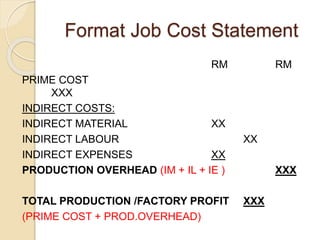
INDIRECT COSTS:
INDIRECT MATERIAL XX
INDIRECT LABOUR XX
INDIRECT EXPENSES XX
PRODUCTION OVERHEAD (IM + IL + IE ) XXX
TOTAL PRODUCTION /FACTORY PROFIT XXX
(PRIME COST + PROD.OVERHEAD)
Format Job Cost Statement
RM
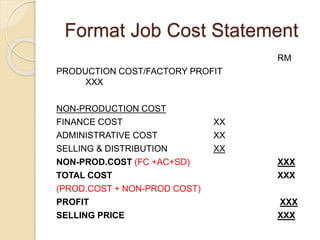
PRODUCTION COST/FACTORY PROFIT
XXX
NON-PRODUCTION COST
FINANCE COST XX
ADMINISTRATIVE COST XX
SELLING & DISTRIBUTION XX
NON-PROD.COST (FC +AC+SD) XXX
TOTAL COST XXX
(PROD.COST + NON-PROD COST)
PROFIT XXX
SELLING PRICE XXX
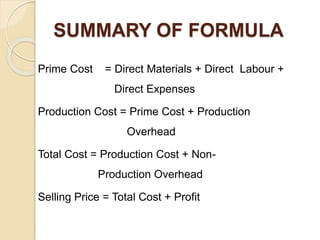
SUMMARY OF FORMULA
Prime Cost = Direct Materials + Direct Labour +
Direct Expenses
Production Cost = Prime Cost + Production
Overhead
Total Cost = Production Cost + Non-
Production Overhead
Selling Price = Total Cost + Profit
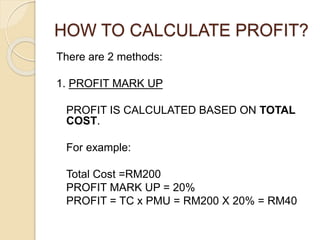
HOW TO CALCULATE PROFIT?
There are 2 methods:
1. PROFIT MARK UP
PROFIT IS CALCULATED BASED ON TOTAL
COST.
For example:
Total Cost =RM200
PROFIT MARK UP = 20%
PROFIT = TC x PMU = RM200 X 20% = RM40
HOW TO CALCULATE PROFIT?
2. PROFIT MARGIN
PROFIT IS CALCULATED BASED ON
SELLING PRICE.
FORMULA:
PROFIT = [%PROFIT MARGIN/(100%-
PROFIT MARGIN %)] X TC
PROFIT= [20%/100%-20%] X RM200 =RM50
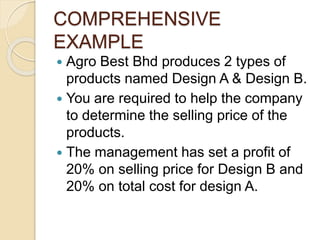
COMPREHENSIVE
EXAMPLE
 Agro Best Bhd produces 2 types of
products named Design A & Design B.
 You are required to help the company
to determine the selling price of the
products.
 The management has set a profit of
20% on selling price for Design B and
20% on total cost for design A.
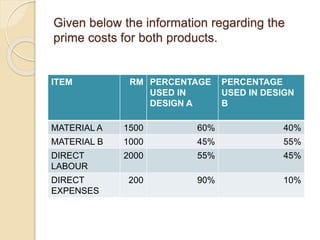
Given below the information regarding the
prime costs for both products.
ITEM RM PERCENTAGE
USED IN
DESIGN A
PERCENTAGE
USED IN DESIGN
B
MATERIAL A 1500 60% 40%
MATERIAL B 1000 45% 55%
DIRECT
LABOUR
2000 55% 45%
DIRECT
EXPENSES
200 90% 10%
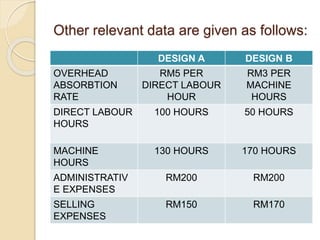
Other relevant data are given as follows:
DESIGN A DESIGN B
OVERHEAD
ABSORBTION
RATE
RM5 PER
DIRECT LABOUR
HOUR
RM3 PER
MACHINE
HOURS
DIRECT LABOUR
HOURS
100 HOURS 50 HOURS
MACHINE
HOURS
130 HOURS 170 HOURS
ADMINISTRATIV
E EXPENSES
RM200 RM200
SELLING
EXPENSES
RM150 RM170
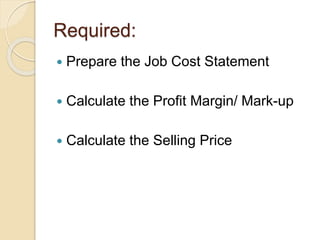
Required:
 Prepare the Job Cost Statement
 Calculate the Profit Margin/ Mark-up
 Calculate the Selling Price
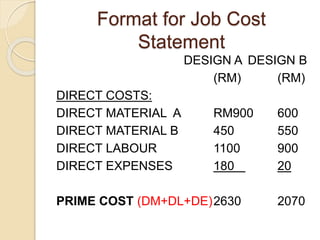
Format for Job Cost
Statement
DESIGN A DESIGN B
(RM) (RM)
DIRECT COSTS:
DIRECT MATERIAL A RM900 600
DIRECT MATERIAL B 450 550
DIRECT LABOUR 1100 900
DIRECT EXPENSES 180 20
PRIME COST (DM+DL+DE)2630 2070
Format Job Cost Statement
DESIGN A DESIGN
B
(RM) (RM)
PRIME COST 2630
2070
INDIRECT COSTS:
INDIRECT MATERIAL 0
INDIRECT LABOUR 0
INDIRECT EXPENSES 0
PRODUCTION OVERHEAD 500 510
TOTAL PRODUCTION 3130 2580
(PRIME COST + PROD.OVERHEAD)
Format Job Cost Statement
DESIGN A DESIGN B
(RM) (RM)
PRODUCTION COST/FACTORY PROFIT 3130
2580
NON-PRODUCTION COST
FINANCE COST 0
ADMINISTRATIVE COST 200 200
SELLING & DISTRIBUTION 150 170
NON-PROD.COST (FC +AC+SD) 350 370
TOTAL COST 3480 2950
(PROD.COST + NON-PROD COST)
PROFIT 696 737.50
SELLING PRICE 4176 3687.50
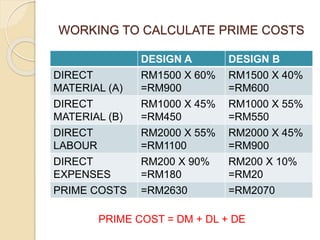
WORKING TO CALCULATE PRIME COSTS
DESIGN A DESIGN B
DIRECT
MATERIAL (A)
RM1500 X 60%
=RM900
RM1500 X 40%
=RM600
DIRECT
MATERIAL (B)
RM1000 X 45%
=RM450
RM1000 X 55%
=RM550
DIRECT
LABOUR
RM2000 X 55%
=RM1100
RM2000 X 45%
=RM900
DIRECT
EXPENSES
RM200 X 90%
=RM180
RM200 X 10%
=RM20
PRIME COSTS =RM2630 =RM2070
PRIME COST = DM + DL + DE
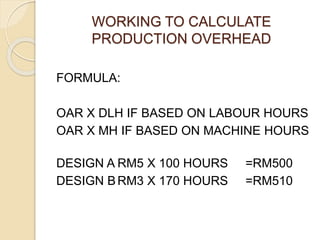
WORKING TO CALCULATE
PRODUCTION OVERHEAD
FORMULA:
OAR X DLH IF BASED ON LABOUR HOURS
OAR X MH IF BASED ON MACHINE HOURS
DESIGN A RM5 X 100 HOURS =RM500
DESIGN BRM3 X 170 HOURS =RM510
WORKING TO CALCULATE
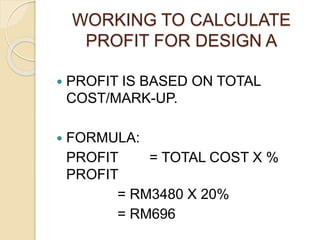
PROFIT FOR DESIGN A
 PROFIT IS BASED ON TOTAL
COST/MARK-UP.
 FORMULA:
PROFIT = TOTAL COST X %
PROFIT
= RM3480 X 20%
= RM696
WORKING TO CALCULATE
PROFIT FOR DESIGN B
 PROFIT IS BASED ON SELLING
PRICE/PROFIT MARGIN
 FORMULA:
PROFIT = [%PROFIT MARGIN/(100%-
PROFIT MARGIN %)] X TC
= 20%/(100%-20%) X RM2950
=( 20%/80% )X RM2950
= RM737.50
THE END

ACC 116 JOB COSTING

  • 1.
  • 2.
    INTRODUCTION  Job costingis defined as form of specific order costing applies where work is undertaken to customers’ special requirements and each order is completed in short duration.  The job is usually carried out within a factory or workshop and moves through processes and operations as a continuously identifiable unit.  E.g. making of coats, jacket, costumes, furniture and etc.
  • 3.
    SPECIFIC ORDER COSTING The job consists of separate contracts, job or batches.  Divided into: 1. Job costing 2. Batch costing 3. Contract costing
  • 4.
    CONTINUOUS OPERATION COSTING  Resultfrom a sequence of continuous /repetitive operations.  The cost is charged before being averaged over the unit produced.  The costs is charged to a department process & not directly to cost unit.
  • 5.
    JOB COSTING Essential featuresare: • Job order according to customer’s requirement compare to contract costing. • Short duration compare to contract costing. • Completed at factory/workshop. • Each job can be accurately identified.
  • 6.
    JOB COSTING Essential featuresare: • Each job can be accurately identified. • Direct costs are charged to individual jobs. • Example of business that use job costing are repairs, advertising agency, assembly of individual aircraft, construction of ships & promotion of new products.
  • 7.
    BATCH COSTING Essential features: Customers orders a quantity of identical units.  The costs are accumulated as for particular job & one batch is one job order.  The recording of costs is done in batch cost card.
  • 8.
    PROCEDURES FOR JOBBING WORK 1.The prospective client will approach the supplier and indicates his requirements. 2. Supplier will record the details such as quantity, quality, size, colour, date and etc. 3. Supplier will calculate the estimate of the cost, the profit margin and selling price. 4. If the client agrees with the price, the job will be carried out with specific job order reference number. (E.g. Job 709)
  • 9.
    PROCEDURES FOR JOBBING WORK 5.The factory floor will prepare Material Requisition Notes (MRN) to request the materials from the store. Purchase Requisition Notes (PRN) will be issued to the purchasing department for special materials or equipment needed. Job cost card /sheet will be set out to perform the jobbing work. 6. When all materials, labour and equipment available in the factory, then the job can be started.
  • 10.
    JOB COST STATEMENT To record costs/charges such as material, labor and other expenses.  To record overhead costs by using pre-determined absorption rate.
  • 11.
    Format for JobCost Statement RM DIRECT COSTS: DIRECT MATERIAL XX DIRECT LABOUR XX DIRECT EXPENSES XX PRIME COST (DM+DL+DE) XXX
  • 12.
    Format Job CostStatement RM RM PRIME COST XXX INDIRECT COSTS: INDIRECT MATERIAL XX INDIRECT LABOUR XX INDIRECT EXPENSES XX PRODUCTION OVERHEAD (IM + IL + IE ) XXX TOTAL PRODUCTION /FACTORY PROFIT XXX (PRIME COST + PROD.OVERHEAD)
  • 13.
    Format Job CostStatement RM PRODUCTION COST/FACTORY PROFIT XXX NON-PRODUCTION COST FINANCE COST XX ADMINISTRATIVE COST XX SELLING & DISTRIBUTION XX NON-PROD.COST (FC +AC+SD) XXX TOTAL COST XXX (PROD.COST + NON-PROD COST) PROFIT XXX SELLING PRICE XXX
  • 14.
    SUMMARY OF FORMULA PrimeCost = Direct Materials + Direct Labour + Direct Expenses Production Cost = Prime Cost + Production Overhead Total Cost = Production Cost + Non- Production Overhead Selling Price = Total Cost + Profit
  • 15.
    HOW TO CALCULATEPROFIT? There are 2 methods: 1. PROFIT MARK UP PROFIT IS CALCULATED BASED ON TOTAL COST. For example: Total Cost =RM200 PROFIT MARK UP = 20% PROFIT = TC x PMU = RM200 X 20% = RM40
  • 16.
    HOW TO CALCULATEPROFIT? 2. PROFIT MARGIN PROFIT IS CALCULATED BASED ON SELLING PRICE. FORMULA: PROFIT = [%PROFIT MARGIN/(100%- PROFIT MARGIN %)] X TC PROFIT= [20%/100%-20%] X RM200 =RM50
  • 17.
    COMPREHENSIVE EXAMPLE  Agro BestBhd produces 2 types of products named Design A & Design B.  You are required to help the company to determine the selling price of the products.  The management has set a profit of 20% on selling price for Design B and 20% on total cost for design A.
  • 18.
    Given below theinformation regarding the prime costs for both products. ITEM RM PERCENTAGE USED IN DESIGN A PERCENTAGE USED IN DESIGN B MATERIAL A 1500 60% 40% MATERIAL B 1000 45% 55% DIRECT LABOUR 2000 55% 45% DIRECT EXPENSES 200 90% 10%
  • 19.
    Other relevant dataare given as follows: DESIGN A DESIGN B OVERHEAD ABSORBTION RATE RM5 PER DIRECT LABOUR HOUR RM3 PER MACHINE HOURS DIRECT LABOUR HOURS 100 HOURS 50 HOURS MACHINE HOURS 130 HOURS 170 HOURS ADMINISTRATIV E EXPENSES RM200 RM200 SELLING EXPENSES RM150 RM170
  • 20.
    Required:  Prepare theJob Cost Statement  Calculate the Profit Margin/ Mark-up  Calculate the Selling Price
  • 21.
    Format for JobCost Statement DESIGN A DESIGN B (RM) (RM) DIRECT COSTS: DIRECT MATERIAL A RM900 600 DIRECT MATERIAL B 450 550 DIRECT LABOUR 1100 900 DIRECT EXPENSES 180 20 PRIME COST (DM+DL+DE)2630 2070
  • 22.
    Format Job CostStatement DESIGN A DESIGN B (RM) (RM) PRIME COST 2630 2070 INDIRECT COSTS: INDIRECT MATERIAL 0 INDIRECT LABOUR 0 INDIRECT EXPENSES 0 PRODUCTION OVERHEAD 500 510 TOTAL PRODUCTION 3130 2580 (PRIME COST + PROD.OVERHEAD)
  • 23.
    Format Job CostStatement DESIGN A DESIGN B (RM) (RM) PRODUCTION COST/FACTORY PROFIT 3130 2580 NON-PRODUCTION COST FINANCE COST 0 ADMINISTRATIVE COST 200 200 SELLING & DISTRIBUTION 150 170 NON-PROD.COST (FC +AC+SD) 350 370 TOTAL COST 3480 2950 (PROD.COST + NON-PROD COST) PROFIT 696 737.50 SELLING PRICE 4176 3687.50
  • 24.
    WORKING TO CALCULATEPRIME COSTS DESIGN A DESIGN B DIRECT MATERIAL (A) RM1500 X 60% =RM900 RM1500 X 40% =RM600 DIRECT MATERIAL (B) RM1000 X 45% =RM450 RM1000 X 55% =RM550 DIRECT LABOUR RM2000 X 55% =RM1100 RM2000 X 45% =RM900 DIRECT EXPENSES RM200 X 90% =RM180 RM200 X 10% =RM20 PRIME COSTS =RM2630 =RM2070 PRIME COST = DM + DL + DE
  • 25.
    WORKING TO CALCULATE PRODUCTIONOVERHEAD FORMULA: OAR X DLH IF BASED ON LABOUR HOURS OAR X MH IF BASED ON MACHINE HOURS DESIGN A RM5 X 100 HOURS =RM500 DESIGN BRM3 X 170 HOURS =RM510
  • 26.
    WORKING TO CALCULATE PROFITFOR DESIGN A  PROFIT IS BASED ON TOTAL COST/MARK-UP.  FORMULA: PROFIT = TOTAL COST X % PROFIT = RM3480 X 20% = RM696
  • 27.
    WORKING TO CALCULATE PROFITFOR DESIGN B  PROFIT IS BASED ON SELLING PRICE/PROFIT MARGIN  FORMULA: PROFIT = [%PROFIT MARGIN/(100%- PROFIT MARGIN %)] X TC = 20%/(100%-20%) X RM2950 =( 20%/80% )X RM2950 = RM737.50
  • 28.