What were some of the results of the Revolution?


Why did Patriots divide into Federalists and Anti-
Federalists?


Describe compromises that helped establish a new
federal system.
p.140-141 Winning the Peace
p. 147 The Assumptions of Republicanism
p. 147-148 The First State Constitutions
p. 149 The Confederation
p. 160-168 Framing a New Government
p. 154-155 Debts, Taxes and Daniel Shays
  (blackboard discussion material)
I. Results of the
Revolution
  A. Independence – Treaty of Paris,
  1783

  B. Expulsion of Loyalists


  C. Continued confiscation and closed
  courts

  D. Economic problems unresolved
II. Revolution and
Government
  A. Representation in the state
  governments

  B. Constitution, Bills of Rights and the
  Common Law


  C. Articles of Confederation
  • central government without customs duties revenue
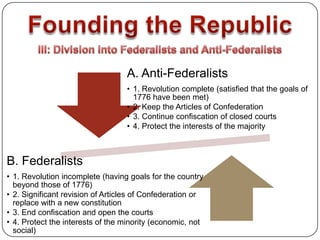
A. Anti-Federalists
                                  • 1. Revolution complete (satisfied that the goals of
                                    1776 have been met)
                                  • 2. Keep the Articles of Confederation
                                  • 3. Continue confiscation of closed courts
                                  • 4. Protect the interests of the majority


B. Federalists
• 1. Revolution incomplete (having goals for the country
  beyond those of 1776)
• 2. Significant revision of Articles of Confederation or
  replace with a new constitution
• 3. End confiscation and open the courts
• 4. Protect the interests of the minority (economic, not
  social)
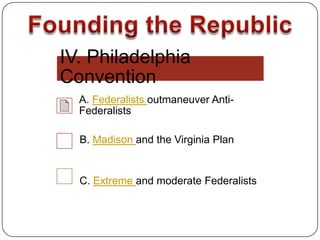
IV. Philadelphia
Convention
  A. Federalists outmaneuver Anti-
  Federalists

  B. Madison and the Virginia Plan


  C. Extreme and moderate Federalists
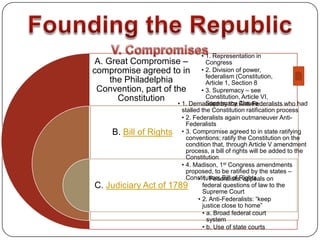
• 1. Representation in
 A. Great Compromise –               Congress
compromise agreed to in • 2. Division of power,
                                     federalism (Constitution,
     the Philadelphia                Article 1, Section 8
 Convention, part of the           • 3. Supremacy – see
       Constitution                  Constitution, Article VI,
                        • 1. Demanded by the Clause
                                     Supremacy Anti-Federalists who had
                          stalled the Constitution ratification process
                          • 2. Federalists again outmaneuver Anti-
                            Federalists
      B. Bill of Rights • 3. Compromise agreed to in state ratifying
                            conventions; ratify the Constitution on the
                            condition that, through Article V amendment
                            process, a bill of rights will be added to the
                            Constitution
                          • 4. Madison, 1st Congress amendments
                            proposed, to be ratified by the states –
                                 • 1. Federalists: appeals on
                            Constitution, Bill of Rights
C. Judiciary Act of 1789           federal questions of law to the
                                   Supreme Court
                                 • 2. Anti-Federalists: “keep
                                   justice close to home”
                                   • a. Broad federal court
                                     system
                                   • b. Use of state courts
What were some of the results of the
Revolution?


Why did Patriots divide into
Federalists and Anti-Federalists?


Describe compromises that helped
establish a new federal system.
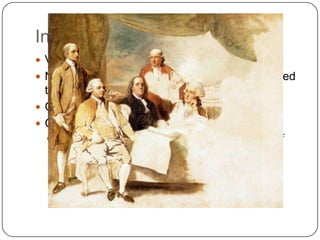
Independence – Treaty of 1783
 Very favorable to the United States
 No treaty possible until Spain and France agreed
  to end hostilities against England
 Clear cut recognition of independence
 Cession of territory:
   Southern border of Canada to northern border of
   (spanish) Florida; Atlantic Ocean to Mississippi
   River
Expulsion of Loyalists
 100,000 fled the country
 Some fled to England (if they had the financial
  means)
 Most went to Canada and established the first
  English-speaking community in Quebec
 Most remained outside the country but some did
  return to re-establish their lives after the anti-Tory
  resentment died down
Continued Confiscation and closed
courts
 Confiscation of Loyalist land resulted in new
 opportunities for patriots to acquire land and
 influence
   “following this war, the new aristocracy will be
   landowners…”
Economic problems unresolved
 Those who were wealthy before the war were
  wealthy after the war
 Those who had social and political influence
  before, held the same influence after
Representation in the state
governments
 Americans agreed that state governments would
  be “republican” = system in which all power
  comes from the people, not from a supreme
  authority.
 “all men are created equal” meant that individual
  talents would be recognized, not aristocracy of
  their position at birth
   Some people would be wealthier than others
   all people would have to earn their success
   no equality of condition but rather equality of
   opportunity
 This never fully came to fruition
Constitutions, bills of rights and
Common Law
 Most basic decision of all states was that their
 constitutions were to be written
   Unwritten constitutions were vague and produce
   corruption (England)
 All agreed that the power of the Executive must
 be limited
   Some states limited the power of their state
    governor more than others
   All states agreed that the governor would not hold a
    seat in the state legislature
     Ensured separation of the two branches
Constitutions, bills of rights and
Common Law
 In 11 of 13 state constitutions the “upper”
  chamber represented the “higher orders” of
  society and did not embrace direct popular
  election
 Common Law – from British practice; monarchy is
  rejected but other British components injected
  into state constitutions
   Habeus Corpus – release from detention/prison
    when cause cannot be given for the detention
   Jury trials
   Various other civil liberties
     Note a certain irony here…one of the first acts of the newly
      independent country was to adopt the law of the foreign
      sovereign from whom independence had just been
      gained…
Articles of Confederation
 A national government that has the power to:
   Conduct wars
   Establish foreign relations
   Issue money (print money)
   CANNOT – tax the people
   CANNOT – regulate trade among the states
   CANNOT – draft men into the regular army
   (see chart on specific powers of each branch)
Federalists outmaneuver Anti-
Federalists
 Virginia sent delegates who were very well
  prepared for constructing a completely new
  government from Philadelphia
 They had a detailed plan and used it to control
  the convention
Madison and the Virginia Plan
 Edmund Randolph proposed a national
  government that consisted of a Legislative,
  Executive and Judicial branch
 Madison’s Virginia Plan stated the Legislative
  branch should be made up of two houses
   The lower house representation would be based on
    population
   The upper house representation would be based on
    an election by members of the lower house
     No system of determining a set number of representatives
      in this upper house
     Small states might not have any representatives in the
      upper house under this format
Extreme and Moderate
Federalists
 Extreme Federalists believed the Central
  government should control the majority of
  workings within the country
 Moderate Federalists felt as if the states should
  retain some sovereignty
Representation in Congress
 Proposal called for a legislature of two houses
 Lower house representation would be based on
 population
   Slaves would also count as 3/5 of a free person in
    determining population and taxation (Three-Fifths
    Compromise)
   3/5 formula based on the belief that a slave was
    only 3/5 as productive as a free worker and thus
    contributed less to the wealth of the state
 Upper house representation would be equal with
 each state having 2 representatives (New Jersey
 Plan)
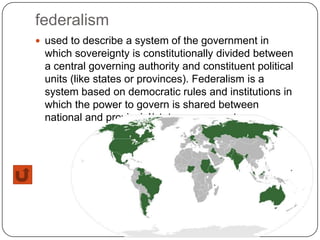
federalism
 used to describe a system of the government in
 which sovereignty is constitutionally divided between
 a central governing authority and constituent political
 units (like states or provinces). Federalism is a
 system based on democratic rules and institutions in
 which the power to govern is shared between
 national and provincial/state governments
Bill of Rights
 One of the very first pieces of business for the
  new Congress
 They immediately began “filling in the gaps” in the
  Constitution thus creating what we know and
  refer to today as the “living constitution”
   Means it was designed to change with the changing
   times
Bill of Rights
Demanded by Anti-Federalists
 Their demand was mainly on the behalf of small
 states (less representation) to protect them from
 Congress
Bill of Rights
 First Amendment – Establishment Clause, Free Exercise Clause;
    freedom of speech, of the press, and of assembly; right to petition
   Second Amendment – Militia (United States), Sovereign state, Right to
    keep and bear arms.
   Third Amendment – Protection from quartering of troops.
   Fourth Amendment – Protection from unreasonable search and seizure.
   Fifth Amendment – due process, double jeopardy, self-incrimination,
    eminent domain.
   Sixth Amendment – Trial by jury and rights of the accused;
    Confrontation Clause, speedy trial, public trial, right to counsel
   Seventh Amendment – Civil trial by jury.
   Eighth Amendment – Prohibition of excessive bail and cruel and
    unusual punishment.
   Ninth Amendment – Protection of rights not specifically enumerated in
    the Constitution.
   Tenth Amendment – Powers of States and people.
Capital moves south
 Congressional meetings (first and second
  continental congress and the 1st official Congress
  in 1789 under the Constitution) were held in New
  York and Philadelphia
 Southerners wanted to move it closer to the south
 A compromise was reached (Hamilton v.
  Jefferson)
   Federal government would agree to take on state
    debts incurred from the war and debt that could not
    be met under the Articles of Confederation
   Needed southern support to do this
   Moving the capital to “Foggy Bottom”, owned by
    George Washington, was enough incentive for
    southerners to agree to compromise
Broad federal court system
 Congress gave Supreme Court the power to
 make the final decision in cases involving the
 constitutionality of state laws
Use of state courts
 Act gave the federal court system power to
 remove certain cases from the state court system
 to be tried in federal court system
   13 district courts, one judge each
   3 circuit courts of appeals, one district judge and
   two supreme court judges

Lesson 7: Founding the Republic

  • 1.
    What were someof the results of the Revolution? Why did Patriots divide into Federalists and Anti- Federalists? Describe compromises that helped establish a new federal system.
  • 2.
    p.140-141 Winning thePeace p. 147 The Assumptions of Republicanism p. 147-148 The First State Constitutions p. 149 The Confederation p. 160-168 Framing a New Government p. 154-155 Debts, Taxes and Daniel Shays (blackboard discussion material)
  • 3.
    I. Results ofthe Revolution A. Independence – Treaty of Paris, 1783 B. Expulsion of Loyalists C. Continued confiscation and closed courts D. Economic problems unresolved
  • 4.
    II. Revolution and Government A. Representation in the state governments B. Constitution, Bills of Rights and the Common Law C. Articles of Confederation • central government without customs duties revenue
  • 5.
    A. Anti-Federalists • 1. Revolution complete (satisfied that the goals of 1776 have been met) • 2. Keep the Articles of Confederation • 3. Continue confiscation of closed courts • 4. Protect the interests of the majority B. Federalists • 1. Revolution incomplete (having goals for the country beyond those of 1776) • 2. Significant revision of Articles of Confederation or replace with a new constitution • 3. End confiscation and open the courts • 4. Protect the interests of the minority (economic, not social)
  • 6.
    IV. Philadelphia Convention A. Federalists outmaneuver Anti- Federalists B. Madison and the Virginia Plan C. Extreme and moderate Federalists
  • 7.
    • 1. Representationin A. Great Compromise – Congress compromise agreed to in • 2. Division of power, federalism (Constitution, the Philadelphia Article 1, Section 8 Convention, part of the • 3. Supremacy – see Constitution Constitution, Article VI, • 1. Demanded by the Clause Supremacy Anti-Federalists who had stalled the Constitution ratification process • 2. Federalists again outmaneuver Anti- Federalists B. Bill of Rights • 3. Compromise agreed to in state ratifying conventions; ratify the Constitution on the condition that, through Article V amendment process, a bill of rights will be added to the Constitution • 4. Madison, 1st Congress amendments proposed, to be ratified by the states – • 1. Federalists: appeals on Constitution, Bill of Rights C. Judiciary Act of 1789 federal questions of law to the Supreme Court • 2. Anti-Federalists: “keep justice close to home” • a. Broad federal court system • b. Use of state courts
  • 8.
    What were someof the results of the Revolution? Why did Patriots divide into Federalists and Anti-Federalists? Describe compromises that helped establish a new federal system.
  • 10.
    Independence – Treatyof 1783  Very favorable to the United States  No treaty possible until Spain and France agreed to end hostilities against England  Clear cut recognition of independence  Cession of territory:  Southern border of Canada to northern border of (spanish) Florida; Atlantic Ocean to Mississippi River
  • 11.
    Expulsion of Loyalists 100,000 fled the country  Some fled to England (if they had the financial means)  Most went to Canada and established the first English-speaking community in Quebec  Most remained outside the country but some did return to re-establish their lives after the anti-Tory resentment died down
  • 12.
    Continued Confiscation andclosed courts  Confiscation of Loyalist land resulted in new opportunities for patriots to acquire land and influence  “following this war, the new aristocracy will be landowners…”
  • 13.
    Economic problems unresolved Those who were wealthy before the war were wealthy after the war  Those who had social and political influence before, held the same influence after
  • 14.
    Representation in thestate governments  Americans agreed that state governments would be “republican” = system in which all power comes from the people, not from a supreme authority.  “all men are created equal” meant that individual talents would be recognized, not aristocracy of their position at birth  Some people would be wealthier than others  all people would have to earn their success  no equality of condition but rather equality of opportunity  This never fully came to fruition
  • 15.
    Constitutions, bills ofrights and Common Law  Most basic decision of all states was that their constitutions were to be written  Unwritten constitutions were vague and produce corruption (England)  All agreed that the power of the Executive must be limited  Some states limited the power of their state governor more than others  All states agreed that the governor would not hold a seat in the state legislature  Ensured separation of the two branches
  • 16.
    Constitutions, bills ofrights and Common Law  In 11 of 13 state constitutions the “upper” chamber represented the “higher orders” of society and did not embrace direct popular election  Common Law – from British practice; monarchy is rejected but other British components injected into state constitutions  Habeus Corpus – release from detention/prison when cause cannot be given for the detention  Jury trials  Various other civil liberties  Note a certain irony here…one of the first acts of the newly independent country was to adopt the law of the foreign sovereign from whom independence had just been gained…
  • 17.
    Articles of Confederation A national government that has the power to:  Conduct wars  Establish foreign relations  Issue money (print money)  CANNOT – tax the people  CANNOT – regulate trade among the states  CANNOT – draft men into the regular army  (see chart on specific powers of each branch)
  • 18.
    Federalists outmaneuver Anti- Federalists Virginia sent delegates who were very well prepared for constructing a completely new government from Philadelphia  They had a detailed plan and used it to control the convention
  • 19.
    Madison and theVirginia Plan  Edmund Randolph proposed a national government that consisted of a Legislative, Executive and Judicial branch  Madison’s Virginia Plan stated the Legislative branch should be made up of two houses  The lower house representation would be based on population  The upper house representation would be based on an election by members of the lower house  No system of determining a set number of representatives in this upper house  Small states might not have any representatives in the upper house under this format
  • 20.
    Extreme and Moderate Federalists Extreme Federalists believed the Central government should control the majority of workings within the country  Moderate Federalists felt as if the states should retain some sovereignty
  • 21.
    Representation in Congress Proposal called for a legislature of two houses  Lower house representation would be based on population  Slaves would also count as 3/5 of a free person in determining population and taxation (Three-Fifths Compromise)  3/5 formula based on the belief that a slave was only 3/5 as productive as a free worker and thus contributed less to the wealth of the state  Upper house representation would be equal with each state having 2 representatives (New Jersey Plan)
  • 22.
    federalism  used todescribe a system of the government in which sovereignty is constitutionally divided between a central governing authority and constituent political units (like states or provinces). Federalism is a system based on democratic rules and institutions in which the power to govern is shared between national and provincial/state governments
  • 23.
    Bill of Rights One of the very first pieces of business for the new Congress  They immediately began “filling in the gaps” in the Constitution thus creating what we know and refer to today as the “living constitution”  Means it was designed to change with the changing times
  • 24.
    Bill of Rights Demandedby Anti-Federalists  Their demand was mainly on the behalf of small states (less representation) to protect them from Congress
  • 25.
    Bill of Rights First Amendment – Establishment Clause, Free Exercise Clause; freedom of speech, of the press, and of assembly; right to petition  Second Amendment – Militia (United States), Sovereign state, Right to keep and bear arms.  Third Amendment – Protection from quartering of troops.  Fourth Amendment – Protection from unreasonable search and seizure.  Fifth Amendment – due process, double jeopardy, self-incrimination, eminent domain.  Sixth Amendment – Trial by jury and rights of the accused; Confrontation Clause, speedy trial, public trial, right to counsel  Seventh Amendment – Civil trial by jury.  Eighth Amendment – Prohibition of excessive bail and cruel and unusual punishment.  Ninth Amendment – Protection of rights not specifically enumerated in the Constitution.  Tenth Amendment – Powers of States and people.
  • 26.
    Capital moves south Congressional meetings (first and second continental congress and the 1st official Congress in 1789 under the Constitution) were held in New York and Philadelphia  Southerners wanted to move it closer to the south  A compromise was reached (Hamilton v. Jefferson)  Federal government would agree to take on state debts incurred from the war and debt that could not be met under the Articles of Confederation  Needed southern support to do this  Moving the capital to “Foggy Bottom”, owned by George Washington, was enough incentive for southerners to agree to compromise
  • 27.
    Broad federal courtsystem  Congress gave Supreme Court the power to make the final decision in cases involving the constitutionality of state laws
  • 28.
    Use of statecourts  Act gave the federal court system power to remove certain cases from the state court system to be tried in federal court system  13 district courts, one judge each  3 circuit courts of appeals, one district judge and two supreme court judges