Chapter 1:
What is Second Language
Acquisition
MR. VATH VARY
AGA INSTITUTE
Course:
Second
Language
Acquisition
(SLA)
• Tel: + 855 17 471 117
• Email: varyvath@gmail.com
Learning Outcomes
Define and distinguish a few SLA key
terms;
Briefly examine different perspectives
to answer the three foundational
questions “What, How and Why”;
Discuss the ways in which the second
language acquisition processes of
individuals may vary.
MR. VATH VARY
Introductory Discussion Questions
What do we know about second
language acquisition (SLA)?
What are the similarities and
differences between First and Second
language acquisition?
How do people learn a second, or a
third, or a fourth language?
What are the implication for
foreign/second language teaching?
MR. VATH VARY
What is SLA?
MR. VATH VARY
SLA
• the study of individuals and
groups who are learning a
language subsequent to
learning their first one as
young children
• and to the process of
learning that language
What is the study of SLA?
MR. VATH VARY
It is the study of
how second
languages are
learned
It is the study of How
learners create a new
language system with
only limited exposure
to a second language
It is the study of Why
most second language
learners do not
achieve the same
degree of proficiency
in a second language
as they do in their
native language
It is the study of Why some
individuals appear to achieve
native0like proficiency in a second
language as they do in their native
language
It Is also concerned with the nature
of the hypotheses (whether
conscious or unconscious) that
learners come up with regarding
the rules of the second language
What is Second Language Acquisition
(SLA)?
The additional
language
• is called a second
language (L2) (the
third, fourth, or tenth)
Target language (TL):
• any language that is the aim or
goal of learning;
• the language being learned (Gass,
Behney & Plosky, 2020)
MR. VATH VARY
The study of any new discipline involves familiarizing oneself with the
specific terminology of that field (Gass, Behney & Plosky, 2020)
What Is Scope Of SLA?
MR. VATH VARY
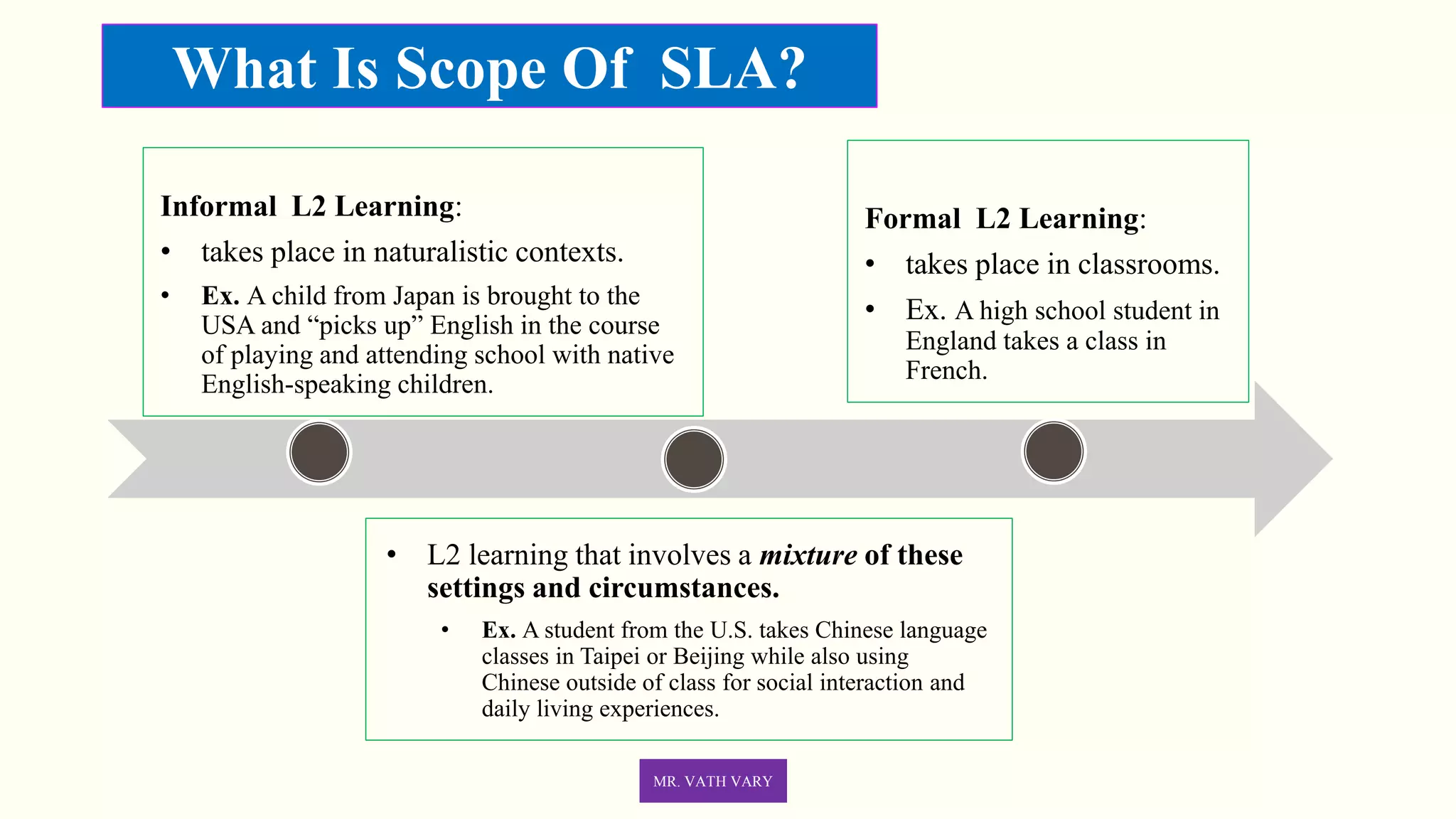
Informal L2 Learning:
• takes place in naturalistic contexts.
• Ex. A child from Japan is brought to the
USA and “picks up” English in the course
of playing and attending school with native
English-speaking children.
• L2 learning that involves a mixture of these
settings and circumstances.
• Ex. A student from the U.S. takes Chinese language
classes in Taipei or Beijing while also using
Chinese outside of class for social interaction and
daily living experiences.
Formal L2 Learning:
• takes place in classrooms.
• Ex. A high school student in
England takes a class in
French.
Three basic questions help us
understand the ‘process’ of SLA
(1) What
exactly does
the L2 learner
come to know?
(2) How does
the learner
acquire this
knowledge?
(3) Why are some
learners more
successful than
others?
MR. VATH VARY
What is SLA?
SLA has emerged as a field of study primarily from
within … to answer the what , how , and why questions
Linguistics Psychology
Applied
linguistics’
subfield
Psycholingu
istics
Sociolinguis
tics
Social
psychology
MR. VATH VARY
An Asian fable of the three blind men
describing an elephant:
 one, feeling the tail, says it
is like a rope;
 another, feeling the side,
says it is flat and rubbery;
 the third, feeling the trunk,
describes it as being like a
long rubber hose
 While each perception
is correct individually,
they fail to provide an
accurate picture of the
total animal because
there is no holistic or
integrated perspective.
MR. VATH VARY
What is SLA?
Linguists
emphasize:
linguistic performance (The use of language
knowledge in actual production) of learners at various
stages of acquisition.
linguistic competence (underlying knowledge
that speakers/hearers have of a language);
the characteristics of the differences and
similarities in the languages that are being
learned;
MR. VATH VARY
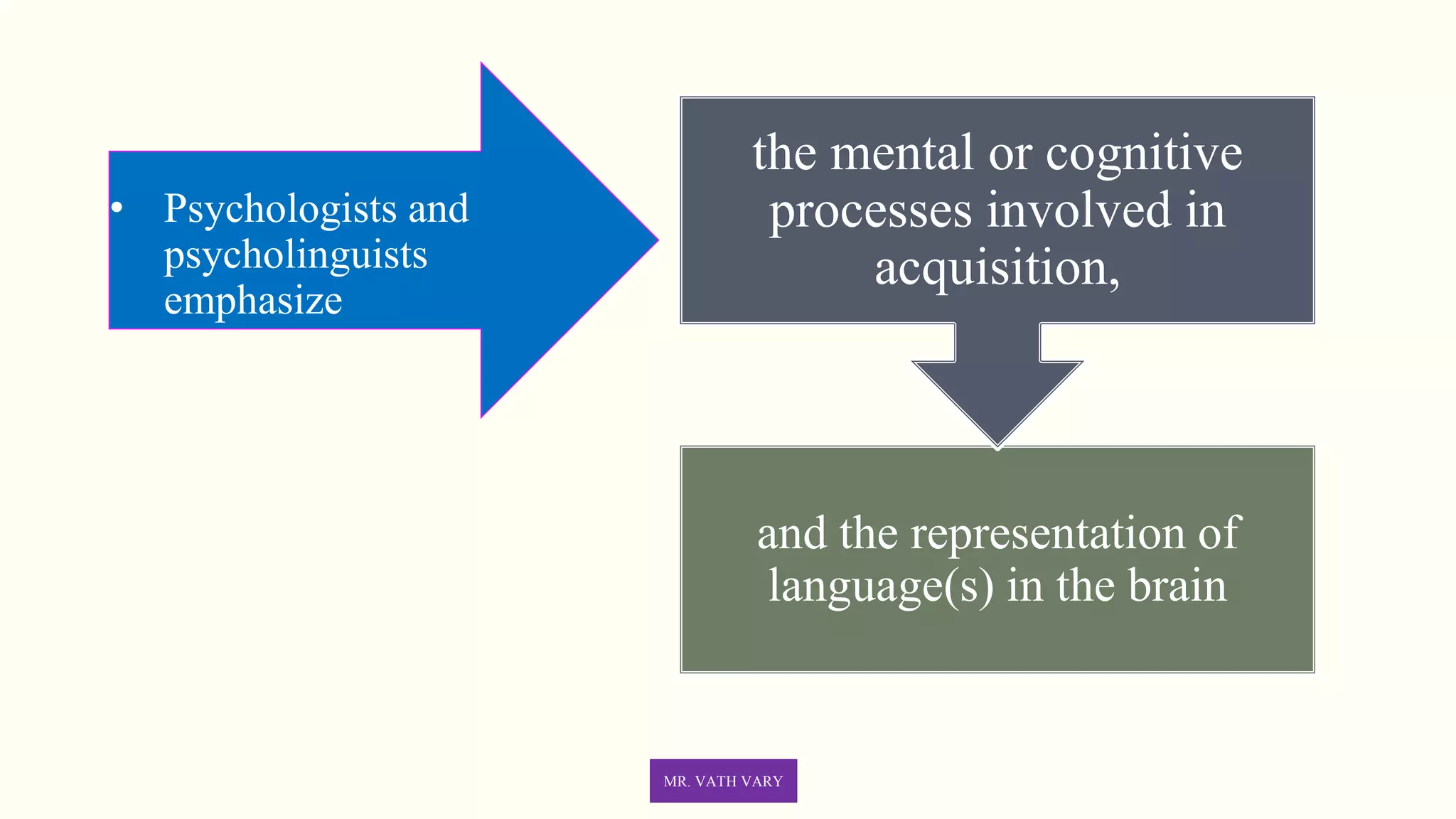
• Psychologists and
psycholinguists
emphasize
and the representation of
language(s) in the brain
the mental or cognitive
processes involved in
acquisition,
MR. VATH VARY
Sociolinguists
emphasize
and extend the scope of study to
communicative competence
(underlying knowledge that
additionally accounts for language
use, or pragmatic competence).
variability in learner linguistic
performance,
MR. VATH VARY
• Social
psychologists
emphasize
and the interactional and larger
social contexts of learning.
group-related phenomena, such
as identity and social
motivation,
MR. VATH VARY
MR. VATH VARY
What is a second language?
the specific areas of
vocabulary knowledge
we need
the level of
grammatical
complexity we have
to attain,
and whether
speaking or
reading skills are
more important.
The four different terms may significantly
affect what we learn.
What is a second language?
Second
language
• is typically an official or societally dominant language
needed for education, employment, and other basic
purposes.
• is often acquired by minority group members or
immigrants who speak another language natively.
Foreign
language
• is one NOT widely used in the learners’ immediate social
context used for future travel or other cross-cultural
communication situations, or studied as a curricular
requirement or elective in school, but with no immediate or
necessary practical application.
MR. VATH VARY
What is a second
language?
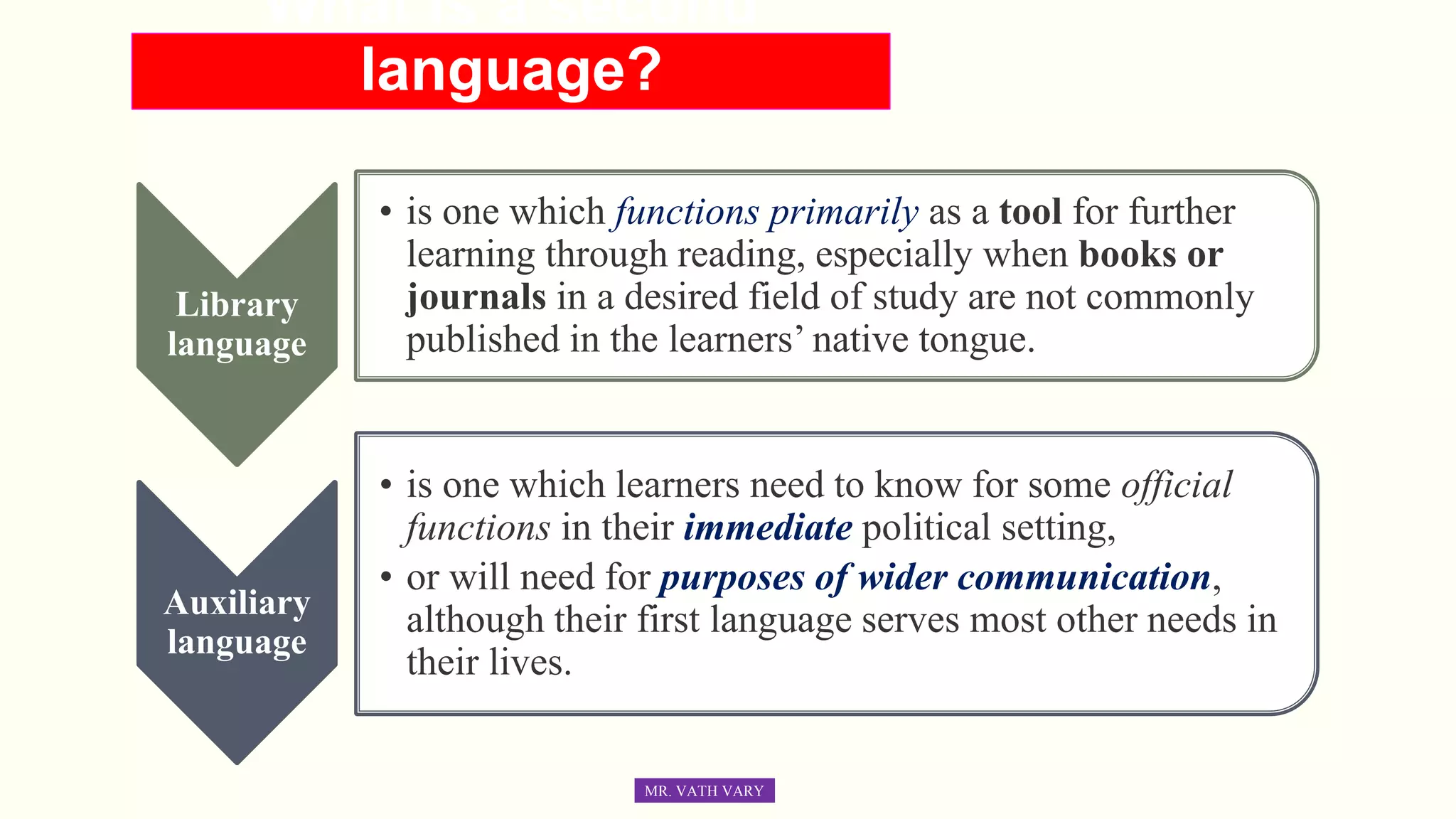
Library
language
• is one which functions primarily as a tool for further
learning through reading, especially when books or
journals in a desired field of study are not commonly
published in the learners’ native tongue.
Auxiliary
language
• is one which learners need to know for some official
functions in their immediate political setting,
• or will need for purposes of wider communication,
although their first language serves most other needs in
their lives.
MR. VATH VARY
What is a first language?
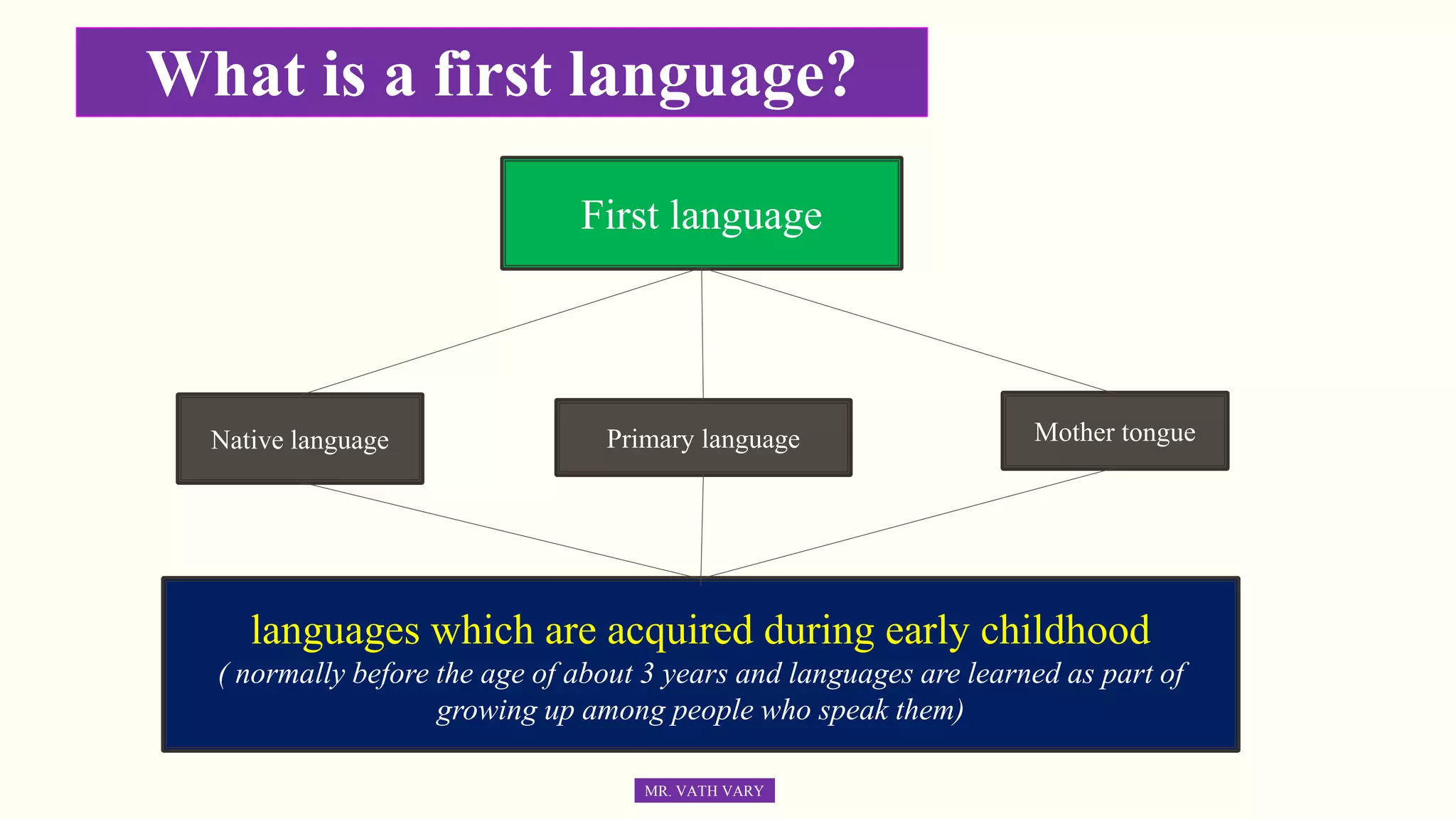
First language
Native language Primary language Mother tongue
languages which are acquired during early childhood
( normally before the age of about 3 years and languages are learned as part of
growing up among people who speak them)
MR. VATH VARY
What is a first
language?
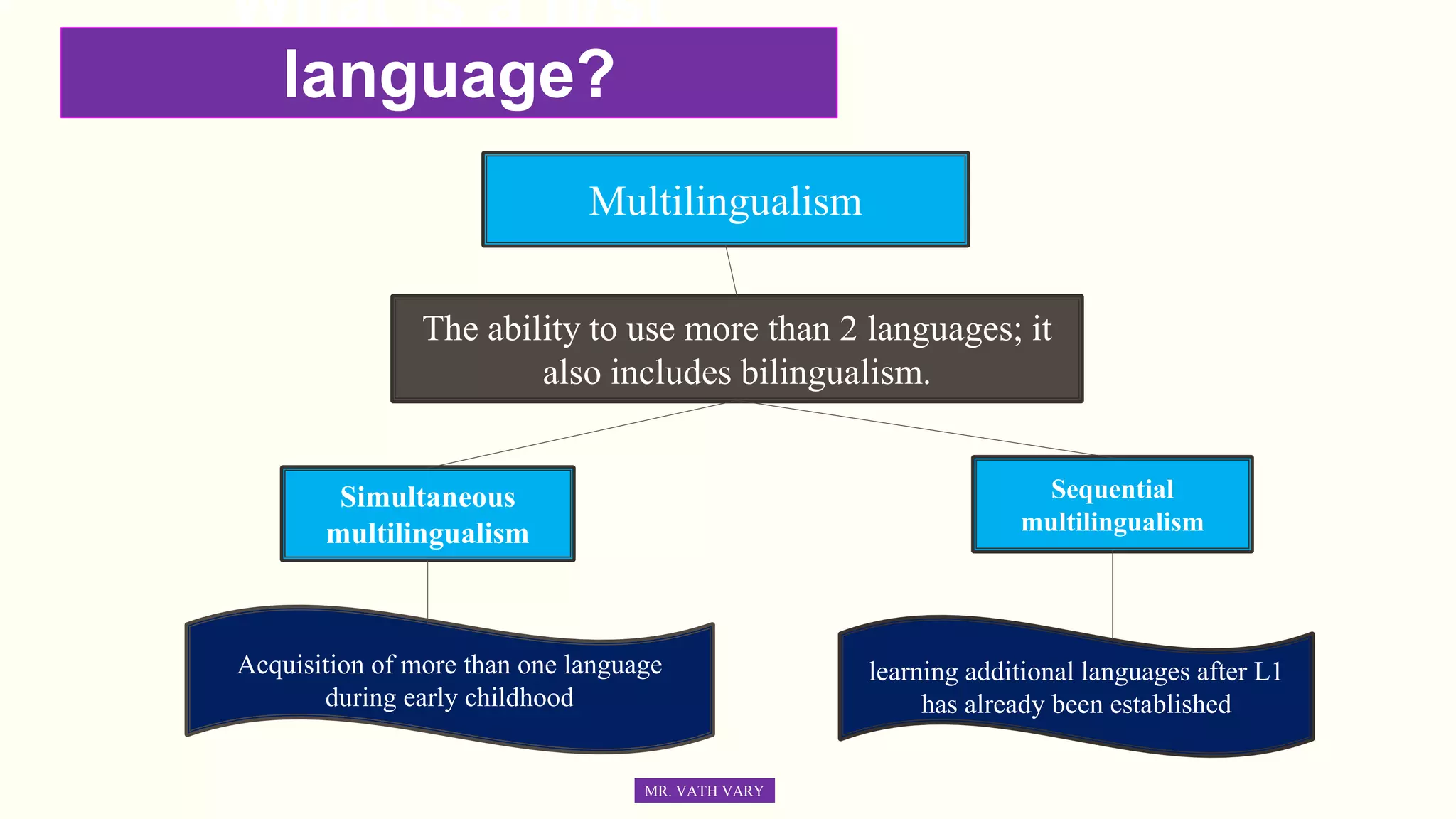
Multilingualism
Simultaneous
multilingualism
The ability to use more than 2 languages; it
also includes bilingualism.
Sequential
multilingualism
Acquisition of more than one language
during early childhood
learning additional languages after L1
has already been established
MR. VATH VARY
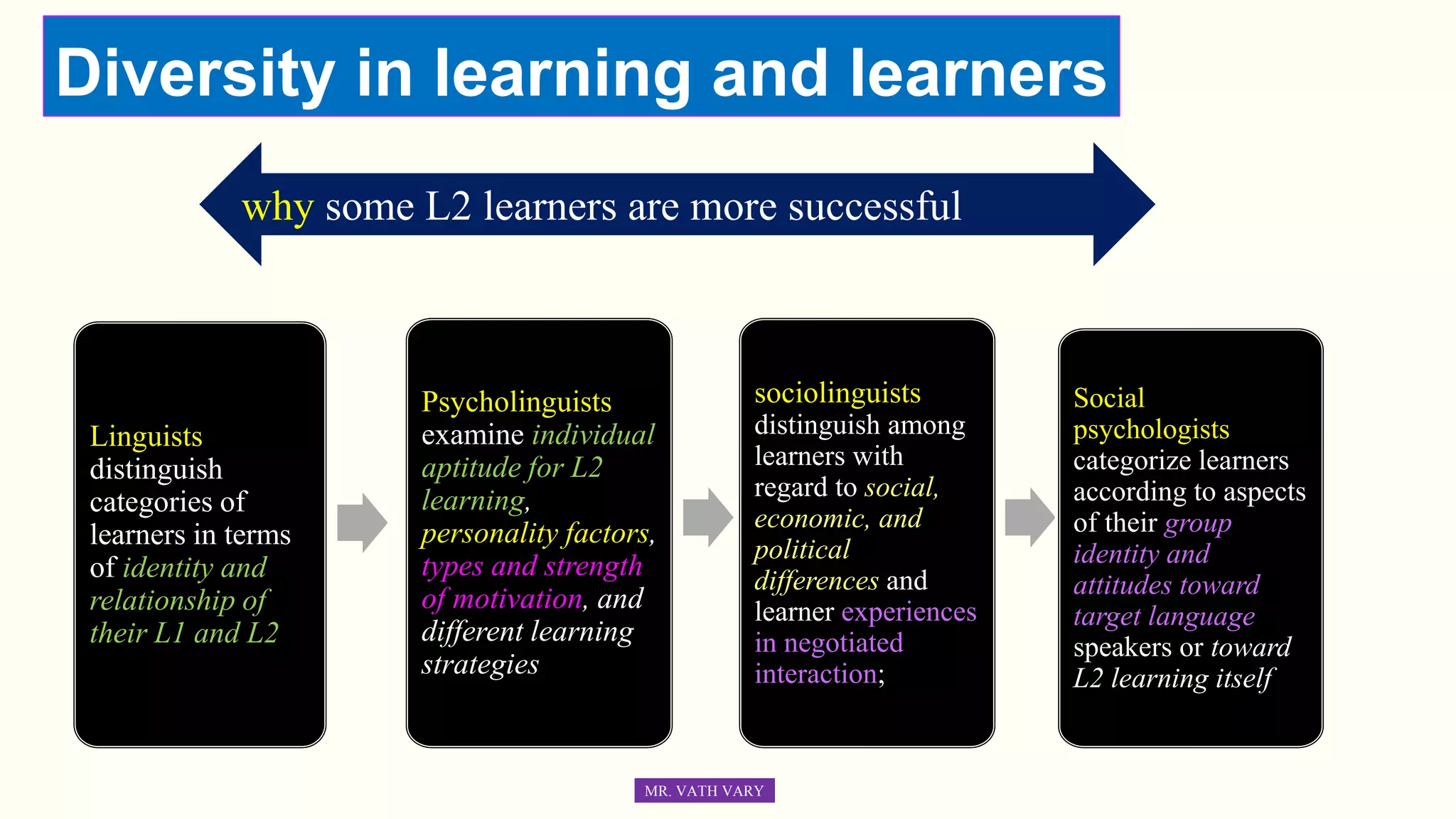
Diversity in learning and learners
MR. VATH VARY
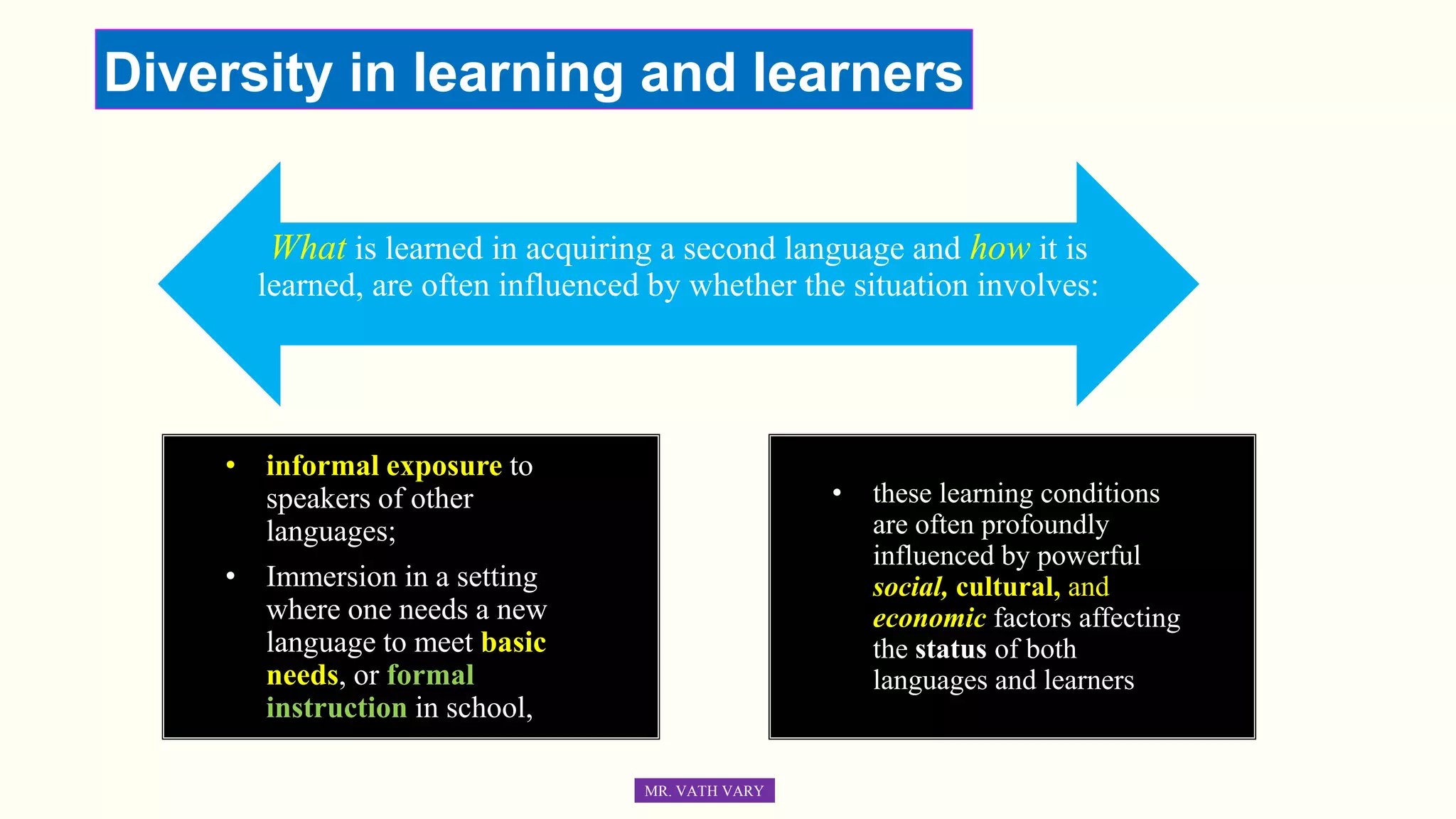
• informal exposure to
speakers of other
languages;
• Immersion in a setting
where one needs a new
language to meet basic
needs, or formal
instruction in school,
• these learning conditions
are often profoundly
influenced by powerful
social, cultural, and
economic factors affecting
the status of both
languages and learners
What is learned in acquiring a second language and how it is
learned, are often influenced by whether the situation involves:
Diversity in learning and learners
MR. VATH VARY
Linguists
distinguish
categories of
learners in terms
of identity and
relationship of
their L1 and L2
Psycholinguists
examine individual
aptitude for L2
learning,
personality factors,
types and strength
of motivation, and
different learning
strategies
sociolinguists
distinguish among
learners with
regard to social,
economic, and
political
differences and
learner experiences
in negotiated
interaction;
Social
psychologists
categorize learners
according to aspects
of their group
identity and
attitudes toward
target language
speakers or toward
L2 learning itself
why some L2 learners are more successful
MR. VATH VARY

CH 1_Introducing Second Language Acquisition.pptx

  • 1.
    Chapter 1: What isSecond Language Acquisition MR. VATH VARY AGA INSTITUTE Course: Second Language Acquisition (SLA) • Tel: + 855 17 471 117 • Email: varyvath@gmail.com
  • 2.
    Learning Outcomes Define anddistinguish a few SLA key terms; Briefly examine different perspectives to answer the three foundational questions “What, How and Why”; Discuss the ways in which the second language acquisition processes of individuals may vary. MR. VATH VARY
  • 3.
    Introductory Discussion Questions Whatdo we know about second language acquisition (SLA)? What are the similarities and differences between First and Second language acquisition? How do people learn a second, or a third, or a fourth language? What are the implication for foreign/second language teaching? MR. VATH VARY
  • 4.
    What is SLA? MR.VATH VARY SLA • the study of individuals and groups who are learning a language subsequent to learning their first one as young children • and to the process of learning that language
  • 5.
    What is thestudy of SLA? MR. VATH VARY It is the study of how second languages are learned It is the study of How learners create a new language system with only limited exposure to a second language It is the study of Why most second language learners do not achieve the same degree of proficiency in a second language as they do in their native language It is the study of Why some individuals appear to achieve native0like proficiency in a second language as they do in their native language It Is also concerned with the nature of the hypotheses (whether conscious or unconscious) that learners come up with regarding the rules of the second language
  • 6.
    What is SecondLanguage Acquisition (SLA)? The additional language • is called a second language (L2) (the third, fourth, or tenth) Target language (TL): • any language that is the aim or goal of learning; • the language being learned (Gass, Behney & Plosky, 2020) MR. VATH VARY The study of any new discipline involves familiarizing oneself with the specific terminology of that field (Gass, Behney & Plosky, 2020)
  • 7.
    What Is ScopeOf SLA? MR. VATH VARY Informal L2 Learning: • takes place in naturalistic contexts. • Ex. A child from Japan is brought to the USA and “picks up” English in the course of playing and attending school with native English-speaking children. • L2 learning that involves a mixture of these settings and circumstances. • Ex. A student from the U.S. takes Chinese language classes in Taipei or Beijing while also using Chinese outside of class for social interaction and daily living experiences. Formal L2 Learning: • takes place in classrooms. • Ex. A high school student in England takes a class in French.
  • 8.
    Three basic questionshelp us understand the ‘process’ of SLA (1) What exactly does the L2 learner come to know? (2) How does the learner acquire this knowledge? (3) Why are some learners more successful than others? MR. VATH VARY
  • 9.
    What is SLA? SLAhas emerged as a field of study primarily from within … to answer the what , how , and why questions Linguistics Psychology Applied linguistics’ subfield Psycholingu istics Sociolinguis tics Social psychology MR. VATH VARY
  • 10.
    An Asian fableof the three blind men describing an elephant:  one, feeling the tail, says it is like a rope;  another, feeling the side, says it is flat and rubbery;  the third, feeling the trunk, describes it as being like a long rubber hose  While each perception is correct individually, they fail to provide an accurate picture of the total animal because there is no holistic or integrated perspective. MR. VATH VARY What is SLA?
  • 11.
    Linguists emphasize: linguistic performance (Theuse of language knowledge in actual production) of learners at various stages of acquisition. linguistic competence (underlying knowledge that speakers/hearers have of a language); the characteristics of the differences and similarities in the languages that are being learned; MR. VATH VARY
  • 12.
    • Psychologists and psycholinguists emphasize andthe representation of language(s) in the brain the mental or cognitive processes involved in acquisition, MR. VATH VARY
  • 13.
    Sociolinguists emphasize and extend thescope of study to communicative competence (underlying knowledge that additionally accounts for language use, or pragmatic competence). variability in learner linguistic performance, MR. VATH VARY
  • 14.
    • Social psychologists emphasize and theinteractional and larger social contexts of learning. group-related phenomena, such as identity and social motivation, MR. VATH VARY
  • 15.
    MR. VATH VARY Whatis a second language? the specific areas of vocabulary knowledge we need the level of grammatical complexity we have to attain, and whether speaking or reading skills are more important. The four different terms may significantly affect what we learn.
  • 16.
    What is asecond language? Second language • is typically an official or societally dominant language needed for education, employment, and other basic purposes. • is often acquired by minority group members or immigrants who speak another language natively. Foreign language • is one NOT widely used in the learners’ immediate social context used for future travel or other cross-cultural communication situations, or studied as a curricular requirement or elective in school, but with no immediate or necessary practical application. MR. VATH VARY
  • 17.
    What is asecond language? Library language • is one which functions primarily as a tool for further learning through reading, especially when books or journals in a desired field of study are not commonly published in the learners’ native tongue. Auxiliary language • is one which learners need to know for some official functions in their immediate political setting, • or will need for purposes of wider communication, although their first language serves most other needs in their lives. MR. VATH VARY
  • 18.
    What is afirst language? First language Native language Primary language Mother tongue languages which are acquired during early childhood ( normally before the age of about 3 years and languages are learned as part of growing up among people who speak them) MR. VATH VARY
  • 19.
    What is afirst language? Multilingualism Simultaneous multilingualism The ability to use more than 2 languages; it also includes bilingualism. Sequential multilingualism Acquisition of more than one language during early childhood learning additional languages after L1 has already been established MR. VATH VARY
  • 20.
    Diversity in learningand learners MR. VATH VARY • informal exposure to speakers of other languages; • Immersion in a setting where one needs a new language to meet basic needs, or formal instruction in school, • these learning conditions are often profoundly influenced by powerful social, cultural, and economic factors affecting the status of both languages and learners What is learned in acquiring a second language and how it is learned, are often influenced by whether the situation involves:
  • 21.
    Diversity in learningand learners MR. VATH VARY Linguists distinguish categories of learners in terms of identity and relationship of their L1 and L2 Psycholinguists examine individual aptitude for L2 learning, personality factors, types and strength of motivation, and different learning strategies sociolinguists distinguish among learners with regard to social, economic, and political differences and learner experiences in negotiated interaction; Social psychologists categorize learners according to aspects of their group identity and attitudes toward target language speakers or toward L2 learning itself why some L2 learners are more successful
  • 22.