Session # 1 and 2
May 17-May 18, 2013
ENGLISH 344:
THEORETICAL FOUNDATIONS IN
TESOL
Agenda, May 17th
Part I (4:30-600)
• Welcome and Introductions
• Course Introduction
• Introduction to the class blog
• Course materials and assignments
• Unpacking our assumptions on language learning
Part II (6:20-8:00)
• Common acronyms
• Starting with a broader perspective: World Englishes and second
language learning
• Theoretical Framework in SLA/Learning Theories
Course Objectives
The main objectives of this course are as follows:
• Explore fundamental concepts related to foreign and second
language learning;
• Learn interdisciplinary approaches to teaching and learning a
second language in diverse educational settings;
• Learn how a second language is acquired from linguistic,
socio-cognitive, and sociocultural approach;
• Demystify stereotypes and mainstream understandings
concerning second language learning and English language
learners.
Course Materials
1. Saville-Troike, M. (2006). Introducing Second Language
Acquisition.
2. Lightbown, P. & Spada, N. (2013). How languages are
learned. Oxford Handbook for teachers.
3. Course blog and individual blog:
http://theoreticalfoundationsintesol2013.blogspot.com/
Course Assignments
• Class Discussion
• Learning Logs
• Exams
Unpacking our assumptions on language learning
• Most of us have assumptions and ideas about how we learn and
teach a second language. Before getting started with
understanding research, it’s important to unveil some of our views
on how languages are learned.
• Read the statements in the introduction of L&S book and indicate
whether you agree with each statement. After you complete your
list, please discuss your results with a partner.
What is Second Language Acquisition (SLA)?
• Gass and Selinker define SLA as the study of how learners create a
new language system (p.1)
• SLA has emerged from a field of study primarily from within
linguistics and subfield such as Sociolinguistics and Applied
Linguistics.
• SLA is an interdisciplinary research field that focuses on learners
and learning rather than teachers and teaching.
• Questions we seek answers:
1. What exactly does the L2 learner come to know?
2. How does the learner acquire this knowledge?
3. Why are some learners more successful than others?
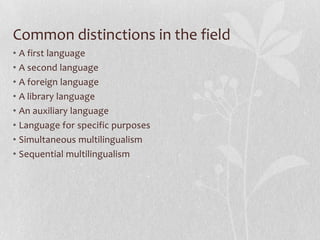
Common distinctions in the field
• A first language
• A second language
• A foreign language
• A library language
• An auxiliary language
• Language for specific purposes
• Simultaneous multilingualism
• Sequential multilingualism
Discussion
• List all the languages that you can use (at any proficiency level).
• Do you think you are a “good” or a “poor” L2 learner? Why?
• What are some of the characteristics of a good language learner?
FOUNDATIONS OF SLA
The world of second languages and “World
Englishes”(Kachru)
The Expanding Circle
Chin
China, Egypt, Indonesia,
Israel, Japan, Korea,
Nepal, Saudi Arabia,
China, Egypt, Indonesia,
Israel, Japan, Korea,
Nepal, Saudi Arabia,
Taiwan, Russia,
Zimbabwe, South Africa,
Caribbean Islands
(EFL)
Taiwan, Russia,
Zimbabwe, South Africa,
Caribbean Islands
(EFL)
a, Egypt, Indonesia,
The Outer Circle
Bangladesh, India
Ghana, Kenya,
Nigeria, Malaysia,
Pakistan,
Philippines,
Singapore, Sri
Lanka, Tanzania,
Zambia
The Inner
Circle
USA
UK
Canada
Australia
New Zealand
• Different varieties of Englishes around the globe--Linguistic
diversity in present-day English use (Total number of L1 and L2
speakers of English is approximately 2.25 billion)
• There are 350 million native English speakers living in the inner
circle countries.
• There are 700 million non-native English speakers in the
expanding and outer circle countries.
• More non-native speakers than native ones: About 80% of the
English speakers of the world are non-native speakers (Braine,
2006)
• The concept of WE allows for varieties in English usage. It allows
us to pluralize English--Englishes
WORLD ENGLISHES
Who are English speakers today?
• The group of speakers whose proficiency levels range from
reasonable to bilingual competence and who live outside of Inner
circle countries. English has little or no official function: EFL
• The group of speakers for whom English serves country-internal
functions: ESL.
• Growing English users who use English among themselves rather
than with native English spreakers: English as a lingua franca (ELF)
How many Englishes are there?
MacArthur’s
circle of
English
Questions TESOL educators and Applied
Linguists ask about world Englishes
1. How are different world Englishes (socially)
perceived?
2. How recognizable are different world Englishes?
what factors influence this recognition?
3. How is English used in the world? how should it be
used? (in part, code-switching and language policy)
4. How do world Englishes differ from each other or
how are they similar (pidgins and creoles)?
The world of second languages: Complicating
the term “native speaker”
• Multilingualism/Bilingualism: ability to use two or more languages
• Monolingualism
• What are some of the main motivations for English language
learning? (See the list on Saville-Troike, p.10)
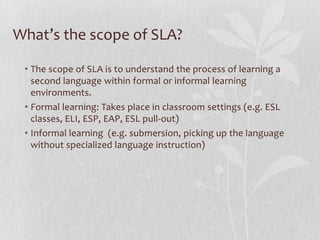
What’s the scope of SLA?
• The scope of SLA is to understand the process of learning a
second language within formal or informal learning
environments.
• Formal learning: Takes place in classroom settings (e.g. ESL
classes, ELI, ESP, EAP, ESL pull-out)
• Informal learning (e.g. submersion, picking up the language
without specialized language instruction)
DIFFERENT
APPROACHES TO THE
STUDY OF SLA
Frameworks of SLA
• Linguistic
• Psychological
• Social
Brief Historical Sketch of the field
50s and before: Focus was on foreign language teaching. Structuralism as
the dominant linguistic model: Emphasis on different levels of production
in speech (phonology, morphology, syntax, semantics)
60s and 70s: Behaviorist account of learning. What do learners bring the act
of acquisition? How do learners transfer from L1?
70s: Acquisition orders (e.g. morpheme studies). Error analysis. This period
was marked by research on non-classroom learners. Inapplicable to
classroom learning.
80s: Krashen’s ideas on acquisition (Monitor theory. Acquisition vs. learning
and input hypothesis). Also, critical review of his ideas. One question left
unanswered: If all learners needed exposure to input, why were so many
L2 learners are still non-native-like?
Historical Sketch Cont.
• 90s Application of linguistic theory and the application of psychological
approaches:
Scholarship continued to focus on the nature of learners’ internal mental
representation. Scholars said language is uniquely human, is encapsulated
in its own module in the brain (Black box), and it comes from birth with a
set of language specific constraints, called Universal Grammar.
• 2000s and beyond: The increasing influence of sociocultural theories,
critical pedagogy and feminist perspectives on language learning:
Microfocus and macrofocus. Focus on learner differences learner
environment, interactions (spoken and written), social and political
context.
IMPORTANT: We make no presumption that any one of these approaches
(linguistic, psychological, socio-cultural, critical) are better or more
privileged than the others. To gain a complete picture of language
learning process, one needs to consider multiple aspects.
Behaviorist account of SLA
• Learning is equated with habit formation (see the Pavlov’s dog
example). Learning means acquisition of new behavior. One
develop responses to environmental stimulus.
• Classic conditioning through Stimulus-response (e.g. when the
dogs heard the sound (the stimulus), they anticipated a meal, and
they would begin salivating (the response). Because of the repeated
association of the sound with food, after a series of trials the sound
alone caused the dogs to salivate.)
• Continuous repetition is a crucial factor for learning.
• With reinforcement and punishment animals learn new behavior.
• No mental process. Learning is a result of a respond to a stimulus.
Behaviorist approaches to SLA
• Second language acquisition takes place if the learner:
1. Imitate the language repeatedly.
2. Reinforcement of accurate forms of language (e.g. catcats,
dog dogs)
3. “Good habits required repeated engagement in the target
behavior-in this case, the production of the L2.”
Differences between L1 and L2 acquisition according to
behaviorist accounts
• For L2 learning, individuals have already acquired certain set of language
skills.
• Models should be accurate and abundant.
• Reinforcement by a large number of language models.
• Students imitating the model repeatedly.
• Teachers giving positive feedback for accurate imitations, and correction
of inaccurate ones (negative evidence vs. positive evidence)
• Differences between L1 and L2 were detected via Contrastive Analysis
(CA)
CA: Wherever languages were similar, there would be positive transfer;
that is, learners would have little difficulty because they would simply be
able to use their old habits in a new context. If the two languages were
different-or two seemingly comparable structures were different-there
would be negative transfer, resulting in learner difficulty and error.
Behaviorism applied in SLA
• Second language learning is variable in its outcome: Learners
who experience different environmental stimuli will experience
different levels of eventual attainment. If learners have
different level of exposure or receive different levels of
feedback, they may differ in their level of language attainment
• Exposure to input is necessary for SLA: Input as stimulus for
habit formation. Environment was seen as a controlling factor
in language learning.
Behaviorism applied to SLA
• Contrastive Analysis Hypothesis focused on the similarities
and differences of learners’ first and second language.
• According to this perspective, learners whose L1 is similar to
L2 will have less difficulty in learning in second language.
• Larsen-freeman(1991) states where two languages are
similar, positive transfer would occur; where they were
different negative transfer, or interference, would result.”
Structural Linguistics
The main question that the structural linguists try to address:
Why do the language operate as it does
Language is portrayed as based on a discrete and finite set of
patterns (matches well with behaviorism, which viewed
learning as the acquisition of set of behaviors)
• The field of SLA at this time viewed language learning as the
imitation and internalization of language patterns.
• Unsuccessful learning took place because of language transfer
from L1: Negative transfer resulted in learners’ committing
language errors.
Criticism towards behaviorism
• Behaviorism is viewed as an ability to inductively discover patterns of
rule governed behavior from the examples provided by the learners’
environment.
• Comparing languages to predict learners’ errors did not help teachers
in the class.
• Corder (1967)—importance of errors: errors do not need to be
treated or surprised as bad habits but they need to be analyzed
carefully since they are evidence of learning
• Selinker (1972)– learners generate unique grammar: interlanguage.
Unique linguistic system that learners create as they attempt to
produce the target language.
• Chomsky’s revolutionary views on language: LAD includes UG which
is indispensible for the child’s ability to acquire his or her native
language.
Reactions to behaviorism (habit formation,
imitation, reinforcement)
--Reactions to Behaviorism: Piage (field of psychology), Chomsky
(linguistics) How can then children has an innate capacity of
learning language and can produce new sentences without
imitation?
• Cognitive/Mentalist views: Chomsky’s Language Acquisition Devise
(LAD), Universal Grammar:
Language as an innate process. children have an innate capacity of
learning language and they can reproduce new sentences they have
never heard before (Mitchell & Myles, 1998). He rejected a learning
theory, which compared animals’ learning simple tasks with
children’s learning a language without direct teaching (Mitchell
&Myles, 1998).
Innativism
• Coined by Noam Chomsky in reaction to what he saw as the
inadequacy of the behaviorist theory of learning.
• In this approach, individuals are believed to be biologically wired
for language (similar to other biological functions)
• The child does not have to be taught. Although language around
the child may not be grammatical (incomplete sentences, slip of
tongue etc.), they still acquire the language.
• Children are born with a special ability: LAD
• Child’s innate endowment: Universal Grammar : Set of principles
which are common to all languages.
According to the innatist position
• All children successfully learn the first language.
• Even children with limited cognitive ability develop complex
language system.
• Children successfully master basic structures of the native language.
• Children accomplish the complex task of language acquisition
without having someone constantly point out to them which of the
sentences they hear are correct.
The Critical period hypothesis (CPH)
• Coined by Lenneberg: Language acquisition like other biological
functions works successfully only when it is stimulated at the
right time—this is called critical period hypothesis!
• Animals, including humans are genetically programmed to
acquire certain kinds of knowledge and skills ate specific times
of life (Saville-Trokie, p. 22).
• Children who do not have access to language in infancy and
childhood will never acquire language (Examples: Victos, The
Wild Child and Genie: Provide evidence in support of CPH).
• Children control most of basic grammatical patterns before they
are 5 or 6. Complex patterns develop througut the school years.
Interactionist position
• Language develops as a result of the complex interplay
between the child and his/her environment.
• Language development is largely independed of the child’s
cognitive development.
• Strong proponent of Interactionist were Piaget and Vygotsky
• Jean Piaget: He tried to understand the development of child’s
cognitive abilities of such things as object permanence
(knowing that things that are hidden from sight are still there)
and logic inferencing. The use of certain words such as
“bigger”, “more” depend on the child’s understanding of the
concepts they represent.
Sociocultural Theory and Second Language
Learning
• “Language is not only a cognitive phenomenon, the product of the
individuals’ brain; it is also fundamentally social phenomenon,
acquired and used interactively, in a variety of contexts for myriad
practical purposes.” Firth &Wegner, 1997, p.297
• Attacks towards Chomsky’s “ideal speaker-listener in a completely
homogeneous speech community”
• Hymes criticized Chomsky for being formalistic and context free.
‘heterogeneous speech community’ (p.57)
• Language is not only viewed as codes but as ways of speaking, and
the structure of language is not grammar but speech act or speech
event.
• Key words: Communicative competence, heterogeneous speech
community, speech events.
FIRST LANGUAGE
ACQUISITION
Agenda, May 18 2013
Part 1 (9:00-10:30)
• First language acquisition
• Developmental sequence
• Pre-school years and school years
Part 2 (11:00-12:30)
• L1 acquisition in behaviorist, innatist and interactionist perspective
• Documentary: Secrets of wild child. The story of Genie.
http://www.youtube.com/watch?v=hmdycJQi4QA
• Discussion
Important concepts about L1 acquisition from Saville-Troike
• L1 as an innate capacity: language is programmed and each
human being is wired with a system to acquire language
• The rate of progression in childhood can vary while the
order of acquisition is invariant.
• Cut-off point for L1 acquisition: Critical Age Hypothesis
Discussion
• What developmental stages do children go through as they learn
their first language?
• Do you have any kids, nieces or nephews who are in the process of
acquiring their firs language? What observations do you have? Do
any of the information in L&S resonate with you?
The first three years
Children go through a developmental sequence for many aspects of their
L1. Babies are designed to discriminate similar sounds early on in their lives
(e.g. pa/ba)
1. Cooing Stage:
0-1: Mostly crying
1-4: Intonational Patterns
2.Babbling stage:
5 Months-9 months Responding to sound and auditory discrimination
3. One-word stage:
10-12 months: Understanding frequently repeated words (e.g.
juice, cookies, bye-bye)
4.Two-word stage:
12 months-24 months: Produce at least 50 different words (e.g. Mommy
Juice, Push truck). Telegraphic language where functional and grammatical
morphemes are missing.
Age 3-5
Fine-tuning stage:
Children produce 2-3 word sentences (e.g.: Daddy fell down, Daddy
dropped something)
Predictable developmental sequence: No use of abstract words such
as temporal space (e.g. tomorrow, yesterday)
Order of acquisition: Grammatical morphemes
Present progressive-ing (Mommy running)
Plural-s (two birds)
Irregular past verb forms (Baby went)
Possessive-s (Mommy’s)
Copula (Mommy is happy)
Articles (the, a/an)
Based on your experiences, what similarities do you notice among
the children at different ages? Which grammatical morphemes do
they find easy and which ones more difficult?
Negation
1. Stage one:
Expressed by the word “no”, as a word in utterence: No cookie
2. Stage two:
Utterances grow longer. Negation appears just before the verb:
Don’t touch that.
3. Stage three:
Negation is inserted in more complex sentences. Children learn how
to add forms of negatives such as “don’t”, “can’t”: I can’t do it.
4. Stage four:
Learning the correct form of auxiliary verbs such as do and be: I don’t
want supper. She doesn’t have candies.
Questions
1. Stage one:
Two-three word sentences with rising intonation. Cookie? Mommy
book?
2. Stage two:
Use word order of declarative sentence to ask questions. You like
this? I have some?
3. Stage three:
Noticing the structure of a question. Can I go the restroom? Are you
happy?
4. Stage four:
Forming more varieties in the auxiliary forms. Are you going to play
with me?
The pre-school and school years
• By age four, children can give commands, ask questions, create
stories, using correct grammatical markers most of the time
(L&S,P.12)
• They begin to develop metalinguistic awareness.
• They can understand what a “word” is.
EXPLAINING L1
THROUGH THEORATICAL
PERSPECTIVE
Behaviorist perspective
• Imitation:
Mother: Shall we play with the dolls?
Lucy: Play with dolls
• Practice:
Cindy: He eat carrot. They both eat carrot.
See the other examples on page 15-16.
The innatist perspectives
• Children’s minds are not blank slates to be filled by imitating the
language they hear in the environment.
• Children are born with an innate ability to discover the rules by
themselves: Children are pre-equipped by Universal Grammar.
E.g.: Jogn believes himself to be intelligent (John believes that
himself is intelligent.
• Most school aged children recognize the ungrammatical forms.
So, researchers who study L1 acquisition from innatist perspective
argue that grammar could never be learned purely on the basis of
imitating and practicing the available input.
• Watching the story of Genie: The Secret of Wild Child
• Discussion Facilitation Sign-up.

English 344 session 1

  • 1.
    Session # 1and 2 May 17-May 18, 2013 ENGLISH 344: THEORETICAL FOUNDATIONS IN TESOL
  • 2.
    Agenda, May 17th PartI (4:30-600) • Welcome and Introductions • Course Introduction • Introduction to the class blog • Course materials and assignments • Unpacking our assumptions on language learning Part II (6:20-8:00) • Common acronyms • Starting with a broader perspective: World Englishes and second language learning • Theoretical Framework in SLA/Learning Theories
  • 3.
    Course Objectives The mainobjectives of this course are as follows: • Explore fundamental concepts related to foreign and second language learning; • Learn interdisciplinary approaches to teaching and learning a second language in diverse educational settings; • Learn how a second language is acquired from linguistic, socio-cognitive, and sociocultural approach; • Demystify stereotypes and mainstream understandings concerning second language learning and English language learners.
  • 4.
    Course Materials 1. Saville-Troike,M. (2006). Introducing Second Language Acquisition. 2. Lightbown, P. & Spada, N. (2013). How languages are learned. Oxford Handbook for teachers. 3. Course blog and individual blog: http://theoreticalfoundationsintesol2013.blogspot.com/
  • 5.
    Course Assignments • ClassDiscussion • Learning Logs • Exams
  • 6.
    Unpacking our assumptionson language learning • Most of us have assumptions and ideas about how we learn and teach a second language. Before getting started with understanding research, it’s important to unveil some of our views on how languages are learned. • Read the statements in the introduction of L&S book and indicate whether you agree with each statement. After you complete your list, please discuss your results with a partner.
  • 7.
    What is SecondLanguage Acquisition (SLA)? • Gass and Selinker define SLA as the study of how learners create a new language system (p.1) • SLA has emerged from a field of study primarily from within linguistics and subfield such as Sociolinguistics and Applied Linguistics. • SLA is an interdisciplinary research field that focuses on learners and learning rather than teachers and teaching. • Questions we seek answers: 1. What exactly does the L2 learner come to know? 2. How does the learner acquire this knowledge? 3. Why are some learners more successful than others?
  • 8.
    Common distinctions inthe field • A first language • A second language • A foreign language • A library language • An auxiliary language • Language for specific purposes • Simultaneous multilingualism • Sequential multilingualism
  • 9.
    Discussion • List allthe languages that you can use (at any proficiency level). • Do you think you are a “good” or a “poor” L2 learner? Why? • What are some of the characteristics of a good language learner?
  • 10.
  • 11.
    The world ofsecond languages and “World Englishes”(Kachru) The Expanding Circle Chin China, Egypt, Indonesia, Israel, Japan, Korea, Nepal, Saudi Arabia, China, Egypt, Indonesia, Israel, Japan, Korea, Nepal, Saudi Arabia, Taiwan, Russia, Zimbabwe, South Africa, Caribbean Islands (EFL) Taiwan, Russia, Zimbabwe, South Africa, Caribbean Islands (EFL) a, Egypt, Indonesia, The Outer Circle Bangladesh, India Ghana, Kenya, Nigeria, Malaysia, Pakistan, Philippines, Singapore, Sri Lanka, Tanzania, Zambia The Inner Circle USA UK Canada Australia New Zealand
  • 12.
    • Different varietiesof Englishes around the globe--Linguistic diversity in present-day English use (Total number of L1 and L2 speakers of English is approximately 2.25 billion) • There are 350 million native English speakers living in the inner circle countries. • There are 700 million non-native English speakers in the expanding and outer circle countries. • More non-native speakers than native ones: About 80% of the English speakers of the world are non-native speakers (Braine, 2006) • The concept of WE allows for varieties in English usage. It allows us to pluralize English--Englishes WORLD ENGLISHES
  • 13.
    Who are Englishspeakers today? • The group of speakers whose proficiency levels range from reasonable to bilingual competence and who live outside of Inner circle countries. English has little or no official function: EFL • The group of speakers for whom English serves country-internal functions: ESL. • Growing English users who use English among themselves rather than with native English spreakers: English as a lingua franca (ELF)
  • 14.
    How many Englishesare there? MacArthur’s circle of English
  • 15.
    Questions TESOL educatorsand Applied Linguists ask about world Englishes 1. How are different world Englishes (socially) perceived? 2. How recognizable are different world Englishes? what factors influence this recognition? 3. How is English used in the world? how should it be used? (in part, code-switching and language policy) 4. How do world Englishes differ from each other or how are they similar (pidgins and creoles)?
  • 16.
    The world ofsecond languages: Complicating the term “native speaker” • Multilingualism/Bilingualism: ability to use two or more languages • Monolingualism • What are some of the main motivations for English language learning? (See the list on Saville-Troike, p.10)
  • 17.
    What’s the scopeof SLA? • The scope of SLA is to understand the process of learning a second language within formal or informal learning environments. • Formal learning: Takes place in classroom settings (e.g. ESL classes, ELI, ESP, EAP, ESL pull-out) • Informal learning (e.g. submersion, picking up the language without specialized language instruction)
  • 18.
  • 19.
    Frameworks of SLA •Linguistic • Psychological • Social
  • 20.
    Brief Historical Sketchof the field 50s and before: Focus was on foreign language teaching. Structuralism as the dominant linguistic model: Emphasis on different levels of production in speech (phonology, morphology, syntax, semantics) 60s and 70s: Behaviorist account of learning. What do learners bring the act of acquisition? How do learners transfer from L1? 70s: Acquisition orders (e.g. morpheme studies). Error analysis. This period was marked by research on non-classroom learners. Inapplicable to classroom learning. 80s: Krashen’s ideas on acquisition (Monitor theory. Acquisition vs. learning and input hypothesis). Also, critical review of his ideas. One question left unanswered: If all learners needed exposure to input, why were so many L2 learners are still non-native-like?
  • 21.
    Historical Sketch Cont. •90s Application of linguistic theory and the application of psychological approaches: Scholarship continued to focus on the nature of learners’ internal mental representation. Scholars said language is uniquely human, is encapsulated in its own module in the brain (Black box), and it comes from birth with a set of language specific constraints, called Universal Grammar. • 2000s and beyond: The increasing influence of sociocultural theories, critical pedagogy and feminist perspectives on language learning: Microfocus and macrofocus. Focus on learner differences learner environment, interactions (spoken and written), social and political context. IMPORTANT: We make no presumption that any one of these approaches (linguistic, psychological, socio-cultural, critical) are better or more privileged than the others. To gain a complete picture of language learning process, one needs to consider multiple aspects.
  • 22.
    Behaviorist account ofSLA • Learning is equated with habit formation (see the Pavlov’s dog example). Learning means acquisition of new behavior. One develop responses to environmental stimulus. • Classic conditioning through Stimulus-response (e.g. when the dogs heard the sound (the stimulus), they anticipated a meal, and they would begin salivating (the response). Because of the repeated association of the sound with food, after a series of trials the sound alone caused the dogs to salivate.) • Continuous repetition is a crucial factor for learning. • With reinforcement and punishment animals learn new behavior. • No mental process. Learning is a result of a respond to a stimulus.
  • 23.
    Behaviorist approaches toSLA • Second language acquisition takes place if the learner: 1. Imitate the language repeatedly. 2. Reinforcement of accurate forms of language (e.g. catcats, dog dogs) 3. “Good habits required repeated engagement in the target behavior-in this case, the production of the L2.”
  • 24.
    Differences between L1and L2 acquisition according to behaviorist accounts • For L2 learning, individuals have already acquired certain set of language skills. • Models should be accurate and abundant. • Reinforcement by a large number of language models. • Students imitating the model repeatedly. • Teachers giving positive feedback for accurate imitations, and correction of inaccurate ones (negative evidence vs. positive evidence) • Differences between L1 and L2 were detected via Contrastive Analysis (CA) CA: Wherever languages were similar, there would be positive transfer; that is, learners would have little difficulty because they would simply be able to use their old habits in a new context. If the two languages were different-or two seemingly comparable structures were different-there would be negative transfer, resulting in learner difficulty and error.
  • 25.
    Behaviorism applied inSLA • Second language learning is variable in its outcome: Learners who experience different environmental stimuli will experience different levels of eventual attainment. If learners have different level of exposure or receive different levels of feedback, they may differ in their level of language attainment • Exposure to input is necessary for SLA: Input as stimulus for habit formation. Environment was seen as a controlling factor in language learning.
  • 26.
    Behaviorism applied toSLA • Contrastive Analysis Hypothesis focused on the similarities and differences of learners’ first and second language. • According to this perspective, learners whose L1 is similar to L2 will have less difficulty in learning in second language. • Larsen-freeman(1991) states where two languages are similar, positive transfer would occur; where they were different negative transfer, or interference, would result.”
  • 27.
    Structural Linguistics The mainquestion that the structural linguists try to address: Why do the language operate as it does Language is portrayed as based on a discrete and finite set of patterns (matches well with behaviorism, which viewed learning as the acquisition of set of behaviors) • The field of SLA at this time viewed language learning as the imitation and internalization of language patterns. • Unsuccessful learning took place because of language transfer from L1: Negative transfer resulted in learners’ committing language errors.
  • 28.
    Criticism towards behaviorism •Behaviorism is viewed as an ability to inductively discover patterns of rule governed behavior from the examples provided by the learners’ environment. • Comparing languages to predict learners’ errors did not help teachers in the class. • Corder (1967)—importance of errors: errors do not need to be treated or surprised as bad habits but they need to be analyzed carefully since they are evidence of learning • Selinker (1972)– learners generate unique grammar: interlanguage. Unique linguistic system that learners create as they attempt to produce the target language. • Chomsky’s revolutionary views on language: LAD includes UG which is indispensible for the child’s ability to acquire his or her native language.
  • 29.
    Reactions to behaviorism(habit formation, imitation, reinforcement) --Reactions to Behaviorism: Piage (field of psychology), Chomsky (linguistics) How can then children has an innate capacity of learning language and can produce new sentences without imitation? • Cognitive/Mentalist views: Chomsky’s Language Acquisition Devise (LAD), Universal Grammar: Language as an innate process. children have an innate capacity of learning language and they can reproduce new sentences they have never heard before (Mitchell & Myles, 1998). He rejected a learning theory, which compared animals’ learning simple tasks with children’s learning a language without direct teaching (Mitchell &Myles, 1998).
  • 30.
    Innativism • Coined byNoam Chomsky in reaction to what he saw as the inadequacy of the behaviorist theory of learning. • In this approach, individuals are believed to be biologically wired for language (similar to other biological functions) • The child does not have to be taught. Although language around the child may not be grammatical (incomplete sentences, slip of tongue etc.), they still acquire the language. • Children are born with a special ability: LAD • Child’s innate endowment: Universal Grammar : Set of principles which are common to all languages.
  • 31.
    According to theinnatist position • All children successfully learn the first language. • Even children with limited cognitive ability develop complex language system. • Children successfully master basic structures of the native language. • Children accomplish the complex task of language acquisition without having someone constantly point out to them which of the sentences they hear are correct.
  • 32.
    The Critical periodhypothesis (CPH) • Coined by Lenneberg: Language acquisition like other biological functions works successfully only when it is stimulated at the right time—this is called critical period hypothesis! • Animals, including humans are genetically programmed to acquire certain kinds of knowledge and skills ate specific times of life (Saville-Trokie, p. 22). • Children who do not have access to language in infancy and childhood will never acquire language (Examples: Victos, The Wild Child and Genie: Provide evidence in support of CPH). • Children control most of basic grammatical patterns before they are 5 or 6. Complex patterns develop througut the school years.
  • 33.
    Interactionist position • Languagedevelops as a result of the complex interplay between the child and his/her environment. • Language development is largely independed of the child’s cognitive development. • Strong proponent of Interactionist were Piaget and Vygotsky • Jean Piaget: He tried to understand the development of child’s cognitive abilities of such things as object permanence (knowing that things that are hidden from sight are still there) and logic inferencing. The use of certain words such as “bigger”, “more” depend on the child’s understanding of the concepts they represent.
  • 34.
    Sociocultural Theory andSecond Language Learning • “Language is not only a cognitive phenomenon, the product of the individuals’ brain; it is also fundamentally social phenomenon, acquired and used interactively, in a variety of contexts for myriad practical purposes.” Firth &Wegner, 1997, p.297 • Attacks towards Chomsky’s “ideal speaker-listener in a completely homogeneous speech community” • Hymes criticized Chomsky for being formalistic and context free. ‘heterogeneous speech community’ (p.57) • Language is not only viewed as codes but as ways of speaking, and the structure of language is not grammar but speech act or speech event. • Key words: Communicative competence, heterogeneous speech community, speech events.
  • 35.
  • 36.
    Agenda, May 182013 Part 1 (9:00-10:30) • First language acquisition • Developmental sequence • Pre-school years and school years Part 2 (11:00-12:30) • L1 acquisition in behaviorist, innatist and interactionist perspective • Documentary: Secrets of wild child. The story of Genie. http://www.youtube.com/watch?v=hmdycJQi4QA • Discussion
  • 37.
    Important concepts aboutL1 acquisition from Saville-Troike • L1 as an innate capacity: language is programmed and each human being is wired with a system to acquire language • The rate of progression in childhood can vary while the order of acquisition is invariant. • Cut-off point for L1 acquisition: Critical Age Hypothesis
  • 38.
    Discussion • What developmentalstages do children go through as they learn their first language? • Do you have any kids, nieces or nephews who are in the process of acquiring their firs language? What observations do you have? Do any of the information in L&S resonate with you?
  • 39.
    The first threeyears Children go through a developmental sequence for many aspects of their L1. Babies are designed to discriminate similar sounds early on in their lives (e.g. pa/ba) 1. Cooing Stage: 0-1: Mostly crying 1-4: Intonational Patterns 2.Babbling stage: 5 Months-9 months Responding to sound and auditory discrimination 3. One-word stage: 10-12 months: Understanding frequently repeated words (e.g. juice, cookies, bye-bye) 4.Two-word stage: 12 months-24 months: Produce at least 50 different words (e.g. Mommy Juice, Push truck). Telegraphic language where functional and grammatical morphemes are missing.
  • 40.
    Age 3-5 Fine-tuning stage: Childrenproduce 2-3 word sentences (e.g.: Daddy fell down, Daddy dropped something) Predictable developmental sequence: No use of abstract words such as temporal space (e.g. tomorrow, yesterday)
  • 41.
    Order of acquisition:Grammatical morphemes Present progressive-ing (Mommy running) Plural-s (two birds) Irregular past verb forms (Baby went) Possessive-s (Mommy’s) Copula (Mommy is happy) Articles (the, a/an) Based on your experiences, what similarities do you notice among the children at different ages? Which grammatical morphemes do they find easy and which ones more difficult?
  • 42.
    Negation 1. Stage one: Expressedby the word “no”, as a word in utterence: No cookie 2. Stage two: Utterances grow longer. Negation appears just before the verb: Don’t touch that. 3. Stage three: Negation is inserted in more complex sentences. Children learn how to add forms of negatives such as “don’t”, “can’t”: I can’t do it. 4. Stage four: Learning the correct form of auxiliary verbs such as do and be: I don’t want supper. She doesn’t have candies.
  • 43.
    Questions 1. Stage one: Two-threeword sentences with rising intonation. Cookie? Mommy book? 2. Stage two: Use word order of declarative sentence to ask questions. You like this? I have some? 3. Stage three: Noticing the structure of a question. Can I go the restroom? Are you happy? 4. Stage four: Forming more varieties in the auxiliary forms. Are you going to play with me?
  • 44.
    The pre-school andschool years • By age four, children can give commands, ask questions, create stories, using correct grammatical markers most of the time (L&S,P.12) • They begin to develop metalinguistic awareness. • They can understand what a “word” is.
  • 45.
  • 46.
    Behaviorist perspective • Imitation: Mother:Shall we play with the dolls? Lucy: Play with dolls • Practice: Cindy: He eat carrot. They both eat carrot. See the other examples on page 15-16.
  • 47.
    The innatist perspectives •Children’s minds are not blank slates to be filled by imitating the language they hear in the environment. • Children are born with an innate ability to discover the rules by themselves: Children are pre-equipped by Universal Grammar. E.g.: Jogn believes himself to be intelligent (John believes that himself is intelligent. • Most school aged children recognize the ungrammatical forms. So, researchers who study L1 acquisition from innatist perspective argue that grammar could never be learned purely on the basis of imitating and practicing the available input.
  • 48.
    • Watching thestory of Genie: The Secret of Wild Child • Discussion Facilitation Sign-up.

Editor's Notes

  • #30 In this view, learning is viewed as a process of recalling what people have already seen and absorbed. For Plato, teaching therefore is helping learners to remember. Locke, on the other hand assumed that humans are “biologically wired” but they need to experience in order to form knowledge and activate their capacities (Phillips & Soltis, 2004). Similar to Locke and Plato’s ideas, behaviorists also think that humans are equipped with innate knowledge and it is in the interaction with the environment that they can learn. Behaviorist account viewed learning in terms of imitation, reinforcement, and habit formation. In Phillips & Soltis’s words, behaviorist orientation “ is easy for educators to master and put to good use; rewarding desirable behavior, and extinguishing (or even punishing) poor behavior, are techniques that all teachers can master”(Phillips & Soltis, 2004 p.29). Chomsky: Chomsky (1959), in his critique emphasized that children have an innate capacity of learning language and they can reproduce new sentences they have never heard before (Mitchell & Myles, 1998). He rejected a learning theory, which compared animals’ learning simple tasks with children’s learning a language without direct teaching (Mitchell &Myles, 1998).
  • #35 Contrary to Chomskian cognitive theories, this view implies that language is socially constructed rather than linguistically intrinsic. As discussed above, the linguistic theory of Chomsky, which asserts an “ideal speaker-listener in a completely homogenous speech community”(Chomsky, 1965, p.3), brought the terms such as ‘language acquisition devise’, ‘universal grammar’ and ‘transformational generative grammar’ to the field of SLA. However, Hymes criticized Chomsky as being ‘formalistic and context-free’ (Hymes, 1972).