MANAGEMENT
RICHARD L. DAFT
Motivating Employees
CHAPTER 15
chapter15
Copyright ©2010 by South-Western, a division of
Cengage Learning. All rights reserved.
3
Learning Outcomes
• Define motivation and explain the difference between current
approaches and traditional approaches to motivation.
• Identify and describe content theories of motivation based on
employee needs.
• Identify and explain process theories of motivation.
• Describe reinforcement theory and how it can be used to motivate
employees.
• Discuss major approaches to job design and how job design
influences motivation.
• Explain how empowerment heightens employee motivation.
• Describe ways that managers can create a sense of meaning and
importance for employees at work.
chapter15
Copyright ©2010 by South-Western, a division of
Cengage Learning. All rights reserved.
4
Are You Engaged or
Disengaged?
• Employee Engagement
– Most people begin new jobs with energy and
enthusiasm
– Employees can lose their drive
• Motivated and engaged employees contribute to
organizational success
• But motivation is a challenge for managers….
chapter15
Copyright ©2010 by South-Western, a division of
Cengage Learning. All rights reserved.
5
Concept of Motivation
Arousal, direction, and persistence of behavior
Employee motivation affects productivity.
A manager’s job is to channel motivation.
chapter15
Copyright ©2010 by South-Western, a division of
Cengage Learning. All rights reserved.
6
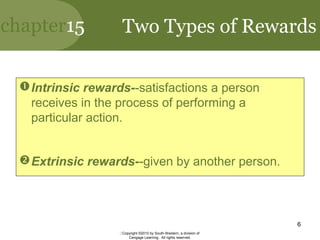
Two Types of Rewards
Intrinsic rewards--satisfactions a person
receives in the process of performing a
particular action.
Extrinsic rewards--given by another person.
chapter15
Copyright ©2010 by South-Western, a division of
Cengage Learning. All rights reserved.
7
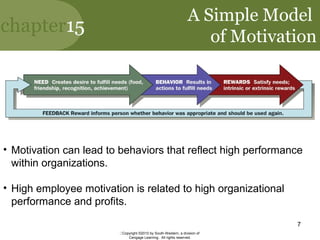
A Simple Model
of Motivation
• Motivation can lead to behaviors that reflect high performance
within organizations.
• High employee motivation is related to high organizational
performance and profits.
chapter15
Copyright ©2010 by South-Western, a division of
Cengage Learning. All rights reserved.
8
Content Perspectives
on Motivation
• Hierarchy of Needs Theory
• ERG Theory
• Two-Factor Theory
• Acquired Needs Theory
These theories emphasize the needs that motivate people.
chapter15
Copyright ©2010 by South-Western, a division of
Cengage Learning. All rights reserved.
9
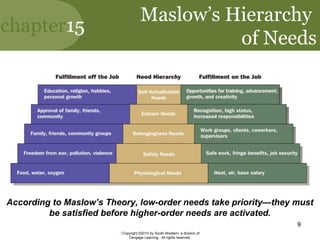
Maslow’s Hierarchy
of Needs
According to Maslow’s Theory, low-order needs take priority—they must
be satisfied before higher-order needs are activated.
chapter15
Copyright ©2010 by South-Western, a division of
Cengage Learning. All rights reserved.
10
Maslow’s Hierarchy
of Needs
Once a need is satisfied, it declines in
importance and the next higher need is
activated
There are opportunities for fulfillment off
the job and on the job in each of the five
levels of needs
chapter15
Copyright ©2010 by South-Western, a division of
Cengage Learning. All rights reserved.
11
ERG Theory
• ERG is a simplification of Maslow.
• Three categories of needs:
– Existence needs. The needs for physical
well-being.
– Relatedness needs. The needs for
satisfactory relationships with others.
– Growth needs. The needs that focus on the
development of human potential and the
desire for personal growth.
chapter15
Copyright ©2010 by South-Western, a division of
Cengage Learning. All rights reserved.
12
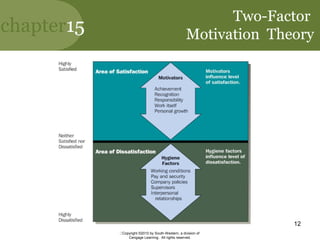
Two-Factor
Motivation Theory
chapter15
• Memotivasi pegawai adalah seni.
• Setiap pegawai memiliki kebutuhan yang
berbeda (cara memotivasi yang berbeda)
• Motivasi yang paling mengena adalah
motivasi dari hati (human/communication
skill)
• Reward over punishment, wortel lalu
tongkat, commitment over sistem.
Copyright ©2010 by South-Western, a division of
Cengage Learning. All rights reserved.
13
chapter15
Copyright ©2010 by South-Western, a division of
Cengage Learning. All rights reserved.
14
Acquired Needs Theory
• Need for Achievement. desire to accomplish
something difficult, master complex tasks, and
surpass others.
• Need for Affiliation. desire to form close personal
relationships, avoid conflict, and establish warm
friendships.
• Need for Power. desire to influence or control
others.
chapter15
Copyright ©2010 by South-Western, a division of
Cengage Learning. All rights reserved.
15
Process Perspectives
on Motivation
• Goal-Setting Theory
• Equity Theory
• Expectancy Theory
These theories explain how people select behavioral
actions to meet their needs.
chapter15
Copyright ©2010 by South-Western, a division of
Cengage Learning. All rights reserved.
16
Goal-Setting
• Specific, challenging targets significantly
enhance people’s motivation and
performance.
• Managers can improve performance by
setting specific goals.
• Goal-setting theory requires:
– Specific Goals
– Difficult Goals
– Acceptance
– Feedback
chapter15
Copyright ©2010 by South-Western, a division of
Cengage Learning. All rights reserved.
17
Equity Theory
Focuses on individuals’ perceptions
of how fairly they are treated
compared with others
Motivated to seek social equity in the
rewards they expect for performance
chapter15
Copyright ©2010 by South-Western, a division of
Cengage Learning. All rights reserved.
18
Methods for Reducing
Perceived Inequities
• Change Work Efforts
• Change Outcomes
• Change Perceptions
• Leave the Job
Employees evaluate the perceived equity of their
rewards compared to others’.
chapter15
Copyright ©2010 by South-Western, a division of
Cengage Learning. All rights reserved.
19
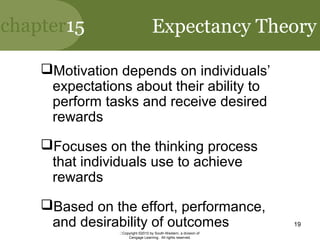
Expectancy Theory
Motivation depends on individuals’
expectations about their ability to
perform tasks and receive desired
rewards
Focuses on the thinking process
that individuals use to achieve
rewards
Based on the effort, performance,
and desirability of outcomes
chapter15
Copyright ©2010 by South-Western, a division of
Cengage Learning. All rights reserved.
20
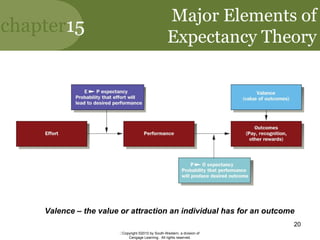
Major Elements of
Expectancy Theory
Valence – the value or attraction an individual has for an outcome
chapter15
Copyright ©2010 by South-Western, a division of
Cengage Learning. All rights reserved.
21
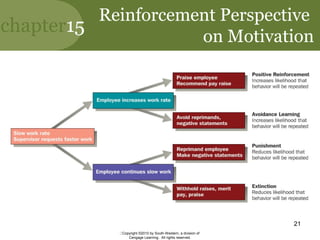
Reinforcement Perspective
on Motivation
chapter15
Copyright ©2010 by South-Western, a division of
Cengage Learning. All rights reserved.
22
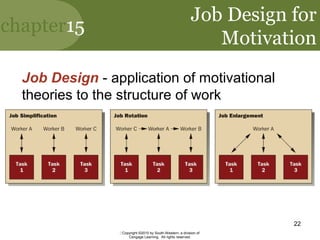
Job Design for
Motivation
Job Design - application of motivational
theories to the structure of work
chapter15
Copyright ©2010 by South-Western, a division of
Cengage Learning. All rights reserved.
23
Job Design for
Motivation
Job Simplification - improve task efficiency
by reducing the number of tasks
Job Rotation - moving employees from one
job to another to provide them with variety and
stimulation
Job Enlargement - combining a series of
tasks into one new, broader job to give
employees variety and challenge
chapter15
Copyright ©2010 by South-Western, a division of
Cengage Learning. All rights reserved.
24
Job Design for
Motivation
Job Enrichment - incorporating
achievement, recognition, and other high-
level motivators into the work
Work redesign – altering jobs to increase
both the quality of employee’s work
experience and their productivity
chapter15
Copyright ©2010 by South-Western, a division of
Cengage Learning. All rights reserved.
25
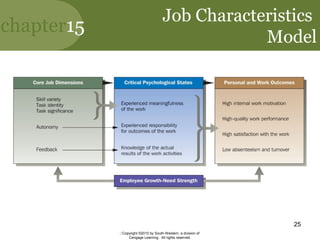
Job Characteristics
Model
chapter15
Copyright ©2010 by South-Western, a division of
Cengage Learning. All rights reserved.
26
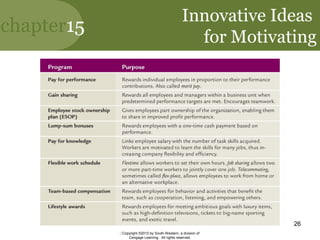
Innovative Ideas
for Motivating
chapter15
Copyright ©2010 by South-Western, a division of
Cengage Learning. All rights reserved.
27
Empowering People
to Meet Higher Needs
 Information - Employees receive
information about company performance
 Knowledge - Employees have knowledge
and skills to contribute to company goals
 Power - Employees have the power to
make substantive decisions
 Rewards - Employees are rewarded based
on the company performance
chapter15
Copyright ©2010 by South-Western, a division of
Cengage Learning. All rights reserved.
28
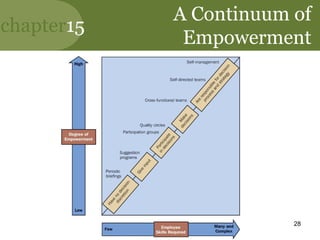
A Continuum of
Empowerment
chapter15
Copyright ©2010 by South-Western, a division of
Cengage Learning. All rights reserved.
29
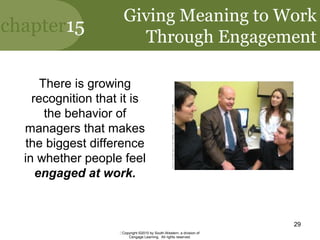
Giving Meaning to Work
Through Engagement
There is growing
recognition that it is
the behavior of
managers that makes
the biggest difference
in whether people feel
engaged at work.

9e daft chapter_15_motivating_employees

  • 1.
  • 2.
  • 3.
    chapter15 Copyright ©2010 bySouth-Western, a division of Cengage Learning. All rights reserved. 3 Learning Outcomes • Define motivation and explain the difference between current approaches and traditional approaches to motivation. • Identify and describe content theories of motivation based on employee needs. • Identify and explain process theories of motivation. • Describe reinforcement theory and how it can be used to motivate employees. • Discuss major approaches to job design and how job design influences motivation. • Explain how empowerment heightens employee motivation. • Describe ways that managers can create a sense of meaning and importance for employees at work.
  • 4.
    chapter15 Copyright ©2010 bySouth-Western, a division of Cengage Learning. All rights reserved. 4 Are You Engaged or Disengaged? • Employee Engagement – Most people begin new jobs with energy and enthusiasm – Employees can lose their drive • Motivated and engaged employees contribute to organizational success • But motivation is a challenge for managers….
  • 5.
    chapter15 Copyright ©2010 bySouth-Western, a division of Cengage Learning. All rights reserved. 5 Concept of Motivation Arousal, direction, and persistence of behavior Employee motivation affects productivity. A manager’s job is to channel motivation.
  • 6.
    chapter15 Copyright ©2010 bySouth-Western, a division of Cengage Learning. All rights reserved. 6 Two Types of Rewards Intrinsic rewards--satisfactions a person receives in the process of performing a particular action. Extrinsic rewards--given by another person.
  • 7.
    chapter15 Copyright ©2010 bySouth-Western, a division of Cengage Learning. All rights reserved. 7 A Simple Model of Motivation • Motivation can lead to behaviors that reflect high performance within organizations. • High employee motivation is related to high organizational performance and profits.
  • 8.
    chapter15 Copyright ©2010 bySouth-Western, a division of Cengage Learning. All rights reserved. 8 Content Perspectives on Motivation • Hierarchy of Needs Theory • ERG Theory • Two-Factor Theory • Acquired Needs Theory These theories emphasize the needs that motivate people.
  • 9.
    chapter15 Copyright ©2010 bySouth-Western, a division of Cengage Learning. All rights reserved. 9 Maslow’s Hierarchy of Needs According to Maslow’s Theory, low-order needs take priority—they must be satisfied before higher-order needs are activated.
  • 10.
    chapter15 Copyright ©2010 bySouth-Western, a division of Cengage Learning. All rights reserved. 10 Maslow’s Hierarchy of Needs Once a need is satisfied, it declines in importance and the next higher need is activated There are opportunities for fulfillment off the job and on the job in each of the five levels of needs
  • 11.
    chapter15 Copyright ©2010 bySouth-Western, a division of Cengage Learning. All rights reserved. 11 ERG Theory • ERG is a simplification of Maslow. • Three categories of needs: – Existence needs. The needs for physical well-being. – Relatedness needs. The needs for satisfactory relationships with others. – Growth needs. The needs that focus on the development of human potential and the desire for personal growth.
  • 12.
    chapter15 Copyright ©2010 bySouth-Western, a division of Cengage Learning. All rights reserved. 12 Two-Factor Motivation Theory
  • 13.
    chapter15 • Memotivasi pegawaiadalah seni. • Setiap pegawai memiliki kebutuhan yang berbeda (cara memotivasi yang berbeda) • Motivasi yang paling mengena adalah motivasi dari hati (human/communication skill) • Reward over punishment, wortel lalu tongkat, commitment over sistem. Copyright ©2010 by South-Western, a division of Cengage Learning. All rights reserved. 13
  • 14.
    chapter15 Copyright ©2010 bySouth-Western, a division of Cengage Learning. All rights reserved. 14 Acquired Needs Theory • Need for Achievement. desire to accomplish something difficult, master complex tasks, and surpass others. • Need for Affiliation. desire to form close personal relationships, avoid conflict, and establish warm friendships. • Need for Power. desire to influence or control others.
  • 15.
    chapter15 Copyright ©2010 bySouth-Western, a division of Cengage Learning. All rights reserved. 15 Process Perspectives on Motivation • Goal-Setting Theory • Equity Theory • Expectancy Theory These theories explain how people select behavioral actions to meet their needs.
  • 16.
    chapter15 Copyright ©2010 bySouth-Western, a division of Cengage Learning. All rights reserved. 16 Goal-Setting • Specific, challenging targets significantly enhance people’s motivation and performance. • Managers can improve performance by setting specific goals. • Goal-setting theory requires: – Specific Goals – Difficult Goals – Acceptance – Feedback
  • 17.
    chapter15 Copyright ©2010 bySouth-Western, a division of Cengage Learning. All rights reserved. 17 Equity Theory Focuses on individuals’ perceptions of how fairly they are treated compared with others Motivated to seek social equity in the rewards they expect for performance
  • 18.
    chapter15 Copyright ©2010 bySouth-Western, a division of Cengage Learning. All rights reserved. 18 Methods for Reducing Perceived Inequities • Change Work Efforts • Change Outcomes • Change Perceptions • Leave the Job Employees evaluate the perceived equity of their rewards compared to others’.
  • 19.
    chapter15 Copyright ©2010 bySouth-Western, a division of Cengage Learning. All rights reserved. 19 Expectancy Theory Motivation depends on individuals’ expectations about their ability to perform tasks and receive desired rewards Focuses on the thinking process that individuals use to achieve rewards Based on the effort, performance, and desirability of outcomes
  • 20.
    chapter15 Copyright ©2010 bySouth-Western, a division of Cengage Learning. All rights reserved. 20 Major Elements of Expectancy Theory Valence – the value or attraction an individual has for an outcome
  • 21.
    chapter15 Copyright ©2010 bySouth-Western, a division of Cengage Learning. All rights reserved. 21 Reinforcement Perspective on Motivation
  • 22.
    chapter15 Copyright ©2010 bySouth-Western, a division of Cengage Learning. All rights reserved. 22 Job Design for Motivation Job Design - application of motivational theories to the structure of work
  • 23.
    chapter15 Copyright ©2010 bySouth-Western, a division of Cengage Learning. All rights reserved. 23 Job Design for Motivation Job Simplification - improve task efficiency by reducing the number of tasks Job Rotation - moving employees from one job to another to provide them with variety and stimulation Job Enlargement - combining a series of tasks into one new, broader job to give employees variety and challenge
  • 24.
    chapter15 Copyright ©2010 bySouth-Western, a division of Cengage Learning. All rights reserved. 24 Job Design for Motivation Job Enrichment - incorporating achievement, recognition, and other high- level motivators into the work Work redesign – altering jobs to increase both the quality of employee’s work experience and their productivity
  • 25.
    chapter15 Copyright ©2010 bySouth-Western, a division of Cengage Learning. All rights reserved. 25 Job Characteristics Model
  • 26.
    chapter15 Copyright ©2010 bySouth-Western, a division of Cengage Learning. All rights reserved. 26 Innovative Ideas for Motivating
  • 27.
    chapter15 Copyright ©2010 bySouth-Western, a division of Cengage Learning. All rights reserved. 27 Empowering People to Meet Higher Needs  Information - Employees receive information about company performance  Knowledge - Employees have knowledge and skills to contribute to company goals  Power - Employees have the power to make substantive decisions  Rewards - Employees are rewarded based on the company performance
  • 28.
    chapter15 Copyright ©2010 bySouth-Western, a division of Cengage Learning. All rights reserved. 28 A Continuum of Empowerment
  • 29.
    chapter15 Copyright ©2010 bySouth-Western, a division of Cengage Learning. All rights reserved. 29 Giving Meaning to Work Through Engagement There is growing recognition that it is the behavior of managers that makes the biggest difference in whether people feel engaged at work.