FINANCIAL
PROJECTIONS
AND BUDGETS
Module 4:
 STRATEGIC PLAN
Is the grand plan of any
organization wherein the overall
objectives are set and specific
program are created in support of
the objectives.
ELEMENTS OF STRATEGIC PLAN
1. Vision Statement – is a description of what the
organization aspires to be in the long term.
2. Mission Statement – is the statement of the
organization’s core purpose. It provides direction
to the whole organization.
3. Corporate Objectives – these statements which
outline the specific goals, in line with the
mission, that an organization would like to
achieve.
4. Corporate Strategies – are the concrete programs for
specific business units, departments, and cross-
functional areas. The corporate strategies have to be
aligned with the mission-vision and the must all be
aimed at achieving the corporate objectives.
5. Departmental Plans and Programs – are synonymous
with operational plans. Departmental plans are specific
in terms of activities, the time lines, the targets, and the
budget per activity.
6. Financial Forecasts and Budgets – the financial
forecast and budgets tie everything together.
Department plans and programs, specific targets, and
forecasts are forecasts are made based on corporate
objectives.
STRENGTHS, WEAKNESSES,
OPPORTUNITIES, THREATS
One of the way through witch
managers can quickly assess the
situation of the company and make the
necessary plan of action is doing a
SWOT analysis.
 Strength – is a resource that is owned or controlled by or is
available to a firm. Strength will give a firm an advantage
over its competitors.
 Weaknesses – is a limitation which affects a firm’s position
relative to its competitors. Weaknesses may affect the way
the firm delivers products and services to customers.
 Opportunity – is a situation in the external environment
which the firm can take advantage of.
 Threat – is an unfavorable situation in firm’s external
environment which may adversely affect the way a firm
does business.
*SWOT stand for STRENGTHS, WEAKNESSESS,
OPPORTUNITIES, and THREATS.
 Financial Forecast
 Every strategic plan is culminated by the preparation of a
financial plan. Financial plans include forecasts.
*Sale forecast – is a projection of sales of a product or service
expressed either in units or absolute monetary value.
Factors that may affect future sale performance
 Inflation rate ( which affects the purchasing power of
consumers, thus also affecting buying behavior and spending
patterns)
 Trends in the market
 Investment climate ( when the economy is conductive for
investing, consumers tend to buy less of consumer products)
 PROJECTED FINANCIAL STATEMENTS
 is a financial projection that presents an
entity’s expected financial positions, results
of operations, and cash flows.
FACTORS OF PREPARING PROJECTED
FINANCIAL STATEMENTS
1. Market conditions – these include inflation,
competitiveness of specific industries, growth,
global markets, consumer demand, and spending
patterns of specific market segments.
2. Economy – this is taken into account if the
economy is thriving, plateauing, or slowing
down.
3. Investment climate – investors in securities and
other financial or investment products always try
to see whether the economy is bullish or bearish.
4. Competitive position of the firm in the
industry – whether a company is market leader, a
nicher (a firm whose marketing strategy is to focus
on a smaller market segment), or a challenger is a
huge determinant of sales, investments to be made,
and other expenses to be incurred in support of
operations.
5. SWOT – this is an analysis of the company’s
strengths and weaknesses, matched with the
opportunities and threats in its external
environment.
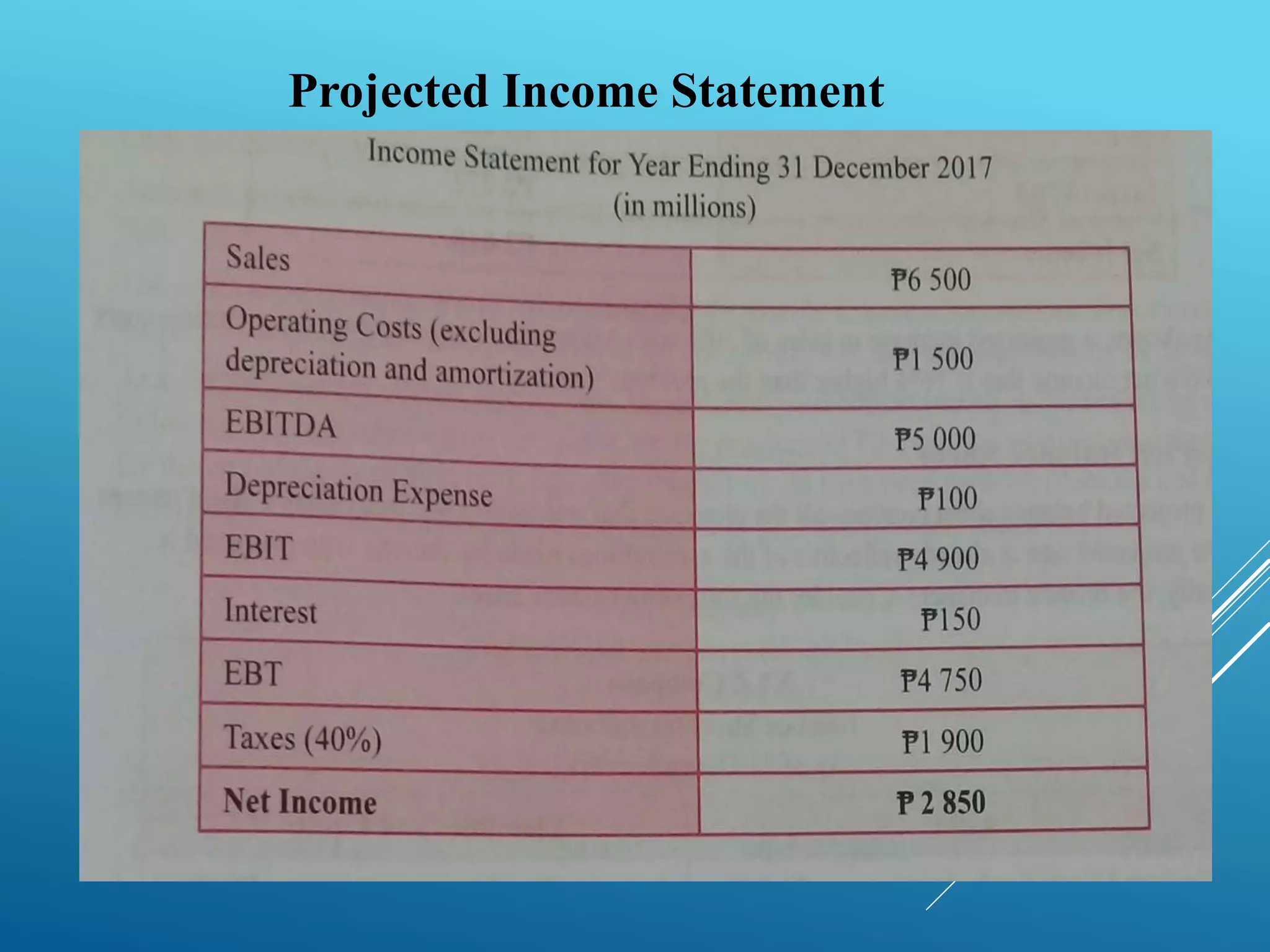
Projected Income Statement
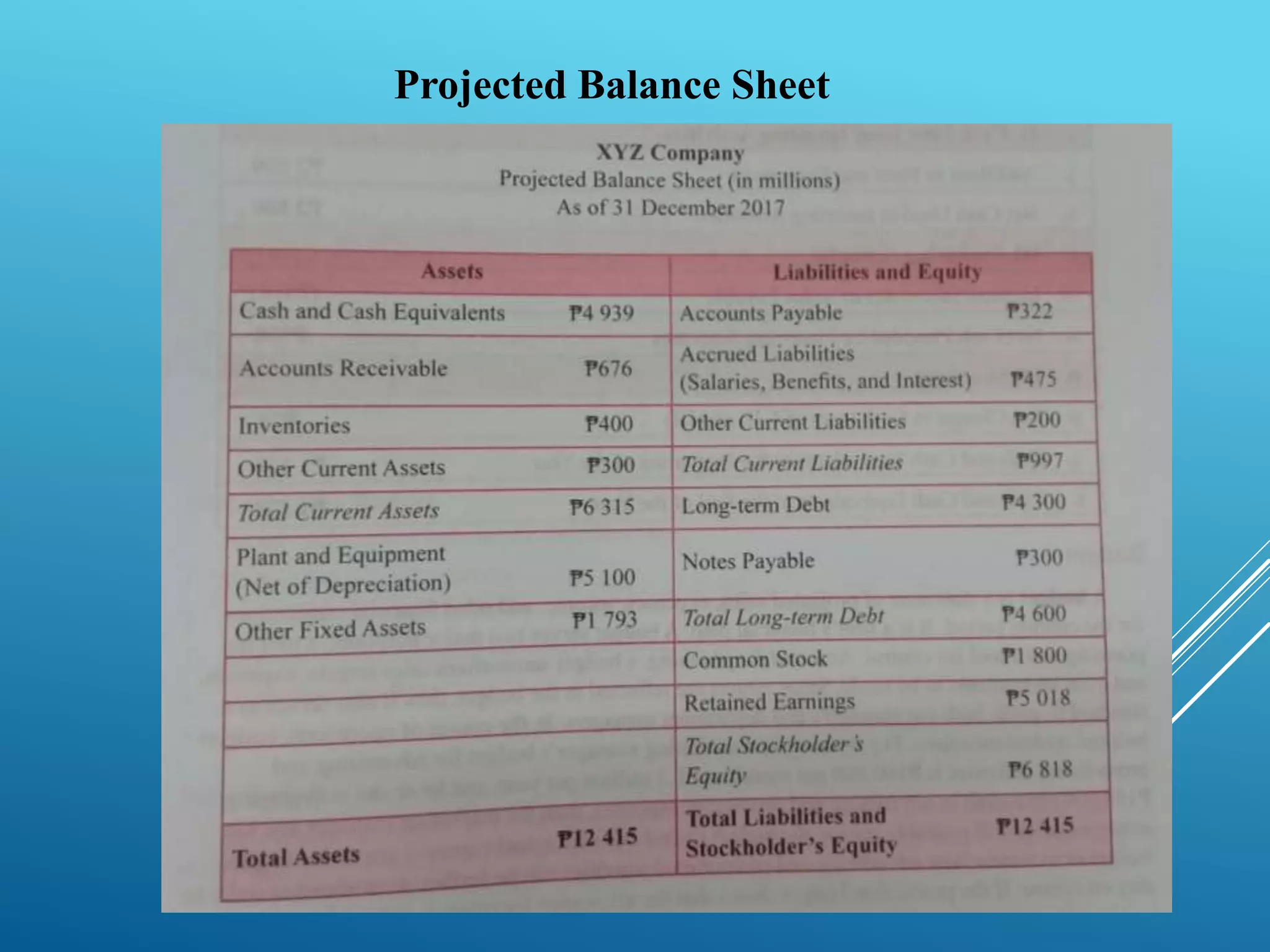
Projected Balance Sheet
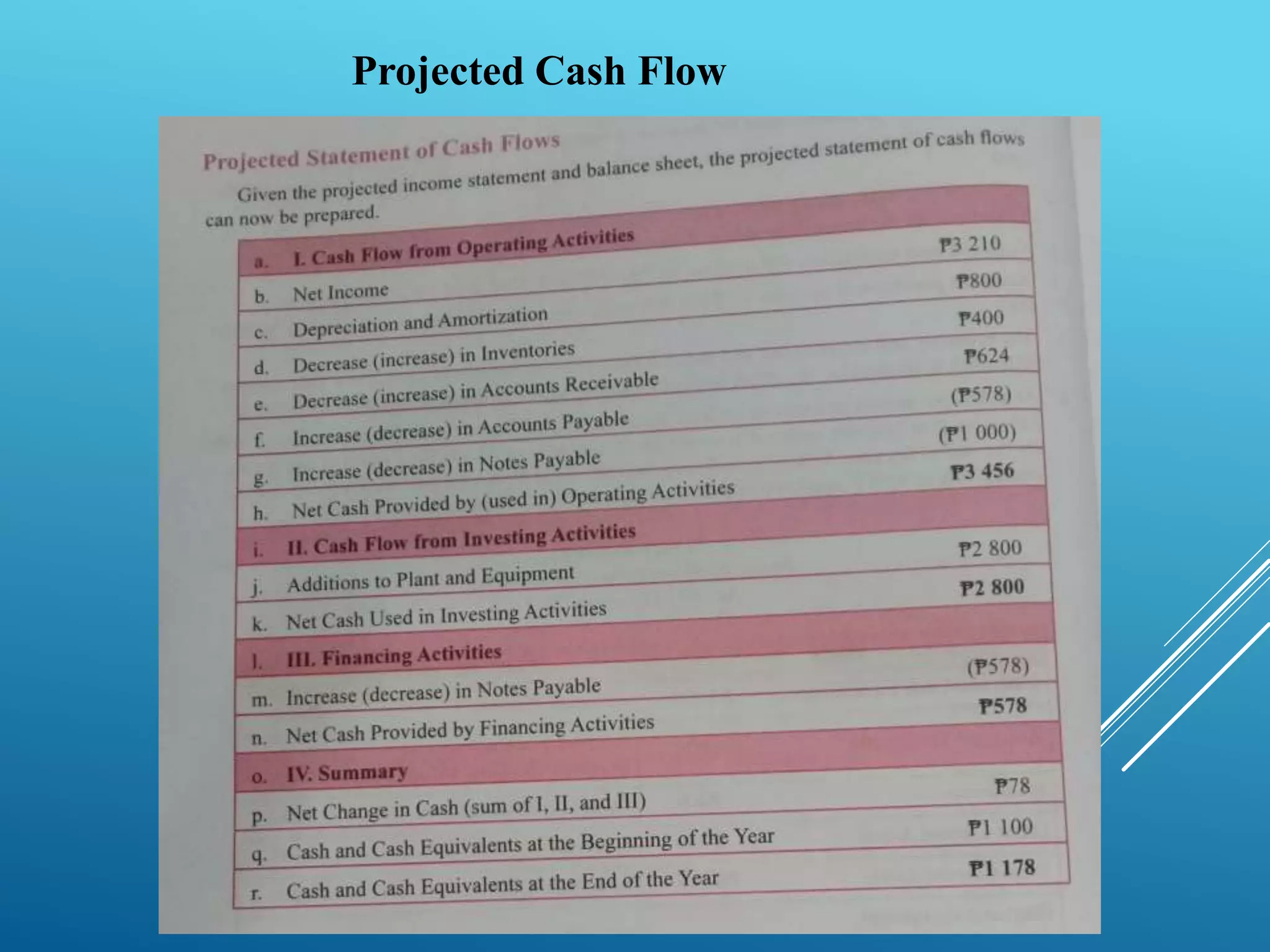
Projected Cash Flow
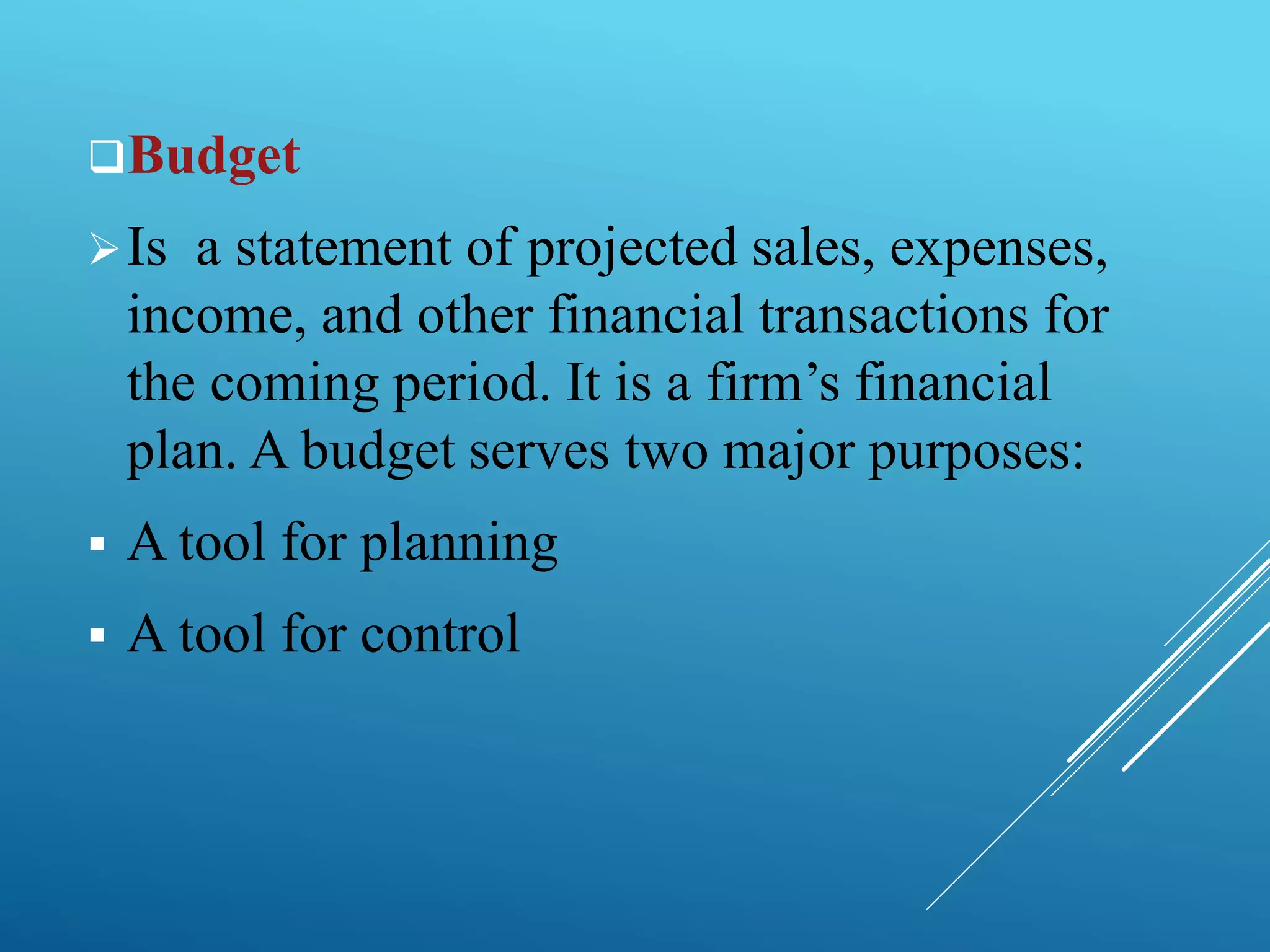
Budget
Is a statement of projected sales, expenses,
income, and other financial transactions for
the coming period. It is a firm’s financial
plan. A budget serves two major purposes:
 A tool for planning
 A tool for control
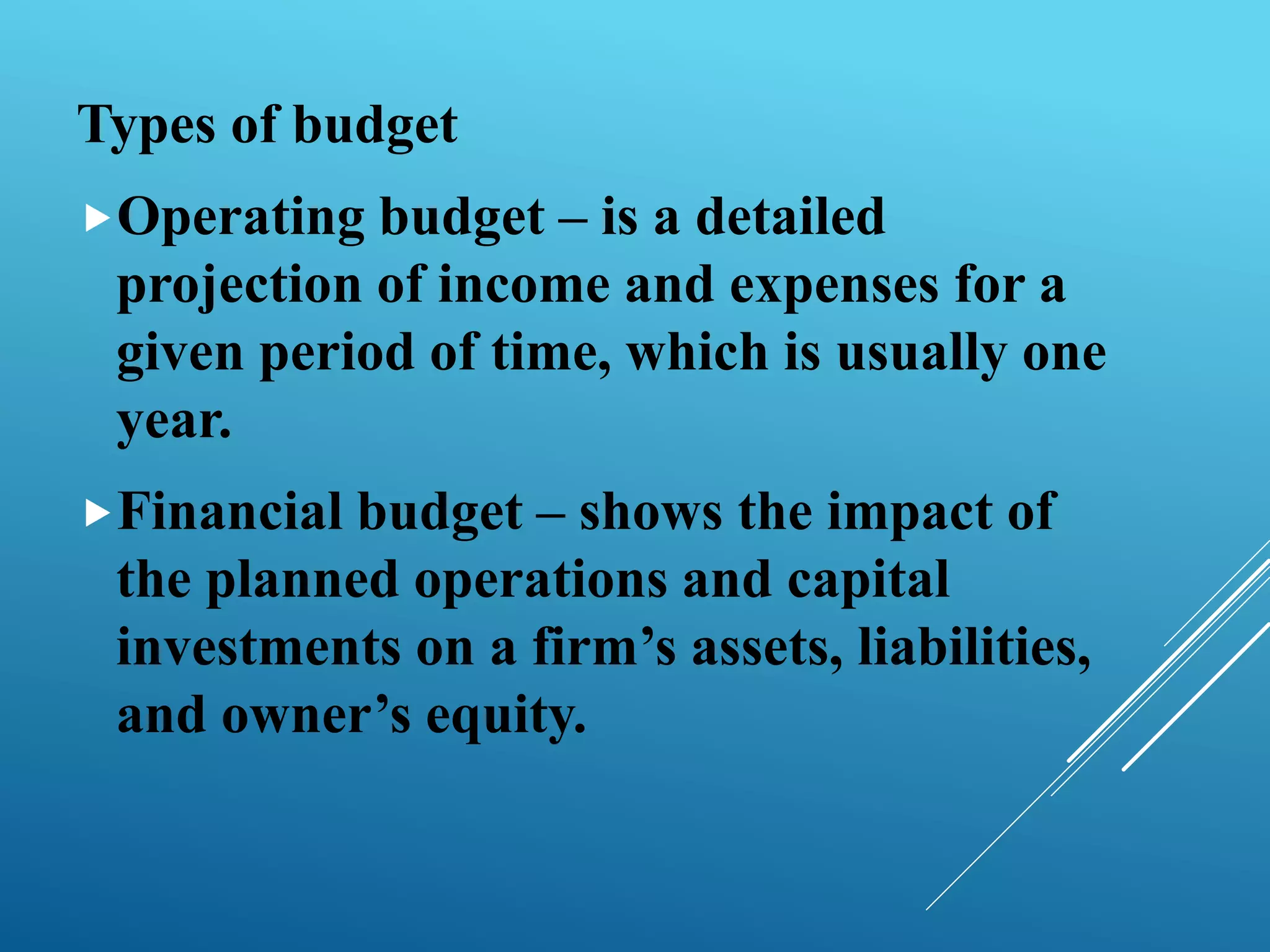
Types of budget
Operating budget – is a detailed
projection of income and expenses for a
given period of time, which is usually one
year.
Financial budget – shows the impact of
the planned operations and capital
investments on a firm’s assets, liabilities,
and owner’s equity.
OPERATING BUDGET
 Sale budget
 Production budget
 Direct materials budget
 Direct labor budget
 Factory overhead budget
 Selling and administrative expense budget
 Income statement
Financial Budget
Cash budget
Balance sheet
PREPARING THE BUDGET
1. Preparation of a sales forecast
2. Determining production volume in
support of the sales forecasts
3. Estimating cash flow
4. Preparation of financial statements
 SALE BUDGET
-Indicates the number of units a firm expects
to sell. That number of units is multiplied by the
selling price. The sale budget is the determinant
of all the other budgets included in the master
budget.
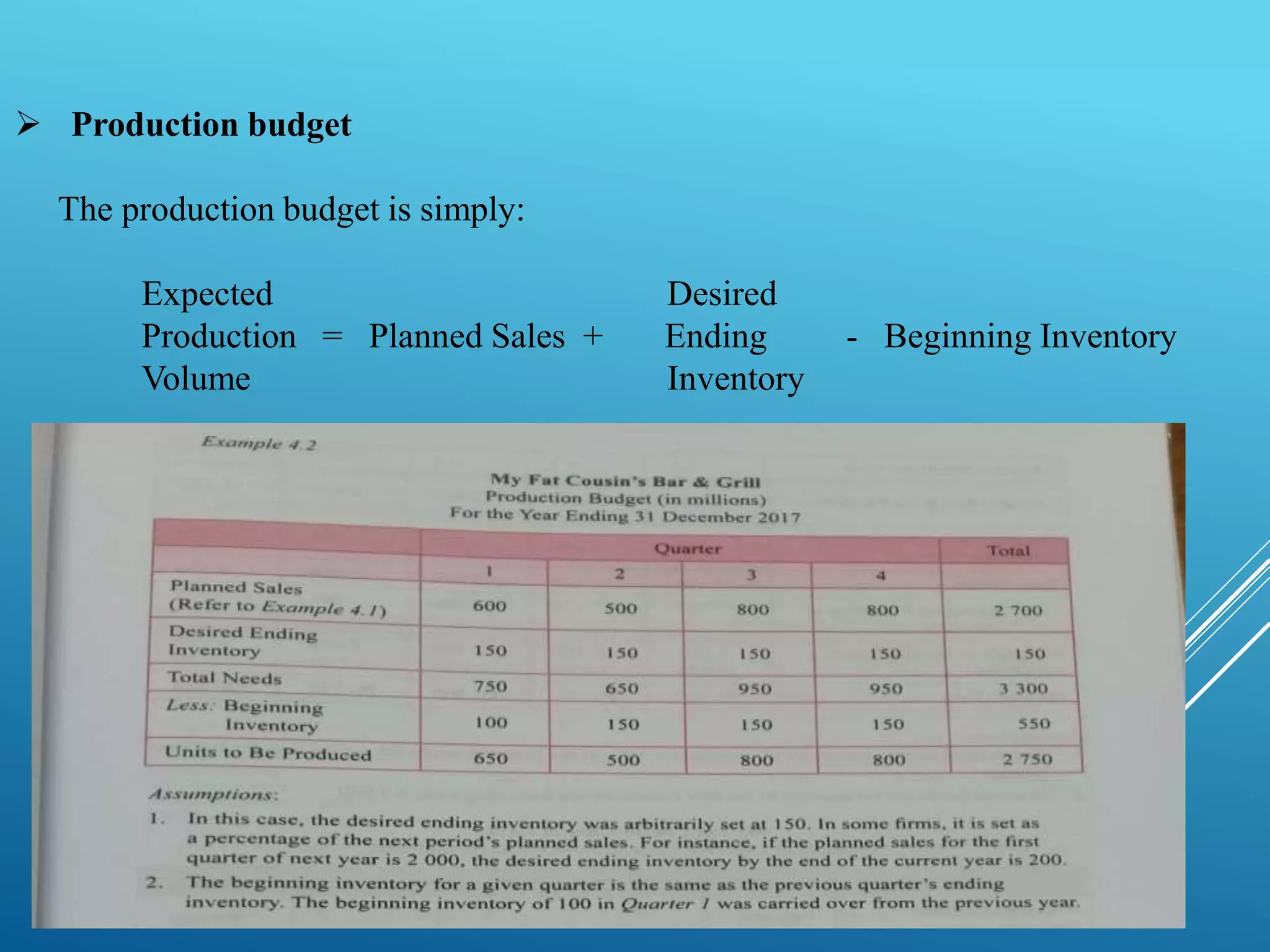
 Production budget
The production budget is simply:
Expected Desired
Production = Planned Sales + Ending - Beginning Inventory
Volume Inventory
 Direct Material Budget
 Direct Labor Budget
 Factory Overhead Budget
 Ending Inventory Budget
 Selling and Administration Budget
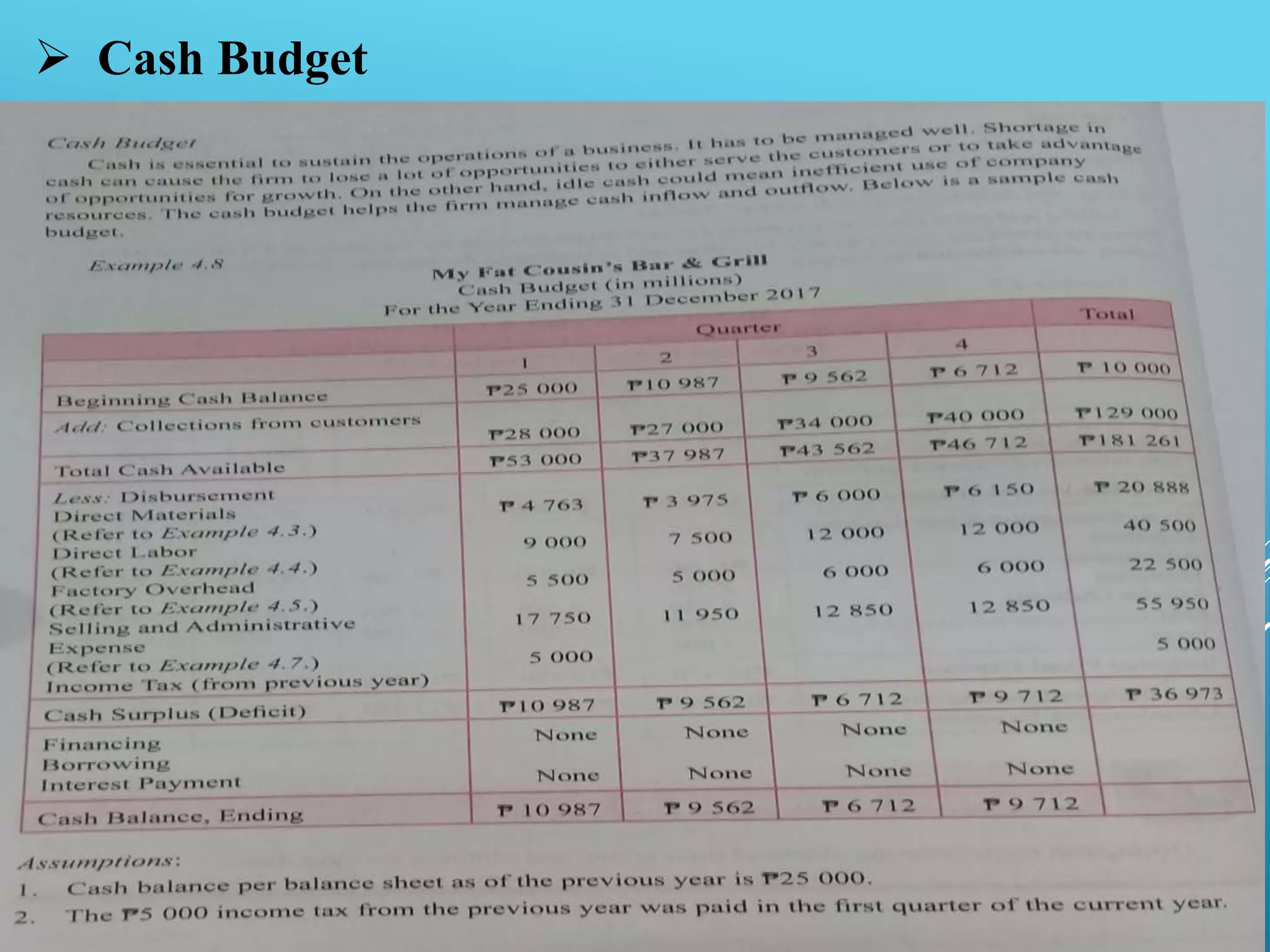
 Cash Budget

Financial projections and budgets

  • 1.
  • 2.
     STRATEGIC PLAN Isthe grand plan of any organization wherein the overall objectives are set and specific program are created in support of the objectives.
  • 3.
    ELEMENTS OF STRATEGICPLAN 1. Vision Statement – is a description of what the organization aspires to be in the long term. 2. Mission Statement – is the statement of the organization’s core purpose. It provides direction to the whole organization. 3. Corporate Objectives – these statements which outline the specific goals, in line with the mission, that an organization would like to achieve.
  • 4.
    4. Corporate Strategies– are the concrete programs for specific business units, departments, and cross- functional areas. The corporate strategies have to be aligned with the mission-vision and the must all be aimed at achieving the corporate objectives. 5. Departmental Plans and Programs – are synonymous with operational plans. Departmental plans are specific in terms of activities, the time lines, the targets, and the budget per activity. 6. Financial Forecasts and Budgets – the financial forecast and budgets tie everything together. Department plans and programs, specific targets, and forecasts are forecasts are made based on corporate objectives.
  • 5.
    STRENGTHS, WEAKNESSES, OPPORTUNITIES, THREATS Oneof the way through witch managers can quickly assess the situation of the company and make the necessary plan of action is doing a SWOT analysis.
  • 6.
     Strength –is a resource that is owned or controlled by or is available to a firm. Strength will give a firm an advantage over its competitors.  Weaknesses – is a limitation which affects a firm’s position relative to its competitors. Weaknesses may affect the way the firm delivers products and services to customers.  Opportunity – is a situation in the external environment which the firm can take advantage of.  Threat – is an unfavorable situation in firm’s external environment which may adversely affect the way a firm does business. *SWOT stand for STRENGTHS, WEAKNESSESS, OPPORTUNITIES, and THREATS.
  • 7.
     Financial Forecast Every strategic plan is culminated by the preparation of a financial plan. Financial plans include forecasts. *Sale forecast – is a projection of sales of a product or service expressed either in units or absolute monetary value. Factors that may affect future sale performance  Inflation rate ( which affects the purchasing power of consumers, thus also affecting buying behavior and spending patterns)  Trends in the market  Investment climate ( when the economy is conductive for investing, consumers tend to buy less of consumer products)
  • 8.
     PROJECTED FINANCIALSTATEMENTS  is a financial projection that presents an entity’s expected financial positions, results of operations, and cash flows.
  • 9.
    FACTORS OF PREPARINGPROJECTED FINANCIAL STATEMENTS 1. Market conditions – these include inflation, competitiveness of specific industries, growth, global markets, consumer demand, and spending patterns of specific market segments. 2. Economy – this is taken into account if the economy is thriving, plateauing, or slowing down. 3. Investment climate – investors in securities and other financial or investment products always try to see whether the economy is bullish or bearish.
  • 10.
    4. Competitive positionof the firm in the industry – whether a company is market leader, a nicher (a firm whose marketing strategy is to focus on a smaller market segment), or a challenger is a huge determinant of sales, investments to be made, and other expenses to be incurred in support of operations. 5. SWOT – this is an analysis of the company’s strengths and weaknesses, matched with the opportunities and threats in its external environment.
  • 11.
  • 12.
  • 13.
  • 14.
    Budget Is a statementof projected sales, expenses, income, and other financial transactions for the coming period. It is a firm’s financial plan. A budget serves two major purposes:  A tool for planning  A tool for control
  • 15.
    Types of budget Operatingbudget – is a detailed projection of income and expenses for a given period of time, which is usually one year. Financial budget – shows the impact of the planned operations and capital investments on a firm’s assets, liabilities, and owner’s equity.
  • 16.
    OPERATING BUDGET  Salebudget  Production budget  Direct materials budget  Direct labor budget  Factory overhead budget  Selling and administrative expense budget  Income statement Financial Budget Cash budget Balance sheet
  • 17.
    PREPARING THE BUDGET 1.Preparation of a sales forecast 2. Determining production volume in support of the sales forecasts 3. Estimating cash flow 4. Preparation of financial statements
  • 18.
     SALE BUDGET -Indicatesthe number of units a firm expects to sell. That number of units is multiplied by the selling price. The sale budget is the determinant of all the other budgets included in the master budget.
  • 20.
     Production budget Theproduction budget is simply: Expected Desired Production = Planned Sales + Ending - Beginning Inventory Volume Inventory
  • 21.
  • 22.
  • 23.
  • 24.
  • 25.
     Selling andAdministration Budget
  • 26.