Paul Wintle CITB
Construction Futures Wales
Programme Manager
Understanding Your Costs
Ian Widdrington & Joe McCarthy
Construction Futures Wales
• Introduction to Construction Futures Wales
• Definitions of Frameworks and Open Book Costing
• Steps to Develop Your Own Open Book Costing
• Working on a Framework for the First Time
• Top Tips For Tenders and PQQs
• Introduction to Accreditations being requested by Buyers
• Culture, Technology, and How to work Profitably on a
Framework
• Questions and Answers
Agenda
Exercise
How do you currently Estimate/Cost Jobs?
What are your experiences of Open Book
Costing to date?
Take 10 mins in Table Groups
Open Book Costing
The Basic Requirements
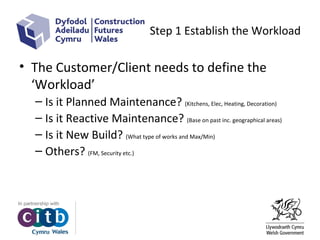
Your Costs!
• Cost of Labour
• Cost of Material
• Cost of Plant / Tools
• Cost of Risk
• Cost of Quality
• Overheads
Step 1 Establish the Workload
• The Customer/Client needs to define the
‘Workload’
– Is it Planned Maintenance? (Kitchens, Elec, Heating, Decoration)
– Is it Reactive Maintenance? (Base on past inc. geographical areas)
– Is it New Build? (What type of works and Max/Min)
– Others? (FM, Security etc.)
Step 2 Establish the Labour who
may be working on the
Framework
• Identify each Operatives Role
• Name them (ideally)
• Can include sub contract and specialists
• Organisation Charts help
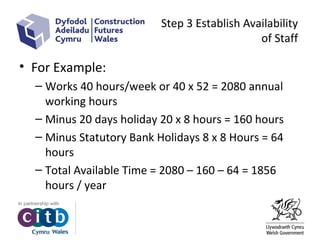
Step 3 Establish Availability
of Staff
• For Example:
– Works 40 hours/week or 40 x 52 = 2080 annual
working hours
– Minus 20 days holiday 20 x 8 hours = 160 hours
– Minus Statutory Bank Holidays 8 x 8 Hours = 64
hours
– Total Available Time = 2080 – 160 – 64 = 1856
hours / year
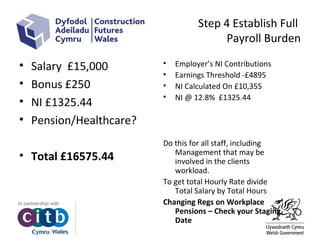
Step 4 Establish Full
Payroll Burden
• Salary £15,000
• Bonus £250
• NI £1325.44
• Pension/Healthcare?
• Total £16575.44
• Employer’s NI Contributions
• Earnings Threshold -£4895
• NI Calculated On £10,355
• NI @ 12.8% £1325.44
Do this for all staff, including
Management that may be
involved in the clients
workload.
To get total Hourly Rate divide
Total Salary by Total Hours
Changing Regs on Workplace
Pensions – Check your Staging
Date
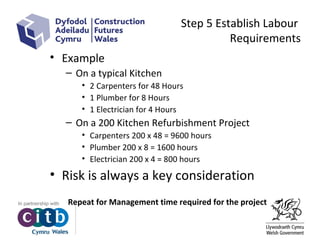
Step 5 Establish Labour
Requirements
• Example
– On a typical Kitchen
• 2 Carpenters for 48 Hours
• 1 Plumber for 8 Hours
• 1 Electrician for 4 Hours
– On a 200 Kitchen Refurbishment Project
• Carpenters 200 x 48 = 9600 hours
• Plumber 200 x 8 = 1600 hours
• Electrician 200 x 4 = 800 hours
• Risk is always a key consideration
Repeat for Management time required for the project
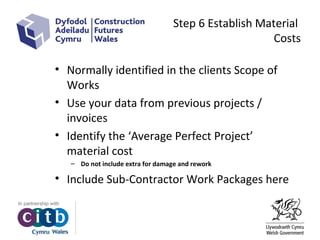
Step 6 Establish Material
Costs
• Normally identified in the clients Scope of
Works
• Use your data from previous projects /
invoices
• Identify the ‘Average Perfect Project’
material cost
– Do not include extra for damage and rework
• Include Sub-Contractor Work Packages here
Step 7 Establish Plant /Tools
Requirements
• Vans (Operatives) / Cars (Management)
– Include Insurance, Maintenance, Tax and Fuel
• Consumables
• Tools / Plant
• Waste Disposal
• Workwear
• Mobile Phones / ICT / Trackers
Apportion the costs as best possible e.g. Van used for 40% of the
time on this framework apportion 40% of the cost to the
project
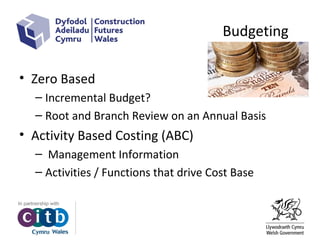
Budgeting
• Zero Based
– Incremental Budget?
– Root and Branch Review on an Annual Basis
• Activity Based Costing (ABC)
– Management Information
– Activities / Functions that drive Cost Base
Step 8 Establish The Cost of
Risk
• Material Cost Increases
• Bad weather
• Fuel Cost Increases
• Client / Design changes
– Scoped and Unscoped Changes
• No access
• Sickness / Holiday Cover
The Risk Money doesn’t necessarily get paid, it will only be used
if the Risk materialises – it is a Client contingency
Step 9 Establish The Cost of
Overhead
• Identify in last years Accounts
• Exclude items covered in other sections of the
Cost Model
• Apportion based on turnover:
– If this contract is 30% of the turnover of the business
then 30% of the Overheads need to be recovered in
the Cost Model
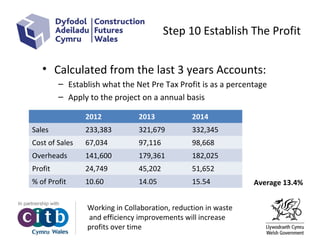
Step 10 Establish The Profit
• Calculated from the last 3 years Accounts:
– Establish what the Net Pre Tax Profit is as a percentage
– Apply to the project on a annual basis
2012 2013 2014
Sales 233,383 321,679 332,345
Cost of Sales 67,034 97,116 98,668
Overheads 141,600 179,361 182,025
Profit 24,749 45,202 51,652
% of Profit 10.60 14.05 15.54 Average 13.4%
Working in Collaboration, reduction in waste
and efficiency improvements will increase
profits over time
Frameworks
Frameworks
Why Are They Needed?
Long term frameworks provides organisations with:
–Work smoothed contracts
–Protected Margins
–Business Certainty
–Opportunities to recruit, develop and retain the workforce
–Opportunities to eliminate waste and inefficiencies
–Shared Innovation, knowledge and expertise
….. Leading to a Sustainable Business
Frameworks
What do you need to win?
A ‘fit’ Organisation
– Strong Leadership
– Values and Culture founded on Learning, Openness & Honesty
– Motivated, skilled, dedicated workforce / Supply Chain
– Competent Management Team
– Simple adaptable processes and systems
Understands the proposed Customer/Client needs
– Who are they?
– What motivates/drives them – Culture and Values
– Who are their customers?
– What are their aspirations
Frameworks
What do you need to win?
Informed of Best Practice
– Egan and Latham
– Collaborative Working
– Innovation
– Continuous Improvement
– Lean Principles
Are appropriately Qualified and Accredited
– Trade Qualifications
– ISO
– CE
– Q-Mark
Frameworks
What do you need to win?
• To get through the Pre-Qualification
Process – Hurdle / Filter
• To Write a winning Bid at Tender stage
– Technical Assessment
• Good Interview Technique and
Presentation
PQQ
Typical Questions Based On?
• Organisation
• Financial Information
• Business Activities
• References
• Quality Assurance
• Health and Safety
• Equal Opportunities
• Environmental Management
• Professional and Business Standing
• Collaborative Working/Partnering
PQQ
Maximising Points?
• Ask for the weighting for each of the criteria
• The higher the weighting the more important to the
client/project
• The higher the weighting the more attention it needs
• Attend industry days
• Review the PQQ before submission
• Ask Questions
• Adhere to word count…… use pictures!
• Develop re-useable ‘chunks’ of information and apply CI
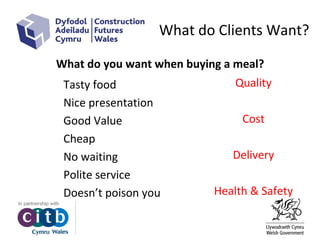
What do Clients Want?
Tasty food
Nice presentation
Good Value
Cheap
No waiting
Polite service
Doesn’t poison you
Quality
Cost
Delivery
Health & Safety
What do you want when buying a meal?
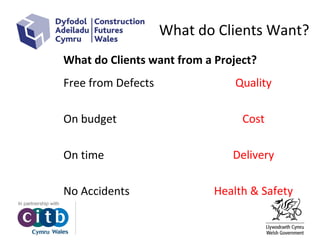
Free from Defects
On budget
On time
No Accidents
Quality
Cost
Delivery
Health & Safety
What do Clients want from a Project?
What do Clients Want?
Tender/Bid
Technical Assessment
• To Evidence your Capability – your Co. and Supply Chains
• Real ‘Glory Stories’
• Client Testimonials
• Time, Cost, Quality, Health & Safety
• Continuous Improvement/Innovation
• Benchmarking
• Value Management
• Suggest alternate business solutions to the client
• Value Engineering
• Understanding your own business to come up with alternative solutions
• Social Benefits
• Local employment, Reinvestment in Local Economy, Social Inclusion
Tender/Bid
Maximising Points
• Tell the Client what they want
• Not what you like to tell them
– Review your Bid again and again and then again!
• Don’t keep it to yourself
• Accuracy is paramount
– Don’t underbid the Real Cost of Delivery
• Will lead to reduced capacity, looking for variations,
lower quality, accidents, reputation damage etc.
Formatting
Interview
What’s Required
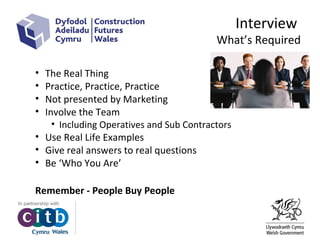
• The Real Thing
• Practice, Practice, Practice
• Not presented by Marketing
• Involve the Team
• Including Operatives and Sub Contractors
• Use Real Life Examples
• Give real answers to real questions
• Be ‘Who You Are’
Remember - People Buy People
Interview
What do Clients Look for?
• An Organisation that:
• Empowers its People and Shares Learning
• Communicates freely with all parties
• Demonstrates Trust and Integrity with a ‘No Blame’ Culture
• Focuses on Client Needs
• Focuses on Overall Benefits (not just their own)
• Lives an Promotes Success
And…..
Enthusiasm, Belief, No Notes – From the Heart, Want It!
Frameworks
Where to find them
Sell 2 Wales www.sell2wales.co.uk
Tenders Electronic Daily http://ted.europa.eu/
Tenders Direct (endorsed by OJEU)
http://www.tendersdirect.co.uk/default.aspx?source=GoogleC1AG2&gclid=CJTcrKqHlJICFQSKMAo
Tender Match
http://www.tendermatch.com/?crcat=payperclick&crsource=google&crkw=ojeu+notices
Accreditations
An Introduction
Clients want appropriately Qualified and Accredited Contractors and
Manufacturers
– Trade Qualifications
– ISO 9000, 14000, OHSAS 18000, BS11000, ISO 27000
– CE Structural Steel, Structural Timber, Individual Products, anything
that has a European Harmonised Standard
– Q-Mark e.g. Doors, Fire Doors, Windows, Glass, Paint, Timber
Panelling, Ply etc.
– Achilles
– Construction Line etc.
Culture and Technology
Working Profitably on a Framework
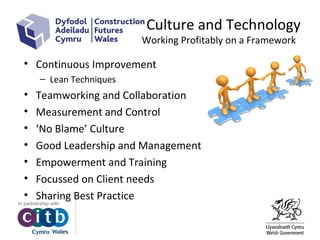
• Continuous Improvement
– Lean Techniques
• Teamworking and Collaboration
• Measurement and Control
• ‘No Blame’ Culture
• Good Leadership and Management
• Empowerment and Training
• Focussed on Client needs
• Sharing Best Practice
Culture and Technology
Working Profitably on a Framework
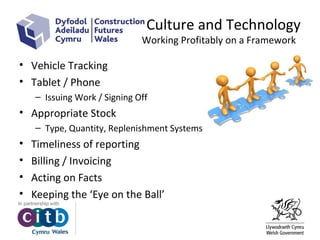
• Vehicle Tracking
• Tablet / Phone
– Issuing Work / Signing Off
• Appropriate Stock
– Type, Quantity, Replenishment Systems
• Timeliness of reporting
• Billing / Invoicing
• Acting on Facts
• Keeping the ‘Eye on the Ball’
Any Questions?
Ian 07717 862797
ian.widdrington@enterprise.uk.com
Joe 07538 413678
joe.mccarthy@enterprise.uk.com

CFW - Understanding Your Costs / Open Book Costing Models

  • 1.
    Paul Wintle CITB ConstructionFutures Wales Programme Manager
  • 2.
    Understanding Your Costs IanWiddrington & Joe McCarthy Construction Futures Wales
  • 3.
    • Introduction toConstruction Futures Wales • Definitions of Frameworks and Open Book Costing • Steps to Develop Your Own Open Book Costing • Working on a Framework for the First Time • Top Tips For Tenders and PQQs • Introduction to Accreditations being requested by Buyers • Culture, Technology, and How to work Profitably on a Framework • Questions and Answers Agenda
  • 4.
    Exercise How do youcurrently Estimate/Cost Jobs? What are your experiences of Open Book Costing to date? Take 10 mins in Table Groups
  • 5.
    Open Book Costing TheBasic Requirements
  • 6.
    Your Costs! • Costof Labour • Cost of Material • Cost of Plant / Tools • Cost of Risk • Cost of Quality • Overheads
  • 7.
    Step 1 Establishthe Workload • The Customer/Client needs to define the ‘Workload’ – Is it Planned Maintenance? (Kitchens, Elec, Heating, Decoration) – Is it Reactive Maintenance? (Base on past inc. geographical areas) – Is it New Build? (What type of works and Max/Min) – Others? (FM, Security etc.)
  • 8.
    Step 2 Establishthe Labour who may be working on the Framework • Identify each Operatives Role • Name them (ideally) • Can include sub contract and specialists • Organisation Charts help
  • 9.
    Step 3 EstablishAvailability of Staff • For Example: – Works 40 hours/week or 40 x 52 = 2080 annual working hours – Minus 20 days holiday 20 x 8 hours = 160 hours – Minus Statutory Bank Holidays 8 x 8 Hours = 64 hours – Total Available Time = 2080 – 160 – 64 = 1856 hours / year
  • 10.
    Step 4 EstablishFull Payroll Burden • Salary £15,000 • Bonus £250 • NI £1325.44 • Pension/Healthcare? • Total £16575.44 • Employer’s NI Contributions • Earnings Threshold -£4895 • NI Calculated On £10,355 • NI @ 12.8% £1325.44 Do this for all staff, including Management that may be involved in the clients workload. To get total Hourly Rate divide Total Salary by Total Hours Changing Regs on Workplace Pensions – Check your Staging Date
  • 11.
    Step 5 EstablishLabour Requirements • Example – On a typical Kitchen • 2 Carpenters for 48 Hours • 1 Plumber for 8 Hours • 1 Electrician for 4 Hours – On a 200 Kitchen Refurbishment Project • Carpenters 200 x 48 = 9600 hours • Plumber 200 x 8 = 1600 hours • Electrician 200 x 4 = 800 hours • Risk is always a key consideration Repeat for Management time required for the project
  • 12.
    Step 6 EstablishMaterial Costs • Normally identified in the clients Scope of Works • Use your data from previous projects / invoices • Identify the ‘Average Perfect Project’ material cost – Do not include extra for damage and rework • Include Sub-Contractor Work Packages here
  • 13.
    Step 7 EstablishPlant /Tools Requirements • Vans (Operatives) / Cars (Management) – Include Insurance, Maintenance, Tax and Fuel • Consumables • Tools / Plant • Waste Disposal • Workwear • Mobile Phones / ICT / Trackers Apportion the costs as best possible e.g. Van used for 40% of the time on this framework apportion 40% of the cost to the project
  • 14.
    Budgeting • Zero Based –Incremental Budget? – Root and Branch Review on an Annual Basis • Activity Based Costing (ABC) – Management Information – Activities / Functions that drive Cost Base
  • 15.
    Step 8 EstablishThe Cost of Risk • Material Cost Increases • Bad weather • Fuel Cost Increases • Client / Design changes – Scoped and Unscoped Changes • No access • Sickness / Holiday Cover The Risk Money doesn’t necessarily get paid, it will only be used if the Risk materialises – it is a Client contingency
  • 16.
    Step 9 EstablishThe Cost of Overhead • Identify in last years Accounts • Exclude items covered in other sections of the Cost Model • Apportion based on turnover: – If this contract is 30% of the turnover of the business then 30% of the Overheads need to be recovered in the Cost Model
  • 17.
    Step 10 EstablishThe Profit • Calculated from the last 3 years Accounts: – Establish what the Net Pre Tax Profit is as a percentage – Apply to the project on a annual basis 2012 2013 2014 Sales 233,383 321,679 332,345 Cost of Sales 67,034 97,116 98,668 Overheads 141,600 179,361 182,025 Profit 24,749 45,202 51,652 % of Profit 10.60 14.05 15.54 Average 13.4% Working in Collaboration, reduction in waste and efficiency improvements will increase profits over time
  • 18.
  • 19.
    Frameworks Why Are TheyNeeded? Long term frameworks provides organisations with: –Work smoothed contracts –Protected Margins –Business Certainty –Opportunities to recruit, develop and retain the workforce –Opportunities to eliminate waste and inefficiencies –Shared Innovation, knowledge and expertise ….. Leading to a Sustainable Business
  • 20.
    Frameworks What do youneed to win? A ‘fit’ Organisation – Strong Leadership – Values and Culture founded on Learning, Openness & Honesty – Motivated, skilled, dedicated workforce / Supply Chain – Competent Management Team – Simple adaptable processes and systems Understands the proposed Customer/Client needs – Who are they? – What motivates/drives them – Culture and Values – Who are their customers? – What are their aspirations
  • 21.
    Frameworks What do youneed to win? Informed of Best Practice – Egan and Latham – Collaborative Working – Innovation – Continuous Improvement – Lean Principles Are appropriately Qualified and Accredited – Trade Qualifications – ISO – CE – Q-Mark
  • 22.
    Frameworks What do youneed to win? • To get through the Pre-Qualification Process – Hurdle / Filter • To Write a winning Bid at Tender stage – Technical Assessment • Good Interview Technique and Presentation
  • 23.
    PQQ Typical Questions BasedOn? • Organisation • Financial Information • Business Activities • References • Quality Assurance • Health and Safety • Equal Opportunities • Environmental Management • Professional and Business Standing • Collaborative Working/Partnering
  • 24.
    PQQ Maximising Points? • Askfor the weighting for each of the criteria • The higher the weighting the more important to the client/project • The higher the weighting the more attention it needs • Attend industry days • Review the PQQ before submission • Ask Questions • Adhere to word count…… use pictures! • Develop re-useable ‘chunks’ of information and apply CI
  • 25.
    What do ClientsWant? Tasty food Nice presentation Good Value Cheap No waiting Polite service Doesn’t poison you Quality Cost Delivery Health & Safety What do you want when buying a meal?
  • 26.
    Free from Defects Onbudget On time No Accidents Quality Cost Delivery Health & Safety What do Clients want from a Project? What do Clients Want?
  • 27.
    Tender/Bid Technical Assessment • ToEvidence your Capability – your Co. and Supply Chains • Real ‘Glory Stories’ • Client Testimonials • Time, Cost, Quality, Health & Safety • Continuous Improvement/Innovation • Benchmarking • Value Management • Suggest alternate business solutions to the client • Value Engineering • Understanding your own business to come up with alternative solutions • Social Benefits • Local employment, Reinvestment in Local Economy, Social Inclusion
  • 28.
    Tender/Bid Maximising Points • Tellthe Client what they want • Not what you like to tell them – Review your Bid again and again and then again! • Don’t keep it to yourself • Accuracy is paramount – Don’t underbid the Real Cost of Delivery • Will lead to reduced capacity, looking for variations, lower quality, accidents, reputation damage etc.
  • 29.
  • 30.
    Interview What’s Required • TheReal Thing • Practice, Practice, Practice • Not presented by Marketing • Involve the Team • Including Operatives and Sub Contractors • Use Real Life Examples • Give real answers to real questions • Be ‘Who You Are’ Remember - People Buy People
  • 31.
    Interview What do ClientsLook for? • An Organisation that: • Empowers its People and Shares Learning • Communicates freely with all parties • Demonstrates Trust and Integrity with a ‘No Blame’ Culture • Focuses on Client Needs • Focuses on Overall Benefits (not just their own) • Lives an Promotes Success And….. Enthusiasm, Belief, No Notes – From the Heart, Want It!
  • 32.
    Frameworks Where to findthem Sell 2 Wales www.sell2wales.co.uk Tenders Electronic Daily http://ted.europa.eu/ Tenders Direct (endorsed by OJEU) http://www.tendersdirect.co.uk/default.aspx?source=GoogleC1AG2&gclid=CJTcrKqHlJICFQSKMAo Tender Match http://www.tendermatch.com/?crcat=payperclick&crsource=google&crkw=ojeu+notices
  • 33.
    Accreditations An Introduction Clients wantappropriately Qualified and Accredited Contractors and Manufacturers – Trade Qualifications – ISO 9000, 14000, OHSAS 18000, BS11000, ISO 27000 – CE Structural Steel, Structural Timber, Individual Products, anything that has a European Harmonised Standard – Q-Mark e.g. Doors, Fire Doors, Windows, Glass, Paint, Timber Panelling, Ply etc. – Achilles – Construction Line etc.
  • 34.
    Culture and Technology WorkingProfitably on a Framework • Continuous Improvement – Lean Techniques • Teamworking and Collaboration • Measurement and Control • ‘No Blame’ Culture • Good Leadership and Management • Empowerment and Training • Focussed on Client needs • Sharing Best Practice
  • 35.
    Culture and Technology WorkingProfitably on a Framework • Vehicle Tracking • Tablet / Phone – Issuing Work / Signing Off • Appropriate Stock – Type, Quantity, Replenishment Systems • Timeliness of reporting • Billing / Invoicing • Acting on Facts • Keeping the ‘Eye on the Ball’
  • 36.
    Any Questions? Ian 07717862797 ian.widdrington@enterprise.uk.com Joe 07538 413678 joe.mccarthy@enterprise.uk.com

Editor's Notes

  • #26 NOTE – animated slide Get the team to come up with what they would look for in buying a meal. Group them into QCD H&S, but get the team to guess the titles. All the meal characteristics can be measured in terms of QCD H&S