shelkenathaji@gmail.com +91 97665 39307
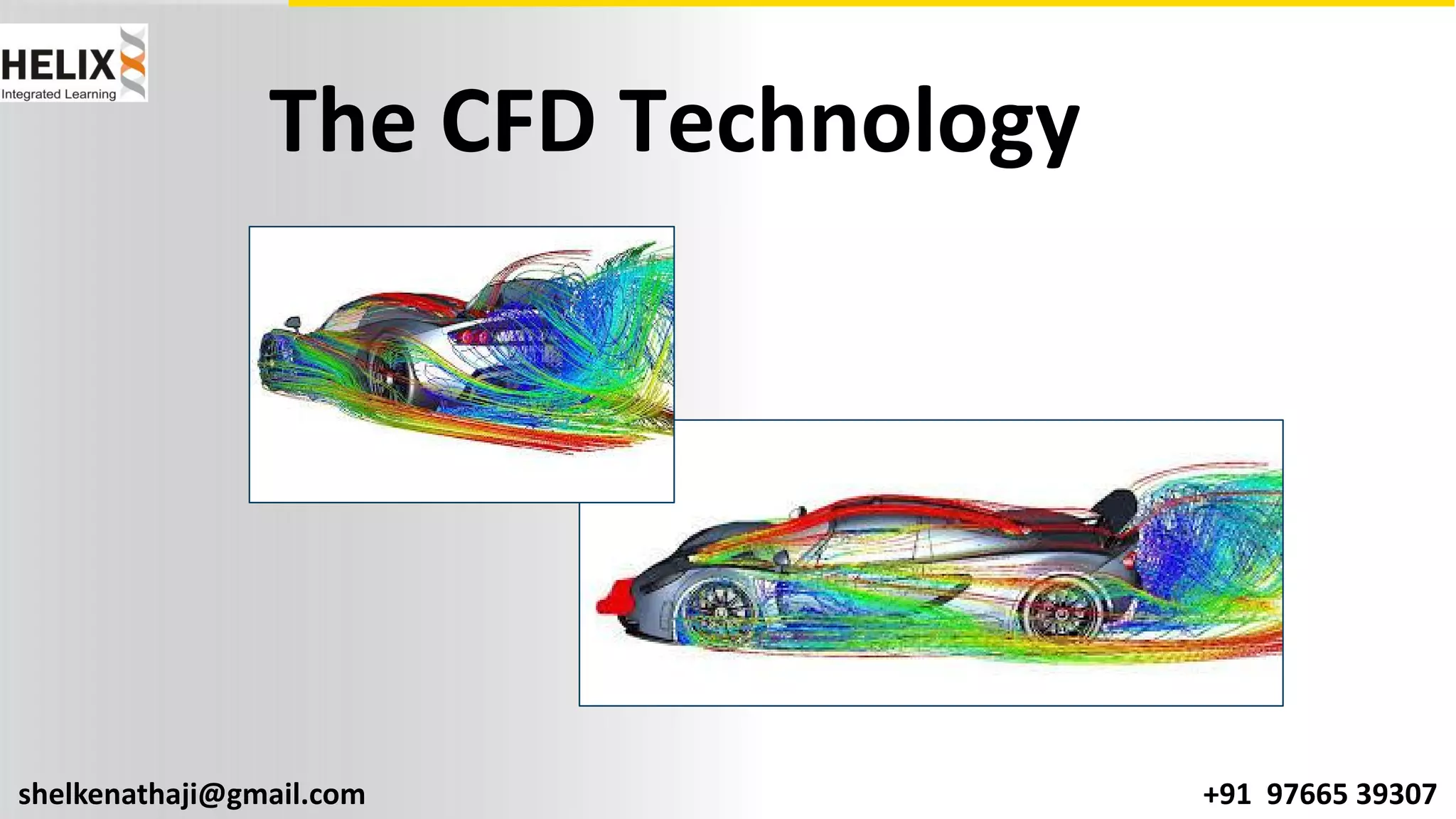
The CFD Technology
shelkenathaji@gmail.com +91 97665 39307
§ Brief History
§ Predictions Methods
§ Mathematical Modeling/Governing Equations
§ Applications
Learning Objectives
shelkenathaji@gmail.com +91 97665 39307
Nathaji Shelke
ü M.E. in Heat Power from Sinhgad College of Engineering
ü15+ years of Industrial Experience in CAD, FEA and CFD
üInternational Certification in software skill set
üPresented International Research papers in Singapore and Australia
üCAD: Creo 2.0, CATIA V5, UG Nx 10.0 & Solid Edge ST 7.0
üCAE: ANSYS 15.0 & Hypermesh 13.
üCFD: ANSYS FLUENT
üCORPORATE CLIENTS : Mahindra, Tata Technologies, TACO, John Deer, Johnson
Control, KPIT Cummins, Whirlpool India Ltd, Onward Technologies, iGATE, PARI,
Thermax Ltd , Applied Thermal, Kirloskar Pneumatic, AESSEAL, Anand Group,
shelkenathaji@gmail.com +91 97665 39307
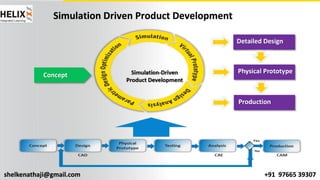
Simulation Driven Product Development
shelkenathaji@gmail.com +91 97665 39307
Streamlined Workflow Strategy
shelkenathaji@gmail.com +91 97665 39307
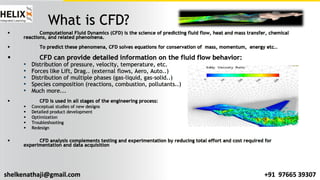
What is CFD?
§ Computational Fluid Dynamics (CFD) is the science of predicting fluid flow, heat and mass transfer, chemical
reactions, and related phenomena.
§ To predict these phenomena, CFD solves equations for conservation of mass, momentum, energy etc..
§ CFD can provide detailed information on the fluid flow behavior:
• Distribution of pressure, velocity, temperature, etc.
• Forces like Lift, Drag.. (external flows, Aero, Auto..)
• Distribution of multiple phases (gas-liquid, gas-solid..)
• Species composition (reactions, combustion, pollutants..)
• Much more...
§ CFD is used in all stages of the engineering process:
§ Conceptual studies of new designs
§ Detailed product development
§ Optimization
§ Troubleshooting
§ Redesign
§ CFD analysis complements testing and experimentation by reducing total effort and cost required for
experimentation and data acquisition
shelkenathaji@gmail.com +91 97665 39307
How Does CFD Work?
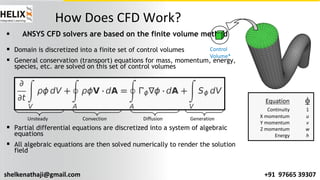
§ ANSYS CFD solvers are based on the finite volume method
§ Domain is discretized into a finite set of control volumes
§ General conservation (transport) equations for mass, momentum, energy,
species, etc. are solved on this set of control volumes
§ Partial differential equations are discretized into a system of algebraic
equations
§ All algebraic equations are then solved numerically to render the solution
field
Control
Volume*
Equation f
Continuity 1
X momentum u
Y momentum v
Z momentum w
Energy h
Unsteady Convection Diffusion Generation
shelkenathaji@gmail.com +91 97665 39307
History
§ Lewis Fry Richardson in England (1881-1953) developed
the first numerical weather prediction system when he
divided physical space into grid cells and used the finite
difference method.
§ The earliest numerical solution for flow past a cylinder
was carried out in 1933 by Thom and reported in England:
§ Kawaguti in Japan obtained a similar solution for flow
around a cylinder in 1953 by using a mechanical desk
calculator, working 20 hours per week for 18 months!
shelkenathaji@gmail.com +91 97665 39307
§ During the 1960s, the theoretical division of NASA at Los
Alamos in the U.S. contributed numerical methods –
Particle-In-Cell (PIC), Marker-and-Cell (MAC), Vorticity-
Stream function methods, Arbitrary Lagrangian-Eulerian
(ALE) methods, The ubiquitous k - e turbulence model.
§ In the 1970s, a group working under D. Brian Spalding, at
Imperial College, London, developed – Parabolic flow
codes (GENMIX), Vorticity-Stream function based codes,
The SIMPLE algorithm , The TEACH code
§ It was in the early 1980s that commercial CFD codes came
into the open market place in a big way.
shelkenathaji@gmail.com +91 97665 39307
NASA’s HiMAT
§ Wind tunnel test of Preliminary design
§ $ 150,000 - redesign cost in wind tunnel test
§ $ 6,000 – redesign cost on super computer
shelkenathaji@gmail.com +91 97665 39307
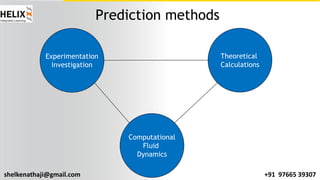
Prediction methods
Theoretical
Calculations
Experimentation
Investigation
Computational
Fluid
Dynamics
shelkenathaji@gmail.com +91 97665 39307
Experimentation investigation
§ The most reliable information
§ Full-scale tests are, in most cases, prohibitively
expensive & often impossible
§ Small-scale models do not always simulate all
features of full-scale equipment
§ Difficulty in measurement
§ Errors of measuring instrument
§ Disturbance of flow due to measuring instrument
shelkenathaji@gmail.com +91 97665 39307
Theoretical calculations
§ It requires mathematical model rather than physical
model
§ Mathematical model consists of set of differential
equations
§ Solutions method are complicated which requires
numerical tools
shelkenathaji@gmail.com +91 97665 39307
CFD
§ The advent of high speed digital computer combined with
development of accurate numerical algorithms holds the
promise that implications of mathematical model can be work
out for almost any practical problem
§ Low cost
§ Speed
§ Complete information
§ Ability to simulate realistic conditions
§ Ability to simulate ideal conditions
§ Worthiness of Results depends on adequate mathematical
model & satisfactory numerical technique
shelkenathaji@gmail.com +91 97665 39307
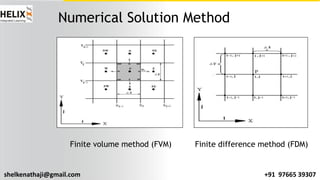
Finite volume method (FVM) Finite difference method (FDM)
Numerical Solution Method
shelkenathaji@gmail.com +91 97665 39307
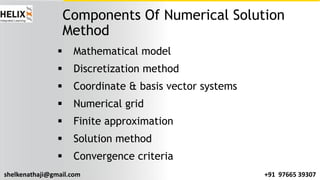
Components Of Numerical Solution
Method
§ Mathematical model
§ Discretization method
§ Coordinate & basis vector systems
§ Numerical grid
§ Finite approximation
§ Solution method
§ Convergence criteria
shelkenathaji@gmail.com +91 97665 39307
GDE of CFD
shelkenathaji@gmail.com +91 97665 39307
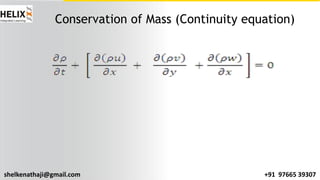
Conservation of Mass (Continuity equation)
shelkenathaji@gmail.com +91 97665 39307
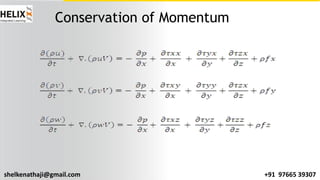
Conservation of Momentum
shelkenathaji@gmail.com +91 97665 39307
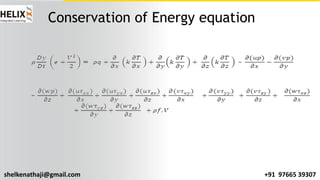
Conservation of Energy equation
shelkenathaji@gmail.com +91 97665 39307
Applications
shelkenathaji@gmail.com +91 97665 39307
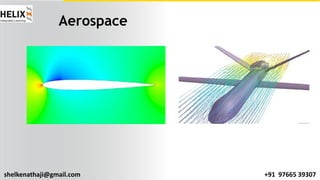
Aerospace
shelkenathaji@gmail.com +91 97665 39307
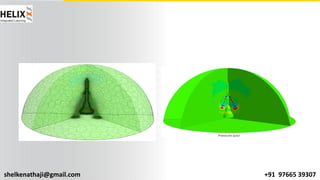
Orion Launch Abort Vehicle
shelkenathaji@gmail.com +91 97665 39307
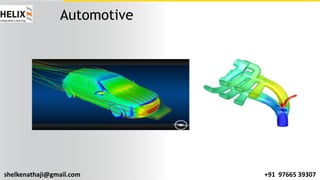
Automotive
shelkenathaji@gmail.com +91 97665 39307
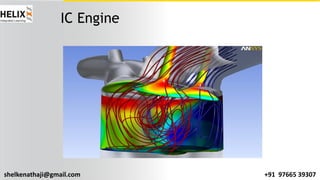
IC Engine
shelkenathaji@gmail.com +91 97665 39307
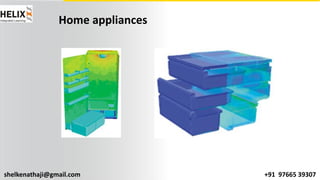
Home appliances
shelkenathaji@gmail.com +91 97665 39307
Pump
shelkenathaji@gmail.com +91 97665 39307
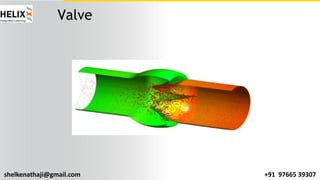
Valve
shelkenathaji@gmail.com +91 97665 39307
Turbine
shelkenathaji@gmail.com +91 97665 39307
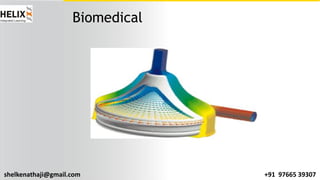
Biomedical
shelkenathaji@gmail.com +91 97665 39307
Biomedical
shelkenathaji@gmail.com +91 97665 39307
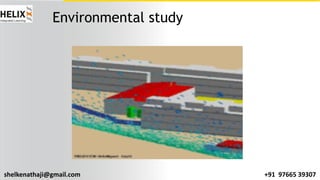
Environmental study
shelkenathaji@gmail.com +91 97665 39307
How to study CFD
§ Fundamentals of FM & HT
§ Governing differential equations of CFD
§ Numerical methods for engineers
§ Finite difference & finite volume methods
§ Concept of turbulence modeling
§ Working knowledge of CFD tool like ANSYS Fluent
shelkenathaji@gmail.com +91 97665 39307
Summary
§ Predictions methods – Theoretical + Experimental +
CFD
§ FVM & FDM
§ Conservation of mass, momentum & energy
§ Applications: Aerospace, Auto, Pump, Valve, Home
Appliances, Biomedical and many more

IntroCFD.pdf

  • 1.
    shelkenathaji@gmail.com +91 9766539307 The CFD Technology
  • 2.
    shelkenathaji@gmail.com +91 9766539307 § Brief History § Predictions Methods § Mathematical Modeling/Governing Equations § Applications Learning Objectives
  • 3.
    shelkenathaji@gmail.com +91 9766539307 Nathaji Shelke ü M.E. in Heat Power from Sinhgad College of Engineering ü15+ years of Industrial Experience in CAD, FEA and CFD üInternational Certification in software skill set üPresented International Research papers in Singapore and Australia üCAD: Creo 2.0, CATIA V5, UG Nx 10.0 & Solid Edge ST 7.0 üCAE: ANSYS 15.0 & Hypermesh 13. üCFD: ANSYS FLUENT üCORPORATE CLIENTS : Mahindra, Tata Technologies, TACO, John Deer, Johnson Control, KPIT Cummins, Whirlpool India Ltd, Onward Technologies, iGATE, PARI, Thermax Ltd , Applied Thermal, Kirloskar Pneumatic, AESSEAL, Anand Group,
  • 4.
    shelkenathaji@gmail.com +91 9766539307 Simulation Driven Product Development
  • 5.
    shelkenathaji@gmail.com +91 9766539307 Streamlined Workflow Strategy
  • 6.
    shelkenathaji@gmail.com +91 9766539307 What is CFD? § Computational Fluid Dynamics (CFD) is the science of predicting fluid flow, heat and mass transfer, chemical reactions, and related phenomena. § To predict these phenomena, CFD solves equations for conservation of mass, momentum, energy etc.. § CFD can provide detailed information on the fluid flow behavior: • Distribution of pressure, velocity, temperature, etc. • Forces like Lift, Drag.. (external flows, Aero, Auto..) • Distribution of multiple phases (gas-liquid, gas-solid..) • Species composition (reactions, combustion, pollutants..) • Much more... § CFD is used in all stages of the engineering process: § Conceptual studies of new designs § Detailed product development § Optimization § Troubleshooting § Redesign § CFD analysis complements testing and experimentation by reducing total effort and cost required for experimentation and data acquisition
  • 7.
    shelkenathaji@gmail.com +91 9766539307 How Does CFD Work? § ANSYS CFD solvers are based on the finite volume method § Domain is discretized into a finite set of control volumes § General conservation (transport) equations for mass, momentum, energy, species, etc. are solved on this set of control volumes § Partial differential equations are discretized into a system of algebraic equations § All algebraic equations are then solved numerically to render the solution field Control Volume* Equation f Continuity 1 X momentum u Y momentum v Z momentum w Energy h Unsteady Convection Diffusion Generation
  • 8.
    shelkenathaji@gmail.com +91 9766539307 History § Lewis Fry Richardson in England (1881-1953) developed the first numerical weather prediction system when he divided physical space into grid cells and used the finite difference method. § The earliest numerical solution for flow past a cylinder was carried out in 1933 by Thom and reported in England: § Kawaguti in Japan obtained a similar solution for flow around a cylinder in 1953 by using a mechanical desk calculator, working 20 hours per week for 18 months!
  • 9.
    shelkenathaji@gmail.com +91 9766539307 § During the 1960s, the theoretical division of NASA at Los Alamos in the U.S. contributed numerical methods – Particle-In-Cell (PIC), Marker-and-Cell (MAC), Vorticity- Stream function methods, Arbitrary Lagrangian-Eulerian (ALE) methods, The ubiquitous k - e turbulence model. § In the 1970s, a group working under D. Brian Spalding, at Imperial College, London, developed – Parabolic flow codes (GENMIX), Vorticity-Stream function based codes, The SIMPLE algorithm , The TEACH code § It was in the early 1980s that commercial CFD codes came into the open market place in a big way.
  • 10.
    shelkenathaji@gmail.com +91 9766539307 NASA’s HiMAT § Wind tunnel test of Preliminary design § $ 150,000 - redesign cost in wind tunnel test § $ 6,000 – redesign cost on super computer
  • 11.
    shelkenathaji@gmail.com +91 9766539307 Prediction methods Theoretical Calculations Experimentation Investigation Computational Fluid Dynamics
  • 12.
    shelkenathaji@gmail.com +91 9766539307 Experimentation investigation § The most reliable information § Full-scale tests are, in most cases, prohibitively expensive & often impossible § Small-scale models do not always simulate all features of full-scale equipment § Difficulty in measurement § Errors of measuring instrument § Disturbance of flow due to measuring instrument
  • 13.
    shelkenathaji@gmail.com +91 9766539307 Theoretical calculations § It requires mathematical model rather than physical model § Mathematical model consists of set of differential equations § Solutions method are complicated which requires numerical tools
  • 14.
    shelkenathaji@gmail.com +91 9766539307 CFD § The advent of high speed digital computer combined with development of accurate numerical algorithms holds the promise that implications of mathematical model can be work out for almost any practical problem § Low cost § Speed § Complete information § Ability to simulate realistic conditions § Ability to simulate ideal conditions § Worthiness of Results depends on adequate mathematical model & satisfactory numerical technique
  • 15.
    shelkenathaji@gmail.com +91 9766539307 Finite volume method (FVM) Finite difference method (FDM) Numerical Solution Method
  • 16.
    shelkenathaji@gmail.com +91 9766539307 Components Of Numerical Solution Method § Mathematical model § Discretization method § Coordinate & basis vector systems § Numerical grid § Finite approximation § Solution method § Convergence criteria
  • 17.
  • 18.
    shelkenathaji@gmail.com +91 9766539307 Conservation of Mass (Continuity equation)
  • 19.
    shelkenathaji@gmail.com +91 9766539307 Conservation of Momentum
  • 20.
    shelkenathaji@gmail.com +91 9766539307 Conservation of Energy equation
  • 21.
  • 22.
  • 23.
    shelkenathaji@gmail.com +91 9766539307 Orion Launch Abort Vehicle
  • 24.
  • 25.
  • 26.
  • 27.
  • 28.
    shelkenathaji@gmail.com +91 9766539307 Home appliances
  • 29.
  • 30.
  • 31.
  • 32.
  • 33.
  • 34.
    shelkenathaji@gmail.com +91 9766539307 Environmental study
  • 35.
  • 36.
    shelkenathaji@gmail.com +91 9766539307 How to study CFD § Fundamentals of FM & HT § Governing differential equations of CFD § Numerical methods for engineers § Finite difference & finite volume methods § Concept of turbulence modeling § Working knowledge of CFD tool like ANSYS Fluent
  • 37.
    shelkenathaji@gmail.com +91 9766539307 Summary § Predictions methods – Theoretical + Experimental + CFD § FVM & FDM § Conservation of mass, momentum & energy § Applications: Aerospace, Auto, Pump, Valve, Home Appliances, Biomedical and many more