TESTING, EVALUATION  &  ASSESSMENT IN ELT
Testing, Evaluation and Assessment By Fitzroy Kennedy. M.A. School of Education. University of Alabama
What is teaching? *Write down the definition of “teaching” *Pair up with someone to come up with a definition  *Share your definitions with the group.
Teaching is... To present information To reveal knowledge or skill To help students to learn * All of the above can be accomplished either deliberately or incidentally  * You can teach by means of explicit instruction, ongoing guidance, deliberate modeling, or  accidental example.
The general purpose of teaching is to help students to learn… How can you know that  the students in your class really learned? by which means?
When you are checking student’s knowledge is… Evaluation Assessment
What is the difference between Assessment and Evaluation?
Differences between assessment and evaluation Timing Assessment Formative.  It is an ongoing process of gathering information on the extent of  learning. Evaluation Summative.   It sums up attainment at the end of the course with a grade.
Focus of measurement Assessment Process-oriented.  How learning is going Evaluation Product-oriented.   What has been learned
Administrator / recipient relationship Assessment Reflective.  Internally defined (criteria / goals) Evaluation Prescriptive.   Externally imposed standards
Findings.  The use of such findings Assessment Diagnostic.  Identify areas of improvement Evaluation Judgmental.   Arrive at an overall grade / score
Ongoing modifiability of criteria Assessment Flexible.  Adjust as problems are clarified Evaluation Fixed.   To reward success, punish failure
Standards of measurement Assessment Absolute.  Tries to reach the ideal outcomes. Evaluation Comparative.  Divide better from worse
Relation between A / E Assessment Cooperative.   Learn from each other Evaluation Competitive.   To try to do better than the others
Dimension of difference Assessment Evaluation Timing Formative Summative Focus of measurement Process-oriented Product-oriented Relationship between administrator and recipient Reflective Prescriptive Finding.  The use of such findings Diagnostic Judgmental Ongoing modifiability of criteria Flexible Fixed Standards of measurement Absolute Comparative Relationship between objects of A / E Cooperative Competitive
So that... Assessment  for formative purposes is designed to stimulate growth, change and improvement in teaching through reflective practice. Evaluation  is used for summative purposes to give an overview of a particular instructor's teaching in a particular course and setting Assessment vs Evaluation
Ways to improve teaching and learning by A/E? Implement research-based “best practices” * Put the examples into practice Employ an assessment-informed model of teaching  focused on  measurable student learning outcomes.
Employ an assessment  informed model  of teaching Define learning outcomes (desired by teachers and / or learners) well in advance. Assess progress toward outcomes, by and for both teacher and learner, continually during learning. Evaluate achievements of outcomes rigorously as each learning opportunity concludes. - Course by course, semester by semester.
Establishing objectives Subject-matter taxonomy by Rebecca Valette and Renee Disick Mechanical skills Knowledge Transfer Communication Criticism
Principles of Assessment To improve their teacher, faculty must define learning  outcomes and measure their achievement. To improve their learning, students must learn how to  use feedback to assess their own progress  (“self-assessment”). The best assessment derives from teacher’s questions  about their own teaching. Assessment provides an impetus for active student  involvement.
Example of Assessment
Content of the ELP
The Biography is an ever-changing part of the ELP which children should revisit and update regularly, enabling them to reflect upon and record what they can do in each language. My language  Biography
The biography contains “can do” statements which children may color in and complete as they progress, building up into a personalized learning diary. By recording activities like this children become aware of their progress and of the linguistic content of the course.
 
My Dossier It is a personal collection of children’s work Children may file texts, pictures or recordings which illustrate their experiences and achievements  Children take pride of their dossier and they make decisions about what is going to be included, removed or replaced When children leave a class, they can select favorite pieces of work which reflect their good job, to show off to their teacher of parents
 
My language passport The passport provides an overview of the languages a child knows, or is learning.  It covers both and school contexts and is a way of giving visibility and value to all language-learning experiences. It can be to motivate young learners and it may be particularly valuable, together with “My Dossier”, when children move from school to school or when teachers change.
The Language Passport should have…
Evaluation Testing students Achievement test
 
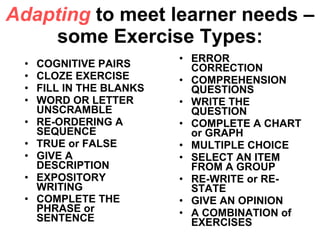
Adapting  to meet learner needs – some Exercise Types: COGNITIVE PAIRS CLOZE EXERCISE FILL IN THE BLANKS WORD OR LETTER UNSCRAMBLE RE-ORDERING A SEQUENCE TRUE or FALSE GIVE A DESCRIPTION EXPOSITORY WRITING COMPLETE THE PHRASE or SENTENCE   ERROR CORRECTION COMPREHENSION QUESTIONS WRITE THE QUESTION COMPLETE A CHART or GRAPH MULTIPLE CHOICE SELECT AN ITEM FROM A GROUP RE-WRITE or RE-STATE GIVE AN OPINION A COMBINATION of EXERCISES
EXPLOITING   LEARNER CHARACTERISTICS To Promote Effective Language Acquisition Some RECOMMENDATIONS:  Use a  variety of exercise  types Use  Multi-Media  activities  Test  only material taught Provide  examples for varying learner characteristics  Teach to and Evaluate a  wide range  of knowledge and skills  Evaluate  communicative skills Use adapted readings, materials and vocabulary at  proper levels
Using  Task-Based  Learning “ A TASK is a  goal-oriented activity with a clear purpose.  A communication task involves achieving an outcome, creating a final product that can be appreciated by others.”  from Jane Willis, 1998
 
Why Test? Students  learn more  in classes that use tests  The  connection  between  testing  and  increased learning  is well-proven in research  Students are  more motivated  in classes that use tests …  (M. Thompson, 2001) The classes in which students  learn most  and for which they  study hardest  are ones in which they are frequently and thoroughly tested…  (Eggan / Kauchak, 1994) Students expect to be tested – adult students  expect  and  respect  formal testing and are challenged by it…  (Hilles ref. by Thompson, 2001)
 
Decide wisely how and when to... Evaluate Assess
Thanks for your attention! Fitzroy Kennedy. M.A. School of Education University of Alabama [email_address]
 

FITZROY KENNEDY, MA - TESTING & ASSESSMENT IN ELT

  • 1.
    TESTING, EVALUATION & ASSESSMENT IN ELT
  • 2.
    Testing, Evaluation andAssessment By Fitzroy Kennedy. M.A. School of Education. University of Alabama
  • 3.
    What is teaching?*Write down the definition of “teaching” *Pair up with someone to come up with a definition *Share your definitions with the group.
  • 4.
    Teaching is... Topresent information To reveal knowledge or skill To help students to learn * All of the above can be accomplished either deliberately or incidentally * You can teach by means of explicit instruction, ongoing guidance, deliberate modeling, or accidental example.
  • 5.
    The general purposeof teaching is to help students to learn… How can you know that the students in your class really learned? by which means?
  • 6.
    When you arechecking student’s knowledge is… Evaluation Assessment
  • 7.
    What is thedifference between Assessment and Evaluation?
  • 8.
    Differences between assessmentand evaluation Timing Assessment Formative. It is an ongoing process of gathering information on the extent of learning. Evaluation Summative. It sums up attainment at the end of the course with a grade.
  • 9.
    Focus of measurementAssessment Process-oriented. How learning is going Evaluation Product-oriented. What has been learned
  • 10.
    Administrator / recipientrelationship Assessment Reflective. Internally defined (criteria / goals) Evaluation Prescriptive. Externally imposed standards
  • 11.
    Findings. Theuse of such findings Assessment Diagnostic. Identify areas of improvement Evaluation Judgmental. Arrive at an overall grade / score
  • 12.
    Ongoing modifiability ofcriteria Assessment Flexible. Adjust as problems are clarified Evaluation Fixed. To reward success, punish failure
  • 13.
    Standards of measurementAssessment Absolute. Tries to reach the ideal outcomes. Evaluation Comparative. Divide better from worse
  • 14.
    Relation between A/ E Assessment Cooperative. Learn from each other Evaluation Competitive. To try to do better than the others
  • 15.
    Dimension of differenceAssessment Evaluation Timing Formative Summative Focus of measurement Process-oriented Product-oriented Relationship between administrator and recipient Reflective Prescriptive Finding. The use of such findings Diagnostic Judgmental Ongoing modifiability of criteria Flexible Fixed Standards of measurement Absolute Comparative Relationship between objects of A / E Cooperative Competitive
  • 16.
    So that... Assessment for formative purposes is designed to stimulate growth, change and improvement in teaching through reflective practice. Evaluation is used for summative purposes to give an overview of a particular instructor's teaching in a particular course and setting Assessment vs Evaluation
  • 17.
    Ways to improveteaching and learning by A/E? Implement research-based “best practices” * Put the examples into practice Employ an assessment-informed model of teaching focused on measurable student learning outcomes.
  • 18.
    Employ an assessment informed model of teaching Define learning outcomes (desired by teachers and / or learners) well in advance. Assess progress toward outcomes, by and for both teacher and learner, continually during learning. Evaluate achievements of outcomes rigorously as each learning opportunity concludes. - Course by course, semester by semester.
  • 19.
    Establishing objectives Subject-mattertaxonomy by Rebecca Valette and Renee Disick Mechanical skills Knowledge Transfer Communication Criticism
  • 20.
    Principles of AssessmentTo improve their teacher, faculty must define learning outcomes and measure their achievement. To improve their learning, students must learn how to use feedback to assess their own progress (“self-assessment”). The best assessment derives from teacher’s questions about their own teaching. Assessment provides an impetus for active student involvement.
  • 21.
  • 22.
  • 23.
    The Biography isan ever-changing part of the ELP which children should revisit and update regularly, enabling them to reflect upon and record what they can do in each language. My language Biography
  • 24.
    The biography contains“can do” statements which children may color in and complete as they progress, building up into a personalized learning diary. By recording activities like this children become aware of their progress and of the linguistic content of the course.
  • 25.
  • 26.
    My Dossier Itis a personal collection of children’s work Children may file texts, pictures or recordings which illustrate their experiences and achievements Children take pride of their dossier and they make decisions about what is going to be included, removed or replaced When children leave a class, they can select favorite pieces of work which reflect their good job, to show off to their teacher of parents
  • 27.
  • 28.
    My language passportThe passport provides an overview of the languages a child knows, or is learning. It covers both and school contexts and is a way of giving visibility and value to all language-learning experiences. It can be to motivate young learners and it may be particularly valuable, together with “My Dossier”, when children move from school to school or when teachers change.
  • 29.
    The Language Passportshould have…
  • 30.
  • 31.
  • 32.
    Adapting tomeet learner needs – some Exercise Types: COGNITIVE PAIRS CLOZE EXERCISE FILL IN THE BLANKS WORD OR LETTER UNSCRAMBLE RE-ORDERING A SEQUENCE TRUE or FALSE GIVE A DESCRIPTION EXPOSITORY WRITING COMPLETE THE PHRASE or SENTENCE ERROR CORRECTION COMPREHENSION QUESTIONS WRITE THE QUESTION COMPLETE A CHART or GRAPH MULTIPLE CHOICE SELECT AN ITEM FROM A GROUP RE-WRITE or RE-STATE GIVE AN OPINION A COMBINATION of EXERCISES
  • 33.
    EXPLOITING LEARNER CHARACTERISTICS To Promote Effective Language Acquisition Some RECOMMENDATIONS: Use a variety of exercise types Use Multi-Media activities Test only material taught Provide examples for varying learner characteristics Teach to and Evaluate a wide range of knowledge and skills Evaluate communicative skills Use adapted readings, materials and vocabulary at proper levels
  • 34.
    Using Task-Based Learning “ A TASK is a goal-oriented activity with a clear purpose. A communication task involves achieving an outcome, creating a final product that can be appreciated by others.” from Jane Willis, 1998
  • 35.
  • 36.
    Why Test? Students learn more in classes that use tests The connection between testing and increased learning is well-proven in research Students are more motivated in classes that use tests … (M. Thompson, 2001) The classes in which students learn most and for which they study hardest are ones in which they are frequently and thoroughly tested… (Eggan / Kauchak, 1994) Students expect to be tested – adult students expect and respect formal testing and are challenged by it… (Hilles ref. by Thompson, 2001)
  • 37.
  • 38.
    Decide wisely howand when to... Evaluate Assess
  • 39.
    Thanks for yourattention! Fitzroy Kennedy. M.A. School of Education University of Alabama [email_address]
  • 40.