Certified Reasoning for
Automated Verification
Asankhaya Sharma
PhD Defense
Building Reliable Software
• Formal Verification
– Proving correctness
of programs
• Testing
– Discovering bugs
in programs
10/6/2015 PhD Defense 2
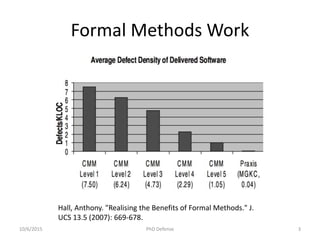
Formal Methods Work
Hall, Anthony. "Realising the Benefits of Formal Methods." J.
UCS 13.5 (2007): 669-678.
10/6/2015 PhD Defense 3
Thesis
“Certified reasoning improves the correctness
and expressivity of automated verification
without sacrificing on performance”
10/6/2015 PhD Defense 4
Certified Reasoning
• Correctness is machine checked
– (Decision) Procedures
– Proofs
– Programs
• Using the Coq Proof Assistant
10/6/2015 PhD Defense 5
Automated Verification
• Hoare Logic
– Specify pre and post conditions for each method
• Separation Logic
– Heap manipulating programs
– Separating conjunction “*” denotes disjoint heaps
• Using the HIP/SLEEK Verification System
10/6/2015 PhD Defense 6
Why Certify?
• Correctness
– Find bugs in implementation of the verifier
• Expressivity
– Verifying more properties by extending decision
procedures to cover richer domain/logic
• Performance
– Code generated from certified procedure should
be scalable
10/6/2015 PhD Defense 7
Thesis Contributions
• Certified Decision Procedure (Omega++)
– Certified Reasoning with Infinity
• Certified Proof (HIPComp)
– Specifying Compatible Sharing in Data Structures
– Automated Verification of Ramifications in SL
• Certified Program (SLEEK DSL)
– Verified Subtyping with Traits and Mixins
10/6/2015 PhD Defense 8
Certified Reasoning with Infinity
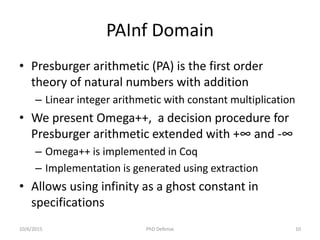
PAInf Domain
• Presburger arithmetic (PA) is the first order
theory of natural numbers with addition
– Linear integer arithmetic with constant multiplication
• We present Omega++, a decision procedure for
Presburger arithmetic extended with +∞ and -∞
– Omega++ is implemented in Coq
– Implementation is generated using extraction
• Allows using infinity as a ghost constant in
specifications
10/6/2015 PhD Defense 10
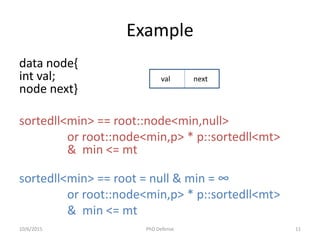
Example
data node{
int val;
node next}
sortedll<min> == root::node<min,null>
or root::node<min,p> * p::sortedll<mt>
& min <= mt
sortedll<min> == root = null & min = ∞
or root::node<min,p> * p::sortedll<mt>
& min <= mt
val next
10/6/2015 PhD Defense 11
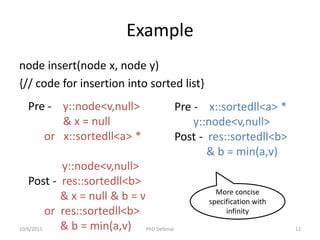
Example
node insert(node x, node y)
{// code for insertion into sorted list}
Pre - y::node<v,null>
& x = null
or x::sortedll<a> *
y::node<v,null>
Post - res::sortedll<b>
& x = null & b = v
or res::sortedll<b>
& b = min(a,v)
Pre - x::sortedll<a> *
y::node<v,null>
Post - res::sortedll<b>
& b = min(a,v)
More concise
specification with
infinity
10/6/2015 PhD Defense 12
Related Work
Lasaruk, Aless, and Thomas Sturm. "Effective quantifier elimination for presburger
arithmetic with infinity." Computer Algebra in Scientific Computing. Springer Berlin
Heidelberg, 2009.
Kapur, Deepak, et al. "Geometric quantifier elimination heuristics for automatically generating
octagonal and max-plus invariants." Automated Reasoning and Mathematics. Springer Berlin
Heidelberg, 2013. 189-228.
Domain Implemented Certified
Proof
Expressivity
[Lasaruk 2009] PA U {∞} ✗ ✗ Cannot express ordering
(no < symbol)
[Kapur 2013] PA U {-∞,+∞} ✗ ✗ Can express ordering
(includes < symbol)
Omega++ PA U {-∞,+∞} ✓ ✓ Can express ordering, min
and max constraints
10/6/2015 PhD Defense 13
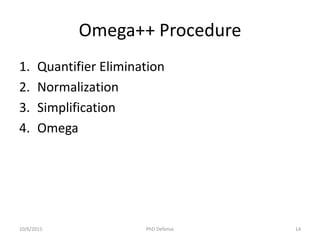
Omega++ Procedure
1. Quantifier Elimination
2. Normalization
3. Simplification
4. Omega
10/6/2015 PhD Defense 14
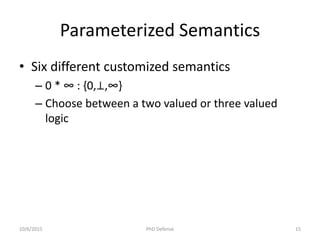
Parameterized Semantics
• Six different customized semantics
– 0 * ∞ : {0,⊥,∞}
– Choose between a two valued or three valued
logic
10/6/2015 PhD Defense 15
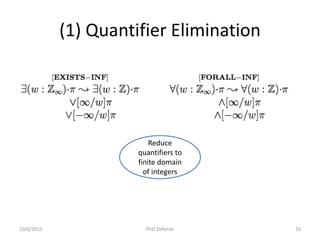
(1) Quantifier Elimination
Reduce
quantifiers to
finite domain
of integers
10/6/2015 PhD Defense 16
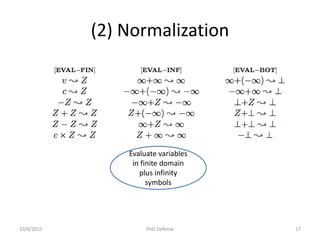
(2) Normalization
Evaluate variables
in finite domain
plus infinity
symbols
10/6/2015 PhD Defense 17
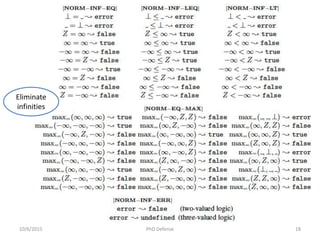
10/6/2015
Eliminate
infinities
PhD Defense 18
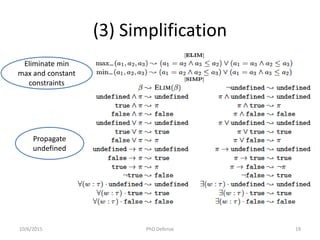
(3) Simplification
10/6/2015
Eliminate min
max and constant
constraints
PhD Defense 19
Propagate
undefined
(4) Omega
• The formula is now in PA so we can use an
existing decision procedure for PA to solve it
– Omega Calculator
10/6/2015 PhD Defense 20
Implementation
• Omega++ is implemented in Coq
– Program (in Gallina) and Proof
– http://loris-
7.ddns.comp.nus.edu.sg/~project/SLPAInf/
• OCaml code is generated from Coq using
extraction
– Extracted code is integrated with HIP/SLEEK
10/6/2015 PhD Defense 21
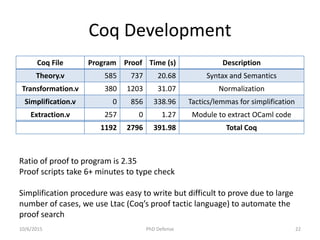
Coq Development
Coq File Program Proof Time (s) Description
Theory.v 585 737 20.68 Syntax and Semantics
Transformation.v 380 1203 31.07 Normalization
Simplification.v 0 856 338.96 Tactics/lemmas for simplification
Extraction.v 257 0 1.27 Module to extract OCaml code
1192 2796 391.98 Total Coq
Ratio of proof to program is 2.35
Proof scripts take 6+ minutes to type check
Simplification procedure was easy to write but difficult to prove due to large
number of cases, we use Ltac (Coq’s proof tactic language) to automate the
proof search
10/6/2015 PhD Defense 22
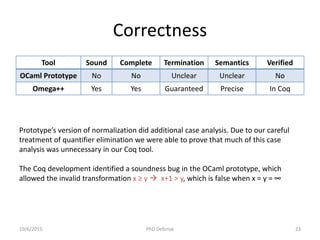
Correctness
Tool Sound Complete Termination Semantics Verified
OCaml Prototype No No Unclear Unclear No
Omega++ Yes Yes Guaranteed Precise In Coq
Prototype’s version of normalization did additional case analysis. Due to our careful
treatment of quantifier elimination we were able to prove that much of this case
analysis was unnecessary in our Coq tool.
The Coq development identified a soundness bug in the OCaml prototype, which
allowed the invalid transformation x ≥ y  x+1 > y, which is false when x = y = ∞
10/6/2015 PhD Defense 23
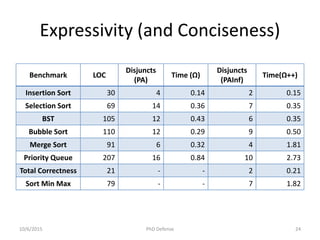
Expressivity (and Conciseness)
Benchmark LOC
Disjuncts
(PA)
Time (Ω)
Disjuncts
(PAInf)
Time(Ω++)
Insertion Sort 30 4 0.14 2 0.15
Selection Sort 69 14 0.36 7 0.35
BST 105 12 0.43 6 0.35
Bubble Sort 110 12 0.29 9 0.50
Merge Sort 91 6 0.32 4 1.81
Priority Queue 207 16 0.84 10 2.73
Total Correctness 21 - - 2 0.21
Sort Min Max 79 - - 7 1.82
10/6/2015 PhD Defense 24
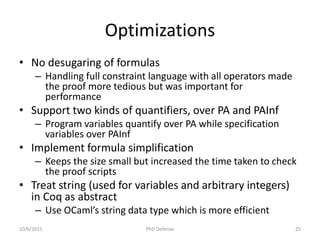
Optimizations
• No desugaring of formulas
– Handling full constraint language with all operators made
the proof more tedious but was important for
performance
• Support two kinds of quantifiers, over PA and PAInf
– Program variables quantify over PA while specification
variables over PAInf
• Implement formula simplification
– Keeps the size small but increased the time taken to check
the proof scripts
• Treat string (used for variables and arbitrary integers)
in Coq as abstract
– Use OCaml’s string data type which is more efficient
10/6/2015 PhD Defense 25
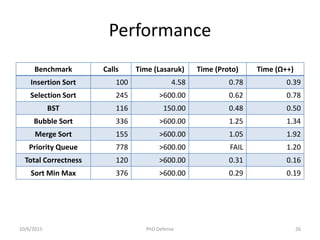
Performance
Benchmark Calls Time (Lasaruk) Time (Proto) Time (Ω++)
Insertion Sort 100 4.58 0.78 0.39
Selection Sort 245 >600.00 0.62 0.78
BST 116 150.00 0.48 0.50
Bubble Sort 336 >600.00 1.25 1.34
Merge Sort 155 >600.00 1.05 1.92
Priority Queue 778 >600.00 FAIL 1.20
Total Correctness 120 >600.00 0.31 0.16
Sort Min Max 376 >600.00 0.29 0.19
10/6/2015 PhD Defense 26
Specifying Compatible Sharing in
Data Structures
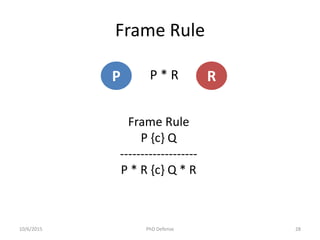
Frame Rule
P RP * R
Frame Rule
P {c} Q
-------------------
P * R {c} Q * R
10/6/2015 PhD Defense 28
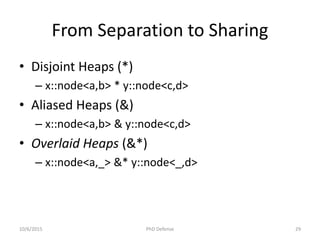
From Separation to Sharing
• Disjoint Heaps (*)
– x::node<a,b> * y::node<c,d>
• Aliased Heaps (&)
– x::node<a,b> & y::node<c,d>
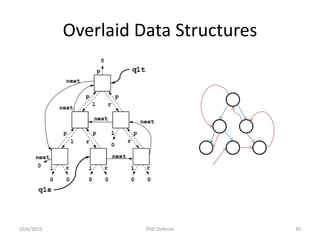
• Overlaid Heaps (&*)
– x::node<a,_> &* y::node<_,d>
10/6/2015 PhD Defense 29
Overlaid Data Structures
10/6/2015 PhD Defense 30
Compatible Sharing
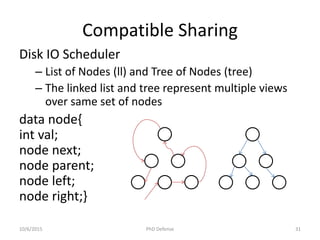
Disk IO Scheduler
– List of Nodes (ll) and Tree of Nodes (tree)
– The linked list and tree represent multiple views
over same set of nodes
data node{
int val;
node next;
node parent;
node left;
node right;}
10/6/2015 PhD Defense 31
Related Work
Lee, Oukseh, Hongseok Yang, and Rasmus Petersen. "Program analysis for overlaid data
structures." Computer Aided Verification. Springer Berlin Heidelberg, 2011.
Drăgoi, Cezara, Constantin Enea, and Mihaela Sighireanu. "Local Shape Analysis for Overlaid Data
Structures." Static Analysis. Springer Berlin Heidelberg, 2013. 150-171.
Expressivity Entailment
Procedure
Program
Analysis
Local
Reasoning
Certified
Proof
Properties
[Lee 2011] List and Tree ✗ ✓ ✗ ✗ Shape
[Drăgoi
2013]
Only Lists ✗ ✓ ✓ ✗ Shape
HIPComp User
Defined
Predicates
✓ ✗ ✓ ✓ Shape, Size
and Bag
10/6/2015 PhD Defense 32
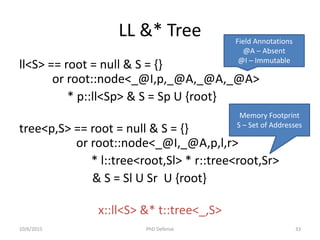
LL &* Tree
ll<S> == root = null & S = {}
or root::node<_@I,p,_@A,_@A,_@A>
* p::ll<Sp> & S = Sp U {root}
tree<p,S> == root = null & S = {}
or root::node<_@I,_@A,p,l,r>
* l::tree<root,Sl> * r::tree<root,Sr>
& S = Sl U Sr U {root}
x::ll<S> &* t::tree<_,S>
Field Annotations
@A – Absent
@I – Immutable
Memory Footprint
S – Set of Addresses
10/6/2015 PhD Defense 33
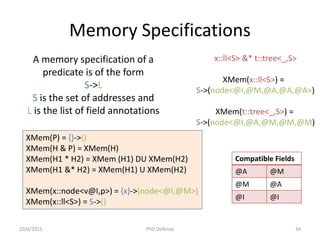
Memory Specifications
XMem(P) = {}->()
XMem(H & P) = XMem(H)
XMem(H1 * H2) = XMem (H1) DU XMem(H2)
XMem(H1 &* H2) = XMem(H1) U XMem(H2)
XMem(x::node<v@I,p>) = {x}->(node<@I,@M>)
XMem(x::ll<S>) = S->()
A memory specification of a
predicate is of the form
S->L
S is the set of addresses and
L is the list of field annotations
x::ll<S> &* t::tree<_,S>
XMem(x::ll<S>) =
S->(node<@I,@M,@A,@A,@A>)
XMem(t::tree<_,S>) =
S->(node<@I,@A,@M,@M,@M)
Compatible Fields
@A @M
@M @A
@I @I
10/6/2015 PhD Defense 34
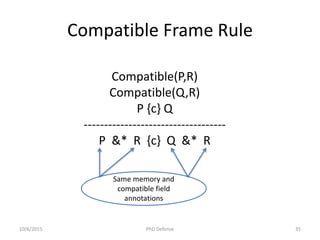
Compatible Frame Rule
Compatible(P,R)
Compatible(Q,R)
P {c} Q
-----------------------------------
P &* R {c} Q &* R
10/6/2015 PhD Defense 35
Same memory and
compatible field
annotations
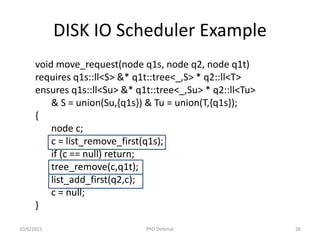
void move_request(node q1s, node q2, node q1t)
requires q1s::ll<S> &* q1t::tree<_,S> * q2::ll<T>
ensures q1s::ll<Su> &* q1t::tree<_,Su> * q2::ll<Tu>
& S = union(Su,{q1s}) & Tu = union(T,{q1s});
{
node c;
c = list_remove_first(q1s);
if (c == null) return;
tree_remove(c,q1t);
list_add_first(q2,c);
c = null;
}
DISK IO Scheduler Example
10/6/2015 PhD Defense 36
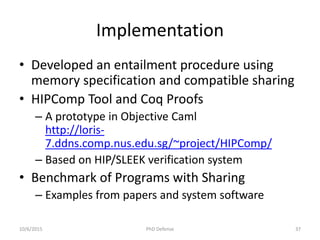
Implementation
• Developed an entailment procedure using
memory specification and compatible sharing
• HIPComp Tool and Coq Proofs
– A prototype in Objective Caml
http://loris-
7.ddns.comp.nus.edu.sg/~project/HIPComp/
– Based on HIP/SLEEK verification system
• Benchmark of Programs with Sharing
– Examples from papers and system software
10/6/2015 PhD Defense 37
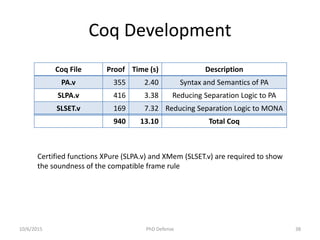
Coq Development
Coq File Proof Time (s) Description
PA.v 355 2.40 Syntax and Semantics of PA
SLPA.v 416 3.38 Reducing Separation Logic to PA
SLSET.v 169 7.32 Reducing Separation Logic to MONA
940 13.10 Total Coq
Certified functions XPure (SLPA.v) and XMem (SLSET.v) are required to show
the soundness of the compatible frame rule
10/6/2015 PhD Defense 38
Correctness
• Found two soundness issues
– In the paper pen proof of XPure function given in
[Chin 2012] a condition was missing (p!=0) in one
of the cases
– Certifying XMem function helped uncover a
soundness bug in the implementation where the
order of Matching and Splitting rules was wrong
Chin, Wei-Ngan, et al. "Automated verification of shape, size and bag properties via
user-defined predicates in separation logic." Science of Computer Programming 77.9
(2012): 1006-1036.
10/6/2015 PhD Defense 39
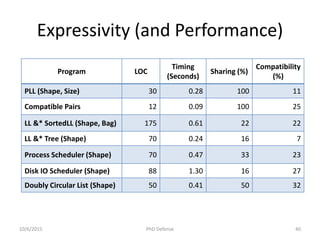
Expressivity (and Performance)
Program LOC
Timing
(Seconds)
Sharing (%)
Compatibility
(%)
PLL (Shape, Size) 30 0.28 100 11
Compatible Pairs 12 0.09 100 25
LL &* SortedLL (Shape, Bag) 175 0.61 22 22
LL &* Tree (Shape) 70 0.24 16 7
Process Scheduler (Shape) 70 0.47 33 23
Disk IO Scheduler (Shape) 88 1.30 16 27
Doubly Circular List (Shape) 50 0.41 50 32
10/6/2015 PhD Defense 40
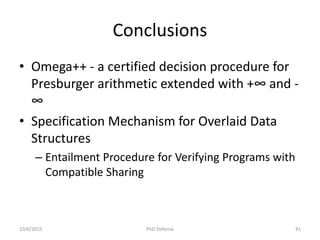
Conclusions
• Omega++ - a certified decision procedure for
Presburger arithmetic extended with +∞ and -
∞
• Specification Mechanism for Overlaid Data
Structures
– Entailment Procedure for Verifying Programs with
Compatible Sharing
10/6/2015 PhD Defense 41
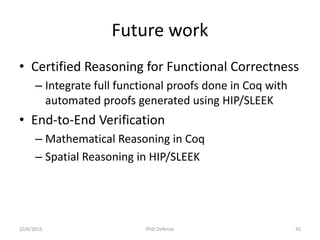
Future work
• Certified Reasoning for Functional Correctness
– Integrate full functional proofs done in Coq with
automated proofs generated using HIP/SLEEK
• End-to-End Verification
– Mathematical Reasoning in Coq
– Spatial Reasoning in HIP/SLEEK
10/6/2015 PhD Defense 42
Thank You !
• Questions ?
• Contact
– asankhaya@u.nus.edu
• Publications
– Certified Reasoning with Infinity [FM 15]
– Verified Subtyping with Traits and Mixins [FSFMA 14]
– Exploiting Undefined Behaviors for Efficient Symbolic Execution
[ICSE (Student Research Competition) 14]
– HIPimm: Verifying Granular Immutability Guarantees [PEPM 14]
– A Refinement Calculus for Promela [ICECCS 13]
– Towards Complete Specifications with an Error Calculus [NFM
13]
10/6/2015 PhD Defense 43
Additional Slides
10/6/2015 PhD Defense 44
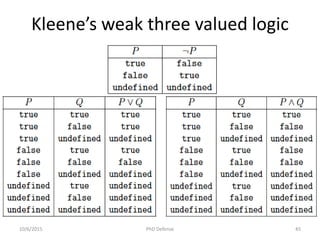
Kleene’s weak three valued logic
10/6/2015 PhD Defense 45
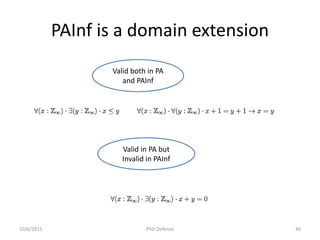
PAInf is a domain extension
Valid both in PA
and PAInf
Valid in PA but
Invalid in PAInf
10/6/2015 PhD Defense 46
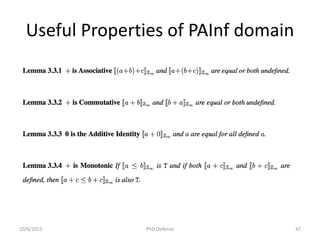
Useful Properties of PAInf domain
10/6/2015 PhD Defense 47
Application
• Quantifier elimination in PAInf for
specification inference
• Using [Kapur 2012] we support inference of
octagonal size constraints using ghost infinity
in the presence of heap-based verification
Kapur, Deepak. "Program analysis using quantifier-elimination heuristics." Theory and
Applications of Models of Computation. Springer Berlin Heidelberg, 2012. 94-108.
10/6/2015 PhD Defense 48
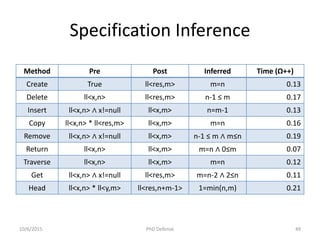
Specification Inference
Method Pre Post Inferred Time (Ω++)
Create True ll<res,m> m=n 0.13
Delete ll<x,n> ll<res,m> n-1 ≤ m 0.17
Insert ll<x,n> ∧ x!=null ll<x,m> n=m-1 0.13
Copy ll<x,n> * ll<res,m> ll<x,m> m=n 0.16
Remove ll<x,n> ∧ x!=null ll<x,m> n-1 ≤ m ∧ m≤n 0.19
Return ll<x,n> ll<x,m> m=n ∧ 0≤m 0.07
Traverse ll<x,n> ll<x,m> m=n 0.12
Get ll<x,n> ∧ x!=null ll<res,m> m=n-2 ∧ 2≤n 0.11
Head ll<x,n> * ll<y,m> ll<res,n+m-1> 1=min(n,m) 0.21
10/6/2015 PhD Defense 49
Conclusions
• Omega++ - a certified decision procedure for
Presburger arithmetic extended with +∞ and -
∞
• Integrated Omega++ in HIP/SLEEK verification
system and evaluated the usefulness for
verification and specification inference
10/6/2015 PhD Defense 50
Verified Subtyping with Traits
and Mixins
Object Oriented Design
• S – Single Responsibility
• O – Open Close
• L – Liskov Substitution
• I – Interface Segregation
• D – Dependency Inversion
First proposed by Robert C. Martin in
comp.object newsgroup in March 1995
10/6/2015 PhD Defense 52
Liskov Substitution Principle
“Let q(x) be a property provable about objects x
of type T. Then q(y) should be provable for
objects y of type S where S is a subtype of T”
- Barbara Liskov and Jeannette Wing
10/6/2015 PhD Defense 53
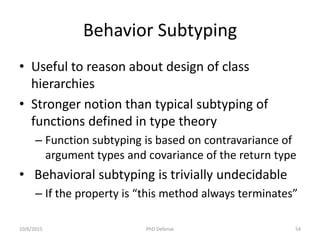
Behavior Subtyping
• Useful to reason about design of class
hierarchies
• Stronger notion than typical subtyping of
functions defined in type theory
– Function subtyping is based on contravariance of
argument types and covariance of the return type
• Behavioral subtyping is trivially undecidable
– If the property is “this method always terminates”
10/6/2015 PhD Defense 54
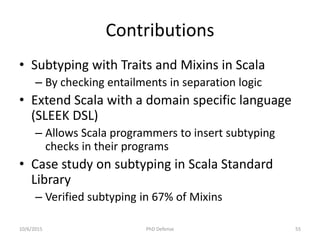
Contributions
• Subtyping with Traits and Mixins in Scala
– By checking entailments in separation logic
• Extend Scala with a domain specific language
(SLEEK DSL)
– Allows Scala programmers to insert subtyping
checks in their programs
• Case study on subtyping in Scala Standard
Library
– Verified subtyping in 67% of Mixins
10/6/2015 PhD Defense 55
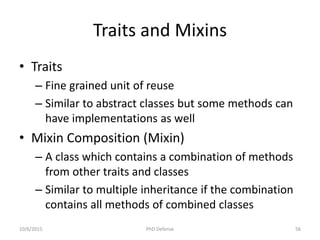
Traits and Mixins
• Traits
– Fine grained unit of reuse
– Similar to abstract classes but some methods can
have implementations as well
• Mixin Composition (Mixin)
– A class which contains a combination of methods
from other traits and classes
– Similar to multiple inheritance if the combination
contains all methods of combined classes
10/6/2015 PhD Defense 56
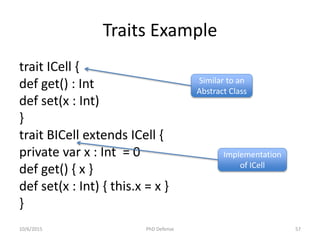
Traits Example
trait ICell {
def get() : Int
def set(x : Int)
}
trait BICell extends ICell {
private var x : Int = 0
def get() { x }
def set(x : Int) { this.x = x }
}
Similar to an
Abstract Class
Implementation
of ICell
10/6/2015 PhD Defense 57
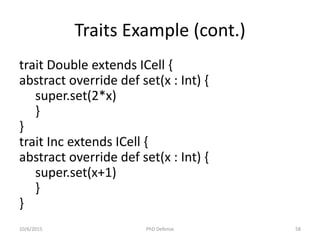
Traits Example (cont.)
trait Double extends ICell {
abstract override def set(x : Int) {
super.set(2*x)
}
}
trait Inc extends ICell {
abstract override def set(x : Int) {
super.set(x+1)
}
}
10/6/2015 PhD Defense 58
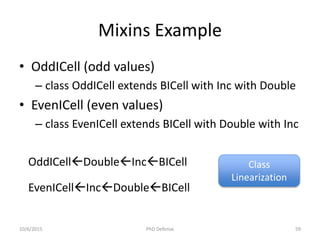
Mixins Example
• OddICell (odd values)
– class OddICell extends BICell with Inc with Double
• EvenICell (even values)
– class EvenICell extends BICell with Double with Inc
OddICellDoubleIncBICell
EvenICellIncDoubleBICell
Class
Linearization
10/6/2015 PhD Defense 59
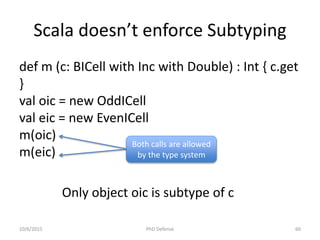
Scala doesn’t enforce Subtyping
def m (c: BICell with Inc with Double) : Int { c.get
}
val oic = new OddICell
val eic = new EvenICell
m(oic)
m(eic)
Both calls are allowed
by the type system
Only object oic is subtype of c
10/6/2015 PhD Defense 60
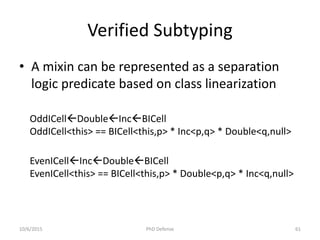
Verified Subtyping
• A mixin can be represented as a separation
logic predicate based on class linearization
OddICellDoubleIncBICell
OddICell<this> == BICell<this,p> * Inc<p,q> * Double<q,null>
EvenICellIncDoubleBICell
EvenICell<this> == BICell<this,p> * Double<p,q> * Inc<q,null>
10/6/2015 PhD Defense 61
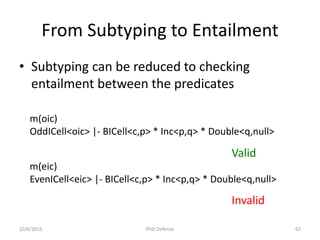
From Subtyping to Entailment
• Subtyping can be reduced to checking
entailment between the predicates
m(oic)
OddICell<oic> |- BICell<c,p> * Inc<p,q> * Double<q,null>
m(eic)
EvenICell<eic> |- BICell<c,p> * Inc<p,q> * Double<q,null>
Valid
Invalid
10/6/2015 PhD Defense 62
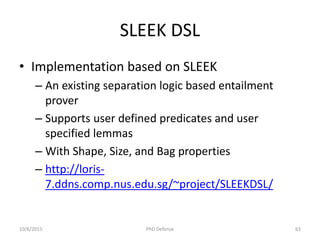
SLEEK DSL
• Implementation based on SLEEK
– An existing separation logic based entailment
prover
– Supports user defined predicates and user
specified lemmas
– With Shape, Size, and Bag properties
– http://loris-
7.ddns.comp.nus.edu.sg/~project/SLEEKDSL/
10/6/2015 PhD Defense 63
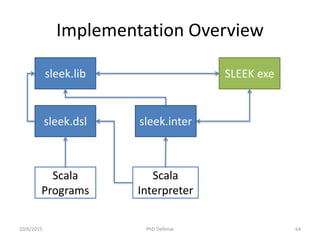
Implementation Overview
SLEEK exesleek.lib
sleek.dsl sleek.inter
Scala
Programs
Scala
Interpreter
10/6/2015 PhD Defense 64
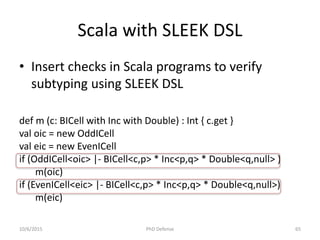
Scala with SLEEK DSL
def m (c: BICell with Inc with Double) : Int { c.get }
val oic = new OddICell
val eic = new EvenICell
if (OddICell<oic> |- BICell<c,p> * Inc<p,q> * Double<q,null> )
m(oic)
if (EvenICell<eic> |- BICell<c,p> * Inc<p,q> * Double<q,null>)
m(eic)
• Insert checks in Scala programs to verify
subtyping using SLEEK DSL
10/6/2015 PhD Defense 65
Experiments
• Scala Standard Library
• Considered four class hierarchies
– Exceptions
– Maths
– Parser Combinators
– Collections
10/6/2015 PhD Defense 66
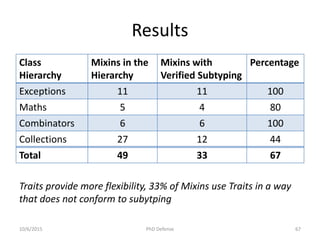
Results
Class
Hierarchy
Mixins in the
Hierarchy
Mixins with
Verified Subtyping
Percentage
Exceptions 11 11 100
Maths 5 4 80
Combinators 6 6 100
Collections 27 12 44
Total 49 33 67
Traits provide more flexibility, 33% of Mixins use Traits in a way
that does not conform to subytping
10/6/2015 PhD Defense 67
Conclusions
• We use entailment proving in separation logic
to check subtyping with Traits and Mixins
• A domain specific language based on SLEEK to
check entailments from Scala programs
• Case study based on Scala Standard Library
10/6/2015 PhD Defense 68
Perspectives
• Lays the foundation for verifying OO Scala
programs
– Specification reuse with traits and mixins
– Inheritance verification
• Static and Dynamic Specifications for traits
and mixins
– Avoid re-verification
– Compositional and modular
10/6/2015 PhD Defense 69

Certified Reasoning for Automated Verification

  • 1.
    Certified Reasoning for AutomatedVerification Asankhaya Sharma PhD Defense
  • 2.
    Building Reliable Software •Formal Verification – Proving correctness of programs • Testing – Discovering bugs in programs 10/6/2015 PhD Defense 2
  • 3.
    Formal Methods Work Hall,Anthony. "Realising the Benefits of Formal Methods." J. UCS 13.5 (2007): 669-678. 10/6/2015 PhD Defense 3
  • 4.
    Thesis “Certified reasoning improvesthe correctness and expressivity of automated verification without sacrificing on performance” 10/6/2015 PhD Defense 4
  • 5.
    Certified Reasoning • Correctnessis machine checked – (Decision) Procedures – Proofs – Programs • Using the Coq Proof Assistant 10/6/2015 PhD Defense 5
  • 6.
    Automated Verification • HoareLogic – Specify pre and post conditions for each method • Separation Logic – Heap manipulating programs – Separating conjunction “*” denotes disjoint heaps • Using the HIP/SLEEK Verification System 10/6/2015 PhD Defense 6
  • 7.
    Why Certify? • Correctness –Find bugs in implementation of the verifier • Expressivity – Verifying more properties by extending decision procedures to cover richer domain/logic • Performance – Code generated from certified procedure should be scalable 10/6/2015 PhD Defense 7
  • 8.
    Thesis Contributions • CertifiedDecision Procedure (Omega++) – Certified Reasoning with Infinity • Certified Proof (HIPComp) – Specifying Compatible Sharing in Data Structures – Automated Verification of Ramifications in SL • Certified Program (SLEEK DSL) – Verified Subtyping with Traits and Mixins 10/6/2015 PhD Defense 8
  • 9.
  • 10.
    PAInf Domain • Presburgerarithmetic (PA) is the first order theory of natural numbers with addition – Linear integer arithmetic with constant multiplication • We present Omega++, a decision procedure for Presburger arithmetic extended with +∞ and -∞ – Omega++ is implemented in Coq – Implementation is generated using extraction • Allows using infinity as a ghost constant in specifications 10/6/2015 PhD Defense 10
  • 11.
    Example data node{ int val; nodenext} sortedll<min> == root::node<min,null> or root::node<min,p> * p::sortedll<mt> & min <= mt sortedll<min> == root = null & min = ∞ or root::node<min,p> * p::sortedll<mt> & min <= mt val next 10/6/2015 PhD Defense 11
  • 12.
    Example node insert(node x,node y) {// code for insertion into sorted list} Pre - y::node<v,null> & x = null or x::sortedll<a> * y::node<v,null> Post - res::sortedll<b> & x = null & b = v or res::sortedll<b> & b = min(a,v) Pre - x::sortedll<a> * y::node<v,null> Post - res::sortedll<b> & b = min(a,v) More concise specification with infinity 10/6/2015 PhD Defense 12
  • 13.
    Related Work Lasaruk, Aless,and Thomas Sturm. "Effective quantifier elimination for presburger arithmetic with infinity." Computer Algebra in Scientific Computing. Springer Berlin Heidelberg, 2009. Kapur, Deepak, et al. "Geometric quantifier elimination heuristics for automatically generating octagonal and max-plus invariants." Automated Reasoning and Mathematics. Springer Berlin Heidelberg, 2013. 189-228. Domain Implemented Certified Proof Expressivity [Lasaruk 2009] PA U {∞} ✗ ✗ Cannot express ordering (no < symbol) [Kapur 2013] PA U {-∞,+∞} ✗ ✗ Can express ordering (includes < symbol) Omega++ PA U {-∞,+∞} ✓ ✓ Can express ordering, min and max constraints 10/6/2015 PhD Defense 13
  • 14.
    Omega++ Procedure 1. QuantifierElimination 2. Normalization 3. Simplification 4. Omega 10/6/2015 PhD Defense 14
  • 15.
    Parameterized Semantics • Sixdifferent customized semantics – 0 * ∞ : {0,⊥,∞} – Choose between a two valued or three valued logic 10/6/2015 PhD Defense 15
  • 16.
    (1) Quantifier Elimination Reduce quantifiersto finite domain of integers 10/6/2015 PhD Defense 16
  • 17.
    (2) Normalization Evaluate variables infinite domain plus infinity symbols 10/6/2015 PhD Defense 17
  • 18.
  • 19.
    (3) Simplification 10/6/2015 Eliminate min maxand constant constraints PhD Defense 19 Propagate undefined
  • 20.
    (4) Omega • Theformula is now in PA so we can use an existing decision procedure for PA to solve it – Omega Calculator 10/6/2015 PhD Defense 20
  • 21.
    Implementation • Omega++ isimplemented in Coq – Program (in Gallina) and Proof – http://loris- 7.ddns.comp.nus.edu.sg/~project/SLPAInf/ • OCaml code is generated from Coq using extraction – Extracted code is integrated with HIP/SLEEK 10/6/2015 PhD Defense 21
  • 22.
    Coq Development Coq FileProgram Proof Time (s) Description Theory.v 585 737 20.68 Syntax and Semantics Transformation.v 380 1203 31.07 Normalization Simplification.v 0 856 338.96 Tactics/lemmas for simplification Extraction.v 257 0 1.27 Module to extract OCaml code 1192 2796 391.98 Total Coq Ratio of proof to program is 2.35 Proof scripts take 6+ minutes to type check Simplification procedure was easy to write but difficult to prove due to large number of cases, we use Ltac (Coq’s proof tactic language) to automate the proof search 10/6/2015 PhD Defense 22
  • 23.
    Correctness Tool Sound CompleteTermination Semantics Verified OCaml Prototype No No Unclear Unclear No Omega++ Yes Yes Guaranteed Precise In Coq Prototype’s version of normalization did additional case analysis. Due to our careful treatment of quantifier elimination we were able to prove that much of this case analysis was unnecessary in our Coq tool. The Coq development identified a soundness bug in the OCaml prototype, which allowed the invalid transformation x ≥ y  x+1 > y, which is false when x = y = ∞ 10/6/2015 PhD Defense 23
  • 24.
    Expressivity (and Conciseness) BenchmarkLOC Disjuncts (PA) Time (Ω) Disjuncts (PAInf) Time(Ω++) Insertion Sort 30 4 0.14 2 0.15 Selection Sort 69 14 0.36 7 0.35 BST 105 12 0.43 6 0.35 Bubble Sort 110 12 0.29 9 0.50 Merge Sort 91 6 0.32 4 1.81 Priority Queue 207 16 0.84 10 2.73 Total Correctness 21 - - 2 0.21 Sort Min Max 79 - - 7 1.82 10/6/2015 PhD Defense 24
  • 25.
    Optimizations • No desugaringof formulas – Handling full constraint language with all operators made the proof more tedious but was important for performance • Support two kinds of quantifiers, over PA and PAInf – Program variables quantify over PA while specification variables over PAInf • Implement formula simplification – Keeps the size small but increased the time taken to check the proof scripts • Treat string (used for variables and arbitrary integers) in Coq as abstract – Use OCaml’s string data type which is more efficient 10/6/2015 PhD Defense 25
  • 26.
    Performance Benchmark Calls Time(Lasaruk) Time (Proto) Time (Ω++) Insertion Sort 100 4.58 0.78 0.39 Selection Sort 245 >600.00 0.62 0.78 BST 116 150.00 0.48 0.50 Bubble Sort 336 >600.00 1.25 1.34 Merge Sort 155 >600.00 1.05 1.92 Priority Queue 778 >600.00 FAIL 1.20 Total Correctness 120 >600.00 0.31 0.16 Sort Min Max 376 >600.00 0.29 0.19 10/6/2015 PhD Defense 26
  • 27.
  • 28.
    Frame Rule P RP* R Frame Rule P {c} Q ------------------- P * R {c} Q * R 10/6/2015 PhD Defense 28
  • 29.
    From Separation toSharing • Disjoint Heaps (*) – x::node<a,b> * y::node<c,d> • Aliased Heaps (&) – x::node<a,b> & y::node<c,d> • Overlaid Heaps (&*) – x::node<a,_> &* y::node<_,d> 10/6/2015 PhD Defense 29
  • 30.
  • 31.
    Compatible Sharing Disk IOScheduler – List of Nodes (ll) and Tree of Nodes (tree) – The linked list and tree represent multiple views over same set of nodes data node{ int val; node next; node parent; node left; node right;} 10/6/2015 PhD Defense 31
  • 32.
    Related Work Lee, Oukseh,Hongseok Yang, and Rasmus Petersen. "Program analysis for overlaid data structures." Computer Aided Verification. Springer Berlin Heidelberg, 2011. Drăgoi, Cezara, Constantin Enea, and Mihaela Sighireanu. "Local Shape Analysis for Overlaid Data Structures." Static Analysis. Springer Berlin Heidelberg, 2013. 150-171. Expressivity Entailment Procedure Program Analysis Local Reasoning Certified Proof Properties [Lee 2011] List and Tree ✗ ✓ ✗ ✗ Shape [Drăgoi 2013] Only Lists ✗ ✓ ✓ ✗ Shape HIPComp User Defined Predicates ✓ ✗ ✓ ✓ Shape, Size and Bag 10/6/2015 PhD Defense 32
  • 33.
    LL &* Tree ll<S>== root = null & S = {} or root::node<_@I,p,_@A,_@A,_@A> * p::ll<Sp> & S = Sp U {root} tree<p,S> == root = null & S = {} or root::node<_@I,_@A,p,l,r> * l::tree<root,Sl> * r::tree<root,Sr> & S = Sl U Sr U {root} x::ll<S> &* t::tree<_,S> Field Annotations @A – Absent @I – Immutable Memory Footprint S – Set of Addresses 10/6/2015 PhD Defense 33
  • 34.
    Memory Specifications XMem(P) ={}->() XMem(H & P) = XMem(H) XMem(H1 * H2) = XMem (H1) DU XMem(H2) XMem(H1 &* H2) = XMem(H1) U XMem(H2) XMem(x::node<v@I,p>) = {x}->(node<@I,@M>) XMem(x::ll<S>) = S->() A memory specification of a predicate is of the form S->L S is the set of addresses and L is the list of field annotations x::ll<S> &* t::tree<_,S> XMem(x::ll<S>) = S->(node<@I,@M,@A,@A,@A>) XMem(t::tree<_,S>) = S->(node<@I,@A,@M,@M,@M) Compatible Fields @A @M @M @A @I @I 10/6/2015 PhD Defense 34
  • 35.
    Compatible Frame Rule Compatible(P,R) Compatible(Q,R) P{c} Q ----------------------------------- P &* R {c} Q &* R 10/6/2015 PhD Defense 35 Same memory and compatible field annotations
  • 36.
    void move_request(node q1s,node q2, node q1t) requires q1s::ll<S> &* q1t::tree<_,S> * q2::ll<T> ensures q1s::ll<Su> &* q1t::tree<_,Su> * q2::ll<Tu> & S = union(Su,{q1s}) & Tu = union(T,{q1s}); { node c; c = list_remove_first(q1s); if (c == null) return; tree_remove(c,q1t); list_add_first(q2,c); c = null; } DISK IO Scheduler Example 10/6/2015 PhD Defense 36
  • 37.
    Implementation • Developed anentailment procedure using memory specification and compatible sharing • HIPComp Tool and Coq Proofs – A prototype in Objective Caml http://loris- 7.ddns.comp.nus.edu.sg/~project/HIPComp/ – Based on HIP/SLEEK verification system • Benchmark of Programs with Sharing – Examples from papers and system software 10/6/2015 PhD Defense 37
  • 38.
    Coq Development Coq FileProof Time (s) Description PA.v 355 2.40 Syntax and Semantics of PA SLPA.v 416 3.38 Reducing Separation Logic to PA SLSET.v 169 7.32 Reducing Separation Logic to MONA 940 13.10 Total Coq Certified functions XPure (SLPA.v) and XMem (SLSET.v) are required to show the soundness of the compatible frame rule 10/6/2015 PhD Defense 38
  • 39.
    Correctness • Found twosoundness issues – In the paper pen proof of XPure function given in [Chin 2012] a condition was missing (p!=0) in one of the cases – Certifying XMem function helped uncover a soundness bug in the implementation where the order of Matching and Splitting rules was wrong Chin, Wei-Ngan, et al. "Automated verification of shape, size and bag properties via user-defined predicates in separation logic." Science of Computer Programming 77.9 (2012): 1006-1036. 10/6/2015 PhD Defense 39
  • 40.
    Expressivity (and Performance) ProgramLOC Timing (Seconds) Sharing (%) Compatibility (%) PLL (Shape, Size) 30 0.28 100 11 Compatible Pairs 12 0.09 100 25 LL &* SortedLL (Shape, Bag) 175 0.61 22 22 LL &* Tree (Shape) 70 0.24 16 7 Process Scheduler (Shape) 70 0.47 33 23 Disk IO Scheduler (Shape) 88 1.30 16 27 Doubly Circular List (Shape) 50 0.41 50 32 10/6/2015 PhD Defense 40
  • 41.
    Conclusions • Omega++ -a certified decision procedure for Presburger arithmetic extended with +∞ and - ∞ • Specification Mechanism for Overlaid Data Structures – Entailment Procedure for Verifying Programs with Compatible Sharing 10/6/2015 PhD Defense 41
  • 42.
    Future work • CertifiedReasoning for Functional Correctness – Integrate full functional proofs done in Coq with automated proofs generated using HIP/SLEEK • End-to-End Verification – Mathematical Reasoning in Coq – Spatial Reasoning in HIP/SLEEK 10/6/2015 PhD Defense 42
  • 43.
    Thank You ! •Questions ? • Contact – asankhaya@u.nus.edu • Publications – Certified Reasoning with Infinity [FM 15] – Verified Subtyping with Traits and Mixins [FSFMA 14] – Exploiting Undefined Behaviors for Efficient Symbolic Execution [ICSE (Student Research Competition) 14] – HIPimm: Verifying Granular Immutability Guarantees [PEPM 14] – A Refinement Calculus for Promela [ICECCS 13] – Towards Complete Specifications with an Error Calculus [NFM 13] 10/6/2015 PhD Defense 43
  • 44.
  • 45.
    Kleene’s weak threevalued logic 10/6/2015 PhD Defense 45
  • 46.
    PAInf is adomain extension Valid both in PA and PAInf Valid in PA but Invalid in PAInf 10/6/2015 PhD Defense 46
  • 47.
    Useful Properties ofPAInf domain 10/6/2015 PhD Defense 47
  • 48.
    Application • Quantifier eliminationin PAInf for specification inference • Using [Kapur 2012] we support inference of octagonal size constraints using ghost infinity in the presence of heap-based verification Kapur, Deepak. "Program analysis using quantifier-elimination heuristics." Theory and Applications of Models of Computation. Springer Berlin Heidelberg, 2012. 94-108. 10/6/2015 PhD Defense 48
  • 49.
    Specification Inference Method PrePost Inferred Time (Ω++) Create True ll<res,m> m=n 0.13 Delete ll<x,n> ll<res,m> n-1 ≤ m 0.17 Insert ll<x,n> ∧ x!=null ll<x,m> n=m-1 0.13 Copy ll<x,n> * ll<res,m> ll<x,m> m=n 0.16 Remove ll<x,n> ∧ x!=null ll<x,m> n-1 ≤ m ∧ m≤n 0.19 Return ll<x,n> ll<x,m> m=n ∧ 0≤m 0.07 Traverse ll<x,n> ll<x,m> m=n 0.12 Get ll<x,n> ∧ x!=null ll<res,m> m=n-2 ∧ 2≤n 0.11 Head ll<x,n> * ll<y,m> ll<res,n+m-1> 1=min(n,m) 0.21 10/6/2015 PhD Defense 49
  • 50.
    Conclusions • Omega++ -a certified decision procedure for Presburger arithmetic extended with +∞ and - ∞ • Integrated Omega++ in HIP/SLEEK verification system and evaluated the usefulness for verification and specification inference 10/6/2015 PhD Defense 50
  • 51.
    Verified Subtyping withTraits and Mixins
  • 52.
    Object Oriented Design •S – Single Responsibility • O – Open Close • L – Liskov Substitution • I – Interface Segregation • D – Dependency Inversion First proposed by Robert C. Martin in comp.object newsgroup in March 1995 10/6/2015 PhD Defense 52
  • 53.
    Liskov Substitution Principle “Letq(x) be a property provable about objects x of type T. Then q(y) should be provable for objects y of type S where S is a subtype of T” - Barbara Liskov and Jeannette Wing 10/6/2015 PhD Defense 53
  • 54.
    Behavior Subtyping • Usefulto reason about design of class hierarchies • Stronger notion than typical subtyping of functions defined in type theory – Function subtyping is based on contravariance of argument types and covariance of the return type • Behavioral subtyping is trivially undecidable – If the property is “this method always terminates” 10/6/2015 PhD Defense 54
  • 55.
    Contributions • Subtyping withTraits and Mixins in Scala – By checking entailments in separation logic • Extend Scala with a domain specific language (SLEEK DSL) – Allows Scala programmers to insert subtyping checks in their programs • Case study on subtyping in Scala Standard Library – Verified subtyping in 67% of Mixins 10/6/2015 PhD Defense 55
  • 56.
    Traits and Mixins •Traits – Fine grained unit of reuse – Similar to abstract classes but some methods can have implementations as well • Mixin Composition (Mixin) – A class which contains a combination of methods from other traits and classes – Similar to multiple inheritance if the combination contains all methods of combined classes 10/6/2015 PhD Defense 56
  • 57.
    Traits Example trait ICell{ def get() : Int def set(x : Int) } trait BICell extends ICell { private var x : Int = 0 def get() { x } def set(x : Int) { this.x = x } } Similar to an Abstract Class Implementation of ICell 10/6/2015 PhD Defense 57
  • 58.
    Traits Example (cont.) traitDouble extends ICell { abstract override def set(x : Int) { super.set(2*x) } } trait Inc extends ICell { abstract override def set(x : Int) { super.set(x+1) } } 10/6/2015 PhD Defense 58
  • 59.
    Mixins Example • OddICell(odd values) – class OddICell extends BICell with Inc with Double • EvenICell (even values) – class EvenICell extends BICell with Double with Inc OddICellDoubleIncBICell EvenICellIncDoubleBICell Class Linearization 10/6/2015 PhD Defense 59
  • 60.
    Scala doesn’t enforceSubtyping def m (c: BICell with Inc with Double) : Int { c.get } val oic = new OddICell val eic = new EvenICell m(oic) m(eic) Both calls are allowed by the type system Only object oic is subtype of c 10/6/2015 PhD Defense 60
  • 61.
    Verified Subtyping • Amixin can be represented as a separation logic predicate based on class linearization OddICellDoubleIncBICell OddICell<this> == BICell<this,p> * Inc<p,q> * Double<q,null> EvenICellIncDoubleBICell EvenICell<this> == BICell<this,p> * Double<p,q> * Inc<q,null> 10/6/2015 PhD Defense 61
  • 62.
    From Subtyping toEntailment • Subtyping can be reduced to checking entailment between the predicates m(oic) OddICell<oic> |- BICell<c,p> * Inc<p,q> * Double<q,null> m(eic) EvenICell<eic> |- BICell<c,p> * Inc<p,q> * Double<q,null> Valid Invalid 10/6/2015 PhD Defense 62
  • 63.
    SLEEK DSL • Implementationbased on SLEEK – An existing separation logic based entailment prover – Supports user defined predicates and user specified lemmas – With Shape, Size, and Bag properties – http://loris- 7.ddns.comp.nus.edu.sg/~project/SLEEKDSL/ 10/6/2015 PhD Defense 63
  • 64.
    Implementation Overview SLEEK exesleek.lib sleek.dslsleek.inter Scala Programs Scala Interpreter 10/6/2015 PhD Defense 64
  • 65.
    Scala with SLEEKDSL def m (c: BICell with Inc with Double) : Int { c.get } val oic = new OddICell val eic = new EvenICell if (OddICell<oic> |- BICell<c,p> * Inc<p,q> * Double<q,null> ) m(oic) if (EvenICell<eic> |- BICell<c,p> * Inc<p,q> * Double<q,null>) m(eic) • Insert checks in Scala programs to verify subtyping using SLEEK DSL 10/6/2015 PhD Defense 65
  • 66.
    Experiments • Scala StandardLibrary • Considered four class hierarchies – Exceptions – Maths – Parser Combinators – Collections 10/6/2015 PhD Defense 66
  • 67.
    Results Class Hierarchy Mixins in the Hierarchy Mixinswith Verified Subtyping Percentage Exceptions 11 11 100 Maths 5 4 80 Combinators 6 6 100 Collections 27 12 44 Total 49 33 67 Traits provide more flexibility, 33% of Mixins use Traits in a way that does not conform to subytping 10/6/2015 PhD Defense 67
  • 68.
    Conclusions • We useentailment proving in separation logic to check subtyping with Traits and Mixins • A domain specific language based on SLEEK to check entailments from Scala programs • Case study based on Scala Standard Library 10/6/2015 PhD Defense 68
  • 69.
    Perspectives • Lays thefoundation for verifying OO Scala programs – Specification reuse with traits and mixins – Inheritance verification • Static and Dynamic Specifications for traits and mixins – Avoid re-verification – Compositional and modular 10/6/2015 PhD Defense 69

Editor's Notes

  • #22 Haskell and Scheme code can also be generated we use OCaml as we integrate with HIP/SLEEK