Design and Implementation of
Security Graph Language (SGL)
Dr. Asankhaya Sharma
Director of Software Engineering
CA Veracode
Motivation
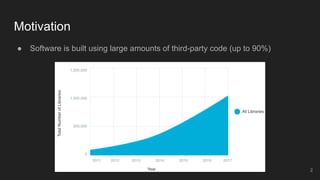
● Software is built using large amounts of third-party code (up to 90%)
2
Motivation
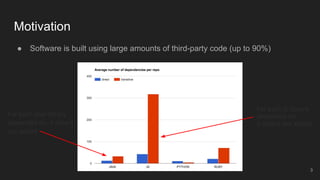
● Software is built using large amounts of third-party code (up to 90%)
For each Java library
depended on, 4 others
are added
For each JS library
depended on,
9 others are added
3
● Unaudited third-party code is a liability
○ Apache Struts (2018)
■ CVE-2018-11776: RCE via URL
■ CVE-2017-5638: RCE via HTTP headers (Equifax breach)
○ Malicious libraries (eslint-scope, crossenv, 2018)
○ Heartbleed (OpenSSL, 2017)
○ GHOST (glibc, 2015)
○ Apache Commons Collections deserialization RCE (2015)
Motivation
4
● Manual auditing is infeasible
○ Hundreds of dependencies
○ Constantly changing
● Automated audits
○ Dependency-level
■ Ensure you’re not using a vulnerable version
○ Source-level
■ Ensure you’re not vulnerable, despite using a vulnerable version
■ Ensure you won’t be vulnerable as things change
● Potential vulnerabilities, anti-patterns
Motivation
5
● Capture the space in some abstract form
● Be able to interrogate it using flexible queries
● Automate and share these queries to rule out classes of issues
What we want
6
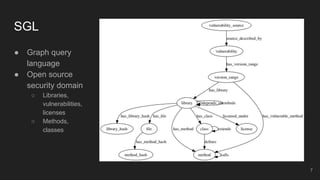
SGL
● Graph query
language
● Open source
security domain
○ Libraries,
vulnerabilities,
licenses
○ Methods,
classes
7
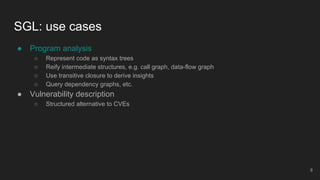
● Program analysis
○ Represent code as syntax trees
○ Reify intermediate structures, e.g. call graph, data-flow graph
○ Use transitive closure to derive insights
○ Query dependency graphs, etc.
● Vulnerability description
○ Structured alternative to CVEs
SGL: use cases
8
Related work
● Code analysis + graph databases
○ Yamaguchi, Fabian, et al. "Modeling and discovering vulnerabilities with code property
graphs." Security and Privacy (SP), 2014 IEEE Symposium on. IEEE, 2014.
● Graph query languages
○ Gremlin
○ Cypher
● Vulnerability description languages
○ OVAL
9
● Declarative Gremlin subset
● Compiled to Gremlin
● Transitive closure
● Optimizations
○ Reachability indices
○ Query planning
SGL: implementation
10
● Graph traversals
● Represent frontier as a stream
● Composition of (stateful) functions
● Turing-complete
○ Stateful variables
○ Imperative control flow
○ Branching
Detour: Gremlin
11
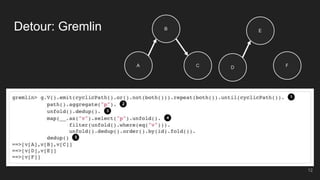
Detour: Gremlin
12
Detour: Gremlin
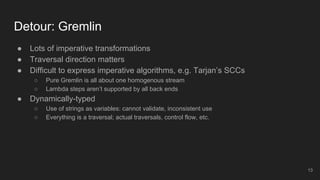
● Lots of imperative transformations
● Traversal direction matters
● Difficult to express imperative algorithms, e.g. Tarjan’s SCCs
○ Pure Gremlin is all about one homogenous stream
○ Lambda steps aren’t supported by all back ends
● Dynamically-typed
○ Use of strings as variables: cannot validate, inconsistent use
○ Everything is a traversal; actual traversals, control flow, etc.
13
Detour: Gremlin
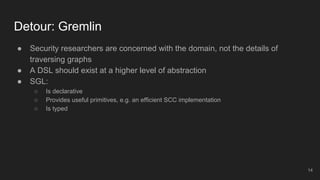
● Security researchers are concerned with the domain, not the details of
traversing graphs
● A DSL should exist at a higher level of abstraction
● SGL:
○ Is declarative
○ Provides useful primitives, e.g. an efficient SCC implementation
○ Is typed
14
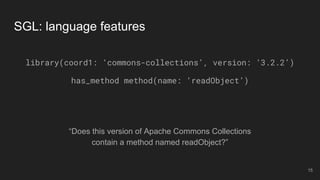
“Does this version of Apache Commons Collections
contain a method named readObject?”
SGL: language features
library(coord1: ‘commons-collections’, version: ‘3.2.2’)
has_method method(name: ‘readObject’)
15
SGL: language features
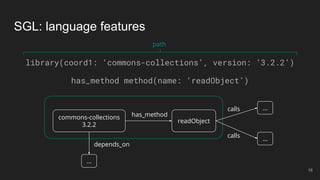
library(coord1: ‘commons-collections’, version: ‘3.2.2’)
has_method method(name: ‘readObject’)
commons-collections
3.2.2
readObject
...
...
...
has_method
depends_on
calls
calls
path
16
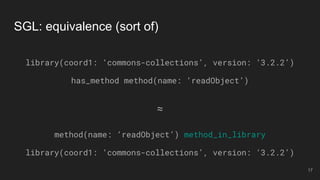
method(name: ‘readObject’) method_in_library
library(coord1: ‘commons-collections’, version: ‘3.2.2’)
SGL: equivalence (sort of)
library(coord1: ‘commons-collections’, version: ‘3.2.2’)
has_method method(name: ‘readObject’)
≈
17
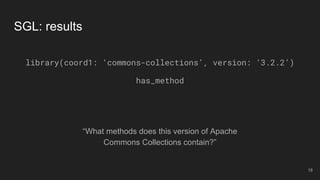
“What methods does this version of Apache
Commons Collections contain?”
SGL: results
library(coord1: ‘commons-collections’, version: ‘3.2.2’)
has_method
18
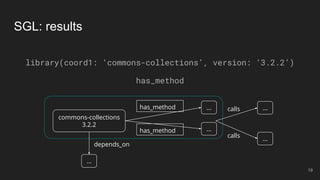
SGL: results
library(coord1: ‘commons-collections’, version: ‘3.2.2’)
has_method
commons-collections
3.2.2
...
...
has_method
depends_on
calls
calls
...
...has_method
...
19
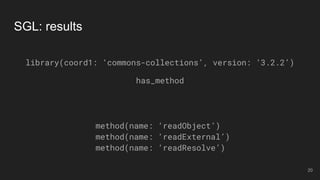
method(name: ‘readObject’)
method(name: ‘readExternal’)
method(name: ‘readResolve’)
SGL: results
library(coord1: ‘commons-collections’, version: ‘3.2.2’)
has_method
20
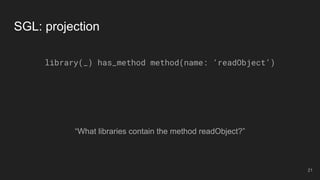
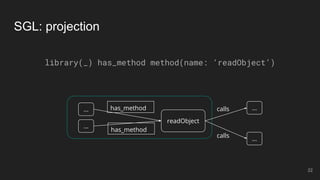
“What libraries contain the method readObject?”
SGL: projection
library(_) has_method method(name: ‘readObject’)
21
SGL: projection
library(_) has_method method(name: ‘readObject’)
22
readObject
...
...
has_method calls
calls
...
...
has_method
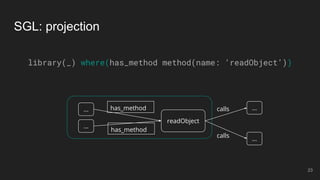
SGL: projection
library(_) where(has_method method(name: ‘readObject’))
readObject
...
...
has_method calls
calls
...
...
has_method
23
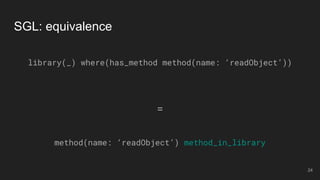
SGL: equivalence
library(_) where(has_method method(name: ‘readObject’))
=
method(name: ‘readObject’) method_in_library
24
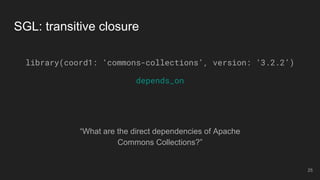
“What are the direct dependencies of Apache
Commons Collections?”
SGL: transitive closure
library(coord1: ‘commons-collections’, version: ‘3.2.2’)
depends_on
25
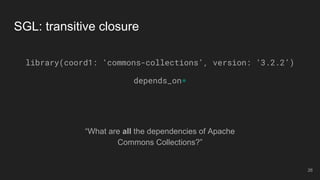
SGL: transitive closure
“What are all the dependencies of Apache
Commons Collections?”
library(coord1: ‘commons-collections’, version: ‘3.2.2’)
depends_on*
26
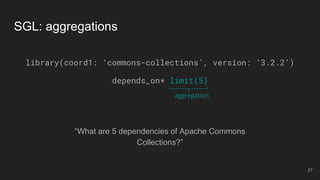
SGL: aggregations
“What are 5 dependencies of Apache Commons
Collections?”
library(coord1: ‘commons-collections’, version: ‘3.2.2’)
depends_on* limit(5)
aggregation
27
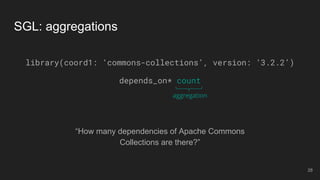
“How many dependencies of Apache Commons
Collections are there?”
SGL: aggregations
library(coord1: ‘commons-collections’, version: ‘3.2.2’)
depends_on* count
aggregation
28
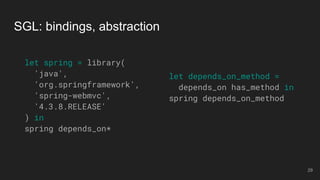
let depends_on_method =
depends_on has_method in
spring depends_on_method
SGL: bindings, abstraction
let spring = library(
'java',
'org.springframework',
'spring-webmvc',
'4.3.8.RELEASE'
) in
spring depends_on*
29
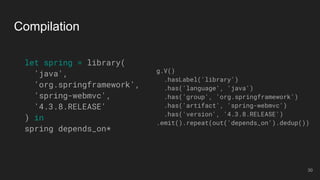
Compilation
let spring = library(
'java',
'org.springframework',
'spring-webmvc',
'4.3.8.RELEASE'
) in
spring depends_on*
g.V()
.hasLabel('library')
.has('language', 'java')
.has('group', 'org.springframework')
.has('artifact', 'spring-webmvc')
.has('version', '4.3.8.RELEASE')
.emit().repeat(out('depends_on').dedup())
30
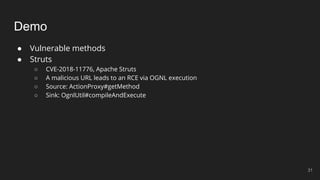
Demo
● Vulnerable methods
● Struts
○ CVE-2018-11776, Apache Struts
○ A malicious URL leads to an RCE via OGNL execution
○ Source: ActionProxy#getMethod
○ Sink: OgnlUtil#compileAndExecute
31
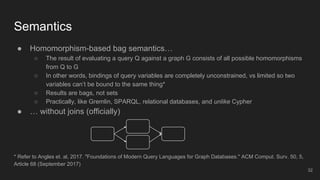
● Homomorphism-based bag semantics…
○ The result of evaluating a query Q against a graph G consists of all possible homomorphisms
from Q to G
○ In other words, bindings of query variables are completely unconstrained, vs limited so two
variables can’t be bound to the same thing*
○ Results are bags, not sets
○ Practically, like Gremlin, SPARQL, relational databases, and unlike Cypher
● … without joins (officially)
* Refer to Angles et. al, 2017. "Foundations of Modern Query Languages for Graph Databases." ACM Comput. Surv. 50, 5,
Article 68 (September 2017)
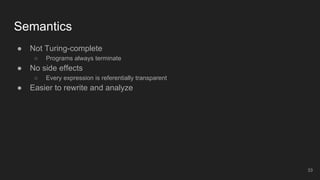
Semantics
32
Semantics
● Not Turing-complete
○ Programs always terminate
● No side effects
○ Every expression is referentially transparent
● Easier to rewrite and analyze
33
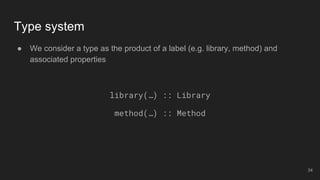
● We consider a type as the product of a label (e.g. library, method) and
associated properties
library(…) :: Library
method(…) :: Method
Type system
34
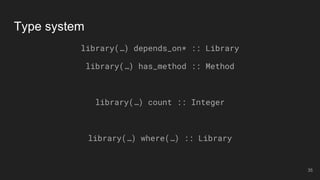
Type system
library(…) depends_on* :: Library
library(…) has_method :: Method
library(…) count :: Integer
library(…) where(…) :: Library
35
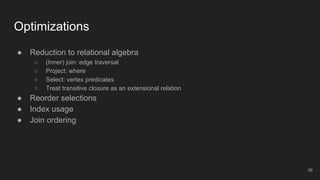
● Reduction to relational algebra
○ (Inner) join: edge traversal
○ Project: where
○ Select: vertex predicates
○ Treat transitive closure as an extensional relation
● Reorder selections
● Index usage
● Join ordering
Optimizations
36
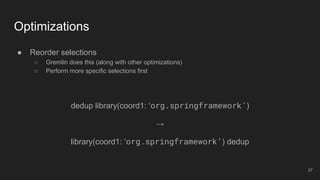
● Reorder selections
○ Gremlin does this (along with other optimizations)
○ Perform more specific selections first
dedup library(coord1: ‘org.springframework’)
→
library(coord1: ‘org.springframework’) dedup
Optimizations
37
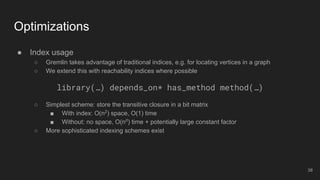
● Index usage
○ Gremlin takes advantage of traditional indices, e.g. for locating vertices in a graph
○ We extend this with reachability indices where possible
library(…) depends_on* has_method method(…)
○ Simplest scheme: store the transitive closure in a bit matrix
■ With index: O(n2
) space, O(1) time
■ Without: no space, O(nd
) time + potentially large constant factor
○ More sophisticated indexing schemes exist
Optimizations
38
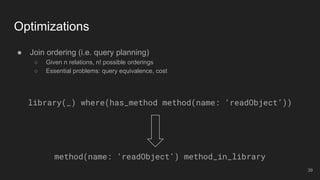
● Join ordering (i.e. query planning)
○ Given n relations, n! possible orderings
○ Essential problems: query equivalence, cost
Optimizations
library(_) where(has_method method(name: ‘readObject’))
method(name: ‘readObject’) method_in_library
39
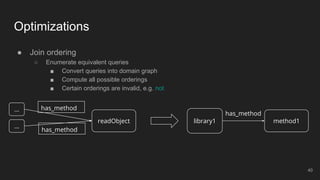
● Join ordering
○ Enumerate equivalent queries
■ Convert queries into domain graph
■ Compute all possible orderings
■ Certain orderings are invalid, e.g. not
Optimizations
readObject
has_method...
...
has_method
method1
has_method
library1
40
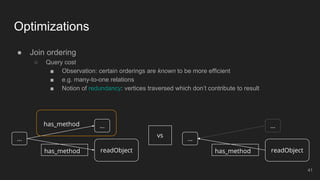
● Join ordering
○ Query cost
■ Observation: certain orderings are known to be more efficient
■ e.g. many-to-one relations
■ Notion of redundancy: vertices traversed which don’t contribute to result
Optimizations
readObject
has_method
...
...
has_method readObject
...
...
has_method
vs
41
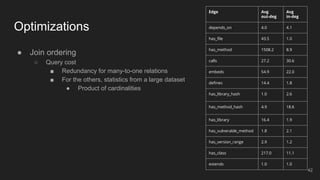
● Join ordering
○ Query cost
■ Redundancy for many-to-one relations
■ For the others, statistics from a large dataset
● Product of cardinalities
Optimizations
Edge Avg
out-deg
Avg
in-deg
depends_on 4.0 4.1
has_file 43.5 1.0
has_method 1508.2 8.9
calls 27.2 30.6
embeds 54.9 22.0
defines 14.4 1.8
has_library_hash 1.0 2.6
has_method_hash 4.9 18.6
has_library 16.4 1.9
has_vulnerable_method 1.8 2.1
has_version_range 2.9 1.2
has_class 217.0 11.1
extends 1.0 1.0
42
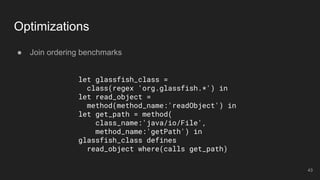
● Join ordering benchmarks
Optimizations
let glassfish_class =
class(regex 'org.glassfish.*') in
let read_object =
method(method_name:'readObject') in
let get_path = method(
class_name:'java/io/File',
method_name:'getPath') in
glassfish_class defines
read_object where(calls get_path)
43
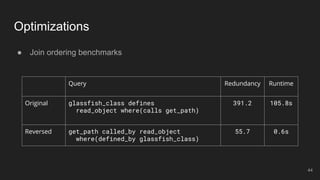
● Join ordering benchmarks
Optimizations
Query Redundancy Runtime
Original glassfish_class defines
read_object where(calls get_path)
391.2 105.8s
Reversed get_path called_by read_object
where(defined_by glassfish_class)
55.7 0.6s
44
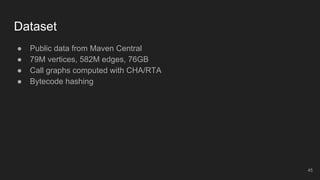
Dataset
● Public data from Maven Central
● 79M vertices, 582M edges, 76GB
● Call graphs computed with CHA/RTA
● Bytecode hashing
45
● Program analysis
● Vulnerability description
○ Structured alternative to CVEs
SGL: use cases
46
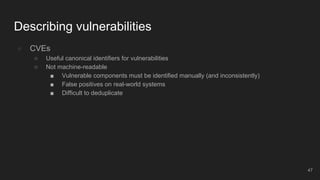
● CVEs
○ Useful canonical identifiers for vulnerabilities
○ Not machine-readable
■ Vulnerable components must be identified manually (and inconsistently)
■ False positives on real-world systems
■ Difficult to deduplicate
Describing vulnerabilities
47
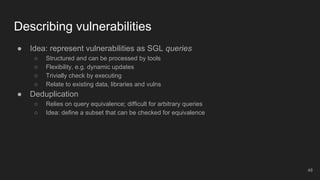
Describing vulnerabilities
● Idea: represent vulnerabilities as SGL queries
○ Structured and can be processed by tools
○ Flexibility, e.g. dynamic updates
○ Trivially check by executing
○ Relate to existing data, libraries and vulns
● Deduplication
○ Relies on query equivalence; difficult for arbitrary queries
○ Idea: define a subset that can be checked for equivalence
48
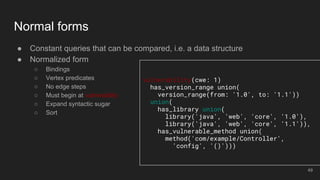
● Constant queries that can be compared, i.e. a data structure
● Normalized form
○ Bindings
○ Vertex predicates
○ No edge steps
○ Must begin at vulnerability
○ Expand syntactic sugar
○ Sort
Normal forms
vulnerability(cwe: 1)
has_version_range union(
version_range(from: '1.0', to: '1.1'))
union(
has_library union(
library('java', 'web', 'core', '1.0'),
library('java', 'web', 'core', '1.1')),
has_vulnerable_method union(
method('com/example/Controller',
'config', '()')))
49
Reification
● We’d also like to use vulnerabilities in queries
○ “Find all vulnerable libraries”
● Reify vulnerabilities as vertices
● Distinguish by storing normalized query in a property
50
Considerations
● Dynamically-updating vulnerabilities
○ e.g. when a new library version is released
○ Can be convenient, but would require manual review anyway
● Finding similar vulnerabilities
○ Search for vulnerabilities associated with a library
○ Generalize query by removing predicates
51
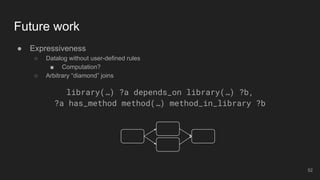
● Expressiveness
○ Datalog without user-defined rules
■ Computation?
○ Arbitrary “diamond” joins
library(…) ?a depends_on library(…) ?b,
?a has_method method(…) method_in_library ?b
Future work
52
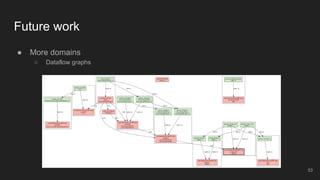
● More domains
○ Dataflow graphs
Future work
53
Try it out
● www.sourceclear.com
● Sign up for a free trial
● Activate an agent
● SRCCLR_ENABLE_SGL=true srcclr scan --url
https://github.com/srcclr/example-java-maven --sgl
54
Thank you!
55
● Questions?
● More info - sgl.org
● Contact
○ Twitter - @asankhaya

Design and Implementation of the Security Graph Language

  • 1.
    Design and Implementationof Security Graph Language (SGL) Dr. Asankhaya Sharma Director of Software Engineering CA Veracode
  • 2.
    Motivation ● Software isbuilt using large amounts of third-party code (up to 90%) 2
  • 3.
    Motivation ● Software isbuilt using large amounts of third-party code (up to 90%) For each Java library depended on, 4 others are added For each JS library depended on, 9 others are added 3
  • 4.
    ● Unaudited third-partycode is a liability ○ Apache Struts (2018) ■ CVE-2018-11776: RCE via URL ■ CVE-2017-5638: RCE via HTTP headers (Equifax breach) ○ Malicious libraries (eslint-scope, crossenv, 2018) ○ Heartbleed (OpenSSL, 2017) ○ GHOST (glibc, 2015) ○ Apache Commons Collections deserialization RCE (2015) Motivation 4
  • 5.
    ● Manual auditingis infeasible ○ Hundreds of dependencies ○ Constantly changing ● Automated audits ○ Dependency-level ■ Ensure you’re not using a vulnerable version ○ Source-level ■ Ensure you’re not vulnerable, despite using a vulnerable version ■ Ensure you won’t be vulnerable as things change ● Potential vulnerabilities, anti-patterns Motivation 5
  • 6.
    ● Capture thespace in some abstract form ● Be able to interrogate it using flexible queries ● Automate and share these queries to rule out classes of issues What we want 6
  • 7.
    SGL ● Graph query language ●Open source security domain ○ Libraries, vulnerabilities, licenses ○ Methods, classes 7
  • 8.
    ● Program analysis ○Represent code as syntax trees ○ Reify intermediate structures, e.g. call graph, data-flow graph ○ Use transitive closure to derive insights ○ Query dependency graphs, etc. ● Vulnerability description ○ Structured alternative to CVEs SGL: use cases 8
  • 9.
    Related work ● Codeanalysis + graph databases ○ Yamaguchi, Fabian, et al. "Modeling and discovering vulnerabilities with code property graphs." Security and Privacy (SP), 2014 IEEE Symposium on. IEEE, 2014. ● Graph query languages ○ Gremlin ○ Cypher ● Vulnerability description languages ○ OVAL 9
  • 10.
    ● Declarative Gremlinsubset ● Compiled to Gremlin ● Transitive closure ● Optimizations ○ Reachability indices ○ Query planning SGL: implementation 10
  • 11.
    ● Graph traversals ●Represent frontier as a stream ● Composition of (stateful) functions ● Turing-complete ○ Stateful variables ○ Imperative control flow ○ Branching Detour: Gremlin 11
  • 12.
  • 13.
    Detour: Gremlin ● Lotsof imperative transformations ● Traversal direction matters ● Difficult to express imperative algorithms, e.g. Tarjan’s SCCs ○ Pure Gremlin is all about one homogenous stream ○ Lambda steps aren’t supported by all back ends ● Dynamically-typed ○ Use of strings as variables: cannot validate, inconsistent use ○ Everything is a traversal; actual traversals, control flow, etc. 13
  • 14.
    Detour: Gremlin ● Securityresearchers are concerned with the domain, not the details of traversing graphs ● A DSL should exist at a higher level of abstraction ● SGL: ○ Is declarative ○ Provides useful primitives, e.g. an efficient SCC implementation ○ Is typed 14
  • 15.
    “Does this versionof Apache Commons Collections contain a method named readObject?” SGL: language features library(coord1: ‘commons-collections’, version: ‘3.2.2’) has_method method(name: ‘readObject’) 15
  • 16.
    SGL: language features library(coord1:‘commons-collections’, version: ‘3.2.2’) has_method method(name: ‘readObject’) commons-collections 3.2.2 readObject ... ... ... has_method depends_on calls calls path 16
  • 17.
    method(name: ‘readObject’) method_in_library library(coord1:‘commons-collections’, version: ‘3.2.2’) SGL: equivalence (sort of) library(coord1: ‘commons-collections’, version: ‘3.2.2’) has_method method(name: ‘readObject’) ≈ 17
  • 18.
    “What methods doesthis version of Apache Commons Collections contain?” SGL: results library(coord1: ‘commons-collections’, version: ‘3.2.2’) has_method 18
  • 19.
    SGL: results library(coord1: ‘commons-collections’,version: ‘3.2.2’) has_method commons-collections 3.2.2 ... ... has_method depends_on calls calls ... ...has_method ... 19
  • 20.
    method(name: ‘readObject’) method(name: ‘readExternal’) method(name:‘readResolve’) SGL: results library(coord1: ‘commons-collections’, version: ‘3.2.2’) has_method 20
  • 21.
    “What libraries containthe method readObject?” SGL: projection library(_) has_method method(name: ‘readObject’) 21
  • 22.
    SGL: projection library(_) has_methodmethod(name: ‘readObject’) 22 readObject ... ... has_method calls calls ... ... has_method
  • 23.
    SGL: projection library(_) where(has_methodmethod(name: ‘readObject’)) readObject ... ... has_method calls calls ... ... has_method 23
  • 24.
    SGL: equivalence library(_) where(has_methodmethod(name: ‘readObject’)) = method(name: ‘readObject’) method_in_library 24
  • 25.
    “What are thedirect dependencies of Apache Commons Collections?” SGL: transitive closure library(coord1: ‘commons-collections’, version: ‘3.2.2’) depends_on 25
  • 26.
    SGL: transitive closure “Whatare all the dependencies of Apache Commons Collections?” library(coord1: ‘commons-collections’, version: ‘3.2.2’) depends_on* 26
  • 27.
    SGL: aggregations “What are5 dependencies of Apache Commons Collections?” library(coord1: ‘commons-collections’, version: ‘3.2.2’) depends_on* limit(5) aggregation 27
  • 28.
    “How many dependenciesof Apache Commons Collections are there?” SGL: aggregations library(coord1: ‘commons-collections’, version: ‘3.2.2’) depends_on* count aggregation 28
  • 29.
    let depends_on_method = depends_onhas_method in spring depends_on_method SGL: bindings, abstraction let spring = library( 'java', 'org.springframework', 'spring-webmvc', '4.3.8.RELEASE' ) in spring depends_on* 29
  • 30.
    Compilation let spring =library( 'java', 'org.springframework', 'spring-webmvc', '4.3.8.RELEASE' ) in spring depends_on* g.V() .hasLabel('library') .has('language', 'java') .has('group', 'org.springframework') .has('artifact', 'spring-webmvc') .has('version', '4.3.8.RELEASE') .emit().repeat(out('depends_on').dedup()) 30
  • 31.
    Demo ● Vulnerable methods ●Struts ○ CVE-2018-11776, Apache Struts ○ A malicious URL leads to an RCE via OGNL execution ○ Source: ActionProxy#getMethod ○ Sink: OgnlUtil#compileAndExecute 31
  • 32.
    ● Homomorphism-based bagsemantics… ○ The result of evaluating a query Q against a graph G consists of all possible homomorphisms from Q to G ○ In other words, bindings of query variables are completely unconstrained, vs limited so two variables can’t be bound to the same thing* ○ Results are bags, not sets ○ Practically, like Gremlin, SPARQL, relational databases, and unlike Cypher ● … without joins (officially) * Refer to Angles et. al, 2017. "Foundations of Modern Query Languages for Graph Databases." ACM Comput. Surv. 50, 5, Article 68 (September 2017) Semantics 32
  • 33.
    Semantics ● Not Turing-complete ○Programs always terminate ● No side effects ○ Every expression is referentially transparent ● Easier to rewrite and analyze 33
  • 34.
    ● We considera type as the product of a label (e.g. library, method) and associated properties library(…) :: Library method(…) :: Method Type system 34
  • 35.
    Type system library(…) depends_on*:: Library library(…) has_method :: Method library(…) count :: Integer library(…) where(…) :: Library 35
  • 36.
    ● Reduction torelational algebra ○ (Inner) join: edge traversal ○ Project: where ○ Select: vertex predicates ○ Treat transitive closure as an extensional relation ● Reorder selections ● Index usage ● Join ordering Optimizations 36
  • 37.
    ● Reorder selections ○Gremlin does this (along with other optimizations) ○ Perform more specific selections first dedup library(coord1: ‘org.springframework’) → library(coord1: ‘org.springframework’) dedup Optimizations 37
  • 38.
    ● Index usage ○Gremlin takes advantage of traditional indices, e.g. for locating vertices in a graph ○ We extend this with reachability indices where possible library(…) depends_on* has_method method(…) ○ Simplest scheme: store the transitive closure in a bit matrix ■ With index: O(n2 ) space, O(1) time ■ Without: no space, O(nd ) time + potentially large constant factor ○ More sophisticated indexing schemes exist Optimizations 38
  • 39.
    ● Join ordering(i.e. query planning) ○ Given n relations, n! possible orderings ○ Essential problems: query equivalence, cost Optimizations library(_) where(has_method method(name: ‘readObject’)) method(name: ‘readObject’) method_in_library 39
  • 40.
    ● Join ordering ○Enumerate equivalent queries ■ Convert queries into domain graph ■ Compute all possible orderings ■ Certain orderings are invalid, e.g. not Optimizations readObject has_method... ... has_method method1 has_method library1 40
  • 41.
    ● Join ordering ○Query cost ■ Observation: certain orderings are known to be more efficient ■ e.g. many-to-one relations ■ Notion of redundancy: vertices traversed which don’t contribute to result Optimizations readObject has_method ... ... has_method readObject ... ... has_method vs 41
  • 42.
    ● Join ordering ○Query cost ■ Redundancy for many-to-one relations ■ For the others, statistics from a large dataset ● Product of cardinalities Optimizations Edge Avg out-deg Avg in-deg depends_on 4.0 4.1 has_file 43.5 1.0 has_method 1508.2 8.9 calls 27.2 30.6 embeds 54.9 22.0 defines 14.4 1.8 has_library_hash 1.0 2.6 has_method_hash 4.9 18.6 has_library 16.4 1.9 has_vulnerable_method 1.8 2.1 has_version_range 2.9 1.2 has_class 217.0 11.1 extends 1.0 1.0 42
  • 43.
    ● Join orderingbenchmarks Optimizations let glassfish_class = class(regex 'org.glassfish.*') in let read_object = method(method_name:'readObject') in let get_path = method( class_name:'java/io/File', method_name:'getPath') in glassfish_class defines read_object where(calls get_path) 43
  • 44.
    ● Join orderingbenchmarks Optimizations Query Redundancy Runtime Original glassfish_class defines read_object where(calls get_path) 391.2 105.8s Reversed get_path called_by read_object where(defined_by glassfish_class) 55.7 0.6s 44
  • 45.
    Dataset ● Public datafrom Maven Central ● 79M vertices, 582M edges, 76GB ● Call graphs computed with CHA/RTA ● Bytecode hashing 45
  • 46.
    ● Program analysis ●Vulnerability description ○ Structured alternative to CVEs SGL: use cases 46
  • 47.
    ● CVEs ○ Usefulcanonical identifiers for vulnerabilities ○ Not machine-readable ■ Vulnerable components must be identified manually (and inconsistently) ■ False positives on real-world systems ■ Difficult to deduplicate Describing vulnerabilities 47
  • 48.
    Describing vulnerabilities ● Idea:represent vulnerabilities as SGL queries ○ Structured and can be processed by tools ○ Flexibility, e.g. dynamic updates ○ Trivially check by executing ○ Relate to existing data, libraries and vulns ● Deduplication ○ Relies on query equivalence; difficult for arbitrary queries ○ Idea: define a subset that can be checked for equivalence 48
  • 49.
    ● Constant queriesthat can be compared, i.e. a data structure ● Normalized form ○ Bindings ○ Vertex predicates ○ No edge steps ○ Must begin at vulnerability ○ Expand syntactic sugar ○ Sort Normal forms vulnerability(cwe: 1) has_version_range union( version_range(from: '1.0', to: '1.1')) union( has_library union( library('java', 'web', 'core', '1.0'), library('java', 'web', 'core', '1.1')), has_vulnerable_method union( method('com/example/Controller', 'config', '()'))) 49
  • 50.
    Reification ● We’d alsolike to use vulnerabilities in queries ○ “Find all vulnerable libraries” ● Reify vulnerabilities as vertices ● Distinguish by storing normalized query in a property 50
  • 51.
    Considerations ● Dynamically-updating vulnerabilities ○e.g. when a new library version is released ○ Can be convenient, but would require manual review anyway ● Finding similar vulnerabilities ○ Search for vulnerabilities associated with a library ○ Generalize query by removing predicates 51
  • 52.
    ● Expressiveness ○ Datalogwithout user-defined rules ■ Computation? ○ Arbitrary “diamond” joins library(…) ?a depends_on library(…) ?b, ?a has_method method(…) method_in_library ?b Future work 52
  • 53.
    ● More domains ○Dataflow graphs Future work 53
  • 54.
    Try it out ●www.sourceclear.com ● Sign up for a free trial ● Activate an agent ● SRCCLR_ENABLE_SGL=true srcclr scan --url https://github.com/srcclr/example-java-maven --sgl 54
  • 55.
    Thank you! 55 ● Questions? ●More info - sgl.org ● Contact ○ Twitter - @asankhaya