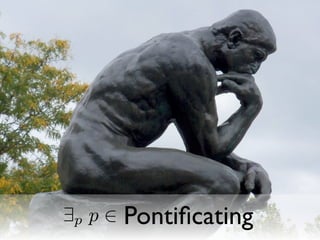
9p p 2   Pontificating
Programming is Hard
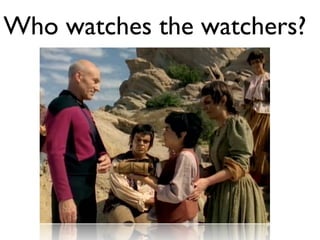
Who watches the watchers?
Let’s talk about
  verification
XUnit
Standard Practice

• We all use it
• Most of us rely on it day to day
• We seem to trust it implicitly
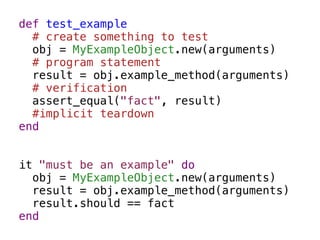
def test_example
  # create something to test
  obj = MyExampleObject.new(arguments)
  # program statement
  result = obj.example_method(arguments)
  # verification
  assert_equal("fact", result)
  #implicit teardown
end


it "must be an example" do
  obj = MyExampleObject.new(arguments)
  result = obj.example_method(arguments)
  result.should == fact
end
XUnit is Complected

• It’s doing too much
XUnit is Complected

• It’s doing too much
• BDD is just XUnit with lots of bad English
XUnit is Complected

• It’s doing too much
• BDD is just XUnit with lots of bad English
• Poor separation of the tester and testee
XUnit is Complected

• It’s doing too much
• BDD is just XUnit with lots of bad English
• Poor separation of the tester and testee
• What are you testing?
XUnit is Complected

• It’s doing too much
• BDD is just XUnit with lots of bad English
• Poor separation of the tester and testee
• What are you testing?
 • Are you sure?!
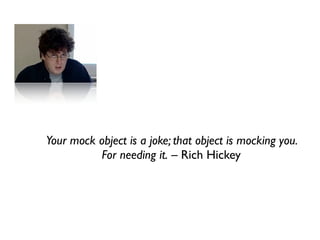
Your mock object is a joke; that object is mocking you.
          For needing it. – Rich Hickey
Coverage is a Lie

• Too many false indicators of comprehensive
  verification
• We work really hard at the wrong things to
  achieve good coverage
• “The Emperor's new suit”
Always in Manual Drive

• Devise, write, and maintain all cases
• Edge cases are a (big) problem
 • Especially with simple functions
• Example: Integer commutative law
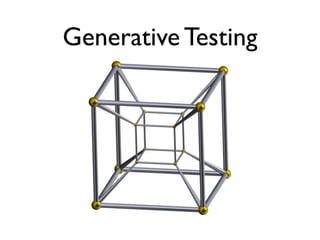
Generative Testing
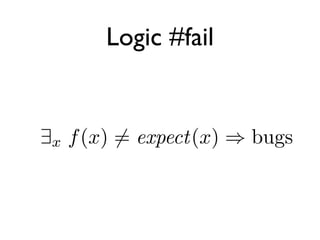
Logic #fail


 9x f (x) 6= expect(x) ) bugs
9x f (x) = expect(x) ) ¬bugs
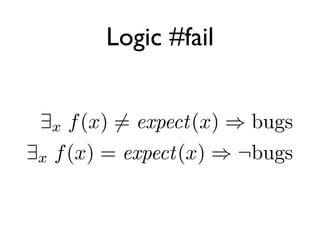
Logic #fail


 9x f (x) 6= expect(x) ) bugs
9x f (x) = expect(x) ) ¬bugs
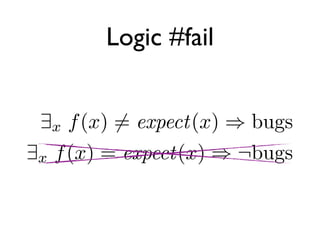
Logic #fail


 9x f (x) 6= expect(x) ) bugs
9x f (x) = expect(x) ) ¬bugs
Generative Testing
• Developing test cases is hard
• We have computers!
• Define your domain, auto-generate inputs
• Write less, test more
• Find edge cases automatically!
Generative Testing
• Developing test cases is hard
• We have computers!
• Define your domain, auto-generate inputs
• Write less, test more
• Find edge cases automatically!
 • (money back guarantee)
(defspec integer-commutative-laws
  (partial map identity)
  [^{:tag `integer} a ^{:tag `integer} b]
  (if (longable? (+' a b))
    (assert (= (+ a b) (+ b a)
               (+' a b) (+' b a)
               (unchecked-add a b)
               (unchecked-add b a)))
    (assert (= (+' a b) (+' b a))))
  (if (longable? (*' a b))
    (assert (= (* a b) (* b a)
               (*' a b) (*' b a)
               (unchecked-multiply a b)
               (unchecked-multiply b a)))
    (assert (= (*' a b) (*' b a)))))
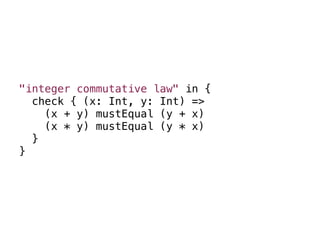
"integer commutative law" in {
  check { (x: Int, y: Int) =>
    (x + y) mustEqual (y + x)
    (x * y) mustEqual (y * x)
  }
}
Generative Testing

• Real world cases?
Generative Testing

• Real world cases?
 • Sparse trees
Generative Testing

• Real world cases?
 • Sparse trees
 • Complex pre-conditions
Generative Testing

• Real world cases?
 • Sparse trees
 • Complex pre-conditions
• How many iterations?
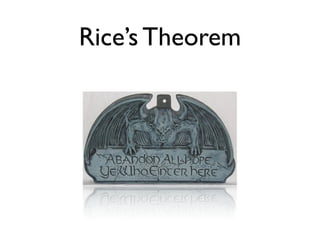
Rice’s Theorem
[…] there exists no automatic method that
decides with generality non-trivial questions
on the black-box behavior of computer
programs. – Wikipedia
Rice’s Theorem

• You can never have enough assertions
Rice’s Theorem

• You can never have enough assertions
• All you can do is improve “confidence”
 • (for some naïve definition thereof)
Rice’s Theorem

• You can never have enough assertions
• All you can do is improve “confidence”
 • (for some naïve definition thereof)
• Black box testing is a farce
Rice’s Theorem

• You can never have enough assertions
• All you can do is improve “confidence”
 • (for some naïve definition thereof)
• Black box testing is a farce
• Partial function indistinguishable from total
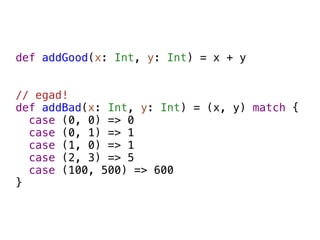
def addGood(x: Int, y: Int) = x + y


// egad!
def addBad(x: Int, y: Int) = (x, y) match {
  case (0, 0) => 0
  case (0, 1) => 1
  case (1, 0) => 1
  case (2, 3) => 5
  case (100, 500) => 600
}
Black Box Testing

• Do we just…enumerate cases?
Black Box Testing

• Do we just…enumerate cases?
• When do we stop? (hint: never!)
Black Box Testing

• Do we just…enumerate cases?
• When do we stop? (hint: never!)
• Can we assume edge cases are predictable?
Black Box Testing

• Do we just…enumerate cases?
• When do we stop? (hint: never!)
• Can we assume edge cases are predictable?
• What can we assume?
Black Box Testing

• Do we just…enumerate cases?
• When do we stop? (hint: never!)
• Can we assume edge cases are predictable?
• What can we assume?
• It’s all undecidable, let’s go shopping
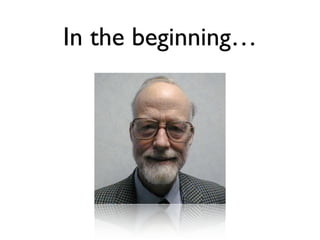
In the beginning…
An Axiomatic Basis for
     Computer
    Programming
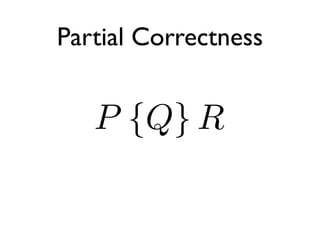
Partial Correctness


   P {Q} R
Built on two ideas
• Axioms
 • The foundation of proofs in our system
    (assignment, precendence, identity, etc)
• Inference
 • Higher order ideas that use combinations
    of axioms to draw conclusions
It drove us to think
about consequence in
 program execution
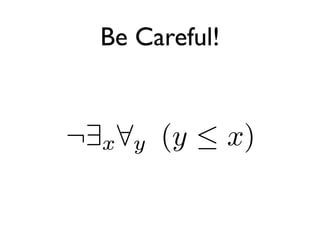
Be Careful!


¬9x 8y (y  x)
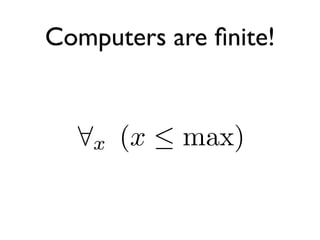
Computers are finite!


  8x (x  max)
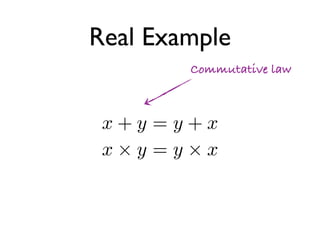
Real Example
        Commutative law


 x+y =y+x
 x⇥y =y⇥x
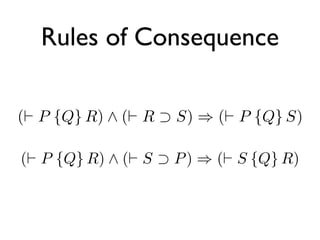
Rules of Consequence

(` P {Q} R) ^ (` R   S) ) (` P {Q} S)

(` P {Q} R) ^ (` S   P ) ) (` S {Q} R)
Our problems are solved!
Se
       e G are solved!
Our problems ö
               del
Type Systems
Type Systems

• Mildly controversial…
Type Systems

• Mildly controversial…
• Formal verification…that you can’t disable!
Type Systems

• Mildly controversial…
• Formal verification…that you can’t disable!
• Part of the language (inextricably)
 • (yes, that is a definitional requirement)
Type Systems

• Mildly controversial…
• Formal verification…that you can’t disable!
• Part of the language (inextricably)
 • (yes, that is a definitional requirement)
• Model correctness as consistency
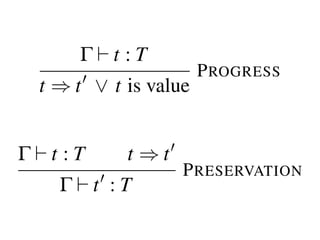
G`t :T
      0                   P ROGRESS
 t ) t _ t is value


G`t :T        t )t   0
                         P RESERVATION
   G`t :T 0
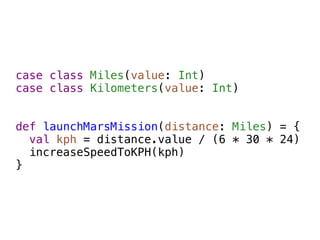
case class Miles(value: Int)
case class Kilometers(value: Int)


def launchMarsMission(distance: Miles) = {
  val kph = distance.value / (6 * 30 * 24)
  increaseSpeedToKPH(kph)
}
trait Forall[CC[_]] {
  def apply[A]: CC[A]
}

trait ST[S, A] {
  def flatMap[B](f: A => ST[S, B]): ST[S, B]
}

object ST {
  def run[A](
    f: Forall[({ type λ[S] = ST[S, A] => A })#λ]): A
}
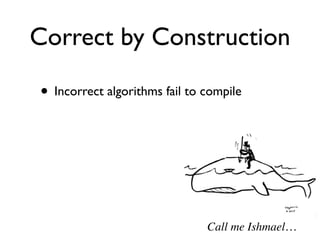
Correct by Construction

• Incorrect algorithms fail to compile


                               Call me Ishmael…
Correct by Construction

• Incorrect algorithms fail to compile
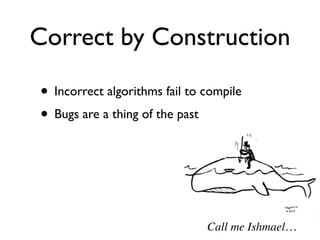
• Bugs are a thing of the past


                               Call me Ishmael…
Correct by Construction

• Incorrect algorithms fail to compile
• Bugs are a thing of the past
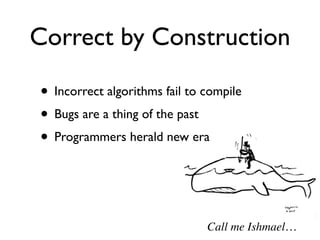
• Programmers herald new era


                               Call me Ishmael…
Correct by Construction

• Incorrect algorithms fail to compile
• Bugs are a thing of the past
• Programmers herald new era
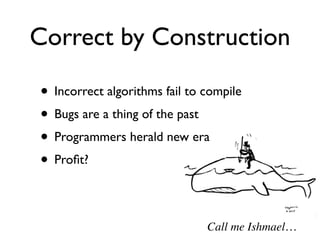
• Profit?

                               Call me Ishmael…
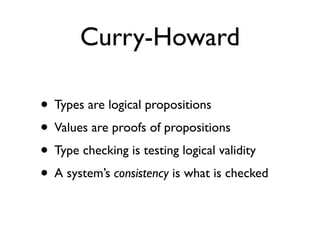
Curry-Howard

• Types are logical propositions
• Values are proofs of propositions
• Type checking is testing logical validity
• A system’s consistency is what is checked
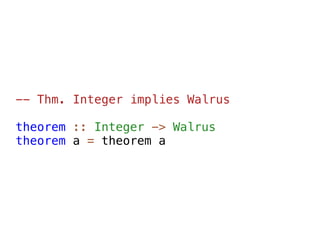
-- Thm. Integer implies Walrus

theorem :: Integer -> Walrus
theorem a = theorem a
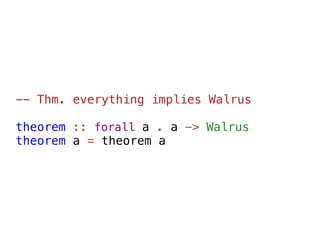
-- Thm. everything implies Walrus

theorem :: forall a . a -> Walrus
theorem a = theorem a
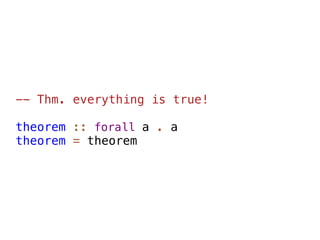
-- Thm. everything is true!

theorem :: forall a . a
theorem = theorem
Gödel
• Self-referentiality is a problem
Gödel
• Self-referentiality is a problem
 • Hello, Strange Loop!
Gödel
• Self-referentiality is a problem
 • Hello, Strange Loop!
• Incomplete or inconsistent
Gödel
• Self-referentiality is a problem
 • Hello, Strange Loop!
• Incomplete or inconsistent
• Some valid programs cannot be typed
Gödel
• Self-referentiality is a problem
 • Hello, Strange Loop!
• Incomplete or inconsistent
• Some valid programs cannot be typed
• Strong normalization helps
 • (avoids the need for recursive types!)
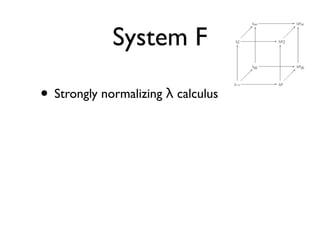
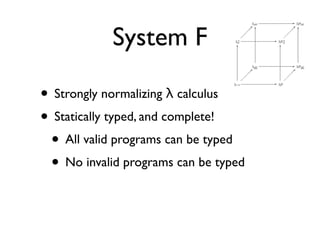
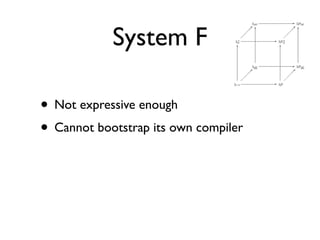
System F

• Strongly normalizing λ calculus
System F

• Strongly normalizing λ calculus
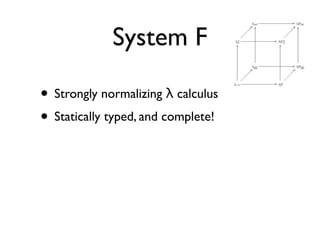
• Statically typed, and complete!
System F

• Strongly normalizing λ calculus
• Statically typed, and complete!
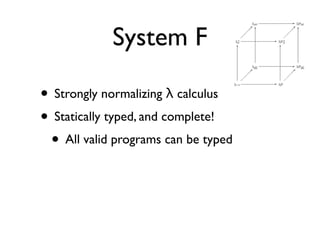
 • All valid programs can be typed
System F

• Strongly normalizing λ calculus
• Statically typed, and complete!
 • All valid programs can be typed
 • No invalid programs can be typed
System F

• Strongly normalizing λ calculus
• Statically typed, and complete!
 • All valid programs can be typed
 • No invalid programs can be typed
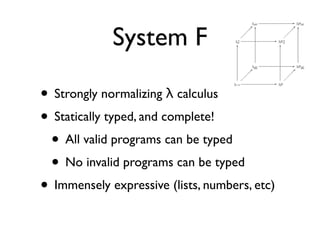
• Immensely expressive (lists, numbers, etc)
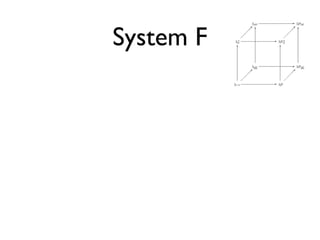
System F
System F

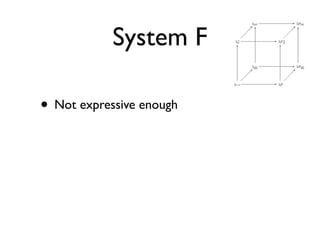
• Not expressive enough
System F

• Not expressive enough
• Cannot bootstrap its own compiler
System F

• Not expressive enough
• Cannot bootstrap its own compiler
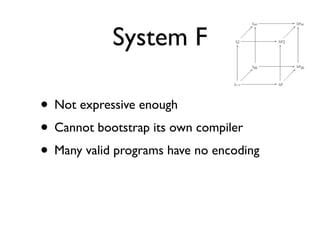
• Many valid programs have no encoding
System F

• Not expressive enough
• Cannot bootstrap its own compiler
• Many valid programs have no encoding
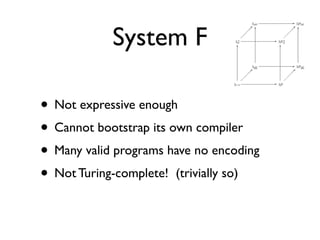
• Not Turing-complete! (trivially so)
Static Typing

• Can’t even answer some basic questions
Static Typing

• Can’t even answer some basic questions
• Fails to definitively answer any questions
 • …for Turing-complete calculi
Static Typing

• Can’t even answer some basic questions
• Fails to definitively answer any questions
 • …for Turing-complete calculi
• Arms race of inconvenience
Static Typing

• Can’t even answer some basic questions
• Fails to definitively answer any questions
 • …for Turing-complete calculi
• Arms race of inconvenience
• Guardrails on a sidewalk
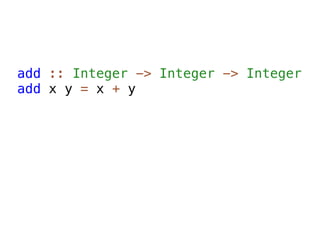
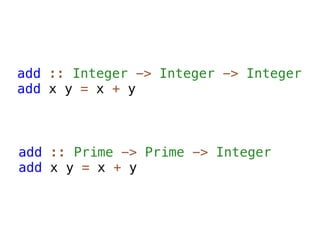
add :: Integer -> Integer -> Integer
add x y = x + y
add :: Integer -> Integer -> Integer
add x y = x + y


add :: Prime -> Prime -> Integer
add x y = x + y
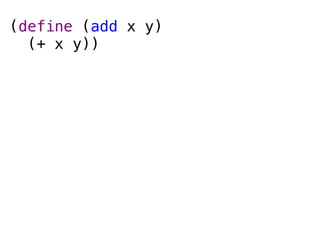
(define (add x y)
  (+ x y))
(define (add x y)
  (+ x y))

(module strangeloop racket
  (provide
   (contract-out
    [add (->* (prime? prime?)
              ()
              integer?)])))
(define (divisible? i m)
  (cond
   [(= i 1) true]
   [else (cond
          [(= (remainder m i) 0) false]
          [else (divisible? (sub1 i) m)])]))

(define (prime? n)
  (divisible? (sub1 n) n))
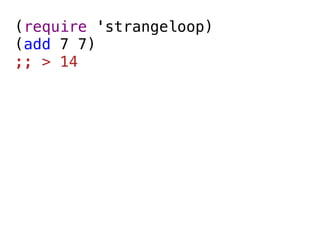
(require 'strangeloop)
(add 7 7)
;; > 14
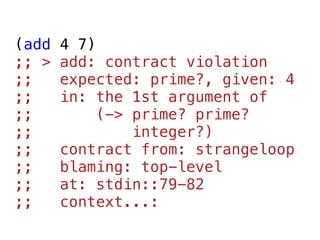
(add   4 7)
;; >   add: contract violation
;;     expected: prime?, given: 4
;;     in: the 1st argument of
;;          (-> prime? prime?
;;              integer?)
;;     contract from: strangeloop
;;     blaming: top-level
;;     at: stdin::79-82
;;     context...:
But like everything
else, it suffers from
   deficiencies...
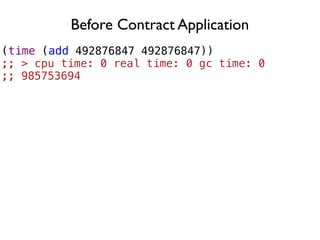
Before Contract Application
(time (add 492876847 492876847))
;; > cpu time: 0 real time: 0 gc time: 0
;; 985753694
Before Contract Application
(time (add 492876847 492876847))
;; > cpu time: 0 real time: 0 gc time: 0
;; 985753694


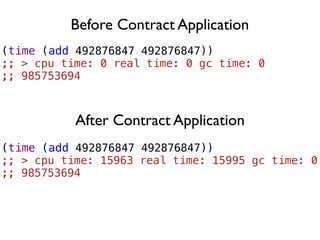
           After Contract Application
(time (add 492876847 492876847))
;; > cpu time: 15963 real time: 15995 gc time: 0
;; 985753694
Runtime issues can
make contracts a non-
starter for production
         code
It’s All Bunk

• Black-Box verification is insufficient
It’s All Bunk

• Black-Box verification is insufficient
• White-Box verification is undecidable
It’s All Bunk

• Black-Box verification is insufficient
• White-Box verification is undecidable
 • …in general!
It’s All Bunk

• Black-Box verification is insufficient
• White-Box verification is undecidable
 • …in general!
• Constrain the domain
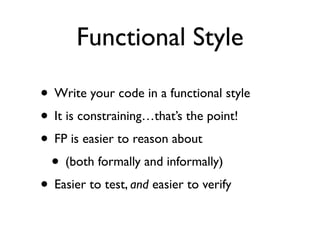
Functional Style

• Write your code in a functional style
• It is constraining…that’s the point!
• FP is easier to reason about
 • (both formally and informally)
• Easier to test, and easier to verify
Programming:
 The Good Parts
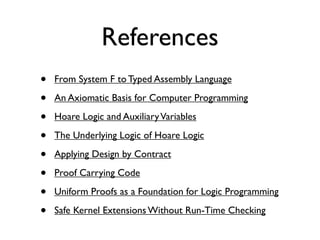
References
•   From System F to Typed Assembly Language

•   An Axiomatic Basis for Computer Programming

•   Hoare Logic and Auxiliary Variables

•   The Underlying Logic of Hoare Logic

•   Applying Design by Contract

•   Proof Carrying Code

•   Uniform Proofs as a Foundation for Logic Programming

•   Safe Kernel Extensions Without Run-Time Checking

Pontificating quantification

  • 1.
    9p p 2 Pontificating
  • 2.
  • 4.
    Who watches thewatchers?
  • 5.
    Let’s talk about verification
  • 6.
  • 7.
    Standard Practice • Weall use it • Most of us rely on it day to day • We seem to trust it implicitly
  • 8.
    def test_example # create something to test obj = MyExampleObject.new(arguments) # program statement result = obj.example_method(arguments) # verification assert_equal("fact", result) #implicit teardown end it "must be an example" do obj = MyExampleObject.new(arguments) result = obj.example_method(arguments) result.should == fact end
  • 9.
    XUnit is Complected •It’s doing too much
  • 10.
    XUnit is Complected •It’s doing too much • BDD is just XUnit with lots of bad English
  • 11.
    XUnit is Complected •It’s doing too much • BDD is just XUnit with lots of bad English • Poor separation of the tester and testee
  • 12.
    XUnit is Complected •It’s doing too much • BDD is just XUnit with lots of bad English • Poor separation of the tester and testee • What are you testing?
  • 13.
    XUnit is Complected •It’s doing too much • BDD is just XUnit with lots of bad English • Poor separation of the tester and testee • What are you testing? • Are you sure?!
  • 14.
    Your mock objectis a joke; that object is mocking you. For needing it. – Rich Hickey
  • 15.
    Coverage is aLie • Too many false indicators of comprehensive verification • We work really hard at the wrong things to achieve good coverage • “The Emperor's new suit”
  • 16.
    Always in ManualDrive • Devise, write, and maintain all cases • Edge cases are a (big) problem • Especially with simple functions • Example: Integer commutative law
  • 17.
  • 18.
    Logic #fail 9xf (x) 6= expect(x) ) bugs 9x f (x) = expect(x) ) ¬bugs
  • 19.
    Logic #fail 9xf (x) 6= expect(x) ) bugs 9x f (x) = expect(x) ) ¬bugs
  • 20.
    Logic #fail 9xf (x) 6= expect(x) ) bugs 9x f (x) = expect(x) ) ¬bugs
  • 21.
    Generative Testing • Developingtest cases is hard • We have computers! • Define your domain, auto-generate inputs • Write less, test more • Find edge cases automatically!
  • 22.
    Generative Testing • Developingtest cases is hard • We have computers! • Define your domain, auto-generate inputs • Write less, test more • Find edge cases automatically! • (money back guarantee)
  • 23.
    (defspec integer-commutative-laws (partial map identity) [^{:tag `integer} a ^{:tag `integer} b] (if (longable? (+' a b)) (assert (= (+ a b) (+ b a) (+' a b) (+' b a) (unchecked-add a b) (unchecked-add b a))) (assert (= (+' a b) (+' b a)))) (if (longable? (*' a b)) (assert (= (* a b) (* b a) (*' a b) (*' b a) (unchecked-multiply a b) (unchecked-multiply b a))) (assert (= (*' a b) (*' b a)))))
  • 24.
    "integer commutative law"in { check { (x: Int, y: Int) => (x + y) mustEqual (y + x) (x * y) mustEqual (y * x) } }
  • 25.
  • 26.
    Generative Testing • Realworld cases? • Sparse trees
  • 27.
    Generative Testing • Realworld cases? • Sparse trees • Complex pre-conditions
  • 28.
    Generative Testing • Realworld cases? • Sparse trees • Complex pre-conditions • How many iterations?
  • 29.
  • 30.
    […] there existsno automatic method that decides with generality non-trivial questions on the black-box behavior of computer programs. – Wikipedia
  • 31.
    Rice’s Theorem • Youcan never have enough assertions
  • 32.
    Rice’s Theorem • Youcan never have enough assertions • All you can do is improve “confidence” • (for some naïve definition thereof)
  • 33.
    Rice’s Theorem • Youcan never have enough assertions • All you can do is improve “confidence” • (for some naïve definition thereof) • Black box testing is a farce
  • 34.
    Rice’s Theorem • Youcan never have enough assertions • All you can do is improve “confidence” • (for some naïve definition thereof) • Black box testing is a farce • Partial function indistinguishable from total
  • 35.
    def addGood(x: Int,y: Int) = x + y // egad! def addBad(x: Int, y: Int) = (x, y) match { case (0, 0) => 0 case (0, 1) => 1 case (1, 0) => 1 case (2, 3) => 5 case (100, 500) => 600 }
  • 36.
    Black Box Testing •Do we just…enumerate cases?
  • 37.
    Black Box Testing •Do we just…enumerate cases? • When do we stop? (hint: never!)
  • 38.
    Black Box Testing •Do we just…enumerate cases? • When do we stop? (hint: never!) • Can we assume edge cases are predictable?
  • 39.
    Black Box Testing •Do we just…enumerate cases? • When do we stop? (hint: never!) • Can we assume edge cases are predictable? • What can we assume?
  • 40.
    Black Box Testing •Do we just…enumerate cases? • When do we stop? (hint: never!) • Can we assume edge cases are predictable? • What can we assume? • It’s all undecidable, let’s go shopping
  • 41.
  • 42.
    An Axiomatic Basisfor Computer Programming
  • 43.
  • 44.
    Built on twoideas • Axioms • The foundation of proofs in our system (assignment, precendence, identity, etc) • Inference • Higher order ideas that use combinations of axioms to draw conclusions
  • 45.
    It drove usto think about consequence in program execution
  • 46.
  • 47.
  • 48.
    Real Example Commutative law x+y =y+x x⇥y =y⇥x
  • 49.
    Rules of Consequence (`P {Q} R) ^ (` R S) ) (` P {Q} S) (` P {Q} R) ^ (` S P ) ) (` S {Q} R)
  • 50.
  • 51.
    Se e G are solved! Our problems ö del
  • 52.
  • 53.
    Type Systems • Mildlycontroversial…
  • 54.
    Type Systems • Mildlycontroversial… • Formal verification…that you can’t disable!
  • 55.
    Type Systems • Mildlycontroversial… • Formal verification…that you can’t disable! • Part of the language (inextricably) • (yes, that is a definitional requirement)
  • 56.
    Type Systems • Mildlycontroversial… • Formal verification…that you can’t disable! • Part of the language (inextricably) • (yes, that is a definitional requirement) • Model correctness as consistency
  • 57.
    G`t :T 0 P ROGRESS t ) t _ t is value G`t :T t )t 0 P RESERVATION G`t :T 0
  • 58.
    case class Miles(value:Int) case class Kilometers(value: Int) def launchMarsMission(distance: Miles) = { val kph = distance.value / (6 * 30 * 24) increaseSpeedToKPH(kph) }
  • 59.
    trait Forall[CC[_]] { def apply[A]: CC[A] } trait ST[S, A] { def flatMap[B](f: A => ST[S, B]): ST[S, B] } object ST { def run[A]( f: Forall[({ type λ[S] = ST[S, A] => A })#λ]): A }
  • 60.
    Correct by Construction •Incorrect algorithms fail to compile Call me Ishmael…
  • 61.
    Correct by Construction •Incorrect algorithms fail to compile • Bugs are a thing of the past Call me Ishmael…
  • 62.
    Correct by Construction •Incorrect algorithms fail to compile • Bugs are a thing of the past • Programmers herald new era Call me Ishmael…
  • 63.
    Correct by Construction •Incorrect algorithms fail to compile • Bugs are a thing of the past • Programmers herald new era • Profit? Call me Ishmael…
  • 64.
    Curry-Howard • Types arelogical propositions • Values are proofs of propositions • Type checking is testing logical validity • A system’s consistency is what is checked
  • 65.
    -- Thm. Integerimplies Walrus theorem :: Integer -> Walrus theorem a = theorem a
  • 66.
    -- Thm. everythingimplies Walrus theorem :: forall a . a -> Walrus theorem a = theorem a
  • 67.
    -- Thm. everythingis true! theorem :: forall a . a theorem = theorem
  • 68.
  • 69.
    Gödel • Self-referentiality isa problem • Hello, Strange Loop!
  • 70.
    Gödel • Self-referentiality isa problem • Hello, Strange Loop! • Incomplete or inconsistent
  • 71.
    Gödel • Self-referentiality isa problem • Hello, Strange Loop! • Incomplete or inconsistent • Some valid programs cannot be typed
  • 72.
    Gödel • Self-referentiality isa problem • Hello, Strange Loop! • Incomplete or inconsistent • Some valid programs cannot be typed • Strong normalization helps • (avoids the need for recursive types!)
  • 73.
    System F • Stronglynormalizing λ calculus
  • 74.
    System F • Stronglynormalizing λ calculus • Statically typed, and complete!
  • 75.
    System F • Stronglynormalizing λ calculus • Statically typed, and complete! • All valid programs can be typed
  • 76.
    System F • Stronglynormalizing λ calculus • Statically typed, and complete! • All valid programs can be typed • No invalid programs can be typed
  • 77.
    System F • Stronglynormalizing λ calculus • Statically typed, and complete! • All valid programs can be typed • No invalid programs can be typed • Immensely expressive (lists, numbers, etc)
  • 78.
  • 79.
    System F • Notexpressive enough
  • 80.
    System F • Notexpressive enough • Cannot bootstrap its own compiler
  • 81.
    System F • Notexpressive enough • Cannot bootstrap its own compiler • Many valid programs have no encoding
  • 82.
    System F • Notexpressive enough • Cannot bootstrap its own compiler • Many valid programs have no encoding • Not Turing-complete! (trivially so)
  • 83.
    Static Typing • Can’teven answer some basic questions
  • 84.
    Static Typing • Can’teven answer some basic questions • Fails to definitively answer any questions • …for Turing-complete calculi
  • 85.
    Static Typing • Can’teven answer some basic questions • Fails to definitively answer any questions • …for Turing-complete calculi • Arms race of inconvenience
  • 86.
    Static Typing • Can’teven answer some basic questions • Fails to definitively answer any questions • …for Turing-complete calculi • Arms race of inconvenience • Guardrails on a sidewalk
  • 88.
    add :: Integer-> Integer -> Integer add x y = x + y
  • 89.
    add :: Integer-> Integer -> Integer add x y = x + y add :: Prime -> Prime -> Integer add x y = x + y
  • 90.
    (define (add xy) (+ x y))
  • 91.
    (define (add xy) (+ x y)) (module strangeloop racket (provide (contract-out [add (->* (prime? prime?) () integer?)])))
  • 92.
    (define (divisible? im) (cond [(= i 1) true] [else (cond [(= (remainder m i) 0) false] [else (divisible? (sub1 i) m)])])) (define (prime? n) (divisible? (sub1 n) n))
  • 93.
  • 94.
    (add 4 7) ;; > add: contract violation ;; expected: prime?, given: 4 ;; in: the 1st argument of ;; (-> prime? prime? ;; integer?) ;; contract from: strangeloop ;; blaming: top-level ;; at: stdin::79-82 ;; context...:
  • 95.
    But like everything else,it suffers from deficiencies...
  • 96.
    Before Contract Application (time(add 492876847 492876847)) ;; > cpu time: 0 real time: 0 gc time: 0 ;; 985753694
  • 97.
    Before Contract Application (time(add 492876847 492876847)) ;; > cpu time: 0 real time: 0 gc time: 0 ;; 985753694 After Contract Application (time (add 492876847 492876847)) ;; > cpu time: 15963 real time: 15995 gc time: 0 ;; 985753694
  • 98.
    Runtime issues can makecontracts a non- starter for production code
  • 99.
    It’s All Bunk •Black-Box verification is insufficient
  • 100.
    It’s All Bunk •Black-Box verification is insufficient • White-Box verification is undecidable
  • 101.
    It’s All Bunk •Black-Box verification is insufficient • White-Box verification is undecidable • …in general!
  • 102.
    It’s All Bunk •Black-Box verification is insufficient • White-Box verification is undecidable • …in general! • Constrain the domain
  • 103.
    Functional Style • Writeyour code in a functional style • It is constraining…that’s the point! • FP is easier to reason about • (both formally and informally) • Easier to test, and easier to verify
  • 104.
  • 105.
    References • From System F to Typed Assembly Language • An Axiomatic Basis for Computer Programming • Hoare Logic and Auxiliary Variables • The Underlying Logic of Hoare Logic • Applying Design by Contract • Proof Carrying Code • Uniform Proofs as a Foundation for Logic Programming • Safe Kernel Extensions Without Run-Time Checking