AGILE
MANAGEMENT
By:
Chaitanya Akula
What Is Agile?
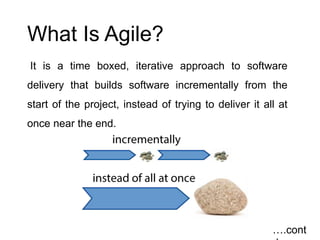
It is a time boxed, iterative approach to software
delivery that builds software incrementally from the
start of the project, instead of trying to deliver it all at
once near the end.
….cont
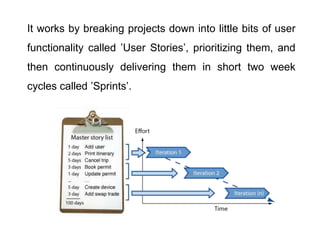
It works by breaking projects down into little bits of user
functionality called ’User Stories’, prioritizing them, and
then continuously delivering them in short two week
cycles called ’Sprints’.
Agile Methodologies
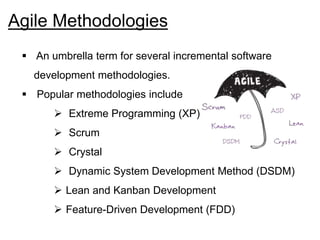
 An umbrella term for several incremental software
development methodologies.
 Popular methodologies include
 Extreme Programming (XP)
 Scrum
 Crystal
 Dynamic System Development Method (DSDM)
 Lean and Kanban Development
 Feature-Driven Development (FDD)
Agile Scrum Methodology
 A lightweight agile project management framework with
broad applicability for managing and controlling
incremental projects of all types.
 Scrum has garnered increasing popularity in the agile
software development community due to its simplicity and
proven productivity.
….contd
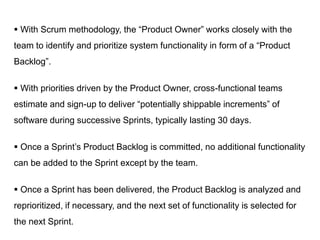
Scrum Methodology Framework
 With Scrum methodology, the “Product Owner” works closely with the
team to identify and prioritize system functionality in form of a “Product
Backlog”.
 With priorities driven by the Product Owner, cross-functional teams
estimate and sign-up to deliver “potentially shippable increments” of
software during successive Sprints, typically lasting 30 days.
 Once a Sprint’s Product Backlog is committed, no additional functionality
can be added to the Sprint except by the team.
 Once a Sprint has been delivered, the Product Backlog is analyzed and
reprioritized, if necessary, and the next set of functionality is selected for
the next Sprint.
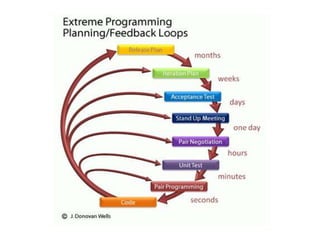
Extreme Programming (XP)
 One of the most popular and controversial agile
methodologies.
 Disciplined approach to delivering high-quality software
quickly and continuously.
 Promotes high customer involvement, rapid feedback
loops, continuous testing, continuous planning, and close
teamwork.
 Delivers working software at very frequent intervals,
In XP, the “Customer” works very closely with the
development team to define and prioritize granular units of
functionality referred to as “User Stories”. The
development team estimates, plans, and delivers the
highest priority user stories in the form of working, tested
software on an iteration-by-iteration basis. In order to
maximize productivity, the practices provide a supportive,
lightweight framework to guide a team and ensure high-
quality software.
Agile Crystal Methodology
 Is one of the most lightweight, adaptable approaches to software
development.
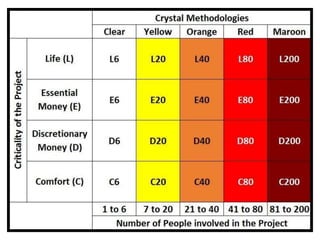
 Comprised of a family of agile methodologies such as crystal clear, crystal
yellow, crystal orange and others, whose unique characteristics are driven
by several factors such as team size, system criticality, and project
priorities.
 Addresses the realization that each project may require a slightly tailored
set of policies, practices, and processes in order to meet the project‘s
unique characteristics.
 Key factors of crystal include teamwork, communication, and simplicity, as
well as reflection to frequently adjust and improve the process.
Agile Lean Methodology
 Originally developed by Mary and Tom Poppendieck.
 The main principles of Lean methodology include:
 Eliminating Waste
 Amplifying Learning
 Deciding as Late as Possible
 Delivering as Fast as Possible
 Empowering the Team
 Building Integrity
 Seeing the Whole
 Eliminates waste through selecting only the truly valuable
features for a system, prioritizing those selected, and
delivering them in small batches.
 Emphasizes the speed and efficiency of development
workflow.
 Relies on rapid and reliable feedback between programmers
and customers.
 It focuses decision-making authority and ability on
individuals and small teams.
 Efficient use of team resources, trying to ensure that
everyone is productive as much of the time as possible.
 Concentrates on concurrent work and the fewest
possible intra-team workflow dependencies.
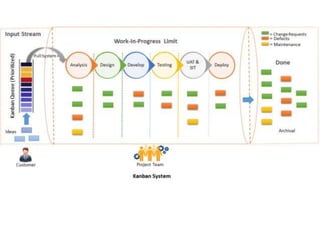
Agile Kanban Methodology
 Used by organizations to manage the creation of products
with an emphasis on continual delivery while not
overburdening the development team.
 Designed to help teams work together more effectively.
 Promotes continuous collaboration and encourages active,
ongoing learning and improvement.
 Kanban is based on 3 basic principles:
 Visualize what you do today (Workflow)
 Limit the amount of work in progress (WIP)
 Enhance flow
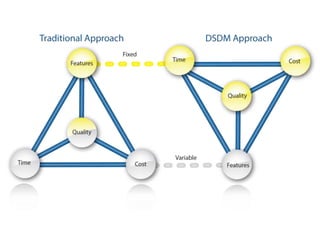
Dynamic System Development Method
(DSDM)
 Provide a comprehensive foundation for planning,
managing, executing, and scaling agile process and iterative
software development projects.
 DSDM is based on nine key principles that primarily revolve
around business needs/value.
 Requirements are baselined at a high level early in the
project.
 Rework is built into the process, and all development
changes must be reversible.
 Requirements are planned and delivered in short, fixed-
length time-boxes.
 Requirements for DSDM projects are prioritized using
MoSCoW Rules:
 M €“- Must have requirements
 S €“- Should have if at all possible
 C €“- Could have but not critical
 W - Won ‘t have this time, but potentially later
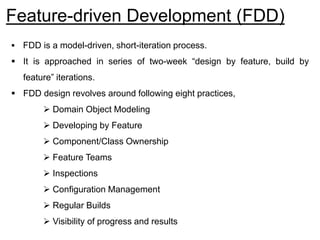
Feature-driven Development (FDD)
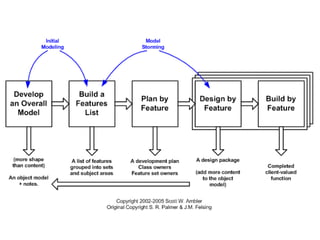
 FDD is a model-driven, short-iteration process.
 It is approached in series of two-week “design by feature, build by
feature” iterations.
 FDD design revolves around following eight practices,
 Domain Object Modeling
 Developing by Feature
 Component/Class Ownership
 Feature Teams
 Inspections
 Configuration Management
 Regular Builds
 Visibility of progress and results
 FDD recommends specific programmer practices such as
“Regular Builds” and “Component/Class Ownership”.
 It scales more straightforwardly than other approaches,
and is better suited to larger teams.
 Unlike other agile methods, FDD describes specific, very
short phases of work.
 These include Domain Walkthrough, Design, Design
Inspection, Code, Code Inspection, and Promote to Build.
Thank You!

Agile management.pptx

  • 1.
  • 2.
    What Is Agile? Itis a time boxed, iterative approach to software delivery that builds software incrementally from the start of the project, instead of trying to deliver it all at once near the end. ….cont
  • 3.
    It works bybreaking projects down into little bits of user functionality called ’User Stories’, prioritizing them, and then continuously delivering them in short two week cycles called ’Sprints’.
  • 4.
    Agile Methodologies  Anumbrella term for several incremental software development methodologies.  Popular methodologies include  Extreme Programming (XP)  Scrum  Crystal  Dynamic System Development Method (DSDM)  Lean and Kanban Development  Feature-Driven Development (FDD)
  • 5.
    Agile Scrum Methodology A lightweight agile project management framework with broad applicability for managing and controlling incremental projects of all types.  Scrum has garnered increasing popularity in the agile software development community due to its simplicity and proven productivity. ….contd
  • 6.
  • 7.
     With Scrummethodology, the “Product Owner” works closely with the team to identify and prioritize system functionality in form of a “Product Backlog”.  With priorities driven by the Product Owner, cross-functional teams estimate and sign-up to deliver “potentially shippable increments” of software during successive Sprints, typically lasting 30 days.  Once a Sprint’s Product Backlog is committed, no additional functionality can be added to the Sprint except by the team.  Once a Sprint has been delivered, the Product Backlog is analyzed and reprioritized, if necessary, and the next set of functionality is selected for the next Sprint.
  • 8.
    Extreme Programming (XP) One of the most popular and controversial agile methodologies.  Disciplined approach to delivering high-quality software quickly and continuously.  Promotes high customer involvement, rapid feedback loops, continuous testing, continuous planning, and close teamwork.  Delivers working software at very frequent intervals,
  • 10.
    In XP, the“Customer” works very closely with the development team to define and prioritize granular units of functionality referred to as “User Stories”. The development team estimates, plans, and delivers the highest priority user stories in the form of working, tested software on an iteration-by-iteration basis. In order to maximize productivity, the practices provide a supportive, lightweight framework to guide a team and ensure high- quality software.
  • 11.
    Agile Crystal Methodology Is one of the most lightweight, adaptable approaches to software development.  Comprised of a family of agile methodologies such as crystal clear, crystal yellow, crystal orange and others, whose unique characteristics are driven by several factors such as team size, system criticality, and project priorities.  Addresses the realization that each project may require a slightly tailored set of policies, practices, and processes in order to meet the project‘s unique characteristics.  Key factors of crystal include teamwork, communication, and simplicity, as well as reflection to frequently adjust and improve the process.
  • 13.
    Agile Lean Methodology Originally developed by Mary and Tom Poppendieck.  The main principles of Lean methodology include:  Eliminating Waste  Amplifying Learning  Deciding as Late as Possible  Delivering as Fast as Possible  Empowering the Team  Building Integrity  Seeing the Whole
  • 14.
     Eliminates wastethrough selecting only the truly valuable features for a system, prioritizing those selected, and delivering them in small batches.  Emphasizes the speed and efficiency of development workflow.  Relies on rapid and reliable feedback between programmers and customers.
  • 15.
     It focusesdecision-making authority and ability on individuals and small teams.  Efficient use of team resources, trying to ensure that everyone is productive as much of the time as possible.  Concentrates on concurrent work and the fewest possible intra-team workflow dependencies.
  • 16.
    Agile Kanban Methodology Used by organizations to manage the creation of products with an emphasis on continual delivery while not overburdening the development team.  Designed to help teams work together more effectively.  Promotes continuous collaboration and encourages active, ongoing learning and improvement.  Kanban is based on 3 basic principles:  Visualize what you do today (Workflow)  Limit the amount of work in progress (WIP)  Enhance flow
  • 18.
    Dynamic System DevelopmentMethod (DSDM)  Provide a comprehensive foundation for planning, managing, executing, and scaling agile process and iterative software development projects.  DSDM is based on nine key principles that primarily revolve around business needs/value.  Requirements are baselined at a high level early in the project.
  • 19.
     Rework isbuilt into the process, and all development changes must be reversible.  Requirements are planned and delivered in short, fixed- length time-boxes.  Requirements for DSDM projects are prioritized using MoSCoW Rules:  M €“- Must have requirements  S €“- Should have if at all possible  C €“- Could have but not critical  W - Won ‘t have this time, but potentially later
  • 21.
    Feature-driven Development (FDD) FDD is a model-driven, short-iteration process.  It is approached in series of two-week “design by feature, build by feature” iterations.  FDD design revolves around following eight practices,  Domain Object Modeling  Developing by Feature  Component/Class Ownership  Feature Teams  Inspections  Configuration Management  Regular Builds  Visibility of progress and results
  • 22.
     FDD recommendsspecific programmer practices such as “Regular Builds” and “Component/Class Ownership”.  It scales more straightforwardly than other approaches, and is better suited to larger teams.  Unlike other agile methods, FDD describes specific, very short phases of work.  These include Domain Walkthrough, Design, Design Inspection, Code, Code Inspection, and Promote to Build.
  • 24.