Size Separation
Mr. G.A.Shete
 Size Separation
 A special technique is used to separate particles of specified size which is
known as the “process of size separation".
 Official Standards For Powders
 The Indian Pharmacopoeia has laid down the standards for powders for
pharmaceutical purposes.
 Coarse powder : A powder of which al! the particles pass through a sieve
no.10 with nominal mesh aperture of 1.70 mm and not more than 40.0
per cent through a Sieve no.44 having nominal mesh aperture of 355 µm
is called coarse powder.
 Moderately coarse powder: A powder of which all the particles pass
through a sieve no.22 with nominal mesh aperture of 710 µm and not
more than 40.0 per cent through a sieve no.60 with nominal mesh
aperture of 250 µm is called moderately coarse powder.
 Moderately fine powder : If all the particles of a powder pass through
a sieve no.44 with nominal mesh aperture of 355 μm and not more than
40.0 per cent through a sieve no. 85 with nominal mesh aperture of 180
μm is called Moderately fine powder
 Fine powder : In case all the particles pass through a sieve no.85 with
a nominal mesh aperture of 180 μm it is called fine powder,
 Very fine powder : If all the particles of the powder pass through a
sieve no. 120 μm with a nominal mesh aperture of 125 μm it is called
as very fine powder.
 Micro fine powder: A powder of which not less than 90%by weight of
particles pass through a sieve with nominal mesh aperture size of 45
um
 Superfine powder: A powder of which not less than 90%by weight of
particles are less than 10 μm in size.
 SIEVES
 Sieves for pharmacopoeial testing are constructed from wire cloth with
square meshes, woven from wires of brass, bronze, stainless steel or
any other suitable material. The wires should be of uniform circular
cross-section and should not be coated or plated. There should not be
any reaction between the material of the sieve and the substance which
is being sifted from it.
Fig: Sieve
 Standards for sieves used for pharmacopoeial testing must specify the
following:
 Number of sieve (Sieve no)
 Nominal size of aperture
 Nominal diameter of the wire
 Approximate percentage sieving area
 Tolerance average aperture size
 SIEVING METHOD
 In this method, the fine powder is separated from the coarse powder by
using sieves of desired number. The degree of fineness of a powder is
known with the help of sieve through which the powdered material is
passed. Sieves are numbered in order to distinguish from each other.
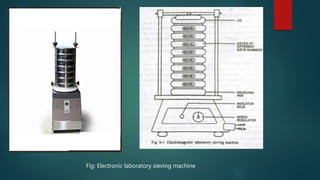
Size separation of powder is done by passing the powdered material
through a set of sieves. Sieves are arranged in descending order i.e.
sieve of larger size is at the top and the smallest one at the bottom. The
bottom sieve is attached to the receiving pan. The material is placed in
the uppermost sieve. The sieves are shaken with the help of mechanical
sieve shaker or electromagnetic devices. It helps the particles to pass
through the sieves.
 The working of mechanical sieving devices are based on any of the
following methods.
 1. Agitation 2. Brushing 3. Centrifugal
Fig: Electronic laboratory sieving machine
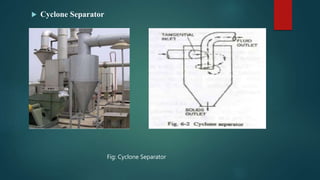
 Cyclone Separator
 Principle :
 In cyclone separator, the centrifugal force is used to separate solids
from fluids. The separation depends not only on the particle size but also
on density of particles. Hence depending on the fluid velocity, the
cyclone separator can be used to separate all types of particles or to
remove only coarse particles and allow fine particles to be carried
through with the fluid.
 Construction
 It consists of a cylindrical vessel with a conical base. In the upper part
of the vessel is fitted with a tangential inlet and a fluid outlet and at the
base it is fitted with solid outlet.
 Working
 The suspension of a solid in gas (usually air) is introduced tangentially
at a very high velocity, so that rotary movement takes place within the
vessel. The fluid is removed from a central outlet at the top. The
rotatory flow within the cyclone separator causes the particles to be
acted on by centrifugal force. The solids are thrown out to the walls,
thereafter it falls to the conical base and discharged out through solids
outlet.
 Uses
 Cyclone separators are used to separate the suspension of a solid in a
gas (air). It can be used with liquid suspensions of solids.
 Cyclone Separator
Fig: Cyclone Separator
 Air Separator
Fig: Air Separator
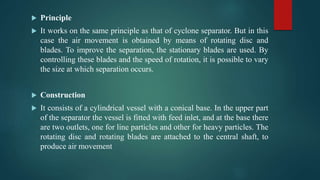
 Principle
 It works on the same principle as that of cyclone separator. But in this
case the air movement is obtained by means of rotating disc and
blades. To improve the separation, the stationary blades are used. By
controlling these blades and the speed of rotation, it is possible to vary
the size at which separation occurs.
 Construction
 It consists of a cylindrical vessel with a conical base. In the upper part
of the separator the vessel is fitted with feed inlet, and at the base there
are two outlets, one for line particles and other for heavy particles. The
rotating disc and rotating blades are attached to the central shaft, to
produce air movement
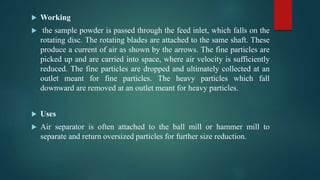
 Working
 the sample powder is passed through the feed inlet, which falls on the
rotating disc. The rotating blades are attached to the same shaft. These
produce a current of air as shown by the arrows. The fine particles are
picked up and are carried into space, where air velocity is sufficiently
reduced. The fine particles are dropped and ultimately collected at an
outlet meant for fine particles. The heavy particles which fall
downward are removed at an outlet meant for heavy particles.
 Uses
 Air separator is often attached to the ball mill or hammer mill to
separate and return oversized particles for further size reduction.
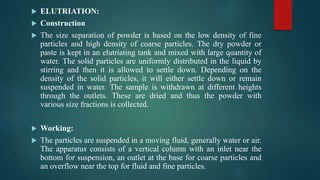
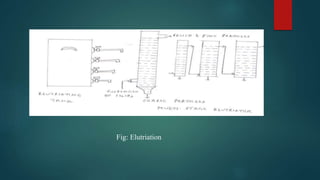
 ELUTRIATION:
 Construction
 The size separation of powder is based on the low density of fine
particles and high density of coarse particles. The dry powder or
paste is kept in an elutriating tank and mixed with large quantity of
water. The solid particles are uniformly distributed in the liquid by
stirring and then it is allowed to settle down. Depending on the
density of the solid particles, it will either settle down or remain
suspended in water. The sample is withdrawn at different heights
through the outlets. These are dried and thus the powder with
various size fractions is collected.
 Working:
 The particles are suspended in a moving fluid, generally water or air.
The apparatus consists of a vertical column with an inlet near the
bottom for suspension, an outlet at the base for coarse particles and
an overflow near the top for fluid and fine particles.
One column will give a single separation into two fractions. If more
than one fraction is required, a number of tubes of increasing area of
cross-section can be connected in series. The velocity of fluid
decreases in succeeding tubes as the area of cross-section increases,
thus giving a number of fractions. These fractions are separated and
dried.
 Application:
 Elutriating tank is used to separate the coarse and fine particles of
powder after levigation
Fig: Elutriation
6.size seperation

6.size seperation

  • 1.
  • 2.
     Size Separation A special technique is used to separate particles of specified size which is known as the “process of size separation".  Official Standards For Powders  The Indian Pharmacopoeia has laid down the standards for powders for pharmaceutical purposes.  Coarse powder : A powder of which al! the particles pass through a sieve no.10 with nominal mesh aperture of 1.70 mm and not more than 40.0 per cent through a Sieve no.44 having nominal mesh aperture of 355 µm is called coarse powder.  Moderately coarse powder: A powder of which all the particles pass through a sieve no.22 with nominal mesh aperture of 710 µm and not more than 40.0 per cent through a sieve no.60 with nominal mesh aperture of 250 µm is called moderately coarse powder.
  • 3.
     Moderately finepowder : If all the particles of a powder pass through a sieve no.44 with nominal mesh aperture of 355 μm and not more than 40.0 per cent through a sieve no. 85 with nominal mesh aperture of 180 μm is called Moderately fine powder  Fine powder : In case all the particles pass through a sieve no.85 with a nominal mesh aperture of 180 μm it is called fine powder,  Very fine powder : If all the particles of the powder pass through a sieve no. 120 μm with a nominal mesh aperture of 125 μm it is called as very fine powder.  Micro fine powder: A powder of which not less than 90%by weight of particles pass through a sieve with nominal mesh aperture size of 45 um  Superfine powder: A powder of which not less than 90%by weight of particles are less than 10 μm in size.
  • 4.
     SIEVES  Sievesfor pharmacopoeial testing are constructed from wire cloth with square meshes, woven from wires of brass, bronze, stainless steel or any other suitable material. The wires should be of uniform circular cross-section and should not be coated or plated. There should not be any reaction between the material of the sieve and the substance which is being sifted from it. Fig: Sieve
  • 5.
     Standards forsieves used for pharmacopoeial testing must specify the following:  Number of sieve (Sieve no)  Nominal size of aperture  Nominal diameter of the wire  Approximate percentage sieving area  Tolerance average aperture size
  • 6.
     SIEVING METHOD In this method, the fine powder is separated from the coarse powder by using sieves of desired number. The degree of fineness of a powder is known with the help of sieve through which the powdered material is passed. Sieves are numbered in order to distinguish from each other. Size separation of powder is done by passing the powdered material through a set of sieves. Sieves are arranged in descending order i.e. sieve of larger size is at the top and the smallest one at the bottom. The bottom sieve is attached to the receiving pan. The material is placed in the uppermost sieve. The sieves are shaken with the help of mechanical sieve shaker or electromagnetic devices. It helps the particles to pass through the sieves.  The working of mechanical sieving devices are based on any of the following methods.  1. Agitation 2. Brushing 3. Centrifugal
  • 7.
  • 8.
     Cyclone Separator Principle :  In cyclone separator, the centrifugal force is used to separate solids from fluids. The separation depends not only on the particle size but also on density of particles. Hence depending on the fluid velocity, the cyclone separator can be used to separate all types of particles or to remove only coarse particles and allow fine particles to be carried through with the fluid.  Construction  It consists of a cylindrical vessel with a conical base. In the upper part of the vessel is fitted with a tangential inlet and a fluid outlet and at the base it is fitted with solid outlet.
  • 9.
     Working  Thesuspension of a solid in gas (usually air) is introduced tangentially at a very high velocity, so that rotary movement takes place within the vessel. The fluid is removed from a central outlet at the top. The rotatory flow within the cyclone separator causes the particles to be acted on by centrifugal force. The solids are thrown out to the walls, thereafter it falls to the conical base and discharged out through solids outlet.  Uses  Cyclone separators are used to separate the suspension of a solid in a gas (air). It can be used with liquid suspensions of solids.
  • 10.
     Cyclone Separator Fig:Cyclone Separator
  • 11.
  • 12.
     Principle  Itworks on the same principle as that of cyclone separator. But in this case the air movement is obtained by means of rotating disc and blades. To improve the separation, the stationary blades are used. By controlling these blades and the speed of rotation, it is possible to vary the size at which separation occurs.  Construction  It consists of a cylindrical vessel with a conical base. In the upper part of the separator the vessel is fitted with feed inlet, and at the base there are two outlets, one for line particles and other for heavy particles. The rotating disc and rotating blades are attached to the central shaft, to produce air movement
  • 13.
     Working  thesample powder is passed through the feed inlet, which falls on the rotating disc. The rotating blades are attached to the same shaft. These produce a current of air as shown by the arrows. The fine particles are picked up and are carried into space, where air velocity is sufficiently reduced. The fine particles are dropped and ultimately collected at an outlet meant for fine particles. The heavy particles which fall downward are removed at an outlet meant for heavy particles.  Uses  Air separator is often attached to the ball mill or hammer mill to separate and return oversized particles for further size reduction.
  • 14.
     ELUTRIATION:  Construction The size separation of powder is based on the low density of fine particles and high density of coarse particles. The dry powder or paste is kept in an elutriating tank and mixed with large quantity of water. The solid particles are uniformly distributed in the liquid by stirring and then it is allowed to settle down. Depending on the density of the solid particles, it will either settle down or remain suspended in water. The sample is withdrawn at different heights through the outlets. These are dried and thus the powder with various size fractions is collected.  Working:  The particles are suspended in a moving fluid, generally water or air. The apparatus consists of a vertical column with an inlet near the bottom for suspension, an outlet at the base for coarse particles and an overflow near the top for fluid and fine particles.
  • 15.
    One column willgive a single separation into two fractions. If more than one fraction is required, a number of tubes of increasing area of cross-section can be connected in series. The velocity of fluid decreases in succeeding tubes as the area of cross-section increases, thus giving a number of fractions. These fractions are separated and dried.  Application:  Elutriating tank is used to separate the coarse and fine particles of powder after levigation
  • 16.