MAJOR CONNECTORS
PRESENTED BY :
Dr. PRAJAKTA BALI GIR
II YEAR MDS
CONTENTS
• INTRODUCTION
• TERMINOLOGIES
• REQUIREMENTS OF MAJOR CONNECTORS
• FUNCTIONS OF MAJOR CONNECTORS
• NOMENCLATURE
• TYPES OF MAJOR CONNECTORS
Department of prosthodontics, crown & bridge and oral implantology, DDCH, Udaipur 2
CONTENTS
• MAXILLARY MAJOR CONNECTORS
• MANDIBULAR MAJOR CONNECTORS
• SUMMARY
• REVIEW OF LITERATURE
• REFERENCES
Department of prosthodontics, crown & bridge and oral implantology, DDCH, Udaipur 3
INTRODUCTION
• When a prosthesis that can be removed from the mouth is used, the prosthesis
must extend to both sides of the arch.
• This enables transfer of functional forces of occlusion from the denture base to all
supporting teeth and tissues within an arch for optimum stability.
• It is through this cross-arch tooth contact, which occurs at some distance from the
functional force, that optimum resistance can be achieved
Department of prosthodontics, crown & bridge and oral implantology, DDCH, Udaipur 4
• This is most effectively accomplished when a rigid major connector joins the
portion of the prosthesis receiving the function to selected regions throughout the
arch.
• A major connector combines all other components of an RPD so that the partial
denture acts as one unit.
• Thus, functional loads can be distributed to all abutment teeth, and cross-arch
stabilization can be provided.
• In addition, in distal extension RPDs, forces can be distributed between both the
abutment teeth and the mucosa by unification of the direct retainers with the
denture base.
Department of prosthodontics, crown & bridge and oral implantology, DDCH, Udaipur 5
INTRODUCTION
TERMINOLOGIES
MAJOR CONNECTOR- GPT 9
The part of a removable partial denture that joins the components on one side of the
arch to those on the opposite side.
CROSS-ARCH STABILIZATION :
Resistance against dislodging or rotational forces obtained by using a partial
removable dental prosthesis design that uses natural teeth on the opposite side of the
dental arch from the edentulous space to assist in stabilization
Department of prosthodontics, crown & bridge and oral implantology, DDCH, Udaipur 6
REQUIREMENTS
• To function effectively and minimize potentially damaging effects, all major
connectors must
• 1. Be rigid
• 2. Provide vertical support and protect the soft tissues
• 3. Provide a means for obtaining indirect retention where indicated
• 4. Provide a means for placement of one or more denture bases
• 5. Promote patient comfort
Department of prosthodontics, crown & bridge and oral implantology, DDCH, Udaipur 7
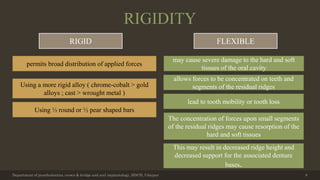
RIGIDITY
Department of prosthodontics, crown & bridge and oral implantology, DDCH, Udaipur 8
RIGID FLEXIBLE
permits broad distribution of applied forces
Using ½ round or ½ pear shaped bars
Using a more rigid alloy ( chrome-cobalt > gold
alloys ; cast > wrought metal )
may cause severe damage to the hard and soft
tissues of the oral cavity
allows forces to be concentrated on teeth and
segments of the residual ridges
lead to tooth mobility or tooth loss
The concentration of forces upon small segments
of the residual ridges may cause resorption of the
hard and soft tissues
This may result in decreased ridge height and
decreased support for the associated denture
bases.
PROVIDE VERTICAL SUPPORT AND
PROTECT THE SOFT TISSUES
• The second fundamental requirement of a major connector is that it must not
permit impingement upon the free gingival margins of the remaining teeth.
• The marginal gingivae are highly vascular and susceptible to injury from sustained
pressure.
• For this reason, care should be exercised during the design and fabrication of
removable partial dentures.
Department of prosthodontics, crown & bridge and oral implantology, DDCH, Udaipur 9
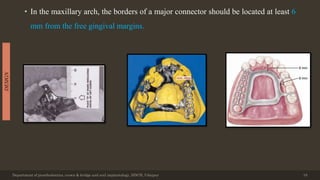
• In the maxillary arch, the borders of a major connector should be located at least 6
mm from the free gingival margins.
Department of prosthodontics, crown & bridge and oral implantology, DDCH, Udaipur 10
DESIGN
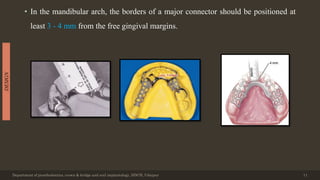
• In the mandibular arch, the borders of a major connector should be positioned at
least 3 - 4 mm from the free gingival margins.
Department of prosthodontics, crown & bridge and oral implantology, DDCH, Udaipur 11
DESIGN
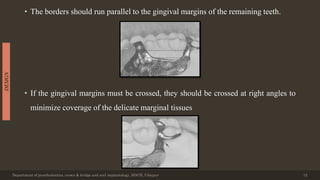
• The borders should run parallel to the gingival margins of the remaining teeth.
• If the gingival margins must be crossed, they should be crossed at right angles to
minimize coverage of the delicate marginal tissues
Department of prosthodontics, crown & bridge and oral implantology, DDCH, Udaipur 12
DESIGN
• Where the major connector crosses a gingival margin, relief (le, space) must be
provided between the metal and soft tissues.
• If relief is not provided, inflammation of the soft tissues will result.
Department of prosthodontics, crown & bridge and oral implantology, DDCH, Udaipur 13
DESIGN
PROVIDE A MEANS FOR OBTAINING
INDIRECT RETENTION WHERE INDICATED
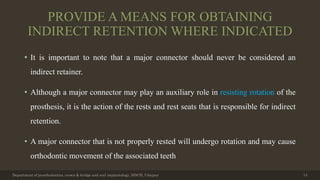
• It is important to note that a major connector should never be considered an
indirect retainer.
• Although a major connector may play an auxiliary role in resisting rotation of the
prosthesis, it is the action of the rests and rest seats that is responsible for indirect
retention.
• A major connector that is not properly rested will undergo rotation and may cause
orthodontic movement of the associated teeth
Department of prosthodontics, crown & bridge and oral implantology, DDCH, Udaipur 14
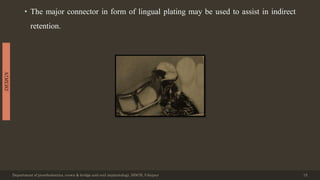
• The major connector in form of lingual plating may be used to assist in indirect
retention.
Department of prosthodontics, crown & bridge and oral implantology, DDCH, Udaipur 15
DESIGN
PROVIDE A MEANS FOR PLACEMENT OF
ONE OR MORE DENTURE BASES
• Number & location of edentulous areas dictate the major connector type.
• Major connector must allow appropriate placement of the denture base.
Department of prosthodontics, crown & bridge and oral implantology, DDCH, Udaipur 16
PROMOTE PATIENT COMFORT
• A major connector must not create food entrapment areas.
• A partial denture must always be designed to be as self -cleansing as possible.
Department of prosthodontics, crown & bridge and oral implantology, DDCH, Udaipur 17
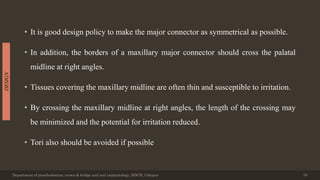
• It is good design policy to make the major connector as symmetrical as possible.
• In addition, the borders of a maxillary major connector should cross the palatal
midline at right angles.
• Tissues covering the maxillary midline are often thin and susceptible to irritation.
• By crossing the maxillary midline at right angles, the length of the crossing may
be minimized and the potential for irritation reduced.
• Tori also should be avoided if possible
Department of prosthodontics, crown & bridge and oral implantology, DDCH, Udaipur 18
DESIGN
Department of prosthodontics, crown & bridge and oral implantology, DDCH, Udaipur 19
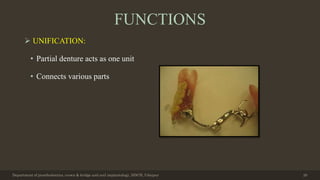
FUNCTIONS
 UNIFICATION:
• Partial denture acts as one unit
• Connects various parts
Department of prosthodontics, crown & bridge and oral implantology, DDCH, Udaipur 20
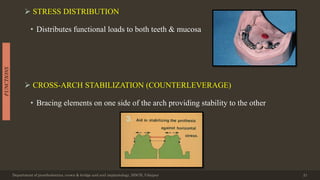
 STRESS DISTRIBUTION
• Distributes functional loads to both teeth & mucosa
 CROSS-ARCH STABILIZATION (COUNTERLEVERAGE)
• Bracing elements on one side of the arch providing stability to the other
Department of prosthodontics, crown & bridge and oral implantology, DDCH, Udaipur 21
FUNCTIONS
NOMENCLATURE
• Major connectors are named by their location and shape.
• Maxillary major connectors are located on the palate.
• Mandibular major connectors are usually located on the lingual surface of the
ridge and teeth.
• Rarely, mandibular major connectors are located on the labial alveolar ridge area
or under the anterior part of the tongue.
Department of prosthodontics, crown & bridge and oral implantology, DDCH, Udaipur 22
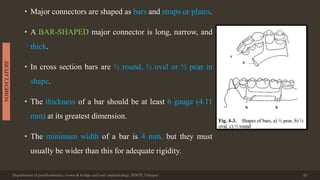
• Major connectors are shaped as bars and straps or plates.
• A BAR-SHAPED major connector is long, narrow, and
thick.
• In cross section bars are ½ round, ½ oval or ½ pear in
shape.
• The thickness of a bar should be at least 6 gauge (4.11
mm) at its greatest dimension.
• The minimum width of a bar is 4 mm, but they must
usually be wider than this for adequate rigidity.
Department of prosthodontics, crown & bridge and oral implantology, DDCH, Udaipur 23
NOMENCLATURE
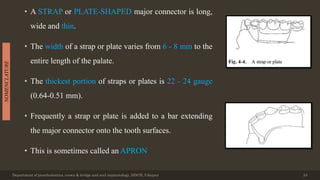
• A STRAP or PLATE-SHAPED major connector is long,
wide and thin.
• The width of a strap or plate varies from 6 - 8 mm to the
entire length of the palate.
• The thickest portion of straps or plates is 22 - 24 gauge
(0.64-0.51 mm).
• Frequently a strap or plate is added to a bar extending
the major connector onto the tooth surfaces.
• This is sometimes called an APRON
Department of prosthodontics, crown & bridge and oral implantology, DDCH, Udaipur 24
NOMENCLATURE
• The more rigid the alloy, the smaller and thinner the framework may be.
• The bigger the arch, the thicker and wider the major connector must be to provide
the necessary rigidity
Department of prosthodontics, crown & bridge and oral implantology, DDCH, Udaipur 25
NOMENCLATURE
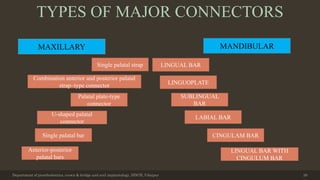
TYPES OF MAJOR CONNECTORS
Department of prosthodontics, crown & bridge and oral implantology, DDCH, Udaipur 26
MAXILLARY MANDIBULAR
LINGUAL BAR
SUBLINGUAL
BAR
LINGUAL BAR WITH
CINGULUM BAR
CINGULAM BAR
LABIAL BAR
LINGUOPLATE
Anterior-posterior
palatal bars
Single palatal bar
U-shaped palatal
connector
Palatal plate-type
connector
Combination anterior and posterior palatal
strap–type connector
Single palatal strap
MAXILLARY MAJOR
CONNECTORS
SPECIAL STRUCTURAL REQUIREMENTS
• All maxillary major connectors should display minor elevations at those borders
that contact the palatal soft tissues
Department of prosthodontics, crown & bridge and oral implantology, DDCH, Udaipur 28
BEAD slightly displace the adjacent soft tissues.
provide excellent visual finish lines for technicians
who finish and polish removable partial denture
framework
mechanical seal and prevents food particles from
collecting under the major connector
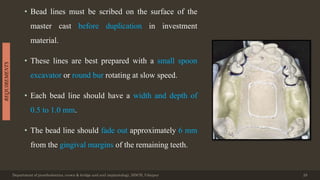
• Bead lines must be scribed on the surface of the
master cast before duplication in investment
material.
• These lines are best prepared with a small spoon
excavator or round bur rotating at slow speed.
• Each bead line should have a width and depth of
0.5 to 1.0 mm.
• The bead line should fade out approximately 6 mm
from the gingival margins of the remaining teeth.
Department of prosthodontics, crown & bridge and oral implantology, DDCH, Udaipur 29
REQUIREMENTS
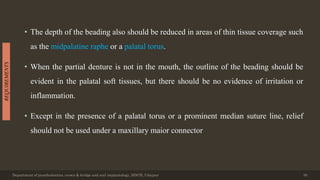
• The depth of the beading also should be reduced in areas of thin tissue coverage such
as the midpalatine raphe or a palatal torus.
• When the partial denture is not in the mouth, the outline of the beading should be
evident in the palatal soft tissues, but there should be no evidence of irritation or
inflammation.
• Except in the presence of a palatal torus or a prominent median suture line, relief
should not be used under a maxillary maior connector
Department of prosthodontics, crown & bridge and oral implantology, DDCH, Udaipur 30
REQUIREMENTS
• The intimate contact between the palatal soft tissues and the metal connector
enhances the retention and stability of the denture.
• To maintain this intimate metal-soft tissue contact, the tissue side of the major
connector is not brought to a high finish during polishing procedures.
• Electrolytic polishing is sufficient to produce a smooth, well-finished surface
without disturbing the accuracy of the casting.
Department of prosthodontics, crown & bridge and oral implantology, DDCH, Udaipur 31
REQUIREMENTS
Department of prosthodontics, crown & bridge and oral implantology, DDCH, Udaipur 32
MAXILLARY
MAJOR
CONNECTOR
TYPE AD DA I/ C
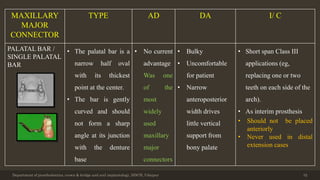
PALATAL BAR /
SINGLE PALATAL
BAR
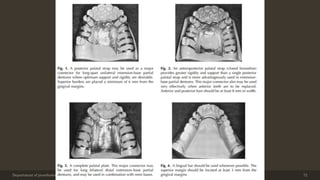
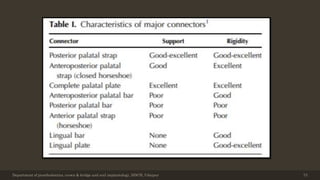
• The palatal bar is a
narrow half oval
with its thickest
point at the center.
• The bar is gently
curved and should
not form a sharp
angle at its junction
with the denture
base
• No current
advantage
Was one
of the
most
widely
used
maxillary
major
connectors
• Bulky
• Uncomfortable
for patient
• Narrow
anteroposterior
width drives
little vertical
support from
bony palate
• Short span Class III
applications (eg,
replacing one or two
teeth on each side of the
arch).
• As interim prosthesis
• Should not be placed
anteriorly
• Never used in distal
extension cases
Department of prosthodontics, crown & bridge and oral implantology, DDCH, Udaipur 33
MAXILLARY
MAJOR
CONNECTOR
TYPE AD DA I / C
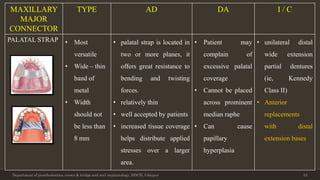
PALATAL STRAP • Most
versatile
• Wide – thin
band of
metal
• Width
should not
be less than
8 mm
• palatal strap is located in
two or more planes, it
offers great resistance to
bending and twisting
forces.
• relatively thin
• well accepted by patients
• increased tissue coverage
helps distribute applied
stresses over a larger
area.
• Patient may
complain of
excessive palatal
coverage
• Cannot be placed
across prominent
median raphe
• Can cause
papillary
hyperplasia
• unilateral distal
wide extension
partial dentures
(ie, Kennedy
Class II)
• Anterior
replacements
with distal
extension bases
Department of prosthodontics, crown & bridge and oral implantology, DDCH, Udaipur 34
MAXILLARY
MAJOR
CONNECTOR
TYPE AD DA I / C
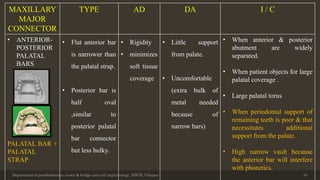
• ANTERIOR-
POSTERIOR
PALATAL
BARS
PALATAL BAR +
PALATAL
STRAP
• Flat anterior bar
is narrower than
the palatal strap.
• Posterior bar is
half oval
,similar to
posterior palatal
bar connector
but less bulky.
• Rigidity
• minimizes
soft tissue
coverage
• Little support
from palate.
• Uncomfortable
(extra bulk of
metal needed
because of
narrow bars)
• When anterior & posterior
abutment are widely
separated.
• When patient objects for large
palatal coverage .
• Large palatal torus
• When periodontal support of
remaining teeth is poor & that
necessitates additional
support from the palate.
• High narrow vault because
the anterior bar will interfere
with phonetics.
Department of prosthodontics, crown & bridge and oral implantology, DDCH, Udaipur 35
MAXILLARY
MAJOR
CONNECTOR
TYPE AD DA I / C
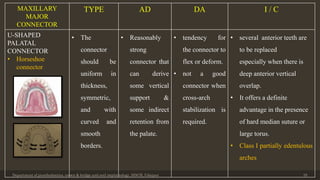
U-SHAPED
PALATAL
CONNECTOR
• Horseshoe
connector
• The
connector
should be
uniform in
thickness,
symmetric,
and with
curved and
smooth
borders.
• Reasonably
strong
connector that
can derive
some vertical
support &
some indirect
retention from
the palate.
• tendency for
the connector to
flex or deform.
• not a good
connector when
cross-arch
stabilization is
required.
• several anterior teeth are
to be replaced
especially when there is
deep anterior vertical
overlap.
• It offers a definite
advantage in the presence
of hard median suture or
large torus.
• Class I partially edentulous
arches
Department of prosthodontics, crown & bridge and oral implantology, DDCH, Udaipur 36
MAXILLARY MAJOR
CONNECTOR
TYPE AD DA I / C
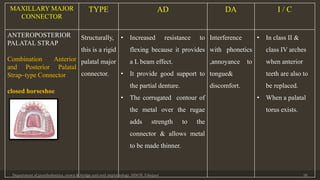
ANTEROPOSTERIOR
PALATAL STRAP
Combination Anterior
and Posterior Palatal
Strap–type Connector
closed horseshoe
Structurally,
this is a rigid
palatal major
connector.
• Increased resistance to
flexing because it provides
a L beam effect.
• It provide good support to
the partial denture.
• The corrugated contour of
the metal over the rugae
adds strength to the
connector & allows metal
to be made thinner.
Interference
with phonetics
,annoyance to
tongue&
discomfort.
• In class II &
class IV arches
when anterior
teeth are also to
be replaced.
• When a palatal
torus exists.
Department of prosthodontics, crown & bridge and oral implantology, DDCH, Udaipur 37
MAXILLARY
MAJOR
CONNECTOR
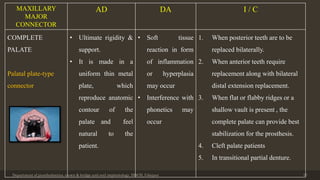
AD DA I / C
COMPLETE
PALATE
Palatal plate-type
connector
• Ultimate rigidity &
support.
• It is made in a
uniform thin metal
plate, which
reproduce anatomic
contour of the
palate and feel
natural to the
patient.
• Soft tissue
reaction in form
of inflammation
or hyperplasia
may occur
• Interference with
phonetics may
occur
1. When posterior teeth are to be
replaced bilaterally.
2. When anterior teeth require
replacement along with bilateral
distal extension replacement.
3. When flat or flabby ridges or a
shallow vault is present , the
complete palate can provide best
stabilization for the prosthesis.
4. Cleft palate patients
5. In transitional partial denture.
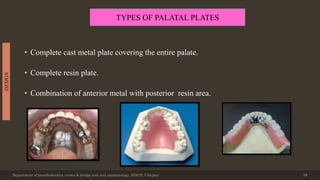
• Complete cast metal plate covering the entire palate.
• Complete resin plate.
• Combination of anterior metal with posterior resin area.
Department of prosthodontics, crown & bridge and oral implantology, DDCH, Udaipur 38
DESIGN
TYPES OF PALATAL PLATES
FACTORS AFFECTING SELECTION OF THE MAXILLARY CONNECTOR
• Rigidity
• The presence of palatal tori
• The need for anterior tooth replacement
• The requirement for indirect retention
• The need to stabilize weakened teeth
• Phonetic considerations
• The mental attitude of the patient
Department of prosthodontics, crown & bridge and oral implantology, DDCH, Udaipur 39
DESIGN
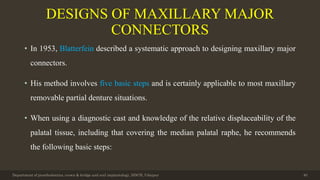
DESIGNS OF MAXILLARY MAJOR
CONNECTORS
• In 1953, Blatterfein described a systematic approach to designing maxillary major
connectors.
• His method involves five basic steps and is certainly applicable to most maxillary
removable partial denture situations.
• When using a diagnostic cast and knowledge of the relative displaceability of the
palatal tissue, including that covering the median palatal raphe, he recommends
the following basic steps:
Department of prosthodontics, crown & bridge and oral implantology, DDCH, Udaipur 40
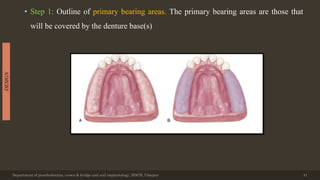
• Step 1: Outline of primary bearing areas. The primary bearing areas are those that
will be covered by the denture base(s)
Department of prosthodontics, crown & bridge and oral implantology, DDCH, Udaipur 41
DESIGN
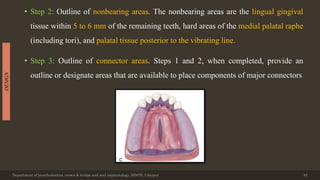
• Step 2: Outline of nonbearing areas. The nonbearing areas are the lingual gingival
tissue within 5 to 6 mm of the remaining teeth, hard areas of the medial palatal raphe
(including tori), and palatal tissue posterior to the vibrating line.
• Step 3: Outline of connector areas. Steps 1 and 2, when completed, provide an
outline or designate areas that are available to place components of major connectors
Department of prosthodontics, crown & bridge and oral implantology, DDCH, Udaipur 42
DESIGN
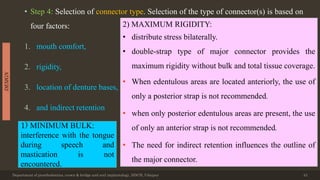
• Step 4: Selection of connector type. Selection of the type of connector(s) is based on
four factors:
1. mouth comfort,
2. rigidity,
3. location of denture bases,
4. and indirect retention
Department of prosthodontics, crown & bridge and oral implantology, DDCH, Udaipur 43
DESIGN
1) MINIMUM BULK:
interference with the tongue
during speech and
mastication is not
encountered.
2) MAXIMUM RIGIDITY:
• distribute stress bilaterally.
• double-strap type of major connector provides the
maximum rigidity without bulk and total tissue coverage.
• When edentulous areas are located anteriorly, the use of
only a posterior strap is not recommended.
• when only posterior edentulous areas are present, the use
of only an anterior strap is not recommended.
• The need for indirect retention influences the outline of
the major connector.
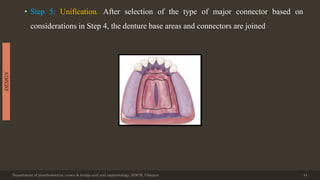
• Step 5: Unification. After selection of the type of major connector based on
considerations in Step 4, the denture base areas and connectors are joined
Department of prosthodontics, crown & bridge and oral implantology, DDCH, Udaipur 44
DESIGN
REVIEW OF STRUCTURAL REQUIREMENTS FOR
MAXILLARY MAJOR CONNECTORS
Department of prosthodontics, crown & bridge and oral implantology, DDCH, Udaipur 45
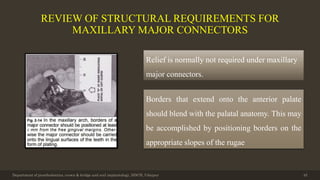
Relief is normally not required under maxillary
major connectors.
Borders that extend onto the anterior palate
should blend with the palatal anatomy. This may
be accomplished by positioning borders on the
appropriate slopes of the rugae
Department of prosthodontics, crown & bridge and oral implantology, DDCH, Udaipur 46
DESIGN
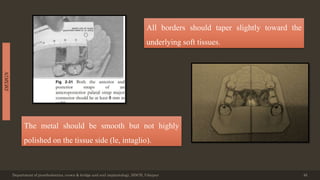
All borders should taper slightly toward the
underlying soft tissues.
The metal should be smooth but not highly
polished on the tissue side (le, intaglio).
Department of prosthodontics, crown & bridge and oral implantology, DDCH, Udaipur 47
DESIGN
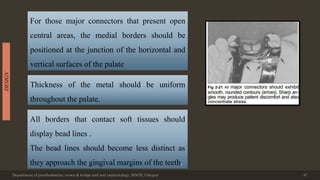
For those major connectors that present open
central areas, the medial borders should be
positioned at the junction of the horizontal and
vertical surfaces of the palate
Thickness of the metal should be uniform
throughout the palate.
All borders that contact soft tissues should
display bead lines .
The bead lines should become less distinct as
they approach the gingival margins of the teeth.
MANDIBULAR MAJOR
CONNECTORS
SPECIAL STRUCTURAL
REQUIREMENTS
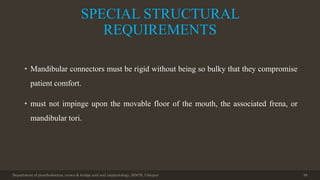
• Mandibular connectors must be rigid without being so bulky that they compromise
patient comfort.
• must not impinge upon the movable floor of the mouth, the associated frena, or
mandibular tori.
Department of prosthodontics, crown & bridge and oral implantology, DDCH, Udaipur 49
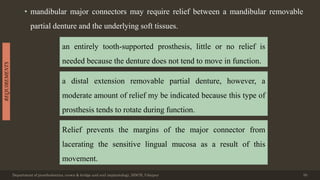
• mandibular major connectors may require relief between a mandibular removable
partial denture and the underlying soft tissues.
Department of prosthodontics, crown & bridge and oral implantology, DDCH, Udaipur 50
REQUIREMENTS
an entirely tooth-supported prosthesis, little or no relief is
needed because the denture does not tend to move in function.
a distal extension removable partial denture, however, a
moderate amount of relief my be indicated because this type of
prosthesis tends to rotate during function.
Relief prevents the margins of the major connector from
lacerating the sensitive lingual mucosa as a result of this
movement.
Department of prosthodontics, crown & bridge and oral implantology, DDCH, Udaipur 51
REQUIREMENTS
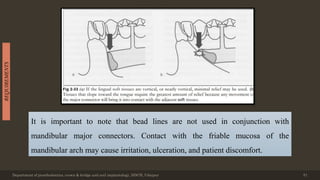
It is important to note that bead lines are not used in conjunction with
mandibular major connectors. Contact with the friable mucosa of the
mandibular arch may cause irritation, ulceration, and patient discomfort.
Department of prosthodontics, crown & bridge and oral implantology, DDCH, Udaipur 52
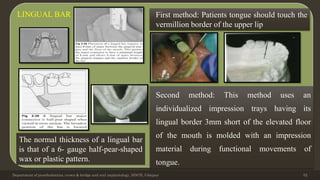
LINGUAL BAR
The normal thickness of a lingual bar
is that of a 6- gauge half-pear-shaped
wax or plastic pattern.
First method: Patients tongue should touch the
vermillion border of the upper lip
Second method: This method uses an
individualized impression trays having its
lingual border 3mm short of the elevated floor
of the mouth is molded with an impression
material during functional movements of
tongue.
Department of prosthodontics, crown & bridge and oral implantology, DDCH, Udaipur 53
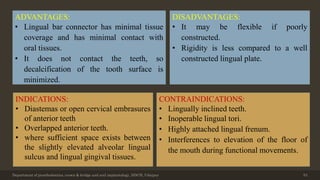
ADVANTAGES:
• Lingual bar connector has minimal tissue
coverage and has minimal contact with
oral tissues.
• It does not contact the teeth, so
decalcification of the tooth surface is
minimized.
INDICATIONS:
• Diastemas or open cervical embrasures
of anterior teeth
• Overlapped anterior teeth.
• where sufficient space exists between
the slightly elevated alveolar lingual
sulcus and lingual gingival tissues.
DISADVANTAGES:
• It may be flexible if poorly
constructed.
• Rigidity is less compared to a well
constructed lingual plate.
CONTRAINDICATIONS:
• Lingually inclined teeth.
• Inoperable lingual tori.
• Highly attached lingual frenum.
• Interferences to elevation of the floor of
the mouth during functional movements.
Department of prosthodontics, crown & bridge and oral implantology, DDCH, Udaipur 54
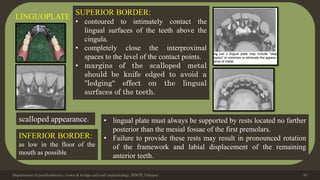
LINGUOPLATE
scalloped appearance.
INFERIOR BORDER:
as low in the floor of the
mouth as possible
SUPERIOR BORDER:
• contoured to intimately contact the
lingual surfaces of the teeth above the
cingula.
• completely close the interproximal
spaces to the level of the contact points.
• margins of the scalloped metal
should be knife edged to avoid a
"ledging" effect on the lingual
surfaces of the teeth.
• lingual plate must always be supported by rests located no farther
posterior than the mesial fossae of the first premolars.
• Failure to provide these rests may result in pronounced rotation
of the framework and labial displacement of the remaining
anterior teeth.
Department of prosthodontics, crown & bridge and oral implantology, DDCH, Udaipur 55
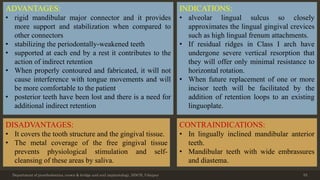
ADVANTAGES:
• rigid mandibular major connector and it provides
more support and stabilization when compared to
other connectors
• stabilizing the periodontally-weakened teeth
• supported at each end by a rest it contributes to the
action of indirect retention
• When properly contoured and fabricated, it will not
cause interference with tongue movements and will
be more comfortable to the patient.
• posterior teeth have been lost and there is a need for
additional indirect retention
DISADVANTAGES:
• It covers the tooth structure and the gingival tissue.
• The metal coverage of the free gingival tissue
prevents physiological stimulation and self-
cleansing of these areas by saliva.
INDICATIONS:
• alveolar lingual sulcus so closely
approximates the lingual gingival crevices
such as high lingual frenum attachments.
• If residual ridges in Class I arch have
undergone severe vertical resorption that
they will offer only minimal resistance to
horizontal rotation.
• When future replacement of one or more
incisor teeth will be facilitated by the
addition of retention loops to an existing
linguoplate.
CONTRAINDICATIONS:
• In lingually inclined mandibular anterior
teeth.
• Mandibular teeth with wide embrassures
and diastema.
Department of prosthodontics, crown & bridge and oral implantology, DDCH, Udaipur 56
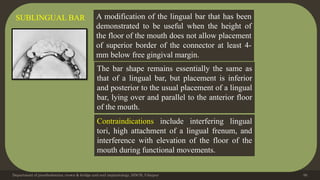
SUBLINGUAL BAR A modification of the lingual bar that has been
demonstrated to be useful when the height of
the floor of the mouth does not allow placement
of superior border of the connector at least 4-
mm below free gingival margin.
The bar shape remains essentially the same as
that of a lingual bar, but placement is inferior
and posterior to the usual placement of a lingual
bar, lying over and parallel to the anterior floor
of the mouth.
Contraindications include interfering lingual
tori, high attachment of a lingual frenum, and
interference with elevation of the floor of the
mouth during functional movements.
Department of prosthodontics, crown & bridge and oral implantology, DDCH, Udaipur 57
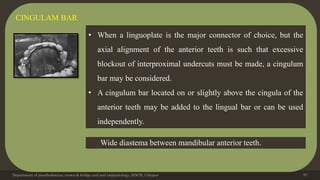
CINGULAM BAR
• When a linguoplate is the major connector of choice, but the
axial alignment of the anterior teeth is such that excessive
blockout of interproximal undercuts must be made, a cingulum
bar may be considered.
• A cingulum bar located on or slightly above the cingula of the
anterior teeth may be added to the lingual bar or can be used
independently.
Wide diastema between mandibular anterior teeth.
Department of prosthodontics, crown & bridge and oral implantology, DDCH, Udaipur 58
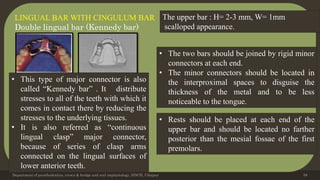
LINGUAL BAR WITH CINGULUM BAR
Double lingual bar (Kennedy bar)
• This type of major connector is also
called “Kennedy bar” . It distribute
stresses to all of the teeth with which it
comes in contact there by reducing the
stresses to the underlying tissues.
• It is also referred as “continuous
lingual clasp” major connector,
because of series of clasp arms
connected on the lingual surfaces of
lower anterior teeth.
The upper bar : H= 2-3 mm, W= 1mm
scalloped appearance.
• The two bars should be joined by rigid minor
connectors at each end.
• The minor connectors should be located in
the interproximal spaces to disguise the
thickness of the metal and to be less
noticeable to the tongue.
• Rests should be placed at each end of the
upper bar and should be located no farther
posterior than the mesial fossae of the first
premolars.
Department of prosthodontics, crown & bridge and oral implantology, DDCH, Udaipur 59
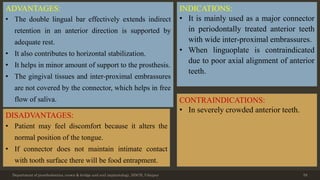
ADVANTAGES:
• The double lingual bar effectively extends indirect
retention in an anterior direction is supported by
adequate rest.
• It also contributes to horizontal stabilization.
• It helps in minor amount of support to the prosthesis.
• The gingival tissues and inter-proximal embrassures
are not covered by the connector, which helps in free
flow of saliva.
DISADVANTAGES:
• Patient may feel discomfort because it alters the
normal position of the tongue.
• If connector does not maintain intimate contact
with tooth surface there will be food entrapment.
INDICATIONS:
• It is mainly used as a major connector
in periodontally treated anterior teeth
with wide inter-proximal embrassures.
• When linguoplate is contraindicated
due to poor axial alignment of anterior
teeth.
CONTRAINDICATIONS:
• In severely crowded anterior teeth.
Department of prosthodontics, crown & bridge and oral implantology, DDCH, Udaipur 60
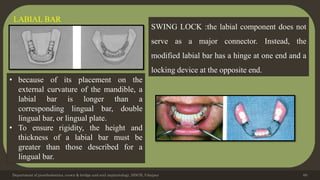
LABIAL BAR
• because of its placement on the
external curvature of the mandible, a
labial bar is longer than a
corresponding lingual bar, double
lingual bar, or lingual plate.
• To ensure rigidity, the height and
thickness of a labial bar must be
greater than those described for a
lingual bar.
SWING LOCK :the labial component does not
serve as a major connector. Instead, the
modified labial bar has a hinge at one end and a
locking device at the opposite end.
Department of prosthodontics, crown & bridge and oral implantology, DDCH, Udaipur 61
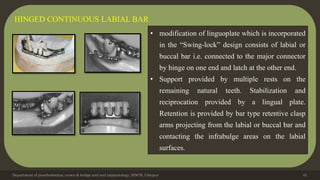
HINGED CONTINUOUS LABIAL BAR
• modification of linguoplate which is incorporated
in the “Swing-lock” design consists of labial or
buccal bar i.e. connected to the major connector
by hinge on one end and latch at the other end.
• Support provided by multiple rests on the
remaining natural teeth. Stabilization and
reciprocation provided by a lingual plate.
Retention is provided by bar type retentive clasp
arms projecting from the labial or buccal bar and
contacting the infrabulge areas on the labial
surfaces.
Department of prosthodontics, crown & bridge and oral implantology, DDCH, Udaipur 62
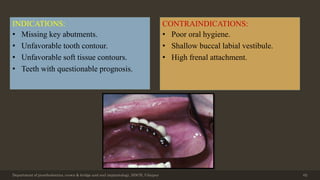
INDICATIONS:
• Missing key abutments.
• Unfavorable tooth contour.
• Unfavorable soft tissue contours.
• Teeth with questionable prognosis.
CONTRAINDICATIONS:
• Poor oral hygiene.
• Shallow buccal labial vestibule.
• High frenal attachment.
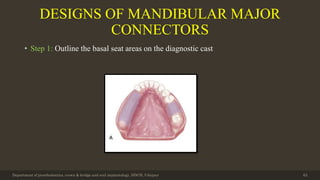
DESIGNS OF MANDIBULAR MAJOR
CONNECTORS
• Step 1: Outline the basal seat areas on the diagnostic cast
Department of prosthodontics, crown & bridge and oral implantology, DDCH, Udaipur 63
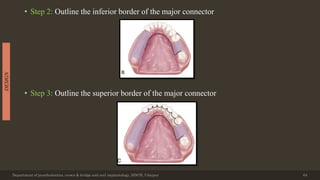
• Step 2: Outline the inferior border of the major connector
• Step 3: Outline the superior border of the major connector
Department of prosthodontics, crown & bridge and oral implantology, DDCH, Udaipur 64
DESIGN
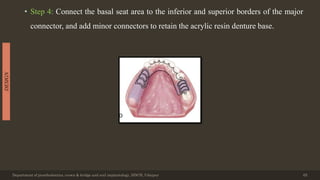
• Step 4: Connect the basal seat area to the inferior and superior borders of the major
connector, and add minor connectors to retain the acrylic resin denture base.
Department of prosthodontics, crown & bridge and oral implantology, DDCH, Udaipur 65
DESIGN
SUMMARY
• Major connectors by uniting the other components of a removable partial dentures
acts like a foundation bringing about bilateral distribution of forces which depends
on the rigidity of the connector.
• Utmost care should be taken to prevent a major connector from interfering with
normal functions or having any damaging effects to the remaining oral structure.
• Although there are many variations in major connector, a thorough comprehension
of all factors influencing their design will lead to the best design for each patient.
Department of prosthodontics, crown & bridge and oral implantology, DDCH, Udaipur 67
CLASSIC ARTICLE
SELECTION OF A MAJOR CONNECTOR FOR THE EXTENSION-
BASE REMOVABLE PARTIAL DENTURE
• The selection of a major connector is not a difficult procedure if the dentist
considers two important factors.
• The first is the degree to which the removable partial denture must be supported
by structures other than the natural teeth.
• The second is the degree of rigidity required of the major connector to adequately
distribute functional stresses from one side of the arch to the other.
Department of prosthodontics, crown & bridge and oral implantology, DDCH, Udaipur 69
Department of prosthodontics, crown & bridge and oral implantology, DDCH, Udaipur 70
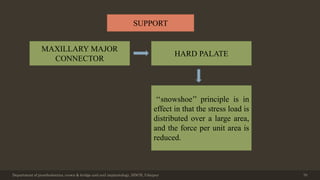
SUPPORT
MAXILLARY MAJOR
CONNECTOR
HARD PALATE
‘‘snowshoe’’ principle is in
effect in that the stress load is
distributed over a large area,
and the force per unit area is
reduced.
Department of prosthodontics, crown & bridge and oral implantology, DDCH, Udaipur 71
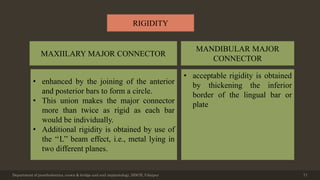
RIGIDITY
MAXIILARY MAJOR CONNECTOR
• enhanced by the joining of the anterior
and posterior bars to form a circle.
• This union makes the major connector
more than twice as rigid as each bar
would be individually.
• Additional rigidity is obtained by use of
the ‘‘L’’ beam effect, i.e., metal lying in
two different planes.
MANDIBULAR MAJOR
CONNECTOR
• acceptable rigidity is obtained
by thickening the inferior
border of the lingual bar or
plate
Department of prosthodontics, crown & bridge and oral implantology, DDCH, Udaipur 72
Department of prosthodontics, crown & bridge and oral implantology, DDCH, Udaipur 73
REVIEW OF
LITERATURE
Wada J, Hideshima M, Uchikura K, Shichiri Y, Inukai S, Matsuura H, Wakabayashi
N. Influence of the Covering Area of Major Connectors of Mandibular Dentures on
the Accuracy of Speech Production: A Pilot Study. Folia Phoniatrica et Logopaedica.
2020;72(6):419-28.
• Fifteen adults (12 men and 3 women aged 26–40 years) with healthy dentition were
recruited. Four target syllables were used for the assessments: [i], [ti], [çi], and [ki]. There
were four speaking conditions: without a connector (control), wearing lingual bar (5 mm
width), wearing lingual plates (12 mm width), and wearing connectors covering the
occlusal surface of lower dentition (16 mm width; CO). The accuracy of speech
production was evaluated by mean appearance ratio of correct labels (MARC) and
incorrect labels (MARIC) of the phonetic segments which were calculated with a speech
evaluation system (VoiceAnalyzer).
Department of prosthodontics, crown & bridge and oral implantology, DDCH, Udaipur 75
• The MARC in the 3 target syllables [i], [ti], and [ki] significantly decreased with
CO. For the target syllable [ʃi], the MARICs of [ti], [i], and [çi] with CO were
significantly lower than that in the control. For the target syllable (ti], the MARIC
of [ki] with CO was significantly higher than that in the control. For the target
syllable [çi], the MARIC of [gi] with CO was significantly higher than that in the
control.
• RPDs with major connectors covering the lower dentition could disturb speech
production during the initial phase of RPD treatment. Prosthodontic treatment with
such RPD designs requires further consideration regarding the information given
to patients before starting the treatment.
Department of prosthodontics, crown & bridge and oral implantology, DDCH, Udaipur 76
Pienkos TE, Morris WJ, Gronet PM, Cameron SM, Looney SW. The strength of
multiple major connector designs under simulated functional loading. The Journal of
prosthetic dentistry. 2007 May 1;97(5):299-304.
• The purpose of this study was to determine the minimum major connector
dimensions of 1 mandibular and 2 maxillary major connectors that would provide
adequate functional strength.
• Sixty chromium-cobalt alloy (Vitallium) RDP frameworks were fabricated. The
major connector designs were: a mandibular lingual bar, a maxillary palatal strap,
and a maxillary anterior-posterior (A-P) palatal strap. Four groups of 5
frameworks with diminishing dimensions were fabricated for each major
connector design.
Department of prosthodontics, crown & bridge and oral implantology, DDCH, Udaipur 77
• The lingual bar was tested at 4, 3, 2.5, and 2 mm in height, occlusogingivally, and
1.6 mm in thickness; the palatal strap at 8, 6, 4, and 2 mm, anteroposteriorly; and
the A-P palatal strap at 10 × 6, 8 × 4, 6 × 2.5, and 4 × 2 mm, anteroposteriorly. All
maxillary frameworks were 0.65 mm in thickness. The frameworks were of a
Kennedy Class II Mod I design with 3 widely separated vertical reference points
to measure deformation. Two tests were conducted to evaluate the functional
strength for each framework. The first test was masticatory simulation, or torsional
force. The second test was a drop test from a height of 3 feet. Permanent
deformation was then determined after each test. The Cochran-Armitage test
(α=.05) was used for both the torsion test and the drop test.
Department of prosthodontics, crown & bridge and oral implantology, DDCH, Udaipur 78
• A statistically significant difference in permanent deformation was found for the
palatal strap design among the 4 different dimensions for the compressive test
(P=.015) and the drop test (P=.044).
• It is safe to reduce the dimensions of some major connectors under normal loads.
The reduced size of the connectors places the removable partial denture at
increased risk for deformation when dropped from a height.
Department of prosthodontics, crown & bridge and oral implantology, DDCH, Udaipur 79
REFERENCES
• Dental laboratory procedures. Vol 3, removable partial denture. Kenneth D Rudd; Robert M
Morrow; John E Rhoads; C. V. Mosby Company.
• McCracken’s Removable Partial Prosthodontics. A.B. Carr, G.P. McGivney, D.T. Brown. 11th
edition.
• Stewart’s Clinical Removable Partial Prosthodontics. Rodney D. Phoenix, David R. Cagna,
Charles F. DeFreest. 3rd edition
• Wada J, Hideshima M, Uchikura K, Shichiri Y, Inukai S, Matsuura H, Wakabayashi N. Influence of
the Covering Area of Major Connectors of Mandibular Dentures on the Accuracy of Speech
Production: A Pilot Study. Folia Phoniatrica et Logopaedica. 2020;72(6):419-28.
• Pienkos TE, Morris WJ, Gronet PM, Cameron SM, Looney SW. The strength of multiple major
connector designs under simulated functional loading. The Journal of prosthetic dentistry. 2007
May 1;97(5):299-304.
• Classic article,selection of a major connector for the extension-base removable partial denture
Department of prosthodontics, crown & bridge and oral implantology, DDCH, Udaipur 81
• Pienkos TE, Morris WJ, Gronet PM, Cameron SM, Looney SW. The strength of
multiple major connector designs under simulated functional loading. The Journal
of prosthetic dentistry. 2007 May 1;97(5):299-304.
• Classic article,selection of a major connector for the extension-base removable
partial denture
Department of prosthodontics, crown & bridge and oral implantology, DDCH, Udaipur 82

Major connectors

  • 1.
    MAJOR CONNECTORS PRESENTED BY: Dr. PRAJAKTA BALI GIR II YEAR MDS
  • 2.
    CONTENTS • INTRODUCTION • TERMINOLOGIES •REQUIREMENTS OF MAJOR CONNECTORS • FUNCTIONS OF MAJOR CONNECTORS • NOMENCLATURE • TYPES OF MAJOR CONNECTORS Department of prosthodontics, crown & bridge and oral implantology, DDCH, Udaipur 2
  • 3.
    CONTENTS • MAXILLARY MAJORCONNECTORS • MANDIBULAR MAJOR CONNECTORS • SUMMARY • REVIEW OF LITERATURE • REFERENCES Department of prosthodontics, crown & bridge and oral implantology, DDCH, Udaipur 3
  • 4.
    INTRODUCTION • When aprosthesis that can be removed from the mouth is used, the prosthesis must extend to both sides of the arch. • This enables transfer of functional forces of occlusion from the denture base to all supporting teeth and tissues within an arch for optimum stability. • It is through this cross-arch tooth contact, which occurs at some distance from the functional force, that optimum resistance can be achieved Department of prosthodontics, crown & bridge and oral implantology, DDCH, Udaipur 4
  • 5.
    • This ismost effectively accomplished when a rigid major connector joins the portion of the prosthesis receiving the function to selected regions throughout the arch. • A major connector combines all other components of an RPD so that the partial denture acts as one unit. • Thus, functional loads can be distributed to all abutment teeth, and cross-arch stabilization can be provided. • In addition, in distal extension RPDs, forces can be distributed between both the abutment teeth and the mucosa by unification of the direct retainers with the denture base. Department of prosthodontics, crown & bridge and oral implantology, DDCH, Udaipur 5 INTRODUCTION
  • 6.
    TERMINOLOGIES MAJOR CONNECTOR- GPT9 The part of a removable partial denture that joins the components on one side of the arch to those on the opposite side. CROSS-ARCH STABILIZATION : Resistance against dislodging or rotational forces obtained by using a partial removable dental prosthesis design that uses natural teeth on the opposite side of the dental arch from the edentulous space to assist in stabilization Department of prosthodontics, crown & bridge and oral implantology, DDCH, Udaipur 6
  • 7.
    REQUIREMENTS • To functioneffectively and minimize potentially damaging effects, all major connectors must • 1. Be rigid • 2. Provide vertical support and protect the soft tissues • 3. Provide a means for obtaining indirect retention where indicated • 4. Provide a means for placement of one or more denture bases • 5. Promote patient comfort Department of prosthodontics, crown & bridge and oral implantology, DDCH, Udaipur 7
  • 8.
    RIGIDITY Department of prosthodontics,crown & bridge and oral implantology, DDCH, Udaipur 8 RIGID FLEXIBLE permits broad distribution of applied forces Using ½ round or ½ pear shaped bars Using a more rigid alloy ( chrome-cobalt > gold alloys ; cast > wrought metal ) may cause severe damage to the hard and soft tissues of the oral cavity allows forces to be concentrated on teeth and segments of the residual ridges lead to tooth mobility or tooth loss The concentration of forces upon small segments of the residual ridges may cause resorption of the hard and soft tissues This may result in decreased ridge height and decreased support for the associated denture bases.
  • 9.
    PROVIDE VERTICAL SUPPORTAND PROTECT THE SOFT TISSUES • The second fundamental requirement of a major connector is that it must not permit impingement upon the free gingival margins of the remaining teeth. • The marginal gingivae are highly vascular and susceptible to injury from sustained pressure. • For this reason, care should be exercised during the design and fabrication of removable partial dentures. Department of prosthodontics, crown & bridge and oral implantology, DDCH, Udaipur 9
  • 10.
    • In themaxillary arch, the borders of a major connector should be located at least 6 mm from the free gingival margins. Department of prosthodontics, crown & bridge and oral implantology, DDCH, Udaipur 10 DESIGN
  • 11.
    • In themandibular arch, the borders of a major connector should be positioned at least 3 - 4 mm from the free gingival margins. Department of prosthodontics, crown & bridge and oral implantology, DDCH, Udaipur 11 DESIGN
  • 12.
    • The bordersshould run parallel to the gingival margins of the remaining teeth. • If the gingival margins must be crossed, they should be crossed at right angles to minimize coverage of the delicate marginal tissues Department of prosthodontics, crown & bridge and oral implantology, DDCH, Udaipur 12 DESIGN
  • 13.
    • Where themajor connector crosses a gingival margin, relief (le, space) must be provided between the metal and soft tissues. • If relief is not provided, inflammation of the soft tissues will result. Department of prosthodontics, crown & bridge and oral implantology, DDCH, Udaipur 13 DESIGN
  • 14.
    PROVIDE A MEANSFOR OBTAINING INDIRECT RETENTION WHERE INDICATED • It is important to note that a major connector should never be considered an indirect retainer. • Although a major connector may play an auxiliary role in resisting rotation of the prosthesis, it is the action of the rests and rest seats that is responsible for indirect retention. • A major connector that is not properly rested will undergo rotation and may cause orthodontic movement of the associated teeth Department of prosthodontics, crown & bridge and oral implantology, DDCH, Udaipur 14
  • 15.
    • The majorconnector in form of lingual plating may be used to assist in indirect retention. Department of prosthodontics, crown & bridge and oral implantology, DDCH, Udaipur 15 DESIGN
  • 16.
    PROVIDE A MEANSFOR PLACEMENT OF ONE OR MORE DENTURE BASES • Number & location of edentulous areas dictate the major connector type. • Major connector must allow appropriate placement of the denture base. Department of prosthodontics, crown & bridge and oral implantology, DDCH, Udaipur 16
  • 17.
    PROMOTE PATIENT COMFORT •A major connector must not create food entrapment areas. • A partial denture must always be designed to be as self -cleansing as possible. Department of prosthodontics, crown & bridge and oral implantology, DDCH, Udaipur 17
  • 18.
    • It isgood design policy to make the major connector as symmetrical as possible. • In addition, the borders of a maxillary major connector should cross the palatal midline at right angles. • Tissues covering the maxillary midline are often thin and susceptible to irritation. • By crossing the maxillary midline at right angles, the length of the crossing may be minimized and the potential for irritation reduced. • Tori also should be avoided if possible Department of prosthodontics, crown & bridge and oral implantology, DDCH, Udaipur 18 DESIGN
  • 19.
    Department of prosthodontics,crown & bridge and oral implantology, DDCH, Udaipur 19
  • 20.
    FUNCTIONS  UNIFICATION: • Partialdenture acts as one unit • Connects various parts Department of prosthodontics, crown & bridge and oral implantology, DDCH, Udaipur 20
  • 21.
     STRESS DISTRIBUTION •Distributes functional loads to both teeth & mucosa  CROSS-ARCH STABILIZATION (COUNTERLEVERAGE) • Bracing elements on one side of the arch providing stability to the other Department of prosthodontics, crown & bridge and oral implantology, DDCH, Udaipur 21 FUNCTIONS
  • 22.
    NOMENCLATURE • Major connectorsare named by their location and shape. • Maxillary major connectors are located on the palate. • Mandibular major connectors are usually located on the lingual surface of the ridge and teeth. • Rarely, mandibular major connectors are located on the labial alveolar ridge area or under the anterior part of the tongue. Department of prosthodontics, crown & bridge and oral implantology, DDCH, Udaipur 22
  • 23.
    • Major connectorsare shaped as bars and straps or plates. • A BAR-SHAPED major connector is long, narrow, and thick. • In cross section bars are ½ round, ½ oval or ½ pear in shape. • The thickness of a bar should be at least 6 gauge (4.11 mm) at its greatest dimension. • The minimum width of a bar is 4 mm, but they must usually be wider than this for adequate rigidity. Department of prosthodontics, crown & bridge and oral implantology, DDCH, Udaipur 23 NOMENCLATURE
  • 24.
    • A STRAPor PLATE-SHAPED major connector is long, wide and thin. • The width of a strap or plate varies from 6 - 8 mm to the entire length of the palate. • The thickest portion of straps or plates is 22 - 24 gauge (0.64-0.51 mm). • Frequently a strap or plate is added to a bar extending the major connector onto the tooth surfaces. • This is sometimes called an APRON Department of prosthodontics, crown & bridge and oral implantology, DDCH, Udaipur 24 NOMENCLATURE
  • 25.
    • The morerigid the alloy, the smaller and thinner the framework may be. • The bigger the arch, the thicker and wider the major connector must be to provide the necessary rigidity Department of prosthodontics, crown & bridge and oral implantology, DDCH, Udaipur 25 NOMENCLATURE
  • 26.
    TYPES OF MAJORCONNECTORS Department of prosthodontics, crown & bridge and oral implantology, DDCH, Udaipur 26 MAXILLARY MANDIBULAR LINGUAL BAR SUBLINGUAL BAR LINGUAL BAR WITH CINGULUM BAR CINGULAM BAR LABIAL BAR LINGUOPLATE Anterior-posterior palatal bars Single palatal bar U-shaped palatal connector Palatal plate-type connector Combination anterior and posterior palatal strap–type connector Single palatal strap
  • 27.
  • 28.
    SPECIAL STRUCTURAL REQUIREMENTS •All maxillary major connectors should display minor elevations at those borders that contact the palatal soft tissues Department of prosthodontics, crown & bridge and oral implantology, DDCH, Udaipur 28 BEAD slightly displace the adjacent soft tissues. provide excellent visual finish lines for technicians who finish and polish removable partial denture framework mechanical seal and prevents food particles from collecting under the major connector
  • 29.
    • Bead linesmust be scribed on the surface of the master cast before duplication in investment material. • These lines are best prepared with a small spoon excavator or round bur rotating at slow speed. • Each bead line should have a width and depth of 0.5 to 1.0 mm. • The bead line should fade out approximately 6 mm from the gingival margins of the remaining teeth. Department of prosthodontics, crown & bridge and oral implantology, DDCH, Udaipur 29 REQUIREMENTS
  • 30.
    • The depthof the beading also should be reduced in areas of thin tissue coverage such as the midpalatine raphe or a palatal torus. • When the partial denture is not in the mouth, the outline of the beading should be evident in the palatal soft tissues, but there should be no evidence of irritation or inflammation. • Except in the presence of a palatal torus or a prominent median suture line, relief should not be used under a maxillary maior connector Department of prosthodontics, crown & bridge and oral implantology, DDCH, Udaipur 30 REQUIREMENTS
  • 31.
    • The intimatecontact between the palatal soft tissues and the metal connector enhances the retention and stability of the denture. • To maintain this intimate metal-soft tissue contact, the tissue side of the major connector is not brought to a high finish during polishing procedures. • Electrolytic polishing is sufficient to produce a smooth, well-finished surface without disturbing the accuracy of the casting. Department of prosthodontics, crown & bridge and oral implantology, DDCH, Udaipur 31 REQUIREMENTS
  • 32.
    Department of prosthodontics,crown & bridge and oral implantology, DDCH, Udaipur 32 MAXILLARY MAJOR CONNECTOR TYPE AD DA I/ C PALATAL BAR / SINGLE PALATAL BAR • The palatal bar is a narrow half oval with its thickest point at the center. • The bar is gently curved and should not form a sharp angle at its junction with the denture base • No current advantage Was one of the most widely used maxillary major connectors • Bulky • Uncomfortable for patient • Narrow anteroposterior width drives little vertical support from bony palate • Short span Class III applications (eg, replacing one or two teeth on each side of the arch). • As interim prosthesis • Should not be placed anteriorly • Never used in distal extension cases
  • 33.
    Department of prosthodontics,crown & bridge and oral implantology, DDCH, Udaipur 33 MAXILLARY MAJOR CONNECTOR TYPE AD DA I / C PALATAL STRAP • Most versatile • Wide – thin band of metal • Width should not be less than 8 mm • palatal strap is located in two or more planes, it offers great resistance to bending and twisting forces. • relatively thin • well accepted by patients • increased tissue coverage helps distribute applied stresses over a larger area. • Patient may complain of excessive palatal coverage • Cannot be placed across prominent median raphe • Can cause papillary hyperplasia • unilateral distal wide extension partial dentures (ie, Kennedy Class II) • Anterior replacements with distal extension bases
  • 34.
    Department of prosthodontics,crown & bridge and oral implantology, DDCH, Udaipur 34 MAXILLARY MAJOR CONNECTOR TYPE AD DA I / C • ANTERIOR- POSTERIOR PALATAL BARS PALATAL BAR + PALATAL STRAP • Flat anterior bar is narrower than the palatal strap. • Posterior bar is half oval ,similar to posterior palatal bar connector but less bulky. • Rigidity • minimizes soft tissue coverage • Little support from palate. • Uncomfortable (extra bulk of metal needed because of narrow bars) • When anterior & posterior abutment are widely separated. • When patient objects for large palatal coverage . • Large palatal torus • When periodontal support of remaining teeth is poor & that necessitates additional support from the palate. • High narrow vault because the anterior bar will interfere with phonetics.
  • 35.
    Department of prosthodontics,crown & bridge and oral implantology, DDCH, Udaipur 35 MAXILLARY MAJOR CONNECTOR TYPE AD DA I / C U-SHAPED PALATAL CONNECTOR • Horseshoe connector • The connector should be uniform in thickness, symmetric, and with curved and smooth borders. • Reasonably strong connector that can derive some vertical support & some indirect retention from the palate. • tendency for the connector to flex or deform. • not a good connector when cross-arch stabilization is required. • several anterior teeth are to be replaced especially when there is deep anterior vertical overlap. • It offers a definite advantage in the presence of hard median suture or large torus. • Class I partially edentulous arches
  • 36.
    Department of prosthodontics,crown & bridge and oral implantology, DDCH, Udaipur 36 MAXILLARY MAJOR CONNECTOR TYPE AD DA I / C ANTEROPOSTERIOR PALATAL STRAP Combination Anterior and Posterior Palatal Strap–type Connector closed horseshoe Structurally, this is a rigid palatal major connector. • Increased resistance to flexing because it provides a L beam effect. • It provide good support to the partial denture. • The corrugated contour of the metal over the rugae adds strength to the connector & allows metal to be made thinner. Interference with phonetics ,annoyance to tongue& discomfort. • In class II & class IV arches when anterior teeth are also to be replaced. • When a palatal torus exists.
  • 37.
    Department of prosthodontics,crown & bridge and oral implantology, DDCH, Udaipur 37 MAXILLARY MAJOR CONNECTOR AD DA I / C COMPLETE PALATE Palatal plate-type connector • Ultimate rigidity & support. • It is made in a uniform thin metal plate, which reproduce anatomic contour of the palate and feel natural to the patient. • Soft tissue reaction in form of inflammation or hyperplasia may occur • Interference with phonetics may occur 1. When posterior teeth are to be replaced bilaterally. 2. When anterior teeth require replacement along with bilateral distal extension replacement. 3. When flat or flabby ridges or a shallow vault is present , the complete palate can provide best stabilization for the prosthesis. 4. Cleft palate patients 5. In transitional partial denture.
  • 38.
    • Complete castmetal plate covering the entire palate. • Complete resin plate. • Combination of anterior metal with posterior resin area. Department of prosthodontics, crown & bridge and oral implantology, DDCH, Udaipur 38 DESIGN TYPES OF PALATAL PLATES
  • 39.
    FACTORS AFFECTING SELECTIONOF THE MAXILLARY CONNECTOR • Rigidity • The presence of palatal tori • The need for anterior tooth replacement • The requirement for indirect retention • The need to stabilize weakened teeth • Phonetic considerations • The mental attitude of the patient Department of prosthodontics, crown & bridge and oral implantology, DDCH, Udaipur 39 DESIGN
  • 40.
    DESIGNS OF MAXILLARYMAJOR CONNECTORS • In 1953, Blatterfein described a systematic approach to designing maxillary major connectors. • His method involves five basic steps and is certainly applicable to most maxillary removable partial denture situations. • When using a diagnostic cast and knowledge of the relative displaceability of the palatal tissue, including that covering the median palatal raphe, he recommends the following basic steps: Department of prosthodontics, crown & bridge and oral implantology, DDCH, Udaipur 40
  • 41.
    • Step 1:Outline of primary bearing areas. The primary bearing areas are those that will be covered by the denture base(s) Department of prosthodontics, crown & bridge and oral implantology, DDCH, Udaipur 41 DESIGN
  • 42.
    • Step 2:Outline of nonbearing areas. The nonbearing areas are the lingual gingival tissue within 5 to 6 mm of the remaining teeth, hard areas of the medial palatal raphe (including tori), and palatal tissue posterior to the vibrating line. • Step 3: Outline of connector areas. Steps 1 and 2, when completed, provide an outline or designate areas that are available to place components of major connectors Department of prosthodontics, crown & bridge and oral implantology, DDCH, Udaipur 42 DESIGN
  • 43.
    • Step 4:Selection of connector type. Selection of the type of connector(s) is based on four factors: 1. mouth comfort, 2. rigidity, 3. location of denture bases, 4. and indirect retention Department of prosthodontics, crown & bridge and oral implantology, DDCH, Udaipur 43 DESIGN 1) MINIMUM BULK: interference with the tongue during speech and mastication is not encountered. 2) MAXIMUM RIGIDITY: • distribute stress bilaterally. • double-strap type of major connector provides the maximum rigidity without bulk and total tissue coverage. • When edentulous areas are located anteriorly, the use of only a posterior strap is not recommended. • when only posterior edentulous areas are present, the use of only an anterior strap is not recommended. • The need for indirect retention influences the outline of the major connector.
  • 44.
    • Step 5:Unification. After selection of the type of major connector based on considerations in Step 4, the denture base areas and connectors are joined Department of prosthodontics, crown & bridge and oral implantology, DDCH, Udaipur 44 DESIGN
  • 45.
    REVIEW OF STRUCTURALREQUIREMENTS FOR MAXILLARY MAJOR CONNECTORS Department of prosthodontics, crown & bridge and oral implantology, DDCH, Udaipur 45 Relief is normally not required under maxillary major connectors. Borders that extend onto the anterior palate should blend with the palatal anatomy. This may be accomplished by positioning borders on the appropriate slopes of the rugae
  • 46.
    Department of prosthodontics,crown & bridge and oral implantology, DDCH, Udaipur 46 DESIGN All borders should taper slightly toward the underlying soft tissues. The metal should be smooth but not highly polished on the tissue side (le, intaglio).
  • 47.
    Department of prosthodontics,crown & bridge and oral implantology, DDCH, Udaipur 47 DESIGN For those major connectors that present open central areas, the medial borders should be positioned at the junction of the horizontal and vertical surfaces of the palate Thickness of the metal should be uniform throughout the palate. All borders that contact soft tissues should display bead lines . The bead lines should become less distinct as they approach the gingival margins of the teeth.
  • 48.
  • 49.
    SPECIAL STRUCTURAL REQUIREMENTS • Mandibularconnectors must be rigid without being so bulky that they compromise patient comfort. • must not impinge upon the movable floor of the mouth, the associated frena, or mandibular tori. Department of prosthodontics, crown & bridge and oral implantology, DDCH, Udaipur 49
  • 50.
    • mandibular majorconnectors may require relief between a mandibular removable partial denture and the underlying soft tissues. Department of prosthodontics, crown & bridge and oral implantology, DDCH, Udaipur 50 REQUIREMENTS an entirely tooth-supported prosthesis, little or no relief is needed because the denture does not tend to move in function. a distal extension removable partial denture, however, a moderate amount of relief my be indicated because this type of prosthesis tends to rotate during function. Relief prevents the margins of the major connector from lacerating the sensitive lingual mucosa as a result of this movement.
  • 51.
    Department of prosthodontics,crown & bridge and oral implantology, DDCH, Udaipur 51 REQUIREMENTS It is important to note that bead lines are not used in conjunction with mandibular major connectors. Contact with the friable mucosa of the mandibular arch may cause irritation, ulceration, and patient discomfort.
  • 52.
    Department of prosthodontics,crown & bridge and oral implantology, DDCH, Udaipur 52 LINGUAL BAR The normal thickness of a lingual bar is that of a 6- gauge half-pear-shaped wax or plastic pattern. First method: Patients tongue should touch the vermillion border of the upper lip Second method: This method uses an individualized impression trays having its lingual border 3mm short of the elevated floor of the mouth is molded with an impression material during functional movements of tongue.
  • 53.
    Department of prosthodontics,crown & bridge and oral implantology, DDCH, Udaipur 53 ADVANTAGES: • Lingual bar connector has minimal tissue coverage and has minimal contact with oral tissues. • It does not contact the teeth, so decalcification of the tooth surface is minimized. INDICATIONS: • Diastemas or open cervical embrasures of anterior teeth • Overlapped anterior teeth. • where sufficient space exists between the slightly elevated alveolar lingual sulcus and lingual gingival tissues. DISADVANTAGES: • It may be flexible if poorly constructed. • Rigidity is less compared to a well constructed lingual plate. CONTRAINDICATIONS: • Lingually inclined teeth. • Inoperable lingual tori. • Highly attached lingual frenum. • Interferences to elevation of the floor of the mouth during functional movements.
  • 54.
    Department of prosthodontics,crown & bridge and oral implantology, DDCH, Udaipur 54 LINGUOPLATE scalloped appearance. INFERIOR BORDER: as low in the floor of the mouth as possible SUPERIOR BORDER: • contoured to intimately contact the lingual surfaces of the teeth above the cingula. • completely close the interproximal spaces to the level of the contact points. • margins of the scalloped metal should be knife edged to avoid a "ledging" effect on the lingual surfaces of the teeth. • lingual plate must always be supported by rests located no farther posterior than the mesial fossae of the first premolars. • Failure to provide these rests may result in pronounced rotation of the framework and labial displacement of the remaining anterior teeth.
  • 55.
    Department of prosthodontics,crown & bridge and oral implantology, DDCH, Udaipur 55 ADVANTAGES: • rigid mandibular major connector and it provides more support and stabilization when compared to other connectors • stabilizing the periodontally-weakened teeth • supported at each end by a rest it contributes to the action of indirect retention • When properly contoured and fabricated, it will not cause interference with tongue movements and will be more comfortable to the patient. • posterior teeth have been lost and there is a need for additional indirect retention DISADVANTAGES: • It covers the tooth structure and the gingival tissue. • The metal coverage of the free gingival tissue prevents physiological stimulation and self- cleansing of these areas by saliva. INDICATIONS: • alveolar lingual sulcus so closely approximates the lingual gingival crevices such as high lingual frenum attachments. • If residual ridges in Class I arch have undergone severe vertical resorption that they will offer only minimal resistance to horizontal rotation. • When future replacement of one or more incisor teeth will be facilitated by the addition of retention loops to an existing linguoplate. CONTRAINDICATIONS: • In lingually inclined mandibular anterior teeth. • Mandibular teeth with wide embrassures and diastema.
  • 56.
    Department of prosthodontics,crown & bridge and oral implantology, DDCH, Udaipur 56 SUBLINGUAL BAR A modification of the lingual bar that has been demonstrated to be useful when the height of the floor of the mouth does not allow placement of superior border of the connector at least 4- mm below free gingival margin. The bar shape remains essentially the same as that of a lingual bar, but placement is inferior and posterior to the usual placement of a lingual bar, lying over and parallel to the anterior floor of the mouth. Contraindications include interfering lingual tori, high attachment of a lingual frenum, and interference with elevation of the floor of the mouth during functional movements.
  • 57.
    Department of prosthodontics,crown & bridge and oral implantology, DDCH, Udaipur 57 CINGULAM BAR • When a linguoplate is the major connector of choice, but the axial alignment of the anterior teeth is such that excessive blockout of interproximal undercuts must be made, a cingulum bar may be considered. • A cingulum bar located on or slightly above the cingula of the anterior teeth may be added to the lingual bar or can be used independently. Wide diastema between mandibular anterior teeth.
  • 58.
    Department of prosthodontics,crown & bridge and oral implantology, DDCH, Udaipur 58 LINGUAL BAR WITH CINGULUM BAR Double lingual bar (Kennedy bar) • This type of major connector is also called “Kennedy bar” . It distribute stresses to all of the teeth with which it comes in contact there by reducing the stresses to the underlying tissues. • It is also referred as “continuous lingual clasp” major connector, because of series of clasp arms connected on the lingual surfaces of lower anterior teeth. The upper bar : H= 2-3 mm, W= 1mm scalloped appearance. • The two bars should be joined by rigid minor connectors at each end. • The minor connectors should be located in the interproximal spaces to disguise the thickness of the metal and to be less noticeable to the tongue. • Rests should be placed at each end of the upper bar and should be located no farther posterior than the mesial fossae of the first premolars.
  • 59.
    Department of prosthodontics,crown & bridge and oral implantology, DDCH, Udaipur 59 ADVANTAGES: • The double lingual bar effectively extends indirect retention in an anterior direction is supported by adequate rest. • It also contributes to horizontal stabilization. • It helps in minor amount of support to the prosthesis. • The gingival tissues and inter-proximal embrassures are not covered by the connector, which helps in free flow of saliva. DISADVANTAGES: • Patient may feel discomfort because it alters the normal position of the tongue. • If connector does not maintain intimate contact with tooth surface there will be food entrapment. INDICATIONS: • It is mainly used as a major connector in periodontally treated anterior teeth with wide inter-proximal embrassures. • When linguoplate is contraindicated due to poor axial alignment of anterior teeth. CONTRAINDICATIONS: • In severely crowded anterior teeth.
  • 60.
    Department of prosthodontics,crown & bridge and oral implantology, DDCH, Udaipur 60 LABIAL BAR • because of its placement on the external curvature of the mandible, a labial bar is longer than a corresponding lingual bar, double lingual bar, or lingual plate. • To ensure rigidity, the height and thickness of a labial bar must be greater than those described for a lingual bar. SWING LOCK :the labial component does not serve as a major connector. Instead, the modified labial bar has a hinge at one end and a locking device at the opposite end.
  • 61.
    Department of prosthodontics,crown & bridge and oral implantology, DDCH, Udaipur 61 HINGED CONTINUOUS LABIAL BAR • modification of linguoplate which is incorporated in the “Swing-lock” design consists of labial or buccal bar i.e. connected to the major connector by hinge on one end and latch at the other end. • Support provided by multiple rests on the remaining natural teeth. Stabilization and reciprocation provided by a lingual plate. Retention is provided by bar type retentive clasp arms projecting from the labial or buccal bar and contacting the infrabulge areas on the labial surfaces.
  • 62.
    Department of prosthodontics,crown & bridge and oral implantology, DDCH, Udaipur 62 INDICATIONS: • Missing key abutments. • Unfavorable tooth contour. • Unfavorable soft tissue contours. • Teeth with questionable prognosis. CONTRAINDICATIONS: • Poor oral hygiene. • Shallow buccal labial vestibule. • High frenal attachment.
  • 63.
    DESIGNS OF MANDIBULARMAJOR CONNECTORS • Step 1: Outline the basal seat areas on the diagnostic cast Department of prosthodontics, crown & bridge and oral implantology, DDCH, Udaipur 63
  • 64.
    • Step 2:Outline the inferior border of the major connector • Step 3: Outline the superior border of the major connector Department of prosthodontics, crown & bridge and oral implantology, DDCH, Udaipur 64 DESIGN
  • 65.
    • Step 4:Connect the basal seat area to the inferior and superior borders of the major connector, and add minor connectors to retain the acrylic resin denture base. Department of prosthodontics, crown & bridge and oral implantology, DDCH, Udaipur 65 DESIGN
  • 66.
  • 67.
    • Major connectorsby uniting the other components of a removable partial dentures acts like a foundation bringing about bilateral distribution of forces which depends on the rigidity of the connector. • Utmost care should be taken to prevent a major connector from interfering with normal functions or having any damaging effects to the remaining oral structure. • Although there are many variations in major connector, a thorough comprehension of all factors influencing their design will lead to the best design for each patient. Department of prosthodontics, crown & bridge and oral implantology, DDCH, Udaipur 67
  • 68.
    CLASSIC ARTICLE SELECTION OFA MAJOR CONNECTOR FOR THE EXTENSION- BASE REMOVABLE PARTIAL DENTURE
  • 69.
    • The selectionof a major connector is not a difficult procedure if the dentist considers two important factors. • The first is the degree to which the removable partial denture must be supported by structures other than the natural teeth. • The second is the degree of rigidity required of the major connector to adequately distribute functional stresses from one side of the arch to the other. Department of prosthodontics, crown & bridge and oral implantology, DDCH, Udaipur 69
  • 70.
    Department of prosthodontics,crown & bridge and oral implantology, DDCH, Udaipur 70 SUPPORT MAXILLARY MAJOR CONNECTOR HARD PALATE ‘‘snowshoe’’ principle is in effect in that the stress load is distributed over a large area, and the force per unit area is reduced.
  • 71.
    Department of prosthodontics,crown & bridge and oral implantology, DDCH, Udaipur 71 RIGIDITY MAXIILARY MAJOR CONNECTOR • enhanced by the joining of the anterior and posterior bars to form a circle. • This union makes the major connector more than twice as rigid as each bar would be individually. • Additional rigidity is obtained by use of the ‘‘L’’ beam effect, i.e., metal lying in two different planes. MANDIBULAR MAJOR CONNECTOR • acceptable rigidity is obtained by thickening the inferior border of the lingual bar or plate
  • 72.
    Department of prosthodontics,crown & bridge and oral implantology, DDCH, Udaipur 72
  • 73.
    Department of prosthodontics,crown & bridge and oral implantology, DDCH, Udaipur 73
  • 74.
  • 75.
    Wada J, HideshimaM, Uchikura K, Shichiri Y, Inukai S, Matsuura H, Wakabayashi N. Influence of the Covering Area of Major Connectors of Mandibular Dentures on the Accuracy of Speech Production: A Pilot Study. Folia Phoniatrica et Logopaedica. 2020;72(6):419-28. • Fifteen adults (12 men and 3 women aged 26–40 years) with healthy dentition were recruited. Four target syllables were used for the assessments: [i], [ti], [çi], and [ki]. There were four speaking conditions: without a connector (control), wearing lingual bar (5 mm width), wearing lingual plates (12 mm width), and wearing connectors covering the occlusal surface of lower dentition (16 mm width; CO). The accuracy of speech production was evaluated by mean appearance ratio of correct labels (MARC) and incorrect labels (MARIC) of the phonetic segments which were calculated with a speech evaluation system (VoiceAnalyzer). Department of prosthodontics, crown & bridge and oral implantology, DDCH, Udaipur 75
  • 76.
    • The MARCin the 3 target syllables [i], [ti], and [ki] significantly decreased with CO. For the target syllable [ʃi], the MARICs of [ti], [i], and [çi] with CO were significantly lower than that in the control. For the target syllable (ti], the MARIC of [ki] with CO was significantly higher than that in the control. For the target syllable [çi], the MARIC of [gi] with CO was significantly higher than that in the control. • RPDs with major connectors covering the lower dentition could disturb speech production during the initial phase of RPD treatment. Prosthodontic treatment with such RPD designs requires further consideration regarding the information given to patients before starting the treatment. Department of prosthodontics, crown & bridge and oral implantology, DDCH, Udaipur 76
  • 77.
    Pienkos TE, MorrisWJ, Gronet PM, Cameron SM, Looney SW. The strength of multiple major connector designs under simulated functional loading. The Journal of prosthetic dentistry. 2007 May 1;97(5):299-304. • The purpose of this study was to determine the minimum major connector dimensions of 1 mandibular and 2 maxillary major connectors that would provide adequate functional strength. • Sixty chromium-cobalt alloy (Vitallium) RDP frameworks were fabricated. The major connector designs were: a mandibular lingual bar, a maxillary palatal strap, and a maxillary anterior-posterior (A-P) palatal strap. Four groups of 5 frameworks with diminishing dimensions were fabricated for each major connector design. Department of prosthodontics, crown & bridge and oral implantology, DDCH, Udaipur 77
  • 78.
    • The lingualbar was tested at 4, 3, 2.5, and 2 mm in height, occlusogingivally, and 1.6 mm in thickness; the palatal strap at 8, 6, 4, and 2 mm, anteroposteriorly; and the A-P palatal strap at 10 × 6, 8 × 4, 6 × 2.5, and 4 × 2 mm, anteroposteriorly. All maxillary frameworks were 0.65 mm in thickness. The frameworks were of a Kennedy Class II Mod I design with 3 widely separated vertical reference points to measure deformation. Two tests were conducted to evaluate the functional strength for each framework. The first test was masticatory simulation, or torsional force. The second test was a drop test from a height of 3 feet. Permanent deformation was then determined after each test. The Cochran-Armitage test (α=.05) was used for both the torsion test and the drop test. Department of prosthodontics, crown & bridge and oral implantology, DDCH, Udaipur 78
  • 79.
    • A statisticallysignificant difference in permanent deformation was found for the palatal strap design among the 4 different dimensions for the compressive test (P=.015) and the drop test (P=.044). • It is safe to reduce the dimensions of some major connectors under normal loads. The reduced size of the connectors places the removable partial denture at increased risk for deformation when dropped from a height. Department of prosthodontics, crown & bridge and oral implantology, DDCH, Udaipur 79
  • 80.
  • 81.
    • Dental laboratoryprocedures. Vol 3, removable partial denture. Kenneth D Rudd; Robert M Morrow; John E Rhoads; C. V. Mosby Company. • McCracken’s Removable Partial Prosthodontics. A.B. Carr, G.P. McGivney, D.T. Brown. 11th edition. • Stewart’s Clinical Removable Partial Prosthodontics. Rodney D. Phoenix, David R. Cagna, Charles F. DeFreest. 3rd edition • Wada J, Hideshima M, Uchikura K, Shichiri Y, Inukai S, Matsuura H, Wakabayashi N. Influence of the Covering Area of Major Connectors of Mandibular Dentures on the Accuracy of Speech Production: A Pilot Study. Folia Phoniatrica et Logopaedica. 2020;72(6):419-28. • Pienkos TE, Morris WJ, Gronet PM, Cameron SM, Looney SW. The strength of multiple major connector designs under simulated functional loading. The Journal of prosthetic dentistry. 2007 May 1;97(5):299-304. • Classic article,selection of a major connector for the extension-base removable partial denture Department of prosthodontics, crown & bridge and oral implantology, DDCH, Udaipur 81
  • 82.
    • Pienkos TE,Morris WJ, Gronet PM, Cameron SM, Looney SW. The strength of multiple major connector designs under simulated functional loading. The Journal of prosthetic dentistry. 2007 May 1;97(5):299-304. • Classic article,selection of a major connector for the extension-base removable partial denture Department of prosthodontics, crown & bridge and oral implantology, DDCH, Udaipur 82

Editor's Notes

  • #33 Bilateral tooth supported 22 g plastic framework to reduce bulk Torque and leverage = not used To be rigid resisr torque = bulky
  • #35 The two bars are joined by flat longitudinal elements on each side of the palate. This configuration gives the effect of a circle and is considerably more rigid than any of the individual elements. The two bars, lying in different planes, produce a structurally strong L-beam effect.
  • #36 consists of a thin band of metal running along the lingual surfaces of the remaining teeth and extending onto the palatal tissues for 6 to 8 mm The borders must be either 6mm away from the gingival margin or extend onto the lingual surfaces of the teeth. DA=When vertical force is applied to one or both ends of a horseshoe major or connector, there is a . To avoid the tendency to flex, the metal crossing the anterior palate must be thicker than that used in most other major connectors. This places the greatest bulk of metal in an area that is critical to patient comfort and phonetics.
  • #37 . The borders of the connectors should be placed 6mm away from the gingival margins or should extend on the palatal surface of the teeth. The anterior strap should be positioned as back as possible on the rugae area. The posterior strap should be placed as far back as possible but should not contact the soft palate. Each strap should be at least 8 mm in width and relatively thin in cross section The open area in the palatal region should be at least 20 x 15 mm.
  • #38 . The anterior border should be 6 mm away from the gingival margin or must cover cingula of anterior teeth. Posterior borders are extended to the junction of hard and soft palate. The posterior border is beaded to prevent debris from collecting beneath the complete palate.
  • #42 Palatal extent = 2mm from the palatal surface of posterior teeth.
  • #43 Nonbearing = black
  • #47 Both anterior and posterior borders should cross the maxillary midline at right angles, never diagonally (
  • #48 Both anterior and posterior borders should cross the maxillary midline at right angles, never diagonally (
  • #51 a distal extension removable partial denture, however, a moderate amount of relief my be indicated because this type of prosthesis tends to rotate during function.
  • #52 a distal extension removable partial denture, however, a moderate amount of relief my be indicated because this type of prosthesis tends to rotate during function.
  • #53 nearest the floor of the mouth The resultant casting will be relatively rigid unless the span is extremely long. If there is concern that the bar will not be rigid, wax may be added to the half-pear shape to increase its thickness. If space is available, the height of the bar also may be increased. Failure to provide 3 mm of space may lead to irritation of the adjacent soft tissues. Intraoral measurements (see Fig 2-37) may be transferred to the corresponding dental cast.
  • #55 half-pear-shaped lingual bar with a thin, solid piece of metal extending from its superior border (Fig 2-39). This thin projection of metal is carried onto the lingual surfaces of the teeth and presents a scalloped appearance. The inferior border of a lingual plate should be positioned as low in the floor of the mouth as possible, but should not interfere with the functional movements of the tongue and soft tissues. T Sealing these spaces from the lingual aspect prevents food from being packed into these areas. Ledging occurs when metal margins are thick or linear and produces unnatural contours, which are annoying to the tongue.
  • #59 A double lingual bar displays characteristics of both lingual bar and lingual plate major connectors e upper and lower components of a double lingual bar are not joined by a continuous sheet of metal. As a result, the lingual surfaces of the teeth and the interproximal soft tissues are largely exposed.
  • #61 The Swing-Lock removable partial denture represents a useful modification of the labial bar concept. The labial component functions as a gate that may be closed and locked to provide retention.