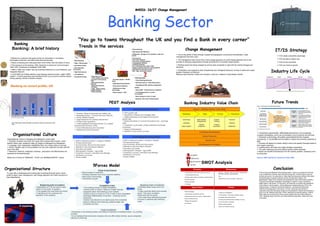
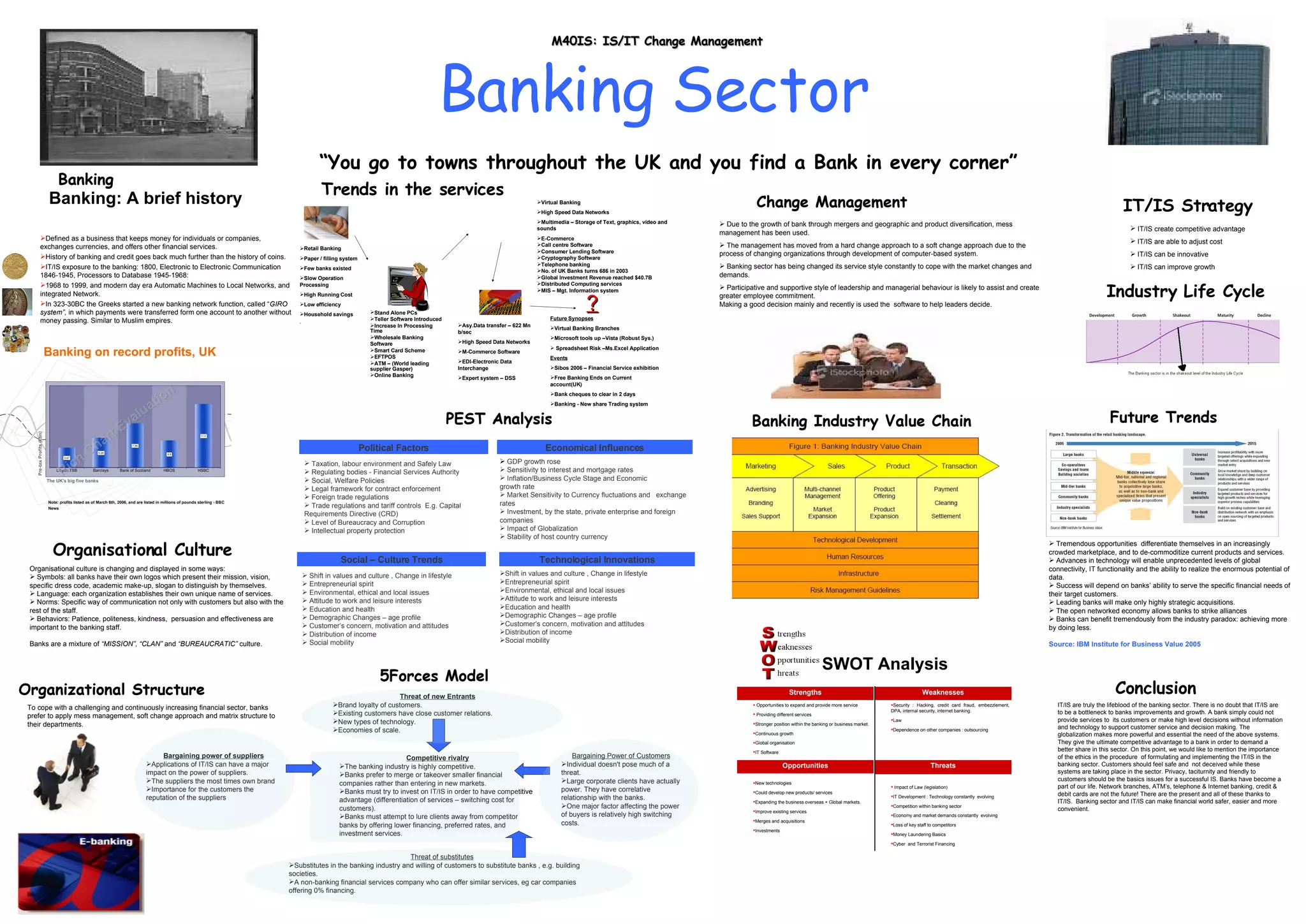
Banking Sector M40IS: IS/IT Change Management Industry Life Cycle Conclusion IT/IS create competitive advantage IT /IS  are able to  adjust cost IT /IS  can b e innovative IT /IS  can improve  growth IT/IS Strategy PEST Analysis Banking “ You   go   to towns   throughout the UK   and you find a   Bank   in every corner”   Future Trends Change Management Organizational Structure Due to the growth of bank through mergers and geographic and product diversification, mess management has been used.  The management has moved from a hard change approach to a soft change approach due to the process of changing organizations through development of computer-based system.  Banking sector has being changed its service style constantly to cope with the market changes and demands. Participative and supportive style of leadership and managerial behaviour is likely to assist and create greater employee commitment. Making a good decision mainly and recently is used the  software to help leaders decide. Organisational culture is changing and displayed in some ways: Symbols: all banks have their own logos which present their mission, vision, specific dress code, academic make-up, slogan to distinguish by themselves. Language: each organization establishes their own unique name of services.  Norms: Specific way of communication not only with customers but also with the rest of the staff.  Behaviors: Patience, politeness, kindness,  persuasion and effectiveness are important to the banking staff.  Banks are a mixture of  “MISSION”,   “CLAN”  and  “BUREAUCRATIC”  culture. To cope with a challenging and continuously increasing financial sector, banks prefer to apply mess management, soft change approach and matrix structure to their departments.  Banking Industry Value Chain Political Factors Taxation, labour environment and Safely Law Regulating bodies - Financial Services Authority Social, Welfare Policies Legal framework for contract enforcement Foreign trade regulations Trade regulations and tariff controls  E.g. Capital  Requirements Directive (CRD) Level of Bureaucracy and Corruption Intellectual property protection Economical Influences GDP growth rose Sensitivity to interest and mortgage rates Inflation/Business Cycle Stage and Economic growth rate Market Sensitivity to Currency fluctuations and  exchange rates Investment, by the state, private enterprise and foreign companies Impact of Globalization Stability of host country currency Shift in values and culture , Change in lifestyle Entrepreneurial spirit Environmental, ethical and local issues Attitude to work and leisure interests Education and health Demographic Changes – age profile Customer’s concern, motivation and attitudes Distribution of income Social mobility Technological Innovations Social – Culture Trends Shift in values and culture , Change in lifestyle Entrepreneurial spirit Environmental, ethical and local issues Attitude to work and leisure interests Education and health Demographic Changes – age profile Customer’s concern, motivation and attitudes Distribution of income Social mobility Threat of new Entrants Brand loyalty of customers. Existing customers have close customer relations. New types of technology. Economies of scale. Bargaining power of suppliers Applications of IT/IS can have a major impact on the power of suppliers. The suppliers the most times own brand Importance for the customers the reputation of the suppliers Competitive rivalry The banking industry is highly competitive. Banks prefer to merge or takeover smaller financial companies rather than entering in new markets.  Banks must try to invest on IT/IS in order to have competitive advantage (differentiation of services – switching cost for customers). Banks must attempt to lure clients away from competitor banks by offering lower financing, preferred rates, and investment services.   Bargaining Power of Customers Individual doesn't pose much of a threat. Large corporate clients have actually power. They have correlative relationship with the banks.  One major factor affecting the power of buyers is relatively high switching costs. Threat of substitutes Substitutes in the banking industry and willing of customers to substitute banks , e.g. building societies. A non-banking financial services company who can offer similar services, eg car companies offering 0% financing. 5Forces Model IT/IS are truly the lifeblood of the banking sector. There is no doubt that IT/IS are to be a bottleneck to banks improvements and growth. A bank simply could not provide services to  its customers or make high level decisions without information and technology to support customer service and decision making. The globalization makes more powerful and essential the need of the above systems. They give the ultimate competitive advantage to a bank in order to demand a better share in this sector. On this point, we would like to mention the importance of the ethics in the procedure  of formulating and implementing the IT/IS in the banking sector. Customers should feel safe and  not deceived while these systems are taking place in the sector. Privacy, taciturnity and friendly to customers should be the basics issues for a successful IS. Banks have become a part of our life. Network branches, ATM’s, telephone & Internet banking, credit & debit cards are not the future! There are the present and all of these thanks to IT/IS.  Banking sector and IT/IS can make financial world safer, easier and more convenient.  T remendous opportunities   differentiate themselves in an   increasingly crowded marketplace, and to de-commoditize   current products and services.  Advances  in technology will enable unprecedented levels of global   connectivity, IT functionality and the ability to realize the   enormous potential of data. S uccess will depend on banks’ ability to serve   the specific financial needs of their target customers. Leading banks will make only highly strategic acquisitions.  T he open networked economy allows banks to strike   alliances  B anks can benefit tremendously  f rom the industry paradox: achieving more by doing less. Source:  IBM Institute for Business Value  2005 Retail Banking  Paper / filling system Few banks existed Slow Operation Processing High Running Cost Low efficiency Household savings .  Stand Alone PCs Teller Software Introduced Increase In Processing Time Wholesale Banking Software Smart Card Scheme EFTPOS ATM – (World leading supplier Gasper) Online Banking Virtual Banking High Speed Data Networks Multimedia – Storage of Text, graphics, video and sounds E-Commerce Call centre Software Consumer Lending Software Cryptography Software Telephone banking No. of UK Banks turns 686 in 2003  Global Investment Revenue reached $40.7B Distributed Computing services MIS – Mgt. Information system Asy.Data transfer – 622 Mn b/sec High Speed Data Networks  M-Commerce Software EDI-Electronic Data Interchange Expert system – DSS Future Synopses Virtual Banking Branches Microsoft tools up –Vista (Robust Sys.) Spreadsheet Risk –Ms.Excel Application Events Sibos 2006 – Financial Service exhibition Free Banking Ends on Current account(UK) Bank cheques to clear in 2 days  Banking - New share Trading system ? Trends in the services Organisational Culture Banking: A brief history Defined as a business that keeps money for individuals or companies, exchanges currencies, and offers other financial services. History of banking and credit goes back much further than the history of coins. IT/IS exposure to the banking: 1800, Electronic to Electronic Communication 1846-1945, Processors to Database 1945-1968: 1968 to 1999, and modern day era Automatic Machines to Local Networks, and integrated Network. In 323-30BC the Greeks started a new banking network function, called “ GIRO system”,  in which payments were transferred form one account to another without money passing. Similar to Muslim empires. SWOT Analysis Strengths Weaknesses Opportunities to expand and provide more service Providing different services Stronger position within the banking or business market. Continuous growth Global organisation IT Software Security : Hacking, credit card fraud, embezzlement, DPA, internal security, internet banking. Law Dependence on other companies : outsourcing  Opportunities Threats New technologies Could develop new products/ services Expanding the business overseas + Global markets. Improve existing services Merges and acquisitions Investments Impact of Law (legislation) IT Development : Technology constantly  evolving Competition within banking sector Economy and market demands constantly  evolving Loss of key staff to competitors Money Laundering Basics Cyber  and Terrorist Financing

2

  • 1.
    Banking Sector M40IS:IS/IT Change Management Industry Life Cycle Conclusion IT/IS create competitive advantage IT /IS are able to adjust cost IT /IS can b e innovative IT /IS can improve growth IT/IS Strategy PEST Analysis Banking “ You go to towns throughout the UK and you find a Bank in every corner” Future Trends Change Management Organizational Structure Due to the growth of bank through mergers and geographic and product diversification, mess management has been used. The management has moved from a hard change approach to a soft change approach due to the process of changing organizations through development of computer-based system. Banking sector has being changed its service style constantly to cope with the market changes and demands. Participative and supportive style of leadership and managerial behaviour is likely to assist and create greater employee commitment. Making a good decision mainly and recently is used the software to help leaders decide. Organisational culture is changing and displayed in some ways: Symbols: all banks have their own logos which present their mission, vision, specific dress code, academic make-up, slogan to distinguish by themselves. Language: each organization establishes their own unique name of services. Norms: Specific way of communication not only with customers but also with the rest of the staff. Behaviors: Patience, politeness, kindness, persuasion and effectiveness are important to the banking staff. Banks are a mixture of “MISSION”, “CLAN” and “BUREAUCRATIC” culture. To cope with a challenging and continuously increasing financial sector, banks prefer to apply mess management, soft change approach and matrix structure to their departments. Banking Industry Value Chain Political Factors Taxation, labour environment and Safely Law Regulating bodies - Financial Services Authority Social, Welfare Policies Legal framework for contract enforcement Foreign trade regulations Trade regulations and tariff controls E.g. Capital Requirements Directive (CRD) Level of Bureaucracy and Corruption Intellectual property protection Economical Influences GDP growth rose Sensitivity to interest and mortgage rates Inflation/Business Cycle Stage and Economic growth rate Market Sensitivity to Currency fluctuations and exchange rates Investment, by the state, private enterprise and foreign companies Impact of Globalization Stability of host country currency Shift in values and culture , Change in lifestyle Entrepreneurial spirit Environmental, ethical and local issues Attitude to work and leisure interests Education and health Demographic Changes – age profile Customer’s concern, motivation and attitudes Distribution of income Social mobility Technological Innovations Social – Culture Trends Shift in values and culture , Change in lifestyle Entrepreneurial spirit Environmental, ethical and local issues Attitude to work and leisure interests Education and health Demographic Changes – age profile Customer’s concern, motivation and attitudes Distribution of income Social mobility Threat of new Entrants Brand loyalty of customers. Existing customers have close customer relations. New types of technology. Economies of scale. Bargaining power of suppliers Applications of IT/IS can have a major impact on the power of suppliers. The suppliers the most times own brand Importance for the customers the reputation of the suppliers Competitive rivalry The banking industry is highly competitive. Banks prefer to merge or takeover smaller financial companies rather than entering in new markets. Banks must try to invest on IT/IS in order to have competitive advantage (differentiation of services – switching cost for customers). Banks must attempt to lure clients away from competitor banks by offering lower financing, preferred rates, and investment services. Bargaining Power of Customers Individual doesn't pose much of a threat. Large corporate clients have actually power. They have correlative relationship with the banks. One major factor affecting the power of buyers is relatively high switching costs. Threat of substitutes Substitutes in the banking industry and willing of customers to substitute banks , e.g. building societies. A non-banking financial services company who can offer similar services, eg car companies offering 0% financing. 5Forces Model IT/IS are truly the lifeblood of the banking sector. There is no doubt that IT/IS are to be a bottleneck to banks improvements and growth. A bank simply could not provide services to its customers or make high level decisions without information and technology to support customer service and decision making. The globalization makes more powerful and essential the need of the above systems. They give the ultimate competitive advantage to a bank in order to demand a better share in this sector. On this point, we would like to mention the importance of the ethics in the procedure of formulating and implementing the IT/IS in the banking sector. Customers should feel safe and not deceived while these systems are taking place in the sector. Privacy, taciturnity and friendly to customers should be the basics issues for a successful IS. Banks have become a part of our life. Network branches, ATM’s, telephone & Internet banking, credit & debit cards are not the future! There are the present and all of these thanks to IT/IS. Banking sector and IT/IS can make financial world safer, easier and more convenient. T remendous opportunities differentiate themselves in an increasingly crowded marketplace, and to de-commoditize current products and services. Advances in technology will enable unprecedented levels of global connectivity, IT functionality and the ability to realize the enormous potential of data. S uccess will depend on banks’ ability to serve the specific financial needs of their target customers. Leading banks will make only highly strategic acquisitions. T he open networked economy allows banks to strike alliances B anks can benefit tremendously f rom the industry paradox: achieving more by doing less. Source: IBM Institute for Business Value 2005 Retail Banking Paper / filling system Few banks existed Slow Operation Processing High Running Cost Low efficiency Household savings . Stand Alone PCs Teller Software Introduced Increase In Processing Time Wholesale Banking Software Smart Card Scheme EFTPOS ATM – (World leading supplier Gasper) Online Banking Virtual Banking High Speed Data Networks Multimedia – Storage of Text, graphics, video and sounds E-Commerce Call centre Software Consumer Lending Software Cryptography Software Telephone banking No. of UK Banks turns 686 in 2003 Global Investment Revenue reached $40.7B Distributed Computing services MIS – Mgt. Information system Asy.Data transfer – 622 Mn b/sec High Speed Data Networks M-Commerce Software EDI-Electronic Data Interchange Expert system – DSS Future Synopses Virtual Banking Branches Microsoft tools up –Vista (Robust Sys.) Spreadsheet Risk –Ms.Excel Application Events Sibos 2006 – Financial Service exhibition Free Banking Ends on Current account(UK) Bank cheques to clear in 2 days Banking - New share Trading system ? Trends in the services Organisational Culture Banking: A brief history Defined as a business that keeps money for individuals or companies, exchanges currencies, and offers other financial services. History of banking and credit goes back much further than the history of coins. IT/IS exposure to the banking: 1800, Electronic to Electronic Communication 1846-1945, Processors to Database 1945-1968: 1968 to 1999, and modern day era Automatic Machines to Local Networks, and integrated Network. In 323-30BC the Greeks started a new banking network function, called “ GIRO system”, in which payments were transferred form one account to another without money passing. Similar to Muslim empires. SWOT Analysis Strengths Weaknesses Opportunities to expand and provide more service Providing different services Stronger position within the banking or business market. Continuous growth Global organisation IT Software Security : Hacking, credit card fraud, embezzlement, DPA, internal security, internet banking. Law Dependence on other companies : outsourcing Opportunities Threats New technologies Could develop new products/ services Expanding the business overseas + Global markets. Improve existing services Merges and acquisitions Investments Impact of Law (legislation) IT Development : Technology constantly evolving Competition within banking sector Economy and market demands constantly evolving Loss of key staff to competitors Money Laundering Basics Cyber and Terrorist Financing