PREPARED BY
Priyank Patel
OPERATION MANAGEMENT IN
BANKING
INTRODUCTION OF BANKING
 The business activity of accepting and safeguarding
money owned by other individuals and entities and then
lending out this money in order to earn profit.
 Financial backbone.
 Main challenge is to create value by differentiating
themselves from competition on
the one hand, while working within the regulatory
boundaries on the other hand
 It is governed by Banking Regulation Act of India, 1949
OPERATION MANAGEMENT IN BANKING
 Banking operations processes and transactions are
executed correctly, which minimizing risk and maximizing
quality of service.
 A core function of Operations is to control and manage the
processing of trades made by the various other divisions
of the bank.
 Operations is a on-revenue making
division.
 Operations is viewed as the engine of
the bank.
 Its work also needs to take place 24
hours a day 7 days a week, in different
markets and different time zones.
COMMERCIAL LAWS WITH REFERENCE TO
BANKING OPERATIONS
 Information Technology Act, 2000
 Prevention of Money Laundering Act 2002
 Right to Information Act
 Foreign Exchange Management Act
 Sale of Goods Act: 1930
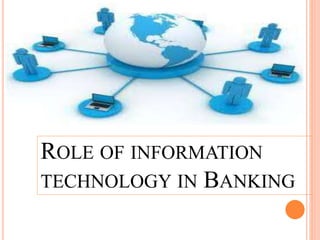
ROLE OF INFORMATION
TECHNOLOGY IN BANKING
INTRODUCTION OF IT
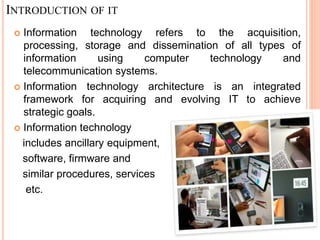
 Information technology refers to the acquisition,
processing, storage and dissemination of all types of
information using computer technology and
telecommunication systems.
 Information technology architecture is an integrated
framework for acquiring and evolving IT to achieve
strategic goals.
 Information technology
includes ancillary equipment,
software, firmware and
similar procedures, services
etc.
IT CONSIDERATIONS
1. Meeting Internal Requirement
 The requirements of the banks are different individually depending
upon their nature and volume of business
 Banks do have the required information but it is scattered.
2. Effective in Data Handling
 the cost of collection of data and putting the same
is prohibitively high.
 accuracy and timeliness of data generation
becomes the causalities in the process.
3. Extending Customer Services
 Addressing to rising customers expectations
becomes the background of the competition.
 Has brought sharp focus on issue of customer
satisfaction.
CONT.…
4. Creative Support for New Product Development
 become necessary for the banks to vitalize the
process of product development.
5. End-user Development of the Non-technical Staff
 Banking being a service industry, it is
the staffs at counters that deliver the products.
 Giving due consideration to this aspect
in choosing architecture in necessary.
TRENDS IN TECHNOLOGY
1. Outsourcing
Outsourcing is one of the most talked about
as also a controversial issue. The drivers for getting in to
outsourcing are many to include gaps in IT expectations
and the reality, demystification of computerization in
general and IT in particulars.
2. Integration:
One of the IT trend is moving from hierarchy to
team approach. The purpose is to see an alternative to
retooling, to react speedily and to develop capabilities
rather than exploiting them. Such integration is necessary
so as to address to prevalent situations:
3. From Solo to Partnership:
With the development of IT, two things are taking place
simultaneously. The work force as a percentage of total staff is going
down and spending on IT as percentage of total spending is going up.
4. Distinctive Edge:
It is always said that many use but a few make use of IT.
Historically, the emphasis is on using IT for large volumes like payrolls,
balancing the books, the consolidation.
5. IT as Profit Centre:
With the evolutionary the process, it was seen as the best means of
generating, MIS. The Banks have been The Banks have been able to just
manage what is to consider as their responsibility as IT, within the
individual banks.
RECENT DEVELOPMENTS IN IT
1. Internet:
Internet is a networking of computers. In this marketing message can
be transferred and received worldwide.
2. Society for Worldwide Inter-bank Financial Telecommunications
SWIFT, as a co-operative society was formed in May 1973 with 239
participating banks from 15 countries with its headquarters at Brussels. It
started functioning in May 1977.
3. Automated Teller Machine (ATM):
ATM is an electronic machine, which is operated by the customer
himself to make deposits, withdrawals and other financial transactions.
ATM is a step in improvement in customer service. ATM facility is
available to the customer 24 hours a day.
CONT….
4. Cash Dispensers:
Cash withdrawal is the basic service rendered by the
bank branches. The operations by this machine are cheaper
than manual operations which is cheaper and fast than that
of ATM.
5. Bank net:
Bank net is started in February 1991. It is
communication network established by RBI on the basis of
recommendation of the committee appointed.
6. Phone Banking:
Customers can now dial up the bank’s designed
telephone number and he by dialling his ID number will be
able to get connectivity to bank’s designated computer.
7. Tele-banking:
Tele banking is another innovation, which provided
the facility of 24 hour banking to the customer. Tele-
banking is based on the voice processing facility available
on bank computers.
8. Internet Banking:
Internet banking enables a customer to do
banking transactions through the bank’s website on the
Internet.
9. Mobile Banking:
Mobile banking facility is an extension of internet
banking. The bank is in association with the cellular
service providers offers this service. For this service,
mobile phone should either be SMS or WAP enabled.
10. Any where Banking:
With expansion of technology, it is now possible to
obtain financial details from the bank from remote
locations. Basic transaction can be effected from faraway
places.
11. Voice Mail:
Talking of answering systems, there are several
banks mainly foreign banks now offering very advanced
touch tone telephone answering service which route the
customer call directly to the department concerned and
allow the customer to leave a message for the concerned
desk or department, if the person is not available.
CHALLENGES AHEAD
 Important Business Challenges:
Meet customer expectations on service and facility
offered by the bank.
Customer retention.
Managing the spread and sustain the operating
profit.
Retaining the current market share in the industry
and the improving the same.
Completion from other players in the banking
industry.
CONT.…
 Other Important Operational Challenges:
Frequent challenges in technologies used focusing
up grades in hardware and software, attending to that
implementation issues and timely roll out.
Managing technology, security and business risks.
System re-engineering to enable. Defined and
implemented efficient processes to be able to reap
benefits off technology to its fullest potential.
Upgrading the skill of work force spread across the
country.
HOW TO MEET THE CHALLENGES?
At corporate level to meet the challenges, various initiated have
been taken and implementation is in process.
1. Centralization of functions
Inward clearing data uploading and processing
Check book issues
MIS-On-Line Monitoring/Generation of statement by
controlling offices
Audit from the remote location
Sending mails and statement of accounts to customers &
completion of non- mandatory field in newly opened accounts.
2. Revised Account opening from for capturing complete
customer/Account data as per CBS requirement.
3. Call centre for customers.
CONT.…
4. Customer Relationship Management (CRM)
Application.
5. Data Warehousing.
SUGGESTIONS.
To facilitate successful implementation of the initiative,
following are some of the suggestions;
 Completion of correct MIS details in all accounts and
SRM’s.
 Customer/ Account data completion/correction.
 Customer-ID crystallization.
 Aggressive marketing of Internet Banking & Debit Card
products to increase share of delivery channels transaction.
 Skill up gradation & increase in awareness of all staff
member.
CONCLUSION
 Indian public sector banks that hold around 75 % of
market share do have taken initiative in the field of
IT.
 Awareness and appreciation of IT are very crucial.
 IT and India have become synonymous.
 As far as banking industry in India is concerned it
can be said that although the Indian banks may not
be as technologically advanced as their
counterparts in the developed world, they are
following the majority of international trends on the
IT front.
REFERENCES
 http://www.investorwords.com/5413/banking.html.
 http://venkrajen.in/docs/legal_aspects_all_modules.
pdf.
 http://www.unofficialguidetobanking.com/operations
.php.

Banking Management

  • 1.
  • 2.
    INTRODUCTION OF BANKING The business activity of accepting and safeguarding money owned by other individuals and entities and then lending out this money in order to earn profit.  Financial backbone.  Main challenge is to create value by differentiating themselves from competition on the one hand, while working within the regulatory boundaries on the other hand  It is governed by Banking Regulation Act of India, 1949
  • 4.
    OPERATION MANAGEMENT INBANKING  Banking operations processes and transactions are executed correctly, which minimizing risk and maximizing quality of service.  A core function of Operations is to control and manage the processing of trades made by the various other divisions of the bank.  Operations is a on-revenue making division.  Operations is viewed as the engine of the bank.  Its work also needs to take place 24 hours a day 7 days a week, in different markets and different time zones.
  • 5.
    COMMERCIAL LAWS WITHREFERENCE TO BANKING OPERATIONS  Information Technology Act, 2000  Prevention of Money Laundering Act 2002  Right to Information Act  Foreign Exchange Management Act  Sale of Goods Act: 1930
  • 6.
  • 7.
    INTRODUCTION OF IT Information technology refers to the acquisition, processing, storage and dissemination of all types of information using computer technology and telecommunication systems.  Information technology architecture is an integrated framework for acquiring and evolving IT to achieve strategic goals.  Information technology includes ancillary equipment, software, firmware and similar procedures, services etc.
  • 8.
    IT CONSIDERATIONS 1. MeetingInternal Requirement  The requirements of the banks are different individually depending upon their nature and volume of business  Banks do have the required information but it is scattered. 2. Effective in Data Handling  the cost of collection of data and putting the same is prohibitively high.  accuracy and timeliness of data generation becomes the causalities in the process. 3. Extending Customer Services  Addressing to rising customers expectations becomes the background of the competition.  Has brought sharp focus on issue of customer satisfaction.
  • 9.
    CONT.… 4. Creative Supportfor New Product Development  become necessary for the banks to vitalize the process of product development. 5. End-user Development of the Non-technical Staff  Banking being a service industry, it is the staffs at counters that deliver the products.  Giving due consideration to this aspect in choosing architecture in necessary.
  • 10.
    TRENDS IN TECHNOLOGY 1.Outsourcing Outsourcing is one of the most talked about as also a controversial issue. The drivers for getting in to outsourcing are many to include gaps in IT expectations and the reality, demystification of computerization in general and IT in particulars. 2. Integration: One of the IT trend is moving from hierarchy to team approach. The purpose is to see an alternative to retooling, to react speedily and to develop capabilities rather than exploiting them. Such integration is necessary so as to address to prevalent situations:
  • 11.
    3. From Soloto Partnership: With the development of IT, two things are taking place simultaneously. The work force as a percentage of total staff is going down and spending on IT as percentage of total spending is going up. 4. Distinctive Edge: It is always said that many use but a few make use of IT. Historically, the emphasis is on using IT for large volumes like payrolls, balancing the books, the consolidation. 5. IT as Profit Centre: With the evolutionary the process, it was seen as the best means of generating, MIS. The Banks have been The Banks have been able to just manage what is to consider as their responsibility as IT, within the individual banks.
  • 12.
    RECENT DEVELOPMENTS INIT 1. Internet: Internet is a networking of computers. In this marketing message can be transferred and received worldwide. 2. Society for Worldwide Inter-bank Financial Telecommunications SWIFT, as a co-operative society was formed in May 1973 with 239 participating banks from 15 countries with its headquarters at Brussels. It started functioning in May 1977. 3. Automated Teller Machine (ATM): ATM is an electronic machine, which is operated by the customer himself to make deposits, withdrawals and other financial transactions. ATM is a step in improvement in customer service. ATM facility is available to the customer 24 hours a day.
  • 13.
    CONT…. 4. Cash Dispensers: Cashwithdrawal is the basic service rendered by the bank branches. The operations by this machine are cheaper than manual operations which is cheaper and fast than that of ATM. 5. Bank net: Bank net is started in February 1991. It is communication network established by RBI on the basis of recommendation of the committee appointed. 6. Phone Banking: Customers can now dial up the bank’s designed telephone number and he by dialling his ID number will be able to get connectivity to bank’s designated computer.
  • 14.
    7. Tele-banking: Tele bankingis another innovation, which provided the facility of 24 hour banking to the customer. Tele- banking is based on the voice processing facility available on bank computers. 8. Internet Banking: Internet banking enables a customer to do banking transactions through the bank’s website on the Internet. 9. Mobile Banking: Mobile banking facility is an extension of internet banking. The bank is in association with the cellular service providers offers this service. For this service, mobile phone should either be SMS or WAP enabled.
  • 15.
    10. Any whereBanking: With expansion of technology, it is now possible to obtain financial details from the bank from remote locations. Basic transaction can be effected from faraway places. 11. Voice Mail: Talking of answering systems, there are several banks mainly foreign banks now offering very advanced touch tone telephone answering service which route the customer call directly to the department concerned and allow the customer to leave a message for the concerned desk or department, if the person is not available.
  • 16.
    CHALLENGES AHEAD  ImportantBusiness Challenges: Meet customer expectations on service and facility offered by the bank. Customer retention. Managing the spread and sustain the operating profit. Retaining the current market share in the industry and the improving the same. Completion from other players in the banking industry.
  • 17.
    CONT.…  Other ImportantOperational Challenges: Frequent challenges in technologies used focusing up grades in hardware and software, attending to that implementation issues and timely roll out. Managing technology, security and business risks. System re-engineering to enable. Defined and implemented efficient processes to be able to reap benefits off technology to its fullest potential. Upgrading the skill of work force spread across the country.
  • 18.
    HOW TO MEETTHE CHALLENGES? At corporate level to meet the challenges, various initiated have been taken and implementation is in process. 1. Centralization of functions Inward clearing data uploading and processing Check book issues MIS-On-Line Monitoring/Generation of statement by controlling offices Audit from the remote location Sending mails and statement of accounts to customers & completion of non- mandatory field in newly opened accounts. 2. Revised Account opening from for capturing complete customer/Account data as per CBS requirement. 3. Call centre for customers.
  • 19.
    CONT.… 4. Customer RelationshipManagement (CRM) Application. 5. Data Warehousing.
  • 20.
    SUGGESTIONS. To facilitate successfulimplementation of the initiative, following are some of the suggestions;  Completion of correct MIS details in all accounts and SRM’s.  Customer/ Account data completion/correction.  Customer-ID crystallization.  Aggressive marketing of Internet Banking & Debit Card products to increase share of delivery channels transaction.  Skill up gradation & increase in awareness of all staff member.
  • 21.
    CONCLUSION  Indian publicsector banks that hold around 75 % of market share do have taken initiative in the field of IT.  Awareness and appreciation of IT are very crucial.  IT and India have become synonymous.  As far as banking industry in India is concerned it can be said that although the Indian banks may not be as technologically advanced as their counterparts in the developed world, they are following the majority of international trends on the IT front.
  • 22.