
Supratik Nag
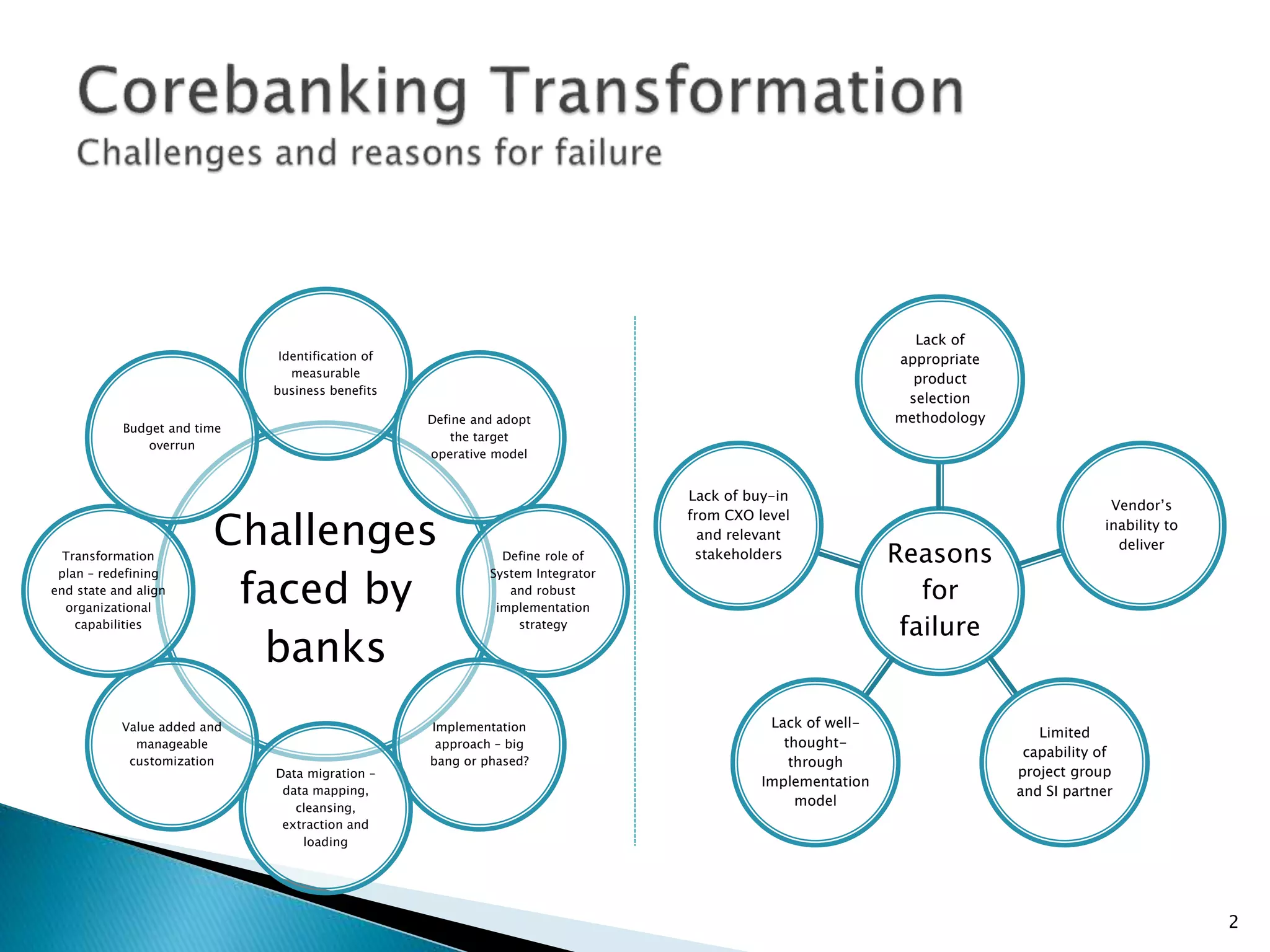
Challenges
faced by
banks
Identification of
measurable
business benefits
Define and adopt
the target
operative model
Define role of
System Integrator
and robust
implementation
strategy
Implementation
approach – big
bang or phased?
Data migration –
data mapping,
cleansing,
extraction and
loading
Value added and
manageable
customization
Transformation
plan – redefining
end state and align
organizational
capabilities
Budget and time
overrun
Reasons
for
failure
Lack of
appropriate
product
selection
methodology
Vendor’s
inability to
deliver
Limited
capability of
project group
and SI partner
Lack of well-
thought-
through
Implementation
model
Lack of buy-in
from CXO level
and relevant
stakeholders
2
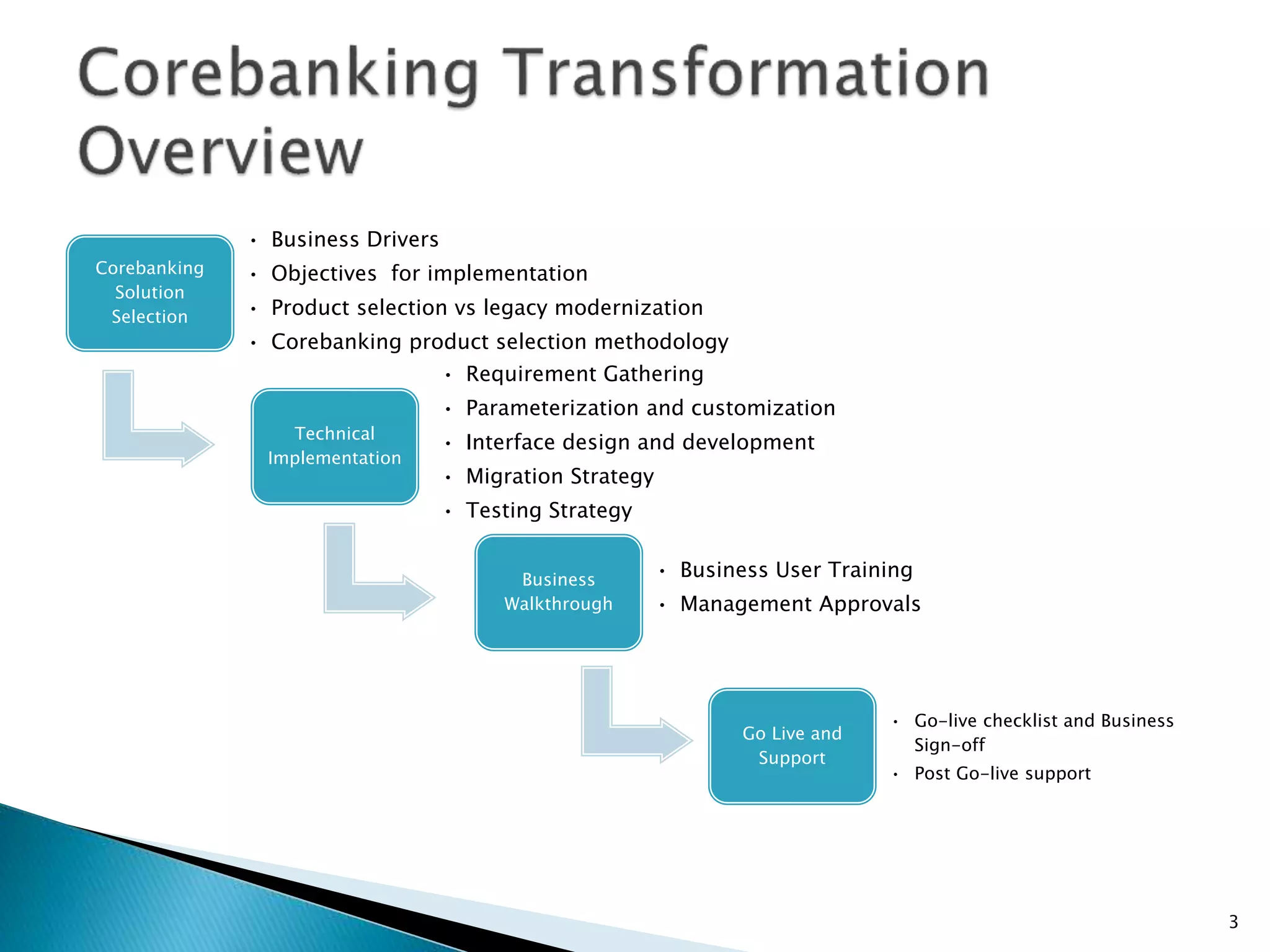
Corebanking
Solution
Selection
• Business Drivers
• Objectives for implementation
• Product selection vs legacy modernization
• Corebanking product selection methodology
Technical
Implementation
• Requirement Gathering
• Parameterization and customization
• Interface design and development
• Migration Strategy
• Testing Strategy
Business
Walkthrough
• Business User Training
• Management Approvals
Go Live and
Support
• Go-live checklist and Business
Sign-off
• Post Go-live support
3
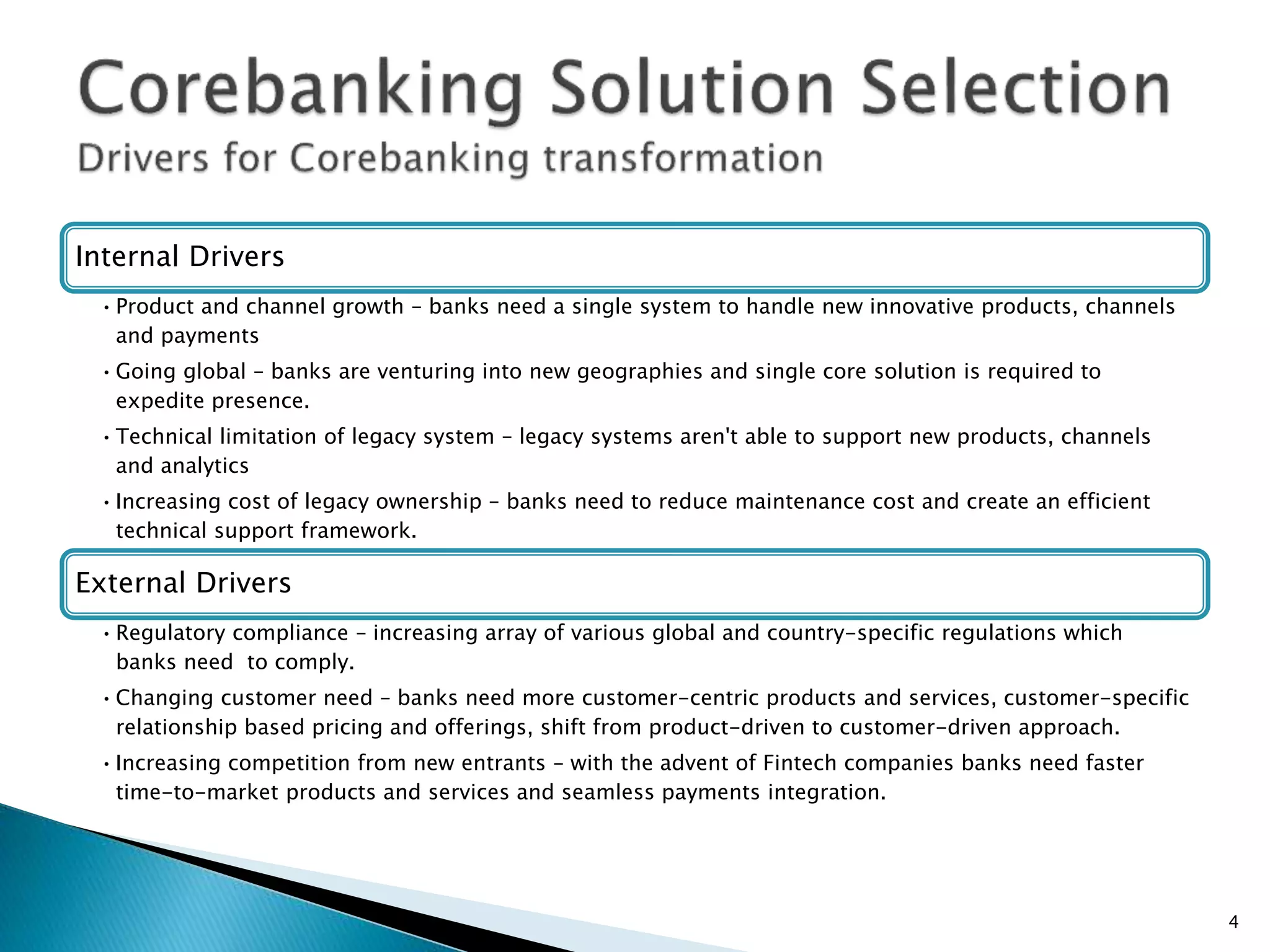
Internal Drivers
•Product and channel growth – banks need a single system to handle new innovative products, channels
and payments
•Going global – banks are venturing into new geographies and single core solution is required to
expedite presence.
•Technical limitation of legacy system – legacy systems aren't able to support new products, channels
and analytics
•Increasing cost of legacy ownership – banks need to reduce maintenance cost and create an efficient
technical support framework.
External Drivers
•Regulatory compliance – increasing array of various global and country-specific regulations which
banks need to comply.
•Changing customer need – banks need more customer-centric products and services, customer-specific
relationship based pricing and offerings, shift from product-driven to customer-driven approach.
•Increasing competition from new entrants – with the advent of Fintech companies banks need faster
time-to-market products and services and seamless payments integration.
4
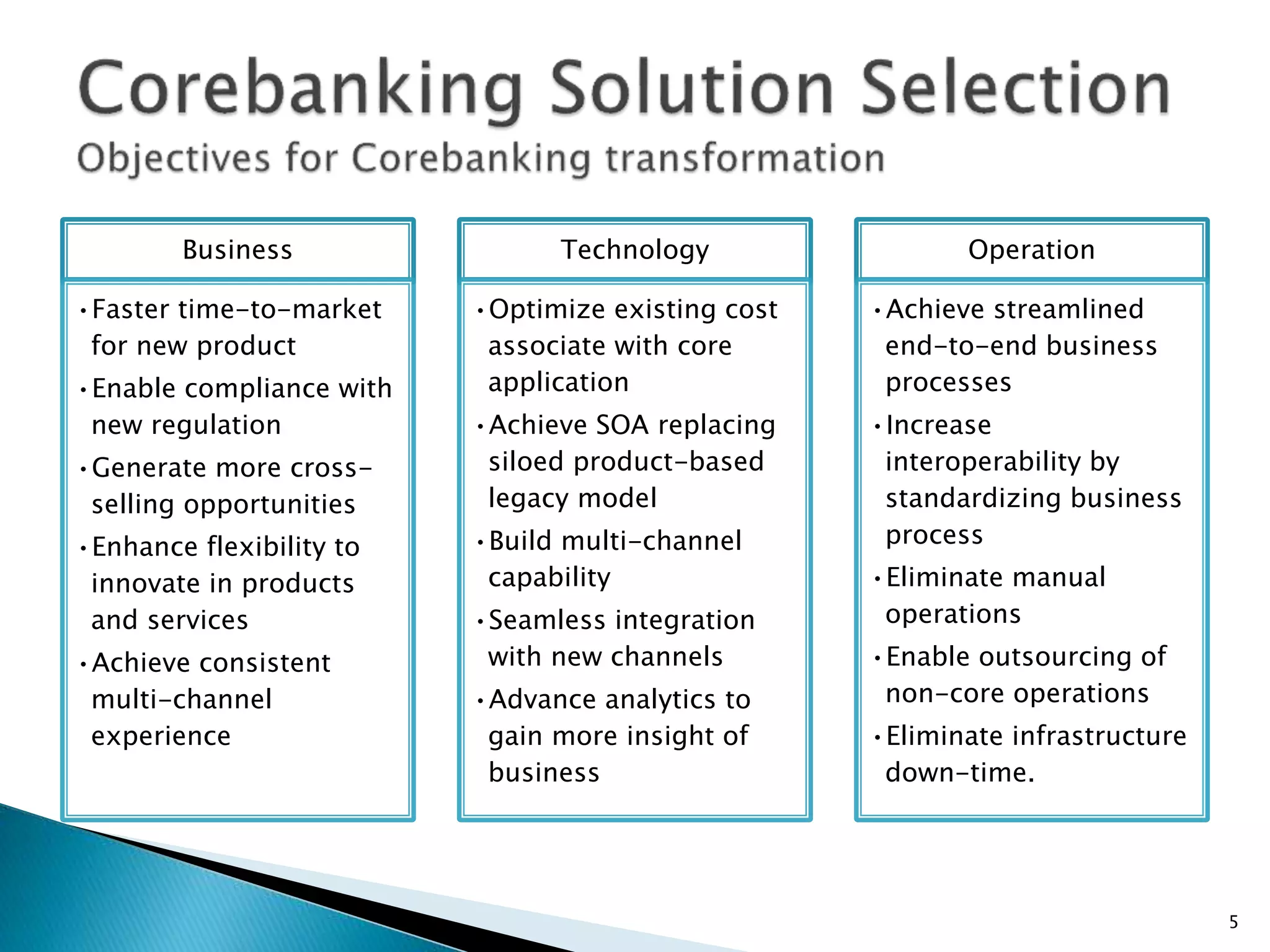
Business
•Faster time-to-market
for new product
•Enable compliance with
new regulation
•Generate more cross-
selling opportunities
•Enhance flexibility to
innovate in products
and services
•Achieve consistent
multi-channel
experience
Technology
•Optimize existing cost
associate with core
application
•Achieve SOA replacing
siloed product-based
legacy model
•Build multi-channel
capability
•Seamless integration
with new channels
•Advance analytics to
gain more insight of
business
Operation
•Achieve streamlined
end-to-end business
processes
•Increase
interoperability by
standardizing business
process
•Eliminate manual
operations
•Enable outsourcing of
non-core operations
•Eliminate infrastructure
down-time.
5
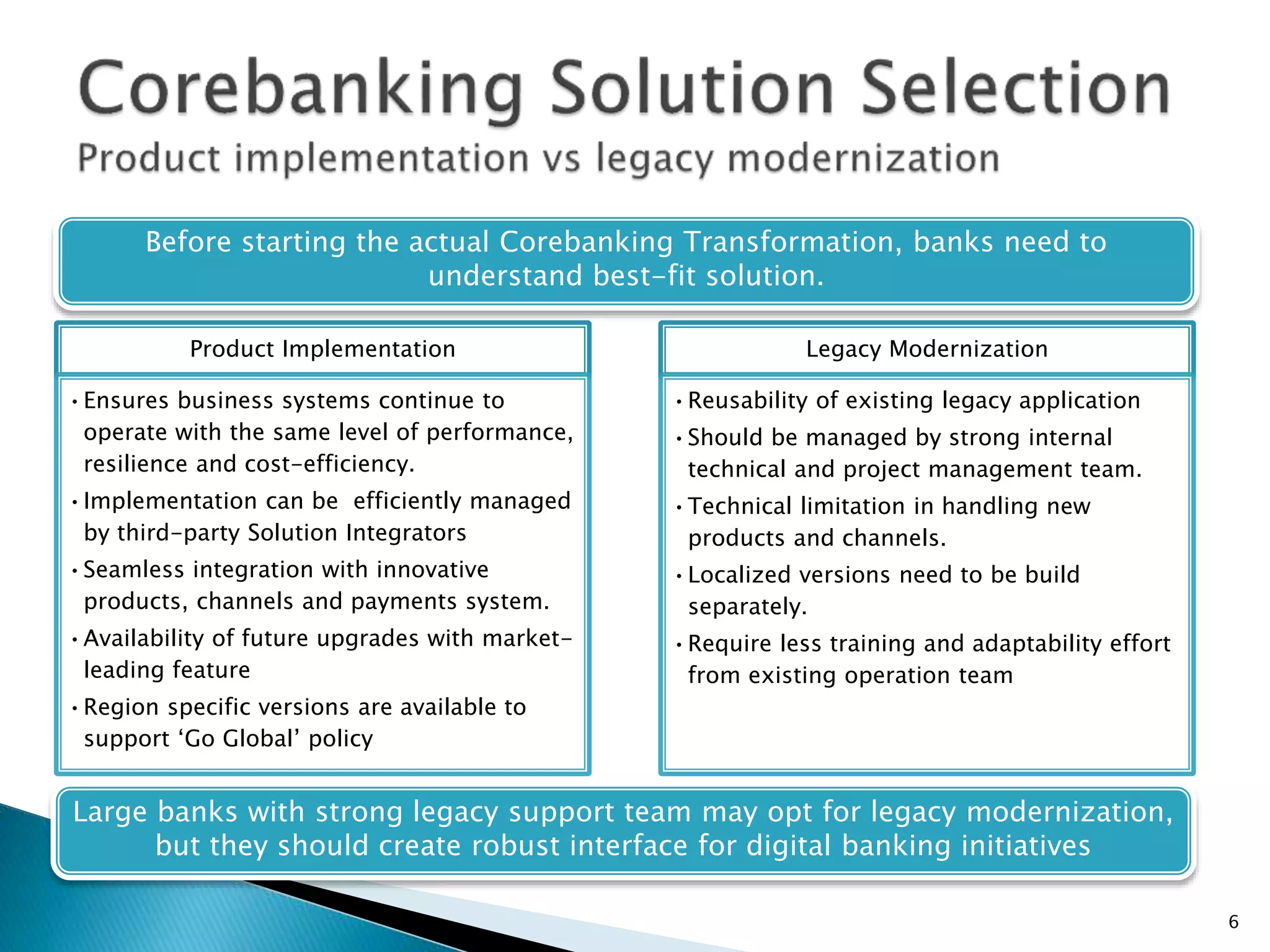
Before starting the actual Corebanking Transformation, banks need to
understand best-fit solution.
Large banks with strong legacy support team may opt for legacy modernization,
but they should create robust interface for digital banking initiatives
6
Product Implementation
•Ensures business systems continue to
operate with the same level of performance,
resilience and cost-efficiency.
•Implementation can be efficiently managed
by third-party Solution Integrators
•Seamless integration with innovative
products, channels and payments system.
•Availability of future upgrades with market-
leading feature
•Region specific versions are available to
support ‘Go Global’ policy
Legacy Modernization
•Reusability of existing legacy application
•Should be managed by strong internal
technical and project management team.
•Technical limitation in handling new
products and channels.
•Localized versions need to be build
separately.
•Require less training and adaptability effort
from existing operation team
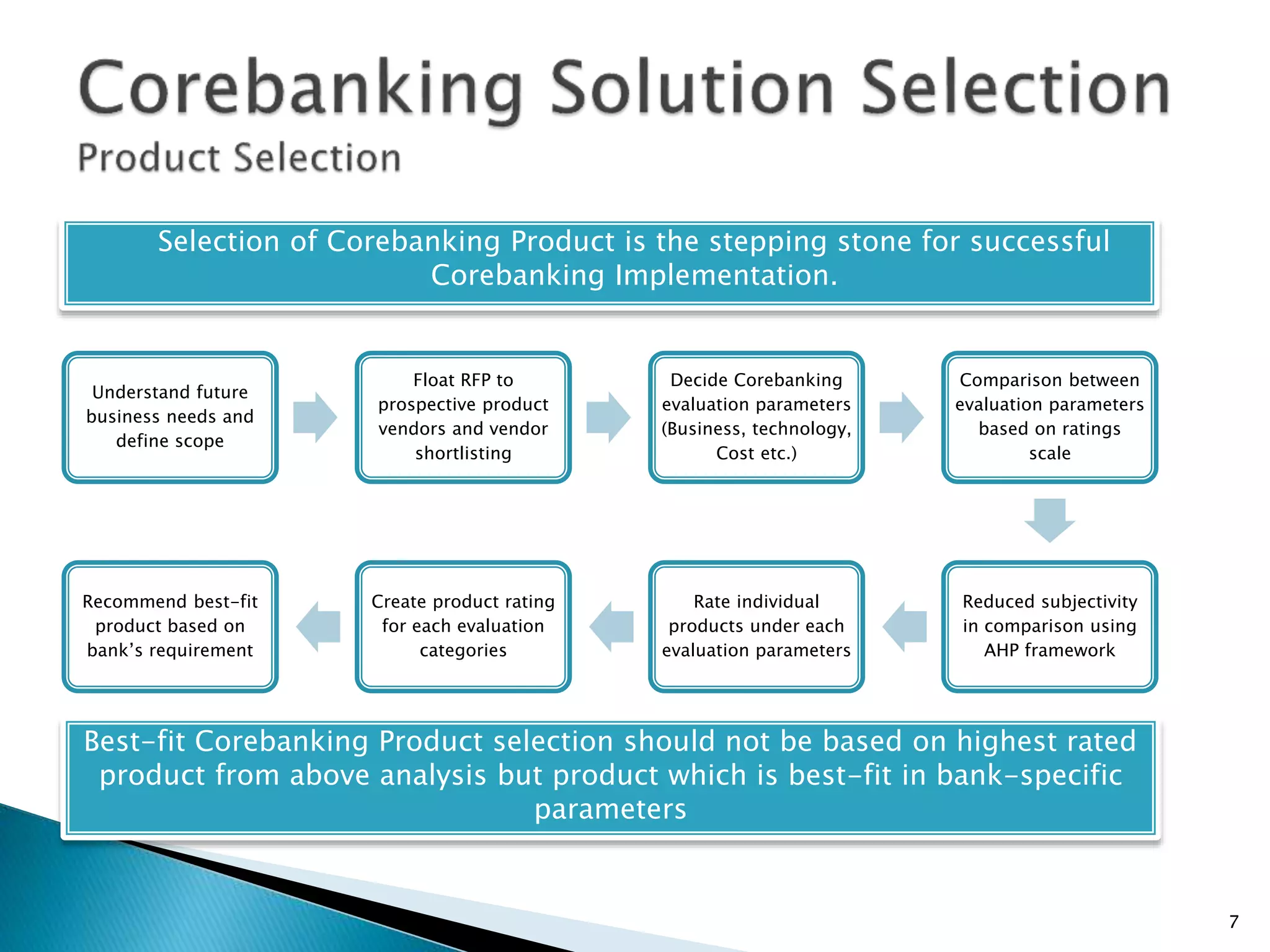
 Selection of Corebanking Product is the stepping stone for successful
Corebanking Implementation.
Understand future
business needs and
define scope
Float RFP to
prospective product
vendors and vendor
shortlisting
Decide Corebanking
evaluation parameters
(Business, technology,
Cost etc.)
Comparison between
evaluation parameters
based on ratings
scale
Reduced subjectivity
in comparison using
AHP framework
Rate individual
products under each
evaluation parameters
Create product rating
for each evaluation
categories
Recommend best-fit
product based on
bank’s requirement
Best-fit Corebanking Product selection should not be based on highest rated
product from above analysis but product which is best-fit in bank-specific
parameters
7
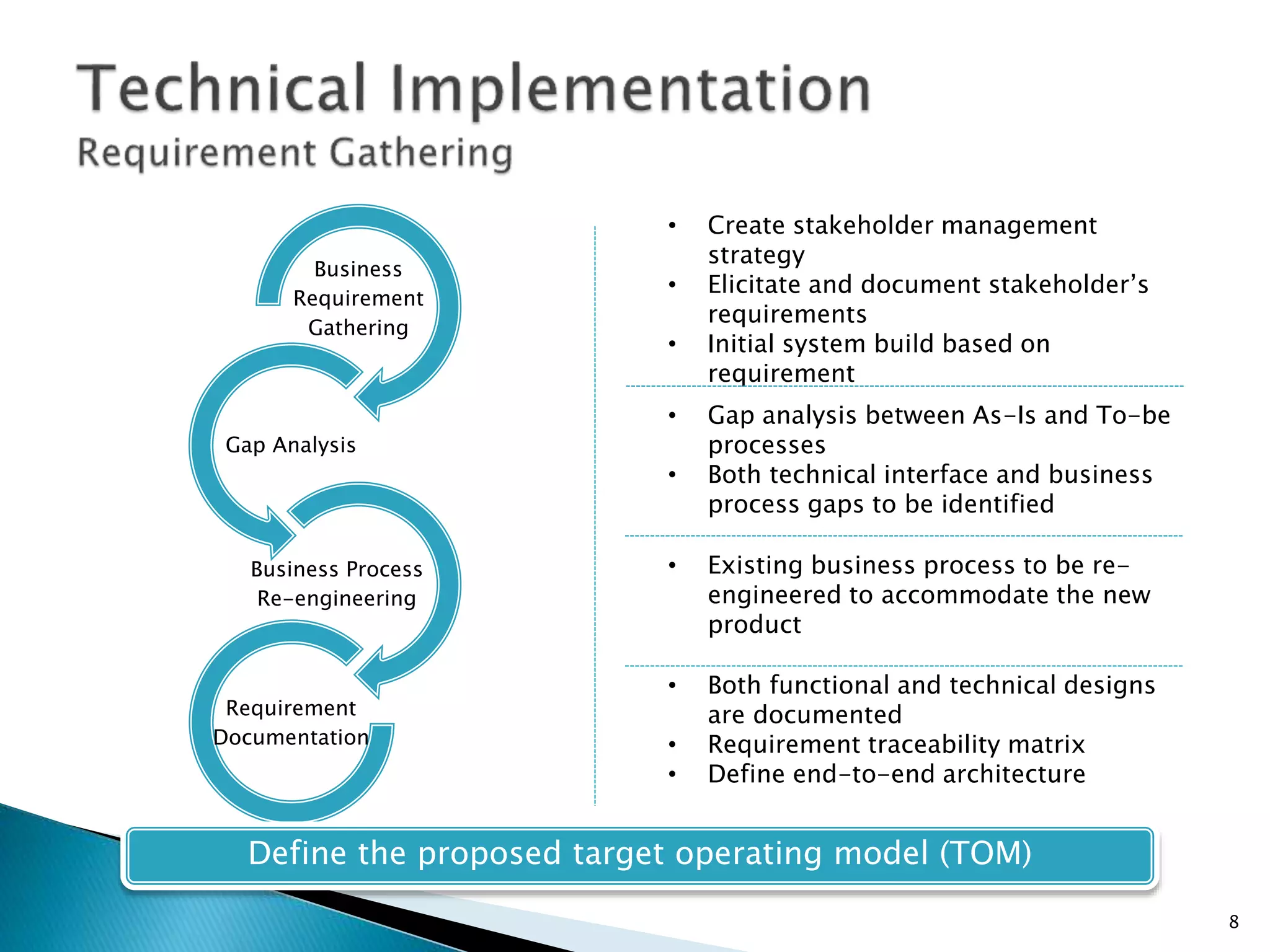
Business
Requirement
Gathering
Gap Analysis
Business Process
Re-engineering
Requirement
Documentation
• Create stakeholder management
strategy
• Elicitate and document stakeholder’s
requirements
• Initial system build based on
requirement
• Gap analysis between As-Is and To-be
processes
• Both technical interface and business
process gaps to be identified
• Existing business process to be re-
engineered to accommodate the new
product
• Both functional and technical designs
are documented
• Requirement traceability matrix
• Define end-to-end architecture
Define the proposed target operating model (TOM)
8
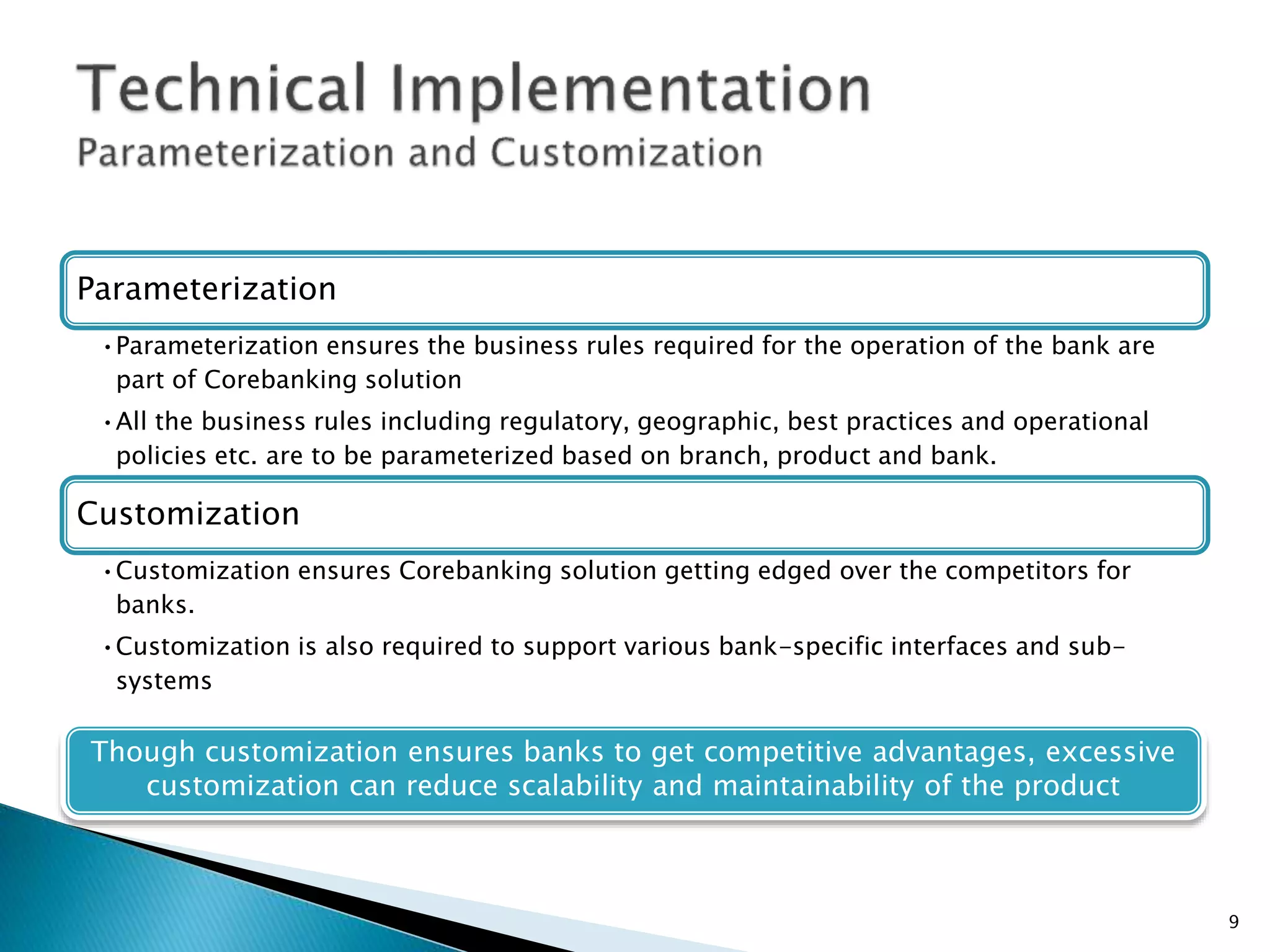
Parameterization
•Parameterization ensures the business rules required for the operation of the bank are
part of Corebanking solution
•All the business rules including regulatory, geographic, best practices and operational
policies etc. are to be parameterized based on branch, product and bank.
Customization
•Customization ensures Corebanking solution getting edged over the competitors for
banks.
•Customization is also required to support various bank-specific interfaces and sub-
systems
Though customization ensures banks to get competitive advantages, excessive
customization can reduce scalability and maintainability of the product
9
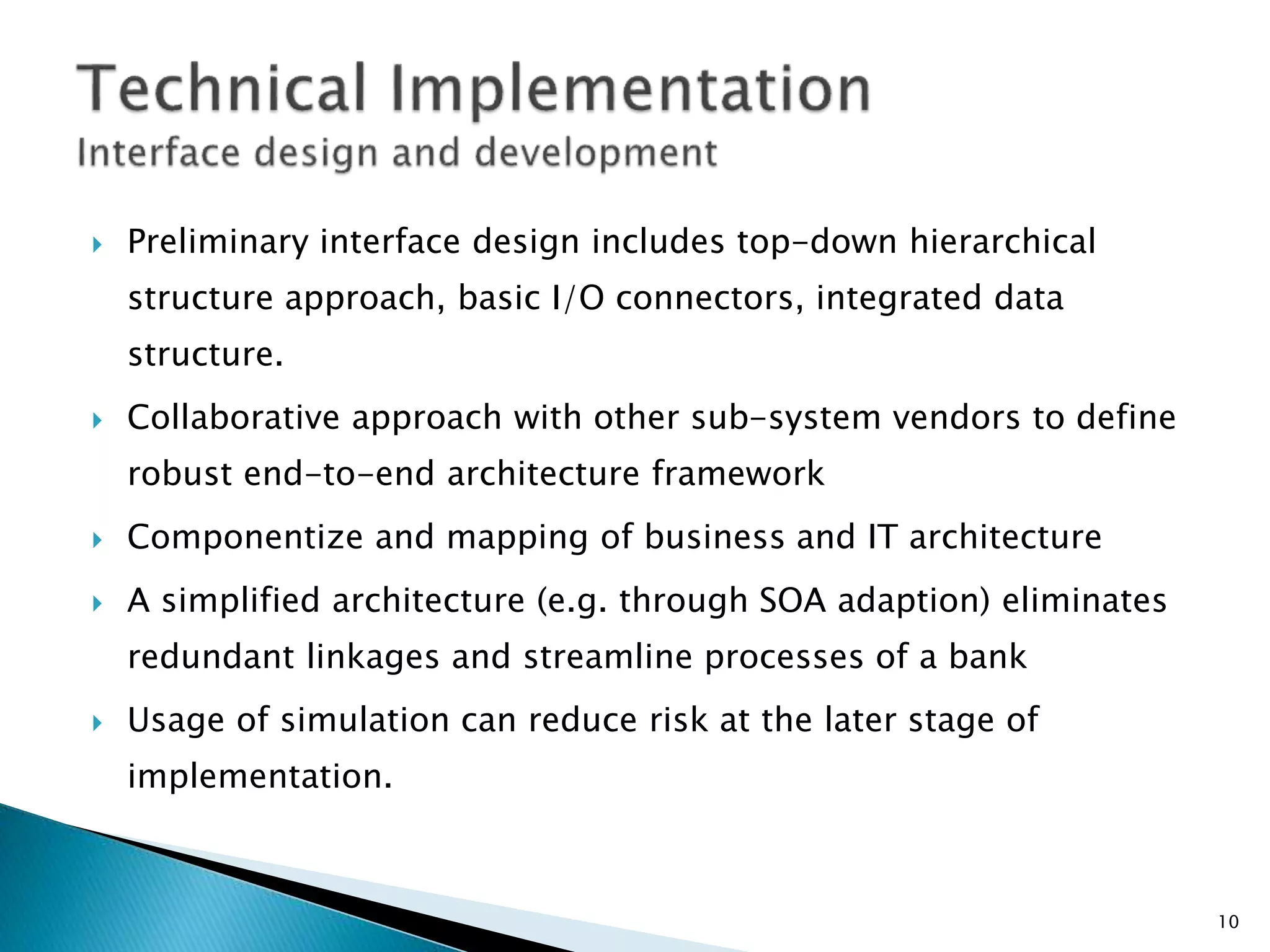
 Preliminary interface design includes top-down hierarchical
structure approach, basic I/O connectors, integrated data
structure.
 Collaborative approach with other sub-system vendors to define
robust end-to-end architecture framework
 Componentize and mapping of business and IT architecture
 A simplified architecture (e.g. through SOA adaption) eliminates
redundant linkages and streamline processes of a bank
 Usage of simulation can reduce risk at the later stage of
implementation.
10
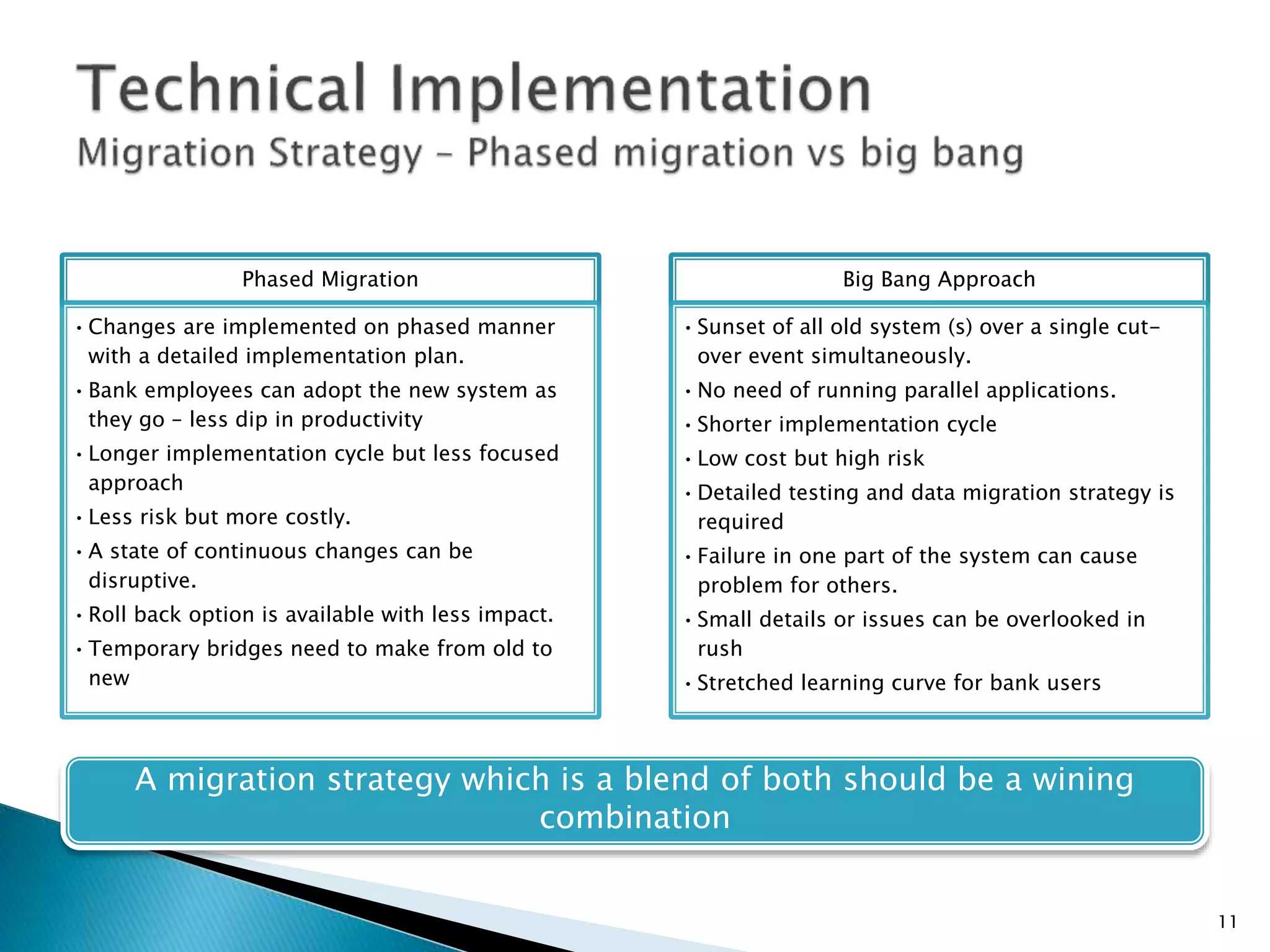
Phased Migration
•Changes are implemented on phased manner
with a detailed implementation plan.
•Bank employees can adopt the new system as
they go – less dip in productivity
•Longer implementation cycle but less focused
approach
•Less risk but more costly.
•A state of continuous changes can be
disruptive.
•Roll back option is available with less impact.
•Temporary bridges need to make from old to
new
Big Bang Approach
•Sunset of all old system (s) over a single cut-
over event simultaneously.
•No need of running parallel applications.
•Shorter implementation cycle
•Low cost but high risk
•Detailed testing and data migration strategy is
required
•Failure in one part of the system can cause
problem for others.
•Small details or issues can be overlooked in
rush
•Stretched learning curve for bank users
A migration strategy which is a blend of both should be a wining
combination
11
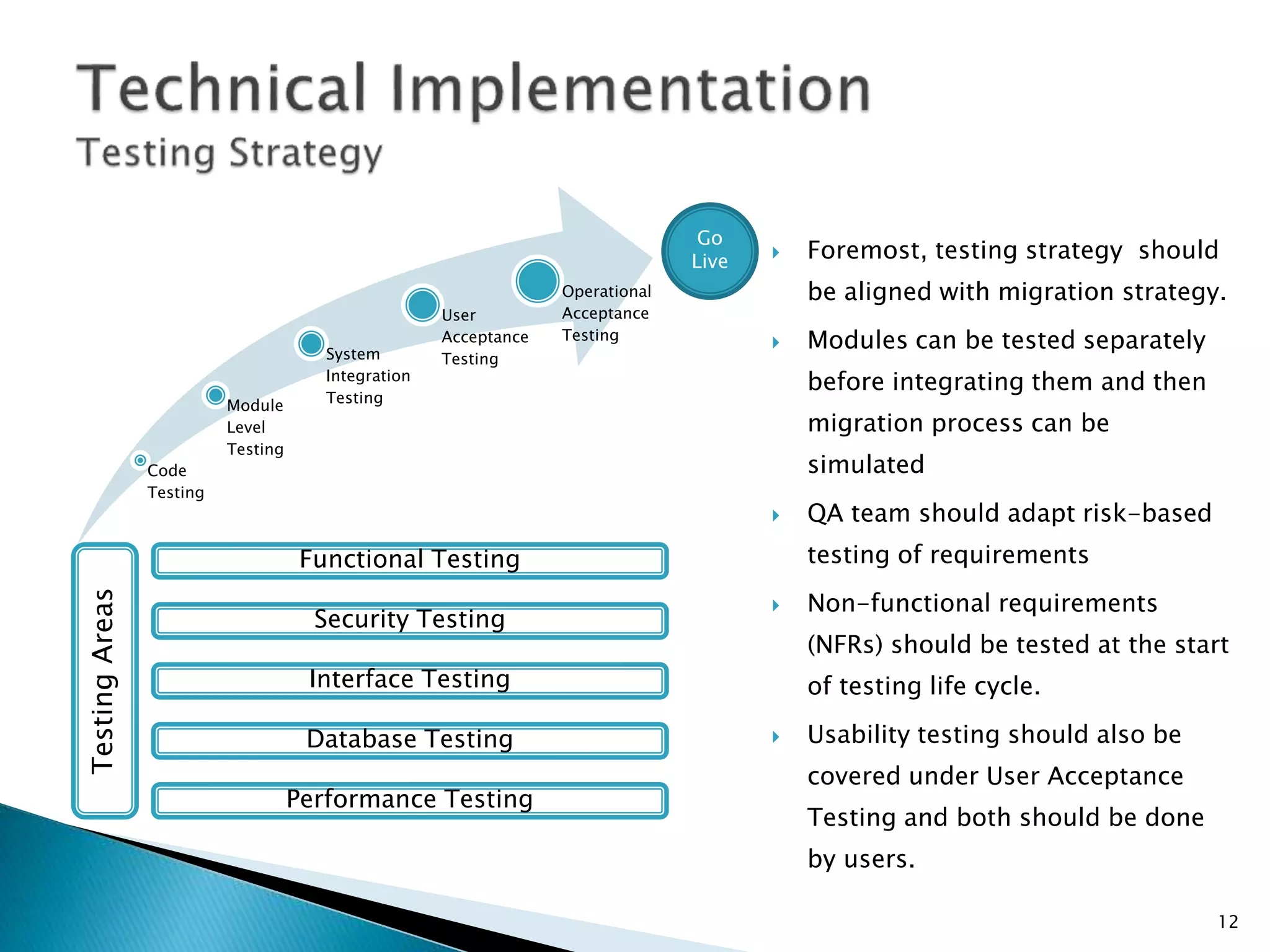
 Foremost, testing strategy should
be aligned with migration strategy.
 Modules can be tested separately
before integrating them and then
migration process can be
simulated
 QA team should adapt risk-based
testing of requirements
 Non-functional requirements
(NFRs) should be tested at the start
of testing life cycle.
 Usability testing should also be
covered under User Acceptance
Testing and both should be done
by users.
Code
Testing
Module
Level
Testing
System
Integration
Testing
User
Acceptance
Testing
Operational
Acceptance
Testing
Go
Live
Functional Testing
Security Testing
Interface Testing
Database Testing
Performance Testing
TestingAreas
12
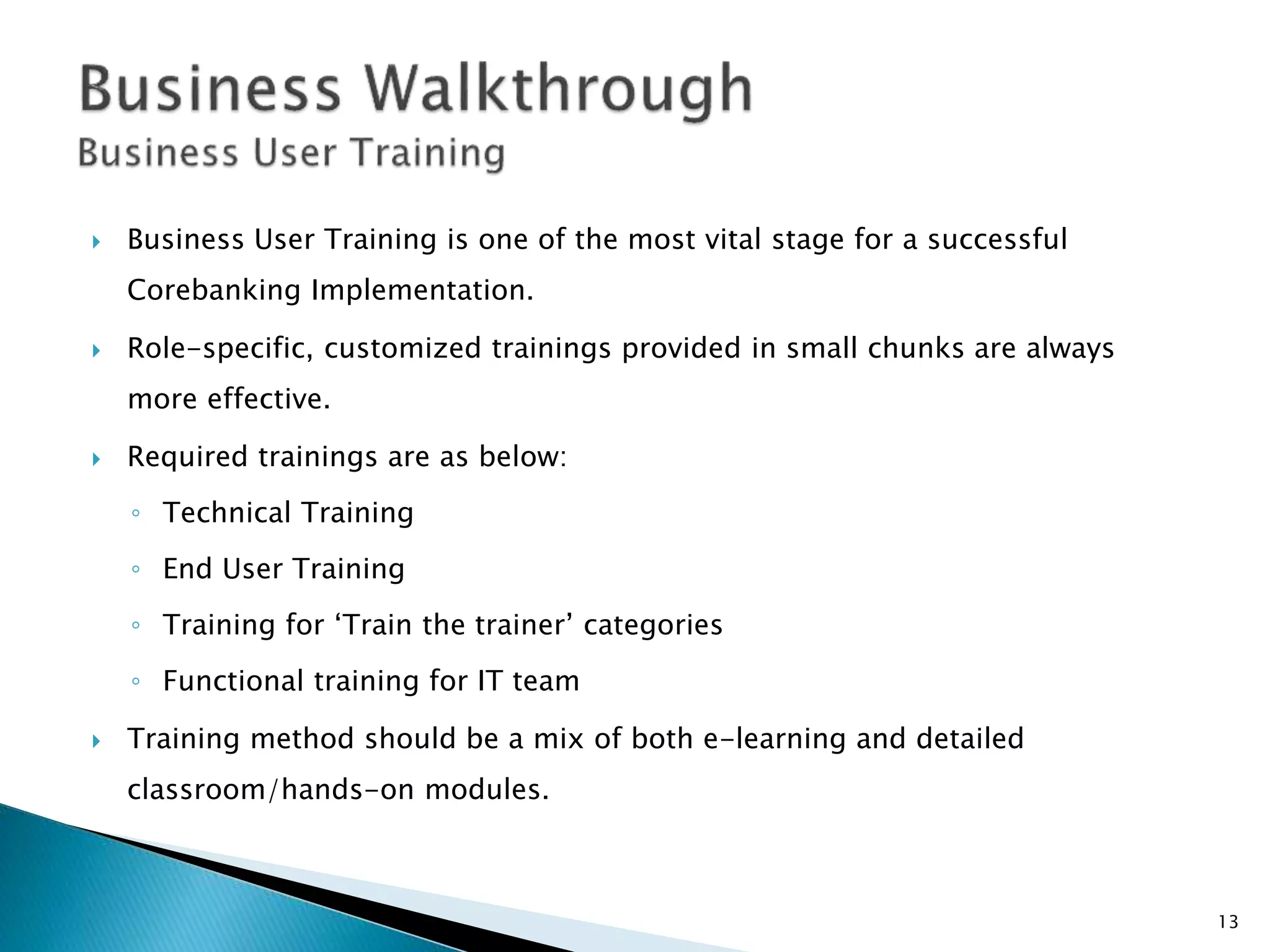
 Business User Training is one of the most vital stage for a successful
Corebanking Implementation.
 Role-specific, customized trainings provided in small chunks are always
more effective.
 Required trainings are as below:
◦ Technical Training
◦ End User Training
◦ Training for ‘Train the trainer’ categories
◦ Functional training for IT team
 Training method should be a mix of both e-learning and detailed
classroom/hands-on modules.
13
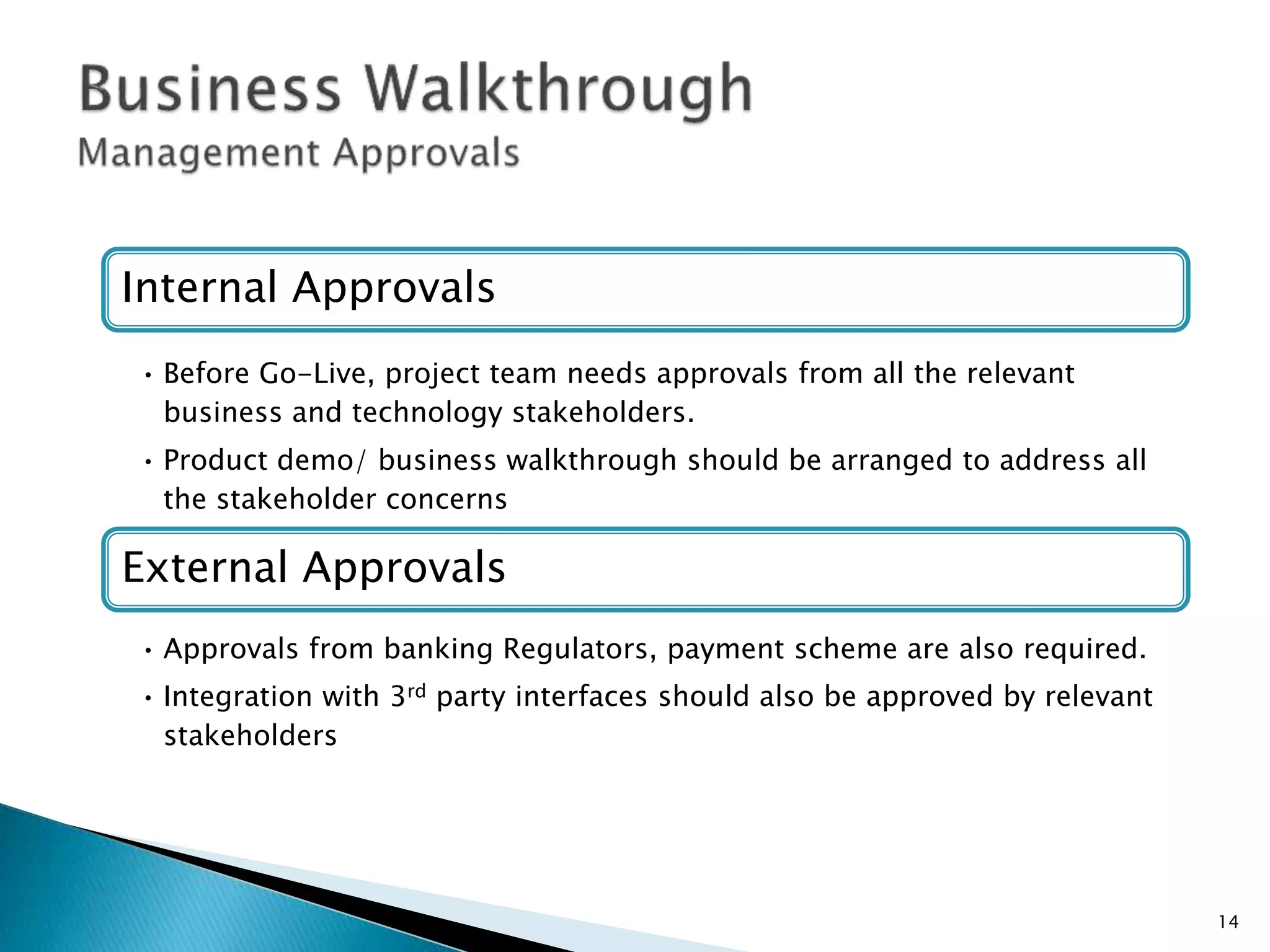
Internal Approvals
• Before Go-Live, project team needs approvals from all the relevant
business and technology stakeholders.
• Product demo/ business walkthrough should be arranged to address all
the stakeholder concerns
External Approvals
• Approvals from banking Regulators, payment scheme are also required.
• Integration with 3rd party interfaces should also be approved by relevant
stakeholders
14
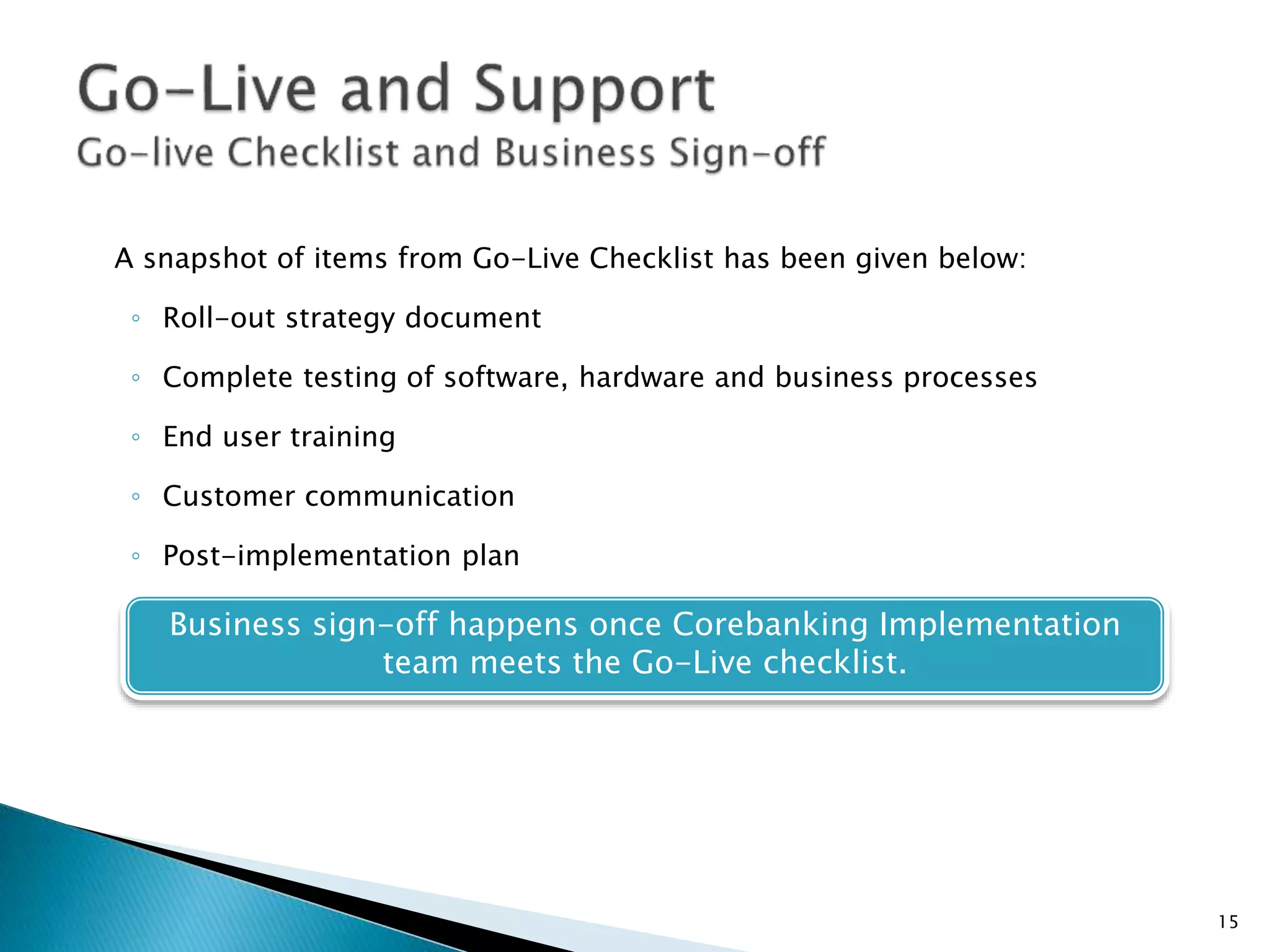
A snapshot of items from Go-Live Checklist has been given below:
◦ Roll-out strategy document
◦ Complete testing of software, hardware and business processes
◦ End user training
◦ Customer communication
◦ Post-implementation plan
Business sign-off happens once Corebanking Implementation
team meets the Go-Live checklist.
15
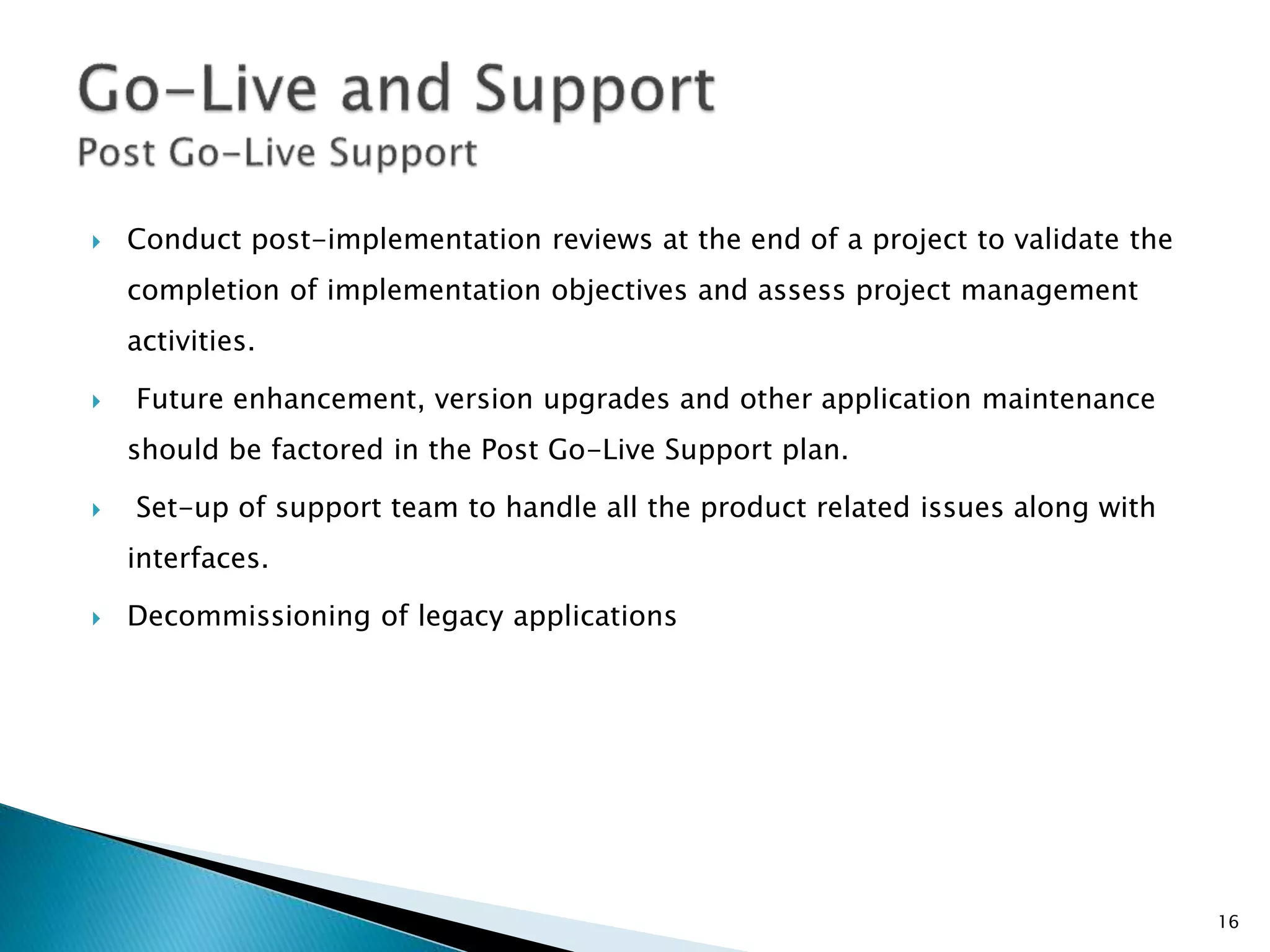
 Conduct post-implementation reviews at the end of a project to validate the
completion of implementation objectives and assess project management
activities.
 Future enhancement, version upgrades and other application maintenance
should be factored in the Post Go-Live Support plan.
 Set-up of support team to handle all the product related issues along with
interfaces.
 Decommissioning of legacy applications
16
17

Corebanking transformation – a wining formula

  • 1.
  • 2.
    Challenges faced by banks Identification of measurable businessbenefits Define and adopt the target operative model Define role of System Integrator and robust implementation strategy Implementation approach – big bang or phased? Data migration – data mapping, cleansing, extraction and loading Value added and manageable customization Transformation plan – redefining end state and align organizational capabilities Budget and time overrun Reasons for failure Lack of appropriate product selection methodology Vendor’s inability to deliver Limited capability of project group and SI partner Lack of well- thought- through Implementation model Lack of buy-in from CXO level and relevant stakeholders 2
  • 3.
    Corebanking Solution Selection • Business Drivers •Objectives for implementation • Product selection vs legacy modernization • Corebanking product selection methodology Technical Implementation • Requirement Gathering • Parameterization and customization • Interface design and development • Migration Strategy • Testing Strategy Business Walkthrough • Business User Training • Management Approvals Go Live and Support • Go-live checklist and Business Sign-off • Post Go-live support 3
  • 4.
    Internal Drivers •Product andchannel growth – banks need a single system to handle new innovative products, channels and payments •Going global – banks are venturing into new geographies and single core solution is required to expedite presence. •Technical limitation of legacy system – legacy systems aren't able to support new products, channels and analytics •Increasing cost of legacy ownership – banks need to reduce maintenance cost and create an efficient technical support framework. External Drivers •Regulatory compliance – increasing array of various global and country-specific regulations which banks need to comply. •Changing customer need – banks need more customer-centric products and services, customer-specific relationship based pricing and offerings, shift from product-driven to customer-driven approach. •Increasing competition from new entrants – with the advent of Fintech companies banks need faster time-to-market products and services and seamless payments integration. 4
  • 5.
    Business •Faster time-to-market for newproduct •Enable compliance with new regulation •Generate more cross- selling opportunities •Enhance flexibility to innovate in products and services •Achieve consistent multi-channel experience Technology •Optimize existing cost associate with core application •Achieve SOA replacing siloed product-based legacy model •Build multi-channel capability •Seamless integration with new channels •Advance analytics to gain more insight of business Operation •Achieve streamlined end-to-end business processes •Increase interoperability by standardizing business process •Eliminate manual operations •Enable outsourcing of non-core operations •Eliminate infrastructure down-time. 5
  • 6.
    Before starting theactual Corebanking Transformation, banks need to understand best-fit solution. Large banks with strong legacy support team may opt for legacy modernization, but they should create robust interface for digital banking initiatives 6 Product Implementation •Ensures business systems continue to operate with the same level of performance, resilience and cost-efficiency. •Implementation can be efficiently managed by third-party Solution Integrators •Seamless integration with innovative products, channels and payments system. •Availability of future upgrades with market- leading feature •Region specific versions are available to support ‘Go Global’ policy Legacy Modernization •Reusability of existing legacy application •Should be managed by strong internal technical and project management team. •Technical limitation in handling new products and channels. •Localized versions need to be build separately. •Require less training and adaptability effort from existing operation team
  • 7.
     Selection ofCorebanking Product is the stepping stone for successful Corebanking Implementation. Understand future business needs and define scope Float RFP to prospective product vendors and vendor shortlisting Decide Corebanking evaluation parameters (Business, technology, Cost etc.) Comparison between evaluation parameters based on ratings scale Reduced subjectivity in comparison using AHP framework Rate individual products under each evaluation parameters Create product rating for each evaluation categories Recommend best-fit product based on bank’s requirement Best-fit Corebanking Product selection should not be based on highest rated product from above analysis but product which is best-fit in bank-specific parameters 7
  • 8.
    Business Requirement Gathering Gap Analysis Business Process Re-engineering Requirement Documentation •Create stakeholder management strategy • Elicitate and document stakeholder’s requirements • Initial system build based on requirement • Gap analysis between As-Is and To-be processes • Both technical interface and business process gaps to be identified • Existing business process to be re- engineered to accommodate the new product • Both functional and technical designs are documented • Requirement traceability matrix • Define end-to-end architecture Define the proposed target operating model (TOM) 8
  • 9.
    Parameterization •Parameterization ensures thebusiness rules required for the operation of the bank are part of Corebanking solution •All the business rules including regulatory, geographic, best practices and operational policies etc. are to be parameterized based on branch, product and bank. Customization •Customization ensures Corebanking solution getting edged over the competitors for banks. •Customization is also required to support various bank-specific interfaces and sub- systems Though customization ensures banks to get competitive advantages, excessive customization can reduce scalability and maintainability of the product 9
  • 10.
     Preliminary interfacedesign includes top-down hierarchical structure approach, basic I/O connectors, integrated data structure.  Collaborative approach with other sub-system vendors to define robust end-to-end architecture framework  Componentize and mapping of business and IT architecture  A simplified architecture (e.g. through SOA adaption) eliminates redundant linkages and streamline processes of a bank  Usage of simulation can reduce risk at the later stage of implementation. 10
  • 11.
    Phased Migration •Changes areimplemented on phased manner with a detailed implementation plan. •Bank employees can adopt the new system as they go – less dip in productivity •Longer implementation cycle but less focused approach •Less risk but more costly. •A state of continuous changes can be disruptive. •Roll back option is available with less impact. •Temporary bridges need to make from old to new Big Bang Approach •Sunset of all old system (s) over a single cut- over event simultaneously. •No need of running parallel applications. •Shorter implementation cycle •Low cost but high risk •Detailed testing and data migration strategy is required •Failure in one part of the system can cause problem for others. •Small details or issues can be overlooked in rush •Stretched learning curve for bank users A migration strategy which is a blend of both should be a wining combination 11
  • 12.
     Foremost, testingstrategy should be aligned with migration strategy.  Modules can be tested separately before integrating them and then migration process can be simulated  QA team should adapt risk-based testing of requirements  Non-functional requirements (NFRs) should be tested at the start of testing life cycle.  Usability testing should also be covered under User Acceptance Testing and both should be done by users. Code Testing Module Level Testing System Integration Testing User Acceptance Testing Operational Acceptance Testing Go Live Functional Testing Security Testing Interface Testing Database Testing Performance Testing TestingAreas 12
  • 13.
     Business UserTraining is one of the most vital stage for a successful Corebanking Implementation.  Role-specific, customized trainings provided in small chunks are always more effective.  Required trainings are as below: ◦ Technical Training ◦ End User Training ◦ Training for ‘Train the trainer’ categories ◦ Functional training for IT team  Training method should be a mix of both e-learning and detailed classroom/hands-on modules. 13
  • 14.
    Internal Approvals • BeforeGo-Live, project team needs approvals from all the relevant business and technology stakeholders. • Product demo/ business walkthrough should be arranged to address all the stakeholder concerns External Approvals • Approvals from banking Regulators, payment scheme are also required. • Integration with 3rd party interfaces should also be approved by relevant stakeholders 14
  • 15.
    A snapshot ofitems from Go-Live Checklist has been given below: ◦ Roll-out strategy document ◦ Complete testing of software, hardware and business processes ◦ End user training ◦ Customer communication ◦ Post-implementation plan Business sign-off happens once Corebanking Implementation team meets the Go-Live checklist. 15
  • 16.
     Conduct post-implementationreviews at the end of a project to validate the completion of implementation objectives and assess project management activities.  Future enhancement, version upgrades and other application maintenance should be factored in the Post Go-Live Support plan.  Set-up of support team to handle all the product related issues along with interfaces.  Decommissioning of legacy applications 16
  • 17.