Instance Segmentation
How-to for real-time predictions
Arithmer R3 Div. Enrico Rinaldi
Enrico Rinaldi (Ph.D.)
● Education
○ Bachelor of Science in Physics from the University of Milan
○ Master of Science in Theoretical Physics from the University of Milan
○ Ph.D. in Theoretical Particle Physics from the University of Edinburgh
■ Computational Physics and (Big) Data Analysis
■ Particle Physics with Composite Higgs, Dark Matter, and Extra Dimensions
■ Supported by Scottish Universities Physics Alliance (SUPA) fellowship and Japanese Society for the Promotion of
Science (JSPS) fellowship at the Kobayashi-Maskawa Institute of Nagoya University
● Associate Researcher at the Lawrence Livermore National Laboratory
○ High-Performance Computing simulations of particle physics, nuclear physics and string theory
○ Markov Chain Monte Carlo sampling and Optimization problems
● Special Postdoctoral Fellow at the RIKEN BNL Research Center
○ Junior PI of project on numerical simulations for composite dark matter theories
○ GPU computing for HPC simulations of nuclear physics properties
○ Leveraging machine learning techniques to accelerate physics discoveries
● R&D Researcher and Engineer at Arithmer Inc.
○ Research on Geometric Learning, Graph Learning, 3D perception, Computer Vision
○ Applications to robotics, automated measurements systems, optimization problems
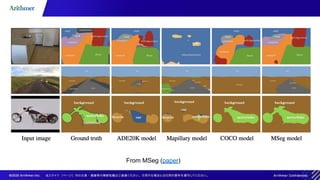
From MSeg (paper)
Instance Segmentation
➔ “Instance segmentation is the task of detecting and delineating each
distinct object of interest appearing in an image” -- source
➔ Sub-task of:
◆ “Object Detection”
◆ “Semantic Segmentation”
➔ Improvements in baselines (R-CNN, FCN) for the “parent” tasks do not
automatically apply to the “daughter” task
➔ Typically combines:
◆ detection of boxes for all objects
◆ segmentation of pixels
Methodology
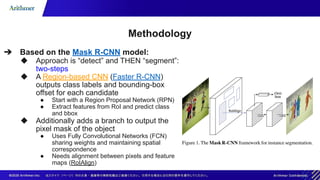
➔ Based on the Mask R-CNN model:
◆ Approach is “detect” and THEN “segment”:
two-steps
◆ A Region-based CNN (Faster R-CNN)
outputs class labels and bounding-box
offset for each candidate
● Start with a Region Proposal Network (RPN)
● Extract features from RoI and predict class
and bbox
◆ Additionally adds a branch to output the
pixel mask of the object
● Uses Fully Convolutional Networks (FCN)
sharing weights and maintaining spatial
correspondence
● Needs alignment between pixels and feature
maps (RoIAlign)
Methodology
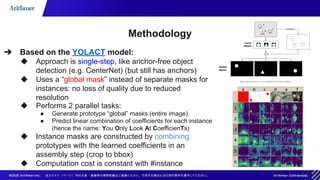
➔ Based on the YOLACT model:
◆ Approach is single-step, like anchor-free object
detection (e.g. CenterNet) (but still has anchors)
◆ Uses a “global mask” instead of separate masks for
instances: no loss of quality due to reduced
resolution
◆ Performs 2 parallel tasks:
● Generate prototype “global” masks (entire image)
● Predict linear combination of coefficients for each instance
(hence the name: You Only Look At CoefficienTs)
◆ Instance masks are constructed by combining
prototypes with the learned coefficients in an
assembly step (crop to bbox)
◆ Computation cost is constant with #instance
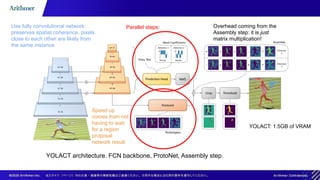
YOLACT architecture. FCN backbone, ProtoNet, Assembly step.
Use fully convolutional network:
preserves spatial coherence, pixels
close to each other are likely from
the same instance
Speed up
comes from not
having to wait
for a region
proposal
network result
Overhead coming from the
Assembly step: it is just
matrix multiplication!
Parallel steps:
YOLACT: 1.5GB of VRAM
Related work
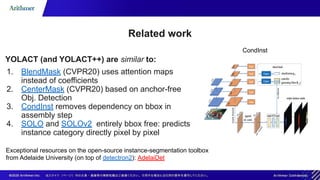
YOLACT (and YOLACT++) are similar to:
1. BlendMask (CVPR20) uses attention maps
instead of coefficients
2. CenterMask (CVPR20) based on anchor-free
Obj. Detection
3. CondInst removes dependency on bbox in
assembly step
4. SOLO and SOLOv2 entirely bbox free: predicts
instance category directly pixel by pixel
Exceptional resources on the open-source instance-segmentation toolbox
from Adelaide University (on top of detectron2): AdelaiDet
CondInst
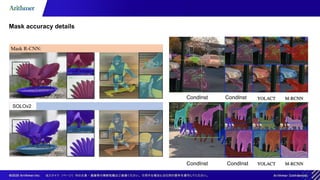
SOLOv2
Mask accuracy details
CondInst CondInst
CondInstCondInst
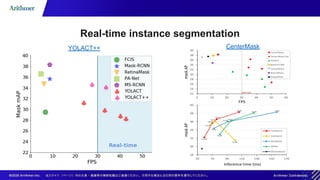
Real-time instance segmentation
YOLACT++ CenterMask
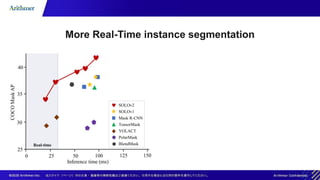
More Real-Time instance segmentation

YOLACT

  • 1.
    Instance Segmentation How-to forreal-time predictions Arithmer R3 Div. Enrico Rinaldi
  • 2.
    Enrico Rinaldi (Ph.D.) ●Education ○ Bachelor of Science in Physics from the University of Milan ○ Master of Science in Theoretical Physics from the University of Milan ○ Ph.D. in Theoretical Particle Physics from the University of Edinburgh ■ Computational Physics and (Big) Data Analysis ■ Particle Physics with Composite Higgs, Dark Matter, and Extra Dimensions ■ Supported by Scottish Universities Physics Alliance (SUPA) fellowship and Japanese Society for the Promotion of Science (JSPS) fellowship at the Kobayashi-Maskawa Institute of Nagoya University ● Associate Researcher at the Lawrence Livermore National Laboratory ○ High-Performance Computing simulations of particle physics, nuclear physics and string theory ○ Markov Chain Monte Carlo sampling and Optimization problems ● Special Postdoctoral Fellow at the RIKEN BNL Research Center ○ Junior PI of project on numerical simulations for composite dark matter theories ○ GPU computing for HPC simulations of nuclear physics properties ○ Leveraging machine learning techniques to accelerate physics discoveries ● R&D Researcher and Engineer at Arithmer Inc. ○ Research on Geometric Learning, Graph Learning, 3D perception, Computer Vision ○ Applications to robotics, automated measurements systems, optimization problems
  • 3.
  • 4.
    Instance Segmentation ➔ “Instancesegmentation is the task of detecting and delineating each distinct object of interest appearing in an image” -- source ➔ Sub-task of: ◆ “Object Detection” ◆ “Semantic Segmentation” ➔ Improvements in baselines (R-CNN, FCN) for the “parent” tasks do not automatically apply to the “daughter” task ➔ Typically combines: ◆ detection of boxes for all objects ◆ segmentation of pixels
  • 5.
    Methodology ➔ Based onthe Mask R-CNN model: ◆ Approach is “detect” and THEN “segment”: two-steps ◆ A Region-based CNN (Faster R-CNN) outputs class labels and bounding-box offset for each candidate ● Start with a Region Proposal Network (RPN) ● Extract features from RoI and predict class and bbox ◆ Additionally adds a branch to output the pixel mask of the object ● Uses Fully Convolutional Networks (FCN) sharing weights and maintaining spatial correspondence ● Needs alignment between pixels and feature maps (RoIAlign)
  • 6.
    Methodology ➔ Based onthe YOLACT model: ◆ Approach is single-step, like anchor-free object detection (e.g. CenterNet) (but still has anchors) ◆ Uses a “global mask” instead of separate masks for instances: no loss of quality due to reduced resolution ◆ Performs 2 parallel tasks: ● Generate prototype “global” masks (entire image) ● Predict linear combination of coefficients for each instance (hence the name: You Only Look At CoefficienTs) ◆ Instance masks are constructed by combining prototypes with the learned coefficients in an assembly step (crop to bbox) ◆ Computation cost is constant with #instance
  • 7.
    YOLACT architecture. FCNbackbone, ProtoNet, Assembly step. Use fully convolutional network: preserves spatial coherence, pixels close to each other are likely from the same instance Speed up comes from not having to wait for a region proposal network result Overhead coming from the Assembly step: it is just matrix multiplication! Parallel steps: YOLACT: 1.5GB of VRAM
  • 9.
    Related work YOLACT (andYOLACT++) are similar to: 1. BlendMask (CVPR20) uses attention maps instead of coefficients 2. CenterMask (CVPR20) based on anchor-free Obj. Detection 3. CondInst removes dependency on bbox in assembly step 4. SOLO and SOLOv2 entirely bbox free: predicts instance category directly pixel by pixel Exceptional resources on the open-source instance-segmentation toolbox from Adelaide University (on top of detectron2): AdelaiDet CondInst
  • 10.
    SOLOv2 Mask accuracy details CondInstCondInst CondInstCondInst
  • 11.
  • 12.