8iaMW_Built Environment SLE.pdf building materials and floor planning
1.
B U ILT E NVI R O N M E N T
B Y G R O U P S A V I L L S
2.
Cement concrete isa composite construction material made by mixing:
Cement, fine aggregates -sand, coarse aggregates - crushed stone, and
water in specific proportions.
When mixed, the cement reacts chemically with water which causes the
mixture to set and harden into a solid, stone-like mass.
INTRODUCTION TO
CEMENT CONCRETE
3.
WHY CEMENT CONCRETE
ISUSED WIDELY?
HIGH
STRENGTH
DURABILITY AVAILABILITY
& ECONOMIC
Concrete can bear heavy
compressive loads, making
it ideal for structural
components like beams,
columns, slabs, and
foundations.
1. 2. 3.
It is free from corrosion and
it lasts for decades with
minimal maintenance, even
under harsh environmental
conditions.
The main ingredients are
easily available and
relatively inexpensive. It is
more cost-effective
compared to steel or timber
structures.
4.
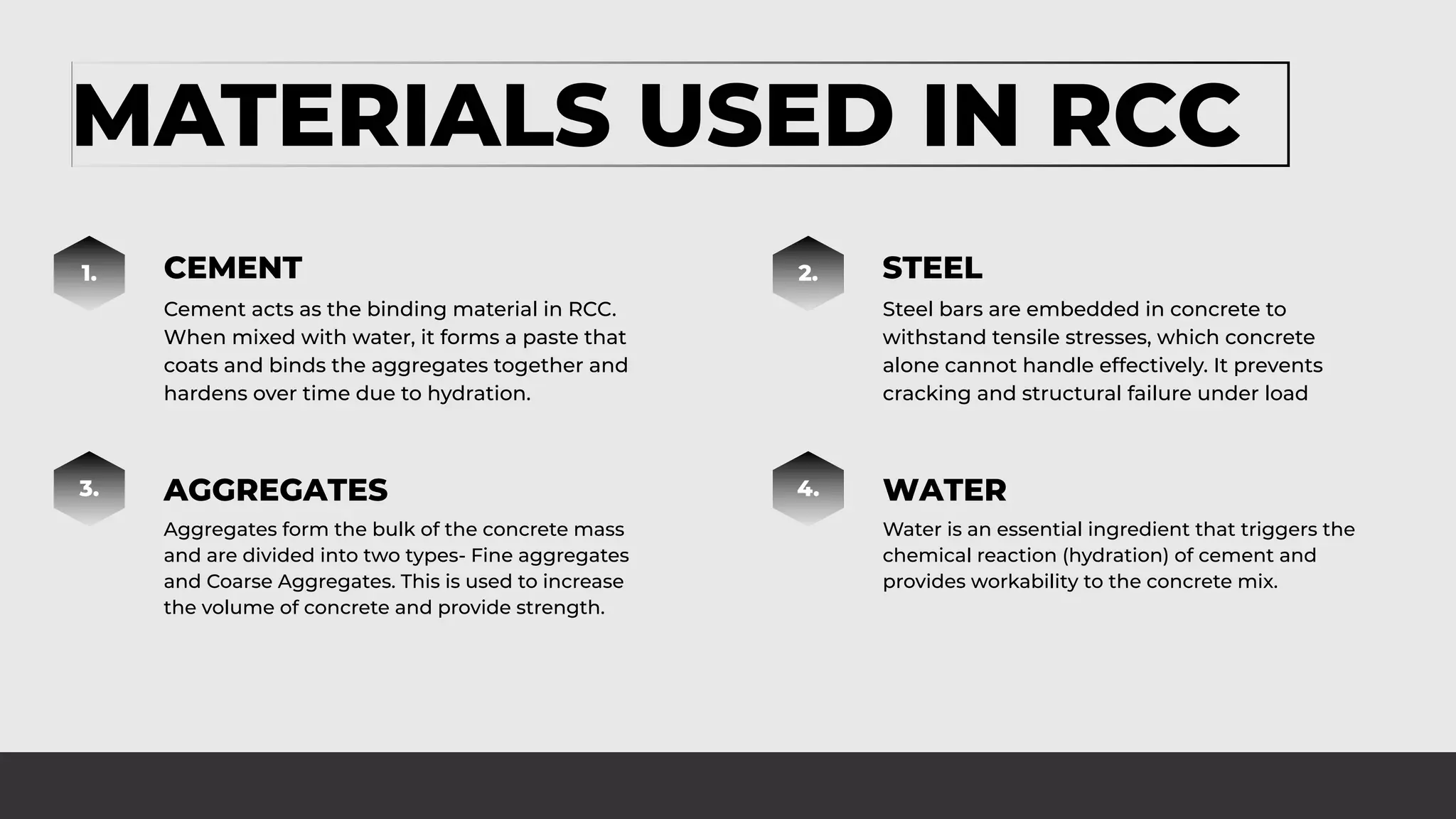
MATERIALS USED INRCC
CEMENT
1.
Cement acts as the binding material in RCC.
When mixed with water, it forms a paste that
coats and binds the aggregates together and
hardens over time due to hydration.
AGGREGATES
3.
Aggregates form the bulk of the concrete mass
and are divided into two types- Fine aggregates
and Coarse Aggregates. This is used to increase
the volume of concrete and provide strength.
STEEL
2.
Steel bars are embedded in concrete to
withstand tensile stresses, which concrete
alone cannot handle effectively. It prevents
cracking and structural failure under load
WATER
4.
Water is an essential ingredient that triggers the
chemical reaction (hydration) of cement and
provides workability to the concrete mix.
5.
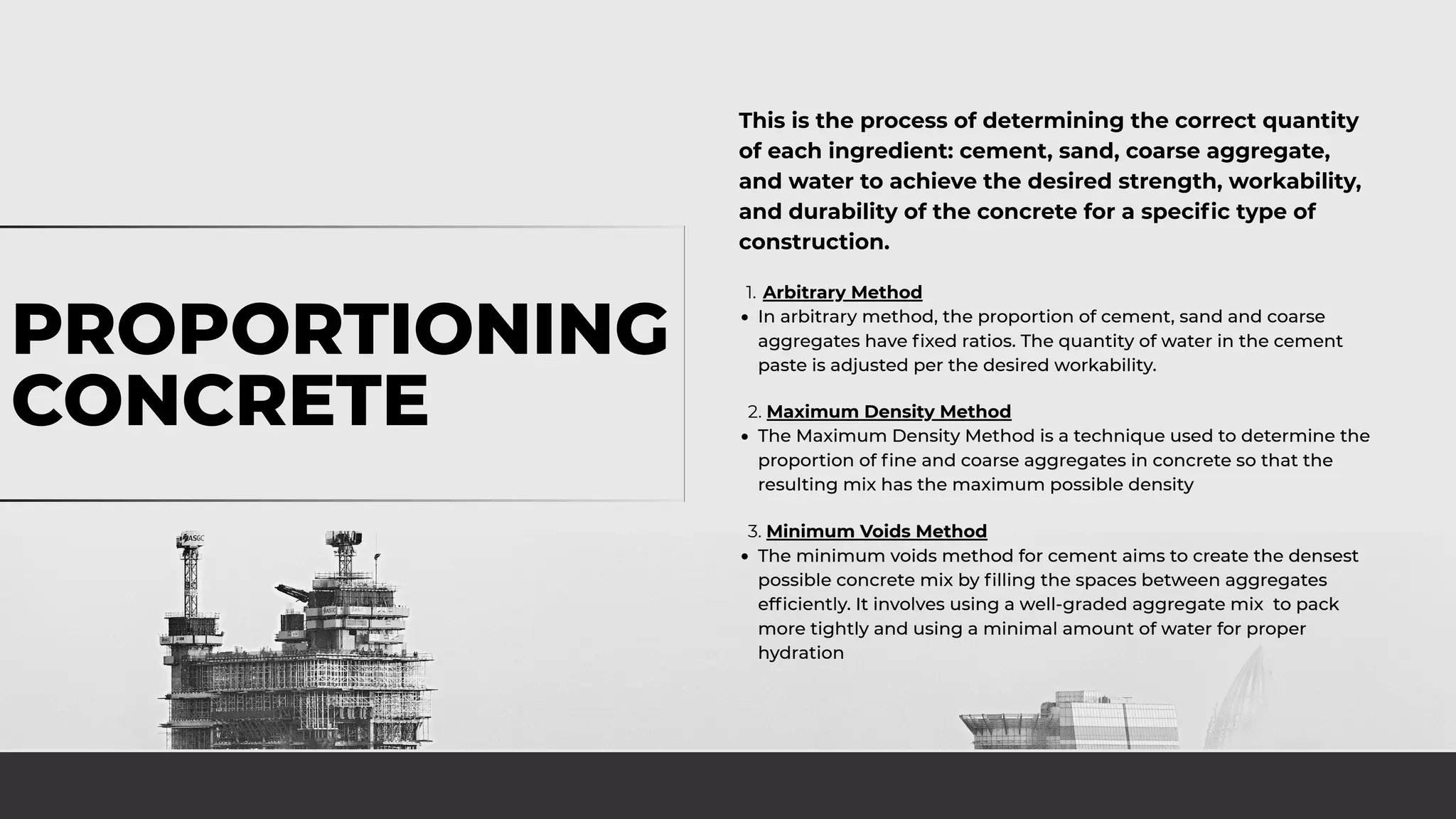
PROPORTIONING
CONCRETE
This is theprocess of determining the correct quantity
of each ingredient: cement, sand, coarse aggregate,
and water to achieve the desired strength, workability,
and durability of the concrete for a specific type of
construction.
1. Arbitrary Method
In arbitrary method, the proportion of cement, sand and coarse
aggregates have fixed ratios. The quantity of water in the cement
paste is adjusted per the desired workability.
2. Maximum Density Method
The Maximum Density Method is a technique used to determine the
proportion of fine and coarse aggregates in concrete so that the
resulting mix has the maximum possible density
3. Minimum Voids Method
The minimum voids method for cement aims to create the densest
possible concrete mix by filling the spaces between aggregates
efficiently. It involves using a well-graded aggregate mix to pack
more tightly and using a minimal amount of water for proper
hydration
6.
TYPES OF MIXING
Mixingof concrete manually on a
clean platform or steel tray using
shovels.
Used for small works like patching,
flooring, minor repairs.
Low initial cost, high labor cost.
Difficult to control water and
proportion accuracy.
Mixing done in a mechanical concrete mixer
for uniform and efficient blending.
Used for large construction works requiring
consistent quality.
High equipment cost, but economical for
large quantities.
Easy to maintain accurate proportions and
water-cement ratio.
Hand Mixing Machine Mixing
7.
WORKABILITY OF
CONCRETE
Workability isthe ease with which concrete can be mixed, placed, compacted,
and finished without loss of uniformity. It helps in ensuring proper compaction
and strength development by reducing voids and providing a uniform texture.
Various tests are conducted to measure this:
The Slump test of concrete is a measure of its consistency
and is a field test. This test indicates the uniformity of
different concrete batches.
The process involves filling a cone-shaped mold with
concrete, tamping it in layers, then lifting the mold to
measure the vertical drop, or "slump".
Slump Test
The Compacting Factor Test is used to measure how easily
concrete can be compacted when the mix has low workability.
It measures the ratio of the partially compacted weight to the
fully compacted weight of a concrete sample to find its
workability The test involves dropping concrete from a
standard height into a cylinder and comparing the weight
before and after full compaction
Compacting Factor Test
8.
CONCRETE CONSTRUCTION
EQUIPMENTS
Road constructionequipment refers to the machinery and tools used for the preparation,
construction, and maintenance of road surfaces. These machines help perform tasks like
grading, mixing, compaction, surfacing, and material transportation efficiently and with
precision.
A concrete bucket is a container used to transport wet concrete
from the mixer to its final position.
The bucket is filled with wet concrete.
It is lifted by cranes, towers, or cable systems to the required
height.
Gate-controlled discharge
Buckets come in different sizes — large ones are used with
cranes or towers, while smaller ones are used for low-level works
Concrete Buckets
It enables precise placement of concrete and at the same times
reduces manual handling but is slower for very large pours and
requires cranes or lifting equipment.
A concrete mixer is a machine used to mix cement, sand,
aggregate, and water to form concrete of uniform consistency.
Aggregates and cement are loaded into a revolving drum with
internal blades.
The drum rotates to mix the ingredients thoroughly.
After mixing, the drum tilts or opens to discharge the concrete.
To ensure quality, the mixing time should be around one to two
minutes and water should be added properly. After use, cleaning
is crucial to prevent hardened concrete inside the drum.
Concrete Mixers
It enables produces uniform, high-quality concrete, saves time
and labor & enables large-scale concrete production but requires
consistent power source.
9.
ROAD CONSTRUCTION
EQUIPMENTS
Road constructionequipment refers to the machinery and tools used for the
preparation, construction, and maintenance of road surfaces. These machines
help perform tasks like grading, mixing, compaction, surfacing, and material
transportation efficiently and with precision.
1.
2.
3.
4.
Bitumen Boiler : Heats bitumen
Concrete Mixer :
Dozer :
Grader :
5.
6.
7.
8.
Road Roller : Compaction
Scarifier :
Scraper :
Tractor : Towing power
9. Miscellaneous :
Prepares cement
concrete
Grading & pushing
material.
Shaping subgrade.
Loosens old road
material
Carries out earthwork
Sprayers, vibrators,
lorries, etc.
10.
DRILLING EQUIPMENTS
Main components: Drill Mast, Drill Bit, Drill Rod, Power Unit, Rotary Head, Feed
System, Mud Pump
Types: Rotary, Percussion, Auger, DTH, Core Drilling.
Applications: piling, soil investigation, water wells.
Advantages: accuracy, depth, and efficiency.
Drilling machines are used to make vertical or inclined holes in the ground for
foundations, soil testing, and installing underground utilities. They operate using
either rotary motion, where the bit continuously cuts into the soil, or percussion
action, where the bit hammers the surface to break rock.
11.
PLACING CONCRETE
UNDER WATER
Thisis used in dams, bridges, deep foundations etc, it becomes necessary to deposit
the concrete under water.
METHODS USED:
1.TREMIE METHOD
A long water-tight pipe (250-300mm) with a hopper on the top.
Concrete flows through the pipe to the bottom without mixing with water.
The pipe is slowing raised as concreting continues.
Used for large underwater works.
Concrete must be ric, with slump 15-20mm.
Water current speed should be less than 50mm/sec.
2. BUCKET METHOD
Concrete is placed in buckets with openable bottoms.
The bucket is lowered and then opened to release concrete.
Used for greater depths.
3. GROUTED CONCRETE:
Cement and sand grout are forced through a pipe to fill voids among aggregates
underwater.
Not commonly used.
12.
When temperature isbelow 15 degrees, curing slows down in setting of concrete but
results in higher ultimate strength.
PRECAUTIONS TO BE TAKEN:
1.CURING: Use warm water or curing compounds to maintain temperature.
2.FORMWORK: Clean and keep free from ice or snow.
3.PROTECTION: Cover and protect fresh concrete from freezing.
4.TEMPERATURE CONTROL: Maintain 15-25 degrees while placing.
5.WATER-CEMENT RATIO: Use minimal water ot water-reducing admixtures.
PLACING CONCRETE IN COLD
& HOT WEATHER
In summer, heat causes water loss and cracks in concrete.
PRECAUTIONS TO BE TAKEN:
1.ADD CHEMICALS: Use retarders to slow down setting.
2.COOL MATERIALS: Pre-cool aggregates to lower concrete temperature.
3.QUICK DEPOSITION: Place concrete immediately after mixing.
4.PROTECTION AFTER PLACING: Cure properly to avoid cracks.
5.WATERING FORMWORK: Keep formwork wet to prevent water loss.
13.
Pre-cast concrete ismade in factory, unlike cast-in-situ (on-site) concrete. It ensures better quality and faster work since
products are made under controlled conditions.
PROCEDURE:
1.Moulds, which may be of timber, steel or sand are prepared.
2.Reinforcement is placed as per design.
3.Concrete is mixed, poured and finished.
4.Products are cured in special tanks.
5.Finished units are transported and placed at site using cranes.
ADVANTAGES:
High-quality concrete due to factory control.
No need for joints or much scaffolding.
Faster construction.
Moulds are reusable.
Units can be dismantled and reused.
Easy shaping and finishing.
DISADVANTAGES:
Risk of damage during transport.
Difficult to connect units perfectly.
Needs special lifting equipment.
Transport and handling can be costly.
PRE-CAST CONCRETE
14.
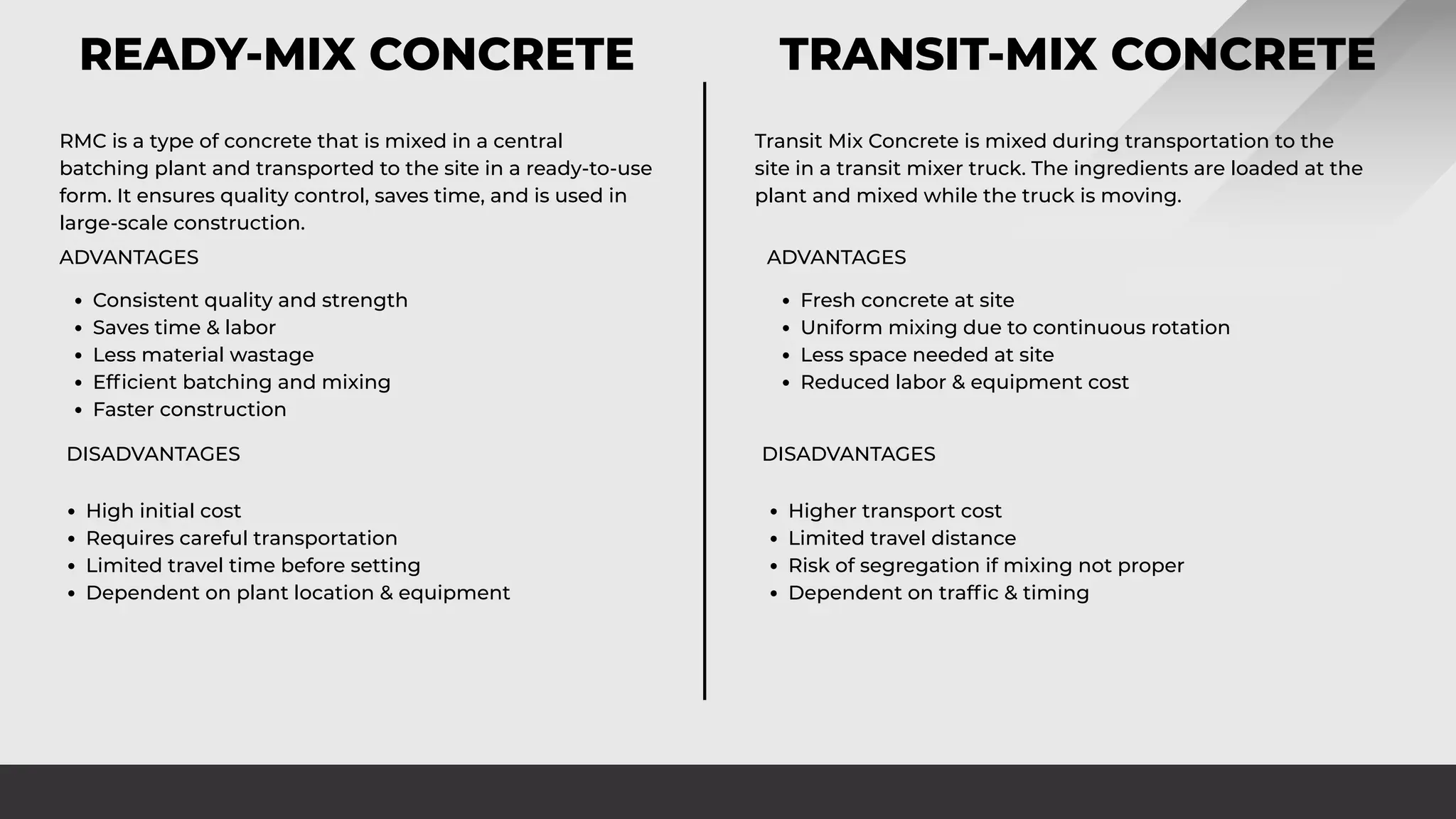
READY-MIX CONCRETE TRANSIT-MIXCONCRETE
Transit Mix Concrete is mixed during transportation to the
site in a transit mixer truck. The ingredients are loaded at the
plant and mixed while the truck is moving.
Fresh concrete at site
Uniform mixing due to continuous rotation
Less space needed at site
Reduced labor & equipment cost
ADVANTAGES
DISADVANTAGES
RMC is a type of concrete that is mixed in a central
batching plant and transported to the site in a ready-to-use
form. It ensures quality control, saves time, and is used in
large-scale construction.
Consistent quality and strength
Saves time & labor
Less material wastage
Efficient batching and mixing
Faster construction
ADVANTAGES
DISADVANTAGES
High initial cost
Requires careful transportation
Limited travel time before setting
Dependent on plant location & equipment
Higher transport cost
Limited travel distance
Risk of segregation if mixing not proper
Dependent on traffic & timing
15.
A framed structureis a building where the load is carried by a skeleton of beams and columns, not by walls.
The walls act only as partitions or coverings, not load-bearing parts.
Main Components:
Columns: Vertical members carrying loads to the foundation.
Beams: Horizontal members supporting slabs.
Slabs: Flat floors or roofs that transfer loads to beams.
Foundation: Transfers building load to the ground.
Load Path: Slab → Beam → Column → Foundation → Ground.
Materials Used: Mainly Reinforced Cement Concrete (RCC) or Steel.
Advantages:
Suitable for multi-storey buildings.
Allows open and flexible floor spaces.
Stronger and more durable than load-bearing walls.
Easier to modify or extend later.
Precautions:
Accurate alignment and spacing of columns.
Proper reinforcement placement.
Strong, well-aligned formwork.
Good concreting and curing practices.
FRAMED STRUCTURES
16.
SUPERVISION OF R.C.C.
WORK
Supervisionof R.C.C. work means carefully checking every stage of
construction to make sure the concrete is strong, durable, and safe. Since
defects in concrete cannot be corrected later, each step must be done
properly under supervision.
1.
2.
3.
4.
CEMENT
FINE AGGREGATE
WATER
PROPORTION
5.
6.
7.
8.
CENTERING
REINFORCEMENT
MIXING
CONSOLIDATION
9. CURING AND FINISHING
CLASSIFICATION
OF EQUIPMENTS
Intermittent Type
MixedType
Continous Flow Type
Also known as batch-type equipment which works in
cycles — it does one batch of work at a time, then
stops before starting the next.
It handles one lot or group of materials at a time.
Flexible: Can be used for making different products
by changing settings.
Example: Concrete Mixer, Bulldozer or Scraper.
It works non-stop, meaning materials keep going in
and finished products keep coming out all the time.
There’s no pause between batches — the process runs
continuously.
Best for making a large quantity of the same product.
Runs all the time, so it saves time and increases
output.
Example: Belt Conveyers, Air compresser, Pipelines
Combination of both intermittent (works in batches) and
continuous (works non-stop) types. It means some parts of
the machine work continuously, while others stop and start
as needed.
Example: Motor grader: It moves forward continuously on
the road, but the blade that levels the ground is adjusted
intermittently (only when needed).
19.
SELECTION OF EQUIPMENT
Standardizationand Justification:
Whenever possible, choose standard
equipment. If specialized equipment is
needed, there must be a clear and strong
justification for it.
Production Planning:
The choice of equipment is a crucial early
step that will influence the entire production
or execution plan.
Past Experience:
Look at how the equipment performed on
similar jobs in the past — it helps you make a
smarter choice.
Cost and Savings:
The money saved by using the machine
should be more than the cost of buying or
renting it.
Economic and Technical Value:
Choose equipment that gives good
performance at the lowest cost — technically
strong and financially worth it.
Versatility:
Pick machines that can do more than one job
or have parts that can be changed for
different uses.
Support and Skilled Workers:
Make sure there are trained people nearby
who can operate and repair the machine
when needed.
Lifespan and Future Use:
The machine should last for a good number
of years and be useful for future projects, or
have a plan for resale or disposal.
20.
STANDARD EQUIPMENT
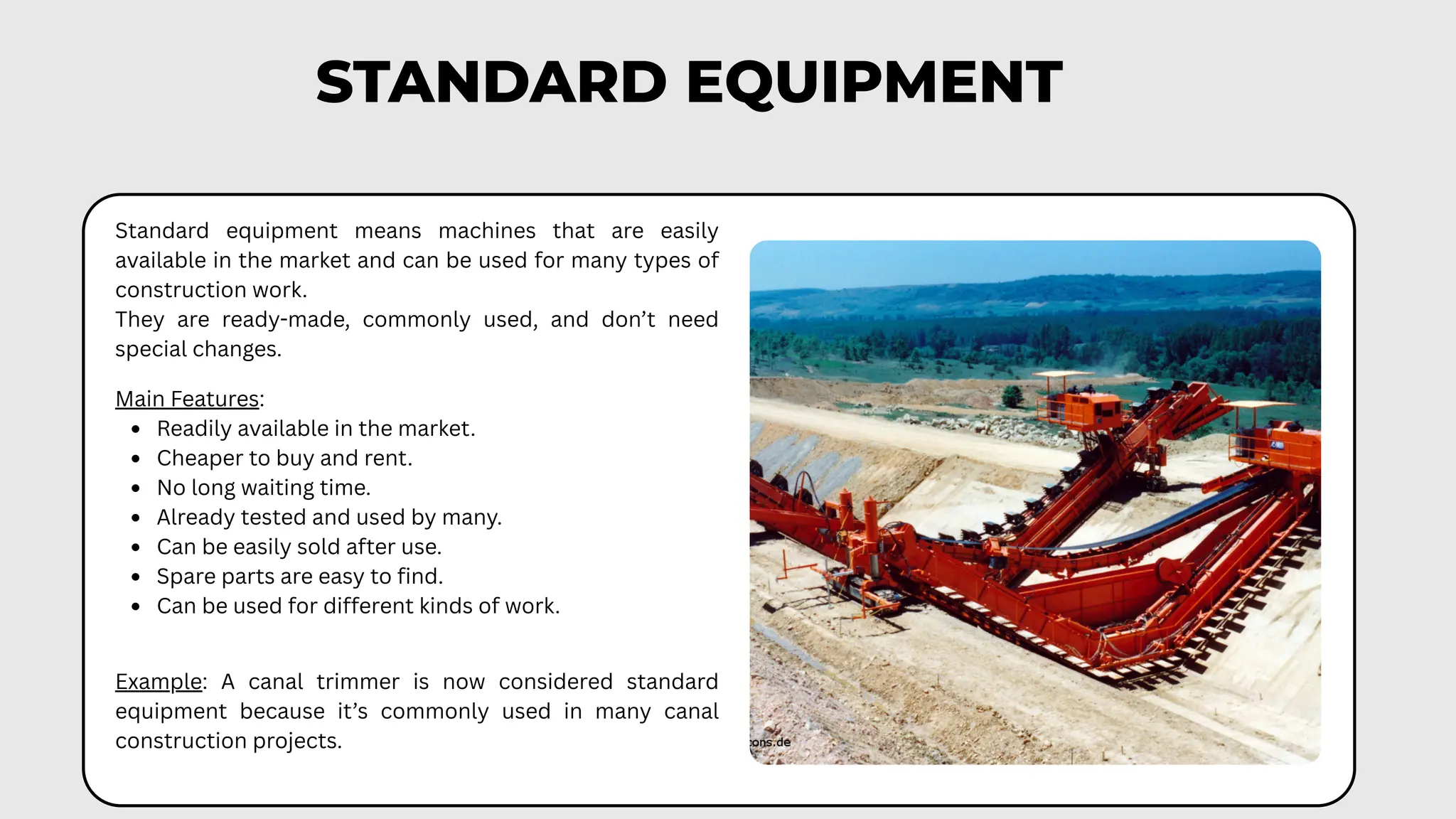
Standard equipmentmeans machines that are easily
available in the market and can be used for many types of
construction work.
They are ready-made, commonly used, and don’t need
special changes.
Main Features:
Readily available in the market.
Cheaper to buy and rent.
No long waiting time.
Already tested and used by many.
Can be easily sold after use.
Spare parts are easy to find.
Can be used for different kinds of work.
Example: A canal trimmer is now considered standard
equipment because it’s commonly used in many canal
construction projects.
21.
Special equipment meansmachines made for one specific
job or project.
They are custom-built or specially modified to do tasks
that normal machines can’t handle.
Main Features:
Usually made on order.
High initial cost.
Custom design takes longer.
Needs proper financial planning before buying.
Not many buyers since it’s made for a unique
purpose.
New or modified design may have issues.
Costly to rent.
Spare parts are hard to find.
Meant for very specific tasks.
Example: A belt conveyor used only to carry materials in
one big construction project can be considered special
equipment for that project.
SPECIAL EQUIPMENT
22.
OWNING & OPERATING
COST
Thefactors which affect the cost of owning & operating equipment are as follows :
Cost of the equipment delivered to the owner
Demand of such equipment at the end of its useful life which will affect the salvage
value
number of hours it is used per year
number of years it is used
severity of the conditions under which it is used
state of mainteinance and repairs
23.
Cost to beconsidered for arriving at the cost
1.Depreciation (Loss in Value Over Time)
When a machine gets older, its value goes down — this is called depreciation. It happens due to wear
and tear, age, or newer models coming out.
a. Straight-Line Method (SLM):
The value reduces equally every year.
Formula:
(Initial Cost – Salvage Value) ÷ Useful Life
Example: If a machine costs ₹10 lakh, will last 5 years, and can be sold for ₹1 lakh
Depreciation = (10,00,000 – 1,00,000) / 5 ₹1.8 lakh per year.
b. Constant percentage Method
The machine loses more value in the early years and less later.
Each year, a fixed percentage is applied to its remaining value.
c. Sinking Fund Method:
Money is set aside every year in a fund so that, with interest, it equals the machine’s cost by the time it
needs replacing.
Used rarely, but helpful for long-term planning.
24.
2. Investing charges(cost of owning the
machine)
These are costs you pay just for owning the
equipment, even if it’s not being used.
Interest on Capital: If bought with a loan, you
pay interest. Even if bought with cash, that
money could’ve earned interest elsewhere
(opportunity cost).
Taxes: Some equipment may be taxed annually.
Insurance: To protect it from theft, accidents, or
damage.
Storage: Cost of keeping it safe when not in use
(like rent or maintenance of storage area).
3.Maintenance & Repairs
Machines need regular care to stay in good shape.
Routine Maintenance: Regular services like oil
changes, greasing, filter replacement, etc.
Major Repairs: Fixing big breakdowns or
replacing important parts.
High-Wear Parts: Replacing tires, tracks, or
cutting edges that wear out over time.
Labor Costs: Paying mechanics and
technicians who repair or maintain the
machine.
These costs depend on how old the machine is,
how well it’s maintained, and how hard it’s used.
4. Operating cost (cost while using the machine
These are the day-to-day running costs when the machine is actually
working.
Fuel: Diesel, petrol, or gas used to run the machine.
Lubricants: Oils and greases needed for smooth operation.
Operator’s Wages: Salary of the person running the machine.
Tires/Tracks: Replacements when worn out.
Consumables: Small items used up during work (filters, bolts, etc.).
25.
ECONOMIC LIFE OFTHE EQUIPMENT
The economic life of a machine means the time period during which it is most cost-effective to use it.
It’s the stage where the machine gives the best work for the least total cost.
When a machine is new, it works well, needs little repair, and the cost per hour is low.
As time passes, it starts needing more repairs and maintenance, so the cost per hour goes up.
After some years, using the old machine becomes more expensive than buying a new one.
That’s when the economic life ends — it’s better to replace the machine than to keep repairing it.
When to replace the Equipment
4. Normal Deterioration
Over time, parts wear out and
performance drops.If the machine
starts giving poor results, it’s time
to replace it.
5. Obsolescence
Even if the machine works fine,
newer models might do the same
job faster and cheaper.Then it’s
smart to replace the old one with a
modern, more efficient machine.
6. Working Method
If the machine is handled roughly
or not maintained properly, it will
wear out sooner.Good care helps
extend its life; careless use
shortens it.
1. Depreciation (Loss in Value):
The older the machine, the less
it’s worth.
When its value becomes too low,
it’s not worth keeping anymore.
2. Downtime
Older machines break down more
often.More breakdowns mean less
work and more cost — so
replacement is better.
3. Inadequacy
When the machine can’t handle the
workload or finish jobs fast enough,
you may need a newer or bigger
model.
26.
SOURCES OF EQUIPMENT
DirectPurchase Hiring
Suitable when equipment is used frequently
or for a long time.
Advantages:
1.Economical in the long run.
2.Better maintenance and care.
3.Always available for use.
Disadvantages:
1.High initial investment.
2.Equipment may become outdated.
3.Risk of low resale value and high storage
cost.
Suitable for short-term or occasional use.
Advantages:
1.Low maintenance responsibility.
2.Equipment available at short notice.
3.Saves investment cost.
4.No risk of equipment becoming obsolete.
Sometimes, contractors use a combination
method — hiring first and purchasing later if
the equipment proves useful.
EXCAVATING EQUIPMENT
These aremachines used to dig in the ground. The most
common one is called an excavator (or digger), which has a
big metal arm with a bucket on the end.
They are used for digging holes, trenches (long, narrow
ditches), and foundations for buildings. They can also be used
to demolish old structures or move large, heavy objects.
This equipment saves a huge amount of time and manual
labor. It can dig much faster and deeper than people can by
hand, making it essential for starting almost any construction
project.
29.
EARTH COMPACTION EQUIPMENT
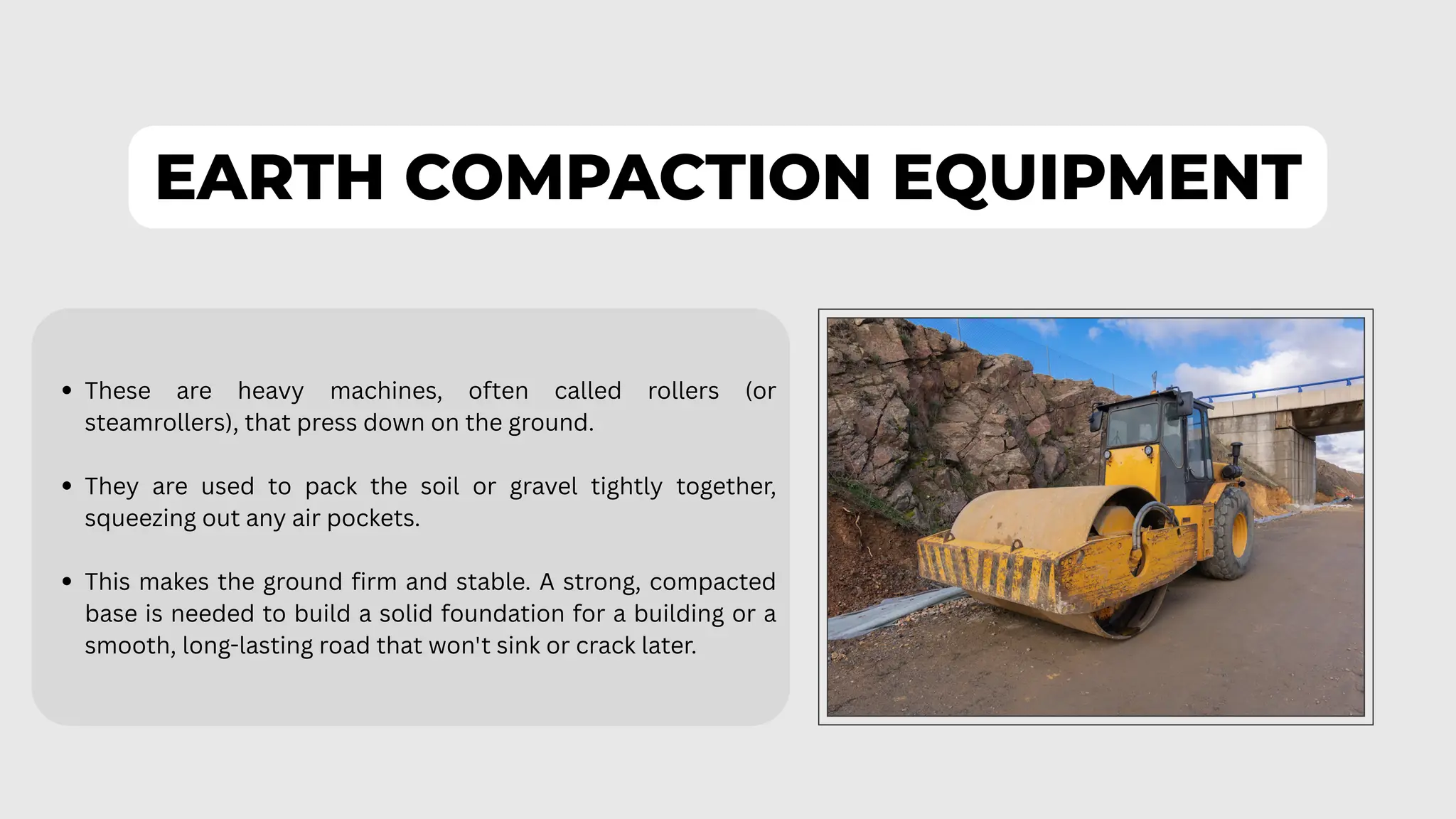
Theseare heavy machines, often called rollers (or
steamrollers), that press down on the ground.
They are used to pack the soil or gravel tightly together,
squeezing out any air pockets.
This makes the ground firm and stable. A strong, compacted
base is needed to build a solid foundation for a building or a
smooth, long-lasting road that won't sink or crack later.
30.
HAULING EQUIPMENT
These arelarge trucks used for moving materials. The most
common type is a dump truck
They are used to "haul" (or carry) large amounts of dirt, sand,
gravel, rocks, and construction waste from one place to
another, either around the construction site or to and from
the site
They make it easy to remove all the dirt from an excavation or
to bring in new materials needed for building, saving a lot of
time and trips.
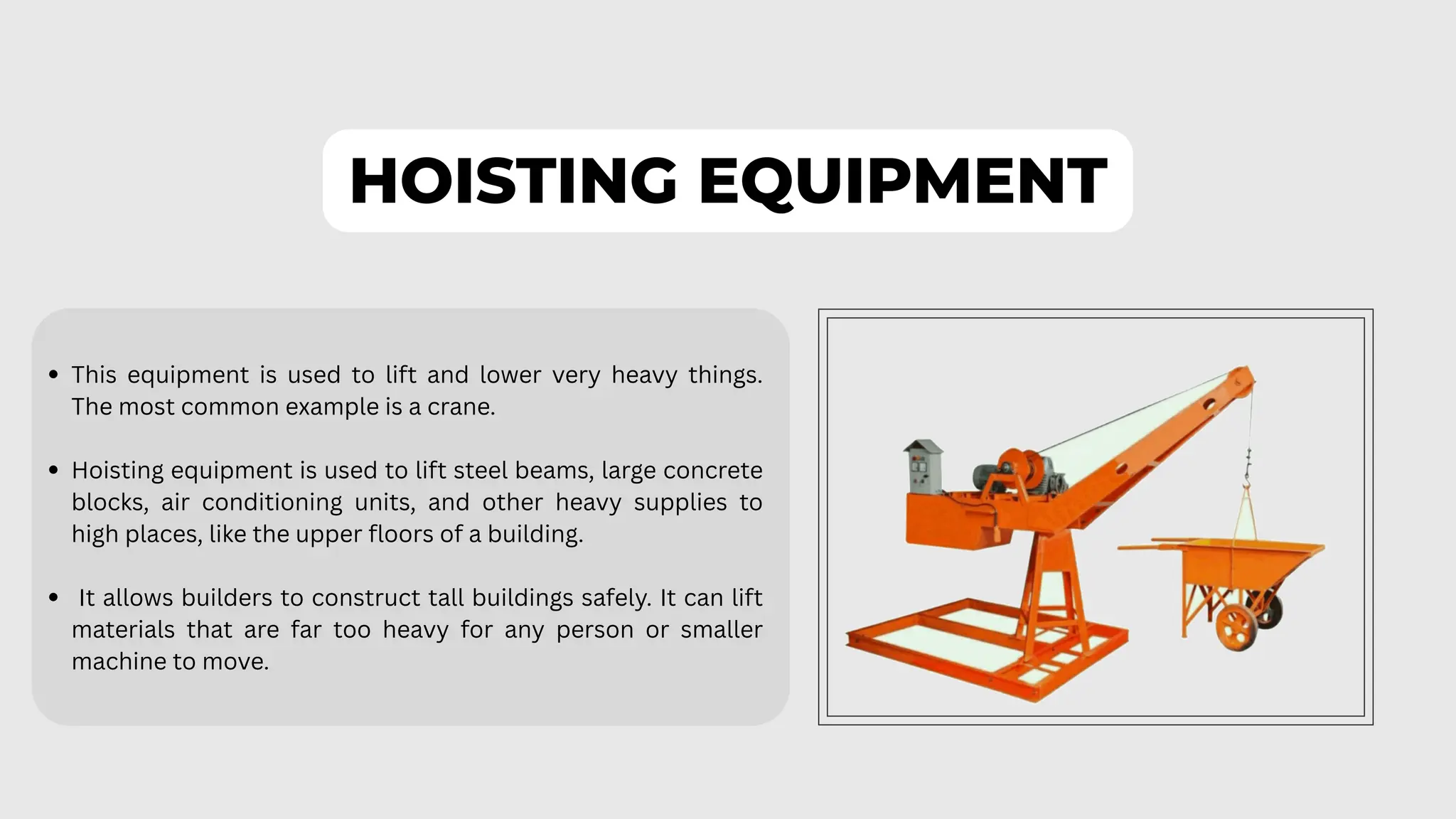
31.
HOISTING EQUIPMENT
This equipmentis used to lift and lower very heavy things.
The most common example is a crane.
Hoisting equipment is used to lift steel beams, large concrete
blocks, air conditioning units, and other heavy supplies to
high places, like the upper floors of a building.
It allows builders to construct tall buildings safely. It can lift
materials that are far too heavy for any person or smaller
machine to move.
32.
CONVEYING EQUIPMENT
This isa machine that moves materials on a long, moving belt.
It's called a conveyor belt.
It's used to move a steady stream of materials like sand,
gravel, or dirt over a distance or up to a different level
without having to use trucks
It provides a continuous, automatic way to move materials,
which is very efficient and saves labor. It's like a moving
walkway for construction supplies.
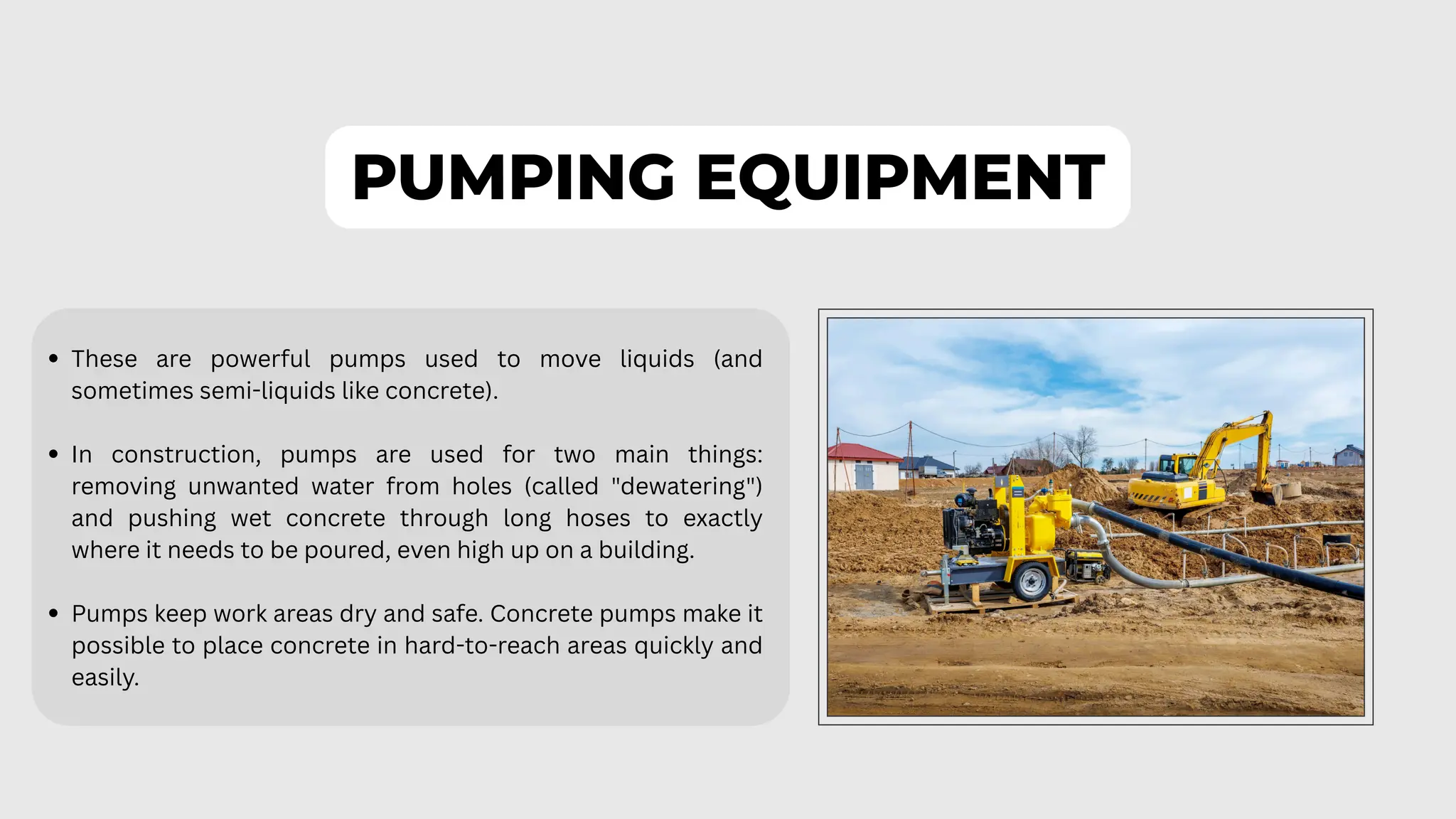
33.
PUMPING EQUIPMENT
These arepowerful pumps used to move liquids (and
sometimes semi-liquids like concrete).
In construction, pumps are used for two main things:
removing unwanted water from holes (called "dewatering")
and pushing wet concrete through long hoses to exactly
where it needs to be poured, even high up on a building.
Pumps keep work areas dry and safe. Concrete pumps make it
possible to place concrete in hard-to-reach areas quickly and
easily.