CONCRETE
• Concrete –
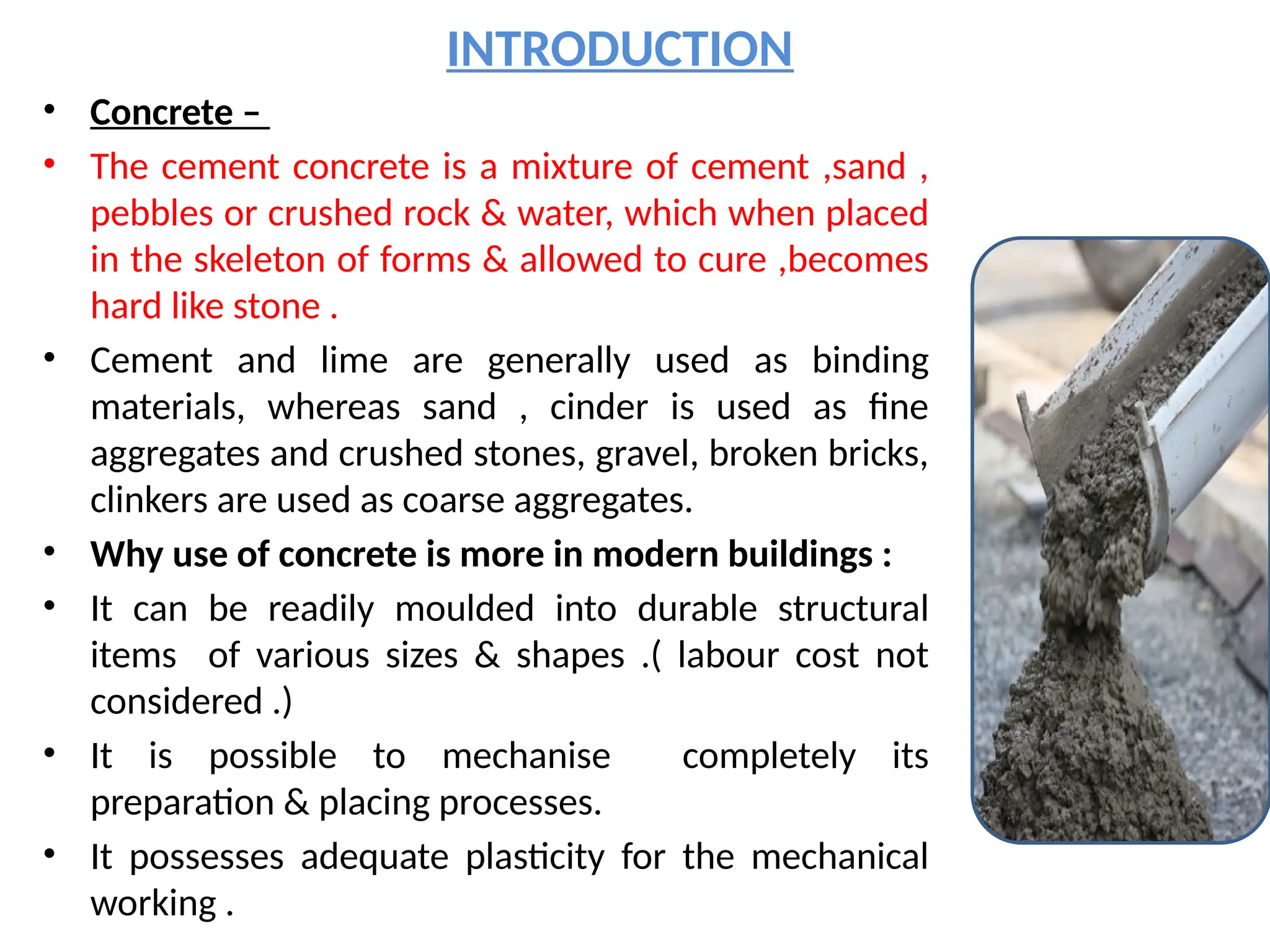
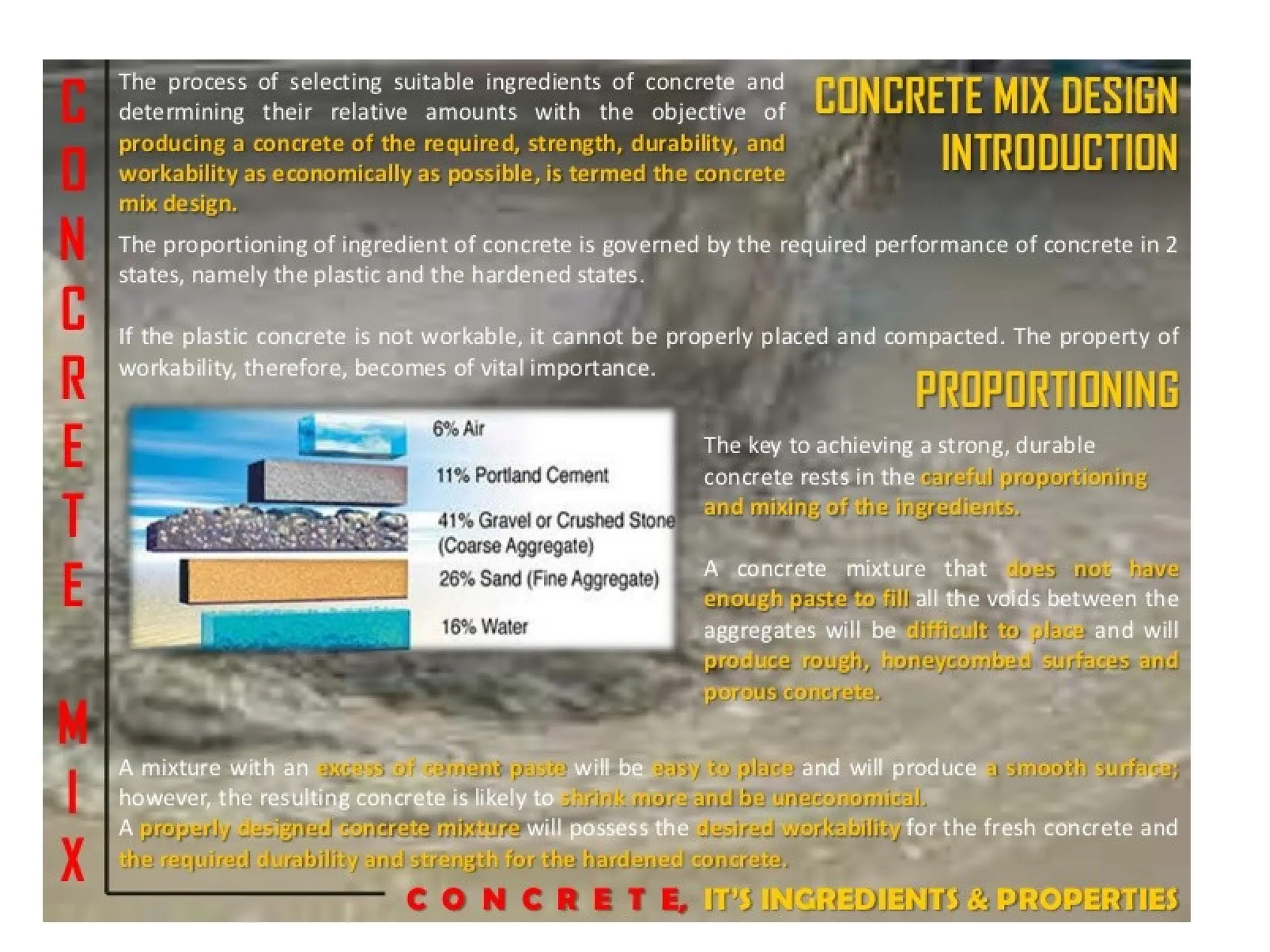
• The cement concrete is a mixture of cement ,sand ,
pebbles or crushed rock & water, which when placed
in the skeleton of forms & allowed to cure ,becomes
hard like stone .
• Cement and lime are generally used as binding
materials, whereas sand , cinder is used as fine
aggregates and crushed stones, gravel, broken bricks,
clinkers are used as coarse aggregates.
• Why use of concrete is more in modern buildings :
• It can be readily moulded into durable structural
items of various sizes & shapes .( labour cost not
considered .)
• It is possible to mechanise completely its
preparation & placing processes.
• It possesses adequate plasticity for the mechanical
working .
INTRODUCTION
Components of Concrete
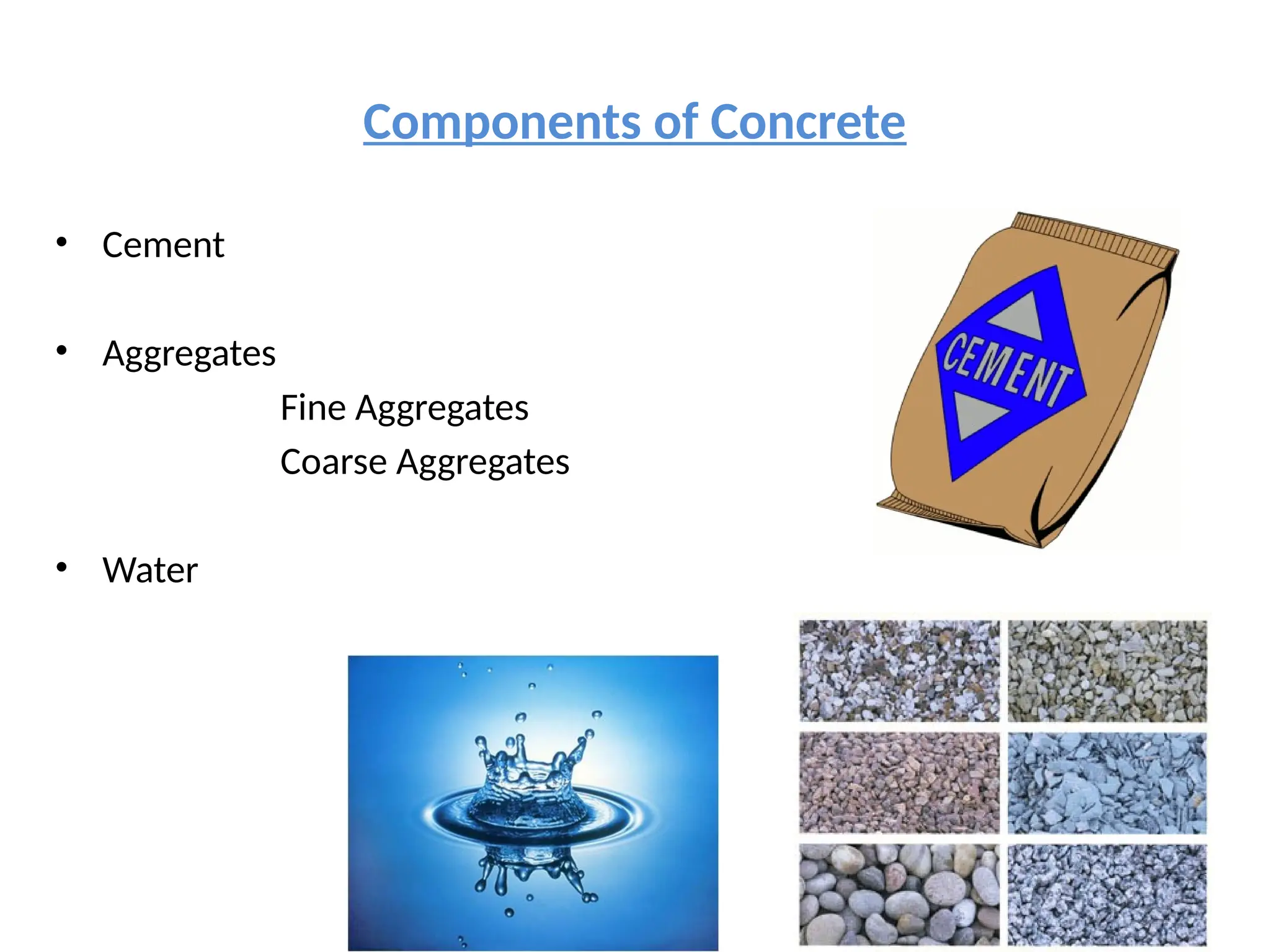
• Cement
• Aggregates
Fine Aggregates
Coarse Aggregates
• Water
Production of concrete
• A good quality concrete is essentially a homogeneous mixture of
cement, coarse and fine aggregates and water which consolidates
into a hard mass due to chemical action between the cement and
water.
• Each of the four constituents has a specific function.
• The coarser aggregate acts as a filler.
• The fine aggregate fills up the voids between the paste and the
coarse aggregate.
• The cement in conjunction with water acts as a binder.
• The mobility of the mixture is aided by the cement paste, fines and
nowadays, increasingly by the use of admixtures .
QUALITIES OF GOOD CONCRETE
• STRENGTH:
• The concrete should be able to withstand the stresses that it is subjected
to. It is quite strong in compression but weak in tension.
• DURABILITY:
• It should be durable enough to resist the effect of weathering agents.
• DENSITY:
• The concrete should be well compacted so that there are no voids or
hollows left. It should weigh 3000 kg/cum
• WATER TIGHTNESS:
• When used for construction of water retaining structures such as dams,
elevated tanks and water reservoirs , then this property of concrete
becomes very important. Otherwise the moisture inside the RCC would
corrode steel and leakage would start resulting in the ultimate failure of
the structure.
• WORKABILITY: It should be easily workable.
• RESISTANCE TO WEAR AND TEAR:
• When used in floors and in the construction of roads , the concrete
should be able to withstand abrasive forces.
GREEN CONCRETE & SET CONCRETE
Freshly prepared concrete till it has not yet set is called wet or green
concrete. After it has thoroughly set and fully hardened it is called
set concrete or just concrete.
Properties of cement concrete
• It has a high compressive strength.
• It is free from corrosion & there no effect of atmospheric agents on
it.
• It hardens with age & the process continues for a longer time after
the concrete has attained sufficient strength.
• It is economical than steel. The main ingredient is aggregate which
is almost 80-90% of total weight .this is available at moderate cost .
• It binds rapidly with steel.
• It forma a hard surface ,capable of resisting abrasion.
Materials used in R.C.C.Work
• Following four materials are required for making R.C.C.work
1. Cement
2. Aggregate
3. Steel
4. Water
Cement – Nowadays , ‘Ordinary Portland Cement’ (OPC) which is
available in three grades should be used for house construction.
Before this , lime was used as a cementing material. But other
special varieties of cement such as rapid hardening cement and
high alumina cement are used under certain circumstance. The
cement should comply with all the standard requirements.
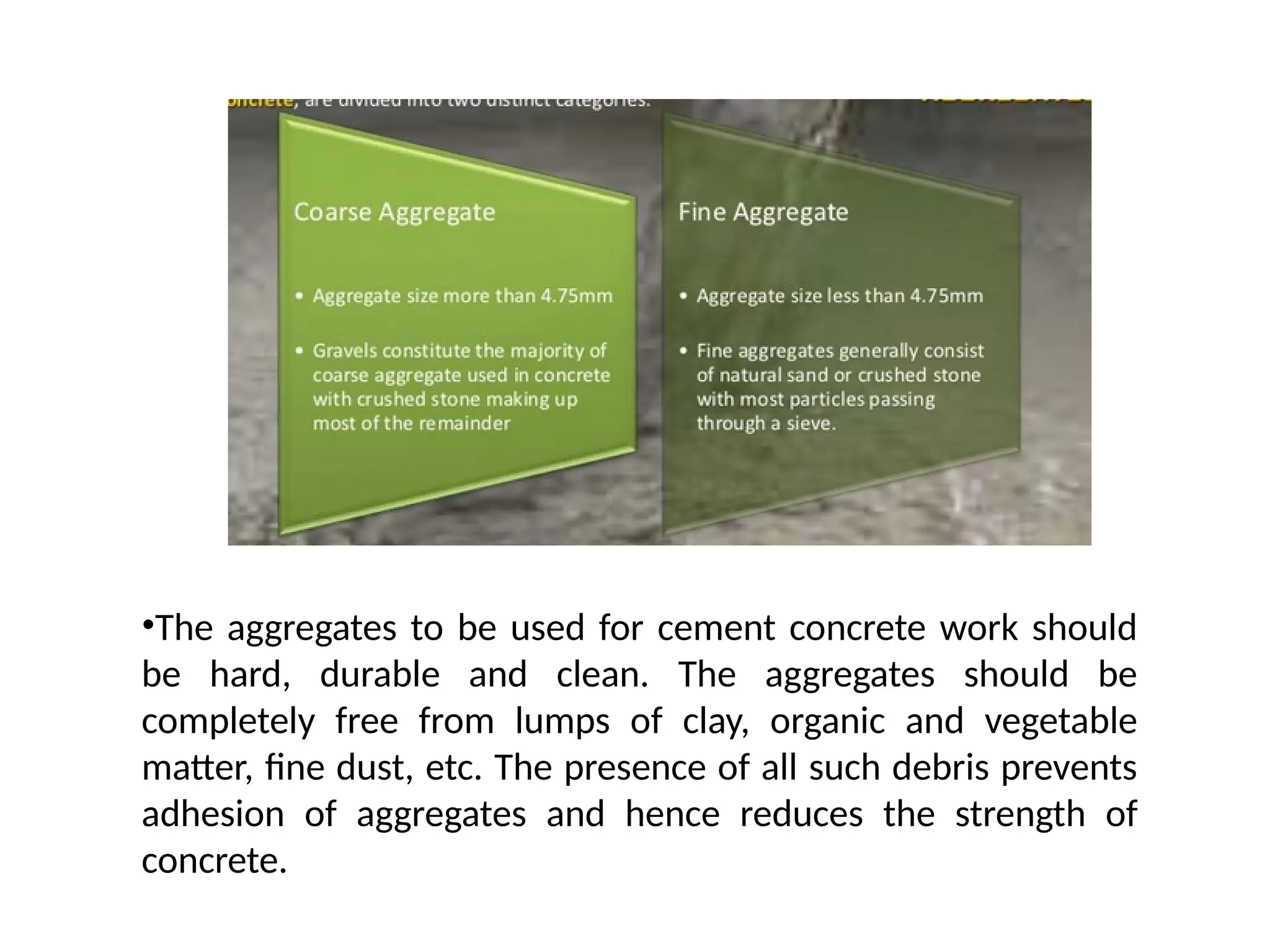
• Aggregate - These are the inert or chemically inactive
materials which form the bulk of cement concrete. These
aggregates are bound together by means of cement. The
aggregates are classified into two categories: fine and
coarse.
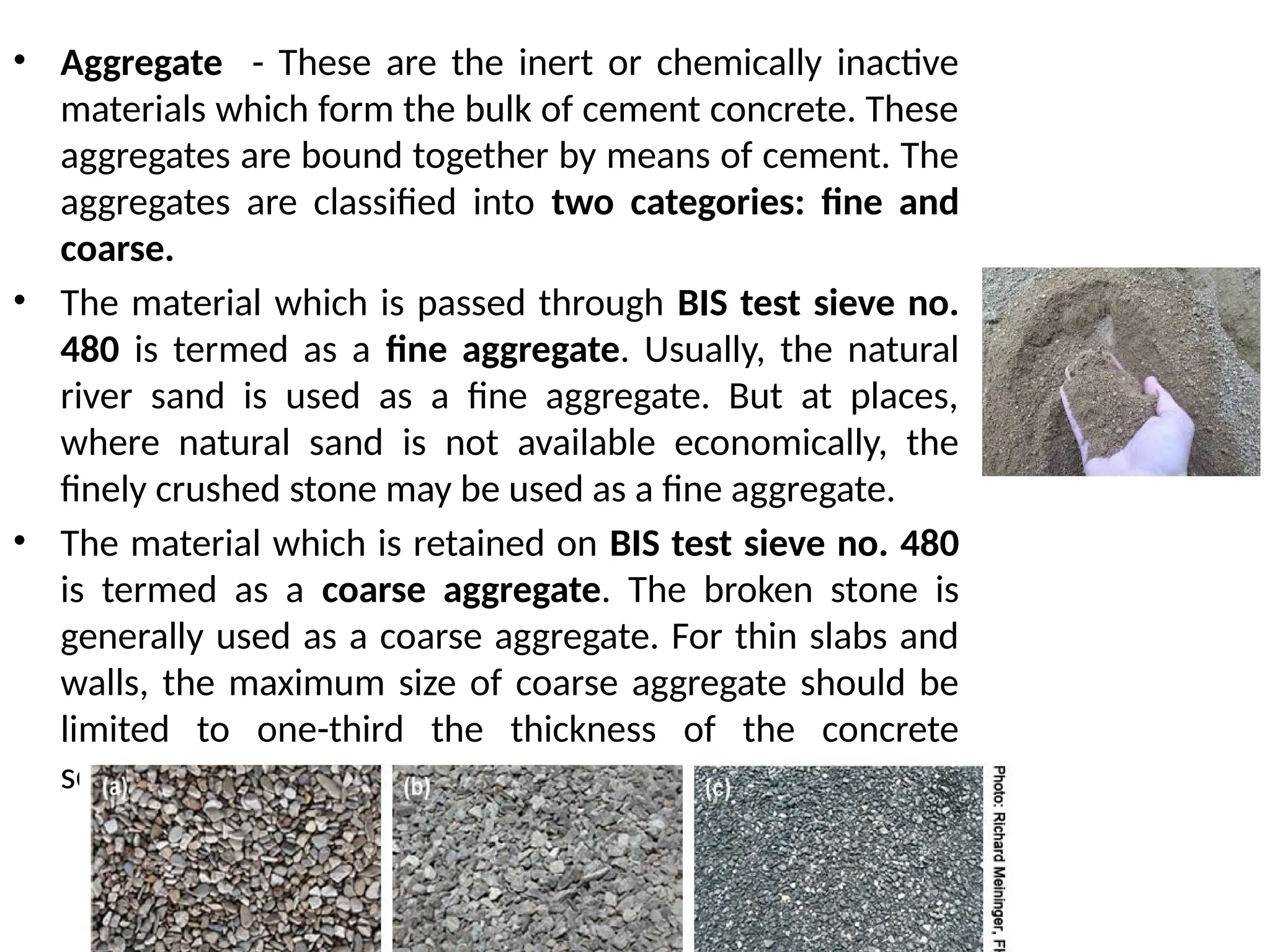
• The material which is passed through BIS test sieve no.
480 is termed as a fine aggregate. Usually, the natural
river sand is used as a fine aggregate. But at places,
where natural sand is not available economically, the
finely crushed stone may be used as a fine aggregate.
• The material which is retained on BIS test sieve no. 480
is termed as a coarse aggregate. The broken stone is
generally used as a coarse aggregate. For thin slabs and
walls, the maximum size of coarse aggregate should be
limited to one-third the thickness of the concrete
section.
•The aggregates to be used for cement concrete work should
be hard, durable and clean. The aggregates should be
completely free from lumps of clay, organic and vegetable
matter, fine dust, etc. The presence of all such debris prevents
adhesion of aggregates and hence reduces the strength of
concrete.
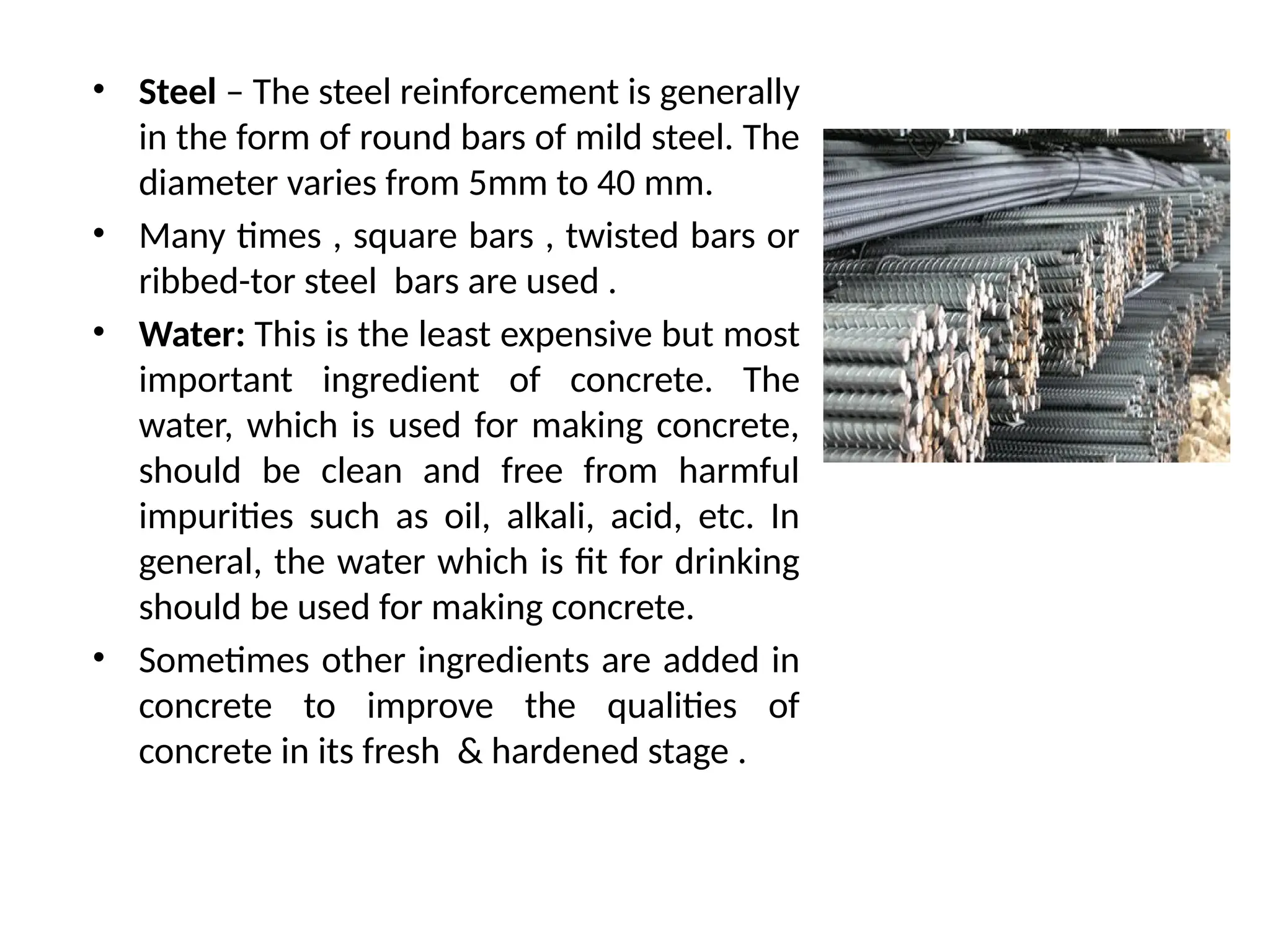
• Steel – The steel reinforcement is generally
in the form of round bars of mild steel. The
diameter varies from 5mm to 40 mm.
• Many times , square bars , twisted bars or
ribbed-tor steel bars are used .
• Water: This is the least expensive but most
important ingredient of concrete. The
water, which is used for making concrete,
should be clean and free from harmful
impurities such as oil, alkali, acid, etc. In
general, the water which is fit for drinking
should be used for making concrete.
• Sometimes other ingredients are added in
concrete to improve the qualities of
concrete in its fresh & hardened stage .
Admixtures
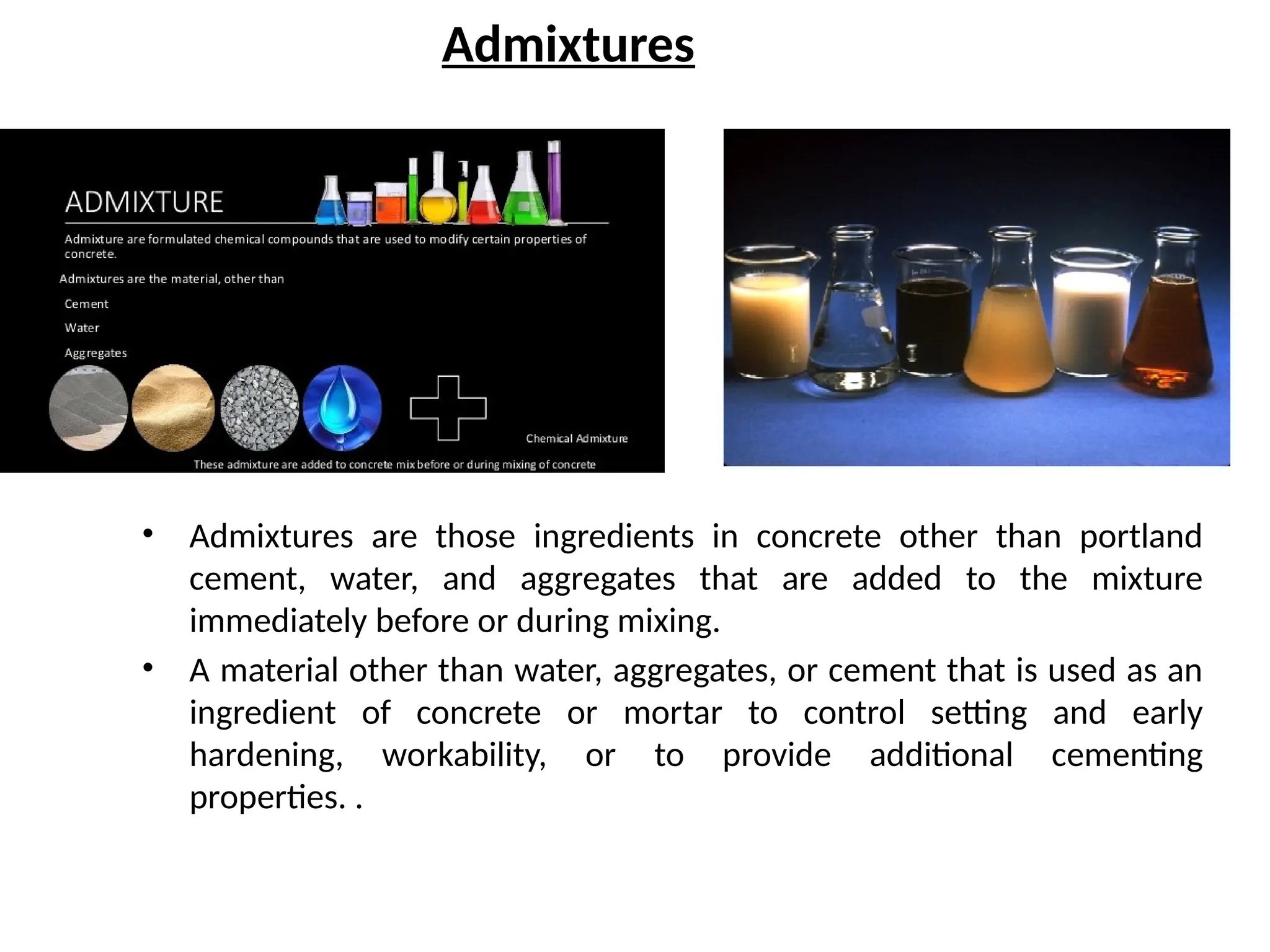
• Admixtures are those ingredients in concrete other than portland
cement, water, and aggregates that are added to the mixture
immediately before or during mixing.
• A material other than water, aggregates, or cement that is used as an
ingredient of concrete or mortar to control setting and early
hardening, workability, or to provide additional cementing
properties. .
Admixtures
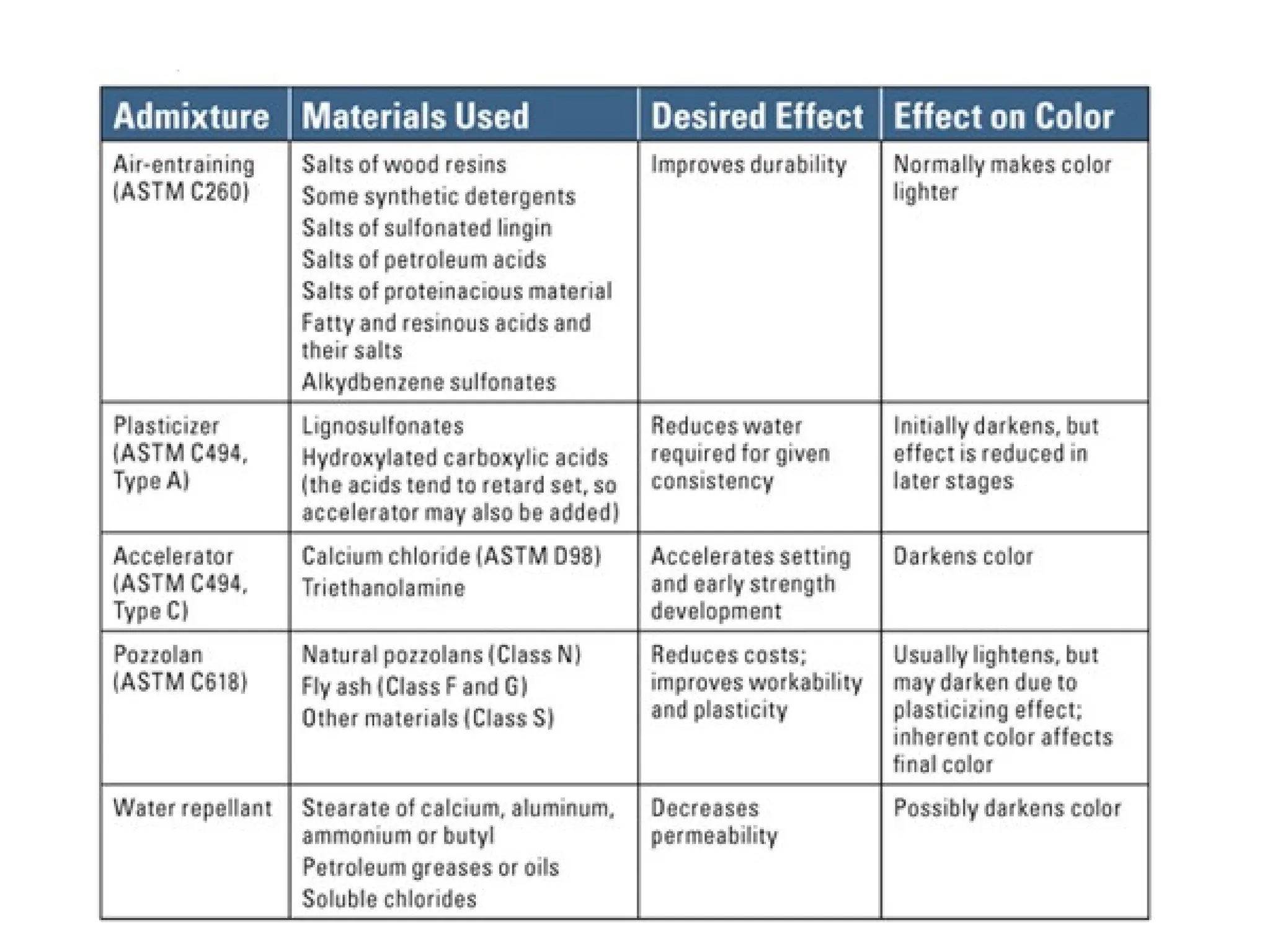
• Admixtures can be classified by function as follows:
• 1. Air-entraining admixtures
• 2. Water-reducing admixtures
• 3. Plasticizers
• 4. Accelerating admixtures
• 5. Retarding admixtures
• 6. Hydration-control admixtures
• 7. Corrosion inhibitors
• 8. Shrinkage reducers
• 9. Alkali-silica reactivity inhibitors
• 10. Coloring admixtures
• 11. Miscellaneous admixtures such as workability, bonding,
dampproofing, permeability reducing, grouting, gas-forming,
antiwashout, foaming, and pumping admixtures .
• Concrete should be workable, finishable, strong, durable,
watertight, and wear resistant. These qualities can often be
obtained easily and economically by the selection of suitable
materials rather than by resorting to admixtures (except air-
entraining admixtures when needed).
• The major reasons for using admixtures are:
• 1. To reduce the cost of concrete construction
• 2. To achieve certain properties in concrete more effectively than
by other means
• 3. To maintain the quality of concrete during the stages of mixing,
transporting, placing, and curing in adverse weather conditions
• 4. To overcome certain emergencies during concreting operations
• The effectiveness of an admixture depends upon factors such as
type, brand, and amount of cementing materials; water content;
aggregate shape, gradation, and proportions; mixing time; slump;
and temperature of the concrete.
Proportioning Concrete
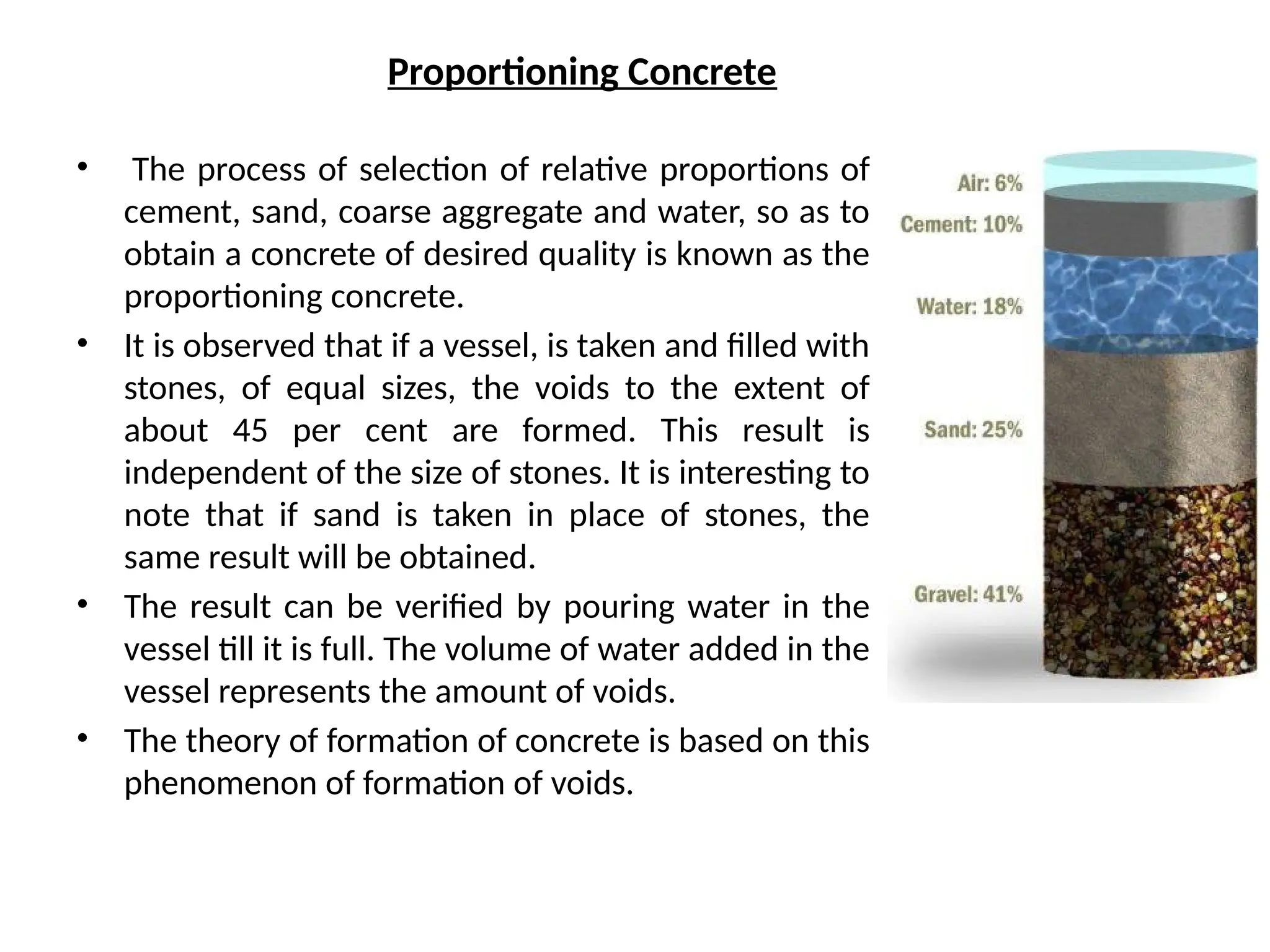
• The process of selection of relative proportions of
cement, sand, coarse aggregate and water, so as to
obtain a concrete of desired quality is known as the
proportioning concrete.
• It is observed that if a vessel, is taken and filled with
stones, of equal sizes, the voids to the extent of
about 45 per cent are formed. This result is
independent of the size of stones. It is interesting to
note that if sand is taken in place of stones, the
same result will be obtained.
• The result can be verified by pouring water in the
vessel till it is full. The volume of water added in the
vessel represents the amount of voids.
• The theory of formation of concrete is based on this
phenomenon of formation of voids.
Proportioning Concrete
• When coarse aggregate is placed, such voids are formed.
• When fine aggregate i.e. sand is added, it occupies these voids.
• Further, when finely powdered cement is added, it occupies the voids of
sand particles.
• Finally, when water is added, it occupies very fine voids between the
cement particles. During the process of setting, a chemical reaction takes
place between water and cement. This results n an absolutely solid
substance, known as the concrete.
• In general, the proportions of coarse aggregate, fine aggregate, cement and
water should be such that the resulting concrete has the following
properties:
(1) When concrete is fresh, it should have enough workability so that it can
be placed in the formwork economically.
(2) The concrete must possess maximum density or in other words, it should
be the strongest and most watertight.
(3) The cost of materials and labour required to form the concrete should be
minimum.
• Following are the different methods of proportions concrete:
(1) Arbitrary method
• (2) Fineness modulus method
• (3) Water cement ratio method
• (4) Minimum voids method
Grading of Aggregates
• In order to obtain concrete of denser quality, the fine and coarse
aggregates are properly graded.
• The grading of fine aggregates is expressed in terms of BIS test no.
480, 240, 120, 60, 30 and 15.
• The grading of fine aggregates has a marked effect on the
uniformity, workability and finishing qualities of concrete.
• The grading of coarse aggregates may be varied through wider
limits than those of sand without appreciable effect on the
workability of concrete.
• In general, it can be stated that it is difficult to provide satisfactory
grading of coarse aggregates than of sand.
WATER CEMENT RATIO
• A cement of average composition requires about 25% of water by mass for
chemical reaction. In addition, an amount of water is needed to fill the gel
pores.
• In The preparation of concrete the water cement ratio is very important .
• For normal construction, the water cement ratio is usually 0.5 .
• Adding to much water will reduce the strength of concrete and can cause
segregation.
• The water in concrete has to perform the following functions :
• The water enters into chemical action with cement & this action causes
the setting & hardening of concrete.
• The water lubricates the aggregates & it facilitates the passage of cement
through voids of aggregates . Thus water makes the concrete workable .
• Water required for these two functions is about 0.50 to 0.60 times the
weight of the cement.
• The ratio of amount of water to the amount of cement by weight is
termed as the Water Cement ratio .
• The strength & quality of concrete primarily depend s upon this ratio.
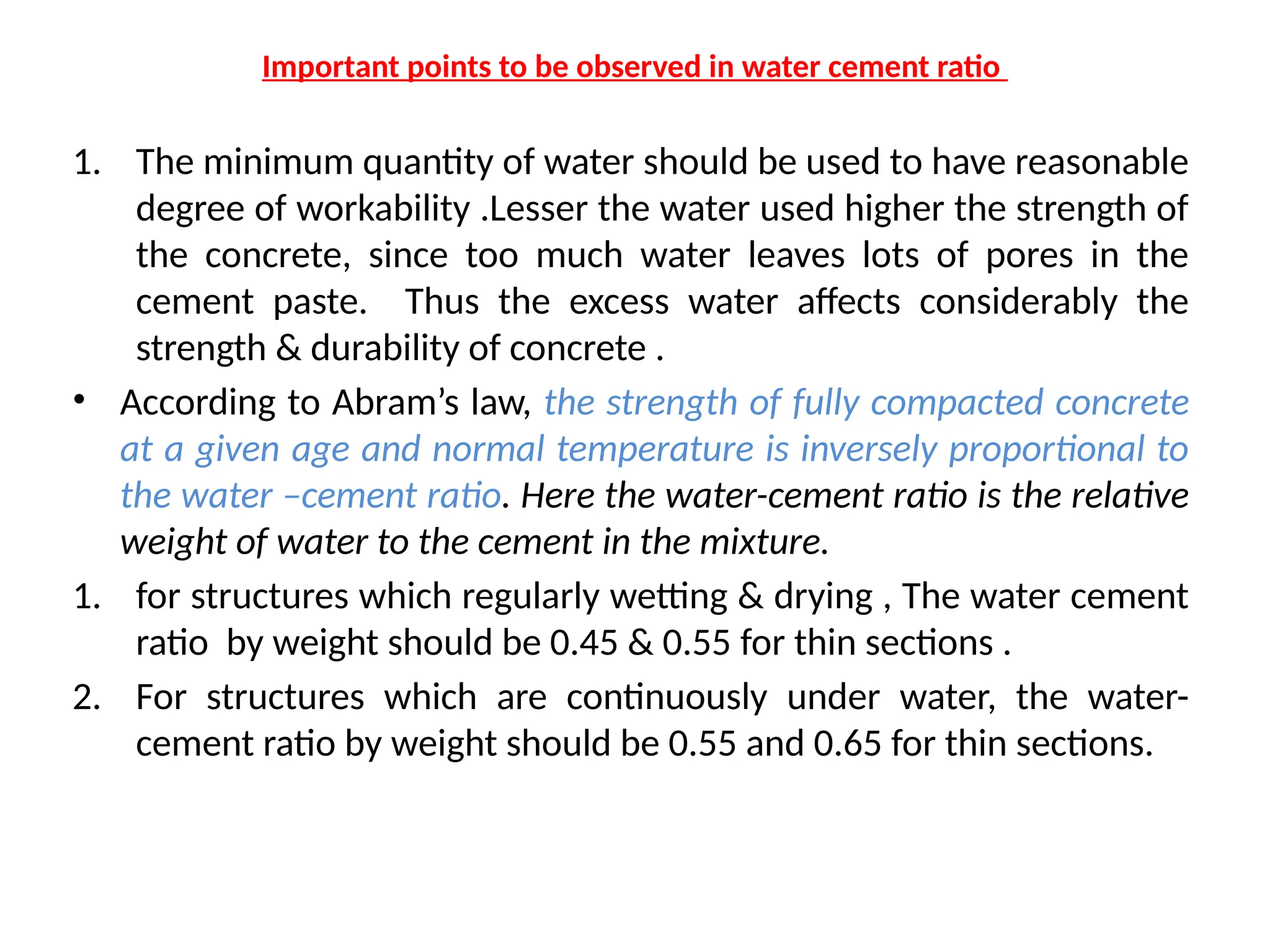
Important points to be observed in water cement ratio
1. The minimum quantity of water should be used to have reasonable
degree of workability .Lesser the water used higher the strength of
the concrete, since too much water leaves lots of pores in the
cement paste. Thus the excess water affects considerably the
strength & durability of concrete .
• According to Abram’s law, the strength of fully compacted concrete
at a given age and normal temperature is inversely proportional to
the water –cement ratio. Here the water-cement ratio is the relative
weight of water to the cement in the mixture.
1. for structures which regularly wetting & drying , The water cement
ratio by weight should be 0.45 & 0.55 for thin sections .
2. For structures which are continuously under water, the water-
cement ratio by weight should be 0.55 and 0.65 for thin sections.
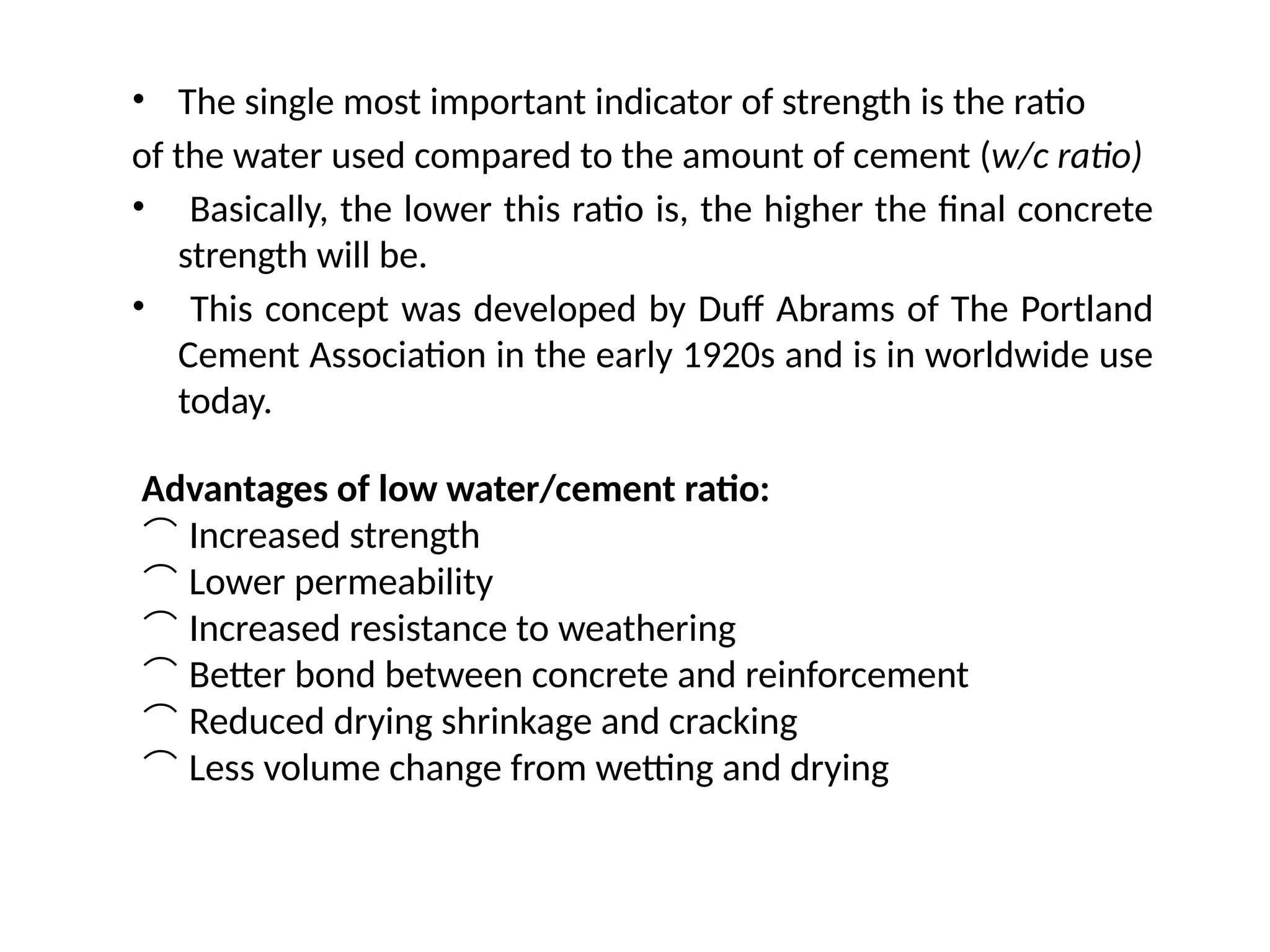
• The single most important indicator of strength is the ratio
of the water used compared to the amount of cement (w/c ratio)
• Basically, the lower this ratio is, the higher the final concrete
strength will be.
• This concept was developed by Duff Abrams of The Portland
Cement Association in the early 1920s and is in worldwide use
today.
Advantages of low water/cement ratio:
 Increased strength
 Lower permeability
 Increased resistance to weathering
 Better bond between concrete and reinforcement
 Reduced drying shrinkage and cracking
 Less volume change from wetting and drying
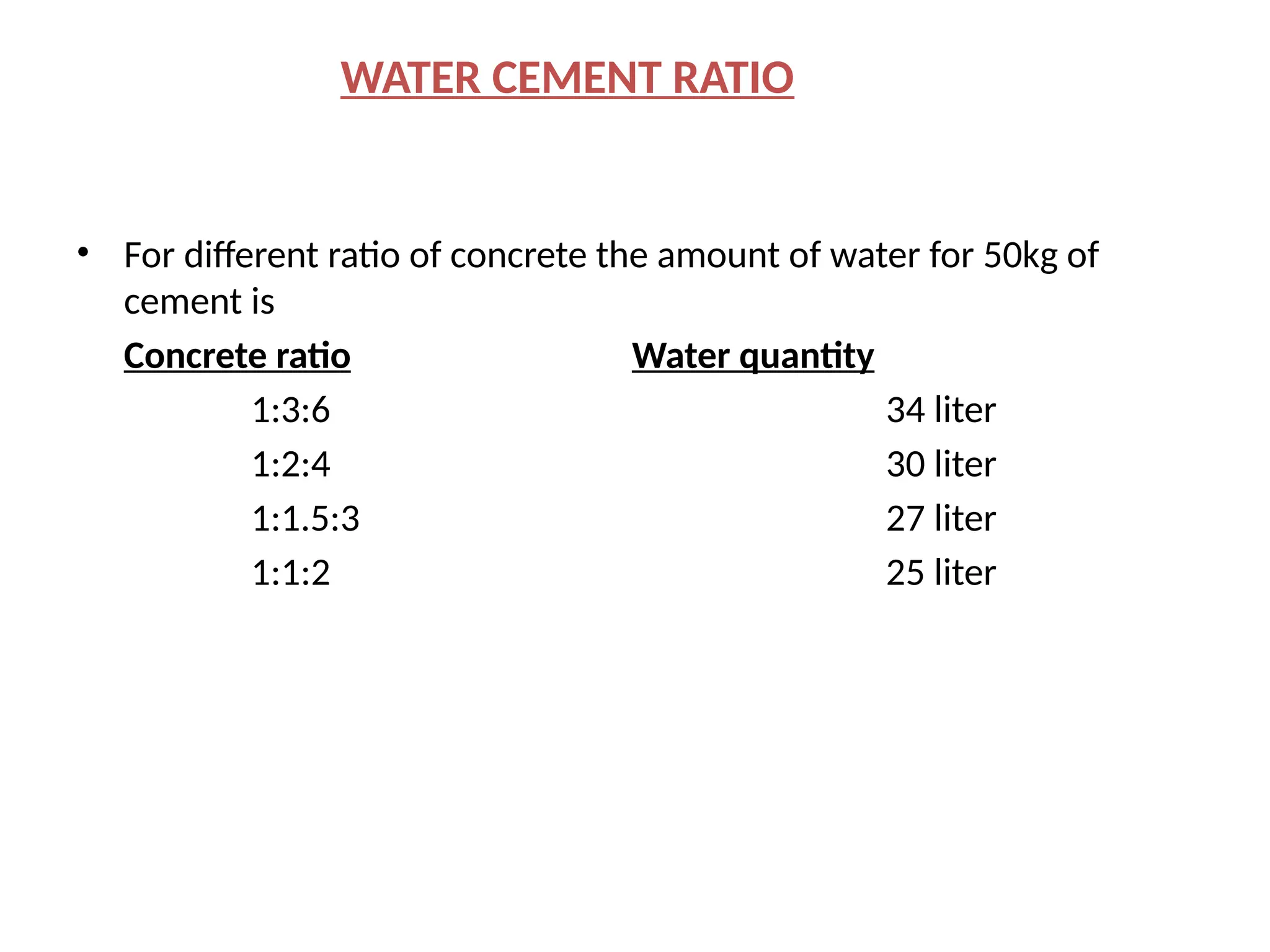
WATER CEMENT RATIO
• For different ratio of concrete the amount of water for 50kg of
cement is
Concrete ratio Water quantity
1:3:6 34 liter
1:2:4 30 liter
1:1.5:3 27 liter
1:1:2 25 liter
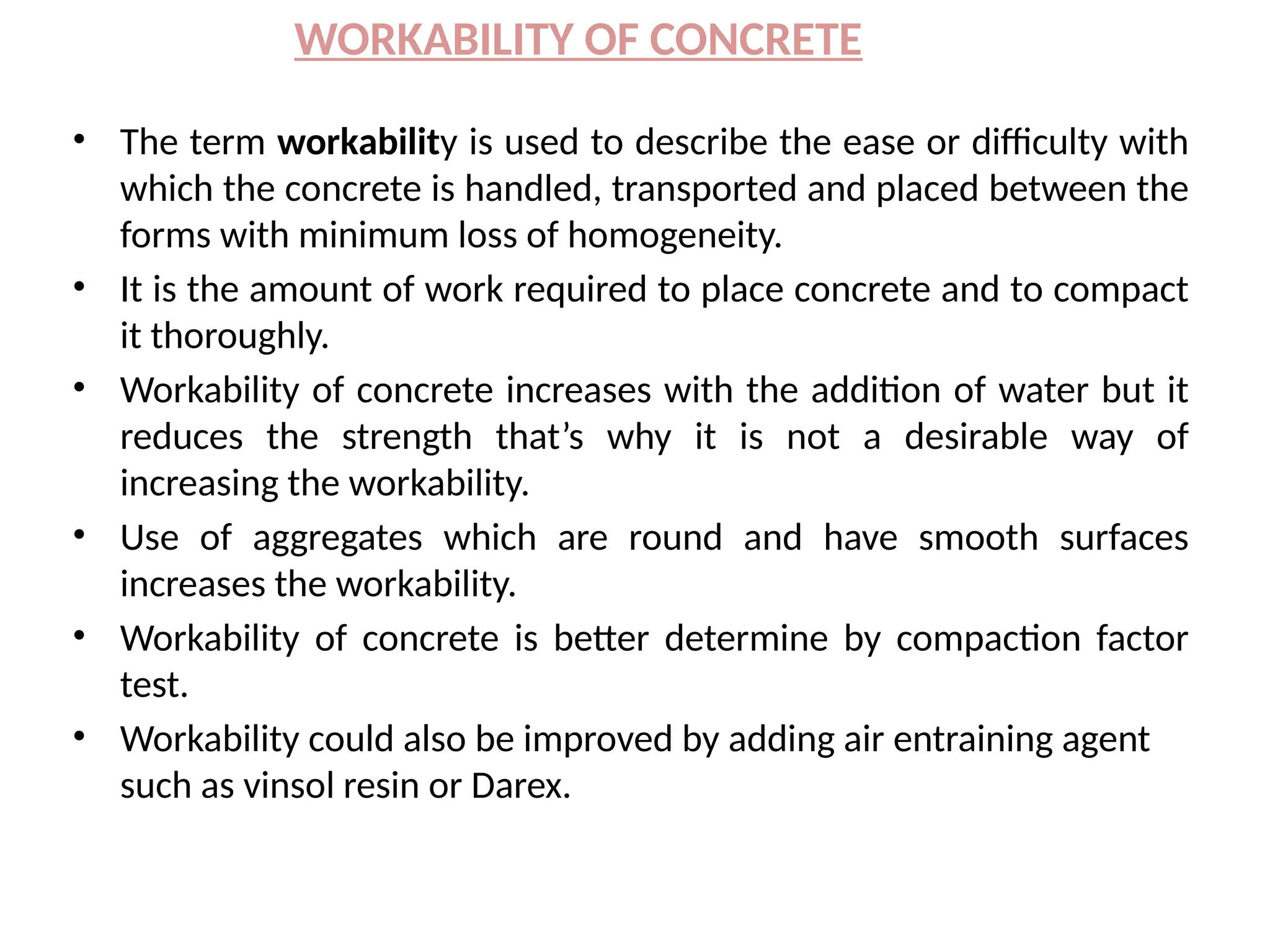
WORKABILITY OF CONCRETE
• The term workability is used to describe the ease or difficulty with
which the concrete is handled, transported and placed between the
forms with minimum loss of homogeneity.
• It is the amount of work required to place concrete and to compact
it thoroughly.
• Workability of concrete increases with the addition of water but it
reduces the strength that’s why it is not a desirable way of
increasing the workability.
• Use of aggregates which are round and have smooth surfaces
increases the workability.
• Workability of concrete is better determine by compaction factor
test.
• Workability could also be improved by adding air entraining agent
such as vinsol resin or Darex.
• The important points in connection with workability are as follows :
• If more water is added to attain the required degree of workability , the
concrete will be of lower strength & poor durability .
• The degree of workability can be obtained :
• 1. by slightly changing the proportion of fine & coarse aggregate ,when the
mixture is too wet .
• 2. by adding a small quantity of water cement paste in the proportion of
original mix, if the mixture is too dry .
• The workability of concrete is affected mainly by water content , water
cement ratio & aggregate cement ratio .
• It is also affected by grading , shaping ,texture & max. size of coarse
aggregates which are to be used in mixture .
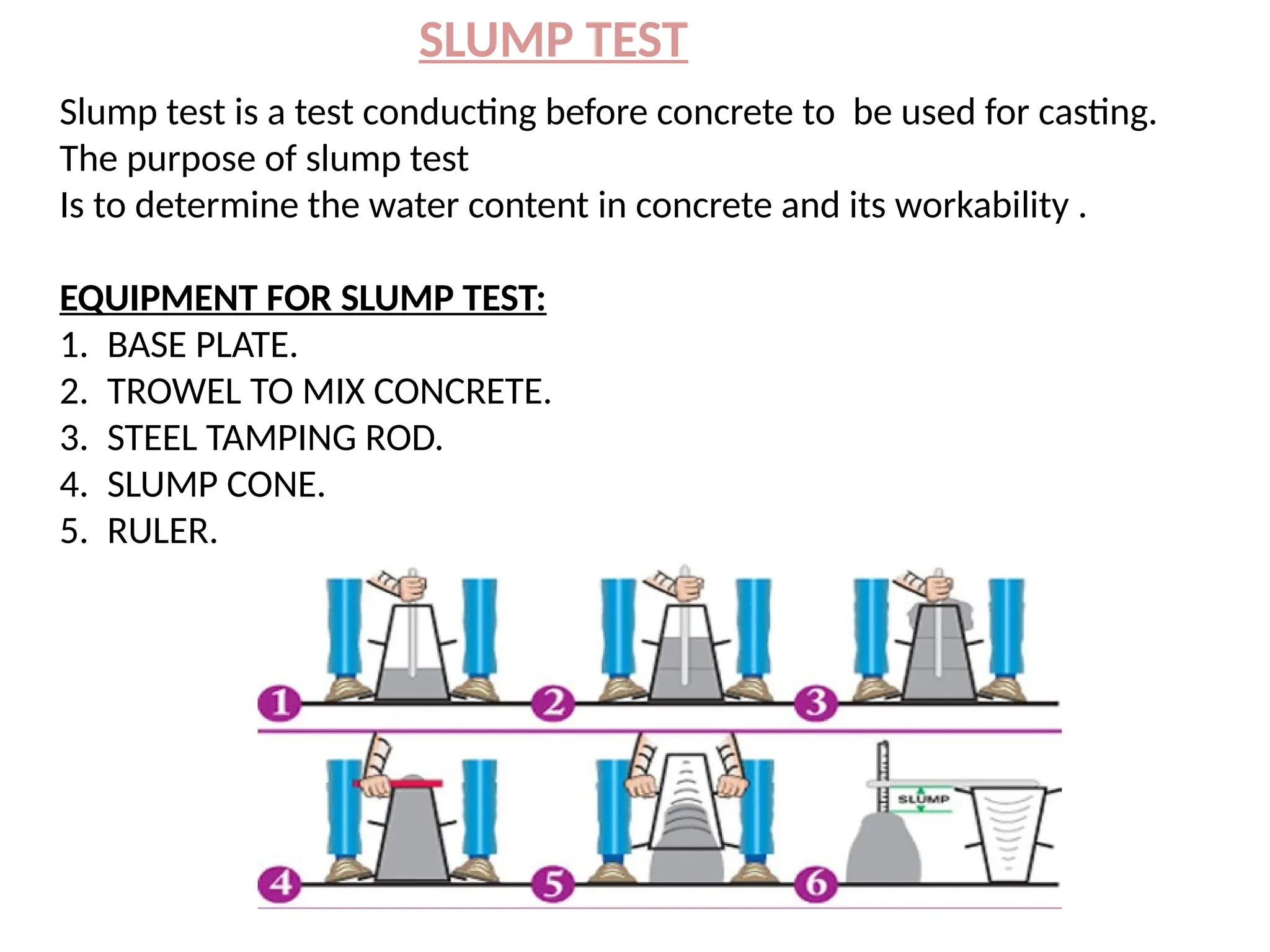
SLUMP TEST
Slump test is a test conducting before concrete to be used for casting.
The purpose of slump test
Is to determine the water content in concrete and its workability .
EQUIPMENT FOR SLUMP TEST:
1. BASE PLATE.
2. TROWEL TO MIX CONCRETE.
3. STEEL TAMPING ROD.
4. SLUMP CONE.
5. RULER.
SLUMP TEST
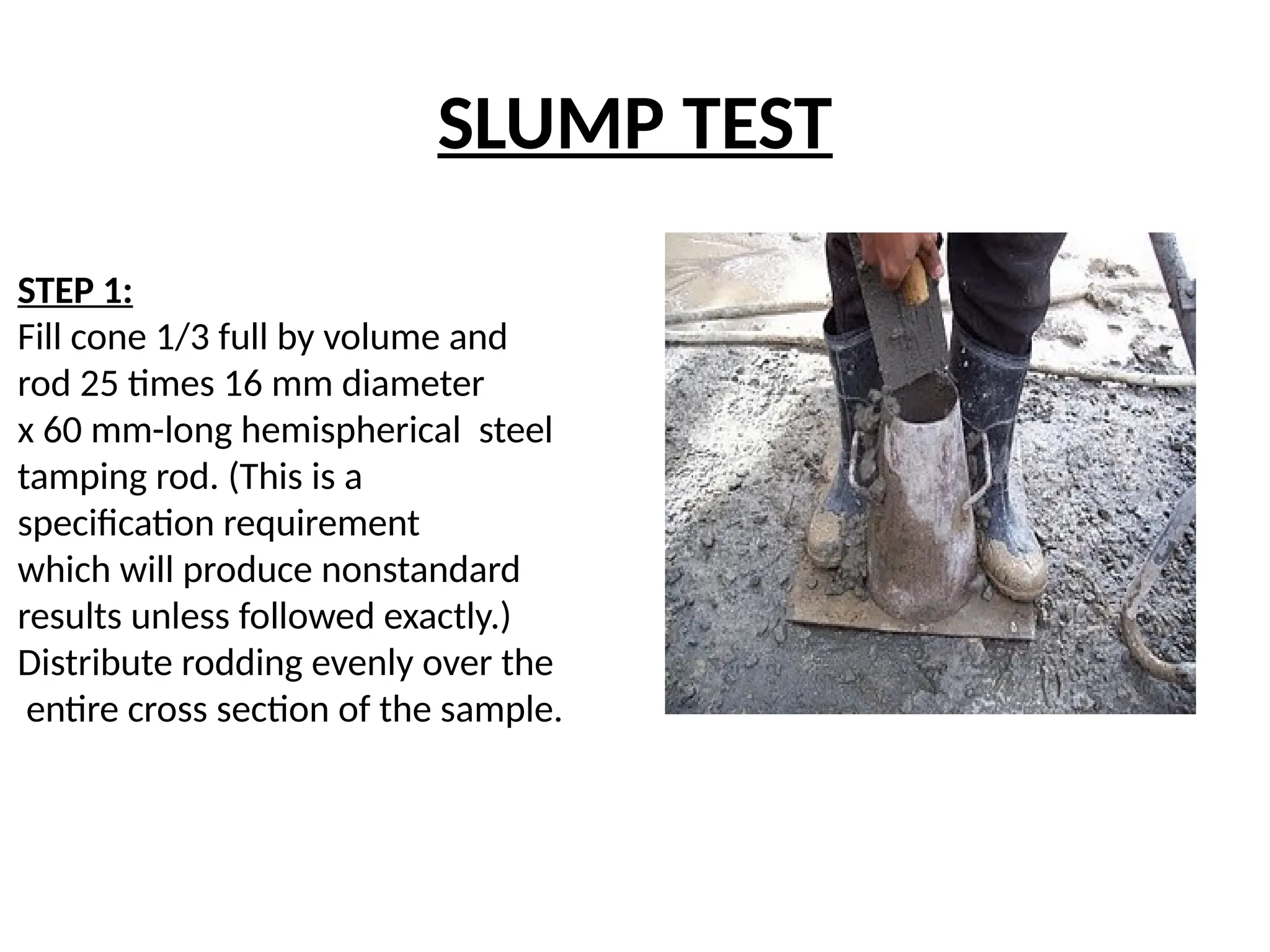
STEP 1:
Fill cone 1/3 full by volume and
rod 25 times 16 mm diameter
x 60 mm-long hemispherical steel
tamping rod. (This is a
specification requirement
which will produce nonstandard
results unless followed exactly.)
Distribute rodding evenly over the
entire cross section of the sample.
SLUMP TEST
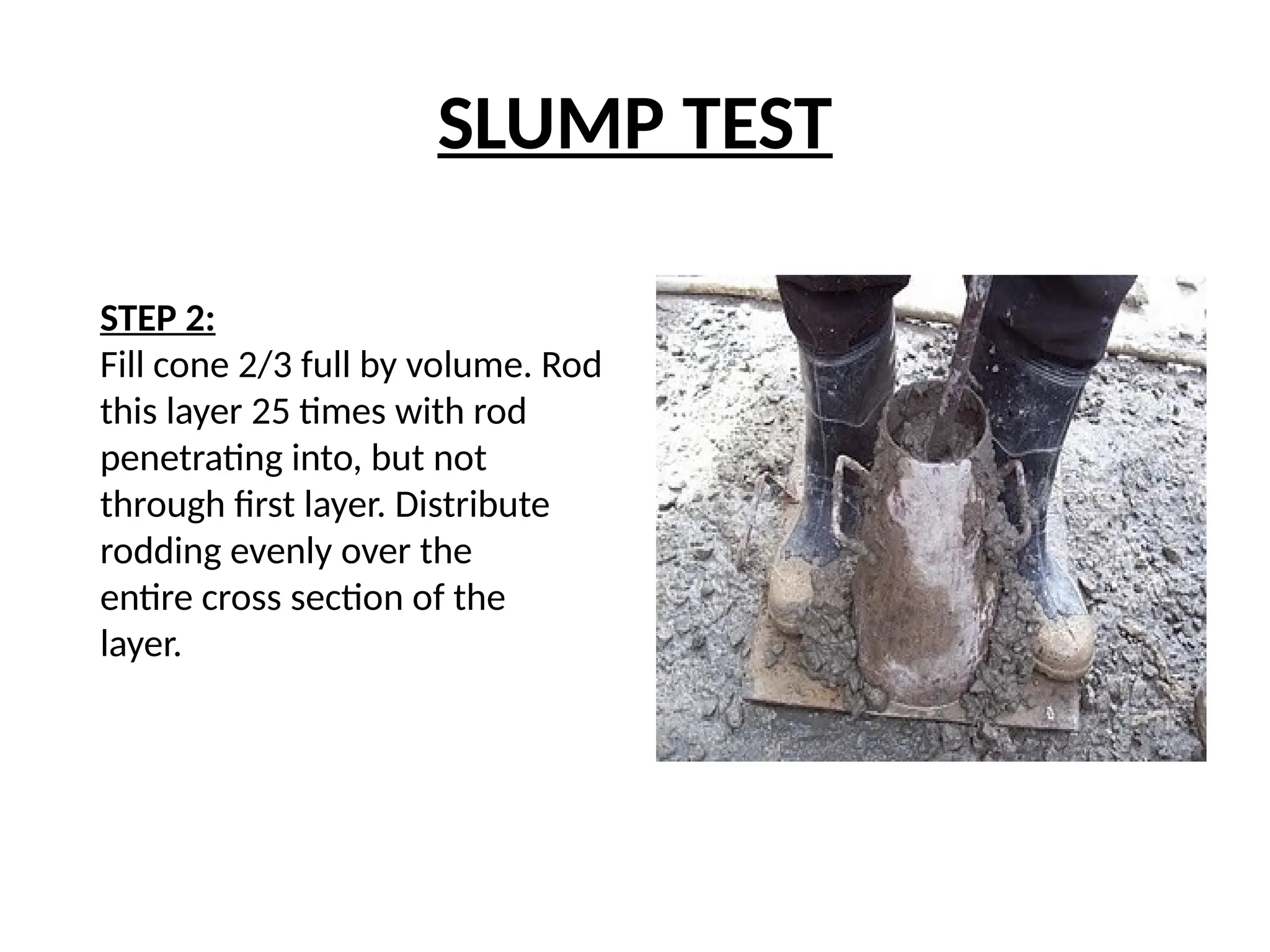
STEP 2:
Fill cone 2/3 full by volume. Rod
this layer 25 times with rod
penetrating into, but not
through first layer. Distribute
rodding evenly over the
entire cross section of the
layer.
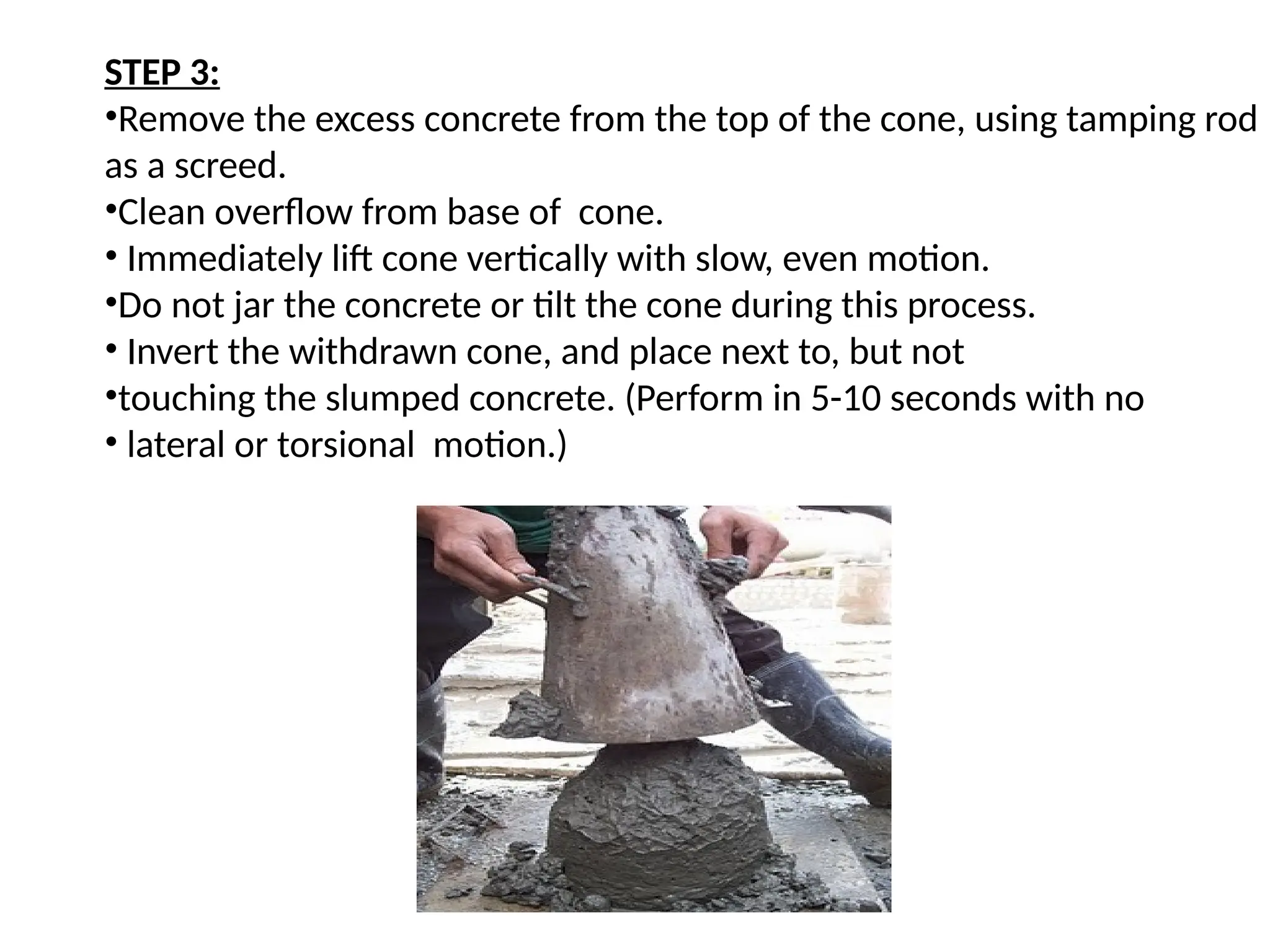
STEP 3:
•Remove the excess concrete from the top of the cone, using tamping rod
as a screed.
•Clean overflow from base of cone.
• Immediately lift cone vertically with slow, even motion.
•Do not jar the concrete or tilt the cone during this process.
• Invert the withdrawn cone, and place next to, but not
•touching the slumped concrete. (Perform in 5-10 seconds with no
• lateral or torsional motion.)
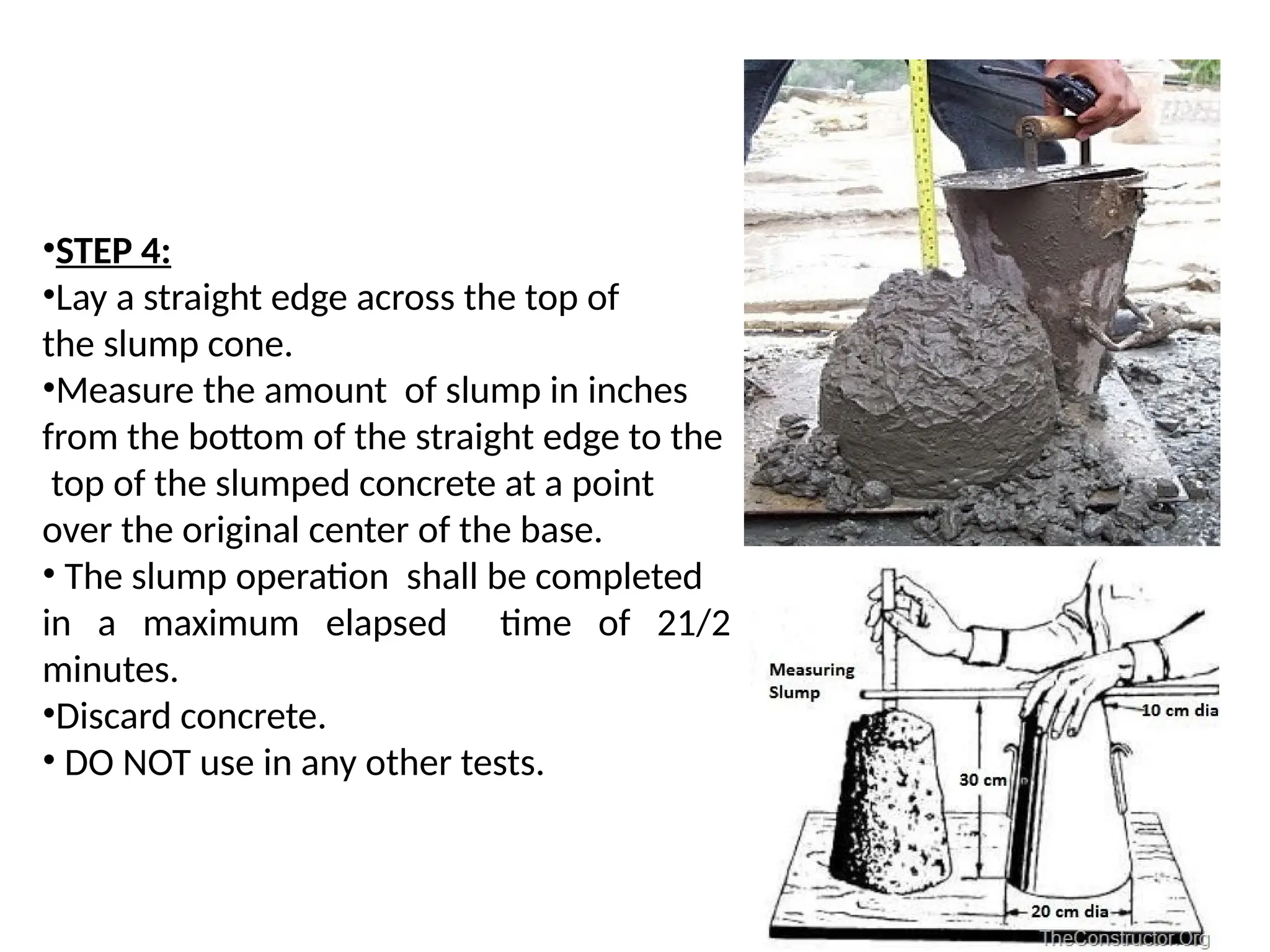
•STEP 4:
•Lay a straight edge across the top of
the slump cone.
•Measure the amount of slump in inches
from the bottom of the straight edge to the
top of the slumped concrete at a point
over the original center of the base.
• The slump operation shall be completed
in a maximum elapsed time of 21/2
minutes.
•Discard concrete.
• DO NOT use in any other tests.
Advantages of slump test
• Slump test is the most commonly used method of measuring
workability of concrete.
• However, it is used conveniently as a control test and gives an
indication of the uniformity of concrete from batch to batch.
Disadvantages of slump test
• It does not measure all factors contributing to workability, nor is it always
representative of the placeability of the concrete.
• It is not suitable for the concrete in which max, size of aggregate exceeds
40 mm .
• There are chances of many shapes of slump to occur & it is difficult to
decide which is correct value.
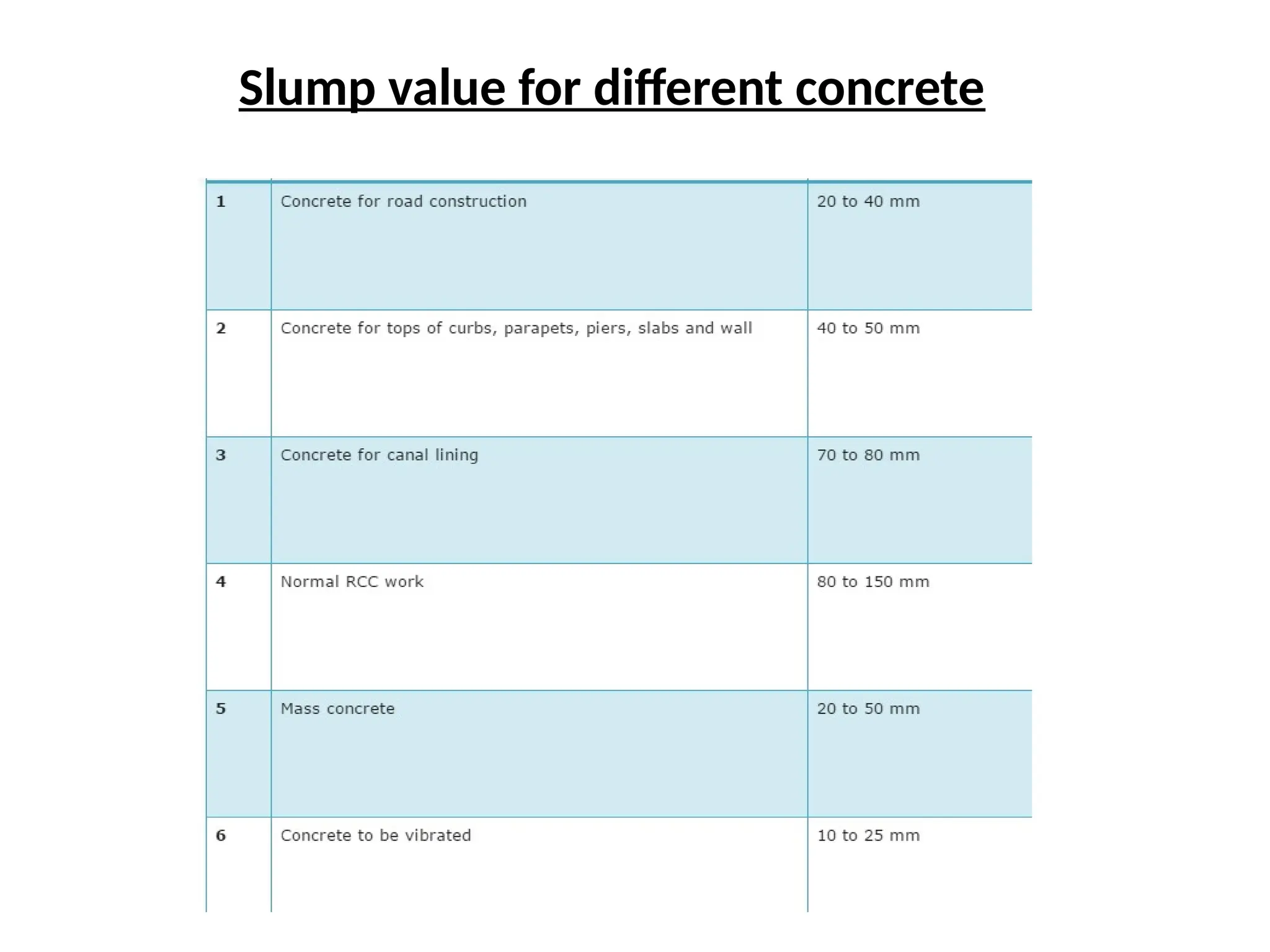
Slump value for different concrete
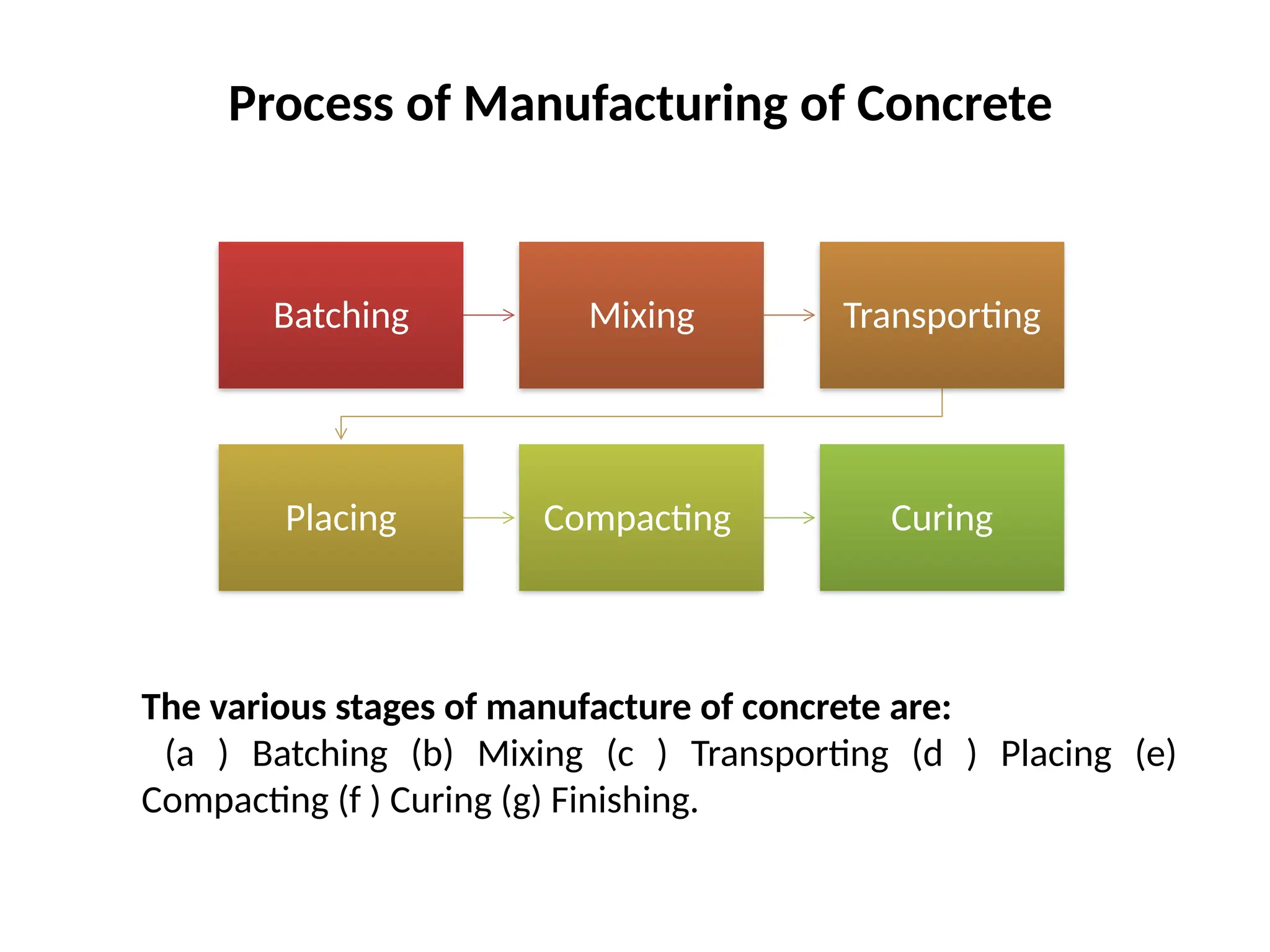
The various stages of manufacture of concrete are:
(a ) Batching (b) Mixing (c ) Transporting (d ) Placing (e)
Compacting (f ) Curing (g) Finishing.
Batching Mixing Transporting
Placing Compacting Curing
Process of Manufacturing of Concrete
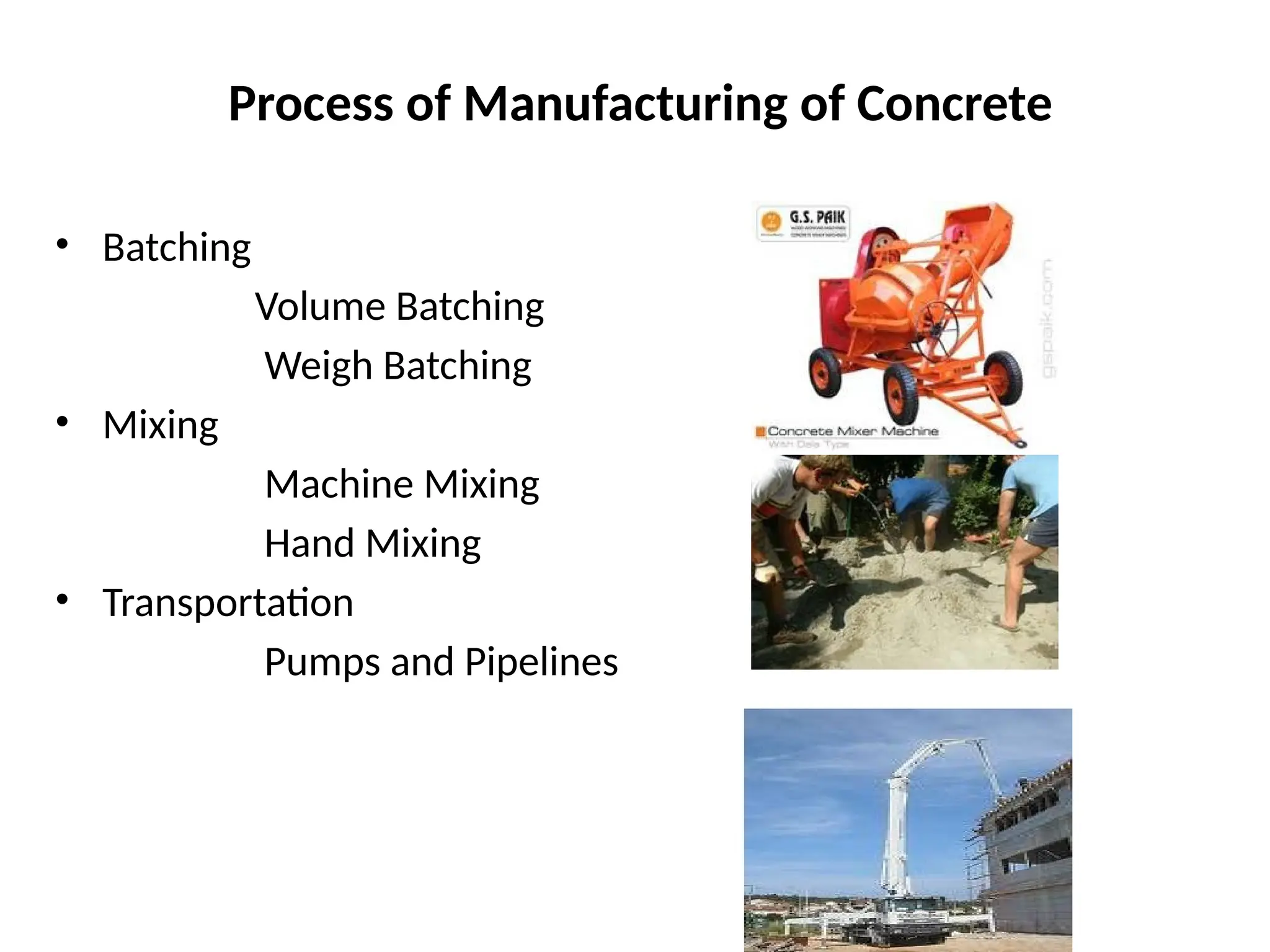
• Batching
Volume Batching
Weigh Batching
• Mixing
Machine Mixing
Hand Mixing
• Transportation
Pumps and Pipelines
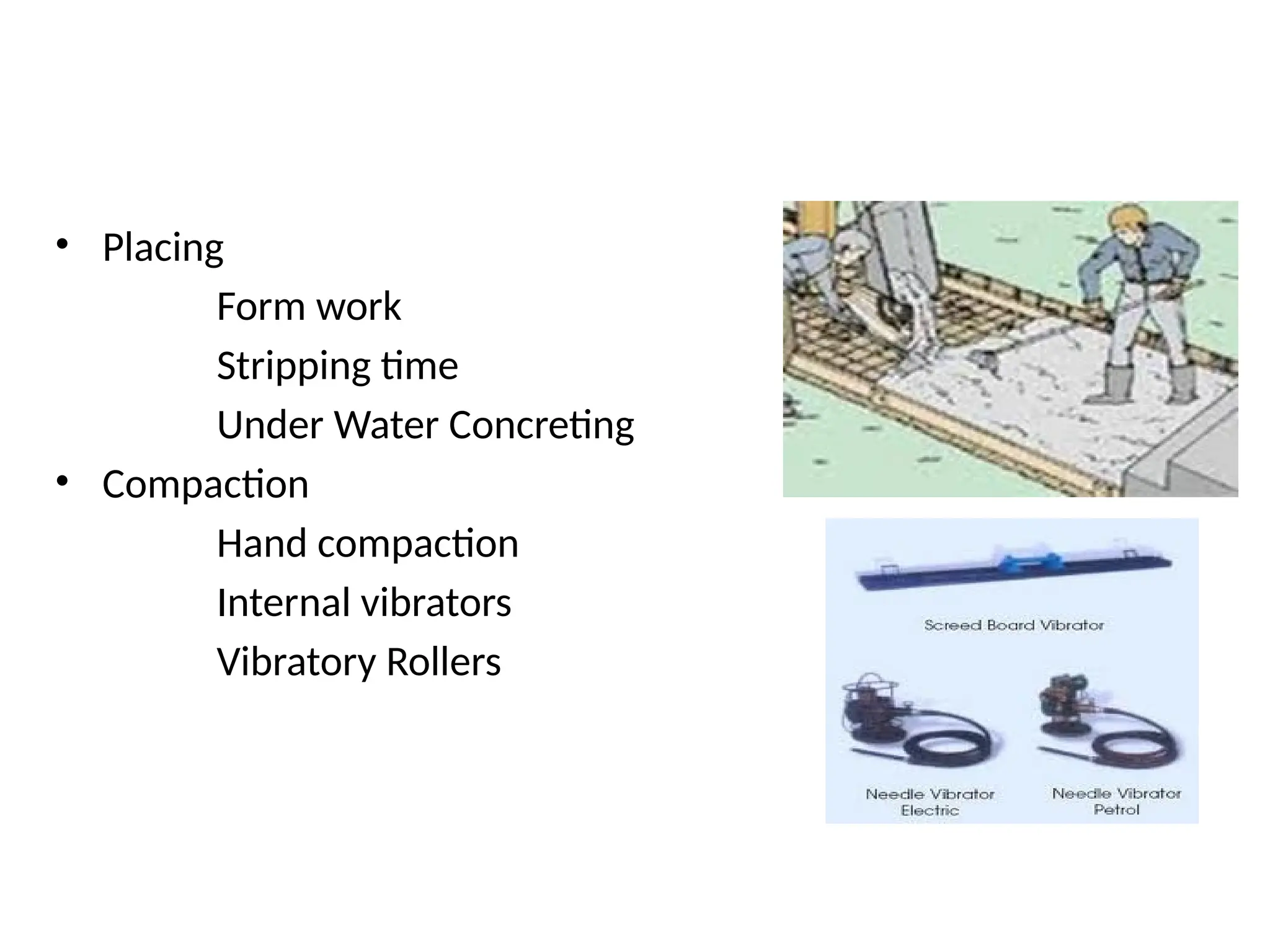
• Placing
Form work
Stripping time
Under Water Concreting
• Compaction
Hand compaction
Internal vibrators
Vibratory Rollers
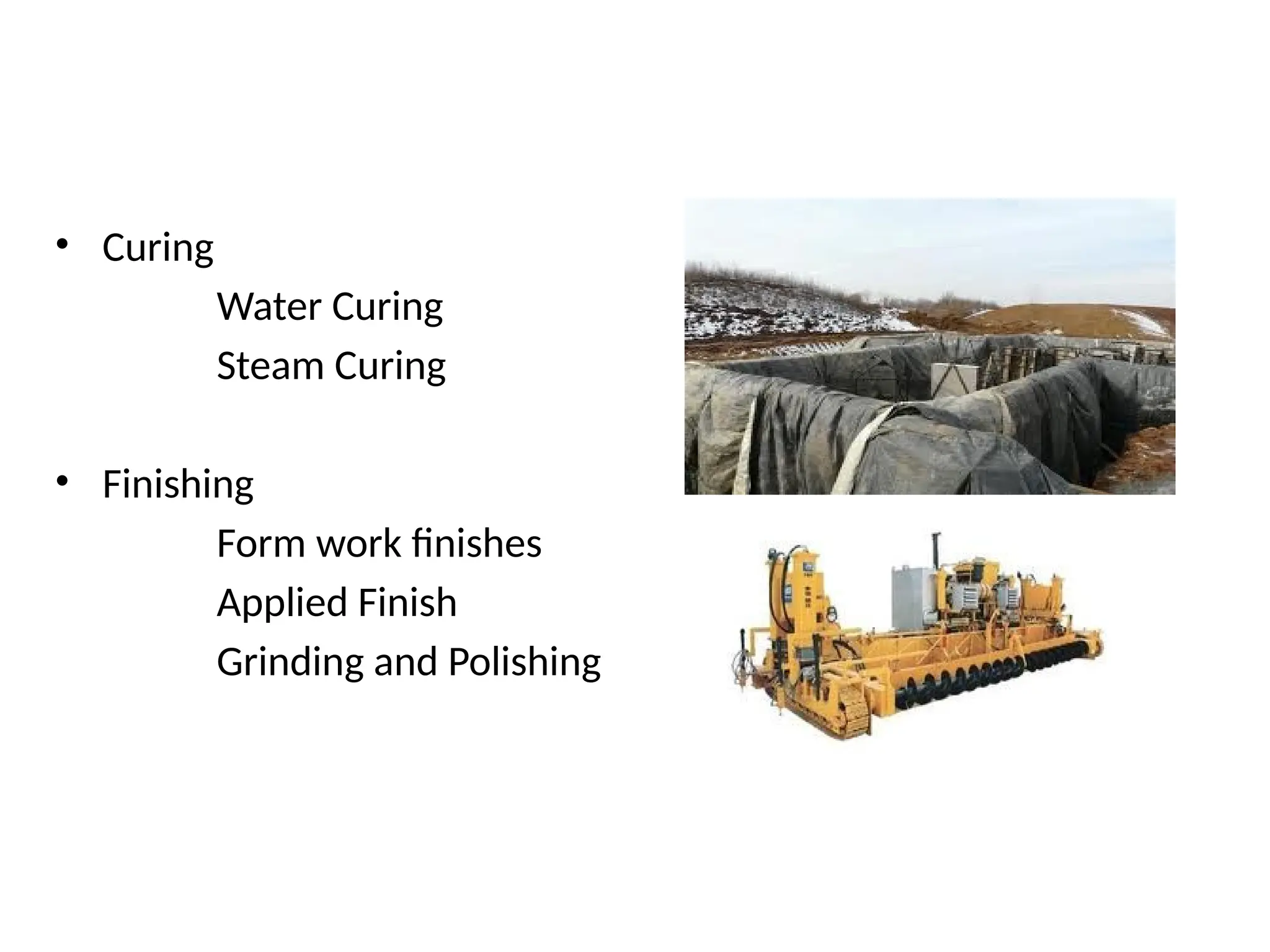
• Curing
Water Curing
Steam Curing
• Finishing
Form work finishes
Applied Finish
Grinding and Polishing
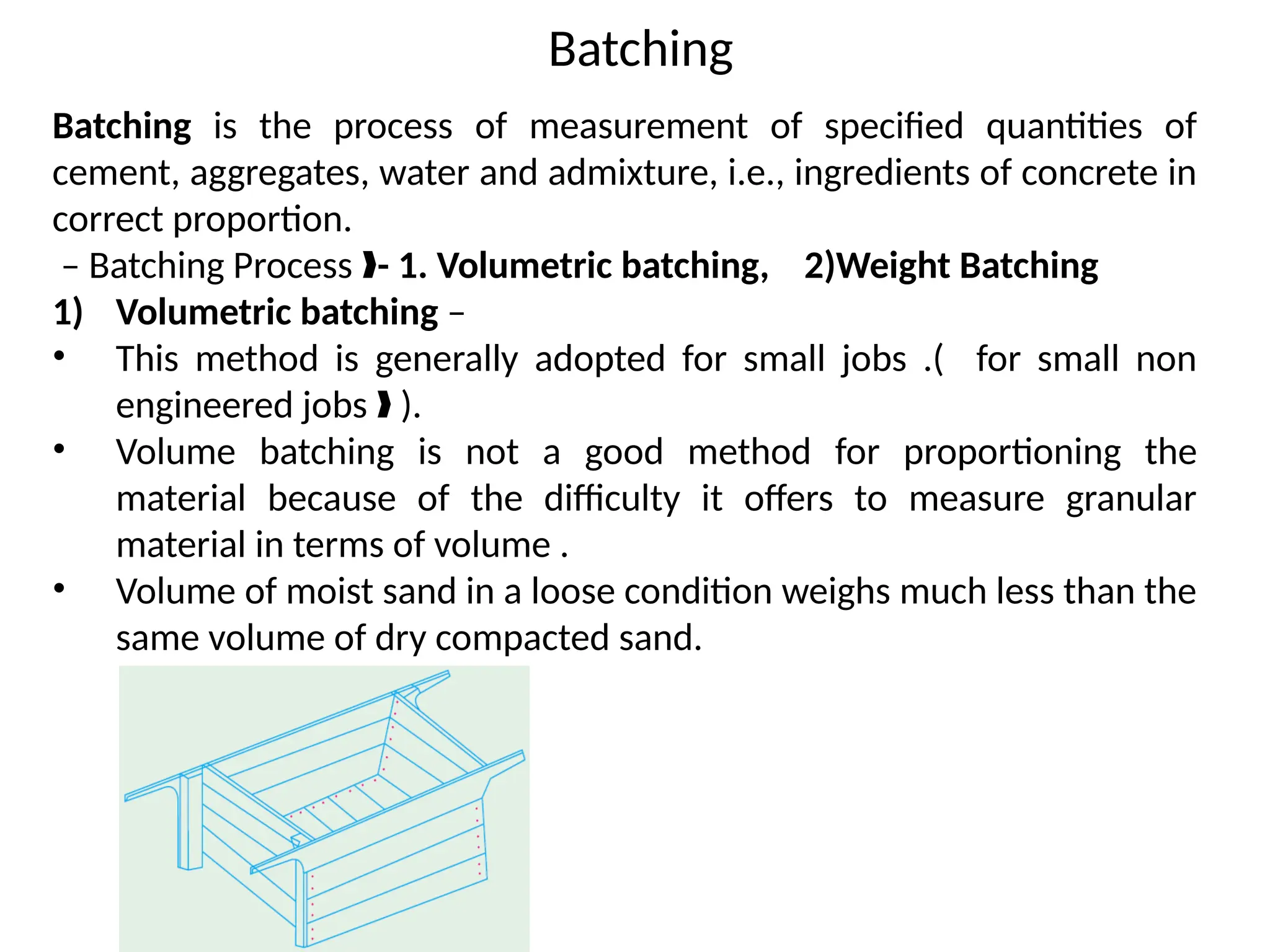
Batching
Batching is the process of measurement of specified quantities of
cement, aggregates, water and admixture, i.e., ingredients of concrete in
correct proportion.
– Batching Process ‰- 1. Volumetric batching, 2)Weight Batching
1) Volumetric batching –
• This method is generally adopted for small jobs .( for small non
engineered jobs ).
‰
• Volume batching is not a good method for proportioning the
material because of the difficulty it offers to measure granular
material in terms of volume .
• Volume of moist sand in a loose condition weighs much less than the
same volume of dry compacted sand.
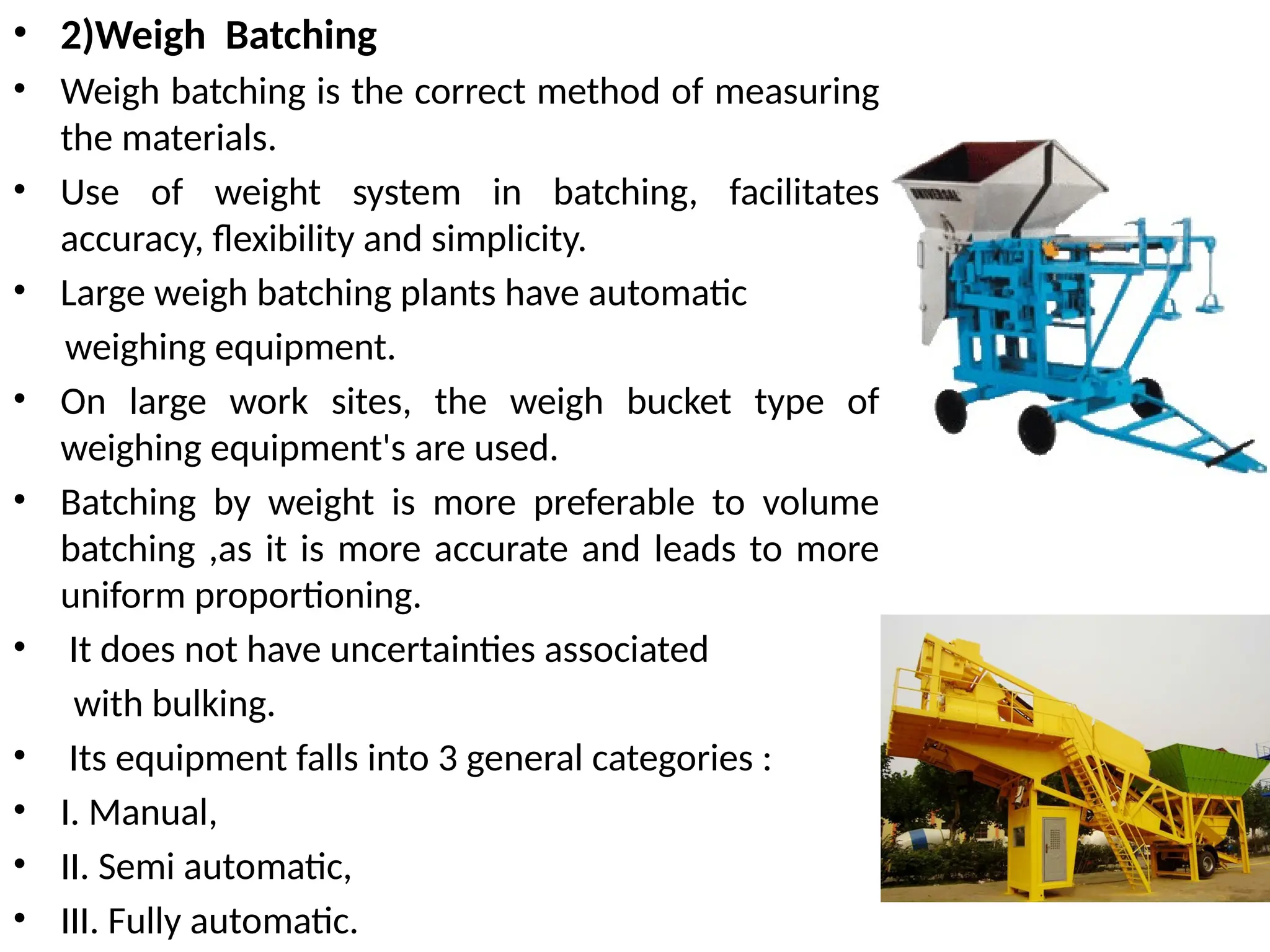
• 2)Weigh Batching
• Weigh batching is the correct method of measuring
the materials.
• Use of weight system in batching, facilitates
accuracy, flexibility and simplicity.
• Large weigh batching plants have automatic
weighing equipment.
• On large work sites, the weigh bucket type of
weighing equipment's are used.
• Batching by weight is more preferable to volume
batching ,as it is more accurate and leads to more
uniform proportioning.
• It does not have uncertainties associated
with bulking.
• Its equipment falls into 3 general categories :
• I. Manual,
• II. Semi automatic,
• III. Fully automatic.
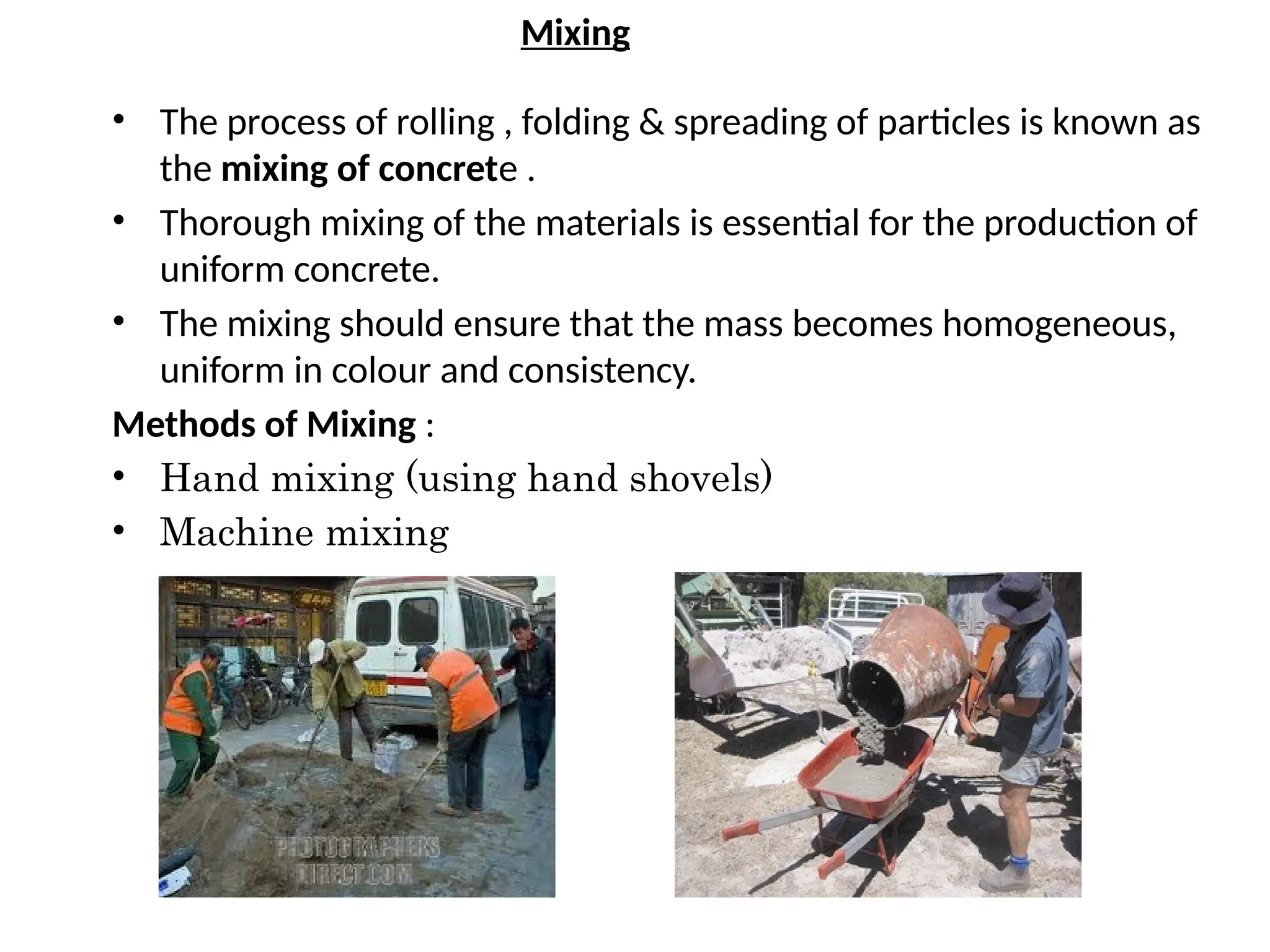
Mixing
• The process of rolling , folding & spreading of particles is known as
the mixing of concrete .
• Thorough mixing of the materials is essential for the production of
uniform concrete.
• The mixing should ensure that the mass becomes homogeneous,
uniform in colour and consistency.
Methods of Mixing :
• Hand mixing (using hand shovels)
• Machine mixing
Hand mixing
• - Mixing ingredients of concrete by hands using ordinary tools like,
hand shovels etc.
• For hand mixing , the materials are stacked on a water-tight
platform of wood , steel or brick .
• The material should be thoroughly mixed at least 3 times before
water is added .
• The prepared mix should be consumed within 30 minutes after
adding water .
• This type of mixing is done for Less output of concrete.
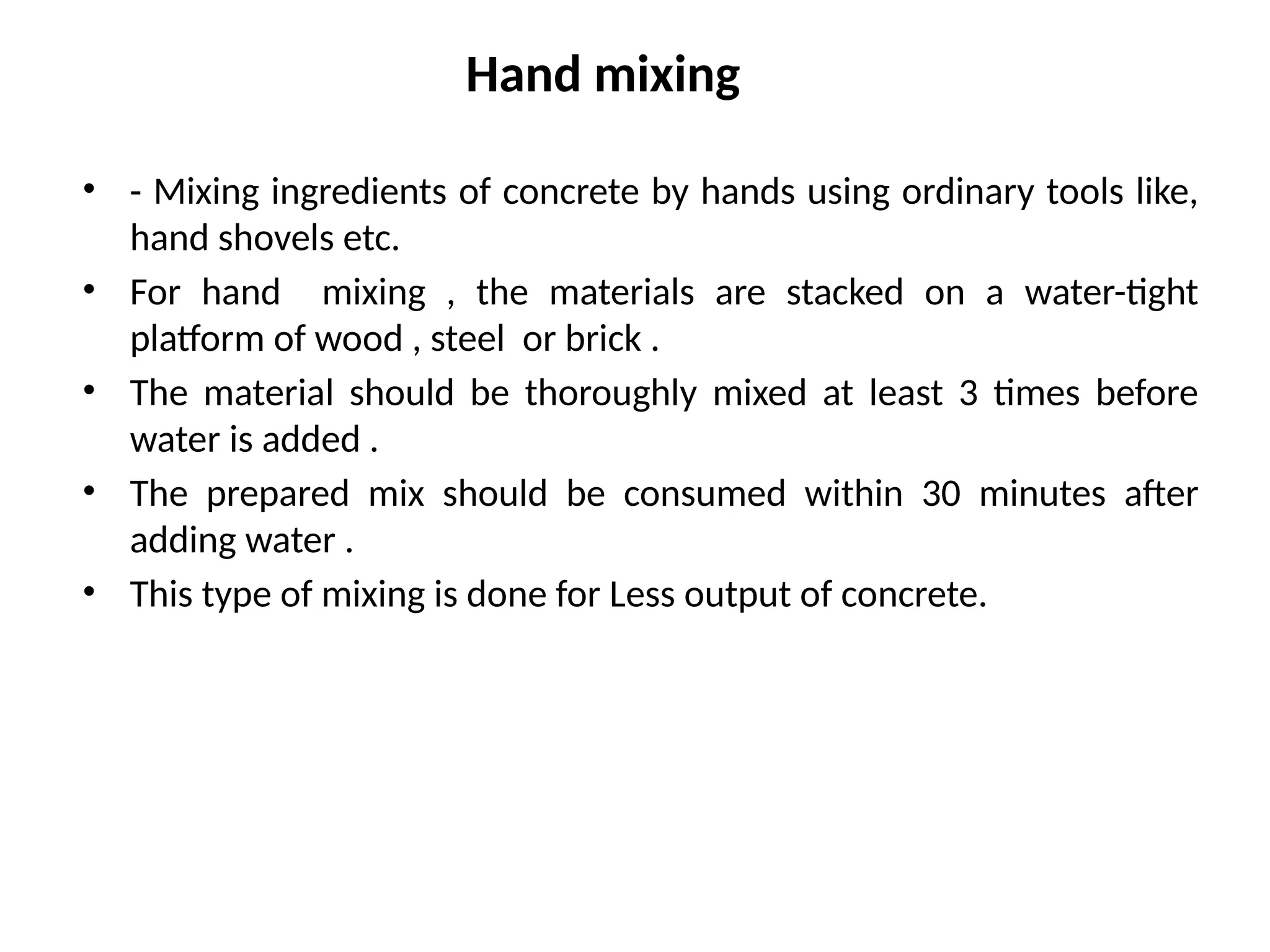
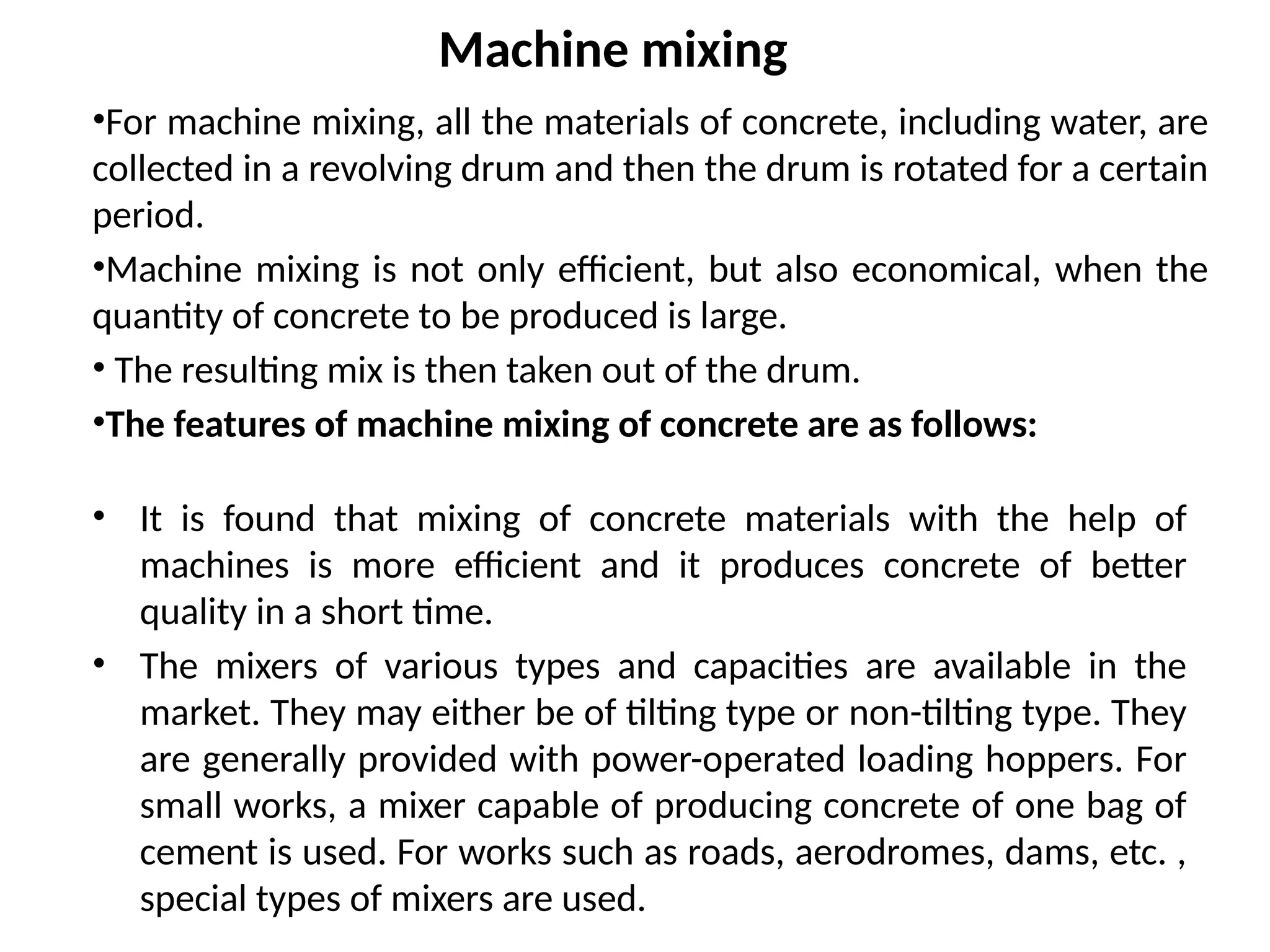
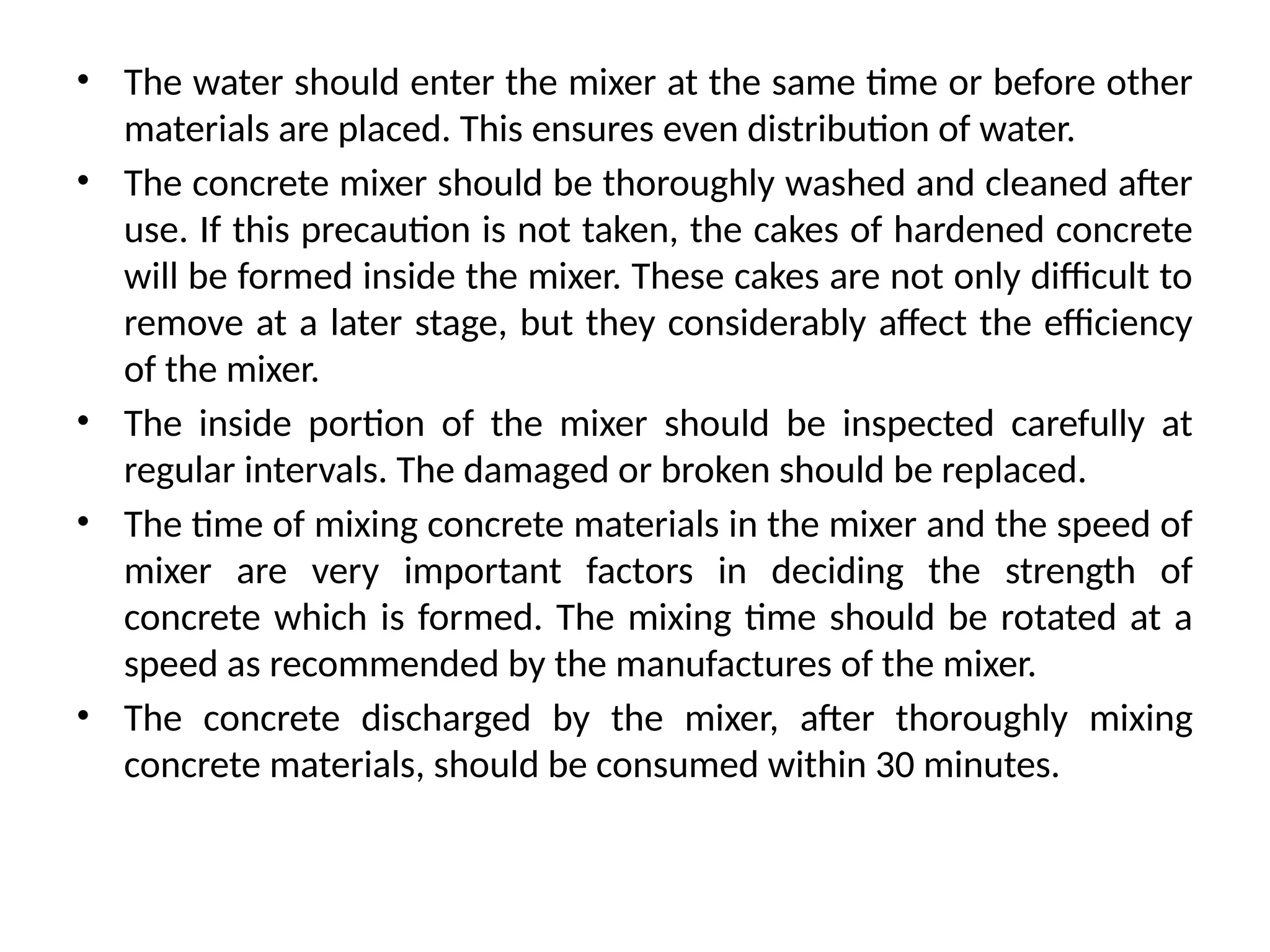
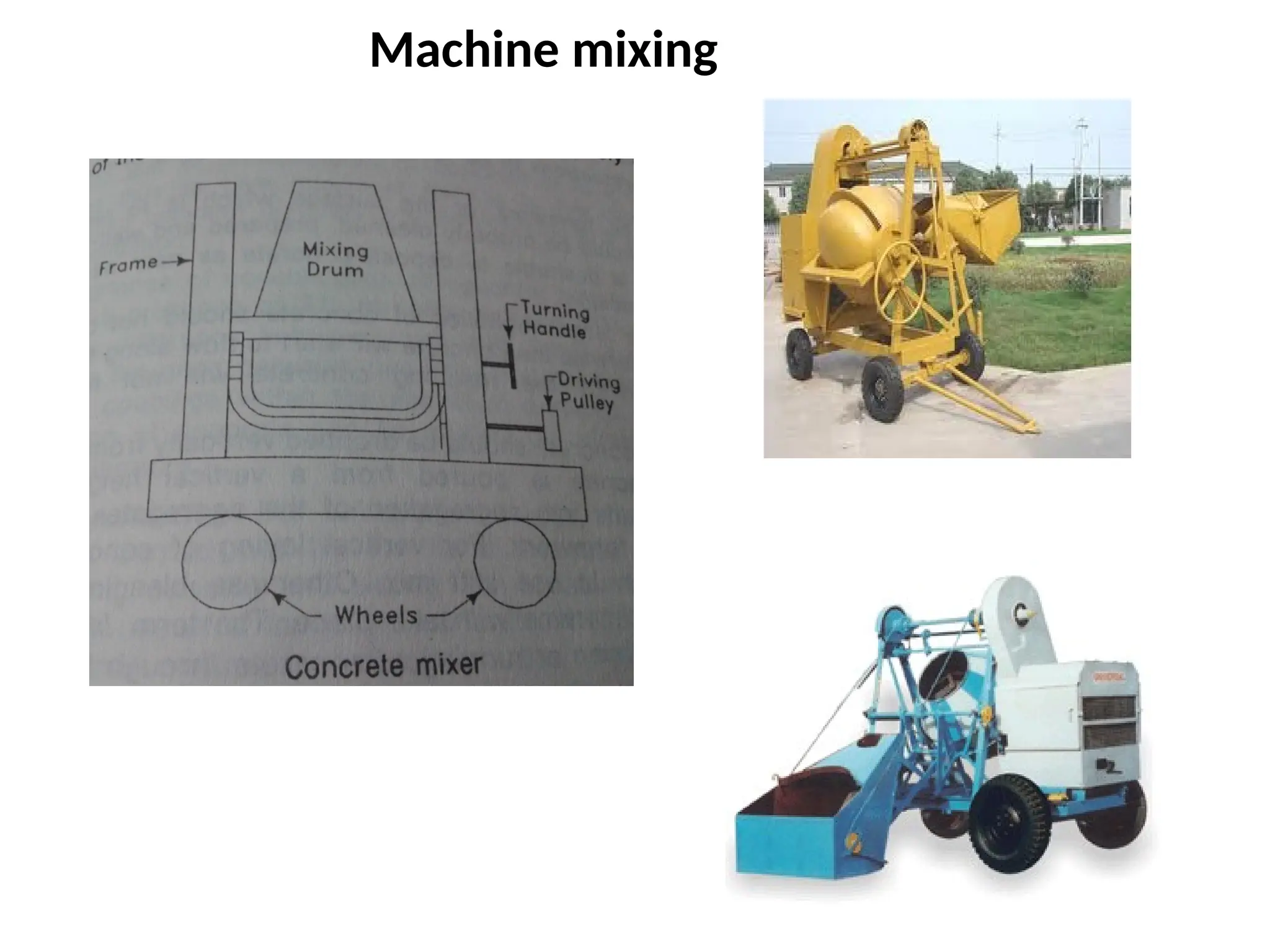
Machine mixing
•For machine mixing, all the materials of concrete, including water, are
collected in a revolving drum and then the drum is rotated for a certain
period.
•Machine mixing is not only efficient, but also economical, when the
quantity of concrete to be produced is large.
• The resulting mix is then taken out of the drum.
•The features of machine mixing of concrete are as follows:
• It is found that mixing of concrete materials with the help of
machines is more efficient and it produces concrete of better
quality in a short time.
• The mixers of various types and capacities are available in the
market. They may either be of tilting type or non-tilting type. They
are generally provided with power-operated loading hoppers. For
small works, a mixer capable of producing concrete of one bag of
cement is used. For works such as roads, aerodromes, dams, etc. ,
special types of mixers are used.
• The water should enter the mixer at the same time or before other
materials are placed. This ensures even distribution of water.
• The concrete mixer should be thoroughly washed and cleaned after
use. If this precaution is not taken, the cakes of hardened concrete
will be formed inside the mixer. These cakes are not only difficult to
remove at a later stage, but they considerably affect the efficiency
of the mixer.
• The inside portion of the mixer should be inspected carefully at
regular intervals. The damaged or broken should be replaced.
• The time of mixing concrete materials in the mixer and the speed of
mixer are very important factors in deciding the strength of
concrete which is formed. The mixing time should be rotated at a
speed as recommended by the manufactures of the mixer.
• The concrete discharged by the mixer, after thoroughly mixing
concrete materials, should be consumed within 30 minutes.
Machine mixing
TRANSPORTING & PLACING OF CONCRETE
• Once the concrete mixture is ready, it is transported to the work site.
• The type of equipment to be used for transport of concrete depends
upon the nature of work , height above ground level & distance
between the point of preparation & placing of concrete .
• For ordinary work, human ladder is formed & the concrete is
conveyed in pans from hand to hand . For important or bigger works,
there are many methods of transporting concrete, including
wheelbarrows, buckets, belt conveyors, special trucks, and pumping.
• THE IMPORTANT precautions necessary in transportation of
concrete are :
• The concrete should be transported in such a way that there is no
segregation of aggregates.
• Water should not be added to the concrete during its passage from
mixer to the formwork.
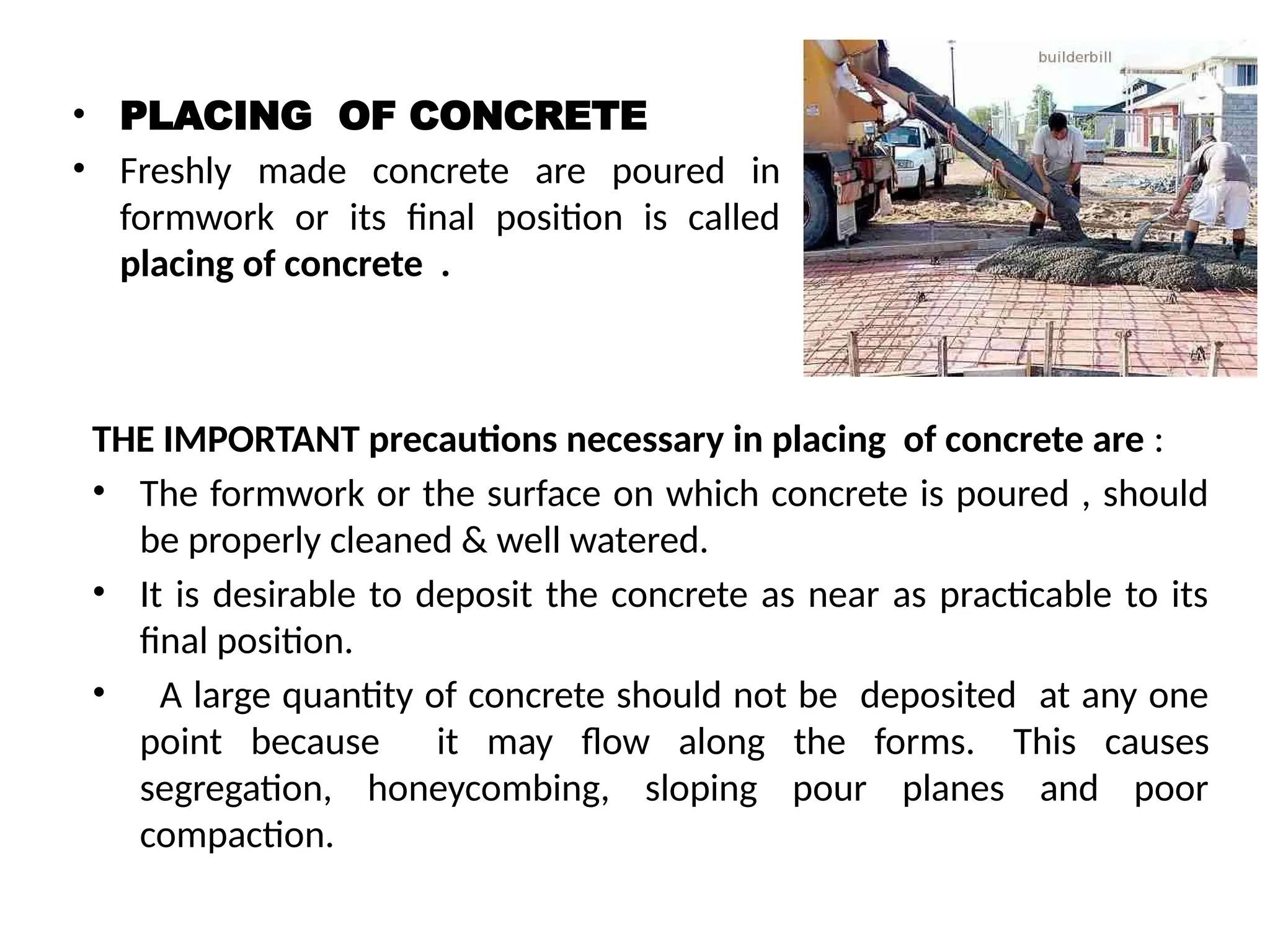
• PLACING OF CONCRETE
• Freshly made concrete are poured in
formwork or its final position is called
placing of concrete .
THE IMPORTANT precautions necessary in placing of concrete are :
• The formwork or the surface on which concrete is poured , should
be properly cleaned & well watered.
• It is desirable to deposit the concrete as near as practicable to its
final position.
• A large quantity of concrete should not be deposited at any one
point because it may flow along the forms. This causes
segregation, honeycombing, sloping pour planes and poor
compaction.
THE IMPORTANT precautions necessary in placing of concrete are :
• The concrete should be dropped vertically from a reasonable
height . For vertical laying of concrete, stiff mix should be used to
avoid bleeding of concrete. Bleeding means running of concrete
through formwork.
• Concrete should be deposited in horizontal layers and compacted
each layer thoroughly before the next layer is placed. As far as
practicable, each layer should be placed in a continuous operation,
the thickness depending on the size and shape of the sections. The
concrete consistency, reinforcement spacing, method of
compaction and the need for placing the next layer before the
previous one has hardened. These layers should be 0.2 to 0.4 m
thick. In mass concrete, thicker layers 0.4 to 0.6 m thick can be
used.
• Concrete should be thoroughly worked into position around
reinforcement and embedded fixtures, and into corners of the
formwork.
• The concrete should not be placed on the formwork after 30 mins
of its preparation .
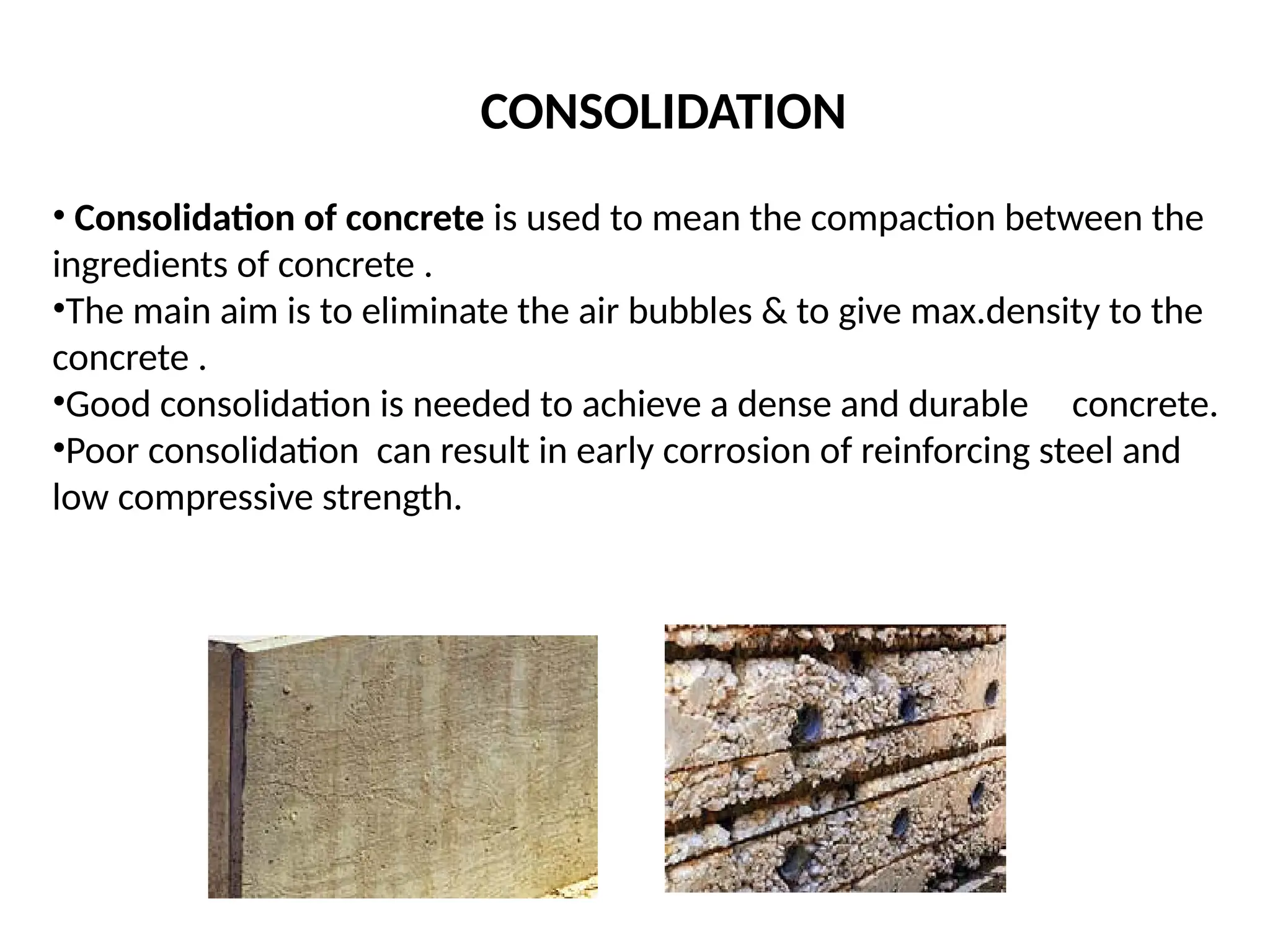
• Consolidation of concrete is used to mean the compaction between the
ingredients of concrete .
•The main aim is to eliminate the air bubbles & to give max.density to the
concrete .
•Good consolidation is needed to achieve a dense and durable concrete.
•Poor consolidation can result in early corrosion of reinforcing steel and
low compressive strength.
CONSOLIDATION
COMPACTION OF CONCRETE
• Compaction of concrete is very important in developing qualities like
strength, durability, imperviousness by making the concrete dense
and free from voids.
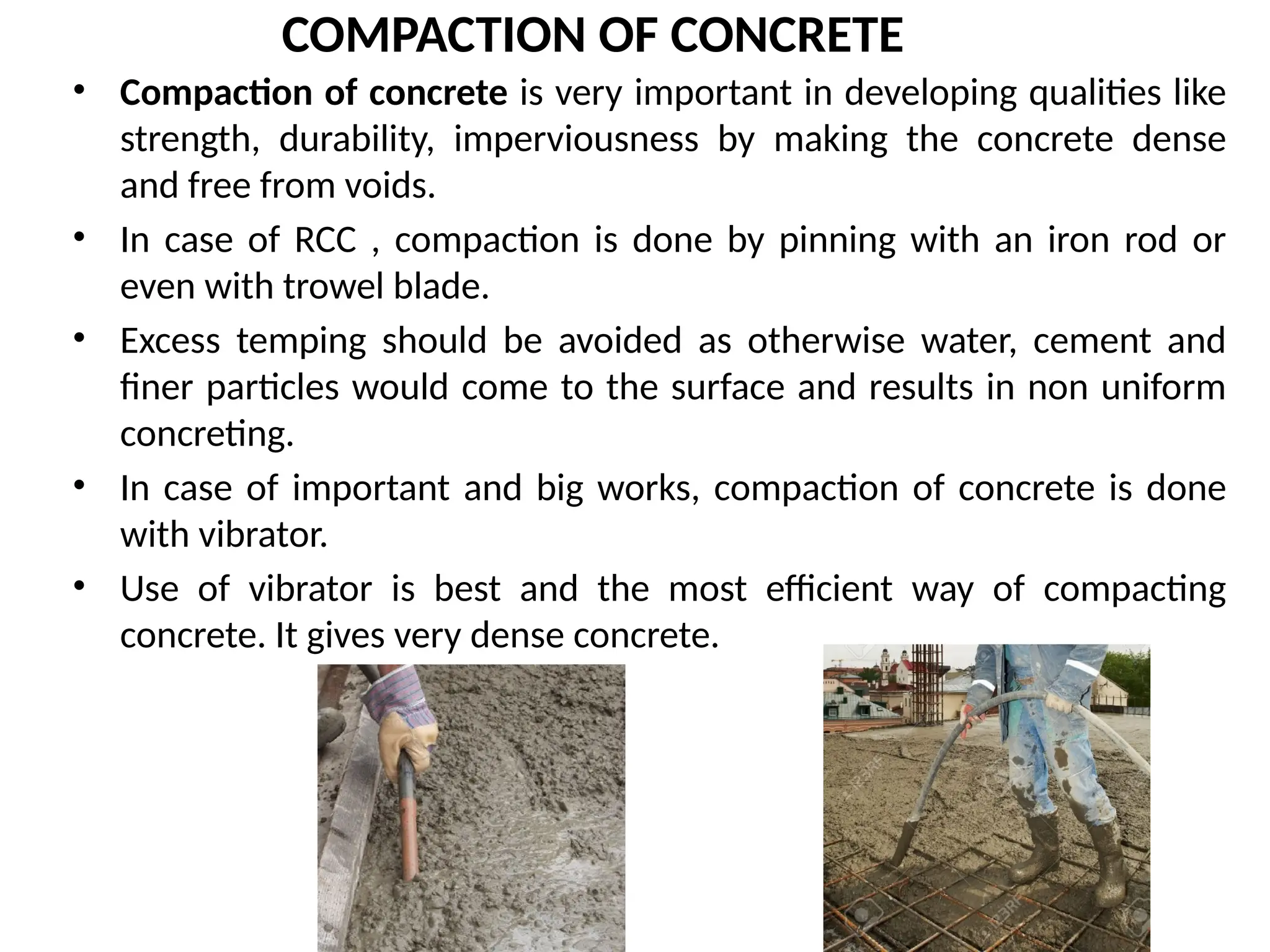
• In case of RCC , compaction is done by pinning with an iron rod or
even with trowel blade.
• Excess temping should be avoided as otherwise water, cement and
finer particles would come to the surface and results in non uniform
concreting.
• In case of important and big works, compaction of concrete is done
with vibrator.
• Use of vibrator is best and the most efficient way of compacting
concrete. It gives very dense concrete.
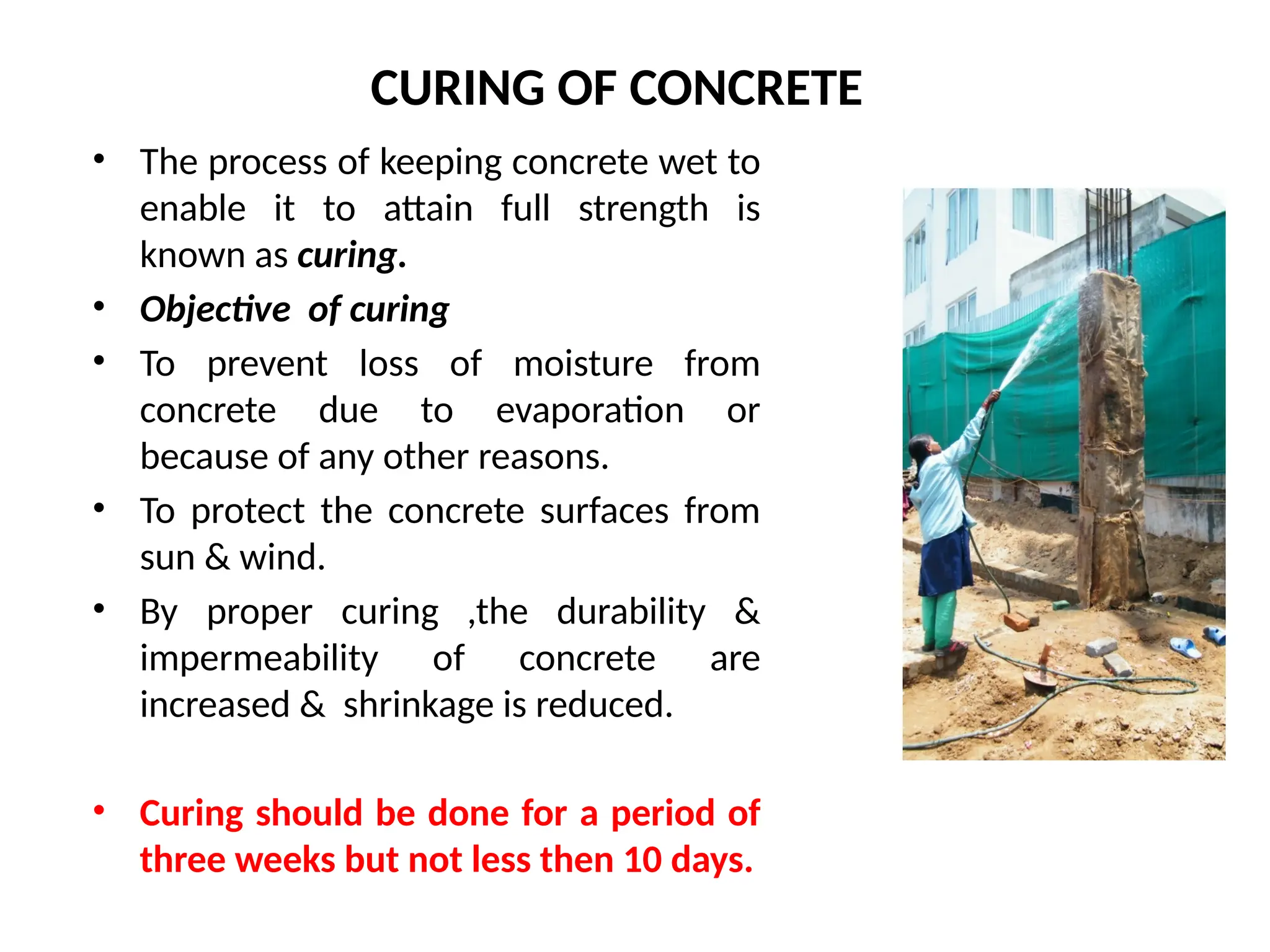
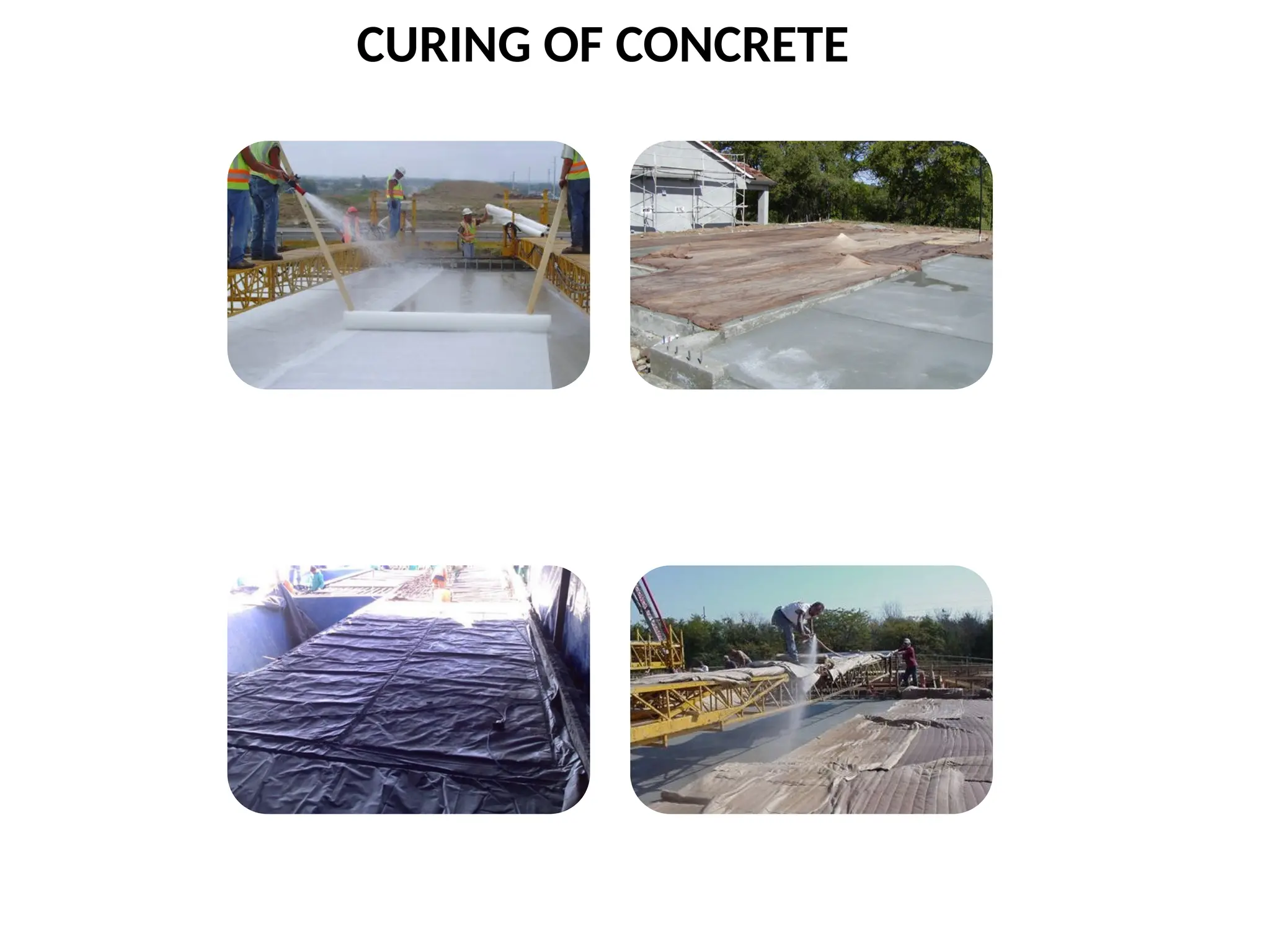
CURING OF CONCRETE
• The process of keeping concrete wet to
enable it to attain full strength is
known as curing.
• Objective of curing
• To prevent loss of moisture from
concrete due to evaporation or
because of any other reasons.
• To protect the concrete surfaces from
sun & wind.
• By proper curing ,the durability &
impermeability of concrete are
increased & shrinkage is reduced.
• Curing should be done for a period of
three weeks but not less then 10 days.
CURING OF CONCRETE
concrete-sy1.pptx bulliding material in architecture

concrete-sy1.pptx bulliding material in architecture

  • 1.
  • 2.
    • Concrete – •The cement concrete is a mixture of cement ,sand , pebbles or crushed rock & water, which when placed in the skeleton of forms & allowed to cure ,becomes hard like stone . • Cement and lime are generally used as binding materials, whereas sand , cinder is used as fine aggregates and crushed stones, gravel, broken bricks, clinkers are used as coarse aggregates. • Why use of concrete is more in modern buildings : • It can be readily moulded into durable structural items of various sizes & shapes .( labour cost not considered .) • It is possible to mechanise completely its preparation & placing processes. • It possesses adequate plasticity for the mechanical working . INTRODUCTION
  • 3.
    Components of Concrete •Cement • Aggregates Fine Aggregates Coarse Aggregates • Water
  • 4.
    Production of concrete •A good quality concrete is essentially a homogeneous mixture of cement, coarse and fine aggregates and water which consolidates into a hard mass due to chemical action between the cement and water. • Each of the four constituents has a specific function. • The coarser aggregate acts as a filler. • The fine aggregate fills up the voids between the paste and the coarse aggregate. • The cement in conjunction with water acts as a binder. • The mobility of the mixture is aided by the cement paste, fines and nowadays, increasingly by the use of admixtures .
  • 5.
    QUALITIES OF GOODCONCRETE • STRENGTH: • The concrete should be able to withstand the stresses that it is subjected to. It is quite strong in compression but weak in tension. • DURABILITY: • It should be durable enough to resist the effect of weathering agents. • DENSITY: • The concrete should be well compacted so that there are no voids or hollows left. It should weigh 3000 kg/cum • WATER TIGHTNESS: • When used for construction of water retaining structures such as dams, elevated tanks and water reservoirs , then this property of concrete becomes very important. Otherwise the moisture inside the RCC would corrode steel and leakage would start resulting in the ultimate failure of the structure. • WORKABILITY: It should be easily workable. • RESISTANCE TO WEAR AND TEAR: • When used in floors and in the construction of roads , the concrete should be able to withstand abrasive forces.
  • 6.
    GREEN CONCRETE &SET CONCRETE Freshly prepared concrete till it has not yet set is called wet or green concrete. After it has thoroughly set and fully hardened it is called set concrete or just concrete.
  • 7.
    Properties of cementconcrete • It has a high compressive strength. • It is free from corrosion & there no effect of atmospheric agents on it. • It hardens with age & the process continues for a longer time after the concrete has attained sufficient strength. • It is economical than steel. The main ingredient is aggregate which is almost 80-90% of total weight .this is available at moderate cost . • It binds rapidly with steel. • It forma a hard surface ,capable of resisting abrasion.
  • 8.
    Materials used inR.C.C.Work • Following four materials are required for making R.C.C.work 1. Cement 2. Aggregate 3. Steel 4. Water Cement – Nowadays , ‘Ordinary Portland Cement’ (OPC) which is available in three grades should be used for house construction. Before this , lime was used as a cementing material. But other special varieties of cement such as rapid hardening cement and high alumina cement are used under certain circumstance. The cement should comply with all the standard requirements.
  • 9.
    • Aggregate -These are the inert or chemically inactive materials which form the bulk of cement concrete. These aggregates are bound together by means of cement. The aggregates are classified into two categories: fine and coarse. • The material which is passed through BIS test sieve no. 480 is termed as a fine aggregate. Usually, the natural river sand is used as a fine aggregate. But at places, where natural sand is not available economically, the finely crushed stone may be used as a fine aggregate. • The material which is retained on BIS test sieve no. 480 is termed as a coarse aggregate. The broken stone is generally used as a coarse aggregate. For thin slabs and walls, the maximum size of coarse aggregate should be limited to one-third the thickness of the concrete section.
  • 10.
    •The aggregates tobe used for cement concrete work should be hard, durable and clean. The aggregates should be completely free from lumps of clay, organic and vegetable matter, fine dust, etc. The presence of all such debris prevents adhesion of aggregates and hence reduces the strength of concrete.
  • 11.
    • Steel –The steel reinforcement is generally in the form of round bars of mild steel. The diameter varies from 5mm to 40 mm. • Many times , square bars , twisted bars or ribbed-tor steel bars are used . • Water: This is the least expensive but most important ingredient of concrete. The water, which is used for making concrete, should be clean and free from harmful impurities such as oil, alkali, acid, etc. In general, the water which is fit for drinking should be used for making concrete. • Sometimes other ingredients are added in concrete to improve the qualities of concrete in its fresh & hardened stage .
  • 12.
    Admixtures • Admixtures arethose ingredients in concrete other than portland cement, water, and aggregates that are added to the mixture immediately before or during mixing. • A material other than water, aggregates, or cement that is used as an ingredient of concrete or mortar to control setting and early hardening, workability, or to provide additional cementing properties. .
  • 13.
    Admixtures • Admixtures canbe classified by function as follows: • 1. Air-entraining admixtures • 2. Water-reducing admixtures • 3. Plasticizers • 4. Accelerating admixtures • 5. Retarding admixtures • 6. Hydration-control admixtures • 7. Corrosion inhibitors • 8. Shrinkage reducers • 9. Alkali-silica reactivity inhibitors • 10. Coloring admixtures • 11. Miscellaneous admixtures such as workability, bonding, dampproofing, permeability reducing, grouting, gas-forming, antiwashout, foaming, and pumping admixtures .
  • 14.
    • Concrete shouldbe workable, finishable, strong, durable, watertight, and wear resistant. These qualities can often be obtained easily and economically by the selection of suitable materials rather than by resorting to admixtures (except air- entraining admixtures when needed). • The major reasons for using admixtures are: • 1. To reduce the cost of concrete construction • 2. To achieve certain properties in concrete more effectively than by other means • 3. To maintain the quality of concrete during the stages of mixing, transporting, placing, and curing in adverse weather conditions • 4. To overcome certain emergencies during concreting operations • The effectiveness of an admixture depends upon factors such as type, brand, and amount of cementing materials; water content; aggregate shape, gradation, and proportions; mixing time; slump; and temperature of the concrete.
  • 16.
    Proportioning Concrete • Theprocess of selection of relative proportions of cement, sand, coarse aggregate and water, so as to obtain a concrete of desired quality is known as the proportioning concrete. • It is observed that if a vessel, is taken and filled with stones, of equal sizes, the voids to the extent of about 45 per cent are formed. This result is independent of the size of stones. It is interesting to note that if sand is taken in place of stones, the same result will be obtained. • The result can be verified by pouring water in the vessel till it is full. The volume of water added in the vessel represents the amount of voids. • The theory of formation of concrete is based on this phenomenon of formation of voids.
  • 17.
    Proportioning Concrete • Whencoarse aggregate is placed, such voids are formed. • When fine aggregate i.e. sand is added, it occupies these voids. • Further, when finely powdered cement is added, it occupies the voids of sand particles. • Finally, when water is added, it occupies very fine voids between the cement particles. During the process of setting, a chemical reaction takes place between water and cement. This results n an absolutely solid substance, known as the concrete. • In general, the proportions of coarse aggregate, fine aggregate, cement and water should be such that the resulting concrete has the following properties: (1) When concrete is fresh, it should have enough workability so that it can be placed in the formwork economically. (2) The concrete must possess maximum density or in other words, it should be the strongest and most watertight. (3) The cost of materials and labour required to form the concrete should be minimum.
  • 19.
    • Following arethe different methods of proportions concrete: (1) Arbitrary method • (2) Fineness modulus method • (3) Water cement ratio method • (4) Minimum voids method
  • 20.
    Grading of Aggregates •In order to obtain concrete of denser quality, the fine and coarse aggregates are properly graded. • The grading of fine aggregates is expressed in terms of BIS test no. 480, 240, 120, 60, 30 and 15. • The grading of fine aggregates has a marked effect on the uniformity, workability and finishing qualities of concrete. • The grading of coarse aggregates may be varied through wider limits than those of sand without appreciable effect on the workability of concrete. • In general, it can be stated that it is difficult to provide satisfactory grading of coarse aggregates than of sand.
  • 21.
    WATER CEMENT RATIO •A cement of average composition requires about 25% of water by mass for chemical reaction. In addition, an amount of water is needed to fill the gel pores. • In The preparation of concrete the water cement ratio is very important . • For normal construction, the water cement ratio is usually 0.5 . • Adding to much water will reduce the strength of concrete and can cause segregation. • The water in concrete has to perform the following functions : • The water enters into chemical action with cement & this action causes the setting & hardening of concrete. • The water lubricates the aggregates & it facilitates the passage of cement through voids of aggregates . Thus water makes the concrete workable . • Water required for these two functions is about 0.50 to 0.60 times the weight of the cement. • The ratio of amount of water to the amount of cement by weight is termed as the Water Cement ratio . • The strength & quality of concrete primarily depend s upon this ratio.
  • 22.
    Important points tobe observed in water cement ratio 1. The minimum quantity of water should be used to have reasonable degree of workability .Lesser the water used higher the strength of the concrete, since too much water leaves lots of pores in the cement paste. Thus the excess water affects considerably the strength & durability of concrete . • According to Abram’s law, the strength of fully compacted concrete at a given age and normal temperature is inversely proportional to the water –cement ratio. Here the water-cement ratio is the relative weight of water to the cement in the mixture. 1. for structures which regularly wetting & drying , The water cement ratio by weight should be 0.45 & 0.55 for thin sections . 2. For structures which are continuously under water, the water- cement ratio by weight should be 0.55 and 0.65 for thin sections.
  • 23.
    • The singlemost important indicator of strength is the ratio of the water used compared to the amount of cement (w/c ratio) • Basically, the lower this ratio is, the higher the final concrete strength will be. • This concept was developed by Duff Abrams of The Portland Cement Association in the early 1920s and is in worldwide use today. Advantages of low water/cement ratio:  Increased strength  Lower permeability  Increased resistance to weathering  Better bond between concrete and reinforcement  Reduced drying shrinkage and cracking  Less volume change from wetting and drying
  • 24.
    WATER CEMENT RATIO •For different ratio of concrete the amount of water for 50kg of cement is Concrete ratio Water quantity 1:3:6 34 liter 1:2:4 30 liter 1:1.5:3 27 liter 1:1:2 25 liter
  • 25.
    WORKABILITY OF CONCRETE •The term workability is used to describe the ease or difficulty with which the concrete is handled, transported and placed between the forms with minimum loss of homogeneity. • It is the amount of work required to place concrete and to compact it thoroughly. • Workability of concrete increases with the addition of water but it reduces the strength that’s why it is not a desirable way of increasing the workability. • Use of aggregates which are round and have smooth surfaces increases the workability. • Workability of concrete is better determine by compaction factor test. • Workability could also be improved by adding air entraining agent such as vinsol resin or Darex.
  • 26.
    • The importantpoints in connection with workability are as follows : • If more water is added to attain the required degree of workability , the concrete will be of lower strength & poor durability . • The degree of workability can be obtained : • 1. by slightly changing the proportion of fine & coarse aggregate ,when the mixture is too wet . • 2. by adding a small quantity of water cement paste in the proportion of original mix, if the mixture is too dry . • The workability of concrete is affected mainly by water content , water cement ratio & aggregate cement ratio . • It is also affected by grading , shaping ,texture & max. size of coarse aggregates which are to be used in mixture .
  • 27.
    SLUMP TEST Slump testis a test conducting before concrete to be used for casting. The purpose of slump test Is to determine the water content in concrete and its workability . EQUIPMENT FOR SLUMP TEST: 1. BASE PLATE. 2. TROWEL TO MIX CONCRETE. 3. STEEL TAMPING ROD. 4. SLUMP CONE. 5. RULER.
  • 28.
    SLUMP TEST STEP 1: Fillcone 1/3 full by volume and rod 25 times 16 mm diameter x 60 mm-long hemispherical steel tamping rod. (This is a specification requirement which will produce nonstandard results unless followed exactly.) Distribute rodding evenly over the entire cross section of the sample.
  • 29.
    SLUMP TEST STEP 2: Fillcone 2/3 full by volume. Rod this layer 25 times with rod penetrating into, but not through first layer. Distribute rodding evenly over the entire cross section of the layer.
  • 30.
    STEP 3: •Remove theexcess concrete from the top of the cone, using tamping rod as a screed. •Clean overflow from base of cone. • Immediately lift cone vertically with slow, even motion. •Do not jar the concrete or tilt the cone during this process. • Invert the withdrawn cone, and place next to, but not •touching the slumped concrete. (Perform in 5-10 seconds with no • lateral or torsional motion.)
  • 31.
    •STEP 4: •Lay astraight edge across the top of the slump cone. •Measure the amount of slump in inches from the bottom of the straight edge to the top of the slumped concrete at a point over the original center of the base. • The slump operation shall be completed in a maximum elapsed time of 21/2 minutes. •Discard concrete. • DO NOT use in any other tests.
  • 32.
    Advantages of slumptest • Slump test is the most commonly used method of measuring workability of concrete. • However, it is used conveniently as a control test and gives an indication of the uniformity of concrete from batch to batch. Disadvantages of slump test • It does not measure all factors contributing to workability, nor is it always representative of the placeability of the concrete. • It is not suitable for the concrete in which max, size of aggregate exceeds 40 mm . • There are chances of many shapes of slump to occur & it is difficult to decide which is correct value.
  • 33.
    Slump value fordifferent concrete
  • 34.
    The various stagesof manufacture of concrete are: (a ) Batching (b) Mixing (c ) Transporting (d ) Placing (e) Compacting (f ) Curing (g) Finishing. Batching Mixing Transporting Placing Compacting Curing Process of Manufacturing of Concrete
  • 35.
    Process of Manufacturingof Concrete • Batching Volume Batching Weigh Batching • Mixing Machine Mixing Hand Mixing • Transportation Pumps and Pipelines
  • 36.
    • Placing Form work Strippingtime Under Water Concreting • Compaction Hand compaction Internal vibrators Vibratory Rollers
  • 37.
    • Curing Water Curing SteamCuring • Finishing Form work finishes Applied Finish Grinding and Polishing
  • 38.
    Batching Batching is theprocess of measurement of specified quantities of cement, aggregates, water and admixture, i.e., ingredients of concrete in correct proportion. – Batching Process ‰- 1. Volumetric batching, 2)Weight Batching 1) Volumetric batching – • This method is generally adopted for small jobs .( for small non engineered jobs ). ‰ • Volume batching is not a good method for proportioning the material because of the difficulty it offers to measure granular material in terms of volume . • Volume of moist sand in a loose condition weighs much less than the same volume of dry compacted sand.
  • 39.
    • 2)Weigh Batching •Weigh batching is the correct method of measuring the materials. • Use of weight system in batching, facilitates accuracy, flexibility and simplicity. • Large weigh batching plants have automatic weighing equipment. • On large work sites, the weigh bucket type of weighing equipment's are used. • Batching by weight is more preferable to volume batching ,as it is more accurate and leads to more uniform proportioning. • It does not have uncertainties associated with bulking. • Its equipment falls into 3 general categories : • I. Manual, • II. Semi automatic, • III. Fully automatic.
  • 40.
    Mixing • The processof rolling , folding & spreading of particles is known as the mixing of concrete . • Thorough mixing of the materials is essential for the production of uniform concrete. • The mixing should ensure that the mass becomes homogeneous, uniform in colour and consistency. Methods of Mixing : • Hand mixing (using hand shovels) • Machine mixing
  • 41.
    Hand mixing • -Mixing ingredients of concrete by hands using ordinary tools like, hand shovels etc. • For hand mixing , the materials are stacked on a water-tight platform of wood , steel or brick . • The material should be thoroughly mixed at least 3 times before water is added . • The prepared mix should be consumed within 30 minutes after adding water . • This type of mixing is done for Less output of concrete.
  • 42.
    Machine mixing •For machinemixing, all the materials of concrete, including water, are collected in a revolving drum and then the drum is rotated for a certain period. •Machine mixing is not only efficient, but also economical, when the quantity of concrete to be produced is large. • The resulting mix is then taken out of the drum. •The features of machine mixing of concrete are as follows: • It is found that mixing of concrete materials with the help of machines is more efficient and it produces concrete of better quality in a short time. • The mixers of various types and capacities are available in the market. They may either be of tilting type or non-tilting type. They are generally provided with power-operated loading hoppers. For small works, a mixer capable of producing concrete of one bag of cement is used. For works such as roads, aerodromes, dams, etc. , special types of mixers are used.
  • 43.
    • The watershould enter the mixer at the same time or before other materials are placed. This ensures even distribution of water. • The concrete mixer should be thoroughly washed and cleaned after use. If this precaution is not taken, the cakes of hardened concrete will be formed inside the mixer. These cakes are not only difficult to remove at a later stage, but they considerably affect the efficiency of the mixer. • The inside portion of the mixer should be inspected carefully at regular intervals. The damaged or broken should be replaced. • The time of mixing concrete materials in the mixer and the speed of mixer are very important factors in deciding the strength of concrete which is formed. The mixing time should be rotated at a speed as recommended by the manufactures of the mixer. • The concrete discharged by the mixer, after thoroughly mixing concrete materials, should be consumed within 30 minutes.
  • 44.
  • 45.
    TRANSPORTING & PLACINGOF CONCRETE • Once the concrete mixture is ready, it is transported to the work site. • The type of equipment to be used for transport of concrete depends upon the nature of work , height above ground level & distance between the point of preparation & placing of concrete . • For ordinary work, human ladder is formed & the concrete is conveyed in pans from hand to hand . For important or bigger works, there are many methods of transporting concrete, including wheelbarrows, buckets, belt conveyors, special trucks, and pumping. • THE IMPORTANT precautions necessary in transportation of concrete are : • The concrete should be transported in such a way that there is no segregation of aggregates. • Water should not be added to the concrete during its passage from mixer to the formwork.
  • 46.
    • PLACING OFCONCRETE • Freshly made concrete are poured in formwork or its final position is called placing of concrete . THE IMPORTANT precautions necessary in placing of concrete are : • The formwork or the surface on which concrete is poured , should be properly cleaned & well watered. • It is desirable to deposit the concrete as near as practicable to its final position. • A large quantity of concrete should not be deposited at any one point because it may flow along the forms. This causes segregation, honeycombing, sloping pour planes and poor compaction.
  • 47.
    THE IMPORTANT precautionsnecessary in placing of concrete are : • The concrete should be dropped vertically from a reasonable height . For vertical laying of concrete, stiff mix should be used to avoid bleeding of concrete. Bleeding means running of concrete through formwork. • Concrete should be deposited in horizontal layers and compacted each layer thoroughly before the next layer is placed. As far as practicable, each layer should be placed in a continuous operation, the thickness depending on the size and shape of the sections. The concrete consistency, reinforcement spacing, method of compaction and the need for placing the next layer before the previous one has hardened. These layers should be 0.2 to 0.4 m thick. In mass concrete, thicker layers 0.4 to 0.6 m thick can be used. • Concrete should be thoroughly worked into position around reinforcement and embedded fixtures, and into corners of the formwork. • The concrete should not be placed on the formwork after 30 mins of its preparation .
  • 48.
    • Consolidation ofconcrete is used to mean the compaction between the ingredients of concrete . •The main aim is to eliminate the air bubbles & to give max.density to the concrete . •Good consolidation is needed to achieve a dense and durable concrete. •Poor consolidation can result in early corrosion of reinforcing steel and low compressive strength. CONSOLIDATION
  • 49.
    COMPACTION OF CONCRETE •Compaction of concrete is very important in developing qualities like strength, durability, imperviousness by making the concrete dense and free from voids. • In case of RCC , compaction is done by pinning with an iron rod or even with trowel blade. • Excess temping should be avoided as otherwise water, cement and finer particles would come to the surface and results in non uniform concreting. • In case of important and big works, compaction of concrete is done with vibrator. • Use of vibrator is best and the most efficient way of compacting concrete. It gives very dense concrete.
  • 50.
    CURING OF CONCRETE •The process of keeping concrete wet to enable it to attain full strength is known as curing. • Objective of curing • To prevent loss of moisture from concrete due to evaporation or because of any other reasons. • To protect the concrete surfaces from sun & wind. • By proper curing ,the durability & impermeability of concrete are increased & shrinkage is reduced. • Curing should be done for a period of three weeks but not less then 10 days.
  • 51.

Editor's Notes

  • #45 Segregation in concrete is commonly thought as separation of some size groups of aggregates from cement mortar