Cell Boundaries

Chapter 6
What are boundaries?
 We have borders
  surrounding
  countries
 We have boundaries
  on a playing field
 Why are borders
  important?
What are the borders of a
cell?
  Cell membrane
    Thin, flexible barrier
  Cell wall
    Plant, algae, fungi, prokaryotes
    Strong supporting layer
Cell Membrane
  What does it do for cell?
    Controls what goes in and out
       Regulates molecules moving from one liquid side of the
        cell to the other liquid side of the cell
    Protects
    Supports
Cell Membrane
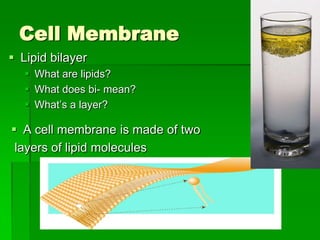
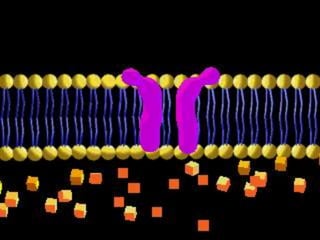
 Lipid bilayer
    What are lipids?
    What does bi- mean?
    What’s a layer?

 A cell membrane is made of two
 layers of lipid molecules
Cell membrane
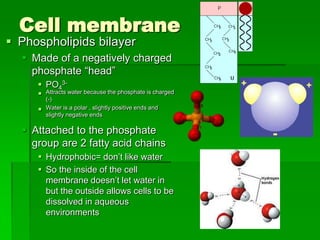
 Phospholipids bilayer
   Made of a negatively charged
    phosphate “head”
      PO43-
      Attracts water because the phosphate is charged
       (-)
        Water is a polar , slightly positive ends and
         slightly negative ends

   Attached to the phosphate
    group are 2 fatty acid chains
      Hydrophobic= don’t like water
      So the inside of the cell
       membrane doesn’t let water in
       but the outside allows cells to be
       dissolved in aqueous
       environments
Other things in the
membrane…
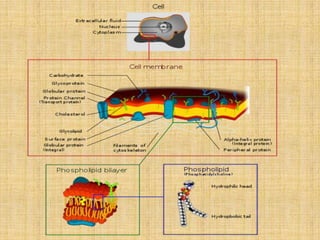
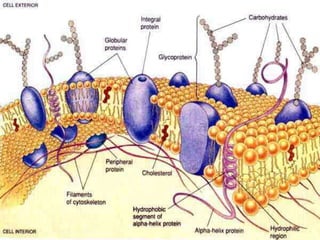
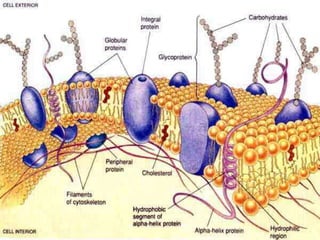
  Proteins embedded
   in lipid bilayer
  Carbohydrates
   attached to proteins
  So many different
   molecules in
   membrane, we call it
   a “mosaic” of
   different molecules
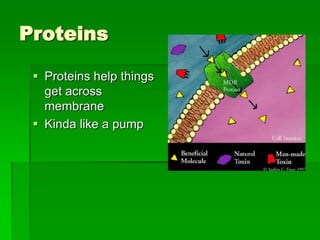
Proteins

  Proteins help things
   get across
   membrane
  Kinda like a pump
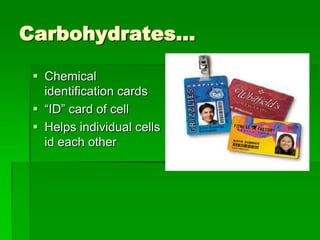
Carbohydrates…

  Chemical
   identification cards
  “ID” card of cell
  Helps individual cells
   id each other
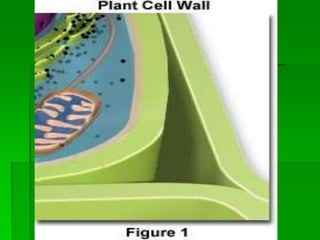
Cell Walls
 Outside cell membrane
  (does NOT replace
  membrane!!!)
 Plants, algae, fungi,
  prokaryotes
 Have pores to allow
  things in
 Function: SUPPORT
  and PROTECT
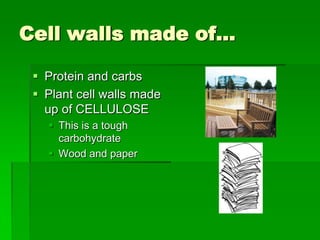
Cell walls made of…

  Protein and carbs
  Plant cell walls made
   up of CELLULOSE
    This is a tough
     carbohydrate
    Wood and paper
The Cell Membrane

   A biological membrane
   Cells exist in liquid environments
   Things need to get in and out of cell
   Different ways to do this….
Concentration (conc.)
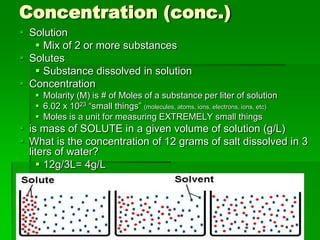
 Solution
    Mix of 2 or more substances
 Solutes
    Substance dissolved in solution
 Concentration
    Molarity (M) is # of Moles of a substance per liter of solution
    6.02 x 10²³ “small things” (molecules, atoms, ions, electrons, ions, etc)
    Moles is a unit for measuring EXTREMELY small things
 is mass of SOLUTE in a given volume of solution (g/L)
 What is the concentration of 12 grams of salt dissolved in 3
  liters of water?
     12g/3L= 4g/L
Diffusion
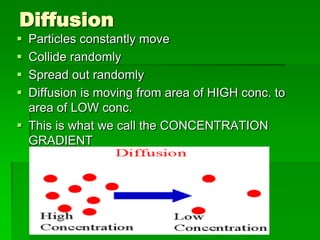
 Particles constantly move
 Collide randomly
 Spread out randomly
 Diffusion is moving from area of HIGH conc. to
  area of LOW conc.
 This is what we call the CONCENTRATION
  GRADIENT
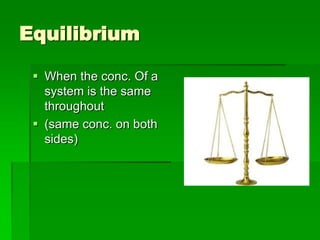
Equilibrium

  When the conc. Of a
   system is the same
   throughout
  (same conc. on both
   sides)
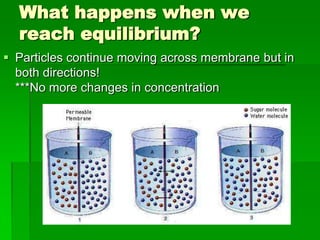
What happens when we
  reach equilibrium?
 Particles continue moving across membrane but in
  both directions!
  ***No more changes in concentration
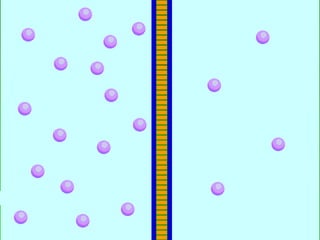
If things can cross a
membrane we call the
membrane PERMEABLE

If things canNOT cross a
membrane we call the
membrane IMPERMEABLE
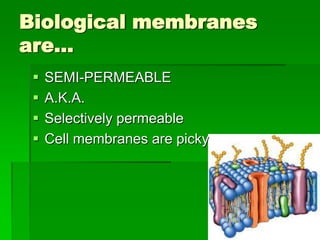
Biological membranes
are…
    SEMI-PERMEABLE
    A.K.A.
    Selectively permeable
    Cell membranes are picky
What’s this have to do
with cells?
  Cell have liquid inside and are found in liquid
   environment
  We have substances (solutes) inside and
   outside cell
  Unequal concentrations means we get
   DIFFUSION!!!
  B/c diffusion depends on random particle
   movements, substances diffuse across
   membranes without requiring the cell to use
   energy
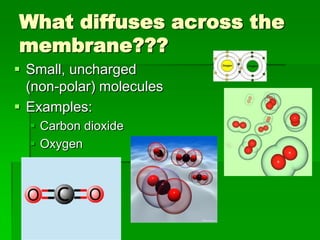
What diffuses across the
membrane???
 Small, uncharged
  (non-polar) molecules
 Examples:
   Carbon dioxide
   Oxygen
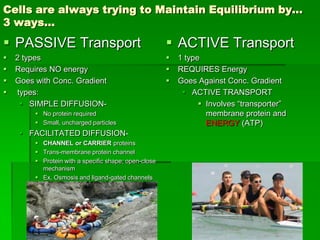
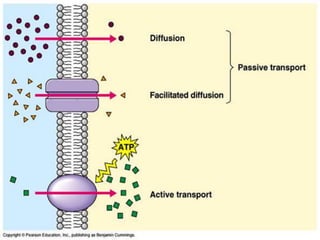
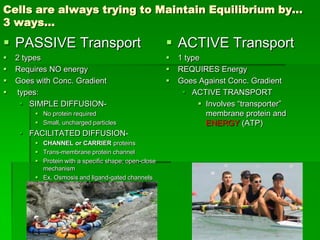
Cells are always trying to Maintain Equilibrium by…
3 ways…

 PASSIVE Transport                                     ACTIVE Transport
   2 types                                               1 type
   Requires NO energy                                    REQUIRES Energy
   Goes with Conc. Gradient                              Goes Against Conc. Gradient
   types:                                                   ACTIVE TRANSPORT
      SIMPLE DIFFUSION-                                          Involves “transporter”
          No protein required                                     membrane protein and
          Small, uncharged particles                              ENERGY (ATP)
      FACILITATED DIFFUSION-
          CHANNEL or CARRIER proteins
          Trans-membrane protein channel
          Protein with a specific shape; open-close
           mechanism
          Ex. Osmosis and ligand-gated channels
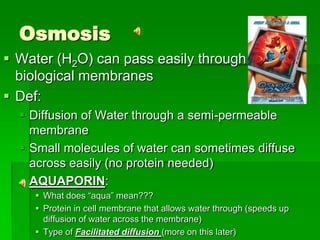
Osmosis
 Water (H2O) can pass easily through most
  biological membranes
 Def:
   Diffusion of Water through a semi-permeable
    membrane
   Small molecules of water can sometimes diffuse
    across easily (no protein needed)
   AQUAPORIN:
     What does “aqua” mean???
     Protein in cell membrane that allows water through (speeds up
      diffusion of water across the membrane)
     Type of Facilitated diffusion (more on this later)
How Osmosis works…
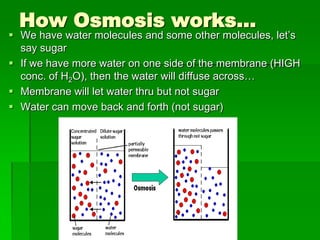
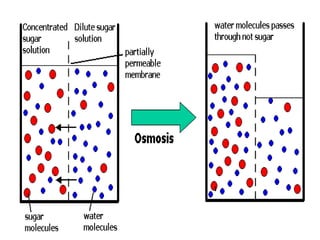
 We have water molecules and some other molecules, let’s
  say sugar
 If we have more water on one side of the membrane (HIGH
  conc. of H2O), then the water will diffuse across…
 Membrane will let water thru but not sugar
 Water can move back and forth (not sugar)
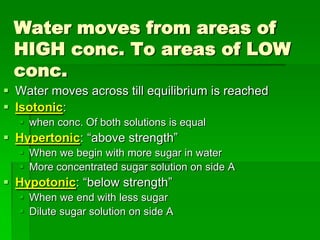
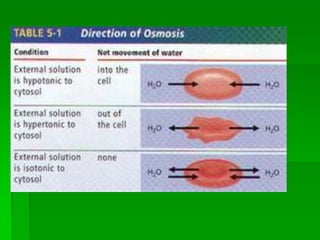
Water moves from areas of
 HIGH conc. To areas of LOW
 conc.
 Water moves across till equilibrium is reached
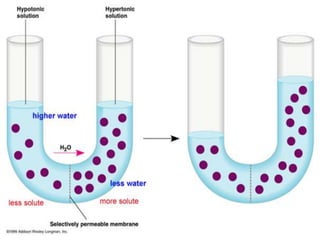
 Isotonic:
   when conc. Of both solutions is equal
 Hypertonic: “above strength”
   When we begin with more sugar in water
   More concentrated sugar solution on side A
 Hypotonic: “below strength”
   When we end with less sugar
   Dilute sugar solution on side A
Osmotic Pressure
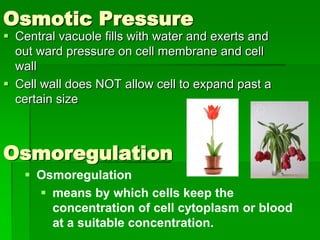
 Central vacuole fills with water and exerts and
  out ward pressure on cell membrane and cell
  wall
 Cell wall does NOT allow cell to expand past a
  certain size


Osmoregulation
    Osmoregulation
      means by which cells keep the
       concentration of cell cytoplasm or blood
       at a suitable concentration.
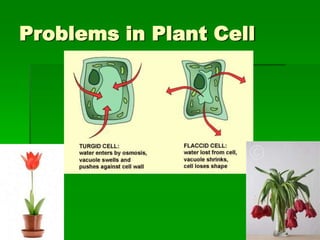
Problems in Plant Cell
Osmotic Pressure
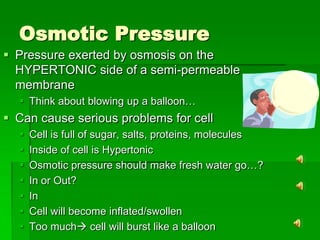
 Pressure exerted by osmosis on the
  HYPERTONIC side of a semi-permeable
  membrane
   Think about blowing up a balloon…
 Can cause serious problems for cell
     Cell is full of sugar, salts, proteins, molecules
     Inside of cell is Hypertonic
     Osmotic pressure should make fresh water go…?
     In or Out?
     In
     Cell will become inflated/swollen
     Too much cell will burst like a balloon
Why don’t all our cells
 burst?
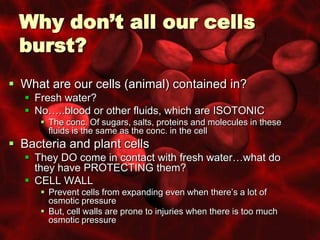
 What are our cells (animal) contained in?
   Fresh water?
   No…..blood or other fluids, which are ISOTONIC
      The conc. Of sugars, salts, proteins and molecules in these
       fluids is the same as the conc. in the cell
 Bacteria and plant cells
   They DO come in contact with fresh water…what do
    they have PROTECTING them?
   CELL WALL
      Prevent cells from expanding even when there’s a lot of
       osmotic pressure
      But, cell walls are prone to injuries when there is too much
       osmotic pressure
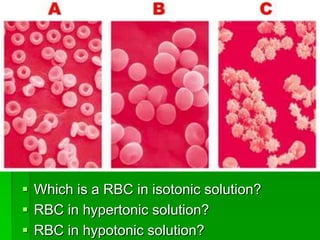
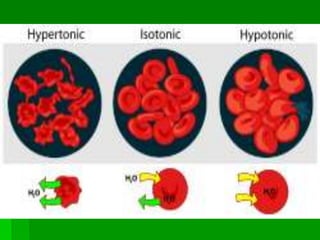
 Which is a RBC in isotonic solution?
 RBC in hypertonic solution?
 RBC in hypotonic solution?
How do big molecules
diffuse across a membrane
so quickly if the membrane
is selectively permeable?
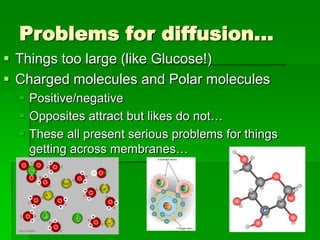
Problems for diffusion…
 Things too large (like Glucose!)
 Charged molecules and Polar molecules
   Positive/negative
   Opposites attract but likes do not…
   These all present serious problems for things
    getting across membranes…
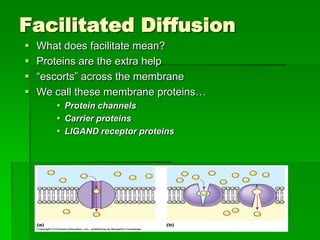
Facilitated Diffusion
   What does facilitate mean?
   Proteins are the extra help
   “escorts” across the membrane
   We call these membrane proteins…
        Protein channels
        Carrier proteins
        LIGAND receptor proteins
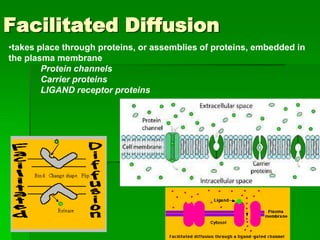
Facilitated Diffusion
•takes place through proteins, or assemblies of proteins, embedded in
the plasma membrane
        Protein channels
        Carrier proteins
        LIGAND receptor proteins
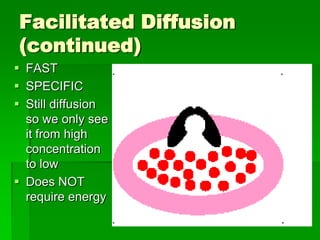
Facilitated Diffusion
(continued)
 FAST
 SPECIFIC
 Still diffusion
  so we only see
  it from high
  concentration
  to low
 Does NOT
  require energy
What about when we want to
go against the
concentration?

(From low concentration to
high?)
What do we need???

 ENERGY!!!!
ACTIVE transport
 Process that moves molecules against the concentration gradient
 Requires ENERGY
 A protein pumps small molecules and ions across a cell membrane against
  the conc. Gradient
 Direct and Indirect Active transport (see animation)
    Forms of molecular transport proteins are used to pump small molecules
      and ions across membrane even against the conc. grad.
    Direct: every 3 Na+ ions pumped across for every 2 K+ ions
    Indirect: Build up of ions on one side opens up another channel to shuttle in other
     molecules (Na+/Glucose channel)
 Electrochemical gradient
    membrane potential (cell membrane is negative)
    Na+ opens build up on the outside of the cell…draws water out of the cell so it doesn’t
     swell or burst!
 To pump large molecules and clumps…
    2 other processes:
         Exocytosis: exo-means….cyto- means…..-sis means….
         Endocytosis: endo-means….cyto- means…..-sis means….
         They can change shape of membrane
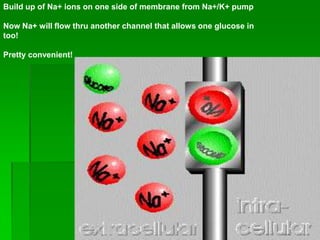
Build up of Na+ ions on one side of membrane from Na+/K+ pump

Now Na+ will flow thru another channel that allows one glucose in
too!

Pretty convenient!
Endocytosis
  When cells need to take in large material
  Process of taking material into the cell by
   process of infolding, or pockets, of the
   cell membrane
  Pocket breaks loose from cell membrane
   and forms a vacuole or vesicle inside the
   cell
  Two Types…
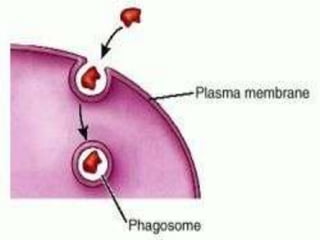
    Phagocytosis
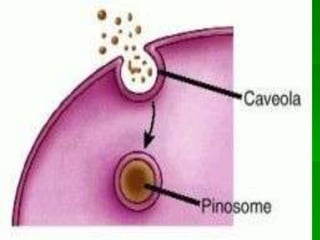
    Pinocytosis
Two types of endocytosis:
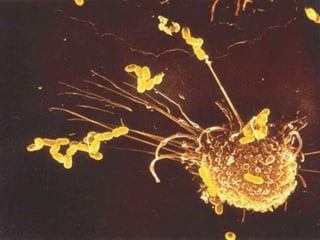
1. Phagocytosis
   “cell eating”
   Extensions of cytoplasm surround the particle
    and package it within a food vesicle
   Cell then engulfs the package
   Amoebas
2. Pinocytosis
     “cell drinking”
     When cell needs to take up liquid
     Tiny pockets in cell membrane form
     Fill with liquid or many smaller molecules
     Then pinch off to form vesicles inside of cell
Exocytosis
  Exo- means…
  Cyto means…
  Sis means…
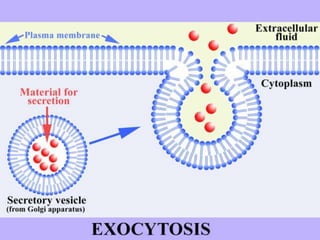
  When cell releases large amounts of material
  Excretes stuff
  Membrane of vacuole surrounding particle
   inside cell fuses with the cell membrane
  The contents in vacuole are then forced out of
   the cell
  We see this in removal of water by contractile
   vacuoles
Cells are always trying to Maintain Equilibrium by…
3 ways…

 PASSIVE Transport                                     ACTIVE Transport
   2 types                                               1 type
   Requires NO energy                                    REQUIRES Energy
   Goes with Conc. Gradient                              Goes Against Conc. Gradient
   types:                                                   ACTIVE TRANSPORT
      SIMPLE DIFFUSION-                                          Involves “transporter”
          No protein required                                     membrane protein and
          Small, uncharged particles                              ENERGY (ATP)
      FACILITATED DIFFUSION-
          CHANNEL or CARRIER proteins
          Trans-membrane protein channel
          Protein with a specific shape; open-close
           mechanism
          Ex. Osmosis and ligand-gated channels
MEMBRANE MAMBO!!!
Membrane Mambo
   10 minutes to plan
   2 teams/Cells
   Nucleus for each team
   Each member must be assigned a molecular role (must be labeled)
      Membrane protein(s)
      Molecule A (ex. Glucose)
      Molecule B (ex. Na+)
      Molecule C (ex. Water)
      Remember molecules are ALWAYS moving!!!
   MUST act out the following types of membrane transport:
      Simple Diffusion
      Osmosis
      Facilitated diffusion (channel, carrier and ligand)
      Active transport (direct and indirect)
   Be prepared to determine the concentration on either side of the membrane
   Your “Nucleus” must turn in a paper with every ones name and roles
   Summary of how each scenario will be acted out

Cell membrane powerpoint diffusion and osmosis revised

  • 2.
  • 3.
    What are boundaries? We have borders surrounding countries  We have boundaries on a playing field  Why are borders important?
  • 4.
    What are theborders of a cell?  Cell membrane  Thin, flexible barrier  Cell wall  Plant, algae, fungi, prokaryotes  Strong supporting layer
  • 5.
    Cell Membrane What does it do for cell?  Controls what goes in and out  Regulates molecules moving from one liquid side of the cell to the other liquid side of the cell  Protects  Supports
  • 6.
    Cell Membrane  Lipidbilayer  What are lipids?  What does bi- mean?  What’s a layer?  A cell membrane is made of two layers of lipid molecules
  • 7.
    Cell membrane  Phospholipidsbilayer  Made of a negatively charged phosphate “head”  PO43-  Attracts water because the phosphate is charged (-)  Water is a polar , slightly positive ends and slightly negative ends  Attached to the phosphate group are 2 fatty acid chains  Hydrophobic= don’t like water  So the inside of the cell membrane doesn’t let water in but the outside allows cells to be dissolved in aqueous environments
  • 9.
    Other things inthe membrane…  Proteins embedded in lipid bilayer  Carbohydrates attached to proteins  So many different molecules in membrane, we call it a “mosaic” of different molecules
  • 11.
    Proteins  Proteinshelp things get across membrane  Kinda like a pump
  • 12.
    Carbohydrates…  Chemical identification cards  “ID” card of cell  Helps individual cells id each other
  • 14.
    Cell Walls  Outsidecell membrane (does NOT replace membrane!!!)  Plants, algae, fungi, prokaryotes  Have pores to allow things in  Function: SUPPORT and PROTECT
  • 16.
    Cell walls madeof…  Protein and carbs  Plant cell walls made up of CELLULOSE  This is a tough carbohydrate  Wood and paper
  • 17.
    The Cell Membrane  A biological membrane  Cells exist in liquid environments  Things need to get in and out of cell  Different ways to do this….
  • 18.
    Concentration (conc.)  Solution  Mix of 2 or more substances  Solutes  Substance dissolved in solution  Concentration  Molarity (M) is # of Moles of a substance per liter of solution  6.02 x 10²³ “small things” (molecules, atoms, ions, electrons, ions, etc)  Moles is a unit for measuring EXTREMELY small things  is mass of SOLUTE in a given volume of solution (g/L)  What is the concentration of 12 grams of salt dissolved in 3 liters of water?  12g/3L= 4g/L
  • 19.
    Diffusion  Particles constantlymove  Collide randomly  Spread out randomly  Diffusion is moving from area of HIGH conc. to area of LOW conc.  This is what we call the CONCENTRATION GRADIENT
  • 21.
    Equilibrium  Whenthe conc. Of a system is the same throughout  (same conc. on both sides)
  • 22.
    What happens whenwe reach equilibrium?  Particles continue moving across membrane but in both directions! ***No more changes in concentration
  • 23.
    If things cancross a membrane we call the membrane PERMEABLE If things canNOT cross a membrane we call the membrane IMPERMEABLE
  • 24.
    Biological membranes are…  SEMI-PERMEABLE  A.K.A.  Selectively permeable  Cell membranes are picky
  • 25.
    What’s this haveto do with cells?  Cell have liquid inside and are found in liquid environment  We have substances (solutes) inside and outside cell  Unequal concentrations means we get DIFFUSION!!!  B/c diffusion depends on random particle movements, substances diffuse across membranes without requiring the cell to use energy
  • 26.
    What diffuses acrossthe membrane???  Small, uncharged (non-polar) molecules  Examples:  Carbon dioxide  Oxygen
  • 27.
    Cells are alwaystrying to Maintain Equilibrium by… 3 ways…  PASSIVE Transport  ACTIVE Transport  2 types  1 type  Requires NO energy  REQUIRES Energy  Goes with Conc. Gradient  Goes Against Conc. Gradient  types:  ACTIVE TRANSPORT  SIMPLE DIFFUSION-  Involves “transporter”  No protein required membrane protein and  Small, uncharged particles ENERGY (ATP)  FACILITATED DIFFUSION-  CHANNEL or CARRIER proteins  Trans-membrane protein channel  Protein with a specific shape; open-close mechanism  Ex. Osmosis and ligand-gated channels
  • 28.
    Osmosis  Water (H2O)can pass easily through most biological membranes  Def:  Diffusion of Water through a semi-permeable membrane  Small molecules of water can sometimes diffuse across easily (no protein needed)  AQUAPORIN:  What does “aqua” mean???  Protein in cell membrane that allows water through (speeds up diffusion of water across the membrane)  Type of Facilitated diffusion (more on this later)
  • 29.
    How Osmosis works… We have water molecules and some other molecules, let’s say sugar  If we have more water on one side of the membrane (HIGH conc. of H2O), then the water will diffuse across…  Membrane will let water thru but not sugar  Water can move back and forth (not sugar)
  • 30.
    Water moves fromareas of HIGH conc. To areas of LOW conc.  Water moves across till equilibrium is reached  Isotonic:  when conc. Of both solutions is equal  Hypertonic: “above strength”  When we begin with more sugar in water  More concentrated sugar solution on side A  Hypotonic: “below strength”  When we end with less sugar  Dilute sugar solution on side A
  • 33.
    Osmotic Pressure  Centralvacuole fills with water and exerts and out ward pressure on cell membrane and cell wall  Cell wall does NOT allow cell to expand past a certain size Osmoregulation  Osmoregulation  means by which cells keep the concentration of cell cytoplasm or blood at a suitable concentration.
  • 34.
  • 35.
    Osmotic Pressure  Pressureexerted by osmosis on the HYPERTONIC side of a semi-permeable membrane  Think about blowing up a balloon…  Can cause serious problems for cell  Cell is full of sugar, salts, proteins, molecules  Inside of cell is Hypertonic  Osmotic pressure should make fresh water go…?  In or Out?  In  Cell will become inflated/swollen  Too much cell will burst like a balloon
  • 36.
    Why don’t allour cells burst?  What are our cells (animal) contained in?  Fresh water?  No…..blood or other fluids, which are ISOTONIC  The conc. Of sugars, salts, proteins and molecules in these fluids is the same as the conc. in the cell  Bacteria and plant cells  They DO come in contact with fresh water…what do they have PROTECTING them?  CELL WALL  Prevent cells from expanding even when there’s a lot of osmotic pressure  But, cell walls are prone to injuries when there is too much osmotic pressure
  • 37.
     Which isa RBC in isotonic solution?  RBC in hypertonic solution?  RBC in hypotonic solution?
  • 40.
    How do bigmolecules diffuse across a membrane so quickly if the membrane is selectively permeable?
  • 41.
    Problems for diffusion… Things too large (like Glucose!)  Charged molecules and Polar molecules  Positive/negative  Opposites attract but likes do not…  These all present serious problems for things getting across membranes…
  • 42.
    Facilitated Diffusion  What does facilitate mean?  Proteins are the extra help  “escorts” across the membrane  We call these membrane proteins…  Protein channels  Carrier proteins  LIGAND receptor proteins
  • 43.
    Facilitated Diffusion •takes placethrough proteins, or assemblies of proteins, embedded in the plasma membrane Protein channels Carrier proteins LIGAND receptor proteins
  • 44.
    Facilitated Diffusion (continued)  FAST SPECIFIC  Still diffusion so we only see it from high concentration to low  Does NOT require energy
  • 46.
    What about whenwe want to go against the concentration? (From low concentration to high?)
  • 47.
    What do weneed??? ENERGY!!!!
  • 48.
    ACTIVE transport  Processthat moves molecules against the concentration gradient  Requires ENERGY  A protein pumps small molecules and ions across a cell membrane against the conc. Gradient  Direct and Indirect Active transport (see animation)  Forms of molecular transport proteins are used to pump small molecules and ions across membrane even against the conc. grad.  Direct: every 3 Na+ ions pumped across for every 2 K+ ions  Indirect: Build up of ions on one side opens up another channel to shuttle in other molecules (Na+/Glucose channel)  Electrochemical gradient  membrane potential (cell membrane is negative)  Na+ opens build up on the outside of the cell…draws water out of the cell so it doesn’t swell or burst!  To pump large molecules and clumps…  2 other processes:  Exocytosis: exo-means….cyto- means…..-sis means….  Endocytosis: endo-means….cyto- means…..-sis means….  They can change shape of membrane
  • 49.
    Build up ofNa+ ions on one side of membrane from Na+/K+ pump Now Na+ will flow thru another channel that allows one glucose in too! Pretty convenient!
  • 50.
    Endocytosis  Whencells need to take in large material  Process of taking material into the cell by process of infolding, or pockets, of the cell membrane  Pocket breaks loose from cell membrane and forms a vacuole or vesicle inside the cell  Two Types…  Phagocytosis  Pinocytosis
  • 52.
    Two types ofendocytosis: 1. Phagocytosis  “cell eating”  Extensions of cytoplasm surround the particle and package it within a food vesicle  Cell then engulfs the package  Amoebas 2. Pinocytosis  “cell drinking”  When cell needs to take up liquid  Tiny pockets in cell membrane form  Fill with liquid or many smaller molecules  Then pinch off to form vesicles inside of cell
  • 55.
    Exocytosis  Exo-means…  Cyto means…  Sis means…  When cell releases large amounts of material  Excretes stuff  Membrane of vacuole surrounding particle inside cell fuses with the cell membrane  The contents in vacuole are then forced out of the cell  We see this in removal of water by contractile vacuoles
  • 58.
    Cells are alwaystrying to Maintain Equilibrium by… 3 ways…  PASSIVE Transport  ACTIVE Transport  2 types  1 type  Requires NO energy  REQUIRES Energy  Goes with Conc. Gradient  Goes Against Conc. Gradient  types:  ACTIVE TRANSPORT  SIMPLE DIFFUSION-  Involves “transporter”  No protein required membrane protein and  Small, uncharged particles ENERGY (ATP)  FACILITATED DIFFUSION-  CHANNEL or CARRIER proteins  Trans-membrane protein channel  Protein with a specific shape; open-close mechanism  Ex. Osmosis and ligand-gated channels
  • 59.
  • 60.
    Membrane Mambo  10 minutes to plan  2 teams/Cells  Nucleus for each team  Each member must be assigned a molecular role (must be labeled)  Membrane protein(s)  Molecule A (ex. Glucose)  Molecule B (ex. Na+)  Molecule C (ex. Water)  Remember molecules are ALWAYS moving!!!  MUST act out the following types of membrane transport:  Simple Diffusion  Osmosis  Facilitated diffusion (channel, carrier and ligand)  Active transport (direct and indirect)  Be prepared to determine the concentration on either side of the membrane  Your “Nucleus” must turn in a paper with every ones name and roles  Summary of how each scenario will be acted out