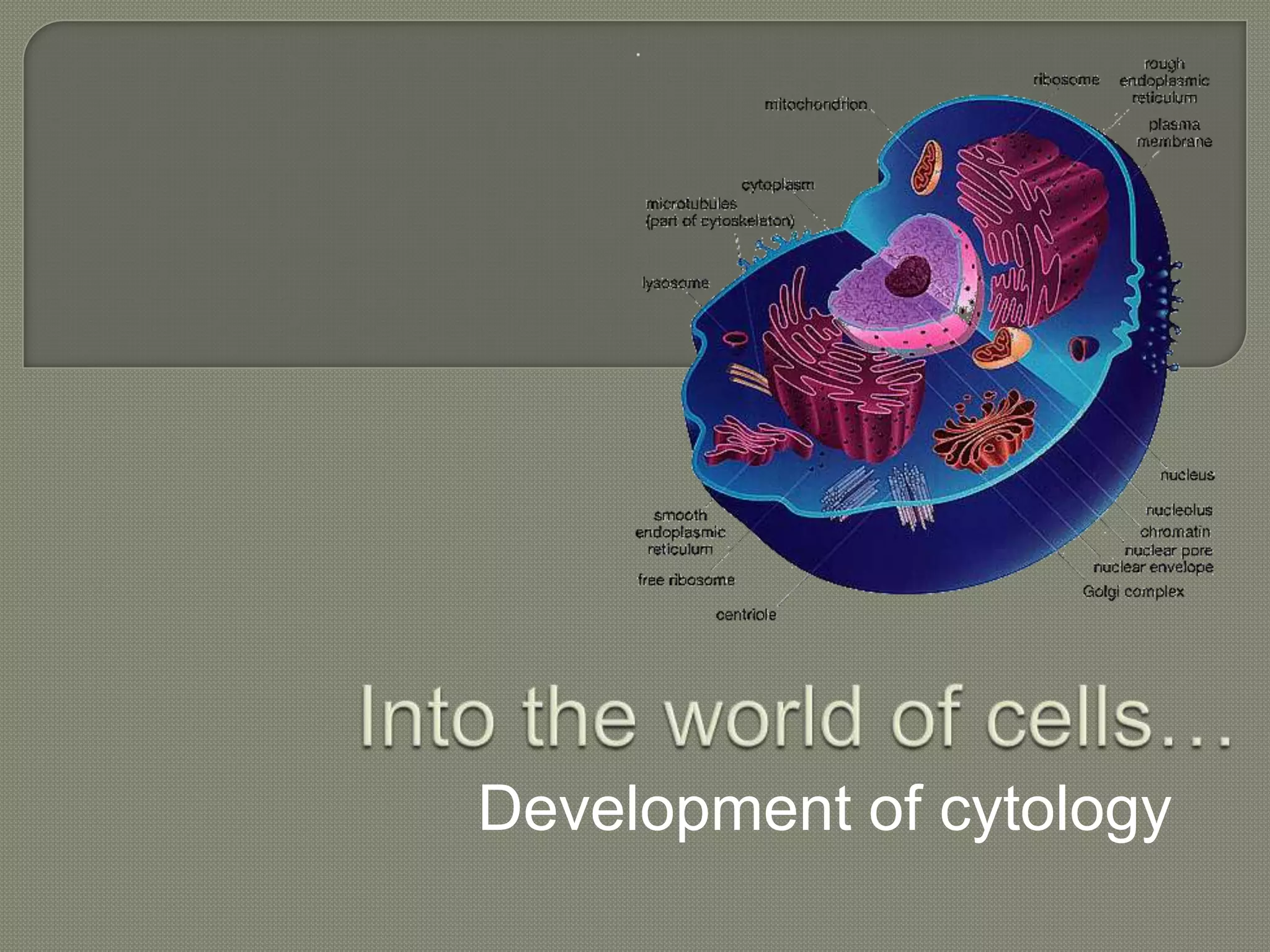
Into the world of cells…Development of cytology
Essential questionAre all living organisms made up of cells?
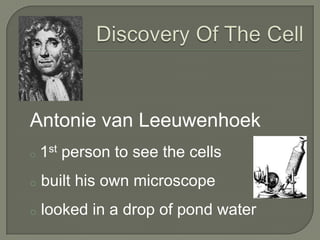
Discovery Of The CellAntonie van Leeuwenhoek1st person to see the cells
 built his own microscope
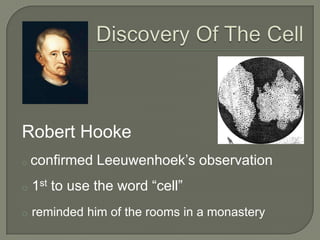
 looked in a drop of pond waterDiscovery Of The CellRobert Hookeconfirmed Leeuwenhoek’s observation
 1st to use the word “cell”
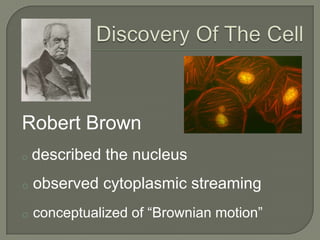
reminded him of the rooms in a monasteryDiscovery Of The CellRobert Browndescribed the nucleus
 observed cytoplasmic streaming
conceptualized of “Brownian motion”Discovery Of The CellMatthias Schleidencontributed to the cell theory
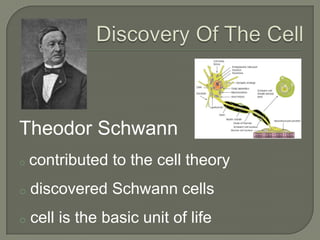
 stated plants are composed of cellsDiscovery Of The CellTheodor Schwanncontributed to the cell theory
 discovered Schwann cells
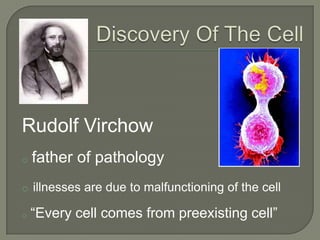
 cell is the basic unit of lifeDiscovery Of The CellRudolf Virchowfather of pathology
illnesses are due to malfunctioning of the cell
“Every cell comes from preexisting cell” Cell TheoryAll organisms are composed of cells.Cells are the basic unit of life.Cells come from preexisting cells.
Essential questionHow are cells studied?
MicroscopyIt is the technical field of using microscopes to view samples or objects
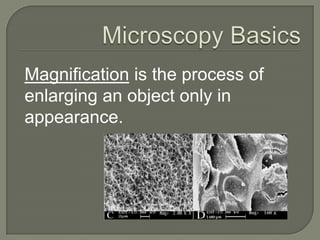
Microscopy BasicsMagnification is the process of enlarging an object only in appearance.
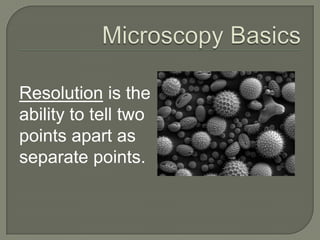
Microscopy BasicsResolutionis the ability to tell two points apart as separate points.
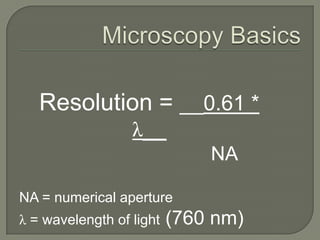
Microscopy BasicsResolution = __0.61 * λ__  			          NANA = numerical apertureλ = wavelength of light (760 nm)
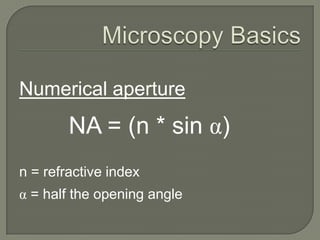
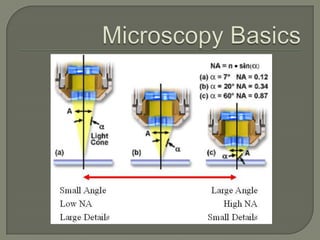
Microscopy BasicsNumerical apertureNA = (n * sin α)n = refractive indexα = half the opening angle
Microscopy Basics
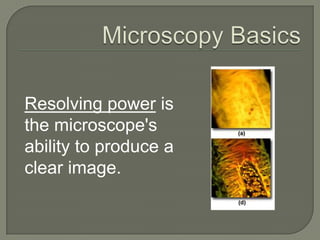
Microscopy BasicsResolving power is the microscope's ability to produce a clear image.
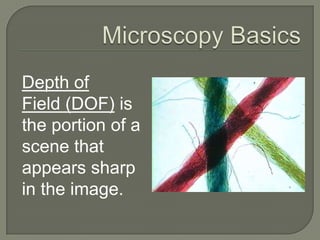
Microscopy BasicsDepth of Field (DOF) is the portion of a scene that appears sharp in the image.
Essential questionWhat are the different types of microscopes?
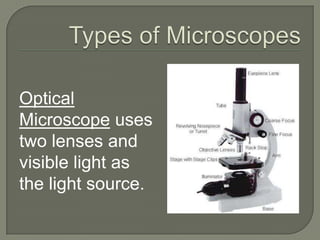
Types of MicroscopesOptical Microscope uses two lenses and visible light as the light source.
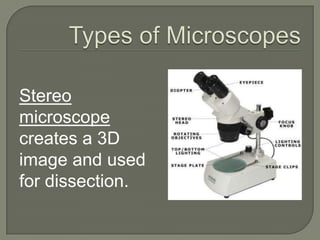
Types of MicroscopesStereo microscope creates a 3D image and used for dissection.
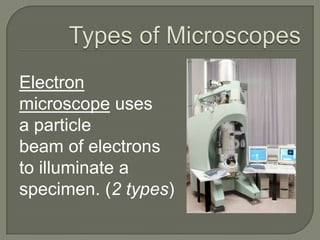
Types of MicroscopesElectron microscope uses a particle beam of electrons to illuminate a specimen. (2 types)
Types of MicroscopesTransmission (TEM) provides internal view of the specimen.Scanning (SEM) provides the external view of the specimen.
Essential questionHow are these specimens prepared for viewing?
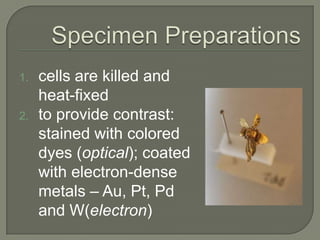
Specimen Preparationscells are killed and heat-fixedto provide contrast: stained with colored dyes (optical); coated with electron-dense metals – Au, Pt, Pd and W(electron)
Other techniquesDifferential Interference – enhance density differencesPhase contrast – some regions appear brighter or darkerDark-field – light is scattered by the specimen

Cellular Basis Of Life