Discovering Cells Looking Inside Cells Chemical Compounds in Cells The Cell in Its Environment Table of Contents
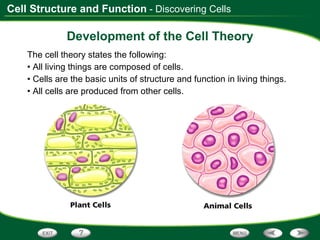
Development of the Cell Theory The cell theory states the following: All living things are composed of cells. Cells are the basic units of structure and function in living things. All cells are produced from other cells. - Discovering Cells
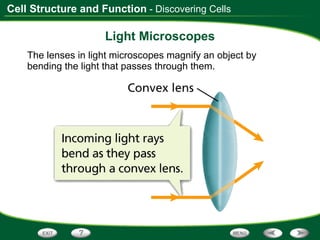
Light Microscopes The lenses in light microscopes magnify an object by bending the light that passes through them. - Discovering Cells
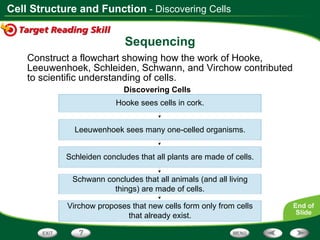
Sequencing Construct a flowchart showing how the work of Hooke, Leeuwenhoek, Schleiden, Schwann, and Virchow contributed to scientific understanding of cells. Discovering Cells Hooke sees cells in cork. Leeuwenhoek sees many one-celled organisms. Schleiden concludes that all plants are made of cells. Schwann concludes that all animals (and all living things) are made of cells. Virchow proposes that new cells form only from cells that already exist. - Discovering Cells
Links on Cell Theory Click the SciLinks button for links on the cell theory. - Discovering Cells
End of Section: Discovering Cells
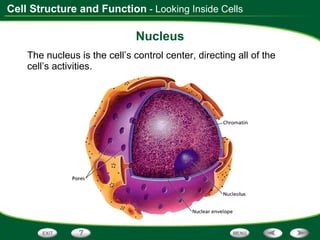
Nucleus The nucleus is the cell’s control center, directing all of the cell’s activities. - Looking Inside Cells
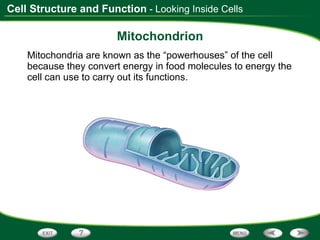
Mitochondrion Mitochondria are known as the “powerhouses” of the cell because they convert energy in food molecules to energy the cell can use to carry out its functions. - Looking Inside Cells
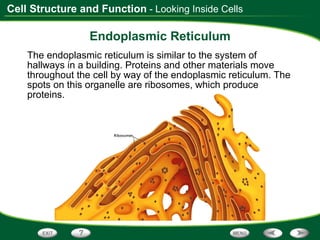
Endoplasmic Reticulum The endoplasmic reticulum is similar to the system of hallways in a building. Proteins and other materials move throughout the cell by way of the endoplasmic reticulum. The spots on this organelle are ribosomes, which produce proteins. - Looking Inside Cells
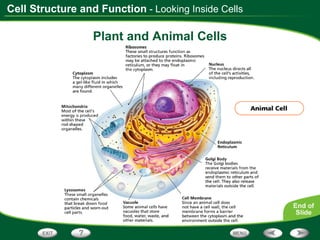
Plant and Animal Cells - Looking Inside Cells
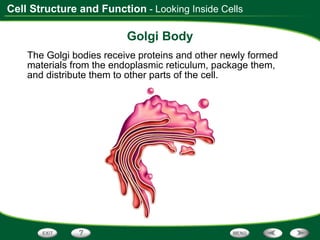
Golgi Body The Golgi bodies receive proteins and other newly formed materials from the endoplasmic reticulum, package them, and distribute them to other parts of the cell. - Looking Inside Cells
Plant and Animal Cells Activity Click the Active Art button to open a browser window and access Active Art about plant and animal cells. - Looking Inside Cells
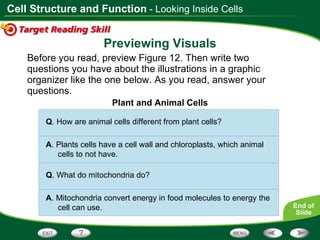
Before you read, preview Figure 12. Then write two questions you have about the illustrations in a graphic organizer like the one below. As you read, answer your questions. Previewing Visuals Q . How are animal cells different from plant cells? A . Plants cells have a cell wall and chloroplasts, which animal cells to not have. Q . What do mitochondria do? A . Mitochondria convert energy in food molecules to energy the cell can use. Plant and Animal Cells - Looking Inside Cells
The Cytoplasm and Organelles Click the Video button to watch a movie about cytoplasm and organelles. - Looking Inside Cells
Specialized Cells Click the Video button to watch a movie about specialized cells. - Looking Inside Cells
End of Section: Looking Inside Cells
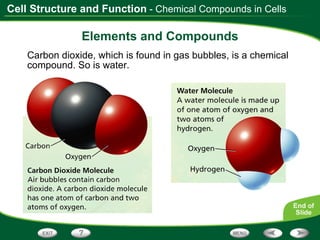
Elements and Compounds Carbon dioxide, which is found in gas bubbles, is a chemical compound. So is water. - Chemical Compounds in Cells
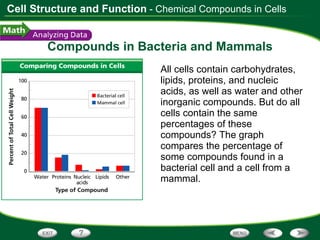
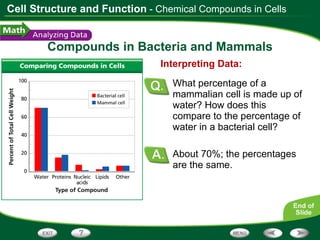
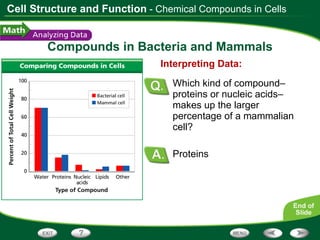
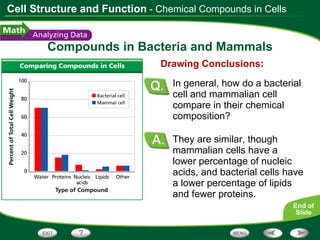
Compounds in Bacteria and Mammals All cells contain carbohydrates, lipids, proteins, and nucleic acids, as well as water and other inorganic compounds. But do all cells contain the same percentages of these compounds? The graph compares the percentage of some compounds found in a bacterial cell and a cell from a mammal. - Chemical Compounds in Cells
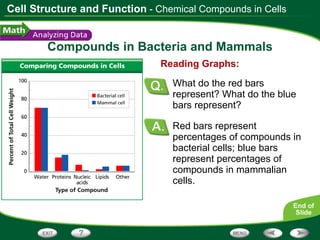
Compounds in Bacteria and Mammals Red bars represent percentages of compounds in bacterial cells; blue bars represent percentages of compounds in mammalian cells. Reading Graphs: What do the red bars represent? What do the blue bars represent? - Chemical Compounds in Cells
Compounds in Bacteria and Mammals About 70%; the percentages are the same. Interpreting Data: What percentage of a mammalian cell is made up of water? How does this compare to the percentage of water in a bacterial cell? - Chemical Compounds in Cells
Compounds in Bacteria and Mammals Proteins Interpreting Data: Which kind of compound–proteins or nucleic acids–makes up the larger percentage of a mammalian cell? - Chemical Compounds in Cells
Compounds in Bacteria and Mammals They are similar, though mammalian cells have a lower percentage of nucleic acids, and bacterial cells have a lower percentage of lipids and fewer proteins. Drawing Conclusions: In general, how do a bacterial cell and mammalian cell compare in their chemical composition? - Chemical Compounds in Cells
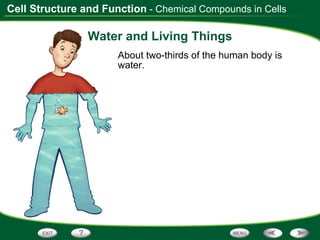
Water and Living Things About two-thirds of the human body is water. - Chemical Compounds in Cells
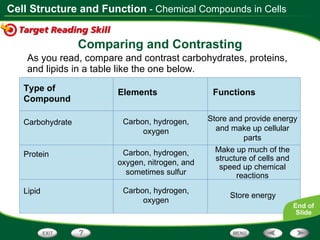
As you read, compare and contrast carbohydrates, proteins, and lipids in a table like the one below. Comparing and Contrasting Type of Compound Elements Functions Carbohydrate Carbon, hydrogen, oxygen Store and provide energy and make up cellular parts Protein Carbon, hydrogen, oxygen, nitrogen, and sometimes sulfur Make up much of the structure of cells and speed up chemical reactions Lipid Carbon, hydrogen, oxygen Store energy - Chemical Compounds in Cells
Links on Proteins Click the SciLinks button for links on proteins. - Chemical Compounds in Cells
End of Section: Chemical Compounds in Cells
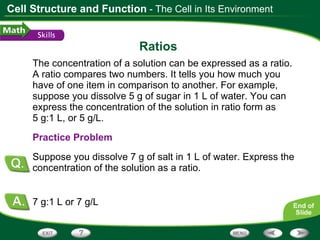
Ratios  The concentration of a solution can be expressed as a ratio. A ratio compares two numbers. It tells you how much you have of one item in comparison to another. For example, suppose you dissolve 5 g of sugar in 1 L of water. You can express the concentration of the solution in ratio form as 5 g:1 L, or 5 g/L. Practice Problem Suppose you dissolve 7 g of salt in 1 L of water. Express the concentration of the solution as a ratio. 7 g:1 L or 7 g/L - The Cell in Its Environment
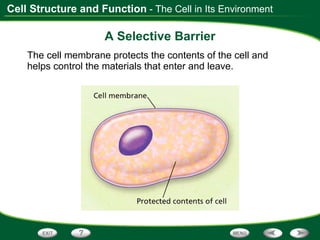
A Selective Barrier The cell membrane protects the contents of the cell and helps control the materials that enter and leave. - The Cell in Its Environment
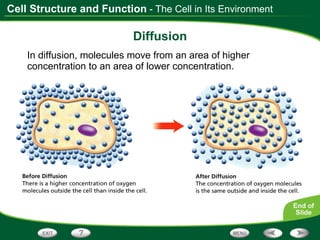
Diffusion In diffusion, molecules move from an area of higher concentration to an area of lower concentration. - The Cell in Its Environment
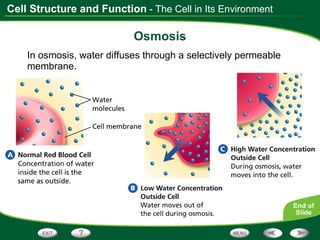
Osmosis In osmosis, water diffuses through a selectively permeable membrane. - The Cell in Its Environment
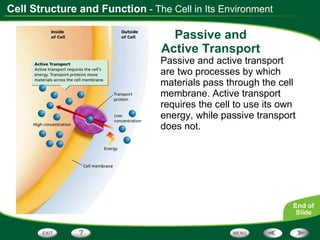
Passive and Active Transport Passive and active transport are two processes by which materials pass through the cell membrane. Active transport requires the cell to use its own energy, while passive transport does not. - The Cell in Its Environment
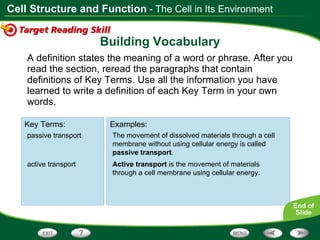
Building Vocabulary A definition states the meaning of a word or phrase. After you read the section, reread the paragraphs that contain definitions of Key Terms. Use all the information you have learned to write a definition of each Key Term in your own words. Key Terms: Examples: - The Cell in Its Environment selectively permeable The cell membrane is  selectively permeable , which means that some substances can pass through the membrane while others cannot. diffusion Diffusion  is the process by which molecules move from an area of higher concentration to an area of lower concentration. osmosis Osmosis  is the diffusion of water molecules through a selectively permeable membrane. The movement of dissolved materials through a cell membrane without using cellular energy is called  passive transport . Active transport  is the movement of materials through a cell membrane using cellular energy. Key Terms: Examples: passive transport active transport
More on Cellular Transport Click the PHSchool.com button for an activity about cellular transport. - The Cell in Its Environment
End of Section: The Cell in Its Environment
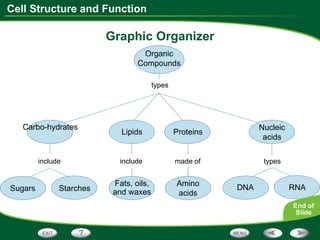
Graphic Organizer Organic Compounds Carbo-hydrates Lipids Proteins Starches Amino acids Sugars Fats, oils, and waxes DNA Nucleic acids RNA types types made of include include
End of Section: Graphic Organizer

Cell Structure And Function

  • 1.
    Discovering Cells LookingInside Cells Chemical Compounds in Cells The Cell in Its Environment Table of Contents
  • 2.
    Development of theCell Theory The cell theory states the following: All living things are composed of cells. Cells are the basic units of structure and function in living things. All cells are produced from other cells. - Discovering Cells
  • 3.
    Light Microscopes Thelenses in light microscopes magnify an object by bending the light that passes through them. - Discovering Cells
  • 4.
    Sequencing Construct aflowchart showing how the work of Hooke, Leeuwenhoek, Schleiden, Schwann, and Virchow contributed to scientific understanding of cells. Discovering Cells Hooke sees cells in cork. Leeuwenhoek sees many one-celled organisms. Schleiden concludes that all plants are made of cells. Schwann concludes that all animals (and all living things) are made of cells. Virchow proposes that new cells form only from cells that already exist. - Discovering Cells
  • 5.
    Links on CellTheory Click the SciLinks button for links on the cell theory. - Discovering Cells
  • 6.
    End of Section:Discovering Cells
  • 7.
    Nucleus The nucleusis the cell’s control center, directing all of the cell’s activities. - Looking Inside Cells
  • 8.
    Mitochondrion Mitochondria areknown as the “powerhouses” of the cell because they convert energy in food molecules to energy the cell can use to carry out its functions. - Looking Inside Cells
  • 9.
    Endoplasmic Reticulum Theendoplasmic reticulum is similar to the system of hallways in a building. Proteins and other materials move throughout the cell by way of the endoplasmic reticulum. The spots on this organelle are ribosomes, which produce proteins. - Looking Inside Cells
  • 10.
    Plant and AnimalCells - Looking Inside Cells
  • 11.
    Golgi Body TheGolgi bodies receive proteins and other newly formed materials from the endoplasmic reticulum, package them, and distribute them to other parts of the cell. - Looking Inside Cells
  • 12.
    Plant and AnimalCells Activity Click the Active Art button to open a browser window and access Active Art about plant and animal cells. - Looking Inside Cells
  • 13.
    Before you read,preview Figure 12. Then write two questions you have about the illustrations in a graphic organizer like the one below. As you read, answer your questions. Previewing Visuals Q . How are animal cells different from plant cells? A . Plants cells have a cell wall and chloroplasts, which animal cells to not have. Q . What do mitochondria do? A . Mitochondria convert energy in food molecules to energy the cell can use. Plant and Animal Cells - Looking Inside Cells
  • 14.
    The Cytoplasm andOrganelles Click the Video button to watch a movie about cytoplasm and organelles. - Looking Inside Cells
  • 15.
    Specialized Cells Clickthe Video button to watch a movie about specialized cells. - Looking Inside Cells
  • 16.
    End of Section:Looking Inside Cells
  • 17.
    Elements and CompoundsCarbon dioxide, which is found in gas bubbles, is a chemical compound. So is water. - Chemical Compounds in Cells
  • 18.
    Compounds in Bacteriaand Mammals All cells contain carbohydrates, lipids, proteins, and nucleic acids, as well as water and other inorganic compounds. But do all cells contain the same percentages of these compounds? The graph compares the percentage of some compounds found in a bacterial cell and a cell from a mammal. - Chemical Compounds in Cells
  • 19.
    Compounds in Bacteriaand Mammals Red bars represent percentages of compounds in bacterial cells; blue bars represent percentages of compounds in mammalian cells. Reading Graphs: What do the red bars represent? What do the blue bars represent? - Chemical Compounds in Cells
  • 20.
    Compounds in Bacteriaand Mammals About 70%; the percentages are the same. Interpreting Data: What percentage of a mammalian cell is made up of water? How does this compare to the percentage of water in a bacterial cell? - Chemical Compounds in Cells
  • 21.
    Compounds in Bacteriaand Mammals Proteins Interpreting Data: Which kind of compound–proteins or nucleic acids–makes up the larger percentage of a mammalian cell? - Chemical Compounds in Cells
  • 22.
    Compounds in Bacteriaand Mammals They are similar, though mammalian cells have a lower percentage of nucleic acids, and bacterial cells have a lower percentage of lipids and fewer proteins. Drawing Conclusions: In general, how do a bacterial cell and mammalian cell compare in their chemical composition? - Chemical Compounds in Cells
  • 23.
    Water and LivingThings About two-thirds of the human body is water. - Chemical Compounds in Cells
  • 24.
    As you read,compare and contrast carbohydrates, proteins, and lipids in a table like the one below. Comparing and Contrasting Type of Compound Elements Functions Carbohydrate Carbon, hydrogen, oxygen Store and provide energy and make up cellular parts Protein Carbon, hydrogen, oxygen, nitrogen, and sometimes sulfur Make up much of the structure of cells and speed up chemical reactions Lipid Carbon, hydrogen, oxygen Store energy - Chemical Compounds in Cells
  • 25.
    Links on ProteinsClick the SciLinks button for links on proteins. - Chemical Compounds in Cells
  • 26.
    End of Section:Chemical Compounds in Cells
  • 27.
    Ratios Theconcentration of a solution can be expressed as a ratio. A ratio compares two numbers. It tells you how much you have of one item in comparison to another. For example, suppose you dissolve 5 g of sugar in 1 L of water. You can express the concentration of the solution in ratio form as 5 g:1 L, or 5 g/L. Practice Problem Suppose you dissolve 7 g of salt in 1 L of water. Express the concentration of the solution as a ratio. 7 g:1 L or 7 g/L - The Cell in Its Environment
  • 28.
    A Selective BarrierThe cell membrane protects the contents of the cell and helps control the materials that enter and leave. - The Cell in Its Environment
  • 29.
    Diffusion In diffusion,molecules move from an area of higher concentration to an area of lower concentration. - The Cell in Its Environment
  • 30.
    Osmosis In osmosis,water diffuses through a selectively permeable membrane. - The Cell in Its Environment
  • 31.
    Passive and ActiveTransport Passive and active transport are two processes by which materials pass through the cell membrane. Active transport requires the cell to use its own energy, while passive transport does not. - The Cell in Its Environment
  • 32.
    Building Vocabulary Adefinition states the meaning of a word or phrase. After you read the section, reread the paragraphs that contain definitions of Key Terms. Use all the information you have learned to write a definition of each Key Term in your own words. Key Terms: Examples: - The Cell in Its Environment selectively permeable The cell membrane is selectively permeable , which means that some substances can pass through the membrane while others cannot. diffusion Diffusion is the process by which molecules move from an area of higher concentration to an area of lower concentration. osmosis Osmosis is the diffusion of water molecules through a selectively permeable membrane. The movement of dissolved materials through a cell membrane without using cellular energy is called passive transport . Active transport is the movement of materials through a cell membrane using cellular energy. Key Terms: Examples: passive transport active transport
  • 33.
    More on CellularTransport Click the PHSchool.com button for an activity about cellular transport. - The Cell in Its Environment
  • 34.
    End of Section:The Cell in Its Environment
  • 35.
    Graphic Organizer OrganicCompounds Carbo-hydrates Lipids Proteins Starches Amino acids Sugars Fats, oils, and waxes DNA Nucleic acids RNA types types made of include include
  • 36.
    End of Section:Graphic Organizer