Animal Cell
Animal Cell

Ryan Young
Nuclear Membrane
• We used licorice pieces to
represent the nuclear
membrane because it is thin
and round like the structure,
plus it went around the
nucleus perfectly.
• The function of the nuclear
membrane is to hold the
nucleolus together and
protects it and the
chromosomes.

Donna Jean Roberts
Nucleus
• The nucleus is made of a
lemon and is meant to stand
out, as it is the center of
control in the cell.
• The nucleus is so important
because it has many jobs,
such as, directing activity in
the cell, containing DNA that
dictate which proteins the
cell produces, and holding
genes.
• It contains the nucleolus
which is also important in
the functioning of a cell.
• All in all, the nucleus is like
the brain of the cell,
responsible for many
functions.
Maggie Prutznal
Nucleolus
• The nucleolus is made of a
fruit roll up to represent the
the dense mass located
inside the nucleus.
• The job of the nucleolus is to
transcribe ribosomal RNA
and combine it with proteins,
creating almost-complete
ribosomes.
• It is composed of proteins
and nucleic acids and
occupies approximately 25%
of the volume of the
nucleus.
• If the nucleolus happens to
malfunction, it results in
disease.
Maggie Prutznal
Chromatins
• Chromatins are found inside
the nucleus and are thread
like structures made of
protein and DNA. They
transfer hereditary
characteristics to other cells
like itself.
• We choose licorice pieces to
represent the chromatins
because they look similar in
the sense that it is stringy,
threadlike, and easily
tangled up.

Danielle Bowser
Cytoplasm
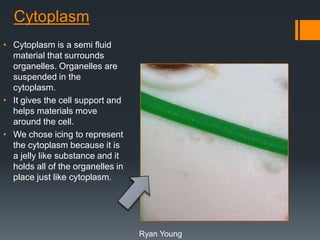
• Cytoplasm is a semi fluid
material that surrounds
organelles. Organelles are
suspended in the
cytoplasm.
• It gives the cell support and
helps materials move
around the cell.
• We chose icing to represent
the cytoplasm because it is
a jelly like substance and it
holds all of the organelles in
place just like cytoplasm.

Ryan Young
Ribosomes
• Ribosomes are small,
dense structures that are
found in all cells.
• Their main function in a
cell is to make proteins.
• We chose sprinkles to
represent them in our cell
model because they are
small and they resemble
ribosomes in cells.

Ryan Young
Smooth and Rough
Endoplasmic Reticulum
•

•

•

We used this candy to represent
the endoplasmic reticulum
because it is made in long, wide
strands that were easy to bend
and look like the structure. The
structure is long and stringy and
used as channels for transporting
things.
The rough endoplasmic
reticulum is the first arrow
because it is sprinkled with
ribosomes (sprinkles), and it‟s
function is to make proteins that
the cell needs.
The smooth endoplasmic
reticulum is the second arrow
because it doesn‟t have
ribosomes and it‟s function is to
prepare proteins to be moved to
the golgi apparatus or other parts
of the cell.

1

2

Donna Jean Roberts
Golgi Body
• The Golgi Body, also know
as the Golgi Apparatus, is
represented by a fruit-by-thefoot, as a Golgi body looks
like an overlapped ribbon.
• The Golgi Body groups items
such as lipids and proteins
and packages them in
vesicles.
• Different molecules get
different kinds of packaging
so the body knows what they
are.
• The Golgi Body “ships
packages” to different
destinations, which can be
located outside the cell or to
other organelles.
Maggie Prutznal
Mitochondria
• The mitochondria is
sometimes referred to as the
power plant of a cell because
of its function.
• A mitochondria‟s main
function is to produce energy
for the cell. The cell then uses
this energy to perform jobs
necessary for a cell to survive
and function.
• We chose to use a group of
gummy bears to represent
them because when they are
put together they resemble
the folds on the inner
membrane of a mitochondria.

Ryan Young
Vacuole
• We used this candy to
represent the vacuole
because it „s structure is
rounded like the vacuole.
• The many m&m‟s represent
one big vacuole, which is
shown by them all being the
same color.
• The vacuole‟s function is to
store water and protein that
the cell needs.

Donna Jean Roberts
Lysosomes
• The lysosome is full of
digestive enzymes that
brake down cellular waste,
fats, proteins, and even the
cell when it dies. Lysosomes
are small, rounded, bag-like
shapes and tend to vary in
size.
• We choose Werther‟s hard
caramel with a soft center to
represent the lysosome
because it is rounded and
bag-like but also has a
gooey center to illustrate the
digestive enzymes.

Danielle Bowser
Cytoskeleton
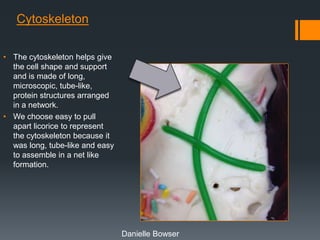
• The cytoskeleton helps give
the cell shape and support
and is made of long,
microscopic, tube-like,
protein structures arranged
in a network.
• We choose easy to pull
apart licorice to represent
the cytoskeleton because it
was long, tube-like and easy
to assemble in a net like
formation.

Danielle Bowser
Cell Membrane
(Plasma Membrane)
• We used licorice to represent
the cell membrane because
it is most like the membrane
structure, which is thick,
round, and long.
• The function of the cell or
plasma membrane is to
control the substances that
go in and out of the cell and
protect the organelles inside.

Donna Jean Roberts

Cell slides

  • 1.
  • 2.
    Nuclear Membrane • Weused licorice pieces to represent the nuclear membrane because it is thin and round like the structure, plus it went around the nucleus perfectly. • The function of the nuclear membrane is to hold the nucleolus together and protects it and the chromosomes. Donna Jean Roberts
  • 3.
    Nucleus • The nucleusis made of a lemon and is meant to stand out, as it is the center of control in the cell. • The nucleus is so important because it has many jobs, such as, directing activity in the cell, containing DNA that dictate which proteins the cell produces, and holding genes. • It contains the nucleolus which is also important in the functioning of a cell. • All in all, the nucleus is like the brain of the cell, responsible for many functions. Maggie Prutznal
  • 4.
    Nucleolus • The nucleolusis made of a fruit roll up to represent the the dense mass located inside the nucleus. • The job of the nucleolus is to transcribe ribosomal RNA and combine it with proteins, creating almost-complete ribosomes. • It is composed of proteins and nucleic acids and occupies approximately 25% of the volume of the nucleus. • If the nucleolus happens to malfunction, it results in disease. Maggie Prutznal
  • 5.
    Chromatins • Chromatins arefound inside the nucleus and are thread like structures made of protein and DNA. They transfer hereditary characteristics to other cells like itself. • We choose licorice pieces to represent the chromatins because they look similar in the sense that it is stringy, threadlike, and easily tangled up. Danielle Bowser
  • 6.
    Cytoplasm • Cytoplasm isa semi fluid material that surrounds organelles. Organelles are suspended in the cytoplasm. • It gives the cell support and helps materials move around the cell. • We chose icing to represent the cytoplasm because it is a jelly like substance and it holds all of the organelles in place just like cytoplasm. Ryan Young
  • 7.
    Ribosomes • Ribosomes aresmall, dense structures that are found in all cells. • Their main function in a cell is to make proteins. • We chose sprinkles to represent them in our cell model because they are small and they resemble ribosomes in cells. Ryan Young
  • 8.
    Smooth and Rough EndoplasmicReticulum • • • We used this candy to represent the endoplasmic reticulum because it is made in long, wide strands that were easy to bend and look like the structure. The structure is long and stringy and used as channels for transporting things. The rough endoplasmic reticulum is the first arrow because it is sprinkled with ribosomes (sprinkles), and it‟s function is to make proteins that the cell needs. The smooth endoplasmic reticulum is the second arrow because it doesn‟t have ribosomes and it‟s function is to prepare proteins to be moved to the golgi apparatus or other parts of the cell. 1 2 Donna Jean Roberts
  • 9.
    Golgi Body • TheGolgi Body, also know as the Golgi Apparatus, is represented by a fruit-by-thefoot, as a Golgi body looks like an overlapped ribbon. • The Golgi Body groups items such as lipids and proteins and packages them in vesicles. • Different molecules get different kinds of packaging so the body knows what they are. • The Golgi Body “ships packages” to different destinations, which can be located outside the cell or to other organelles. Maggie Prutznal
  • 10.
    Mitochondria • The mitochondriais sometimes referred to as the power plant of a cell because of its function. • A mitochondria‟s main function is to produce energy for the cell. The cell then uses this energy to perform jobs necessary for a cell to survive and function. • We chose to use a group of gummy bears to represent them because when they are put together they resemble the folds on the inner membrane of a mitochondria. Ryan Young
  • 11.
    Vacuole • We usedthis candy to represent the vacuole because it „s structure is rounded like the vacuole. • The many m&m‟s represent one big vacuole, which is shown by them all being the same color. • The vacuole‟s function is to store water and protein that the cell needs. Donna Jean Roberts
  • 12.
    Lysosomes • The lysosomeis full of digestive enzymes that brake down cellular waste, fats, proteins, and even the cell when it dies. Lysosomes are small, rounded, bag-like shapes and tend to vary in size. • We choose Werther‟s hard caramel with a soft center to represent the lysosome because it is rounded and bag-like but also has a gooey center to illustrate the digestive enzymes. Danielle Bowser
  • 13.
    Cytoskeleton • The cytoskeletonhelps give the cell shape and support and is made of long, microscopic, tube-like, protein structures arranged in a network. • We choose easy to pull apart licorice to represent the cytoskeleton because it was long, tube-like and easy to assemble in a net like formation. Danielle Bowser
  • 14.
    Cell Membrane (Plasma Membrane) •We used licorice to represent the cell membrane because it is most like the membrane structure, which is thick, round, and long. • The function of the cell or plasma membrane is to control the substances that go in and out of the cell and protect the organelles inside. Donna Jean Roberts