Fluid and Electrolyte Imbalance
Acid and Base Imbalance
Fluid and electrolyte
Disturbance
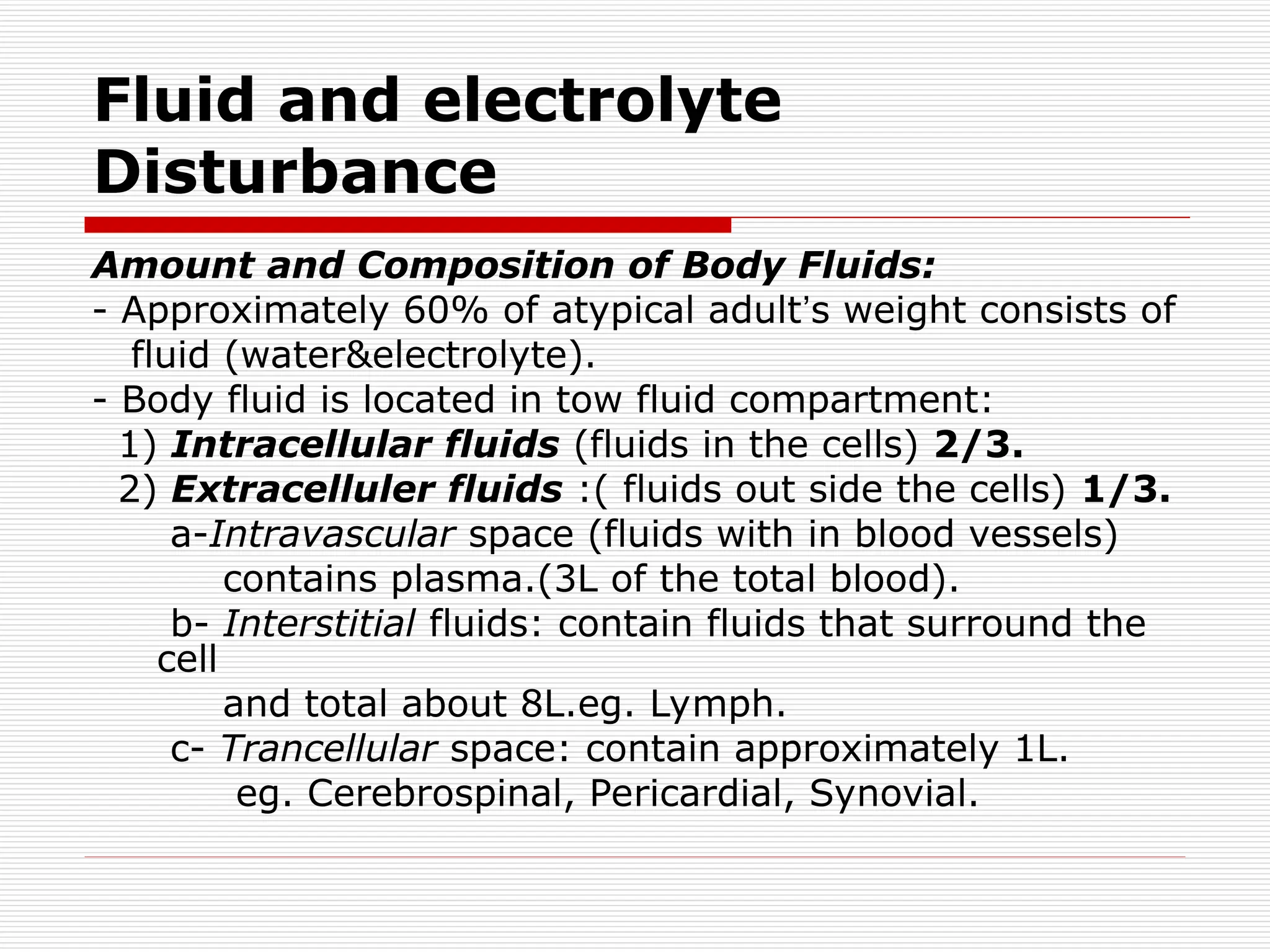
Amount and Composition of Body Fluids:
- Approximately 60% of atypical adult’s weight consists of
fluid (water&electrolyte).
- Body fluid is located in tow fluid compartment:
1) Intracellular fluids (fluids in the cells) 2/3.
2) Extracelluler fluids :( fluids out side the cells) 1/3.
a-Intravascular space (fluids with in blood vessels)
contains plasma.(3L of the total blood).
b- Interstitial fluids: contain fluids that surround the
cell
and total about 8L.eg. Lymph.
c- Trancellular space: contain approximately 1L.
eg. Cerebrospinal, Pericardial, Synovial.
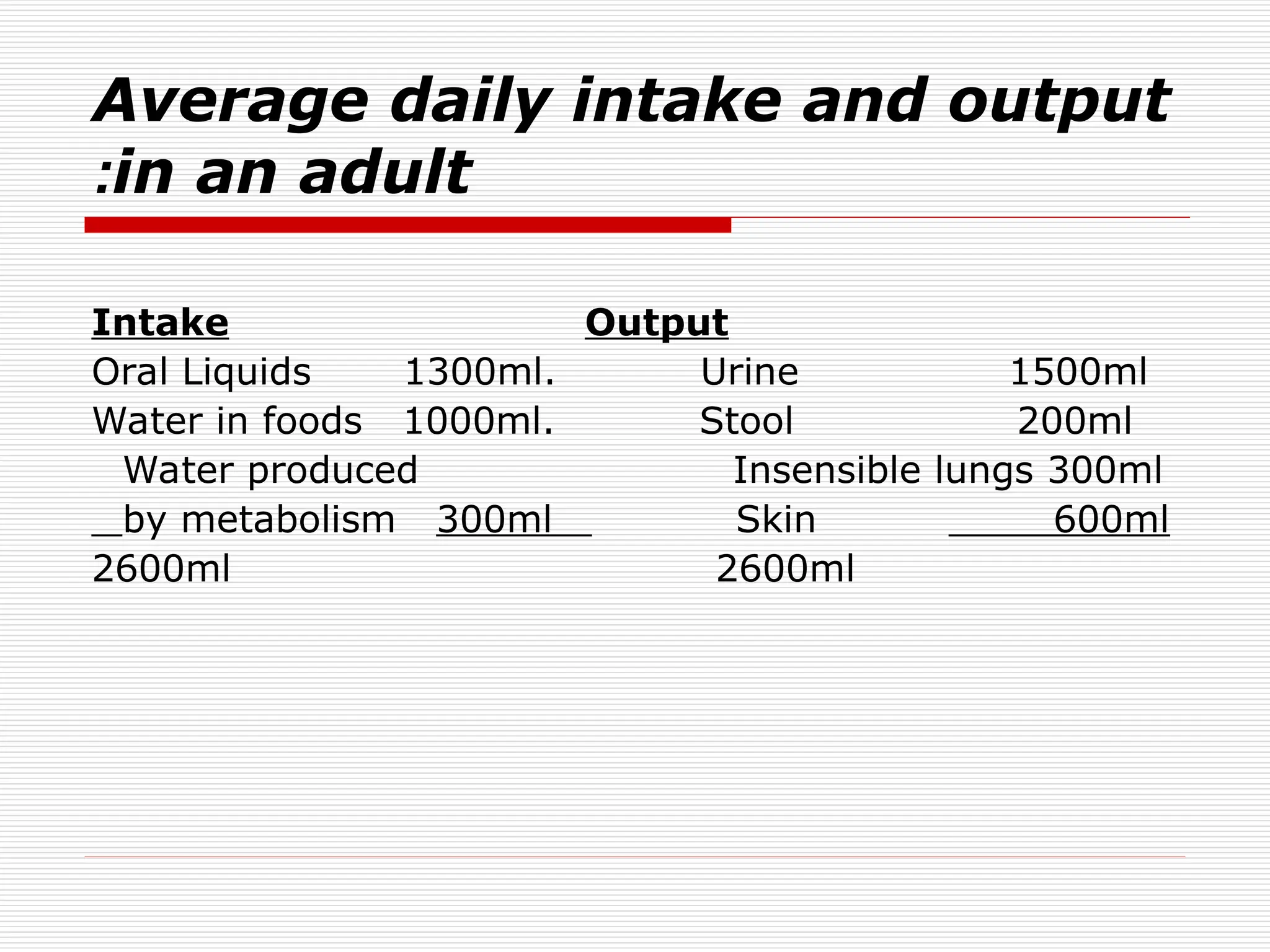
Average daily intake and output
in an adult
:
Intake Output
Oral Liquids 1300ml. Urine 1500ml
Water in foods 1000ml. Stool 200ml
Water produced Insensible lungs 300ml
by metabolism 300ml Skin 600ml
2600ml 2600ml
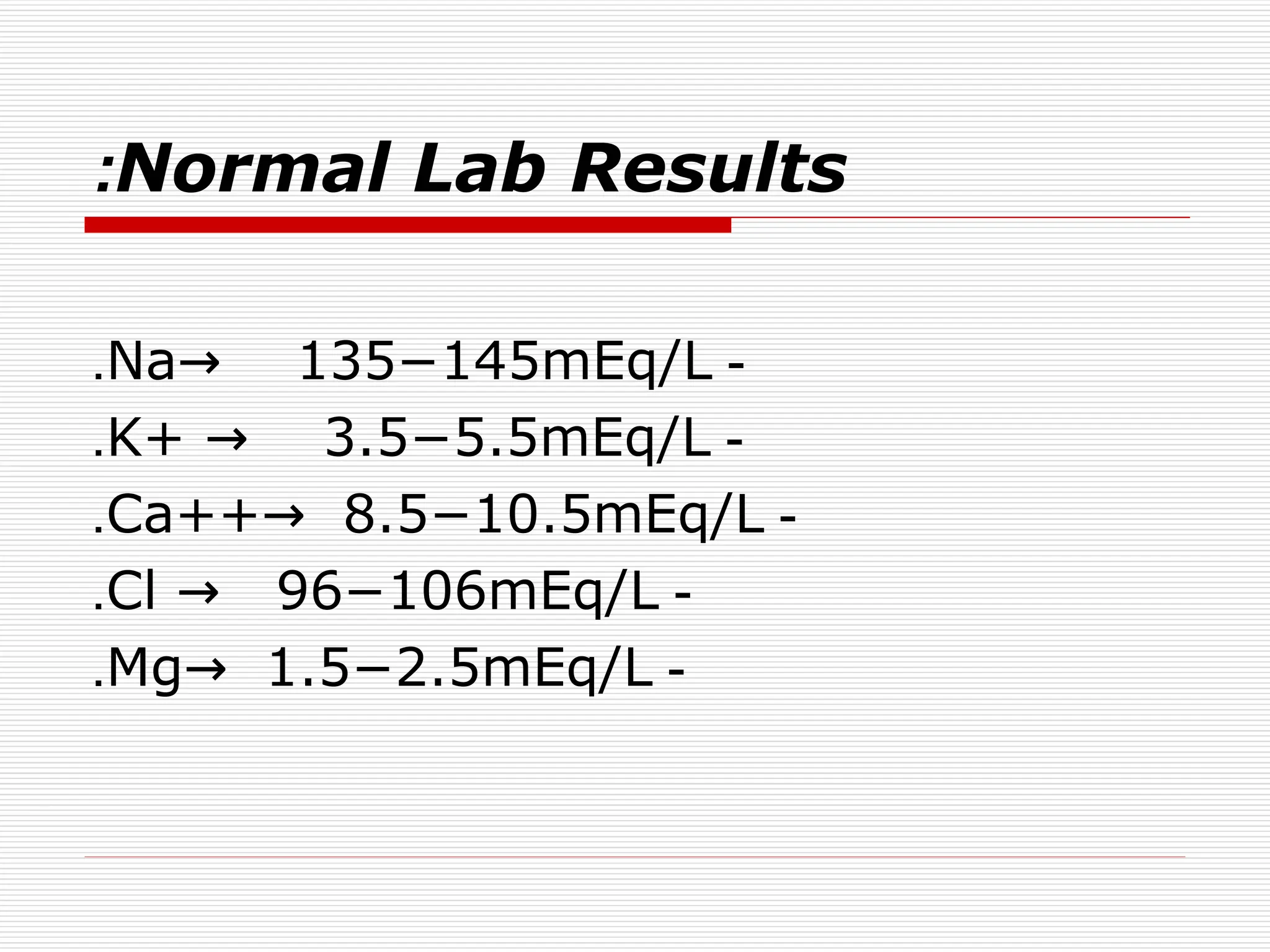
Normal Lab Results
:
-
Na 135−145mEq/L
→
.
-
K+ 3.5−5.5mEq/L
→
.
-
Ca++ 8.5−10.5mEq/L
→
.
-
Cl 96−106mEq/L
→
.
-
Mg 1.5−2.5mEq/L
→
.
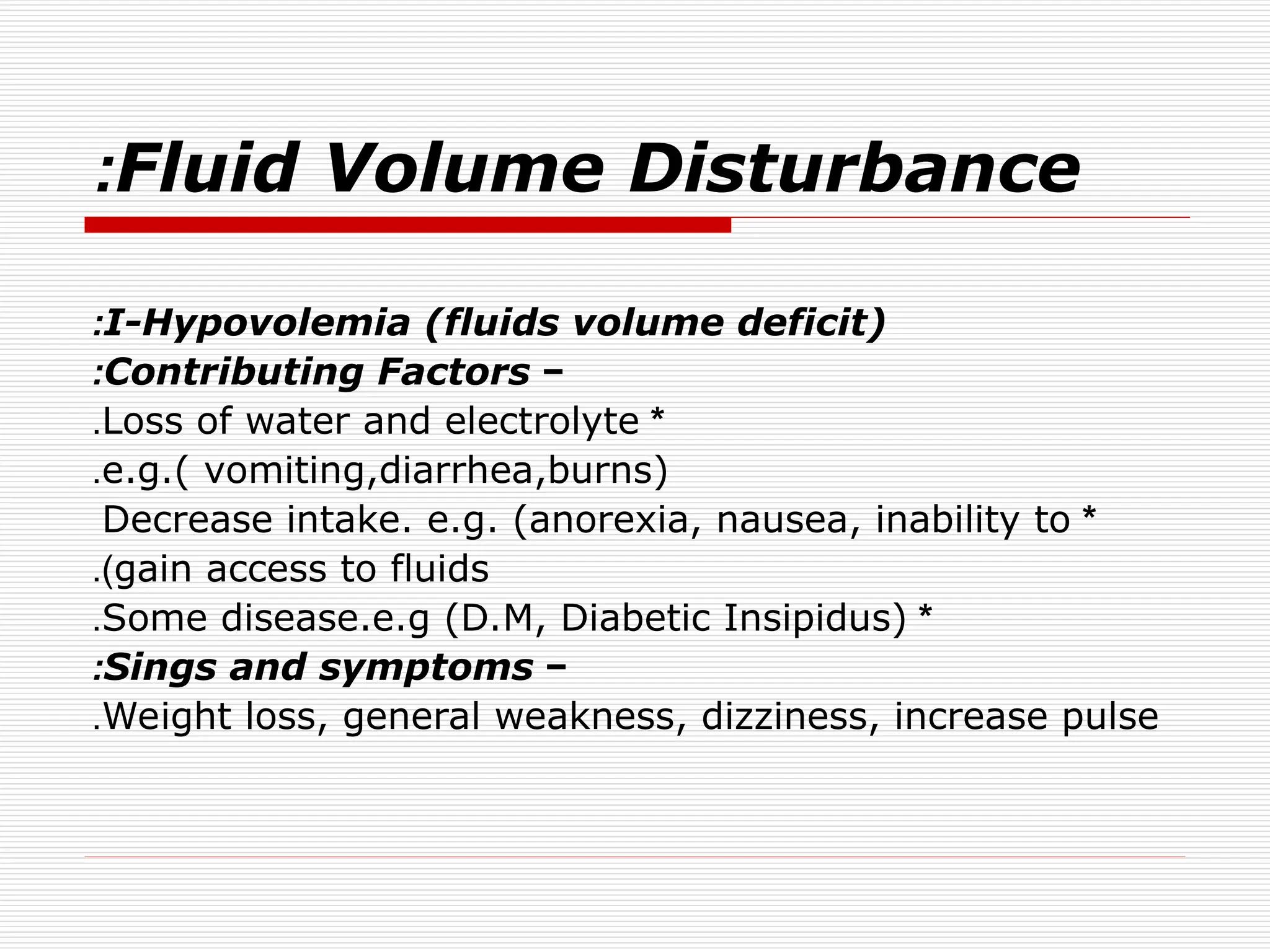
Fluid Volume Disturbance
:
I-Hypovolemia (fluids volume deficit)
:
−
Contributing Factors
:
*
Loss of water and electrolyte
.
e.g.( vomiting,diarrhea,burns)
.
*
Decrease intake. e.g. (anorexia, nausea, inability to
gain access to fluids
.)
*
Some disease.e.g (D.M, Diabetic Insipidus)
.
−
Sings and symptoms
:
Weight loss, general weakness, dizziness, increase pulse
.
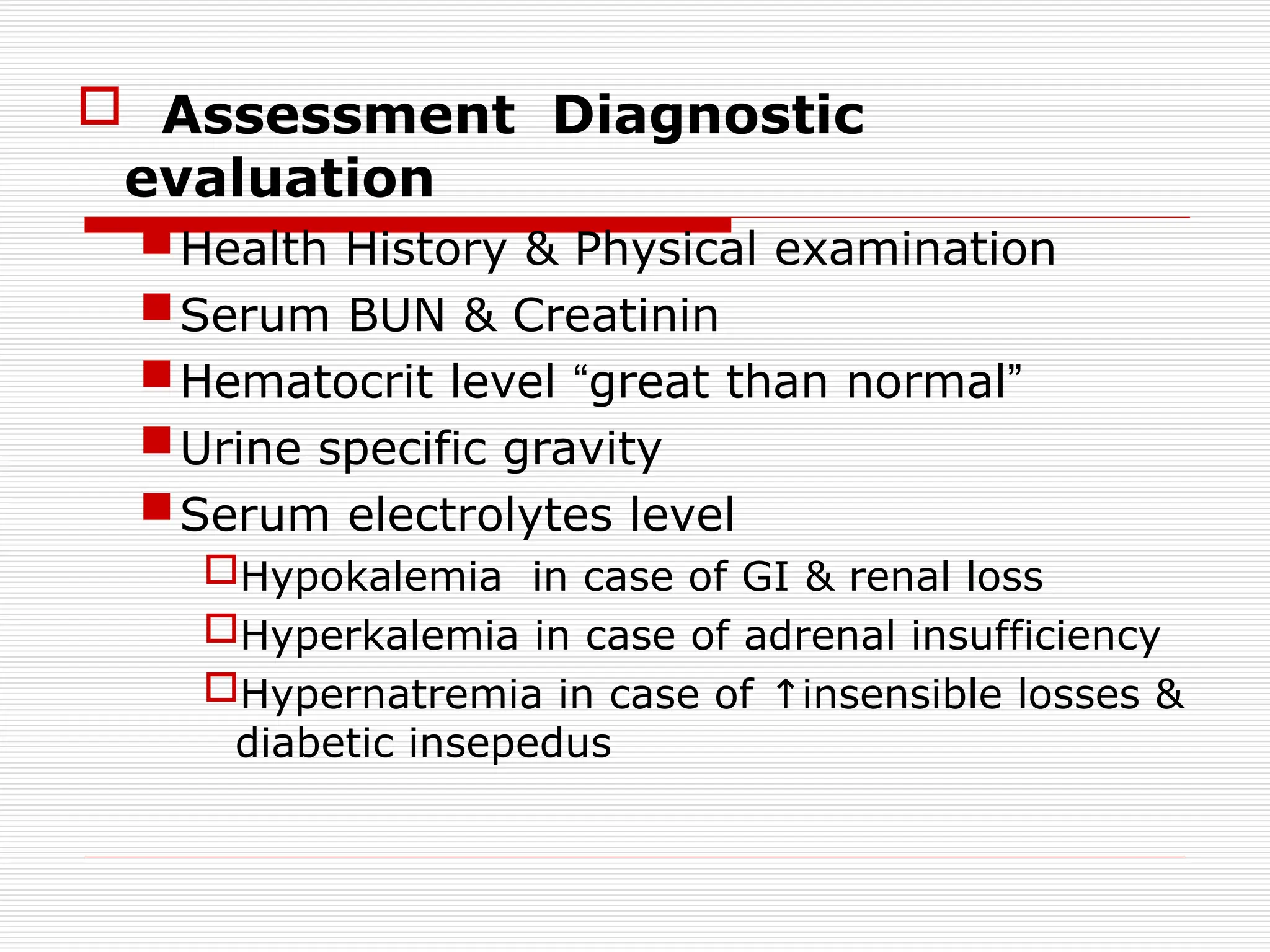
 Assessment Diagnostic
evaluation
Health History & Physical examination
Serum BUN & Creatinin
Hematocrit level “great than normal”
Urine specific gravity
Serum electrolytes level
Hypokalemia in case of GI & renal loss
Hyperkalemia in case of adrenal insufficiency
Hypernatremia in case of insensible losses &
↑
diabetic insepedus
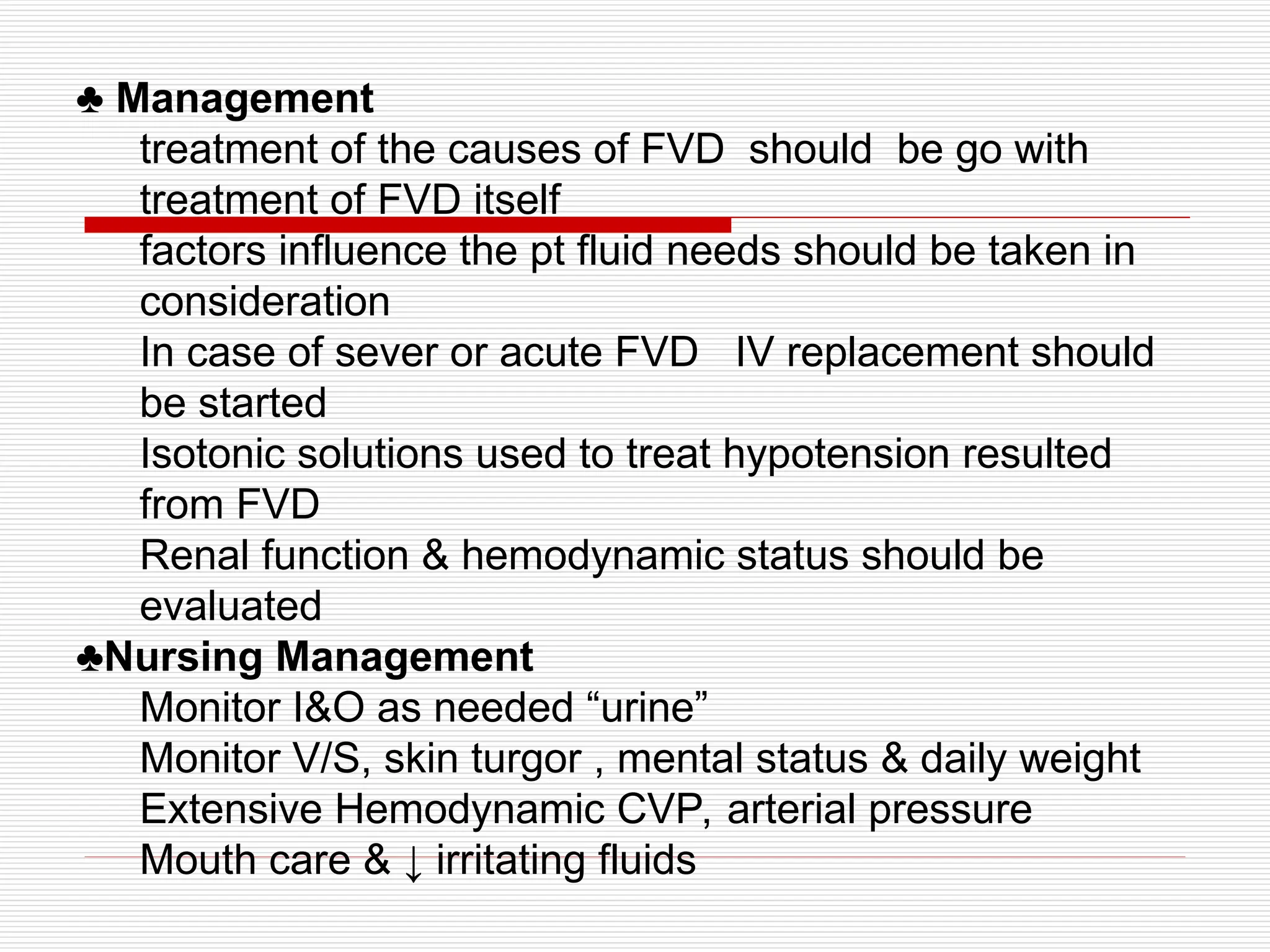
♣ Management
treatment of the causes of FVD should be go with
treatment of FVD itself
factors influence the pt fluid needs should be taken in
consideration
In case of sever or acute FVD IV replacement should
be started
Isotonic solutions used to treat hypotension resulted
from FVD
Renal function & hemodynamic status should be
evaluated
♣Nursing Management
Monitor I&O as needed “urine”
Monitor V/S, skin turgor , mental status & daily weight
Extensive Hemodynamic CVP, arterial pressure
Mouth care & ↓ irritating fluids
Fluid Volume Disturbance
:
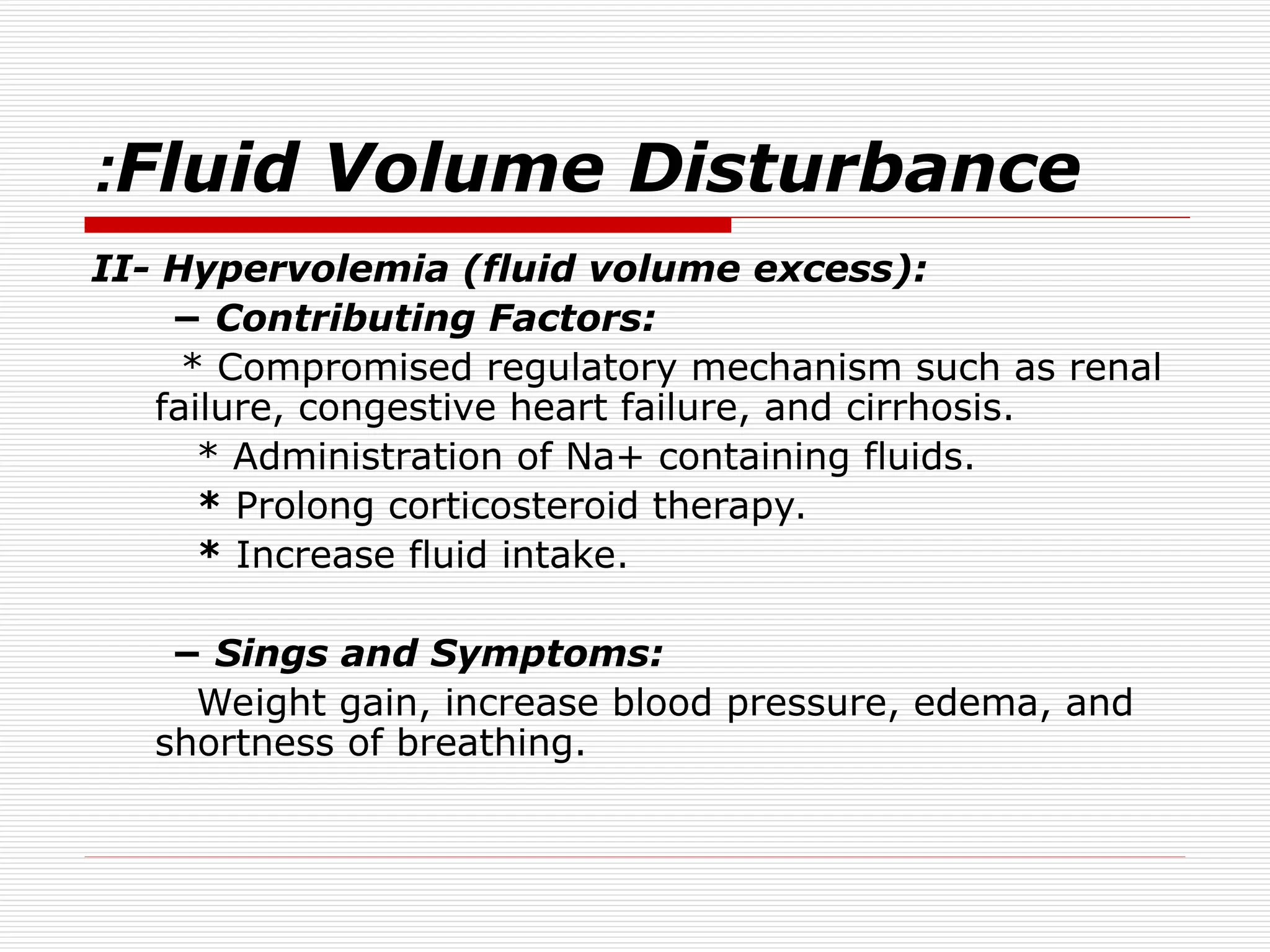
II- Hypervolemia (fluid volume excess):
− Contributing Factors:
* Compromised regulatory mechanism such as renal
failure, congestive heart failure, and cirrhosis.
* Administration of Na+ containing fluids.
* Prolong corticosteroid therapy.
* Increase fluid intake.
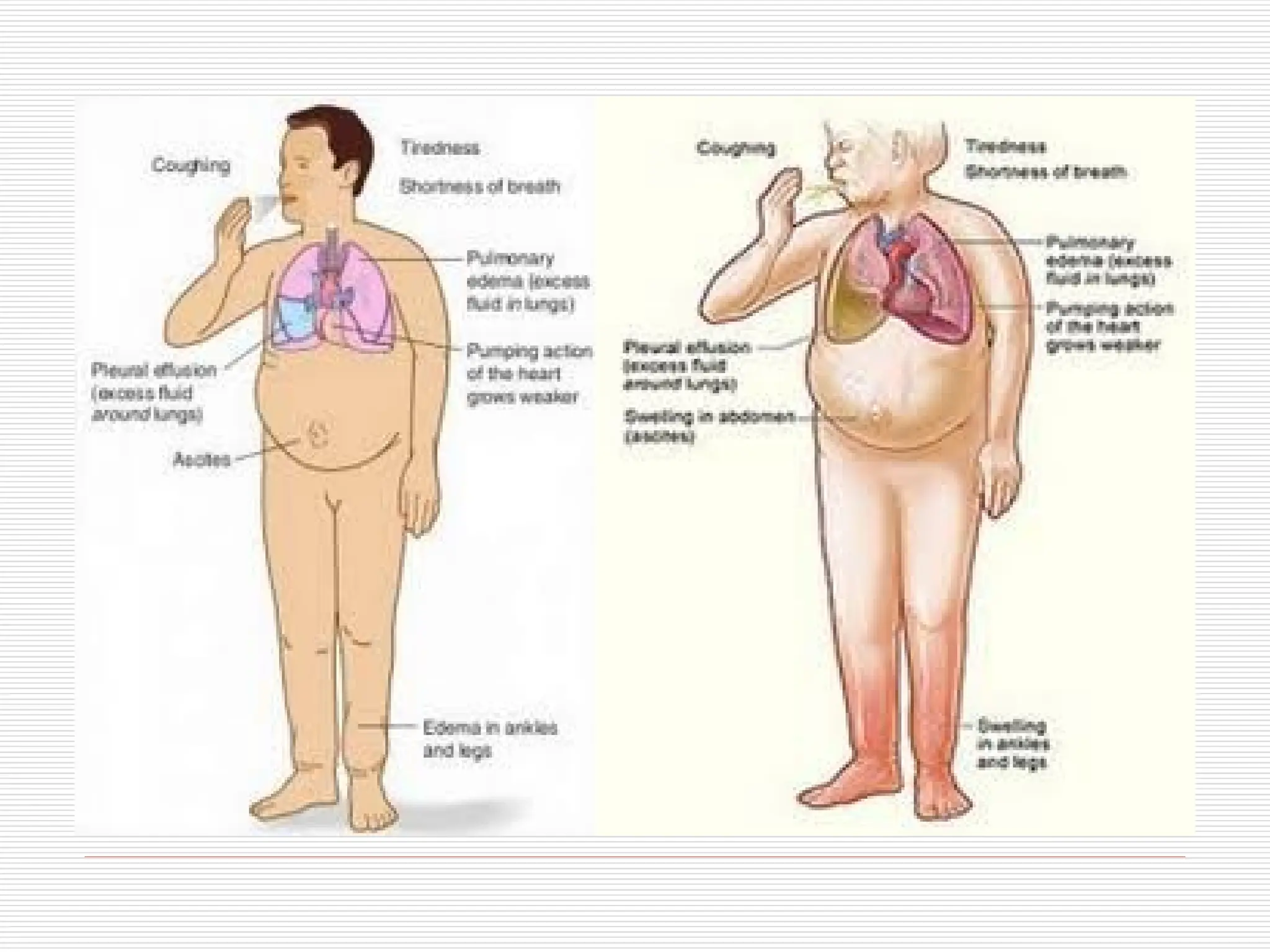
− Sings and Symptoms:
Weight gain, increase blood pressure, edema, and
shortness of breathing.
Assessment & Diagnostic Evaluation
- Decreased BUN , Creatinin , Serum
osmolality & hematocrete because of plasma
dilution, &↓protein intake
- Urine sodium is increased if kidneys excrete
excess fluid
- CXR may disclosed pulmonary congestion
Management
Direct cause should be treated
Symptomatic treatment consist of :
- Diuretics
- restrict fluid & Na intake
- Maintained electrolytes balance
- Hemodialysis in case of renal impairment
- K+ supplement & specific nutrition
Nursing Management:
- Assess breathing , weight ,degree of edema regularly
- I & O measurement regularly
- Semifowlers position in case of shortness of breath
- Patient education
Electrolyte imbalance
:
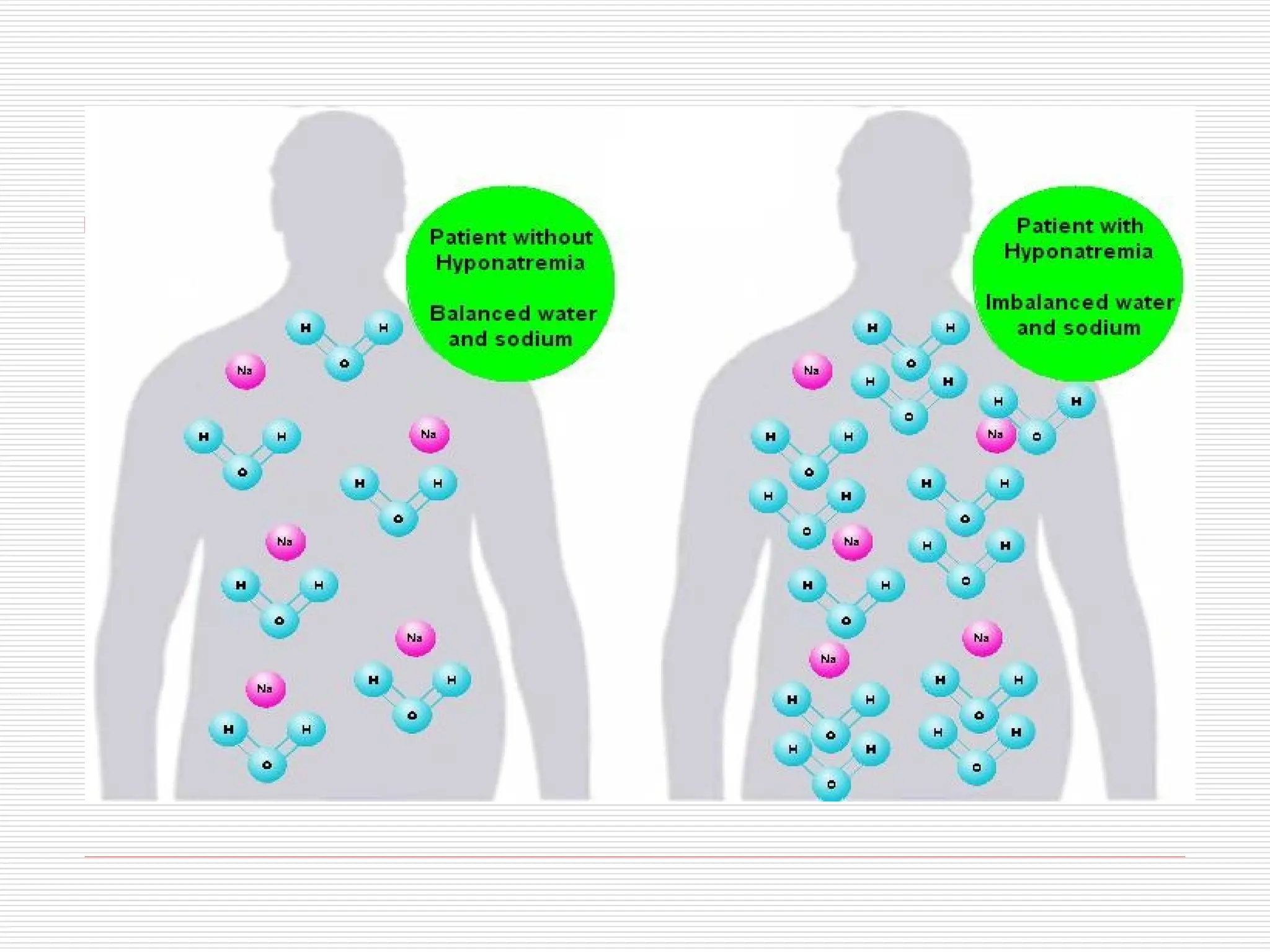
I- SodiumDeficit (Hyponatremia):
−Contributing Factors:
* Use of a diuretic.
* Loss of GI fluids.
* Gain of water.
− Sings and Symptoms:
Anorexia, nausea and vomiting,
headache, lethargy, confusion, seizures.
Hyponatremia, continued
Treatment: correct underlying
disorder
Fluid restrict, + diuretics
Hypertonic saline to increase level 2-3
mEq/L/hr and max rate 100cc of 5%
saline/hr
Electrolyte imbalance
:
II- Sodium Excess (Hypernatremia):
− Contributing Factors:
* Water deprivation in patient.
* Hypertonic tube feeding.
* Diabetes Insipidus.
− Sings and Symptoms:
Thirst, hallucination, lethargy,
restless, pulmonary edema.
Hypernatremia, continued
Treatment: correct underlying
disorder
Free water replacement: (0.6 * kg BW)
* ((Na/140) – 1). Slow infusion of D5W
give ½ over first 8 hrs then rest over
next 16-24 hrs to avoid cerebral
edema.
Electrolyte imbalance
:
III- Potassium Deficit (Hypokalemia):
− Contributing factors:
* Dirrhea, vomiting, gastric suctions.
* Corticosteroid administration.
* Diuretics.
− Sings and symptoms:
Fatigue, anorexia, nausea, vomiting,
muscle weakness, change in ECG.
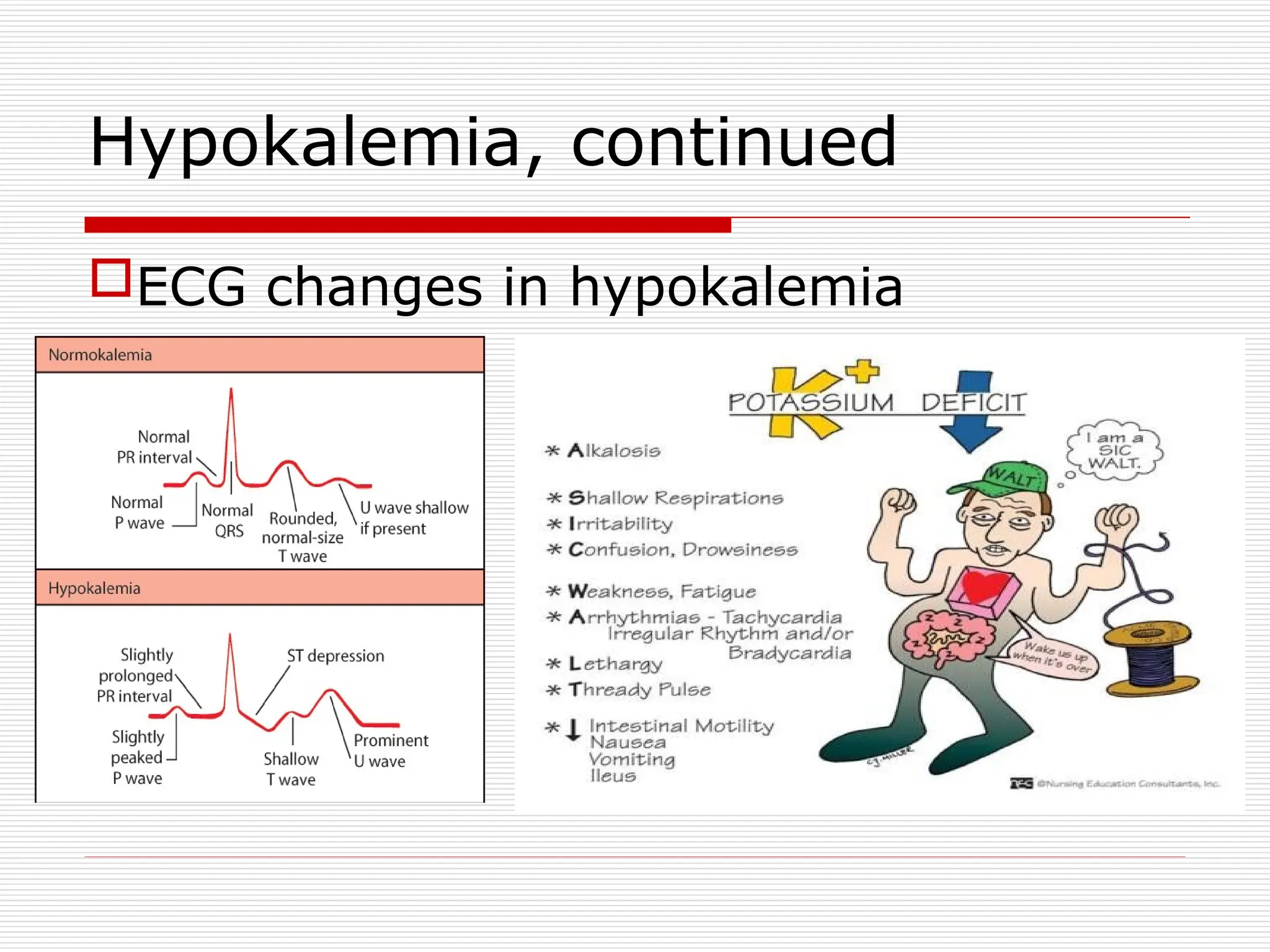
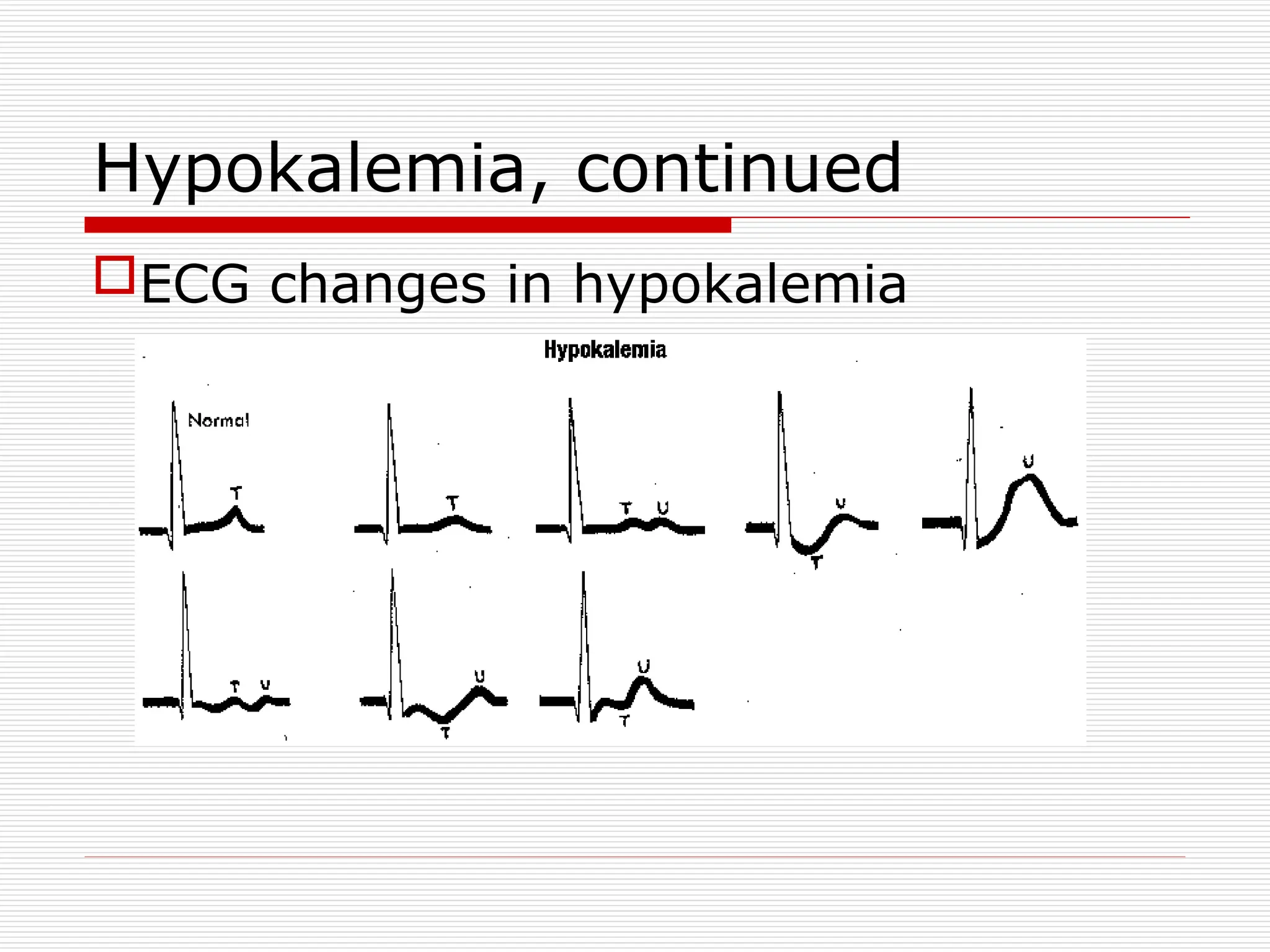
 EKG: low, flat T-waves, ST depression, and U
waves
Hypokalemia, continued
ECG changes in hypokalemia
Hypokalemia, continued
ECG changes in hypokalemia
Hypokalemia, continued
Treatment:
Check renal function
Treat alkalosis, decrease sodium intake
PO with 20-40 mEq doses
IV: peripheral 7.5 mEq/hr, central 20
mEq/hr and increase K+
in maintenance
fluids.
Electrolyte imbalance
:
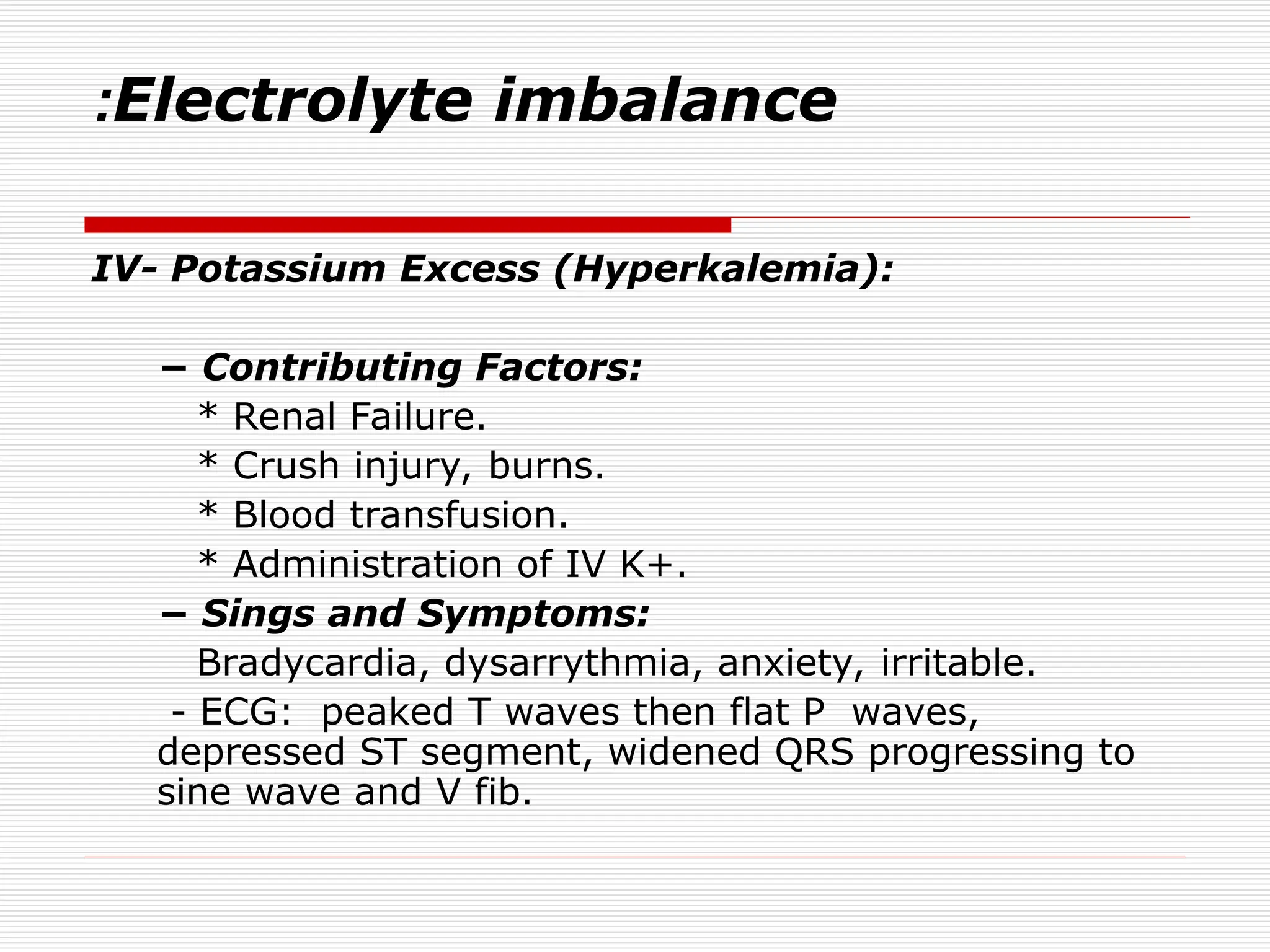
IV- Potassium Excess (Hyperkalemia):
− Contributing Factors:
* Renal Failure.
* Crush injury, burns.
* Blood transfusion.
* Administration of IV K+.
− Sings and Symptoms:
Bradycardia, dysarrythmia, anxiety, irritable.
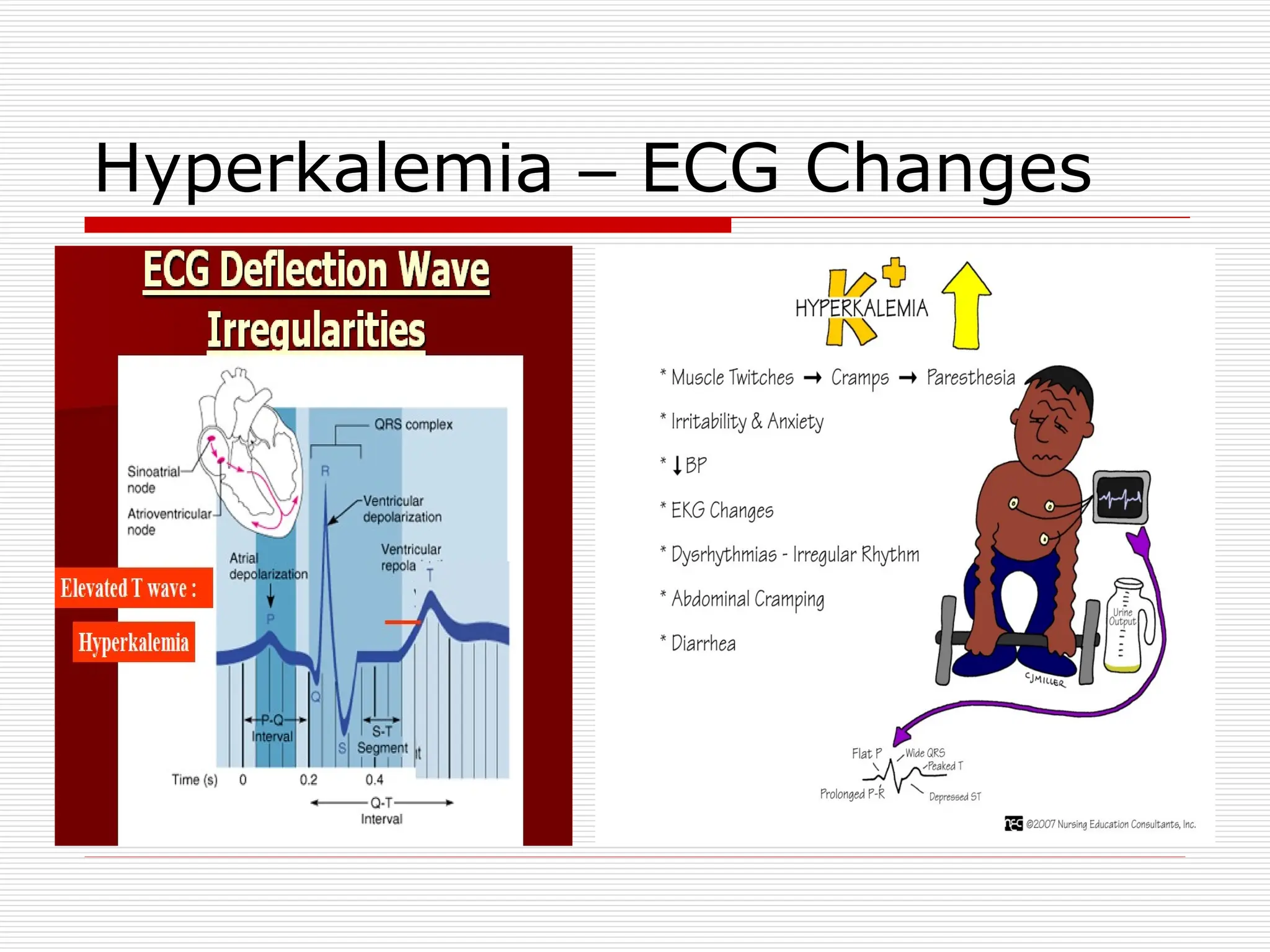
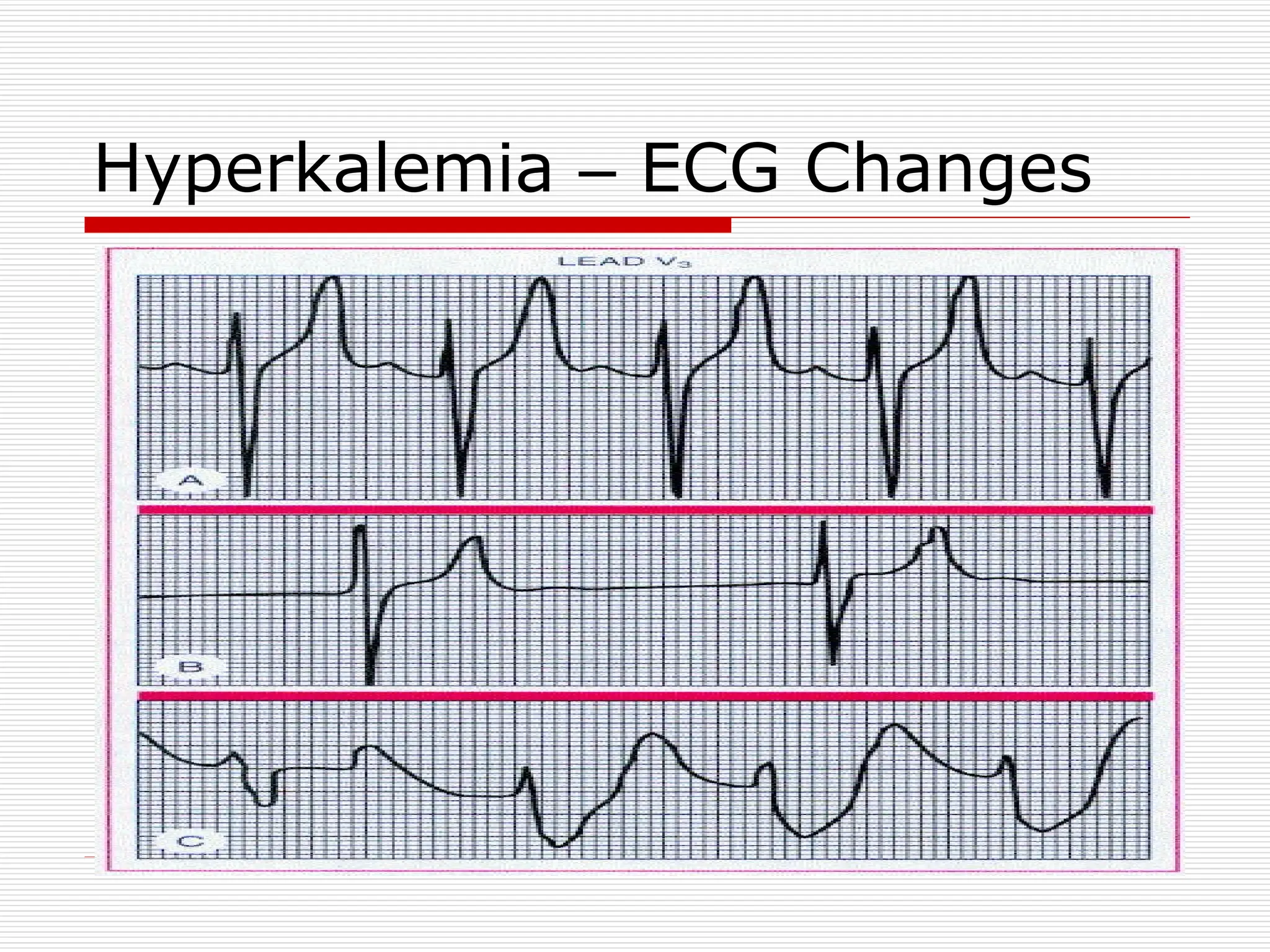
- ECG: peaked T waves then flat P waves,
depressed ST segment, widened QRS progressing to
sine wave and V fib.
Hyperkalemia – ECG Changes
Hyperkalemia, continued
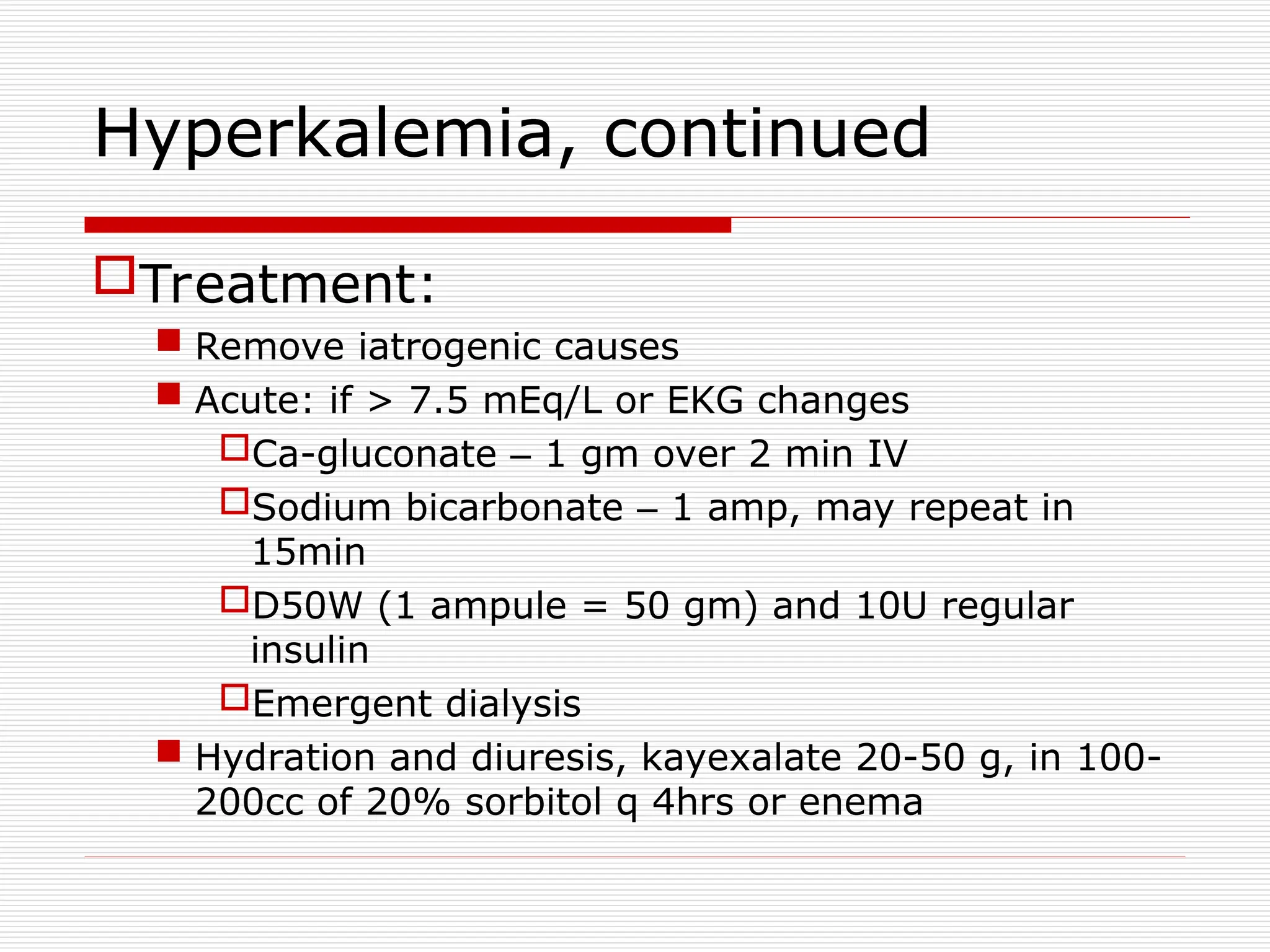
Treatment:
 Remove iatrogenic causes
 Acute: if > 7.5 mEq/L or EKG changes
Ca-gluconate – 1 gm over 2 min IV
Sodium bicarbonate – 1 amp, may repeat in
15min
D50W (1 ampule = 50 gm) and 10U regular
insulin
Emergent dialysis
 Hydration and diuresis, kayexalate 20-50 g, in 100-
200cc of 20% sorbitol q 4hrs or enema
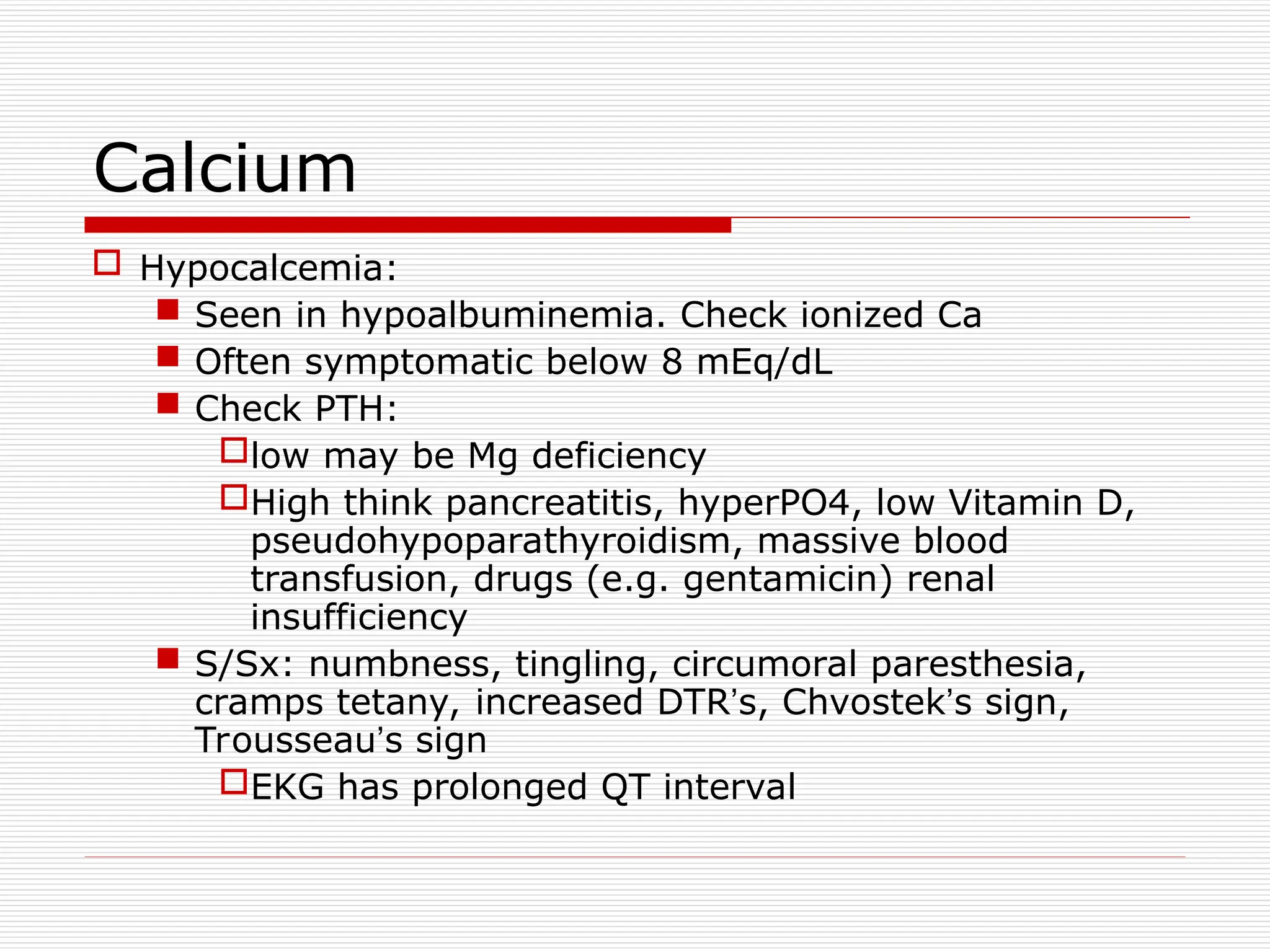
Calcium
 Hypocalcemia:
 Seen in hypoalbuminemia. Check ionized Ca
 Often symptomatic below 8 mEq/dL
 Check PTH:
low may be Mg deficiency
High think pancreatitis, hyperPO4, low Vitamin D,
pseudohypoparathyroidism, massive blood
transfusion, drugs (e.g. gentamicin) renal
insufficiency
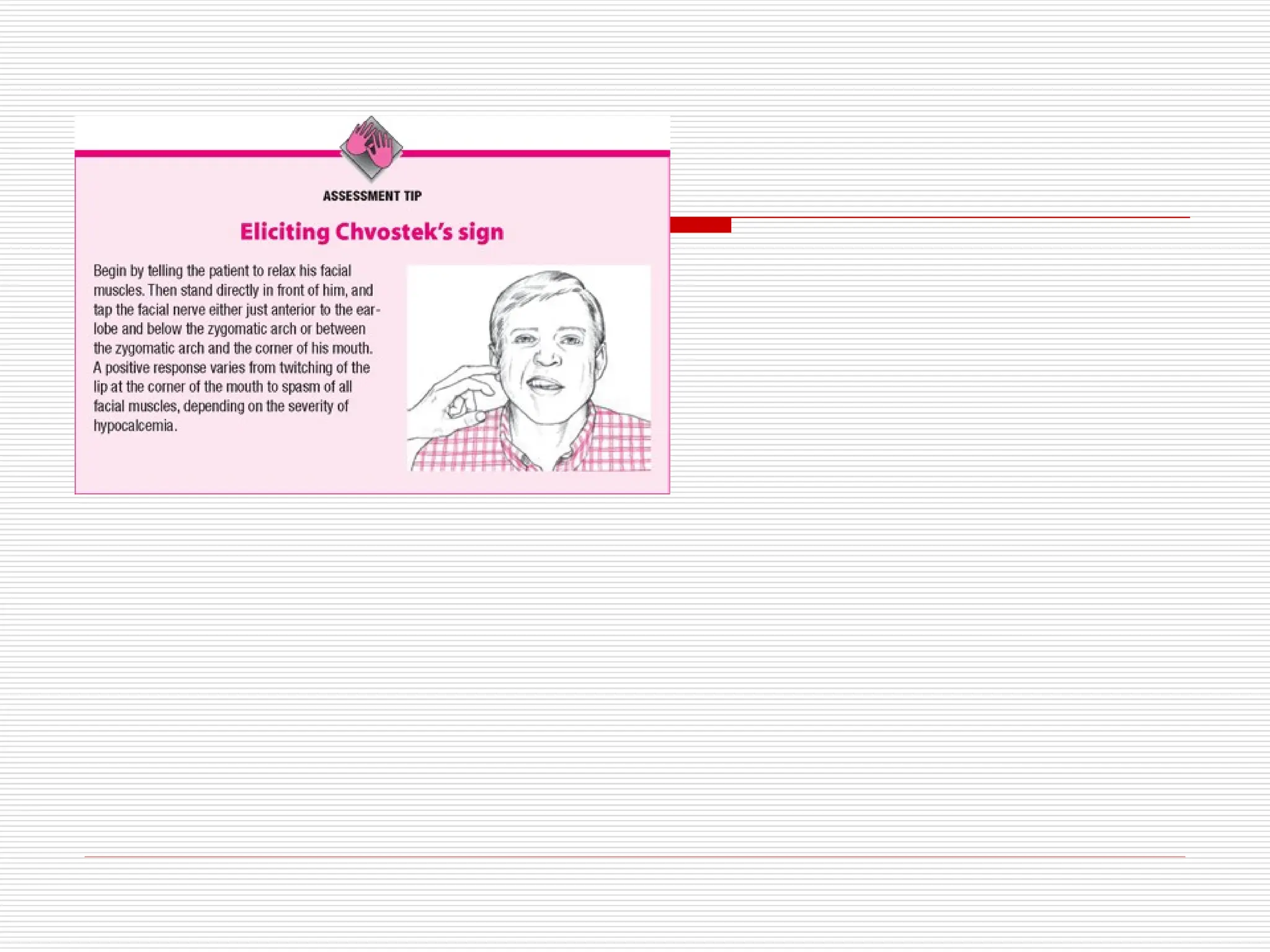
 S/Sx: numbness, tingling, circumoral paresthesia,
cramps tetany, increased DTR’s, Chvostek’s sign,
Trousseau’s sign
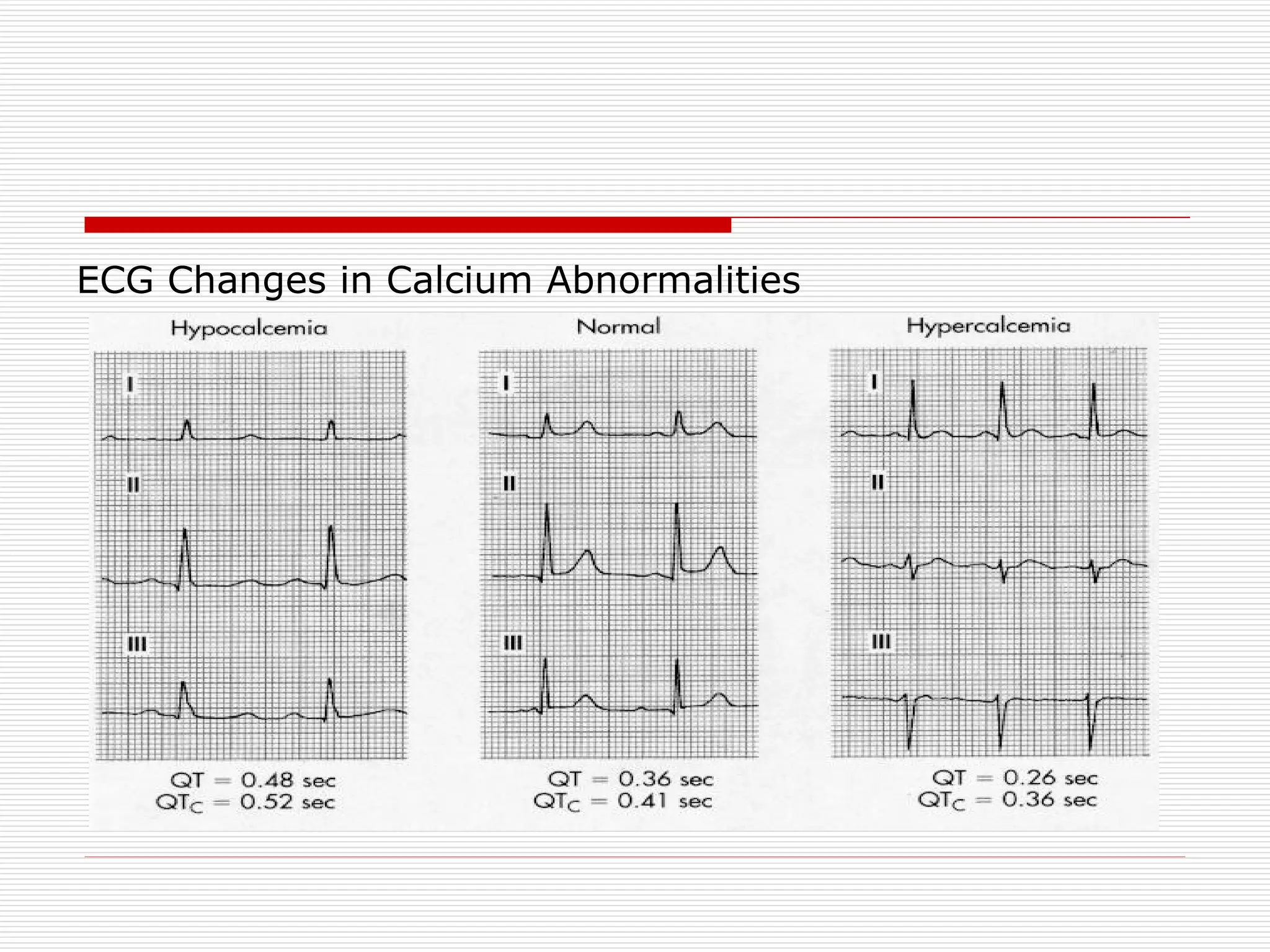
EKG has prolonged QT interval
ECG Changes in Calcium Abnormalities
Calcium, continued
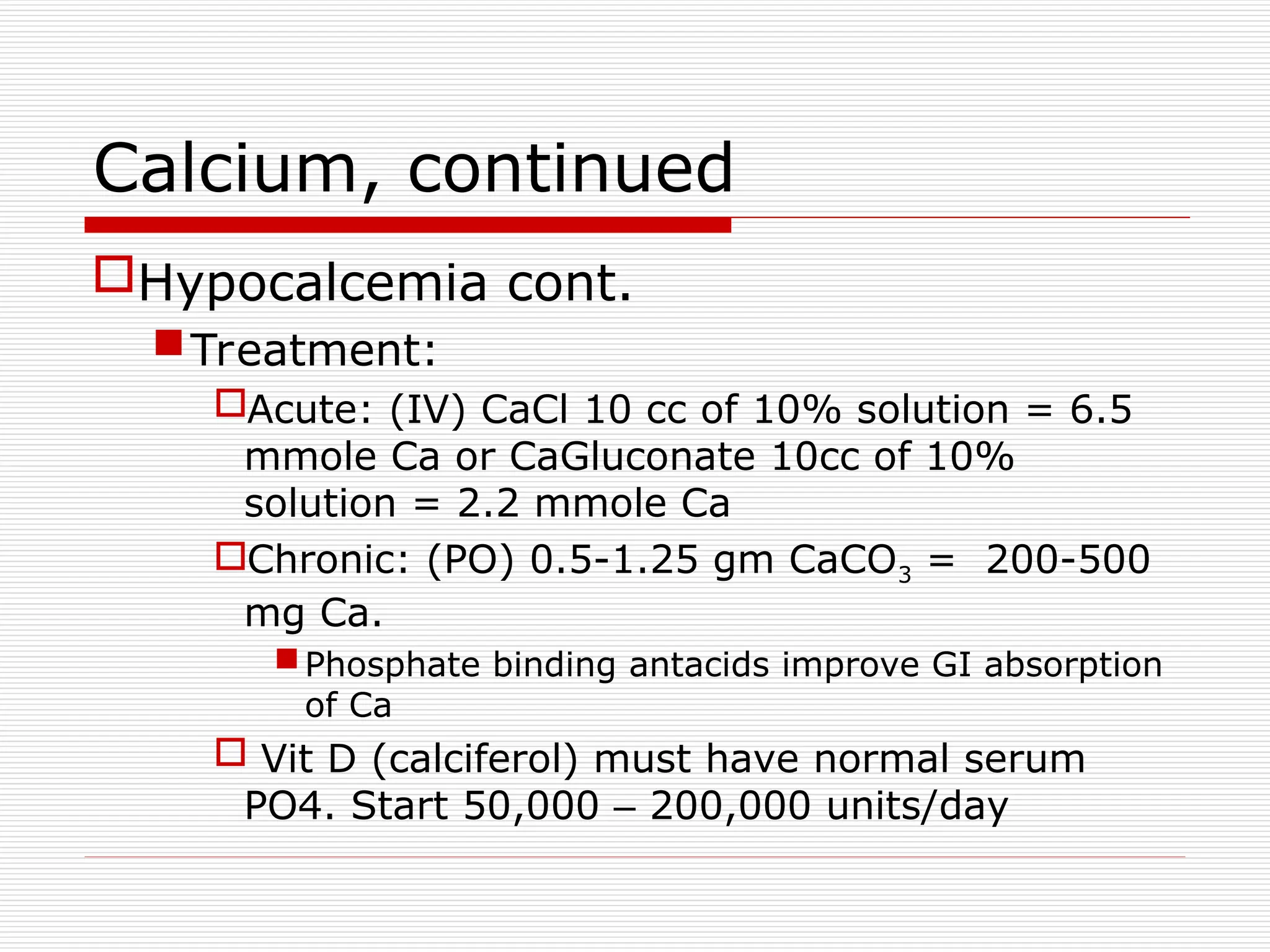
Hypocalcemia cont.
Treatment:
Acute: (IV) CaCl 10 cc of 10% solution = 6.5
mmole Ca or CaGluconate 10cc of 10%
solution = 2.2 mmole Ca
Chronic: (PO) 0.5-1.25 gm CaCO3 = 200-500
mg Ca.
Phosphate binding antacids improve GI absorption
of Ca
 Vit D (calciferol) must have normal serum
PO4. Start 50,000 – 200,000 units/day
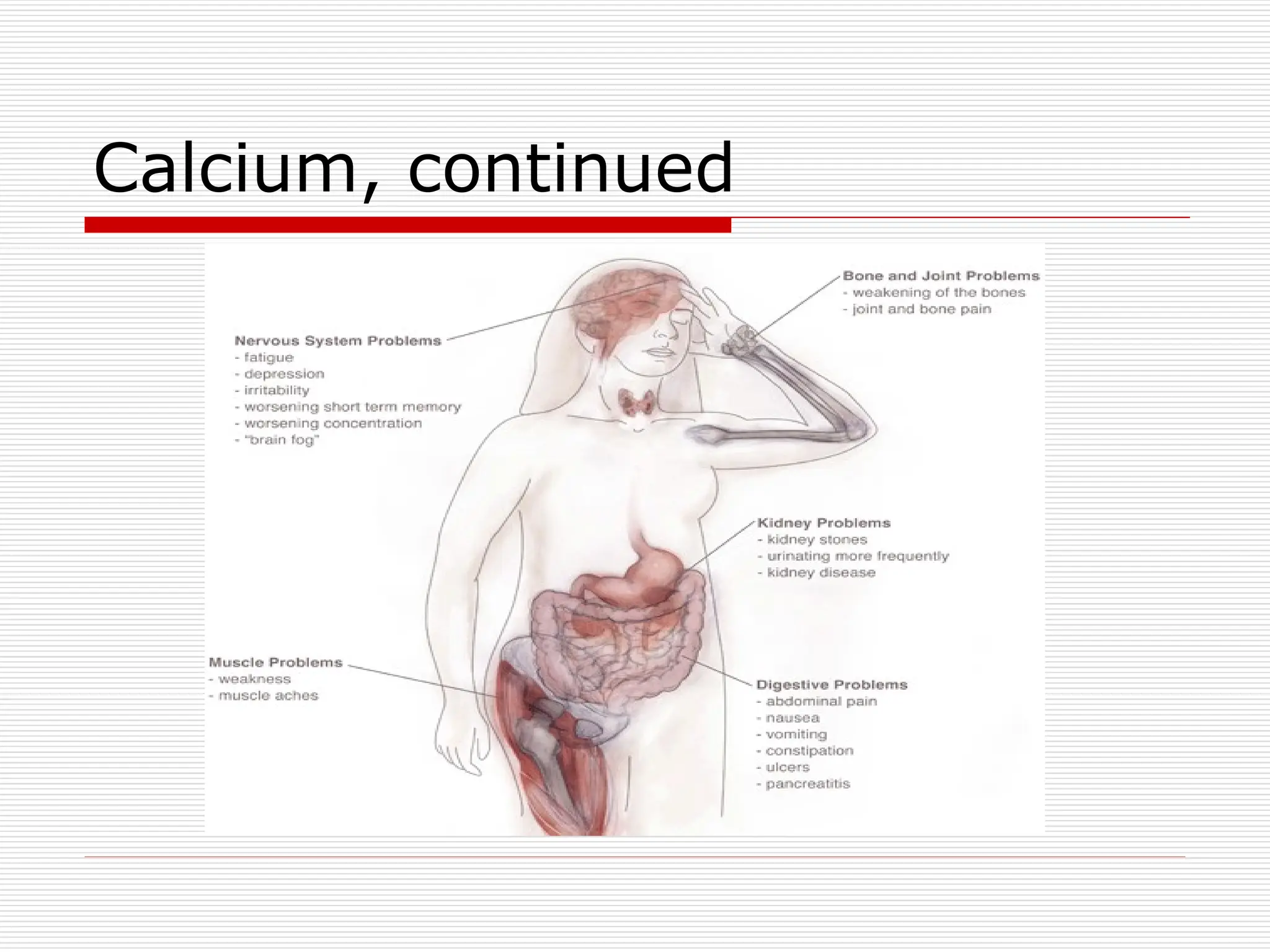
Calcium, continued
Calcium, continued
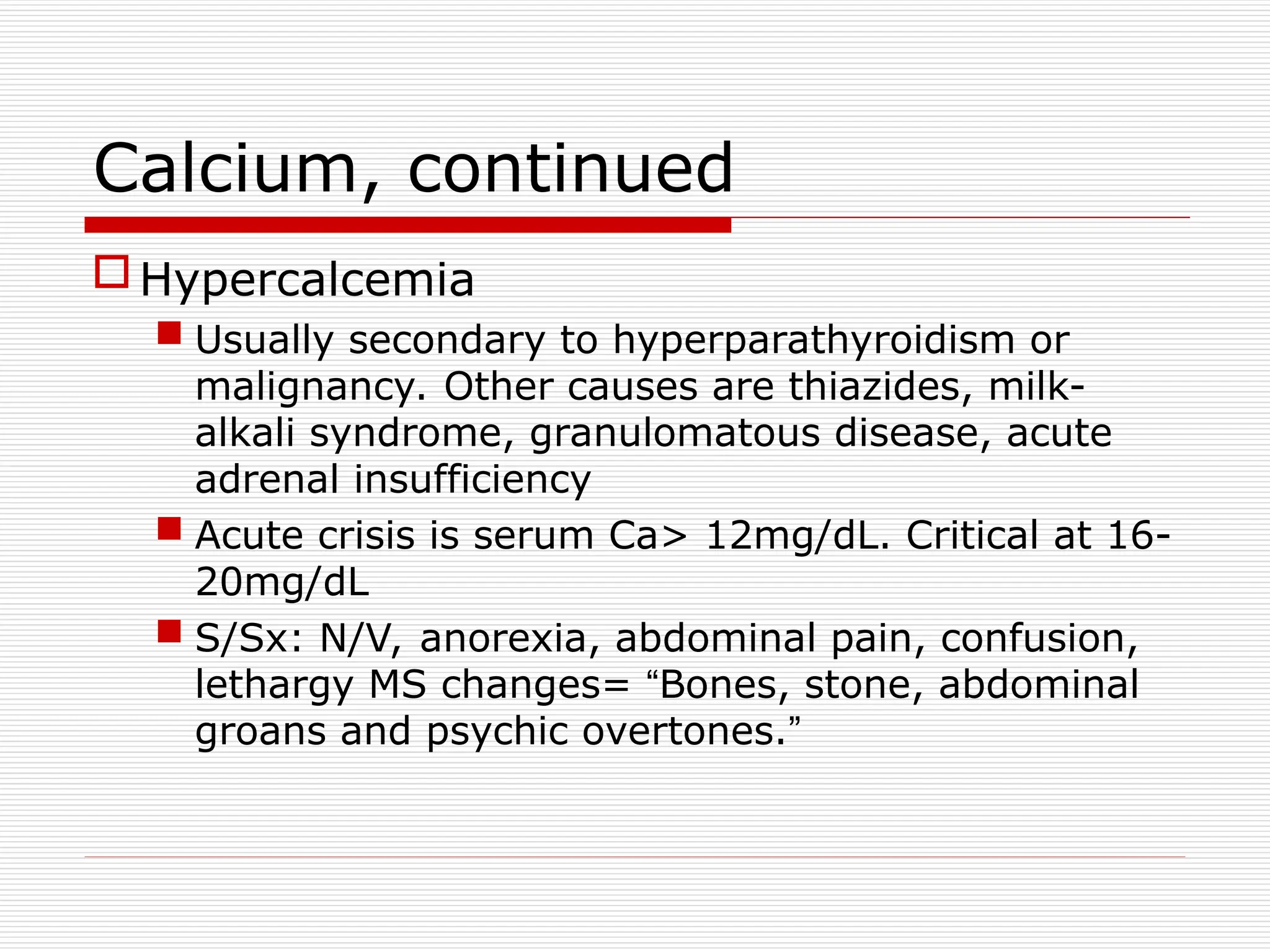
Hypercalcemia
 Usually secondary to hyperparathyroidism or
malignancy. Other causes are thiazides, milk-
alkali syndrome, granulomatous disease, acute
adrenal insufficiency
 Acute crisis is serum Ca> 12mg/dL. Critical at 16-
20mg/dL
 S/Sx: N/V, anorexia, abdominal pain, confusion,
lethargy MS changes= “Bones, stone, abdominal
groans and psychic overtones.”
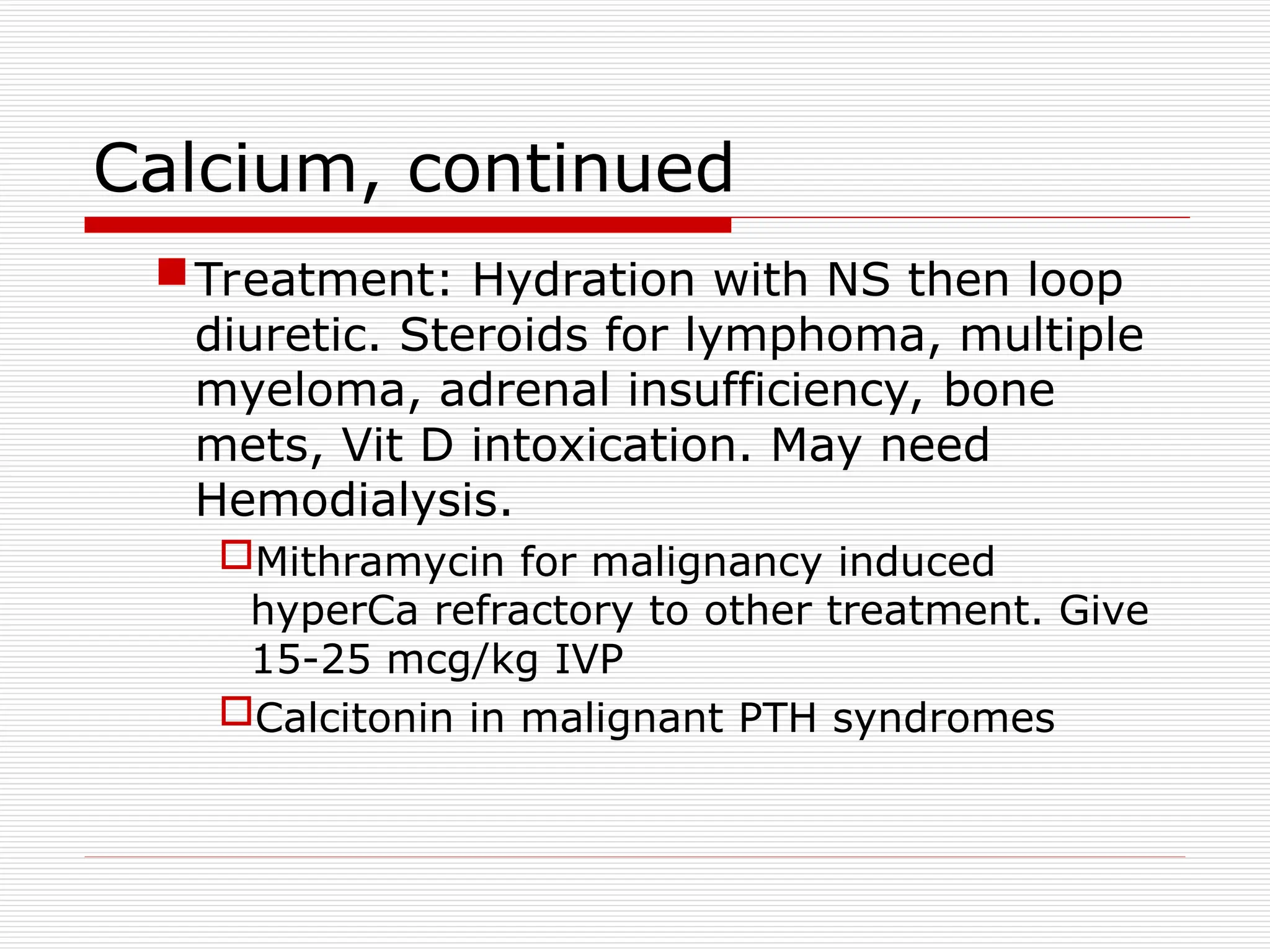
Calcium, continued
Treatment: Hydration with NS then loop
diuretic. Steroids for lymphoma, multiple
myeloma, adrenal insufficiency, bone
mets, Vit D intoxication. May need
Hemodialysis.
Mithramycin for malignancy induced
hyperCa refractory to other treatment. Give
15-25 mcg/kg IVP
Calcitonin in malignant PTH syndromes
Magnesium
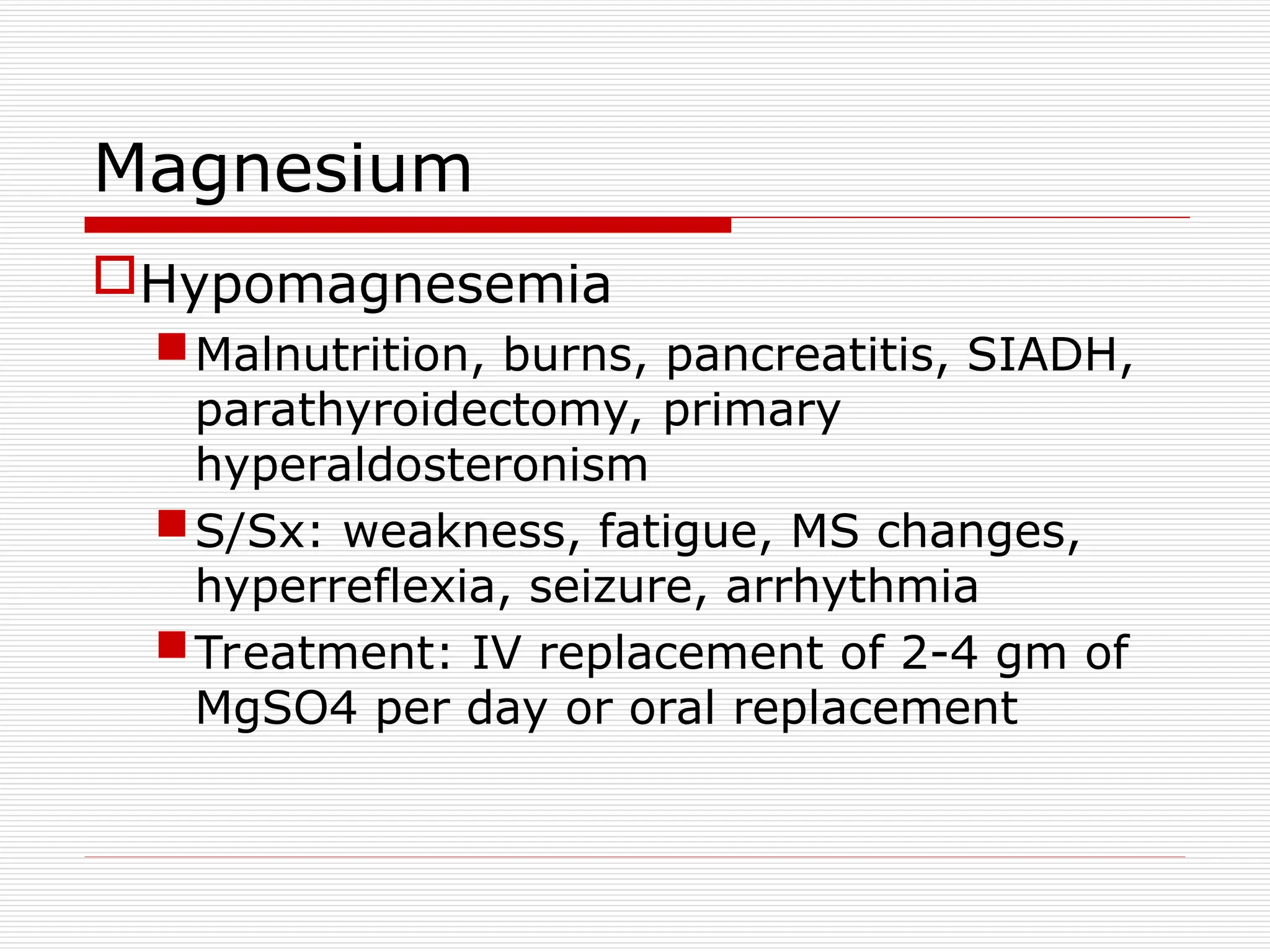
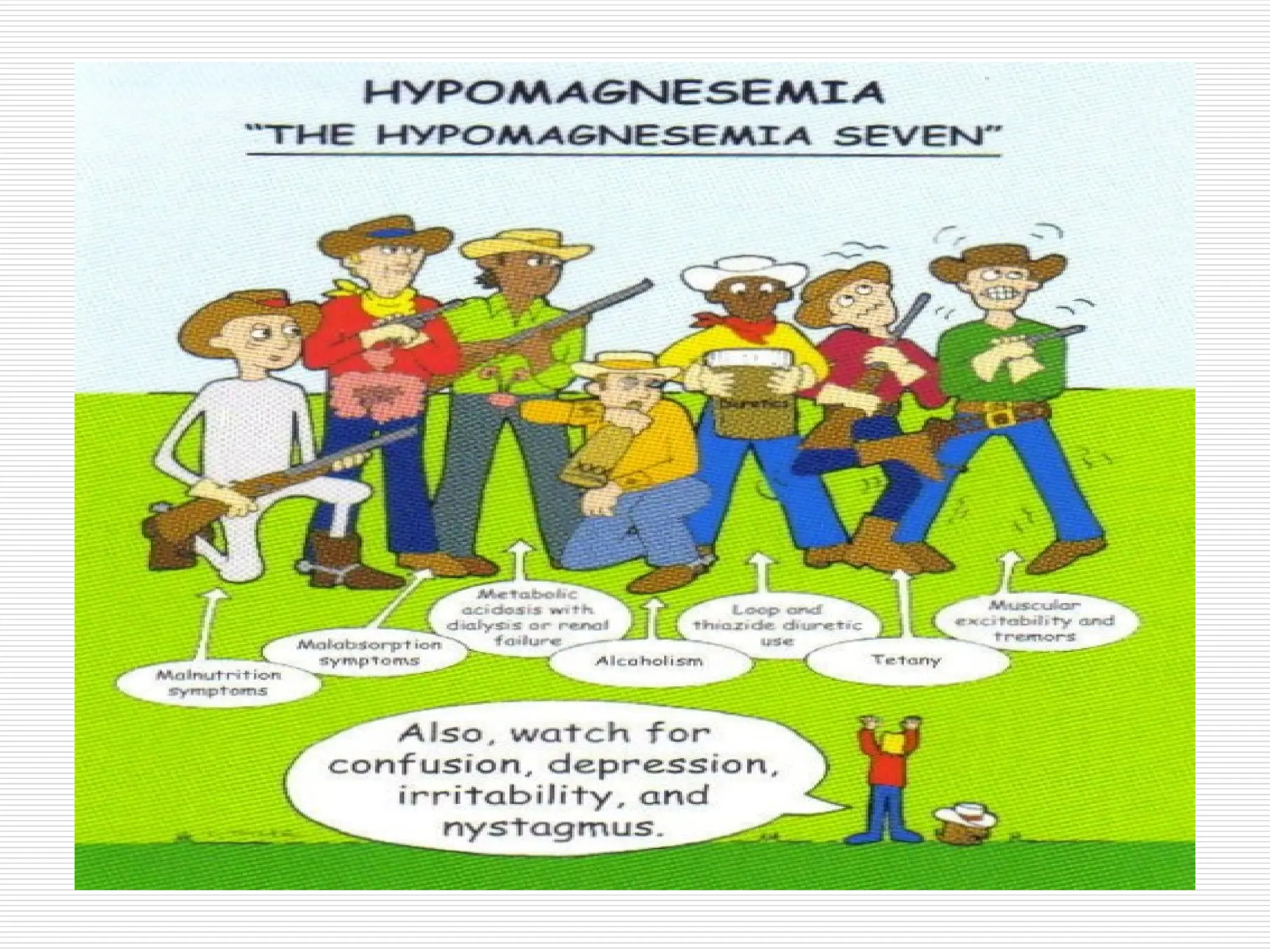
Hypomagnesemia
Malnutrition, burns, pancreatitis, SIADH,
parathyroidectomy, primary
hyperaldosteronism
S/Sx: weakness, fatigue, MS changes,
hyperreflexia, seizure, arrhythmia
Treatment: IV replacement of 2-4 gm of
MgSO4 per day or oral replacement
Magnesium
Magnesium, continued
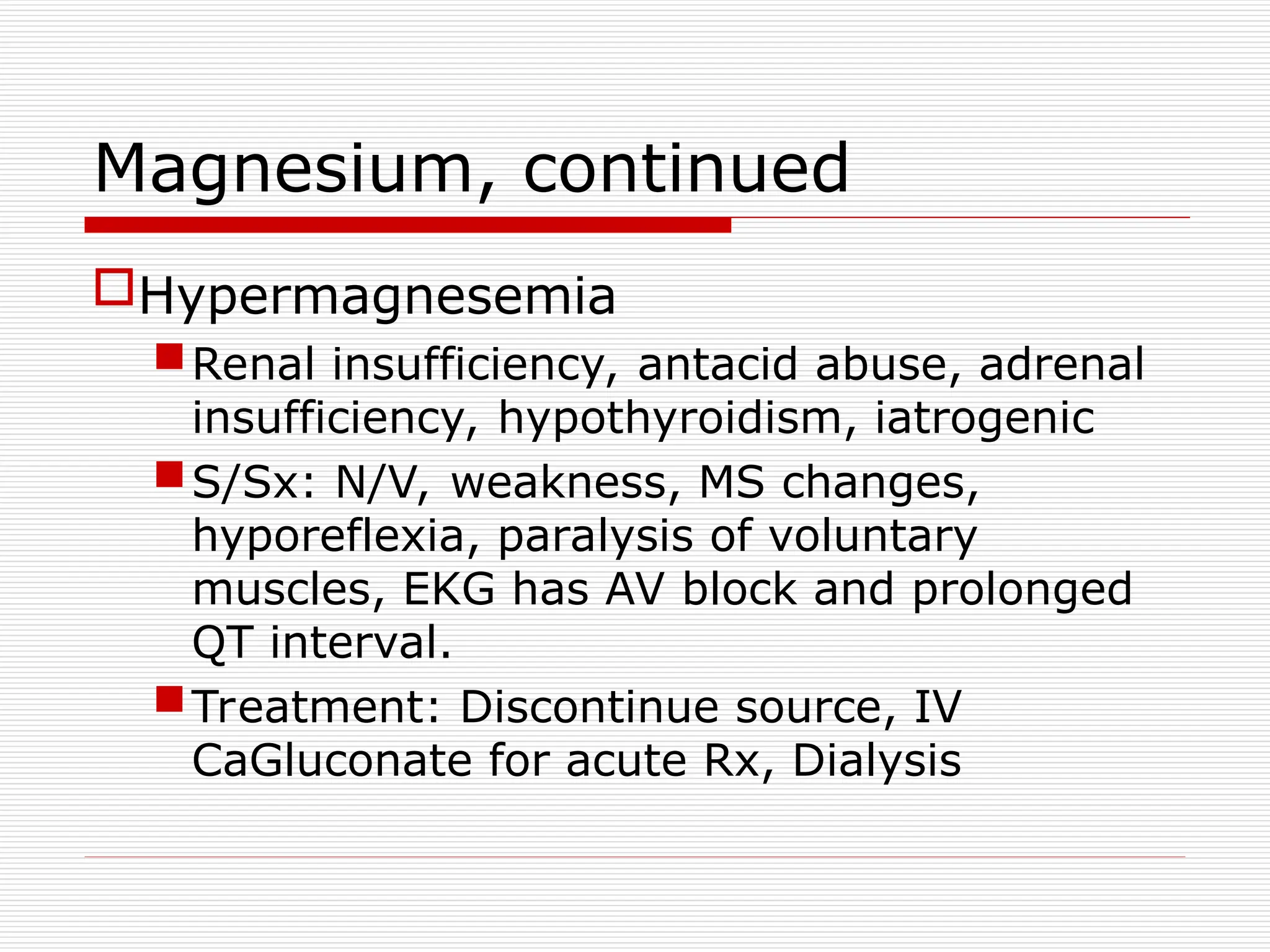
Hypermagnesemia
Renal insufficiency, antacid abuse, adrenal
insufficiency, hypothyroidism, iatrogenic
S/Sx: N/V, weakness, MS changes,
hyporeflexia, paralysis of voluntary
muscles, EKG has AV block and prolonged
QT interval.
Treatment: Discontinue source, IV
CaGluconate for acute Rx, Dialysis
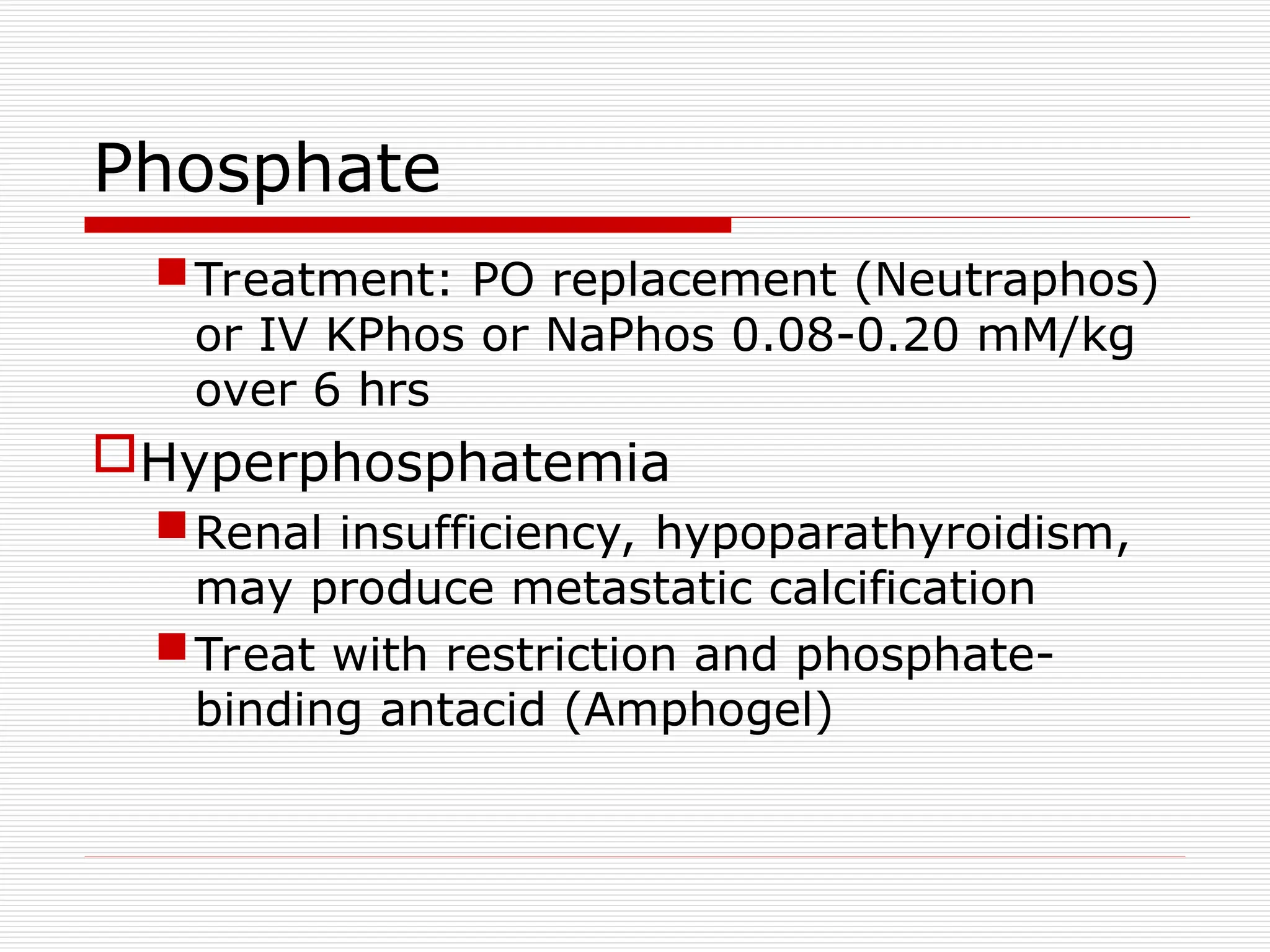
Phosphate
Treatment: PO replacement (Neutraphos)
or IV KPhos or NaPhos 0.08-0.20 mM/kg
over 6 hrs
Hyperphosphatemia
Renal insufficiency, hypoparathyroidism,
may produce metastatic calcification
Treat with restriction and phosphate-
binding antacid (Amphogel)
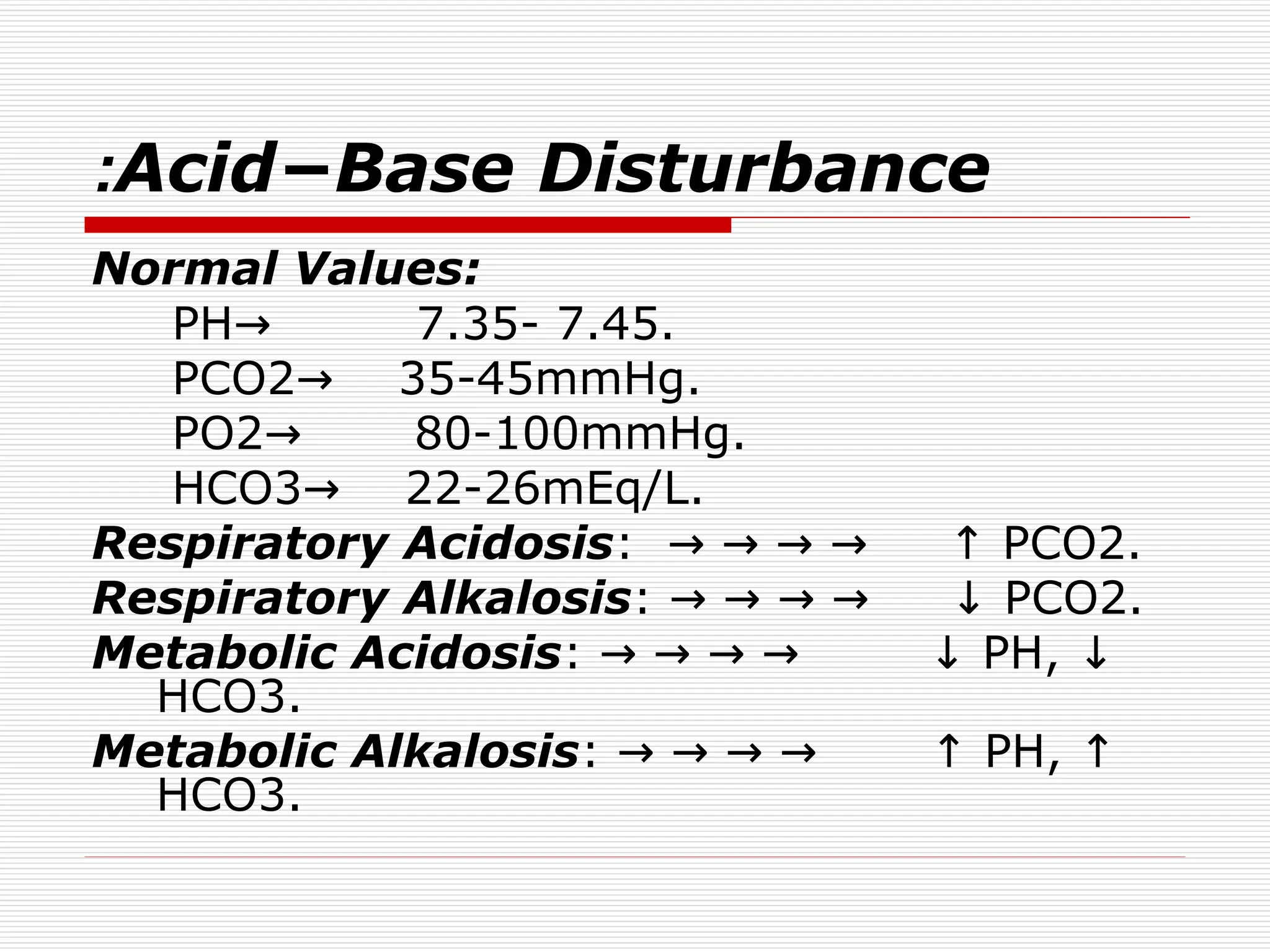
Acid−Base Disturbance
:
Normal Values:
PH 7.35- 7.45.
→
PCO2 35-45mmHg.
→
PO2 80-100mmHg.
→
HCO3 22-26mEq/L.
→
Respiratory Acidosis: PCO2.
→ → → → ↑
Respiratory Alkalosis: PCO2.
→ → → → ↓
Metabolic Acidosis: PH,
→ → → → ↓ ↓
HCO3.
Metabolic Alkalosis: PH,
→ → → → ↑ ↑
HCO3.
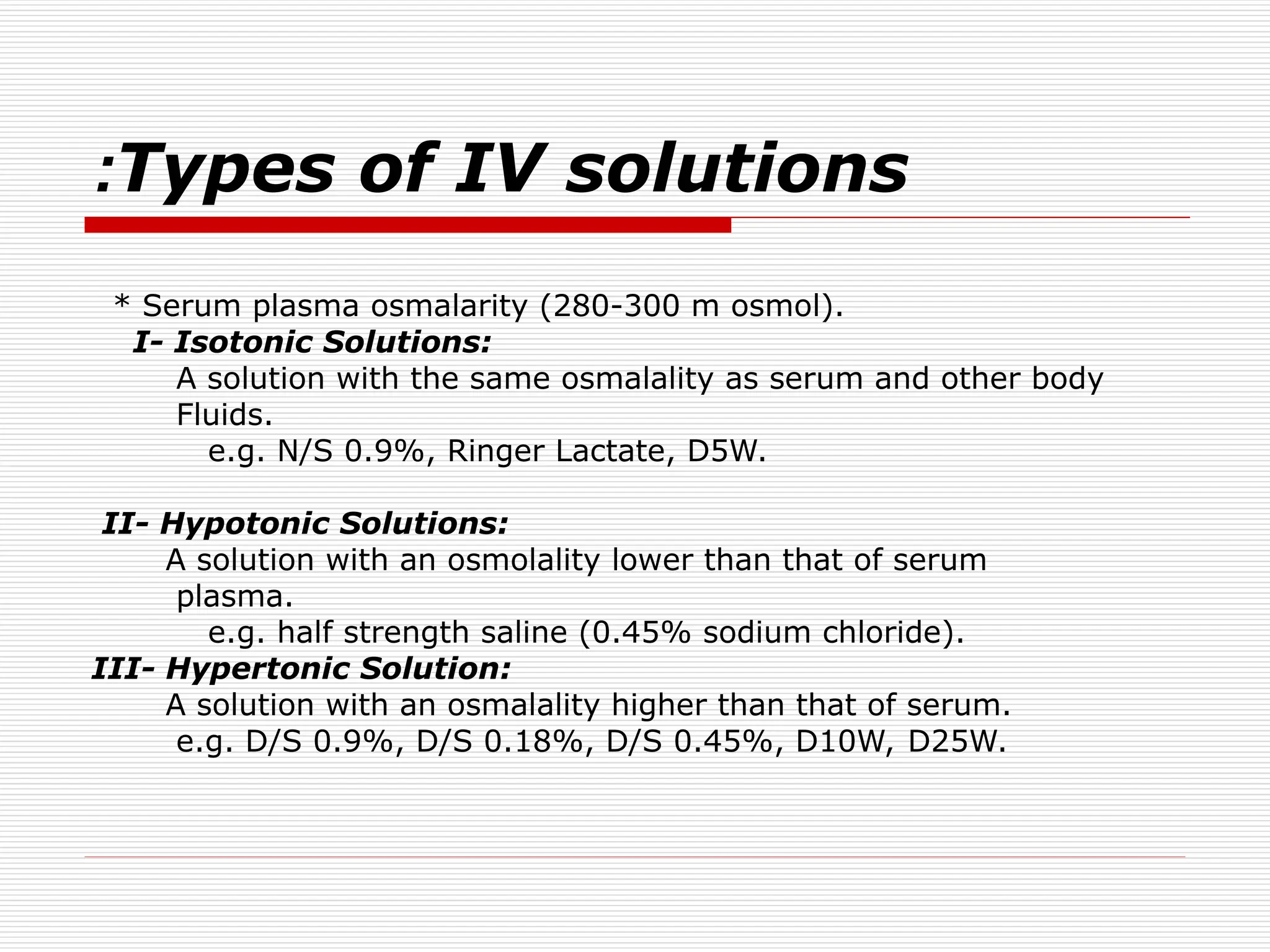
Types of IV solutions
:
* Serum plasma osmalarity (280-300 m osmol).
I- Isotonic Solutions:
A solution with the same osmalality as serum and other body
Fluids.
e.g. N/S 0.9%, Ringer Lactate, D5W.
II- Hypotonic Solutions:
A solution with an osmolality lower than that of serum
plasma.
e.g. half strength saline (0.45% sodium chloride).
III- Hypertonic Solution:
A solution with an osmalality higher than that of serum.
e.g. D/S 0.9%, D/S 0.18%, D/S 0.45%, D10W, D25W.
Types of IV solutions
:
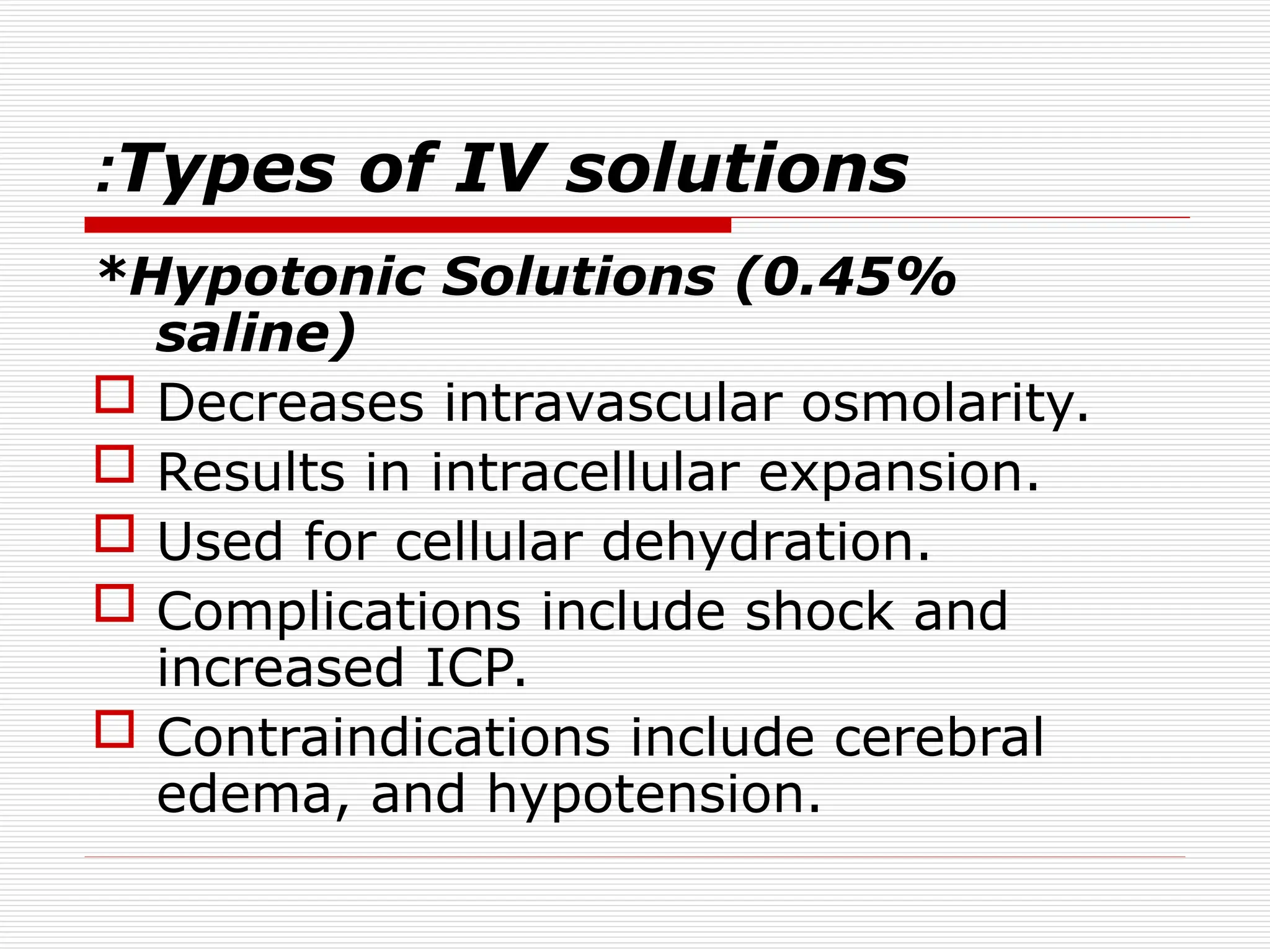
*Hypotonic Solutions (0.45%
saline)
 Decreases intravascular osmolarity.
 Results in intracellular expansion.
 Used for cellular dehydration.
 Complications include shock and
increased ICP.
 Contraindications include cerebral
edema, and hypotension.
Types of IV solutions
:
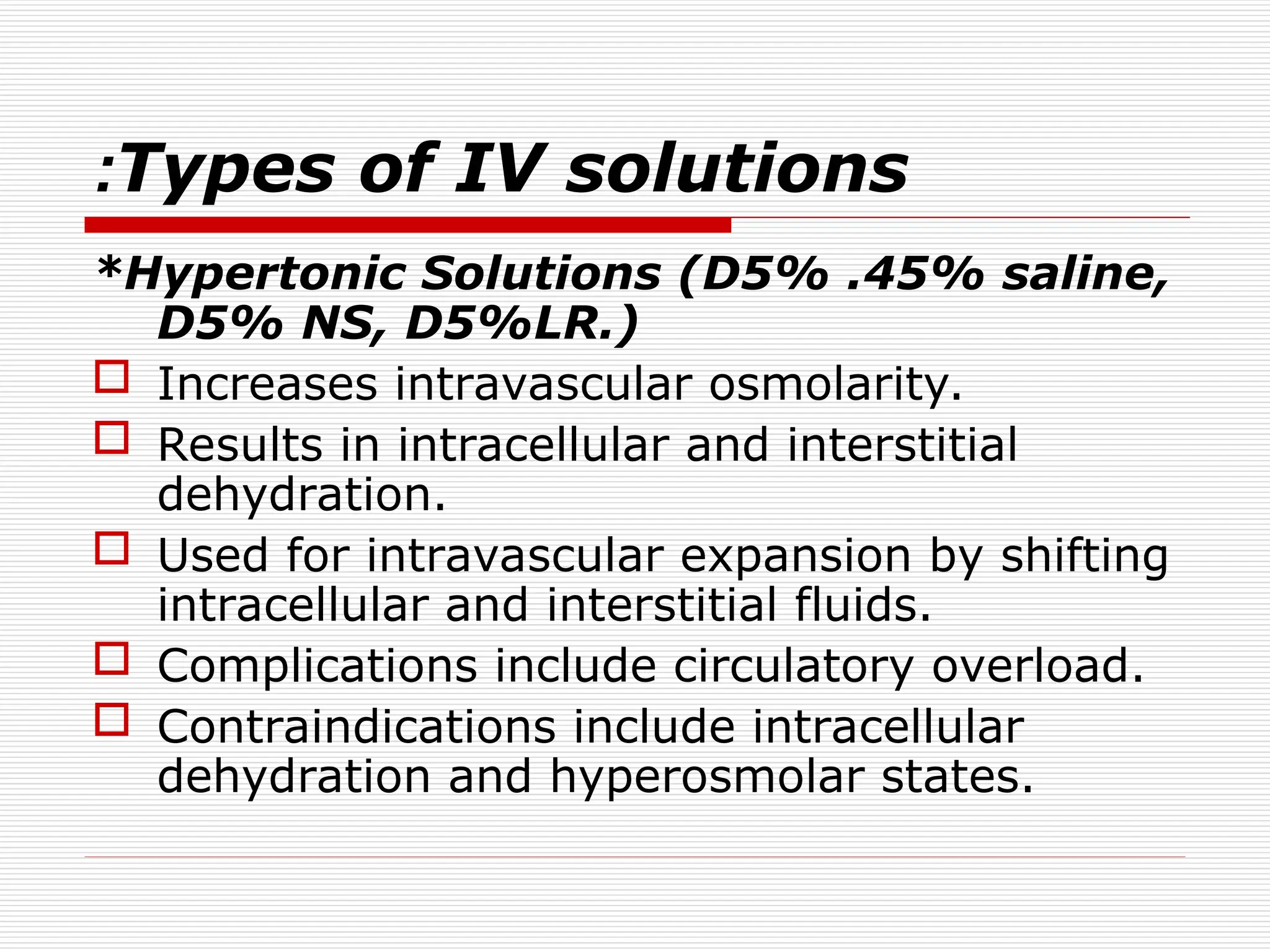
*Hypertonic Solutions (D5% .45% saline,
D5% NS, D5%LR.)
 Increases intravascular osmolarity.
 Results in intracellular and interstitial
dehydration.
 Used for intravascular expansion by shifting
intracellular and interstitial fluids.
 Complications include circulatory overload.
 Contraindications include intracellular
dehydration and hyperosmolar states.
Types of IV solutions
:
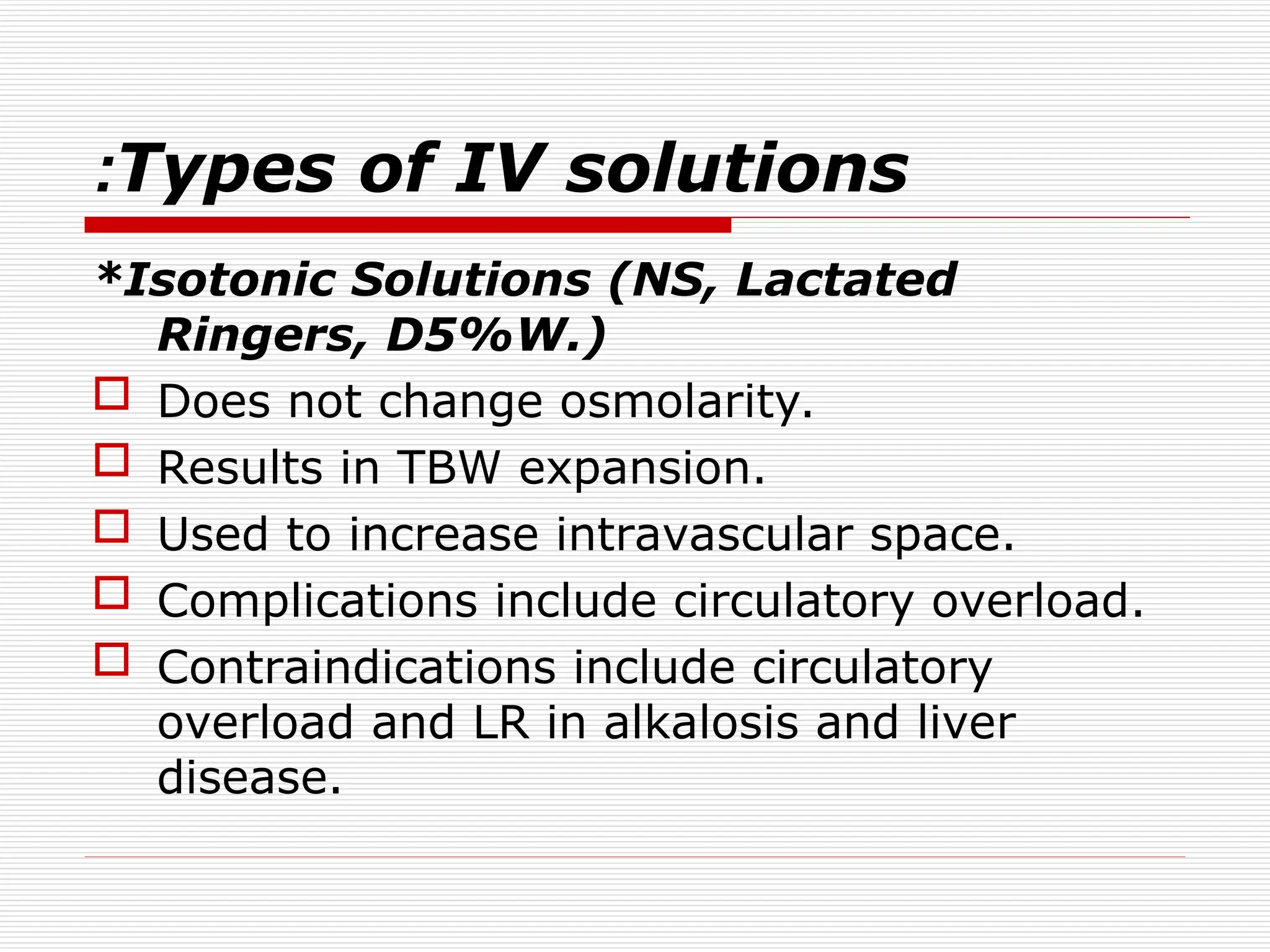
*Isotonic Solutions (NS, Lactated
Ringers, D5%W.)
 Does not change osmolarity.
 Results in TBW expansion.
 Used to increase intravascular space.
 Complications include circulatory overload.
 Contraindications include circulatory
overload and LR in alkalosis and liver
disease.
fluid_and_electrolyte_imbalance_0sdfghjsdfghjkqawsdefghjnkm.ppt

  • 1.
    Fluid and ElectrolyteImbalance Acid and Base Imbalance
  • 2.
    Fluid and electrolyte Disturbance Amountand Composition of Body Fluids: - Approximately 60% of atypical adult’s weight consists of fluid (water&electrolyte). - Body fluid is located in tow fluid compartment: 1) Intracellular fluids (fluids in the cells) 2/3. 2) Extracelluler fluids :( fluids out side the cells) 1/3. a-Intravascular space (fluids with in blood vessels) contains plasma.(3L of the total blood). b- Interstitial fluids: contain fluids that surround the cell and total about 8L.eg. Lymph. c- Trancellular space: contain approximately 1L. eg. Cerebrospinal, Pericardial, Synovial.
  • 3.
    Average daily intakeand output in an adult : Intake Output Oral Liquids 1300ml. Urine 1500ml Water in foods 1000ml. Stool 200ml Water produced Insensible lungs 300ml by metabolism 300ml Skin 600ml 2600ml 2600ml
  • 4.
    Normal Lab Results : - Na135−145mEq/L → . - K+ 3.5−5.5mEq/L → . - Ca++ 8.5−10.5mEq/L → . - Cl 96−106mEq/L → . - Mg 1.5−2.5mEq/L → .
  • 5.
    Fluid Volume Disturbance : I-Hypovolemia(fluids volume deficit) : − Contributing Factors : * Loss of water and electrolyte . e.g.( vomiting,diarrhea,burns) . * Decrease intake. e.g. (anorexia, nausea, inability to gain access to fluids .) * Some disease.e.g (D.M, Diabetic Insipidus) . − Sings and symptoms : Weight loss, general weakness, dizziness, increase pulse .
  • 6.
     Assessment Diagnostic evaluation HealthHistory & Physical examination Serum BUN & Creatinin Hematocrit level “great than normal” Urine specific gravity Serum electrolytes level Hypokalemia in case of GI & renal loss Hyperkalemia in case of adrenal insufficiency Hypernatremia in case of insensible losses & ↑ diabetic insepedus
  • 8.
    ♣ Management treatment ofthe causes of FVD should be go with treatment of FVD itself factors influence the pt fluid needs should be taken in consideration In case of sever or acute FVD IV replacement should be started Isotonic solutions used to treat hypotension resulted from FVD Renal function & hemodynamic status should be evaluated ♣Nursing Management Monitor I&O as needed “urine” Monitor V/S, skin turgor , mental status & daily weight Extensive Hemodynamic CVP, arterial pressure Mouth care & ↓ irritating fluids
  • 9.
    Fluid Volume Disturbance : II-Hypervolemia (fluid volume excess): − Contributing Factors: * Compromised regulatory mechanism such as renal failure, congestive heart failure, and cirrhosis. * Administration of Na+ containing fluids. * Prolong corticosteroid therapy. * Increase fluid intake. − Sings and Symptoms: Weight gain, increase blood pressure, edema, and shortness of breathing.
  • 10.
    Assessment & DiagnosticEvaluation - Decreased BUN , Creatinin , Serum osmolality & hematocrete because of plasma dilution, &↓protein intake - Urine sodium is increased if kidneys excrete excess fluid - CXR may disclosed pulmonary congestion
  • 12.
    Management Direct cause shouldbe treated Symptomatic treatment consist of : - Diuretics - restrict fluid & Na intake - Maintained electrolytes balance - Hemodialysis in case of renal impairment - K+ supplement & specific nutrition Nursing Management: - Assess breathing , weight ,degree of edema regularly - I & O measurement regularly - Semifowlers position in case of shortness of breath - Patient education
  • 13.
    Electrolyte imbalance : I- SodiumDeficit(Hyponatremia): −Contributing Factors: * Use of a diuretic. * Loss of GI fluids. * Gain of water. − Sings and Symptoms: Anorexia, nausea and vomiting, headache, lethargy, confusion, seizures.
  • 15.
    Hyponatremia, continued Treatment: correctunderlying disorder Fluid restrict, + diuretics Hypertonic saline to increase level 2-3 mEq/L/hr and max rate 100cc of 5% saline/hr
  • 16.
    Electrolyte imbalance : II- SodiumExcess (Hypernatremia): − Contributing Factors: * Water deprivation in patient. * Hypertonic tube feeding. * Diabetes Insipidus. − Sings and Symptoms: Thirst, hallucination, lethargy, restless, pulmonary edema.
  • 18.
    Hypernatremia, continued Treatment: correctunderlying disorder Free water replacement: (0.6 * kg BW) * ((Na/140) – 1). Slow infusion of D5W give ½ over first 8 hrs then rest over next 16-24 hrs to avoid cerebral edema.
  • 19.
    Electrolyte imbalance : III- PotassiumDeficit (Hypokalemia): − Contributing factors: * Dirrhea, vomiting, gastric suctions. * Corticosteroid administration. * Diuretics. − Sings and symptoms: Fatigue, anorexia, nausea, vomiting, muscle weakness, change in ECG.  EKG: low, flat T-waves, ST depression, and U waves
  • 20.
  • 21.
  • 22.
    Hypokalemia, continued Treatment: Check renalfunction Treat alkalosis, decrease sodium intake PO with 20-40 mEq doses IV: peripheral 7.5 mEq/hr, central 20 mEq/hr and increase K+ in maintenance fluids.
  • 23.
    Electrolyte imbalance : IV- PotassiumExcess (Hyperkalemia): − Contributing Factors: * Renal Failure. * Crush injury, burns. * Blood transfusion. * Administration of IV K+. − Sings and Symptoms: Bradycardia, dysarrythmia, anxiety, irritable. - ECG: peaked T waves then flat P waves, depressed ST segment, widened QRS progressing to sine wave and V fib.
  • 24.
  • 25.
  • 26.
    Hyperkalemia, continued Treatment:  Removeiatrogenic causes  Acute: if > 7.5 mEq/L or EKG changes Ca-gluconate – 1 gm over 2 min IV Sodium bicarbonate – 1 amp, may repeat in 15min D50W (1 ampule = 50 gm) and 10U regular insulin Emergent dialysis  Hydration and diuresis, kayexalate 20-50 g, in 100- 200cc of 20% sorbitol q 4hrs or enema
  • 27.
    Calcium  Hypocalcemia:  Seenin hypoalbuminemia. Check ionized Ca  Often symptomatic below 8 mEq/dL  Check PTH: low may be Mg deficiency High think pancreatitis, hyperPO4, low Vitamin D, pseudohypoparathyroidism, massive blood transfusion, drugs (e.g. gentamicin) renal insufficiency  S/Sx: numbness, tingling, circumoral paresthesia, cramps tetany, increased DTR’s, Chvostek’s sign, Trousseau’s sign EKG has prolonged QT interval
  • 29.
    ECG Changes inCalcium Abnormalities
  • 30.
    Calcium, continued Hypocalcemia cont. Treatment: Acute:(IV) CaCl 10 cc of 10% solution = 6.5 mmole Ca or CaGluconate 10cc of 10% solution = 2.2 mmole Ca Chronic: (PO) 0.5-1.25 gm CaCO3 = 200-500 mg Ca. Phosphate binding antacids improve GI absorption of Ca  Vit D (calciferol) must have normal serum PO4. Start 50,000 – 200,000 units/day
  • 31.
  • 32.
    Calcium, continued Hypercalcemia  Usuallysecondary to hyperparathyroidism or malignancy. Other causes are thiazides, milk- alkali syndrome, granulomatous disease, acute adrenal insufficiency  Acute crisis is serum Ca> 12mg/dL. Critical at 16- 20mg/dL  S/Sx: N/V, anorexia, abdominal pain, confusion, lethargy MS changes= “Bones, stone, abdominal groans and psychic overtones.”
  • 33.
    Calcium, continued Treatment: Hydrationwith NS then loop diuretic. Steroids for lymphoma, multiple myeloma, adrenal insufficiency, bone mets, Vit D intoxication. May need Hemodialysis. Mithramycin for malignancy induced hyperCa refractory to other treatment. Give 15-25 mcg/kg IVP Calcitonin in malignant PTH syndromes
  • 34.
    Magnesium Hypomagnesemia Malnutrition, burns, pancreatitis,SIADH, parathyroidectomy, primary hyperaldosteronism S/Sx: weakness, fatigue, MS changes, hyperreflexia, seizure, arrhythmia Treatment: IV replacement of 2-4 gm of MgSO4 per day or oral replacement
  • 35.
  • 36.
    Magnesium, continued Hypermagnesemia Renal insufficiency,antacid abuse, adrenal insufficiency, hypothyroidism, iatrogenic S/Sx: N/V, weakness, MS changes, hyporeflexia, paralysis of voluntary muscles, EKG has AV block and prolonged QT interval. Treatment: Discontinue source, IV CaGluconate for acute Rx, Dialysis
  • 37.
    Phosphate Treatment: PO replacement(Neutraphos) or IV KPhos or NaPhos 0.08-0.20 mM/kg over 6 hrs Hyperphosphatemia Renal insufficiency, hypoparathyroidism, may produce metastatic calcification Treat with restriction and phosphate- binding antacid (Amphogel)
  • 38.
    Acid−Base Disturbance : Normal Values: PH7.35- 7.45. → PCO2 35-45mmHg. → PO2 80-100mmHg. → HCO3 22-26mEq/L. → Respiratory Acidosis: PCO2. → → → → ↑ Respiratory Alkalosis: PCO2. → → → → ↓ Metabolic Acidosis: PH, → → → → ↓ ↓ HCO3. Metabolic Alkalosis: PH, → → → → ↑ ↑ HCO3.
  • 39.
    Types of IVsolutions : * Serum plasma osmalarity (280-300 m osmol). I- Isotonic Solutions: A solution with the same osmalality as serum and other body Fluids. e.g. N/S 0.9%, Ringer Lactate, D5W. II- Hypotonic Solutions: A solution with an osmolality lower than that of serum plasma. e.g. half strength saline (0.45% sodium chloride). III- Hypertonic Solution: A solution with an osmalality higher than that of serum. e.g. D/S 0.9%, D/S 0.18%, D/S 0.45%, D10W, D25W.
  • 40.
    Types of IVsolutions : *Hypotonic Solutions (0.45% saline)  Decreases intravascular osmolarity.  Results in intracellular expansion.  Used for cellular dehydration.  Complications include shock and increased ICP.  Contraindications include cerebral edema, and hypotension.
  • 41.
    Types of IVsolutions : *Hypertonic Solutions (D5% .45% saline, D5% NS, D5%LR.)  Increases intravascular osmolarity.  Results in intracellular and interstitial dehydration.  Used for intravascular expansion by shifting intracellular and interstitial fluids.  Complications include circulatory overload.  Contraindications include intracellular dehydration and hyperosmolar states.
  • 42.
    Types of IVsolutions : *Isotonic Solutions (NS, Lactated Ringers, D5%W.)  Does not change osmolarity.  Results in TBW expansion.  Used to increase intravascular space.  Complications include circulatory overload.  Contraindications include circulatory overload and LR in alkalosis and liver disease.