©Goutam Mallik, Assistant Professor, Pharmacology
Page | 1
CELL DIVISION
Cell division is a process by which a single cell reproduces two or more cell. It is of two types
A. Mitosis B.Meiosis
 It may proceed by following ways:
l. Karyokinesis: Division of nuclear material starts with doubling of the chromosome in parent
nucleus, followed by distribution between two daughter nuclei in equal proportion.
2. Cytokinesis: Cytoplasmic division in which each of two daughter cells receives one of the
daughter nuclei. In a few cell types, karyokinesis may occur without cytokinesis.
Phases of the Cell Cycle
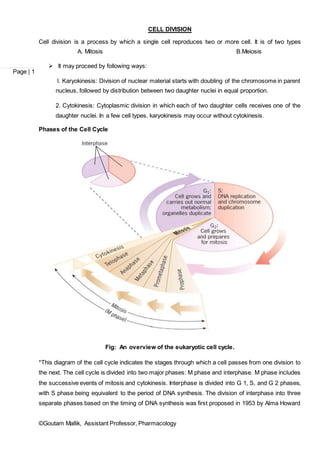
Fig: An overview of the eukaryotic cell cycle.
*This diagram of the cell cycle indicates the stages through which a cell passes from one division to
the next. The cell cycle is divided into two major phases: M phase and interphase. M phase includes
the successive events of mitosis and cytokinesis. Interphase is divided into G 1, S, and G 2 phases,
with S phase being equivalent to the period of DNA synthesis. The division of interphase into three
separate phases based on the timing of DNA synthesis was first proposed in 1953 by Alma Howard
©Goutam Mallik, Assistant Professor, Pharmacology
Page | 2
and Stephen Pelc of Hammersmith Hospital, London, based on their experiments on plant meristem
cells.
 In a population of dividing cells each cell passes through a series of defined stages, which
constitutes the cell cycle.
 The cell cycle can be divided into two major phases based on cellular activities: M phase and
interphase.
 M phase includes (1) the process of mitosis, during which duplicated chromosomes are
separated into two nuclei, and (2) cytokinesis, during which the entire cell divides into two
daughter cells.
 Interphase, the period between cell divisions, is a time when the cell grows and engages in
diverse metabolic activities.
 Whereas M phase usually lasts only an hour or so in mammaliancells, interphase may extend
for days, weeks, or longer, depending on the cell type and the conditions.
Mitosis
 During growth or regeneration of tissue, cells divide by mitosis.
 Each chromosome reproduces itself by splitting lengthwise, so that two identical portions (or
chromatids)pass to the daughter cells and grow into mature chromosomes identicalwith those
in the parent cell.
 Normal cell division or mitosis is divided usually into four stages-prophase, metaphase,
anaphase and telophase.
 The interval between each cell division which is comparatively long is called interphase.
 The process of mitosis together with interphase period constitutes the cell cycle.
 The cycle is extremely short in the case of intestinal epithelium and very long in adult hepatic
cell. Prophase
 During the stage of prophase each chromosome looks as a pair of long entwined filamentous
structures throughout the nucleus due to coiling of DNA molecules.
 They gradually shorten and thicken and become darker.
 The two centrioles with microtubules forming asters move to the opposite side.
 Spindle (group of tubules) becomes visible.
 At the end of prophase nuclear membrane and nucleolus disappear.
 The chromosomes separate from each other and become prominent.
Metaphase
 In the stage of metaphase, the chromosomes assemble at the equator of spindle fibres.
 Chromosomes appear as if suspended by microtubules (spindle filaments) in a single plane
midway between two asters.
 Two chromatids are formed from each chromosome by longitudinal splitting.
©Goutam Mallik, Assistant Professor, Pharmacology
Page | 3
Anaphase
 During anaphase the separated chromatids which form the chromosome of the daughter cell
move towards the opposite poles of the cell.
 Newly separated chromatids now are new chromosomes.
Telophase
 In the stage of telophase, a gradually elongating nuclear membrane due to uncoiling of DNA
molecules is formed around two groups of chromosomes.
 Spindle fibres disappear.
 Formation of nucleolus completes the process of cell division and two identical daughter cells
after cytokinesis are usually formed from one parent cell.
 The different cytoplasmic organoids of the parent cell are distributed between the two daughter
cells.
interphase
 This is a period between end of telophase of one cell division and beginning of prophase of
next division.
 Chromosomes become elongated and too thin to be visible as such but chromatin granules
are visible.
 Each chromosome duplicates (duplication of DNA molecules) forming two chromatids
attached at centromere.
 Two newly formed cells grow.
Meiosis
 Meiosis is the heterotypical process of the formation of germ cells, or sexual reproduction.
 This process occurs during spermatogenesis and oogenesis and starts at the stage when the
primary spermatocytes and oocytes divide to form secondary spermatocytes and oocytes
respectively.
 By the process of meiosis or reduction division each male or female germ cell has in it 22
autosomes and either an X or a Y chromosome (only in sperms).
 In the course of fertilization, the male germ cell (spermatozoon) and female germ cell (ovum)
unite and the numbers of chromosomes are restored to the original 23 pairs.
 When the sperm and ovum unite, the resultant cell (zygote) possesses a full (diploid)
complementof chromosomes,onehalf from the female parent and another half from the male.
Amitosis
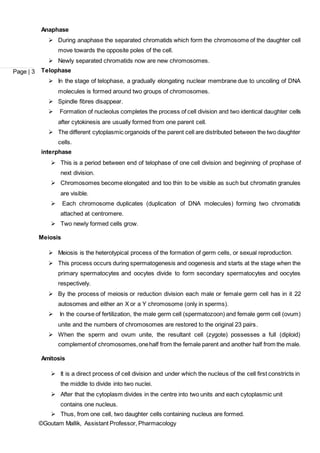
 It is a direct process of cell division and under which the nucleus of the cell first constricts in
the middle to divide into two nuclei.
 After that the cytoplasm divides in the centre into two units and each cytoplasmic unit
contains one nucleus.
 Thus, from one cell, two daughter cells containing nucleus are formed.
©Goutam Mallik, Assistant Professor, Pharmacology
Page | 4
Fig: Stages of mitosis in a cell
Fig: Mitotic cell division showing the changes in the centrosomes, centrioles, chromatids
and nucleus of a cell
***************************************************
Reference
1. KARP’S Cell and Molecular Biology Concepts and Experiments, 8th
Ed. by Janet
Iwasa & Wallace Marshall
2. CC Chaterjee’s Human Physiology 12th Ed Vol.1
3. Essentials of Human Anatomy & Physiology 5th
Ed by Valerie C. Scanlon & Tina
Sanders

Cell division

  • 1.
    ©Goutam Mallik, AssistantProfessor, Pharmacology Page | 1 CELL DIVISION Cell division is a process by which a single cell reproduces two or more cell. It is of two types A. Mitosis B.Meiosis  It may proceed by following ways: l. Karyokinesis: Division of nuclear material starts with doubling of the chromosome in parent nucleus, followed by distribution between two daughter nuclei in equal proportion. 2. Cytokinesis: Cytoplasmic division in which each of two daughter cells receives one of the daughter nuclei. In a few cell types, karyokinesis may occur without cytokinesis. Phases of the Cell Cycle Fig: An overview of the eukaryotic cell cycle. *This diagram of the cell cycle indicates the stages through which a cell passes from one division to the next. The cell cycle is divided into two major phases: M phase and interphase. M phase includes the successive events of mitosis and cytokinesis. Interphase is divided into G 1, S, and G 2 phases, with S phase being equivalent to the period of DNA synthesis. The division of interphase into three separate phases based on the timing of DNA synthesis was first proposed in 1953 by Alma Howard
  • 2.
    ©Goutam Mallik, AssistantProfessor, Pharmacology Page | 2 and Stephen Pelc of Hammersmith Hospital, London, based on their experiments on plant meristem cells.  In a population of dividing cells each cell passes through a series of defined stages, which constitutes the cell cycle.  The cell cycle can be divided into two major phases based on cellular activities: M phase and interphase.  M phase includes (1) the process of mitosis, during which duplicated chromosomes are separated into two nuclei, and (2) cytokinesis, during which the entire cell divides into two daughter cells.  Interphase, the period between cell divisions, is a time when the cell grows and engages in diverse metabolic activities.  Whereas M phase usually lasts only an hour or so in mammaliancells, interphase may extend for days, weeks, or longer, depending on the cell type and the conditions. Mitosis  During growth or regeneration of tissue, cells divide by mitosis.  Each chromosome reproduces itself by splitting lengthwise, so that two identical portions (or chromatids)pass to the daughter cells and grow into mature chromosomes identicalwith those in the parent cell.  Normal cell division or mitosis is divided usually into four stages-prophase, metaphase, anaphase and telophase.  The interval between each cell division which is comparatively long is called interphase.  The process of mitosis together with interphase period constitutes the cell cycle.  The cycle is extremely short in the case of intestinal epithelium and very long in adult hepatic cell. Prophase  During the stage of prophase each chromosome looks as a pair of long entwined filamentous structures throughout the nucleus due to coiling of DNA molecules.  They gradually shorten and thicken and become darker.  The two centrioles with microtubules forming asters move to the opposite side.  Spindle (group of tubules) becomes visible.  At the end of prophase nuclear membrane and nucleolus disappear.  The chromosomes separate from each other and become prominent. Metaphase  In the stage of metaphase, the chromosomes assemble at the equator of spindle fibres.  Chromosomes appear as if suspended by microtubules (spindle filaments) in a single plane midway between two asters.  Two chromatids are formed from each chromosome by longitudinal splitting.
  • 3.
    ©Goutam Mallik, AssistantProfessor, Pharmacology Page | 3 Anaphase  During anaphase the separated chromatids which form the chromosome of the daughter cell move towards the opposite poles of the cell.  Newly separated chromatids now are new chromosomes. Telophase  In the stage of telophase, a gradually elongating nuclear membrane due to uncoiling of DNA molecules is formed around two groups of chromosomes.  Spindle fibres disappear.  Formation of nucleolus completes the process of cell division and two identical daughter cells after cytokinesis are usually formed from one parent cell.  The different cytoplasmic organoids of the parent cell are distributed between the two daughter cells. interphase  This is a period between end of telophase of one cell division and beginning of prophase of next division.  Chromosomes become elongated and too thin to be visible as such but chromatin granules are visible.  Each chromosome duplicates (duplication of DNA molecules) forming two chromatids attached at centromere.  Two newly formed cells grow. Meiosis  Meiosis is the heterotypical process of the formation of germ cells, or sexual reproduction.  This process occurs during spermatogenesis and oogenesis and starts at the stage when the primary spermatocytes and oocytes divide to form secondary spermatocytes and oocytes respectively.  By the process of meiosis or reduction division each male or female germ cell has in it 22 autosomes and either an X or a Y chromosome (only in sperms).  In the course of fertilization, the male germ cell (spermatozoon) and female germ cell (ovum) unite and the numbers of chromosomes are restored to the original 23 pairs.  When the sperm and ovum unite, the resultant cell (zygote) possesses a full (diploid) complementof chromosomes,onehalf from the female parent and another half from the male. Amitosis  It is a direct process of cell division and under which the nucleus of the cell first constricts in the middle to divide into two nuclei.  After that the cytoplasm divides in the centre into two units and each cytoplasmic unit contains one nucleus.  Thus, from one cell, two daughter cells containing nucleus are formed.
  • 4.
    ©Goutam Mallik, AssistantProfessor, Pharmacology Page | 4 Fig: Stages of mitosis in a cell Fig: Mitotic cell division showing the changes in the centrosomes, centrioles, chromatids and nucleus of a cell *************************************************** Reference 1. KARP’S Cell and Molecular Biology Concepts and Experiments, 8th Ed. by Janet Iwasa & Wallace Marshall 2. CC Chaterjee’s Human Physiology 12th Ed Vol.1 3. Essentials of Human Anatomy & Physiology 5th Ed by Valerie C. Scanlon & Tina Sanders