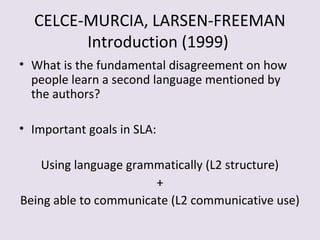
CELCE-MURCIA, LARSEN-FREEMAN
Introduction (1999)
• What is the fundamental disagreement on how
people learn a second language mentioned by
the authors?
• Important goals in SLA:
Using language grammatically (L2 structure)
+
Being able to communicate (L2 communicative use)
CELCE-MURCIA, LARSEN-FREEMAN
Introduction (1999)
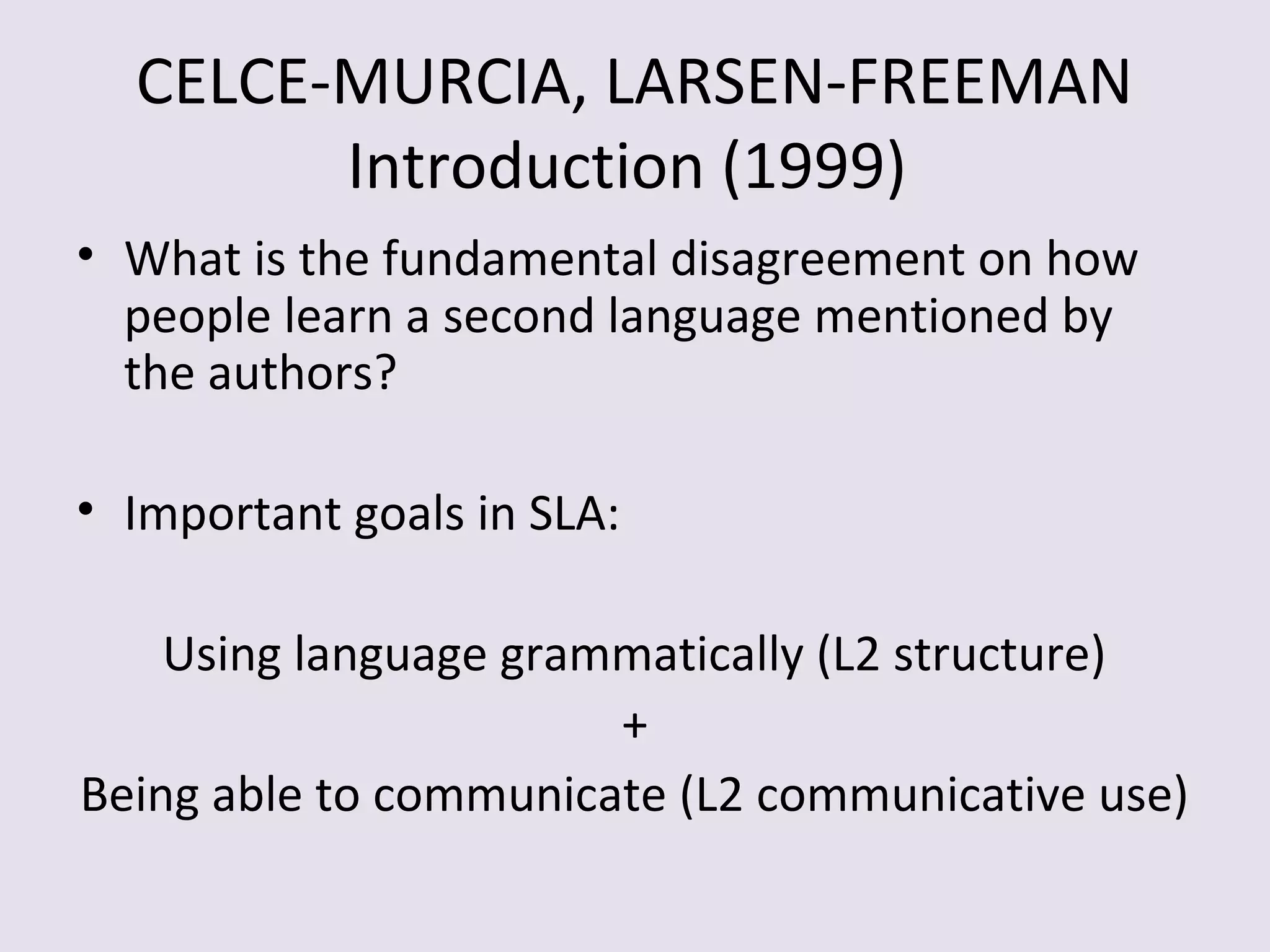
- Three grammatical levels:
Subsentential level => word level =>morphology
Sentential level => sentence level => syntax
Suprasentential level => text level => discourse
CELCE-MURCIA, LARSEN-FREEMAN
Introduction (1999)
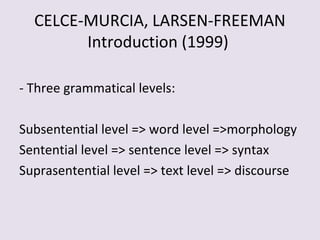
• Rules – are not airtight formulations => language is
mutable, organic
• Giving reasons, not rules, for why grammar functions as it
does
• A conceptual framework for teaching grammar (three
dimensions):
form => morphosyntax/syntax => accuracy
meaning => semantics => meaningfulness
use => pragmatics => appropriateness
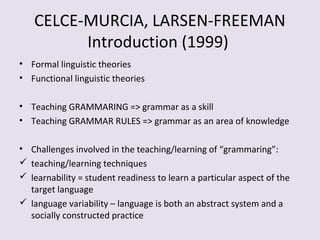
CELCE-MURCIA, LARSEN-FREEMAN
Introduction (1999)
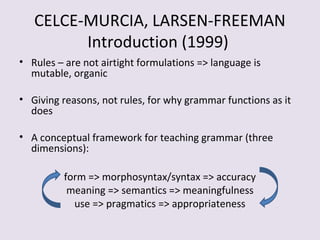
• Formal linguistic theories
• Functional linguistic theories
• Teaching GRAMMARING => grammar as a skill
• Teaching GRAMMAR RULES => grammar as an area of knowledge
• Challenges involved in the teaching/learning of “grammaring”:
 teaching/learning techniques
 learnability = student readiness to learn a particular aspect of the
target language
 language variability – language is both an abstract system and a
socially constructed practice

Celce murcia, larsen-freeman introduction (1999)

  • 1.
    CELCE-MURCIA, LARSEN-FREEMAN Introduction (1999) •What is the fundamental disagreement on how people learn a second language mentioned by the authors? • Important goals in SLA: Using language grammatically (L2 structure) + Being able to communicate (L2 communicative use)
  • 2.
    CELCE-MURCIA, LARSEN-FREEMAN Introduction (1999) -Three grammatical levels: Subsentential level => word level =>morphology Sentential level => sentence level => syntax Suprasentential level => text level => discourse
  • 3.
    CELCE-MURCIA, LARSEN-FREEMAN Introduction (1999) •Rules – are not airtight formulations => language is mutable, organic • Giving reasons, not rules, for why grammar functions as it does • A conceptual framework for teaching grammar (three dimensions): form => morphosyntax/syntax => accuracy meaning => semantics => meaningfulness use => pragmatics => appropriateness
  • 4.
    CELCE-MURCIA, LARSEN-FREEMAN Introduction (1999) •Formal linguistic theories • Functional linguistic theories • Teaching GRAMMARING => grammar as a skill • Teaching GRAMMAR RULES => grammar as an area of knowledge • Challenges involved in the teaching/learning of “grammaring”:  teaching/learning techniques  learnability = student readiness to learn a particular aspect of the target language  language variability – language is both an abstract system and a socially constructed practice