


CEGOS EUROPEAN SURVEY 2011An analysis of L&D practices in Europe: What’s happening in the marketplace today and what do learners want in the future?Document: © Cegos, 2011
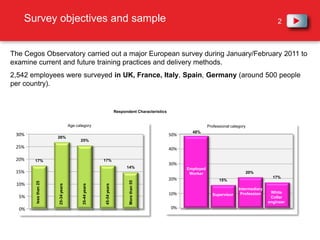
Survey objectives and sampleThe Cegos Observatory carried out a major European survey during January/February 2011 to examine current and future training practices and delivery methods.2,542 employees were surveyed in UK, France, Italy, Spain, Germany (around 500 people per country).Respondent CharacteristicsAge categoryProfessional category48%26%25%17%17%14%EmployedWorker20%17%15%More than 55Intermediary Profession less than 2525-34 years35-44 years45-54 yearsWhiteCollarengineerSupervisor
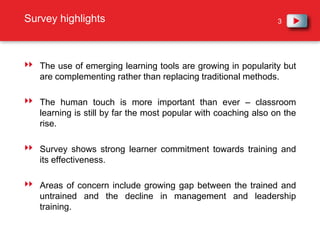
Survey highlightsThe use of emerging learning tools are growing in popularity but are complementing rather than replacing traditional methods.The human touch is more important than ever – classroom learning is still by far the most popular with coaching also on the rise.Survey shows strong learner commitment towards training and its effectiveness.Areas of concern include growing gap between the trained and untrained and the decline in management and leadership training. 
Today’s training practices (trained employees)
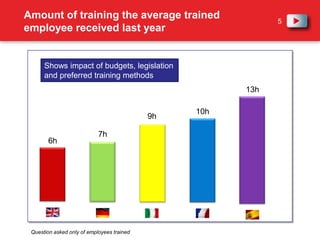
Amount of training the average trained employee received last yearShows impact of budgets, legislation and preferred training methods13h10h9h7h6hQuestion asked only of employees trained
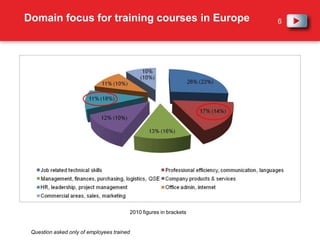
Domain focus for training courses in Europe2010 figures in bracketsQuestion asked only of employees trained
Domain focus for training courses in EuropeTop 3 training areas by country:Job related technical skillsCompany products & servicesProfessional efficiency, communication, languagesJob related technical skillsProfessional efficiency, communication, languagesCompany products & servicesProfessional efficiency, communication, languagesJob related technical skillsHR, leadership, project management Job related technical skillsProfessional efficiency, communication, languagesManagement, finances, purchasing, logistics, QSEJob related technical skillsProfessional efficiency, communication, languages
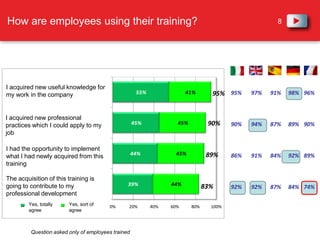
How are employees using their training?95%90%86%92%91%87%84%87%98%89%92%84%97%94%91%92%96%90%89%74%I acquired new useful knowledge for my work in the company95%I acquired new professional practices which I could apply to my job90%I had the opportunity to implement what I had newly acquired from this training89%The acquisition of this training is going to contribute to my professional development83%Yes, totally agree Yes, sort of agree Question asked only of employees trained
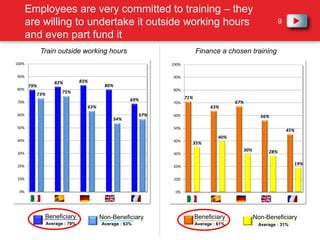
Employees are very committed to training – they are willing to undertake it outside working hours and even part fund itTrain outside working hoursFinance a chosen trainingBeneficiaryBeneficiaryNon-BeneficiaryNon-BeneficiaryAverage : 79%Average : 63%Average : 61%Average : 31%
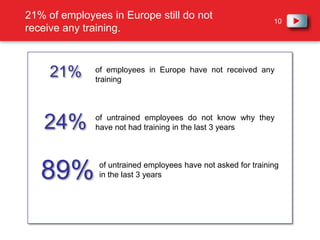
21% of employees in Europe still do not receive any training. 21% of employees in Europe have not received any training24% of untrained employees do not know why they have not had training in the last 3 years89% of untrained employees have not asked for training in the last 3 years
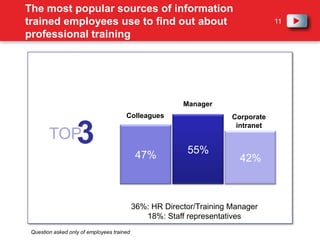
The most popular sources of information trained employees use to find out about professional trainingManagerColleaguesCorporate intranet55%347%42%TOP36%: HR Director/Training Manager18%: Staff representatives Question asked only of employees trained
Sources of information about training...Top 3 sources of information about training by country:ManagerColleaguesCorporate intranetManagerColleaguesHR Director/Training Manager ManagerColleaguesCorporate intranetManagerColleaguesCorporate intranetManagerColleaguesCorporate intranet
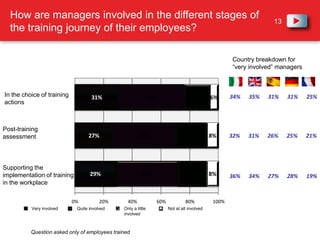
How are managers involved in the different stages of the training journey of their employees?Country breakdown for “very involved” managersIn the choice of training actions 34%		35%		31%		31%		25%31%45%18%6%Post-training assessment32%		31%		26%		25%		21%27%43%22%8%Supporting the implementation of training in the workplace29%43%20%8%36%		34%		27%		28%		19%0%20%40%60%80%100%Very involvedQuite involvedOnly a little involvedNot at all involvedTrès impliqué Assez impliqué Peu impliqué Pas du tout impliqué Question asked only of employees trained
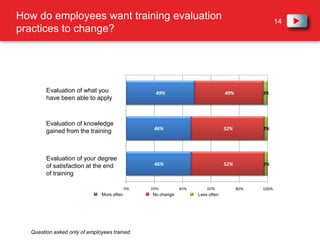
How do employees want training evaluation practices to change? Evaluation of what you have been able to applyEvaluation of knowledge gained from the trainingEvaluation of your degree of satisfaction at the end of trainingMore oftenNo changeLess oftenQuestion asked only of employees trained
Learning provision and delivery methods
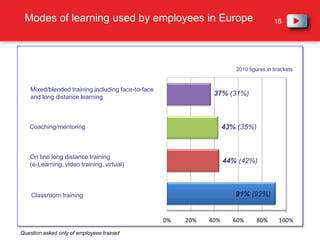
Modes of learning used by employees in Europe2010 figures in bracketsMixed/blended training including face-to-face and long distance learning37% (31%)43% (35%)Coaching/mentoringOn line long distance training  (e-Learning, video training, virtual)44% (42%)91% (92%)Classroom trainingQuestion asked only of employees trained
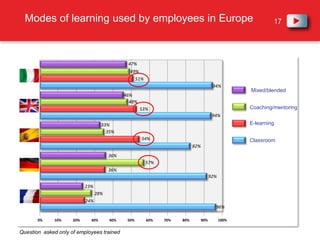
Modes of learning used by employees in Europe47%49%51%94% Mixed/blended46%48%Coaching/mentoring53%94%E-learning33%35%54%Classroom82%36%57%36%92%23%28%24%96%60%40%30%20%10%0%50%100%90%80%70%Question  asked only of employees trained
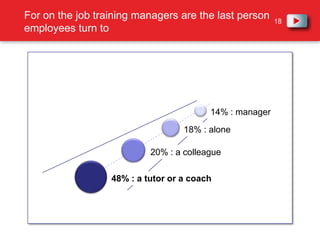
For on the job training managers are the last person employees turn to14% : manager18% : alone20% : a colleague48% : a tutor or a coach
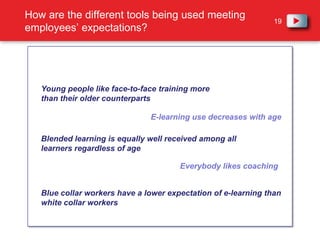
How are the different tools being used meeting employees’ expectations?Young people like face-to-face training more than their older counterpartsE-learning use decreases with ageBlended learning is equally well received among all learners regardless of ageEverybody likes coachingBlue collar workers have a lower expectation of e-learning than white collar workers
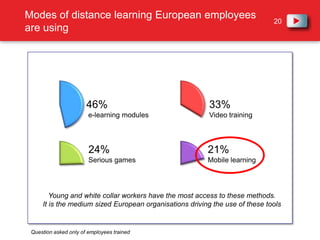
Modes of distance learning European employees are using46%  e-learning modules33%Video training24%Serious games21%Mobile learningYoung and white collar workers have the most access to these methods.It is the medium sized European organisations driving the use of these toolsQuestion asked only of employees trained
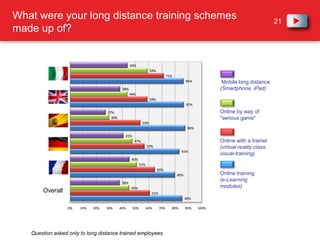
What were your long distance training schemes made up of? Mobile long distance (Smartphone, iPad) Online by way of "serious game"Online with a trainer(virtual reality class, visual-training) Online training(e-Learning modules)OverallQuestion asked only to long distance trained employees
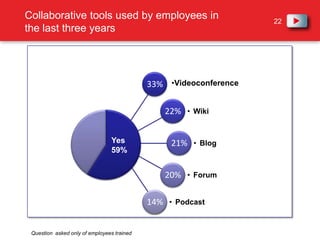
Collaborative tools used by employees in the last three yearsVideoconferenceYes59%Question  asked only of employees trained
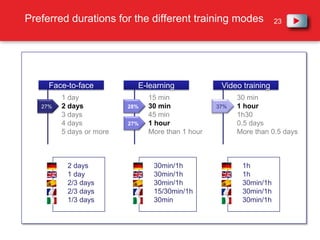
Preferred durations for the different training modesFace-to-faceE-learningVideo training1 day2 days3 days4 days5 days or more15 min30 min45 min1 hourMore than 1 hour30 min1 hour1h300.5 daysMore than 0.5 days27%28%37%27%2 days1 day2/3 days2/3 days1/3 days30min/1h30min/1h30min/1h15/30min/1h30min1h1h30min/1h30min/1h30min/1h
What are learners’ expectations for the future?
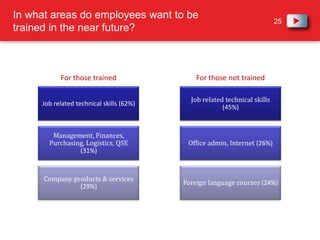
In what areas do employees want to be trained in the near future?For those trainedFor those not trained
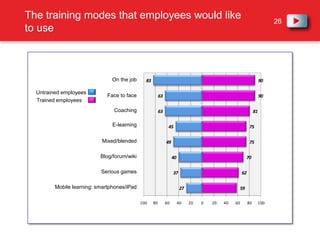
The training modes that employees would like to useOn the jobFace to faceCoachingE-learningMixed/blendedBlog/forum/wikiSerious gamesMobile learning: smartphones/iPadUntrained employeesTrained employees
What can we take away?

Cegos 2011 learning trends survey draft, final may 11

  • 1.
    CEGOS EUROPEANSURVEY 2011An analysis of L&D practices in Europe: What’s happening in the marketplace today and what do learners want in the future?Document: © Cegos, 2011
  • 2.
    Survey objectives andsampleThe Cegos Observatory carried out a major European survey during January/February 2011 to examine current and future training practices and delivery methods.2,542 employees were surveyed in UK, France, Italy, Spain, Germany (around 500 people per country).Respondent CharacteristicsAge categoryProfessional category48%26%25%17%17%14%EmployedWorker20%17%15%More than 55Intermediary Profession less than 2525-34 years35-44 years45-54 yearsWhiteCollarengineerSupervisor
  • 3.
    Survey highlightsThe useof emerging learning tools are growing in popularity but are complementing rather than replacing traditional methods.The human touch is more important than ever – classroom learning is still by far the most popular with coaching also on the rise.Survey shows strong learner commitment towards training and its effectiveness.Areas of concern include growing gap between the trained and untrained and the decline in management and leadership training. 
  • 4.
    Today’s training practices(trained employees)
  • 5.
    Amount of trainingthe average trained employee received last yearShows impact of budgets, legislation and preferred training methods13h10h9h7h6hQuestion asked only of employees trained
  • 6.
    Domain focus fortraining courses in Europe2010 figures in bracketsQuestion asked only of employees trained
  • 7.
    Domain focus fortraining courses in EuropeTop 3 training areas by country:Job related technical skillsCompany products & servicesProfessional efficiency, communication, languagesJob related technical skillsProfessional efficiency, communication, languagesCompany products & servicesProfessional efficiency, communication, languagesJob related technical skillsHR, leadership, project management Job related technical skillsProfessional efficiency, communication, languagesManagement, finances, purchasing, logistics, QSEJob related technical skillsProfessional efficiency, communication, languages
  • 8.
    How are employeesusing their training?95%90%86%92%91%87%84%87%98%89%92%84%97%94%91%92%96%90%89%74%I acquired new useful knowledge for my work in the company95%I acquired new professional practices which I could apply to my job90%I had the opportunity to implement what I had newly acquired from this training89%The acquisition of this training is going to contribute to my professional development83%Yes, totally agree Yes, sort of agree Question asked only of employees trained
  • 9.
    Employees are verycommitted to training – they are willing to undertake it outside working hours and even part fund itTrain outside working hoursFinance a chosen trainingBeneficiaryBeneficiaryNon-BeneficiaryNon-BeneficiaryAverage : 79%Average : 63%Average : 61%Average : 31%
  • 10.
    21% of employeesin Europe still do not receive any training. 21% of employees in Europe have not received any training24% of untrained employees do not know why they have not had training in the last 3 years89% of untrained employees have not asked for training in the last 3 years
  • 11.
    The most popularsources of information trained employees use to find out about professional trainingManagerColleaguesCorporate intranet55%347%42%TOP36%: HR Director/Training Manager18%: Staff representatives Question asked only of employees trained
  • 12.
    Sources of informationabout training...Top 3 sources of information about training by country:ManagerColleaguesCorporate intranetManagerColleaguesHR Director/Training Manager ManagerColleaguesCorporate intranetManagerColleaguesCorporate intranetManagerColleaguesCorporate intranet
  • 13.
    How are managersinvolved in the different stages of the training journey of their employees?Country breakdown for “very involved” managersIn the choice of training actions 34% 35% 31% 31% 25%31%45%18%6%Post-training assessment32% 31% 26% 25% 21%27%43%22%8%Supporting the implementation of training in the workplace29%43%20%8%36% 34% 27% 28% 19%0%20%40%60%80%100%Very involvedQuite involvedOnly a little involvedNot at all involvedTrès impliqué Assez impliqué Peu impliqué Pas du tout impliqué Question asked only of employees trained
  • 14.
    How do employeeswant training evaluation practices to change? Evaluation of what you have been able to applyEvaluation of knowledge gained from the trainingEvaluation of your degree of satisfaction at the end of trainingMore oftenNo changeLess oftenQuestion asked only of employees trained
  • 15.
    Learning provision anddelivery methods
  • 16.
    Modes of learningused by employees in Europe2010 figures in bracketsMixed/blended training including face-to-face and long distance learning37% (31%)43% (35%)Coaching/mentoringOn line long distance training (e-Learning, video training, virtual)44% (42%)91% (92%)Classroom trainingQuestion asked only of employees trained
  • 17.
    Modes of learningused by employees in Europe47%49%51%94% Mixed/blended46%48%Coaching/mentoring53%94%E-learning33%35%54%Classroom82%36%57%36%92%23%28%24%96%60%40%30%20%10%0%50%100%90%80%70%Question asked only of employees trained
  • 18.
    For on thejob training managers are the last person employees turn to14% : manager18% : alone20% : a colleague48% : a tutor or a coach
  • 19.
    How are thedifferent tools being used meeting employees’ expectations?Young people like face-to-face training more than their older counterpartsE-learning use decreases with ageBlended learning is equally well received among all learners regardless of ageEverybody likes coachingBlue collar workers have a lower expectation of e-learning than white collar workers
  • 20.
    Modes of distancelearning European employees are using46% e-learning modules33%Video training24%Serious games21%Mobile learningYoung and white collar workers have the most access to these methods.It is the medium sized European organisations driving the use of these toolsQuestion asked only of employees trained
  • 21.
    What were yourlong distance training schemes made up of? Mobile long distance (Smartphone, iPad) Online by way of "serious game"Online with a trainer(virtual reality class, visual-training) Online training(e-Learning modules)OverallQuestion asked only to long distance trained employees
  • 22.
    Collaborative tools usedby employees in the last three yearsVideoconferenceYes59%Question asked only of employees trained
  • 23.
    Preferred durations forthe different training modesFace-to-faceE-learningVideo training1 day2 days3 days4 days5 days or more15 min30 min45 min1 hourMore than 1 hour30 min1 hour1h300.5 daysMore than 0.5 days27%28%37%27%2 days1 day2/3 days2/3 days1/3 days30min/1h30min/1h30min/1h15/30min/1h30min1h1h30min/1h30min/1h30min/1h
  • 24.
    What are learners’expectations for the future?
  • 25.
    In what areasdo employees want to be trained in the near future?For those trainedFor those not trained
  • 26.
    The training modesthat employees would like to useOn the jobFace to faceCoachingE-learningMixed/blendedBlog/forum/wikiSerious gamesMobile learning: smartphones/iPadUntrained employeesTrained employees
  • 27.
    What can wetake away?

Editor's Notes

  • #13 Key points: The UK has the highest level of employees actively seeking information about professional training. France is the only country with the HR/training function in the top 3 sources of information – this could reflect French legislation mandating a certain amount of training for each employee. Spain has the lowest response rates of any of the countries surveyed, yet they receive the most hours of training and are key users of e-learning and blended learning.