LEARNING NUMBERS
the 49%of pages views
last less than four seconds
Bull city learning, 2015
the average of the words read
by users on a web page is
28%
Bull city learning, 2015
48% of web page views can
jump up when content contains
photos and video
Bull city learning, 2015
between 2000 and 2013, from
12 seconds to 8 seconds is the
dropped average transient
attention span
Bull city learning, 2015
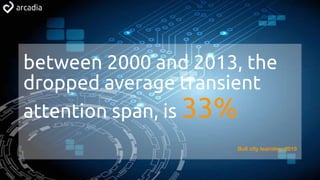
between 2000 and 2013, the
dropped average transient
attention span, is 33%
Bull city learning, 2015
87% of teachers said modern
technologies were creating an
“easily distracted generation with
short attention span”
Bull city learning, 2015
the average office worker
checks his e-mail 30-40 of
times per hour
Bull city learning, 2015
the increase in the number of people
using devices simultaneously, over
the past three years, is 500%
Bull city learning, 2015
21number of times the
average person switches
devices per hour
Bull city learning, 2015
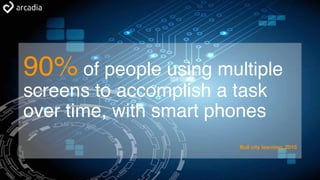
90% of people using multiple
screens to accomplish a task
over time, with smart phones
Bull city learning, 2015
32% of consumer will start
abandoning slow sites between
one and five seconds
Bull city learning, 2015
11% fewer page views as
possibly result if there is a one
second delay in web page load
time
Bull city learning, 2015
37% of the global workforce is
expected to be “mobile” by the end
of 2015
Bersin by Deloitte, 2015
30% of full-time employees do
most of their work somewhere
other than the employee’s location
Bersin by Deloitte, 2015
20% of workforce is
composed by temps,
contractors and freelancers
Bersin by Deloitte, 2015
70% search engine access
is what employees say that
they need for their job
Bersin by Deloitte, 2015
50-60% online courses
access is what employees say
that they need for their job
Bersin by Deloitte, 2015
80% of workforce learning
happens via on-the-job interactions
with peers, teammates and
managers
Bersin by Deloitte, 2015
55% of training courses at
Google are delivered by an
ecosystem of 2,000+ peer learners
Bersin by Deloitte, 2015
2,5 to 5 is the half-life (in
years) of many professional
skills
Bersin by Deloitte, 2015
38% of workers who say they
have opportunities for learning
and growth at their workplace
Bersin by Deloitte, 2015
62% of IT professionals who
report having paid for training
out of their own pockets
Bersin by Deloitte, 2015
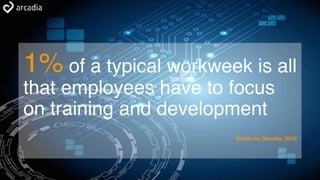
1% of a typical workweek is all
that employees have to focus
on training and development
Bersin by Deloitte, 2015
41% of time workers spend on
things that offer little personal
satisfaction and do not help them
get work done
Bersin by Deloitte, 2015
up to 9 times every
hours, people unlock their
smartphones
Bersin by Deloitte, 2015
2/3 of knowledge workers
actually complain that they
don’t have time to do their job
Bersin by Deloitte, 2015
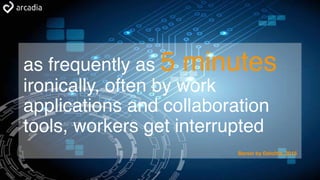
as frequently as 5 minutes
ironically, often by work
applications and collaboration
tools, workers get interrupted
Bersin by Deloitte, 2015
4 minutes is the time that
most learners won’t watch
videos
Bersin by Deloitte, 2015
48% of companies identify
as a priority the research of
new learning technologies
Brandon Hall Group, 2016
47% of companies
recognize the necessity to
develop a learning strategy
Brandon Hall Group, 2016
42% of companies recognize
the necessity of strengthening
the link between training and
performance
Brandon Hall Group, 2016
71 is the mean rank higher on
formal, informal and experiential
learning environments, by users
of technologies (not satisfied)
Brandon Hall Group, 2016
39% of the budget on
learning technologies is
represented by LMS
Brandon Hall Group, 2016
31% of companies estimate to
increment the learning technology
budget during the next 12-18
months
Brandon Hall Group, 2016
18% of companies estimate to
reduce the learning technology
budget during the next 12-18
months
Brandon Hall Group, 2016
61% of people would put in
more time learning on their own if
they got some kind of
professional credit or reward for it
Degree The Importance of Informal Learning, 2015
only 38% of L&D
professionals think they’re
ready to meet the needs of
tomorrow’s learners
ATD Learners of the Future, 2015
3,3 hours a week are
spent by workers on learning
on their own
Degree How the Workforce Learns, 2016
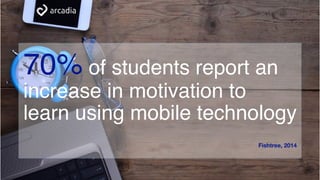
70% of students report an
increase in motivation to
learn using mobile technology
Fishtree, 2014
63% of students use their
mobile phones to go online
Fishtree, 2014
91% of US adults
own a cell phone
Fishtree, 2014
71% of top learning
organizations are adopting
some form of mobile learning
Fishtree, 2014
80% of people will be using
mobile device to access the
internet by 2015
Fishtree, 2014
36% of non-users plan to
use MOOCs in the Future
TD, 2014
Benefits: 72% expand
Learning opportunities
through MOOCs
TD, 2014
Benefits: 59% provide E-
Learning access through
MOOCs
TD, 2014
Benefits: 53% expand
Leadership Curriculum
through MOOCs
TD, 2014
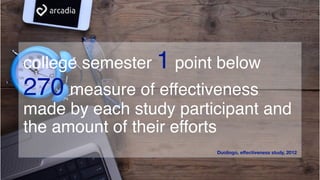
college semester 1 point below
270 measure of effectiveness
made by each study participant and
the amount of their efforts
Duolingo, effectiveness study, 2012
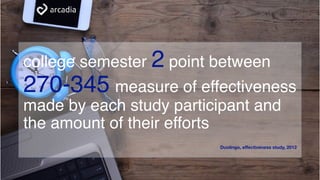
college semester 2 point between
270-345 measure of effectiveness
made by each study participant and
the amount of their efforts
Duolingo, effectiveness study, 2012
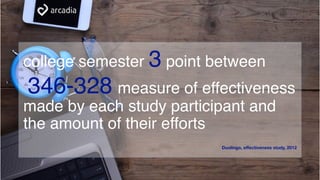
college semester 3 point between
346-328 measure of effectiveness
made by each study participant and
the amount of their efforts
Duolingo, effectiveness study, 2012
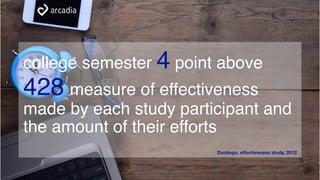
college semester 4 point above
428 measure of effectiveness
made by each study participant and
the amount of their efforts
Duolingo, effectiveness study, 2012
69% of students
graduate with Traditional
Learning Method
eLearning Industry, 2014
31% students don’t
graduate with Traditional
Learning Method
eLearning Industry, 2014
7,200 students each day
drop out of school with
Traditional Learning Method
eLearning Industry, 2014
1,3 million students a
year drop out of school with
Traditional Learning Method
eLearning Industry, 2014
+ 50% of freshman failed
English before the Flipped
Classroom
eLearning Industry, 2014
44% of freshman failed
math before the Flipped
Classroom
eLearning Industry, 2014
19% of freshman failed
English after the Flipped
Classroom
eLearning Industry, 2014
13% of freshman failed
math after the Flipped
Classroom
eLearning Industry, 2014
lecture vs peer instruction flip course
proficiency averages – calculus
lecture : 71,285<
peer instruction flip: 80
Research and Innovation Network, 2014
lecture vs peer instruction flip course
proficiency averages – pre-calculus
lecture : 74,23<
peer instruction flip: 84,923
Research and Innovation Network, 2014
lecture vs peer instruction flip course
proficiency averages – algebra 2
lecture : 82,909<
peer instruction flip: 95,091
Research and Innovation Network, 2014
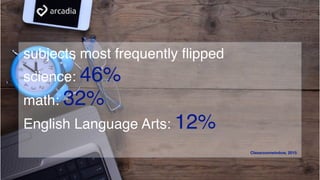
subjects most frequently flipped
science: 46%
math: 32%
English Language Arts: 12%
Classroomwindow, 2015
88% of teachers improved
job satisfaction through the
flipped classroom
Classroomwindow, 2015
46% of teachers improved
significantly Job satisfaction
through the flipped classroom
Classroomwindow, 2015
43% of teachers have put 50%
or more of their instruction online
through the Flipped Classroom
Classroomwindow, 2015
28% of teachers reporting
more than 75% online through
the Flipped Classroom
Classroomwindow, 2015
67% report test score of
students’ improvement
through the flipped classroom
Classroomwindow, 2015
80% report students
attitudes improving through
the flipped classroom
Classroomwindow, 2015
91% of teachers have used
the flipped model less than 2
years
Classroomwindow, 2015
95% of the survey’s
respondents are secondary
school teachers
Classroomwindow, 2015
$ 184 M (across 11 deals) in
the first 4.5 months of 2016 is the
worth PE/VC investments attracted
by Education related companies
PE/VC Investments in Education spike up, 2016
$ 3,7 M are raised by Tabor
- App based Math Tutoring firm
- Series A led by Syven Capital
PE/VC Investments in Education spike up, 2016
$ 70 M attracted by Byjus in
March 2016 led by Belgium-based
Sofina marks the largest investment
for a startup education company
PE/VC Investments in Education spike up, 2016
$ 26 M are raised by text book
publishing company S. Chandled by
IFC in 2016, has become an active
strategic investor
PE/VC Investments in Education spike up, 2016
91% HR and training
professionals planned to
increase virtual training use in
2013
Virtual communications, 2015
33% HR and training
professionals plan to increase
virtual training use by more than
25%
Virtual communications, 2015
74% HR and training
professionals considering virtual
learning environments in next
6-12 months
Virtual communications, 2015
72% HR and training
professionals considering
training webinars
Virtual communications, 2015
64% customer/product training
is the best virtual environment
application
Virtual communications, 2015
62% new hire on-boardings
is the best virtual
environment application
Virtual communications, 2015
57% administrative topics
is the best virtual
environment application
Virtual communications, 2015
48% sales training is the
best virtual environment
application
Virtual communications, 2015
41% IT training is the best
virtual environment
application
Virtual communications, 2015
83% convenience as one
of primary benefits of virtual
training
Virtual communications, 2015
83% travel time as one of
primary benefits of virtual
training
Virtual communications, 2015
79% cost as one of primary
benefits of virtual training
Virtual communications, 2015
52% expert involvement as
one of primary benefits of
virtual training
Virtual communications, 2015
43% participation as one of
primary benefits of virtual
training
Virtual communications, 2015
38% consistency as one of
primary benefits of virtual
training
Virtual communications, 2015
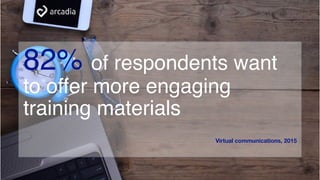
82% of respondents want
to offer more engaging
training materials
Virtual communications, 2015
88% of virtual trainers use
of quizzes, polls, and social
media
Virtual communications, 2015
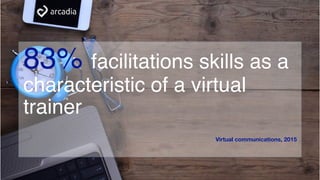
83% facilitations skills as a
characteristic of a virtual
trainer
Virtual communications, 2015
74% voice inflection as a
characteristic of a virtual
trainer
Virtual communications, 2015
69% technology expertise
as a characteristic of a virtual
trainer
Virtual communications, 2015
60% topic expertise as a
characteristic of a virtual
trainer
Virtual communications, 2015
50% funny as a
characteristic of a virtual
trainer
Virtual communications, 2015
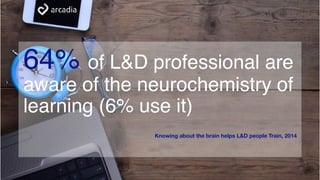
64% of L&D professional are
aware of the neurochemistry of
learning (6% use it)
Knowing about the brain helps L&D people Train, 2014
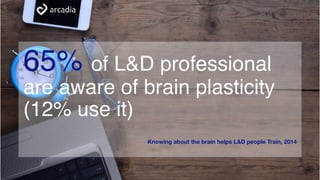
65% of L&D professional
are aware of brain plasticity
(12% use it)
Knowing about the brain helps L&D people Train, 2014
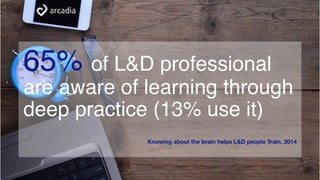
65% of L&D professional
are aware of learning through
deep practice (13% use it)
Knowing about the brain helps L&D people Train, 2014
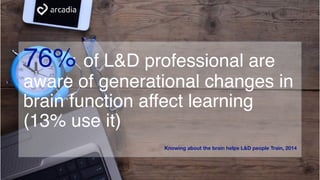
76% of L&D professional are
aware of generational changes in
brain function affect learning
(13% use it)
Knowing about the brain helps L&D people Train, 2014
78% of L&D professional are
aware of cognitive issues around
decision making (16% use it)
Knowing about the brain helps L&D people Train, 2014
71% of L&D professional are
aware of mentalising system
(16% use it)
Knowing about the brain helps L&D people Train, 2014
71% of L&D professional
are aware of unconscious
thought theory (18% use it)
Knowing about the brain helps L&D people Train, 2014
70% of L&D professional are
aware of learning states during
game-based learning (24% use it)
Knowing about the brain helps L&D people Train, 2014
81% of L&D professional are
aware of the correlation between
physical exercise and increased
learning performance (25% use it)
Knowing about the brain helps L&D people Train, 2014
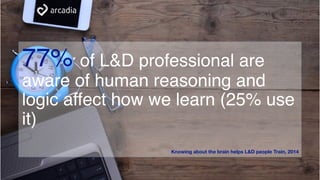
77% of L&D professional are
aware of human reasoning and
logic affect how we learn (25% use
it)
Knowing about the brain helps L&D people Train, 2014
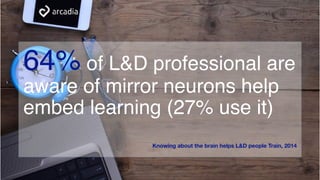
64% of L&D professional are
aware of mirror neurons help
embed learning (27% use it)
Knowing about the brain helps L&D people Train, 2014
SMART MACHINE ERA
DIGITAL MESH
device mesh
ambient user experience
3D printing materials
GARTNER symposium 2015
SMART MACHINE ERA
SMART MACHINE
information of everything
advanced machine learning
autonomous agent and things
GARTNER symposium 2015
SMART MACHINE ERA
MESH NEW IT REALITY
adaptive security architecture
ambient user experience
mesh App & Service Architecture
IoT Architecture and Platforms GARTNER symposium 2015
www.arcadia-consulting.it
info@arcadia-consulting.it

111 Statistics About Learning

  • 1.
  • 2.
    the 49%of pagesviews last less than four seconds Bull city learning, 2015
  • 3.
    the average ofthe words read by users on a web page is 28% Bull city learning, 2015
  • 4.
    48% of webpage views can jump up when content contains photos and video Bull city learning, 2015
  • 5.
    between 2000 and2013, from 12 seconds to 8 seconds is the dropped average transient attention span Bull city learning, 2015
  • 6.
    between 2000 and2013, the dropped average transient attention span, is 33% Bull city learning, 2015
  • 7.
    87% of teacherssaid modern technologies were creating an “easily distracted generation with short attention span” Bull city learning, 2015
  • 8.
    the average officeworker checks his e-mail 30-40 of times per hour Bull city learning, 2015
  • 9.
    the increase inthe number of people using devices simultaneously, over the past three years, is 500% Bull city learning, 2015
  • 10.
    21number of timesthe average person switches devices per hour Bull city learning, 2015
  • 11.
    90% of peopleusing multiple screens to accomplish a task over time, with smart phones Bull city learning, 2015
  • 12.
    32% of consumerwill start abandoning slow sites between one and five seconds Bull city learning, 2015
  • 13.
    11% fewer pageviews as possibly result if there is a one second delay in web page load time Bull city learning, 2015
  • 14.
    37% of theglobal workforce is expected to be “mobile” by the end of 2015 Bersin by Deloitte, 2015
  • 15.
    30% of full-timeemployees do most of their work somewhere other than the employee’s location Bersin by Deloitte, 2015
  • 16.
    20% of workforceis composed by temps, contractors and freelancers Bersin by Deloitte, 2015
  • 17.
    70% search engineaccess is what employees say that they need for their job Bersin by Deloitte, 2015
  • 18.
    50-60% online courses accessis what employees say that they need for their job Bersin by Deloitte, 2015
  • 19.
    80% of workforcelearning happens via on-the-job interactions with peers, teammates and managers Bersin by Deloitte, 2015
  • 20.
    55% of trainingcourses at Google are delivered by an ecosystem of 2,000+ peer learners Bersin by Deloitte, 2015
  • 21.
    2,5 to 5is the half-life (in years) of many professional skills Bersin by Deloitte, 2015
  • 22.
    38% of workerswho say they have opportunities for learning and growth at their workplace Bersin by Deloitte, 2015
  • 23.
    62% of ITprofessionals who report having paid for training out of their own pockets Bersin by Deloitte, 2015
  • 24.
    1% of atypical workweek is all that employees have to focus on training and development Bersin by Deloitte, 2015
  • 25.
    41% of timeworkers spend on things that offer little personal satisfaction and do not help them get work done Bersin by Deloitte, 2015
  • 26.
    up to 9times every hours, people unlock their smartphones Bersin by Deloitte, 2015
  • 27.
    2/3 of knowledgeworkers actually complain that they don’t have time to do their job Bersin by Deloitte, 2015
  • 28.
    as frequently as5 minutes ironically, often by work applications and collaboration tools, workers get interrupted Bersin by Deloitte, 2015
  • 29.
    4 minutes isthe time that most learners won’t watch videos Bersin by Deloitte, 2015
  • 30.
    48% of companiesidentify as a priority the research of new learning technologies Brandon Hall Group, 2016
  • 31.
    47% of companies recognizethe necessity to develop a learning strategy Brandon Hall Group, 2016
  • 32.
    42% of companiesrecognize the necessity of strengthening the link between training and performance Brandon Hall Group, 2016
  • 33.
    71 is themean rank higher on formal, informal and experiential learning environments, by users of technologies (not satisfied) Brandon Hall Group, 2016
  • 34.
    39% of thebudget on learning technologies is represented by LMS Brandon Hall Group, 2016
  • 35.
    31% of companiesestimate to increment the learning technology budget during the next 12-18 months Brandon Hall Group, 2016
  • 36.
    18% of companiesestimate to reduce the learning technology budget during the next 12-18 months Brandon Hall Group, 2016
  • 37.
    61% of peoplewould put in more time learning on their own if they got some kind of professional credit or reward for it Degree The Importance of Informal Learning, 2015
  • 38.
    only 38% ofL&D professionals think they’re ready to meet the needs of tomorrow’s learners ATD Learners of the Future, 2015
  • 39.
    3,3 hours aweek are spent by workers on learning on their own Degree How the Workforce Learns, 2016
  • 40.
    70% of studentsreport an increase in motivation to learn using mobile technology Fishtree, 2014
  • 41.
    63% of studentsuse their mobile phones to go online Fishtree, 2014
  • 42.
    91% of USadults own a cell phone Fishtree, 2014
  • 43.
    71% of toplearning organizations are adopting some form of mobile learning Fishtree, 2014
  • 44.
    80% of peoplewill be using mobile device to access the internet by 2015 Fishtree, 2014
  • 45.
    36% of non-usersplan to use MOOCs in the Future TD, 2014
  • 46.
    Benefits: 72% expand Learningopportunities through MOOCs TD, 2014
  • 47.
    Benefits: 59% provideE- Learning access through MOOCs TD, 2014
  • 48.
    Benefits: 53% expand LeadershipCurriculum through MOOCs TD, 2014
  • 49.
    college semester 1point below 270 measure of effectiveness made by each study participant and the amount of their efforts Duolingo, effectiveness study, 2012
  • 50.
    college semester 2point between 270-345 measure of effectiveness made by each study participant and the amount of their efforts Duolingo, effectiveness study, 2012
  • 51.
    college semester 3point between 346-328 measure of effectiveness made by each study participant and the amount of their efforts Duolingo, effectiveness study, 2012
  • 52.
    college semester 4point above 428 measure of effectiveness made by each study participant and the amount of their efforts Duolingo, effectiveness study, 2012
  • 53.
    69% of students graduatewith Traditional Learning Method eLearning Industry, 2014
  • 54.
    31% students don’t graduatewith Traditional Learning Method eLearning Industry, 2014
  • 55.
    7,200 students eachday drop out of school with Traditional Learning Method eLearning Industry, 2014
  • 56.
    1,3 million studentsa year drop out of school with Traditional Learning Method eLearning Industry, 2014
  • 57.
    + 50% offreshman failed English before the Flipped Classroom eLearning Industry, 2014
  • 58.
    44% of freshmanfailed math before the Flipped Classroom eLearning Industry, 2014
  • 59.
    19% of freshmanfailed English after the Flipped Classroom eLearning Industry, 2014
  • 60.
    13% of freshmanfailed math after the Flipped Classroom eLearning Industry, 2014
  • 61.
    lecture vs peerinstruction flip course proficiency averages – calculus lecture : 71,285< peer instruction flip: 80 Research and Innovation Network, 2014
  • 62.
    lecture vs peerinstruction flip course proficiency averages – pre-calculus lecture : 74,23< peer instruction flip: 84,923 Research and Innovation Network, 2014
  • 63.
    lecture vs peerinstruction flip course proficiency averages – algebra 2 lecture : 82,909< peer instruction flip: 95,091 Research and Innovation Network, 2014
  • 64.
    subjects most frequentlyflipped science: 46% math: 32% English Language Arts: 12% Classroomwindow, 2015
  • 65.
    88% of teachersimproved job satisfaction through the flipped classroom Classroomwindow, 2015
  • 66.
    46% of teachersimproved significantly Job satisfaction through the flipped classroom Classroomwindow, 2015
  • 67.
    43% of teachershave put 50% or more of their instruction online through the Flipped Classroom Classroomwindow, 2015
  • 68.
    28% of teachersreporting more than 75% online through the Flipped Classroom Classroomwindow, 2015
  • 69.
    67% report testscore of students’ improvement through the flipped classroom Classroomwindow, 2015
  • 70.
    80% report students attitudesimproving through the flipped classroom Classroomwindow, 2015
  • 71.
    91% of teachershave used the flipped model less than 2 years Classroomwindow, 2015
  • 72.
    95% of thesurvey’s respondents are secondary school teachers Classroomwindow, 2015
  • 73.
    $ 184 M(across 11 deals) in the first 4.5 months of 2016 is the worth PE/VC investments attracted by Education related companies PE/VC Investments in Education spike up, 2016
  • 74.
    $ 3,7 Mare raised by Tabor - App based Math Tutoring firm - Series A led by Syven Capital PE/VC Investments in Education spike up, 2016
  • 75.
    $ 70 Mattracted by Byjus in March 2016 led by Belgium-based Sofina marks the largest investment for a startup education company PE/VC Investments in Education spike up, 2016
  • 76.
    $ 26 Mare raised by text book publishing company S. Chandled by IFC in 2016, has become an active strategic investor PE/VC Investments in Education spike up, 2016
  • 77.
    91% HR andtraining professionals planned to increase virtual training use in 2013 Virtual communications, 2015
  • 78.
    33% HR andtraining professionals plan to increase virtual training use by more than 25% Virtual communications, 2015
  • 79.
    74% HR andtraining professionals considering virtual learning environments in next 6-12 months Virtual communications, 2015
  • 80.
    72% HR andtraining professionals considering training webinars Virtual communications, 2015
  • 81.
    64% customer/product training isthe best virtual environment application Virtual communications, 2015
  • 82.
    62% new hireon-boardings is the best virtual environment application Virtual communications, 2015
  • 83.
    57% administrative topics isthe best virtual environment application Virtual communications, 2015
  • 84.
    48% sales trainingis the best virtual environment application Virtual communications, 2015
  • 85.
    41% IT trainingis the best virtual environment application Virtual communications, 2015
  • 86.
    83% convenience asone of primary benefits of virtual training Virtual communications, 2015
  • 87.
    83% travel timeas one of primary benefits of virtual training Virtual communications, 2015
  • 88.
    79% cost asone of primary benefits of virtual training Virtual communications, 2015
  • 89.
    52% expert involvementas one of primary benefits of virtual training Virtual communications, 2015
  • 90.
    43% participation asone of primary benefits of virtual training Virtual communications, 2015
  • 91.
    38% consistency asone of primary benefits of virtual training Virtual communications, 2015
  • 92.
    82% of respondentswant to offer more engaging training materials Virtual communications, 2015
  • 93.
    88% of virtualtrainers use of quizzes, polls, and social media Virtual communications, 2015
  • 94.
    83% facilitations skillsas a characteristic of a virtual trainer Virtual communications, 2015
  • 95.
    74% voice inflectionas a characteristic of a virtual trainer Virtual communications, 2015
  • 96.
    69% technology expertise asa characteristic of a virtual trainer Virtual communications, 2015
  • 97.
    60% topic expertiseas a characteristic of a virtual trainer Virtual communications, 2015
  • 98.
    50% funny asa characteristic of a virtual trainer Virtual communications, 2015
  • 99.
    64% of L&Dprofessional are aware of the neurochemistry of learning (6% use it) Knowing about the brain helps L&D people Train, 2014
  • 100.
    65% of L&Dprofessional are aware of brain plasticity (12% use it) Knowing about the brain helps L&D people Train, 2014
  • 101.
    65% of L&Dprofessional are aware of learning through deep practice (13% use it) Knowing about the brain helps L&D people Train, 2014
  • 102.
    76% of L&Dprofessional are aware of generational changes in brain function affect learning (13% use it) Knowing about the brain helps L&D people Train, 2014
  • 103.
    78% of L&Dprofessional are aware of cognitive issues around decision making (16% use it) Knowing about the brain helps L&D people Train, 2014
  • 104.
    71% of L&Dprofessional are aware of mentalising system (16% use it) Knowing about the brain helps L&D people Train, 2014
  • 105.
    71% of L&Dprofessional are aware of unconscious thought theory (18% use it) Knowing about the brain helps L&D people Train, 2014
  • 106.
    70% of L&Dprofessional are aware of learning states during game-based learning (24% use it) Knowing about the brain helps L&D people Train, 2014
  • 107.
    81% of L&Dprofessional are aware of the correlation between physical exercise and increased learning performance (25% use it) Knowing about the brain helps L&D people Train, 2014
  • 108.
    77% of L&Dprofessional are aware of human reasoning and logic affect how we learn (25% use it) Knowing about the brain helps L&D people Train, 2014
  • 109.
    64% of L&Dprofessional are aware of mirror neurons help embed learning (27% use it) Knowing about the brain helps L&D people Train, 2014
  • 110.
    SMART MACHINE ERA DIGITALMESH device mesh ambient user experience 3D printing materials GARTNER symposium 2015
  • 111.
    SMART MACHINE ERA SMARTMACHINE information of everything advanced machine learning autonomous agent and things GARTNER symposium 2015
  • 112.
    SMART MACHINE ERA MESHNEW IT REALITY adaptive security architecture ambient user experience mesh App & Service Architecture IoT Architecture and Platforms GARTNER symposium 2015
  • 113.