Updating the IT skills gap
John O’Sullivan April 28, 2016
Igor Bercu Chisinau, Moldova
Moldova ICT Summit 2016
Disclaimer
The author’s views expressed in this publication do not necessary reflect the views of the United States Agency for International Development or the United
States Government.
What’s it all about ?
• A fresh view of the (alleged) IT skills gap
• Updating earlier studies
• Baseline for further projects by USAID and others
• Methodology: Research + Interviews + Surveys
• 197 companies
• 211 students
• 78 graduates
Economic and political dramas
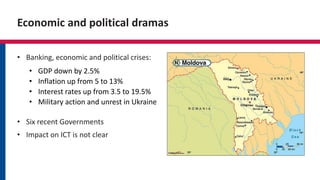
• Banking, economic and political crises:
• GDP down by 2.5%
• Inflation up from 5 to 13%
• Interest rates up from 3.5 to 19.5%
• Military action and unrest in Ukraine
• Six recent Governments
• Impact on ICT is not clear
ICT sector in Moldova
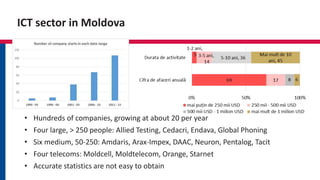
• Hundreds of companies, growing at about 20 per year
• Four large, > 250 people: Allied Testing, Cedacri, Endava, Global Phoning
• Six medium, 50-250: Amdaris, Arax-Impex, DAAC, Neuron, Pentalog, Tacit
• Four telecoms: Moldcell, Moldtelecom, Orange, Starnet
• Accurate statistics are not easy to obtain
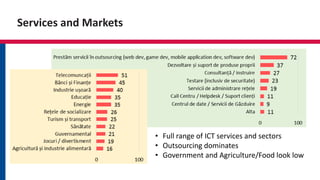
Services and Markets
• Full range of ICT services and sectors
• Outsourcing dominates
• Government and Agriculture/Food look low
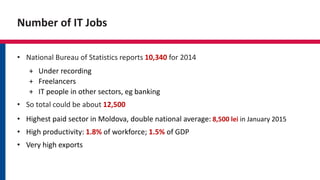
Number of IT Jobs
• National Bureau of Statistics reports 10,340 for 2014
+ Under recording
+ Freelancers
+ IT people in other sectors, eg banking
• So total could be about 12,500
• Highest paid sector in Moldova, double national average: 8,500 lei in January 2015
• High productivity: 1.8% of workforce; 1.5% of GDP
• Very high exports
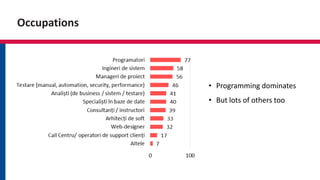
Occupations
• Programming dominates
• But lots of others too
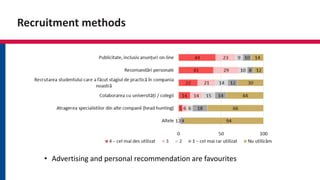
Recruitment methods
• Advertising and personal recommendation are favourites
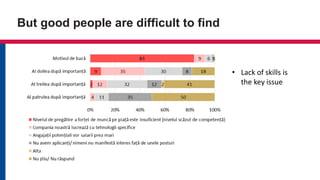
But good people are difficult to find
• Lack of skills is
the key issue
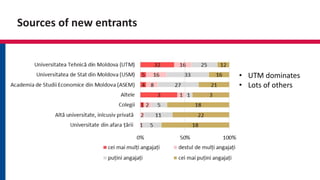
Sources of new entrants
• UTM dominates
• Lots of others
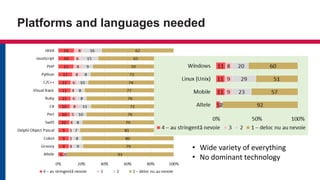
Platforms and languages needed
• Wide variety of everything
• No dominant technology
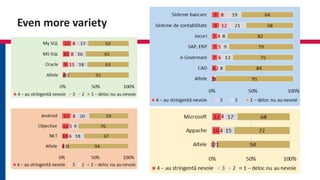
Even more variety
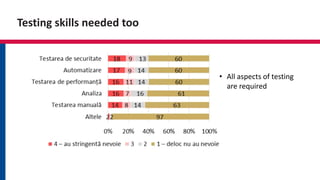
Testing skills needed too
• All aspects of testing
are required
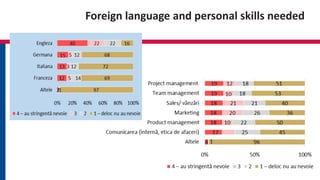
Foreign language and personal skills needed
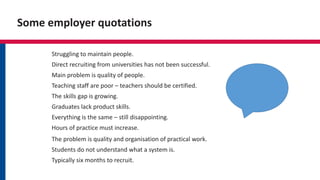
Some employer quotations
Struggling to maintain people.
Direct recruiting from universities has not been successful.
Main problem is quality of people.
Teaching staff are poor – teachers should be certified.
The skills gap is growing.
Graduates lack product skills.
Everything is the same – still disappointing.
Hours of practice must increase.
The problem is quality and organisation of practical work.
Students do not understand what a system is.
Typically six months to recruit.
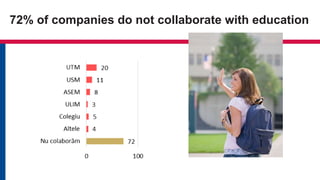
72% of companies do not collaborate with education
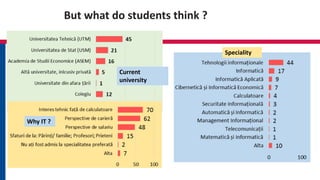
But what do students think ?
Current
university
Speciality
Why IT ?
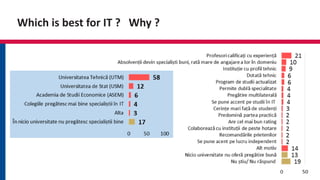
Which is best for IT ? Why ?
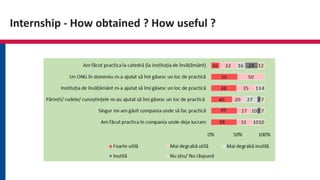
Internship - How obtained ? How useful ?
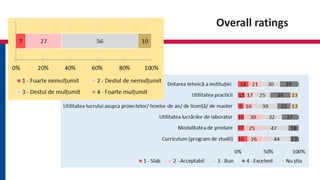
Overall ratings
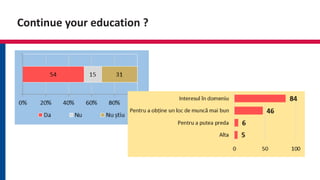
Continue your education ?
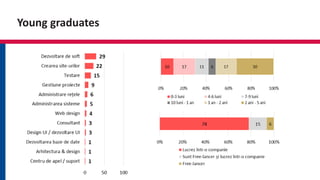
Young graduates
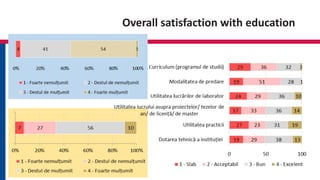
Overall satisfaction with education
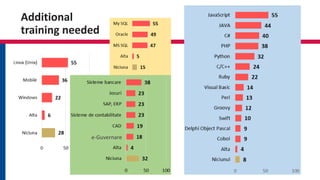
Additional
training needed
e-Guvernare
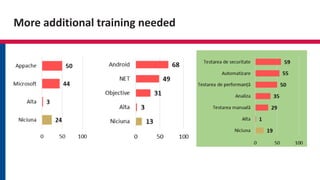
More additional training needed
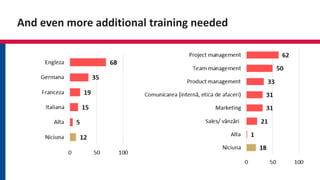
And even more additional training needed
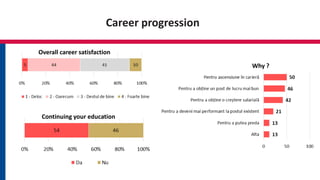
Career progression
Continuing your education
Overall career satisfaction
Why ?
So, is there still a skills gap ?
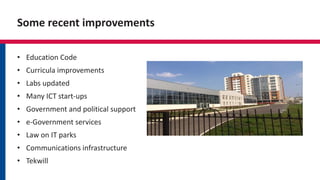
Some recent improvements
• Education Code
• Curricula improvements
• Labs updated
• Many ICT start-ups
• Government and political support
• e-Government services
• Law on IT parks
• Communications infrastructure
• Tekwill
But there is still a gap
• Industry is still complaining
• So are the universities
• It’s quality, not quantity
• Improve industry - university engagement
• Further improvements to curricula
Industry - University engagement
• Participation on governing and management bodies
• Advice on curricula
• Provision of case studies, projects
• Guest and visiting lecturers
• Internships – for lecturers
• External examiners
• Provision of equipment, software, and educational materials
• Help with teacher training
Curricula improvements
• More practical work, less theoretical
• OO programming, Java, C# and C++
• Linux, Mobile, Database, Applications
• Personal skills
• Foreign languages, especially English
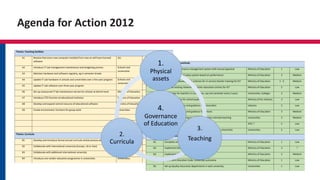
Agenda for Action 2012
Theme: Teaching facilities
A1 Resolve that every new computer installed from now on will have licensed
software
ALL 0 Medium
A2 Introduce IT Lab management maintenance and budgeting process Schools and
universities
1 Low
A3 Maintain hardware and software regularly, eg in semester breaks 1 Low
A4 Update IT Lab hardware in schools and universities over a five year program Schools and
universities
2 - 5 High
A5 Update IT Lab software over three year program 2 - 3 High
A6 Set up outsourced IT lab maintenance service for schools at district level Ministry of Education 2 Medium
A7 Introduce CTO function at educational institutes Ministry of Education 2 Medium
A8 Develop and expand central resource of educational software Ministry of Education 3 High
A9 Create environment, furniture for group work Universities 2 Low
Theme: Curricula
B1 Develop and introduce formal annual curricula review process with industry Universities and ATIC 1 Low
B2 Collaborate with international university (Europe, US or Asia) Universities 2 Low
B3 Collaborate with additional international university Universities 3 Low
B4 Introduce one vendor education programme in universities Universities 1 Medium
Theme: Teachers and teaching methods
C1 Introduce performance management system with annual appraisal Ministry of Education 1 Low
C2 Establish improved salary system based on performance Ministry of Education 2 Medium
C3 Expand staff development schemes for in-service teacher training for ICT Ministry of Education 1 - 2 Medium
C4 Upgrade existing network of teacher education centres for ICT Ministry of Education 2 Low
C5 Internships for teachers in companies, say one semester every 5 years Universities, Colleges 2 Medium
C6 Visits to industry for school pupils Ministry of Ed, Industry 3 Low
C7 Careers information and guidance for universities Industry 2 Low
C8 Careers information and guidance for schools Ministry of Education 3 Medium
C9 Provide further training to teachers on action oriented teaching Universities 3 Medium
C10 Establish ICT teacher association ATIC ? 2 Low
C11 Academic exchanges, two way, twinning with foreign universities Universities 2 Low
Theme: Governance of Education
D1 Complete and adopt new Education Code Ministry of Education 1 Low
D2 Implement Education Code: Doctoral schools Ministry of Education 3 ?
D3 Implement Education Code: VET Ministry of Education 2 Medium
D4 Implement Education Code: University autonomy Ministry of Education 1 Low
D5 Set up Quality Assurance departments in each university Universities 1 Low
4.
Governance
of Education
1.
Physical
assets
3.
Teaching
2.
Curricula
Conclusion
• Good progress
• Still lots to do
• Keep up the good work
• Good luck

Updating The IT skills gap

  • 1.
    Updating the ITskills gap John O’Sullivan April 28, 2016 Igor Bercu Chisinau, Moldova Moldova ICT Summit 2016 Disclaimer The author’s views expressed in this publication do not necessary reflect the views of the United States Agency for International Development or the United States Government.
  • 2.
    What’s it allabout ? • A fresh view of the (alleged) IT skills gap • Updating earlier studies • Baseline for further projects by USAID and others • Methodology: Research + Interviews + Surveys • 197 companies • 211 students • 78 graduates
  • 3.
    Economic and politicaldramas • Banking, economic and political crises: • GDP down by 2.5% • Inflation up from 5 to 13% • Interest rates up from 3.5 to 19.5% • Military action and unrest in Ukraine • Six recent Governments • Impact on ICT is not clear
  • 4.
    ICT sector inMoldova • Hundreds of companies, growing at about 20 per year • Four large, > 250 people: Allied Testing, Cedacri, Endava, Global Phoning • Six medium, 50-250: Amdaris, Arax-Impex, DAAC, Neuron, Pentalog, Tacit • Four telecoms: Moldcell, Moldtelecom, Orange, Starnet • Accurate statistics are not easy to obtain
  • 5.
    Services and Markets •Full range of ICT services and sectors • Outsourcing dominates • Government and Agriculture/Food look low
  • 6.
    Number of ITJobs • National Bureau of Statistics reports 10,340 for 2014 + Under recording + Freelancers + IT people in other sectors, eg banking • So total could be about 12,500 • Highest paid sector in Moldova, double national average: 8,500 lei in January 2015 • High productivity: 1.8% of workforce; 1.5% of GDP • Very high exports
  • 7.
  • 8.
    Recruitment methods • Advertisingand personal recommendation are favourites
  • 9.
    But good peopleare difficult to find • Lack of skills is the key issue
  • 10.
    Sources of newentrants • UTM dominates • Lots of others
  • 11.
    Platforms and languagesneeded • Wide variety of everything • No dominant technology
  • 12.
  • 13.
    Testing skills neededtoo • All aspects of testing are required
  • 14.
    Foreign language andpersonal skills needed
  • 15.
    Some employer quotations Strugglingto maintain people. Direct recruiting from universities has not been successful. Main problem is quality of people. Teaching staff are poor – teachers should be certified. The skills gap is growing. Graduates lack product skills. Everything is the same – still disappointing. Hours of practice must increase. The problem is quality and organisation of practical work. Students do not understand what a system is. Typically six months to recruit.
  • 16.
    72% of companiesdo not collaborate with education
  • 17.
    But what dostudents think ? Current university Speciality Why IT ?
  • 18.
    Which is bestfor IT ? Why ?
  • 19.
    Internship - Howobtained ? How useful ?
  • 20.
  • 21.
  • 22.
  • 23.
  • 24.
  • 25.
  • 26.
    And even moreadditional training needed
  • 27.
    Career progression Continuing youreducation Overall career satisfaction Why ?
  • 28.
    So, is therestill a skills gap ?
  • 29.
    Some recent improvements •Education Code • Curricula improvements • Labs updated • Many ICT start-ups • Government and political support • e-Government services • Law on IT parks • Communications infrastructure • Tekwill
  • 30.
    But there isstill a gap • Industry is still complaining • So are the universities • It’s quality, not quantity • Improve industry - university engagement • Further improvements to curricula
  • 31.
    Industry - Universityengagement • Participation on governing and management bodies • Advice on curricula • Provision of case studies, projects • Guest and visiting lecturers • Internships – for lecturers • External examiners • Provision of equipment, software, and educational materials • Help with teacher training
  • 32.
    Curricula improvements • Morepractical work, less theoretical • OO programming, Java, C# and C++ • Linux, Mobile, Database, Applications • Personal skills • Foreign languages, especially English
  • 33.
    Agenda for Action2012 Theme: Teaching facilities A1 Resolve that every new computer installed from now on will have licensed software ALL 0 Medium A2 Introduce IT Lab management maintenance and budgeting process Schools and universities 1 Low A3 Maintain hardware and software regularly, eg in semester breaks 1 Low A4 Update IT Lab hardware in schools and universities over a five year program Schools and universities 2 - 5 High A5 Update IT Lab software over three year program 2 - 3 High A6 Set up outsourced IT lab maintenance service for schools at district level Ministry of Education 2 Medium A7 Introduce CTO function at educational institutes Ministry of Education 2 Medium A8 Develop and expand central resource of educational software Ministry of Education 3 High A9 Create environment, furniture for group work Universities 2 Low Theme: Curricula B1 Develop and introduce formal annual curricula review process with industry Universities and ATIC 1 Low B2 Collaborate with international university (Europe, US or Asia) Universities 2 Low B3 Collaborate with additional international university Universities 3 Low B4 Introduce one vendor education programme in universities Universities 1 Medium Theme: Teachers and teaching methods C1 Introduce performance management system with annual appraisal Ministry of Education 1 Low C2 Establish improved salary system based on performance Ministry of Education 2 Medium C3 Expand staff development schemes for in-service teacher training for ICT Ministry of Education 1 - 2 Medium C4 Upgrade existing network of teacher education centres for ICT Ministry of Education 2 Low C5 Internships for teachers in companies, say one semester every 5 years Universities, Colleges 2 Medium C6 Visits to industry for school pupils Ministry of Ed, Industry 3 Low C7 Careers information and guidance for universities Industry 2 Low C8 Careers information and guidance for schools Ministry of Education 3 Medium C9 Provide further training to teachers on action oriented teaching Universities 3 Medium C10 Establish ICT teacher association ATIC ? 2 Low C11 Academic exchanges, two way, twinning with foreign universities Universities 2 Low Theme: Governance of Education D1 Complete and adopt new Education Code Ministry of Education 1 Low D2 Implement Education Code: Doctoral schools Ministry of Education 3 ? D3 Implement Education Code: VET Ministry of Education 2 Medium D4 Implement Education Code: University autonomy Ministry of Education 1 Low D5 Set up Quality Assurance departments in each university Universities 1 Low 4. Governance of Education 1. Physical assets 3. Teaching 2. Curricula
  • 34.
    Conclusion • Good progress •Still lots to do • Keep up the good work • Good luck