This document presents an entropy-based adaptive genetic algorithm approach for learning classification rules from data. The key aspects are:
1. Binary encoding is used to represent classification rules, with the consequent determined by the majority of examples a rule matches.
2. The fitness function considers error rate, entropy, rule consistency, and hole ratio to evaluate individuals. Entropy measures the homogeneity of examples matched by rules.
3. An adaptive asymmetric mutation operator is applied, with the mutation inversion probability self-adapting during the algorithm run.
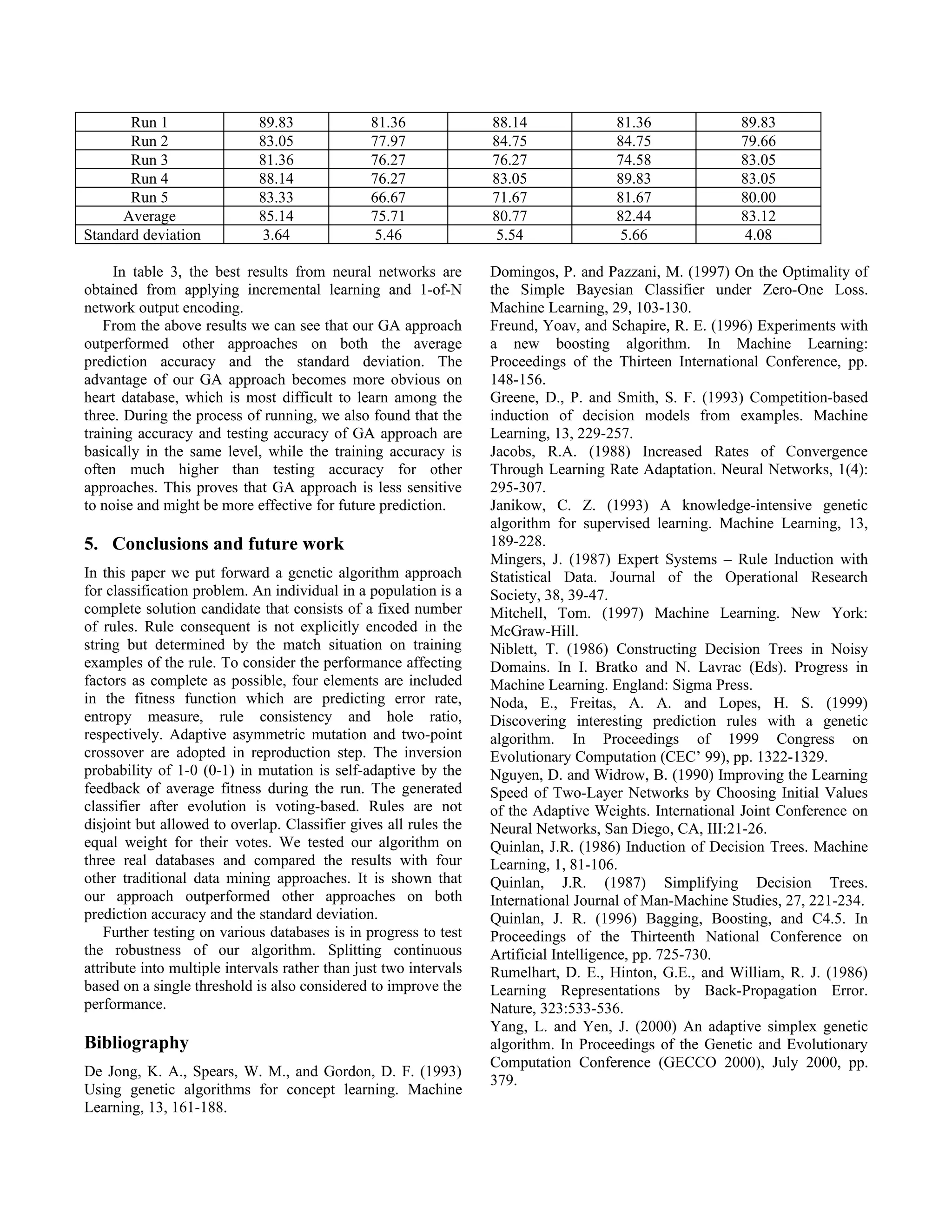
4. The approach is tested on credit, voting, and heart disease databases, outperforming decision trees, neural networks, and naive Bayes methods.


![following is a description of the non-GA approaches we instance class is selected from the maximum weighted
used for the performance comparison studies. average of the predicted class over all decision trees.
1) Induction Decision Trees 3) Neural Networks
The construction of a decision tree is divided into two Inspired in part by biological learning systems, neural
stages. First, creating an initial, large decision tree using a networks approach is built from a densely interconnected set
set of training set. Second, pruning the initial decision tree, of simple units. Since this technique offers many design
if applicable, using a validation set. Given a noise-free selections, we fixed some of them to the ones that had been
training set, the first stage will generate a decision tree that well proven to be good or acceptable design choices. In
can classify correctly all examples in the set. Except that the particular, we use a network architecture with one hidden
training set covers all instances in the domain, the initial layer, the back-propagation learning algorithm (Rumelhart,
decision tree generated will over fit the training data, which Hinton & William, 1986), the delta-bar-delta adaptive
then reduce its performance in the test data. The second learning rates (Jacobs, 1988), and the Nguyen-Widrow
stage helps alleviate this problem by reducing the size of the weight initialization (Nguyen & Widrow, 1990). Discrete-
tree. This process has an effect in generalizing the decision valued attributes fed into the networks input layer is
tree that hopefully could improve its performance in the test represented as 1-of-N encoding using bipolar values to
data. denote the presence (e.g., value 1) and the absence (e.g.,
During the construction of an initial decision tree, the value –1) of an attribute value. Continuous-valued attribute
selection of the best attribute is based on either the is scaled into a real value in the range [–1, 1]. We varied the
information gain (IG) or gain ratio (GR). A binary split is design choices for batch versus incremental learning, and 1-
applied in nodes with continuous-valued attributes. The best of-N versus single network output encoding.
cut-off value of a continuous-valued attribute is locally 4) Naive Bayes
selected within each node in the tree based on the remaining Naive Bayes classifier is a variant of the Bayesian learning
training examples. The tree’s node expansion stops either that manipulates directly probabilities from observed data
when the remaining training set is homogeneous (e.g., all and uses these probabilities to make an optimal decision.
instances have the same target attribute values) or when no This approach assumes that attributes are conditionally
attribute remains for selection. The decision on a leaf independent given a class. Based on this simplifying
resulting from the latter case is determined by selecting the assumption, the probability of observing attributes’
majority of the target attribute value in the remaining conjunction is the product of the probabilities for the
training set. individual attributes. Given an instance with a set of
Decision tree pruning is a process of replacing sub-trees attribute-value pairs, the Naive Bayes approach will choose
with leaves to reduce the size of the decision tree while a class that maximizes the conditional probability of the
retaining and hopefully increasing the accuracy of tree's class given the conjunction of attributes values. Although in
classification. To obtain the best result from the induction practice the independence assumption is not entirely correct,
decision tree method, we varied the use of pruning it does not necessarily degrade the system performance
algorithm to the initial decision tree. We considered using (Domingos & Pazzani, 1997).
the following decision trees pruning algorithms: critical- We also assume that the values of continuous-valued
value pruning (Mingers, 1987), minimum-error pruning attributes follow Gaussian distribution. Hence, once the
(Niblett & Bratko, 1986), pessimistic pruning, cost- mean and the standard deviation of these attributes are
complexity pruning and reduced-error pruning (Quinlan, obtained from the training examples, the probability of the
1987),. corresponding attributes can be calculated from the given
2) Induction Decision Trees with Boosting attribute values. To avoid zero frequency count problem that
Decision Tree with Boosting is a method that generates a can dampen the entire probabilities calculation, we use an
sequence of decision trees from a single training set by re- m-estimate approach in calculating probabilities of discrete-
weighting and re-sampling the samples in the set (Quinlan, valued attributes (Mitchell, 1997).
1996; Freund & Schapire, 1996). Initially, all samples in the
4.3 Comparison results
training set are equally weighted so that their sum is one.
For each database, k-fold cross-validation method is used
Once a decision tree has been created, the samples in the
for evaluation. In this method, a data set is divided equally
training set are re-weighted in such a way that misclassified
into k disjoint subsets. k experiments are then performed
examples will get higher weights than the ones that are
using k different training-test set pairs. A training-test set
easier to classify. The new samples weights are then
pair used in each experiment is generated by using one of
renormalized, and next decision tree is created using higher-
the k subsets as the test set, and using the remaining subsets
weighted samples in the training set. In effect, this process
as the training set. Given k disjoint subsets, for example, the
enforces the more difficult samples to be learned more
first experiment takes the first subset for the test set, and
frequently by decision trees. The trees generated are then
uses the second subset through the kth subset for the training
given weights in accordance with their performance in the
set. The second experiment uses subset 1 and subset 3
training examples (e.g., their accuracy in correctly
through subset k for the training set; and takes subset 2 for
classifying the training data). Given a new instance, the new](https://image.slidesharecdn.com/cec01docdoc3328/75/cec01-doc-doc-5-2048.jpg)