
Addressing in an
              Enterprise Network


              Introducing Routing and Switching in the Enterprise –
              Chapter 4


Version 4.0       © 2006 Cisco Systems, Inc. All rights reserved.   Cisco Public   1
Objectives
ď‚§   Analyze the features and benefits of a hierarchical IP
    addressing structure.
ď‚§   Plan and implement a VLSM IP addressing scheme.
ď‚§   Plan a network using classless routing and CIDR.
ď‚§   Configure and verify both static and dynamic NAT.


    © 2006 Cisco Systems, Inc. All rights reserved.   Cisco Public   2
Features & Benefits of a Hierarchical IP
   Addressing Structure
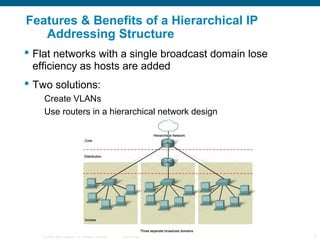
ď‚§ Flat networks with a single broadcast domain lose
  efficiency as hosts are added
ď‚§ Two solutions:
    Create VLANs
    Use routers in a hierarchical network design


    © 2006 Cisco Systems, Inc. All rights reserved.   Cisco Public   3
Features & Benefits of a Hierarchical IP
   Addressing Structure
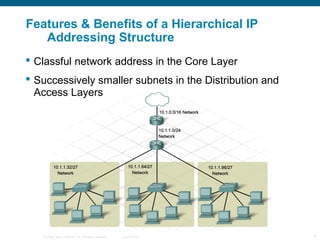
ď‚§ Classful network address in the Core Layer
ď‚§ Successively smaller subnets in the Distribution and
  Access Layers


   © 2006 Cisco Systems, Inc. All rights reserved.   Cisco Public   4
Features & Benefits of a Hierarchical IP
   Addressing Structure
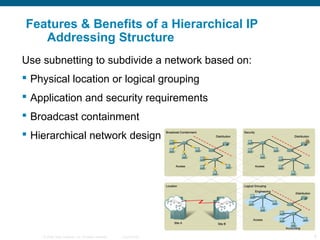
Use subnetting to subdivide a network based on:
ď‚§ Physical location or logical grouping
ď‚§ Application and security requirements
ď‚§ Broadcast containment
ď‚§ Hierarchical network design


    © 2006 Cisco Systems, Inc. All rights reserved.   Cisco Public   5
Plan / Implement a VLSM Addressing Scheme
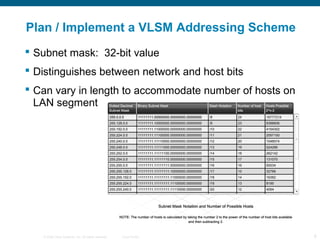
ď‚§ Subnet mask: 32-bit value
ď‚§ Distinguishes between network and host bits
ď‚§ Can vary in length to accommodate number of hosts on
  LAN segment


   © 2006 Cisco Systems, Inc. All rights reserved.   Cisco Public   6
Plan / Implement a VLSM Addressing Scheme
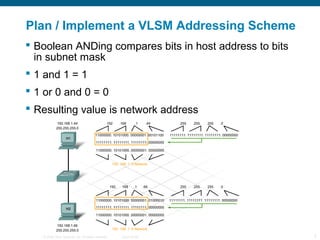
ď‚§ Boolean ANDing compares bits in host address to bits
  in subnet mask
ď‚§ 1 and 1 = 1
ď‚§ 1 or 0 and 0 = 0
ď‚§ Resulting value is network address


   © 2006 Cisco Systems, Inc. All rights reserved.   Cisco Public   7
Plan / Implement a VLSM Addressing Scheme

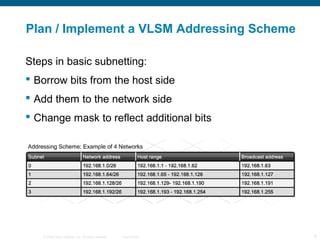
Steps in basic subnetting:
ď‚§ Borrow bits from the host side
ď‚§ Add them to the network side
ď‚§ Change mask to reflect additional bits


   © 2006 Cisco Systems, Inc. All rights reserved.   Cisco Public   8
Plan / Implement a VLSM Addressing Scheme

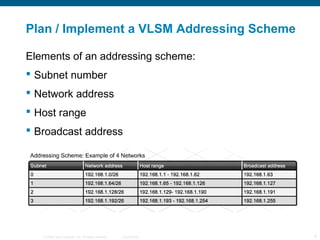
Elements of an addressing scheme:
ď‚§ Subnet number
ď‚§ Network address
ď‚§ Host range
ď‚§ Broadcast address


   © 2006 Cisco Systems, Inc. All rights reserved.   Cisco Public   9
Plan / Implement a VLSM Addressing Scheme
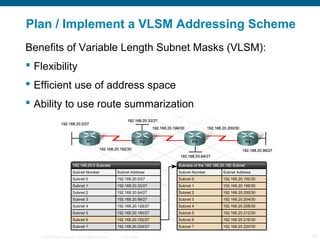
Benefits of Variable Length Subnet Masks (VLSM):
ď‚§ Flexibility
ď‚§ Efficient use of address space
ď‚§ Ability to use route summarization


    © 2006 Cisco Systems, Inc. All rights reserved.   Cisco Public   10
Plan / Implement a VLSM Addressing Scheme
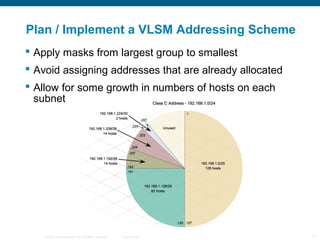
ď‚§ Apply masks from largest group to smallest
ď‚§ Avoid assigning addresses that are already allocated
ď‚§ Allow for some growth in numbers of hosts on each
  subnet


   © 2006 Cisco Systems, Inc. All rights reserved.   Cisco Public   11
Plan a Network Using Classless Routing
   and CIDR
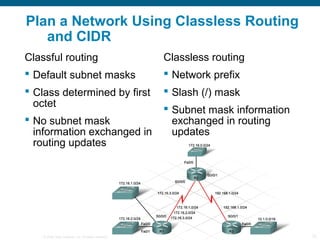
Classful routing                                                     Classless routing
ď‚§ Default subnet masks                                               ď‚§ Network prefix
ď‚§ Class determined by first                                          ď‚§ Slash (/) mask
  octet
                                                                     ď‚§ Subnet mask information
ď‚§ No subnet mask                                                       exchanged in routing
  information exchanged in                                             updates
  routing updates


    © 2006 Cisco Systems, Inc. All rights reserved.   Cisco Public                               12
Plan a Network Using Classless Routing
   and CIDR
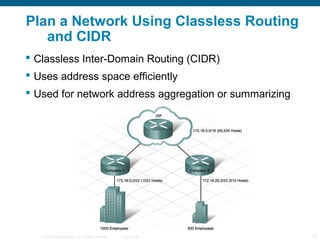
ď‚§ Classless Inter-Domain Routing (CIDR)
ď‚§ Uses address space efficiently
ď‚§ Used for network address aggregation or summarizing


   © 2006 Cisco Systems, Inc. All rights reserved.   Cisco Public   13
Plan a Network Using Classless Routing
    and CIDR
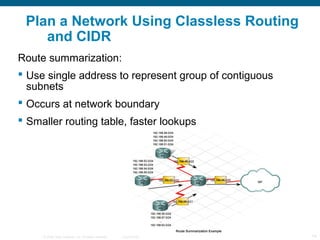
Route summarization:
ď‚§ Use single address to represent group of contiguous
  subnets
ď‚§ Occurs at network boundary
ď‚§ Smaller routing table, faster lookups


     © 2006 Cisco Systems, Inc. All rights reserved.   Cisco Public   14
Plan a Network Using Classless Routing
   and CIDR
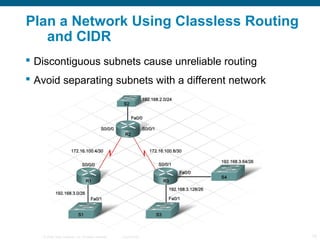
ď‚§ Discontiguous subnets cause unreliable routing
ď‚§ Avoid separating subnets with a different network


   © 2006 Cisco Systems, Inc. All rights reserved.   Cisco Public   15
Plan a Network Using Classless Routing
   and CIDR
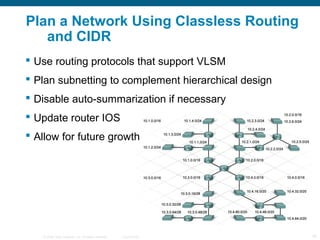
ď‚§ Use routing protocols that support VLSM
ď‚§ Plan subnetting to complement hierarchical design
ď‚§ Disable auto-summarization if necessary
ď‚§ Update router IOS
ď‚§ Allow for future growth


   © 2006 Cisco Systems, Inc. All rights reserved.   Cisco Public   16
Configure and Verify Static and Dynamic
  NAT
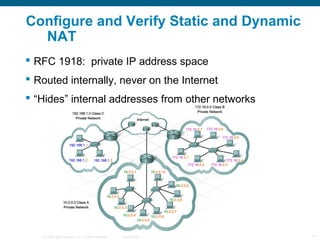
ď‚§ RFC 1918: private IP address space
ď‚§ Routed internally, never on the Internet
 “Hides” internal addresses from other networks


   © 2006 Cisco Systems, Inc. All rights reserved.   Cisco Public   17
Configure and Verify Static and Dynamic
  NAT
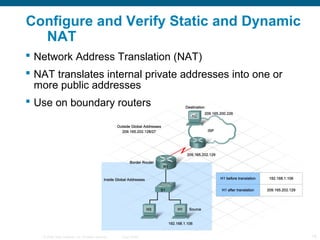
ď‚§ Network Address Translation (NAT)
ď‚§ NAT translates internal private addresses into one or
  more public addresses
ď‚§ Use on boundary routers


   © 2006 Cisco Systems, Inc. All rights reserved.   Cisco Public   18
Configure and Verify Static and Dynamic
  NAT
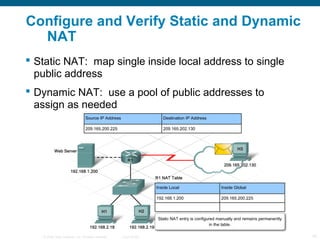
ď‚§ Static NAT: map single inside local address to single
  public address
ď‚§ Dynamic NAT: use a pool of public addresses to
  assign as needed


   © 2006 Cisco Systems, Inc. All rights reserved.   Cisco Public   19
Configure and Verify Static and Dynamic
  NAT
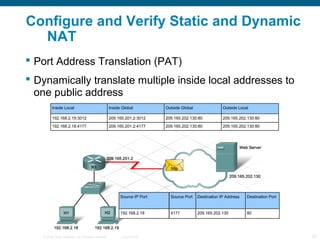
ď‚§ Port Address Translation (PAT)
ď‚§ Dynamically translate multiple inside local addresses to
  one public address


   © 2006 Cisco Systems, Inc. All rights reserved.   Cisco Public   20
Summary
ď‚§ Hierarchical network design groups users into subnets
ď‚§ VLSM enables different masks for each subnet
ď‚§ VLSM requires classless routing protocols
ď‚§ CIDR network addresses are determined by prefix
  length
ď‚§ Route summarization, route aggregation, or
  supernetting, is done on a boundary router
ď‚§ NAT translates private addresses into public addresses
  that route over the Internet
ď‚§ PAT translates multiple local addresses into a single
  public address

    © 2006 Cisco Systems, Inc. All rights reserved.   Cisco Public   21
© 2006 Cisco Systems, Inc. All rights reserved.   Cisco Public   22

CCNA Discovery 3 - Chapter 4

  • 1.
    Addressing in an Enterprise Network Introducing Routing and Switching in the Enterprise – Chapter 4 Version 4.0 © 2006 Cisco Systems, Inc. All rights reserved. Cisco Public 1
  • 2.
    Objectives  Analyze the features and benefits of a hierarchical IP addressing structure.  Plan and implement a VLSM IP addressing scheme.  Plan a network using classless routing and CIDR.  Configure and verify both static and dynamic NAT. © 2006 Cisco Systems, Inc. All rights reserved. Cisco Public 2
  • 3.
    Features & Benefitsof a Hierarchical IP Addressing Structure  Flat networks with a single broadcast domain lose efficiency as hosts are added  Two solutions: Create VLANs Use routers in a hierarchical network design © 2006 Cisco Systems, Inc. All rights reserved. Cisco Public 3
  • 4.
    Features & Benefitsof a Hierarchical IP Addressing Structure  Classful network address in the Core Layer  Successively smaller subnets in the Distribution and Access Layers © 2006 Cisco Systems, Inc. All rights reserved. Cisco Public 4
  • 5.
    Features & Benefitsof a Hierarchical IP Addressing Structure Use subnetting to subdivide a network based on:  Physical location or logical grouping  Application and security requirements  Broadcast containment  Hierarchical network design © 2006 Cisco Systems, Inc. All rights reserved. Cisco Public 5
  • 6.
    Plan / Implementa VLSM Addressing Scheme  Subnet mask: 32-bit value  Distinguishes between network and host bits  Can vary in length to accommodate number of hosts on LAN segment © 2006 Cisco Systems, Inc. All rights reserved. Cisco Public 6
  • 7.
    Plan / Implementa VLSM Addressing Scheme  Boolean ANDing compares bits in host address to bits in subnet mask  1 and 1 = 1  1 or 0 and 0 = 0  Resulting value is network address © 2006 Cisco Systems, Inc. All rights reserved. Cisco Public 7
  • 8.
    Plan / Implementa VLSM Addressing Scheme Steps in basic subnetting:  Borrow bits from the host side  Add them to the network side  Change mask to reflect additional bits © 2006 Cisco Systems, Inc. All rights reserved. Cisco Public 8
  • 9.
    Plan / Implementa VLSM Addressing Scheme Elements of an addressing scheme:  Subnet number  Network address  Host range  Broadcast address © 2006 Cisco Systems, Inc. All rights reserved. Cisco Public 9
  • 10.
    Plan / Implementa VLSM Addressing Scheme Benefits of Variable Length Subnet Masks (VLSM):  Flexibility  Efficient use of address space  Ability to use route summarization © 2006 Cisco Systems, Inc. All rights reserved. Cisco Public 10
  • 11.
    Plan / Implementa VLSM Addressing Scheme  Apply masks from largest group to smallest  Avoid assigning addresses that are already allocated  Allow for some growth in numbers of hosts on each subnet © 2006 Cisco Systems, Inc. All rights reserved. Cisco Public 11
  • 12.
    Plan a NetworkUsing Classless Routing and CIDR Classful routing Classless routing  Default subnet masks  Network prefix  Class determined by first  Slash (/) mask octet  Subnet mask information  No subnet mask exchanged in routing information exchanged in updates routing updates © 2006 Cisco Systems, Inc. All rights reserved. Cisco Public 12
  • 13.
    Plan a NetworkUsing Classless Routing and CIDR  Classless Inter-Domain Routing (CIDR)  Uses address space efficiently  Used for network address aggregation or summarizing © 2006 Cisco Systems, Inc. All rights reserved. Cisco Public 13
  • 14.
    Plan a NetworkUsing Classless Routing and CIDR Route summarization:  Use single address to represent group of contiguous subnets  Occurs at network boundary  Smaller routing table, faster lookups © 2006 Cisco Systems, Inc. All rights reserved. Cisco Public 14
  • 15.
    Plan a NetworkUsing Classless Routing and CIDR  Discontiguous subnets cause unreliable routing  Avoid separating subnets with a different network © 2006 Cisco Systems, Inc. All rights reserved. Cisco Public 15
  • 16.
    Plan a NetworkUsing Classless Routing and CIDR  Use routing protocols that support VLSM  Plan subnetting to complement hierarchical design  Disable auto-summarization if necessary  Update router IOS  Allow for future growth © 2006 Cisco Systems, Inc. All rights reserved. Cisco Public 16
  • 17.
    Configure and VerifyStatic and Dynamic NAT  RFC 1918: private IP address space  Routed internally, never on the Internet  “Hides” internal addresses from other networks © 2006 Cisco Systems, Inc. All rights reserved. Cisco Public 17
  • 18.
    Configure and VerifyStatic and Dynamic NAT  Network Address Translation (NAT)  NAT translates internal private addresses into one or more public addresses  Use on boundary routers © 2006 Cisco Systems, Inc. All rights reserved. Cisco Public 18
  • 19.
    Configure and VerifyStatic and Dynamic NAT  Static NAT: map single inside local address to single public address  Dynamic NAT: use a pool of public addresses to assign as needed © 2006 Cisco Systems, Inc. All rights reserved. Cisco Public 19
  • 20.
    Configure and VerifyStatic and Dynamic NAT  Port Address Translation (PAT)  Dynamically translate multiple inside local addresses to one public address © 2006 Cisco Systems, Inc. All rights reserved. Cisco Public 20
  • 21.
    Summary  Hierarchical networkdesign groups users into subnets  VLSM enables different masks for each subnet  VLSM requires classless routing protocols  CIDR network addresses are determined by prefix length  Route summarization, route aggregation, or supernetting, is done on a boundary router  NAT translates private addresses into public addresses that route over the Internet  PAT translates multiple local addresses into a single public address © 2006 Cisco Systems, Inc. All rights reserved. Cisco Public 21
  • 22.
    © 2006 CiscoSystems, Inc. All rights reserved. Cisco Public 22