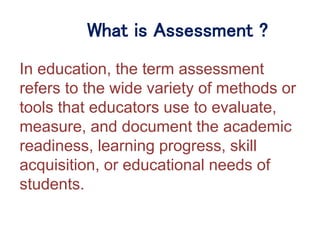
In education, the term assessment
refers to the wide variety of methods or
tools that educators use to evaluate,
measure, and document the academic
readiness, learning progress, skill
acquisition, or educational needs of
students.
What is Assessment ?
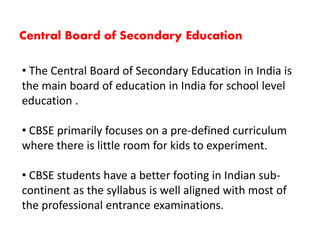
• The Central Board of Secondary Education in India is
the main board of education in India for school level
education .
• CBSE primarily focuses on a pre-defined curriculum
where there is little room for kids to experiment.
• CBSE students have a better footing in Indian sub-
continent as the syllabus is well aligned with most of
the professional entrance examinations.
Central Board of Secondary Education
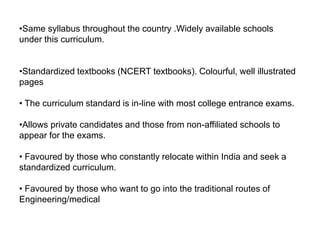
•Same syllabus throughout the country .Widely available schools
under this curriculum.
•Standardized textbooks (NCERT textbooks). Colourful, well illustrated
pages
• The curriculum standard is in-line with most college entrance exams.
•Allows private candidates and those from non-affiliated schools to
appear for the exams.
• Favoured by those who constantly relocate within India and seek a
standardized curriculum.
• Favoured by those who want to go into the traditional routes of
Engineering/medical
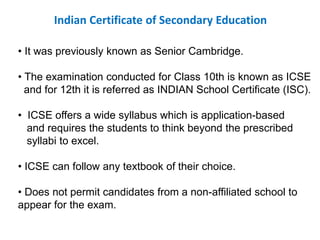
• It was previously known as Senior Cambridge.
• The examination conducted for Class 10th is known as ICSE
and for 12th it is referred as INDIAN School Certificate (ISC).
• ICSE offers a wide syllabus which is application-based
and requires the students to think beyond the prescribed
syllabi to excel.
• ICSE can follow any textbook of their choice.
• Does not permit candidates from a non-affiliated school to
appear for the exam.
Indian Certificate of Secondary Education
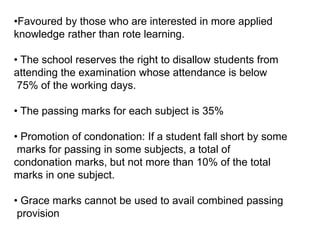
•Favoured by those who are interested in more applied
knowledge rather than rote learning.
• The school reserves the right to disallow students from
attending the examination whose attendance is below
75% of the working days.
• The passing marks for each subject is 35%
• Promotion of condonation: If a student fall short by some
marks for passing in some subjects, a total of
condonation marks, but not more than 10% of the total
marks in one subject.
• Grace marks cannot be used to avail combined passing
provision
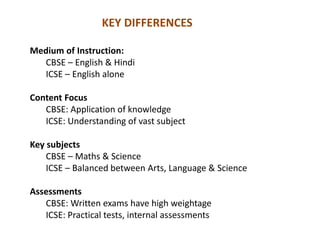
Medium of Instruction:
CBSE – English & Hindi
ICSE – English alone
Content Focus
CBSE: Application of knowledge
ICSE: Understanding of vast subject
Key subjects
CBSE – Maths & Science
ICSE – Balanced between Arts, Language & Science
Assessments
CBSE: Written exams have high weightage
ICSE: Practical tests, internal assessments
KEY DIFFERENCES
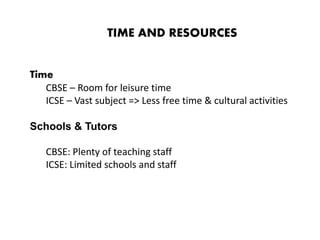
Time
CBSE – Room for leisure time
ICSE – Vast subject => Less free time & cultural activities
Schools & Tutors
CBSE: Plenty of teaching staff
ICSE: Limited schools and staff
TIME AND RESOURCES
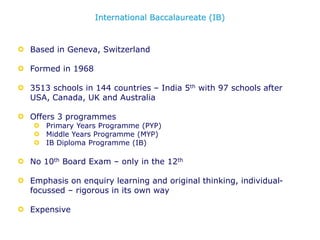
Based in Geneva, Switzerland
Formed in 1968
3513 schools in 144 countries – India 5th with 97 schools after
USA, Canada, UK and Australia
Offers 3 programmes
Primary Years Programme (PYP)
Middle Years Programme (MYP)
IB Diploma Programme (IB)
No 10th Board Exam – only in the 12th
Emphasis on enquiry learning and original thinking, individual-
focussed – rigorous in its own way
Expensive
International Baccalaureate (IB)
IB
• IB is the new kid on the block when it comes to Indian Sub-continent.
• International Baccalaureate (IB) as the name suggests is more
internationally accepted and follows a different teaching methodology
altogether.
• There are three programs:
I. PYP: The Primary Years Programme (Kindergarten to Class 5).
II. MYP: The Middle Years Programme (Class 6 to Class 10).
III. DP: The Diploma Programme (Class 11 to Class 12).
• IB syllabus is accepted world-wide which gives a definite edge to the
students who aspire to go abroad for higher studies.
• There are very few IB World Schools in India, clearly exhibiting its
elitist status.
Gujarat Secondary and
Higher Secondary
Education Board
GSHEB
Formed and run by the Gujarat government’s
Education department.
Conducts the class 10 and 12 exams
Schools affiliated to it must be Gujarati or English
medium
Recognized by all Indian Universities, equivalencies available
for most foreign universities also
Among the more progressive Boards in India today – in line
with other wings of Gujarat government. Working on an
ambitious Examination Reform project
However, the government itself is aligning to the NCERT
curriculum and open to schools going for the central boards
Gujarat Secondary and Higher Secondary
Education Board
Comparative Case Study
• CBSE primarily focuses on a pre-defined curriculum where there is little
room for kids to experiment. Some of the critics even say that it is heavily
examination-based and promotes rote learning. ICSE, on the other hand
offers a wide syllabus which is application-based and requires the students
to think beyond the prescribed syllabi to excel. IB follows an altogether
different approach where there are no prescribed textbooks and kids are
free to explore the myriad world of books. The focus of the IB pedagogy is
on 'how to learn' rather than 'what to learn'.
•CBSE students have a better footing in Indian sub-continent as the syllabus
is well aligned with most of the professional entrance examinations. As per
the statistics, CBSE students fare better in such exams while ICSE students
have to often struggle and go an extra mile to prepare for the exams. IB
students, however compete well in exams where there is little amount of
rote learning and requires higher degree to analytical skills like CAT,SAT,GRE
etc
• The subject of Environmental Education is compulsory in ICSE while it is
optional in both CBSE and IB.
• CBSE allows both regular and private students to appear in the exams while
the same is not the case with IB and ICSE.
• There are plethora of CBSE schools, both elite like DPS, SriRam, Modern
School and affordable schools like Kendriya Vidyalaya for an average middle
class Indian. ICSE schools are little less in number, again with a wide choice
to choose from. However, IB schools are very few in number considering the
high tuition fees and its late entry in Indian Education.
• Internal assessments have been a prime component in ICSE and IB syllabus,
while CBSE is slowly drifting towards this.
• CBSE approves of both English and Hindi as mediums of instruction. On the
contrary, Hindi is treated as a second optional language in IB and ICSE.

Diffrences between boards

  • 2.
    In education, theterm assessment refers to the wide variety of methods or tools that educators use to evaluate, measure, and document the academic readiness, learning progress, skill acquisition, or educational needs of students. What is Assessment ?
  • 4.
    • The CentralBoard of Secondary Education in India is the main board of education in India for school level education . • CBSE primarily focuses on a pre-defined curriculum where there is little room for kids to experiment. • CBSE students have a better footing in Indian sub- continent as the syllabus is well aligned with most of the professional entrance examinations. Central Board of Secondary Education
  • 5.
    •Same syllabus throughoutthe country .Widely available schools under this curriculum. •Standardized textbooks (NCERT textbooks). Colourful, well illustrated pages • The curriculum standard is in-line with most college entrance exams. •Allows private candidates and those from non-affiliated schools to appear for the exams. • Favoured by those who constantly relocate within India and seek a standardized curriculum. • Favoured by those who want to go into the traditional routes of Engineering/medical
  • 7.
    • It waspreviously known as Senior Cambridge. • The examination conducted for Class 10th is known as ICSE and for 12th it is referred as INDIAN School Certificate (ISC). • ICSE offers a wide syllabus which is application-based and requires the students to think beyond the prescribed syllabi to excel. • ICSE can follow any textbook of their choice. • Does not permit candidates from a non-affiliated school to appear for the exam. Indian Certificate of Secondary Education
  • 8.
    •Favoured by thosewho are interested in more applied knowledge rather than rote learning. • The school reserves the right to disallow students from attending the examination whose attendance is below 75% of the working days. • The passing marks for each subject is 35% • Promotion of condonation: If a student fall short by some marks for passing in some subjects, a total of condonation marks, but not more than 10% of the total marks in one subject. • Grace marks cannot be used to avail combined passing provision
  • 9.
    Medium of Instruction: CBSE– English & Hindi ICSE – English alone Content Focus CBSE: Application of knowledge ICSE: Understanding of vast subject Key subjects CBSE – Maths & Science ICSE – Balanced between Arts, Language & Science Assessments CBSE: Written exams have high weightage ICSE: Practical tests, internal assessments KEY DIFFERENCES
  • 10.
    Time CBSE – Roomfor leisure time ICSE – Vast subject => Less free time & cultural activities Schools & Tutors CBSE: Plenty of teaching staff ICSE: Limited schools and staff TIME AND RESOURCES
  • 12.
    Based in Geneva,Switzerland Formed in 1968 3513 schools in 144 countries – India 5th with 97 schools after USA, Canada, UK and Australia Offers 3 programmes Primary Years Programme (PYP) Middle Years Programme (MYP) IB Diploma Programme (IB) No 10th Board Exam – only in the 12th Emphasis on enquiry learning and original thinking, individual- focussed – rigorous in its own way Expensive International Baccalaureate (IB)
  • 13.
    IB • IB isthe new kid on the block when it comes to Indian Sub-continent. • International Baccalaureate (IB) as the name suggests is more internationally accepted and follows a different teaching methodology altogether. • There are three programs: I. PYP: The Primary Years Programme (Kindergarten to Class 5). II. MYP: The Middle Years Programme (Class 6 to Class 10). III. DP: The Diploma Programme (Class 11 to Class 12). • IB syllabus is accepted world-wide which gives a definite edge to the students who aspire to go abroad for higher studies. • There are very few IB World Schools in India, clearly exhibiting its elitist status.
  • 14.
    Gujarat Secondary and HigherSecondary Education Board GSHEB
  • 15.
    Formed and runby the Gujarat government’s Education department. Conducts the class 10 and 12 exams Schools affiliated to it must be Gujarati or English medium Recognized by all Indian Universities, equivalencies available for most foreign universities also Among the more progressive Boards in India today – in line with other wings of Gujarat government. Working on an ambitious Examination Reform project However, the government itself is aligning to the NCERT curriculum and open to schools going for the central boards Gujarat Secondary and Higher Secondary Education Board
  • 16.
    Comparative Case Study •CBSE primarily focuses on a pre-defined curriculum where there is little room for kids to experiment. Some of the critics even say that it is heavily examination-based and promotes rote learning. ICSE, on the other hand offers a wide syllabus which is application-based and requires the students to think beyond the prescribed syllabi to excel. IB follows an altogether different approach where there are no prescribed textbooks and kids are free to explore the myriad world of books. The focus of the IB pedagogy is on 'how to learn' rather than 'what to learn'. •CBSE students have a better footing in Indian sub-continent as the syllabus is well aligned with most of the professional entrance examinations. As per the statistics, CBSE students fare better in such exams while ICSE students have to often struggle and go an extra mile to prepare for the exams. IB students, however compete well in exams where there is little amount of rote learning and requires higher degree to analytical skills like CAT,SAT,GRE etc
  • 17.
    • The subjectof Environmental Education is compulsory in ICSE while it is optional in both CBSE and IB. • CBSE allows both regular and private students to appear in the exams while the same is not the case with IB and ICSE. • There are plethora of CBSE schools, both elite like DPS, SriRam, Modern School and affordable schools like Kendriya Vidyalaya for an average middle class Indian. ICSE schools are little less in number, again with a wide choice to choose from. However, IB schools are very few in number considering the high tuition fees and its late entry in Indian Education. • Internal assessments have been a prime component in ICSE and IB syllabus, while CBSE is slowly drifting towards this. • CBSE approves of both English and Hindi as mediums of instruction. On the contrary, Hindi is treated as a second optional language in IB and ICSE.