CBTP phase one PRESENTATION
By: BABO KABELE TEAM
1
Survey on socio-demographic, means of communication
and basicvital statistics of Babo kebele.
s.n
o
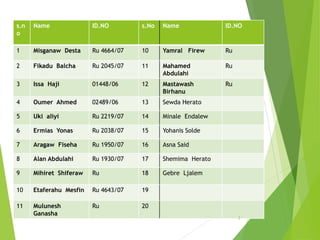
Name ID.NO s.No Name ID.NO
1 Misganaw Desta Ru 4664/07 10 Yamral Firew Ru
2 Fikadu Balcha Ru 2045/07 11 Mahamed
Abdulahi
Ru
3 Issa Haji 01448/06 12 Mastawash
Birhanu
Ru
4 Oumer Ahmed 02489/06 13 Sewda Herato
5 Uki aliyi Ru 2219/07 14 Minale Endalew
6 Ermias Yonas Ru 2038/07 15 Yohanis Solde
7 Aragaw Fiseha Ru 1950/07 16 Asna Said
8 Alan Abdulahi Ru 1930/07 17 Shemima Herato
9 Mihiret Shiferaw Ru 18 Gebre Ljalem
10 Etaferahu Mesfin Ru 4643/07 19
11 Mulunesh
Ganasha
Ru 20
2
outline
 Introduction
 Background
 Objective
 Materials and Methods
 Significance of CBTP
 Ethical consideration
 Measurement of study variables
 Result and Discussion
 Conclusion
 Recommendation
 Problem identification and prioritization
 Action plan
 Acknowledgement
 References
3
 Jimma University is Ethiopia’s first innovative
community oriented educational institute of
higher learning.
 Community based Education (CBE) is a program
through which students get practical problem solving
skills.
 CBE strategies
 CBTP
 TTP/DTTP
 SRP
 CBTP: - is one form of the strategies of CBE-
with different phase. Each phase has specifically
defined educational objectives.
4
Significance of CBE
CBE enables student
 To acquire practical knowledge on their field of study.
 To solve community problems with scientific method.
 To be active learners
 To implement the theoretical knowledge in solving
community problem.
5
BACKGROUND
 Babo kabele is one of the kabele found under Kersa woreda .
 It is 20Km away from Jimma University on the way to addis abeba.
 It is bounded by -Tekur Balto and Sarbo kebele in East
-Girma kebele in north
-Ankeso kebele in south
-Merewa kebele in West
o This kebele lies at 1500-1800 meter above sea level.
o The kebele has two streams named as Kalacha and Birbirsa.
6
Back ground
con’t….
 The total population of Babo kebele is 2315 out of this
1178 are male where as 1137 are female.
 Educational facilities in Babo kebele is as follows.
 One kindergarten and one elementary school.
 There are 5 mosques with no other religious institution.
 In the kebele 78 hectares has been irrigated.
7
Objectives
General Objective
To assess the socio-demographic characters,
vital statistics, means of communication,
socio-economic status and morbidity of
population of Babo kebele.
8
Specific Objective
 To determine the basic statistics of the socio-
demographic status of Babo Kebele along with
possible trends, patterns, anomalies and
merits.
 To determine the vital statistics of Bobo Kebele
with regard to health related issues.
 To assess socio-economic status of residents of
Babo Kebele .
 To determine the means of communications
used in Babo Kebele .
9
Martials and Method
 Study area
Babo kebele found in Kersa woreda, 20Km away from JU main campus.
Study period
The study was conducted from July, 3 to July, 5, 2015.
Study design
Community based cross-sectional study was conducted.
Source population
All households of Babo kebele
Study population
All sampled households of Babo kebele
10
Sample Size Determination And Sampling Technique
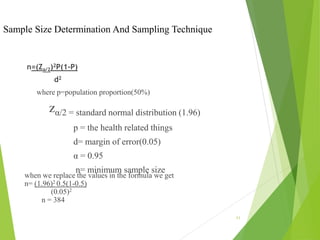
n=(Za/2)2P(1-P)
d2
where p=population proportion(50%)
zα/2 = standard normal distribution (1.96)
p = the health related things
d= margin of error(0.05)
α = 0.95
n= minimum sample size
when we replace the values in the formula we get
n= (1.96)2 0.5(1-0.5)
(0.05)2
n = 384
11
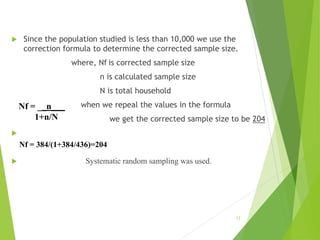
 Since the population studied is less than 10,000 we use the
correction formula to determine the corrected sample size.
where, Nf is corrected sample size
n is calculated sample size
N is total household
when we repeal the values in the formula
we get the corrected sample size to be 204

 Systematic random sampling was used.
12
Nf = __n___
1+n/N
Nf = 384/(1+384/436)=204
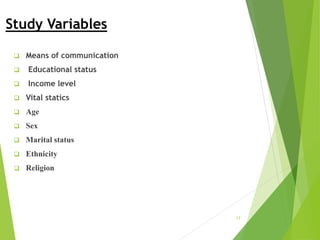
Study Variables
 Means of communication
 Educational status
 Income level
 Vital statics
 Age
 Sex
 Marital status
 Ethnicity
 Religion
13
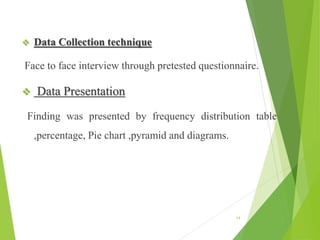
 Data Collection technique
Face to face interview through pretested questionnaire.
 Data Presentation
Finding was presented by frequency distribution table
,percentage, Pie chart ,pyramid and diagrams.
14
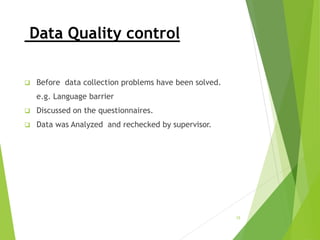
Data Quality control
 Before data collection problems have been solved.
e.g. Language barrier
 Discussed on the questionnaires.
 Data was Analyzed and rechecked by supervisor.
15
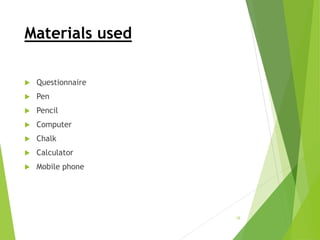
Materials used
 Questionnaire
 Pen
 Pencil
 Computer
 Chalk
 Calculator
 Mobile phone
16
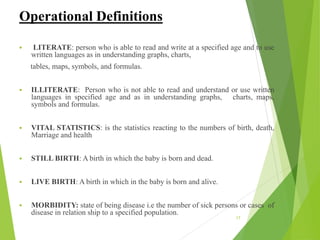
Operational Definitions
 LITERATE: person who is able to read and write at a specified age and to use
written languages as in understanding graphs, charts,
tables, maps, symbols, and formulas.
 ILLITERATE: Person who is not able to read and understand or use written
languages in specified age and as in understanding graphs, charts, maps,
symbols and formulas.
 VITAL STATISTICS: is the statistics reacting to the numbers of birth, death,
Marriage and health
 STILL BIRTH: A birth in which the baby is born and dead.
 LIVE BIRTH: A birth in which in the baby is born and alive.
 MORBIDITY: state of being disease i.e the number of sick persons or cases of
disease in relation ship to a specified population.
17
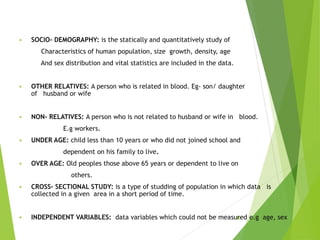
 SOCIO- DEMOGRAPHY: is the statically and quantitatively study of
Characteristics of human population, size growth, density, age
And sex distribution and vital statistics are included in the data.
 OTHER RELATIVES: A person who is related in blood. Eg- son/ daughter
of husband or wife
 NON- RELATIVES: A person who is not related to husband or wife in blood.
E.g workers.
 UNDER AGE: child less than 10 years or who did not joined school and
dependent on his family to live.
 OVER AGE: Old peoples those above 65 years or dependent to live on
others.
 CROSS- SECTIONAL STUDY: is a type of studding of population in which data is
collected in a given area in a short period of time.
 INDEPENDENT VARIABLES: data variables which could not be measured e.g age, sex18
Ethical consideration
 An official permission letter was written to
the Keble before our data collection date.
 The society norms, culture and values
were made taken in to consideration by
each member of our survey group.
 During data collection all group members
went throughout the kebele for
interviewing politely.
19
Result & Discussion
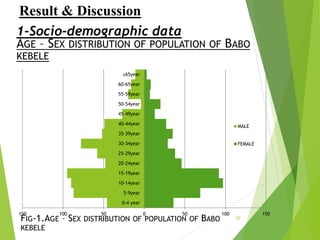
20FIG-1.AGE – SEX DISTRIBUTION OF POPULATION OF BABO
KEBELE
1-Socio-demographic data
AGE – SEX DISTRIBUTION OF POPULATION OF BABO
KEBELE
150 100 50 0 50 100 150
0-4 year
5-9year
10-14year
15-19year
20-24year
25-29year
30-34year
35-39year
40-44year
45-49year
50-54year
55-59year
60-65year
≥65year
MALE
FEMALE
21
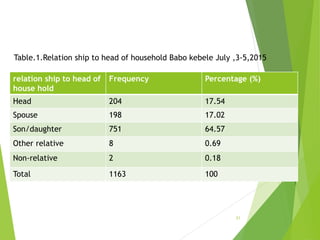
relation ship to head of
house hold
Frequency Percentage (%)
Head 204 17.54
Spouse 198 17.02
Son/daughter 751 64.57
Other relative 8 0.69
Non-relative 2 0.18
Total 1163 100
Table.1.Relation ship to head of household Babo kebele July ,3-5,2015
Ethnicity
22
FIG.2. ETHNICITY OF BABO KEBELE
98.37
0 1.63 00 0 0 00 0 0 0
0
20
40
60
80
100
120
oromo amhara tigre other
 Religion
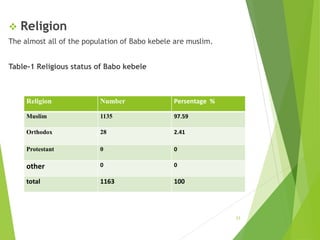
The almost all of the population of Babo kebele are muslim.
Table-1 Religious status of Babo kebele
23
Religion Number Persentage %
Muslim 1135 97.59
Orthodox 28 2.41
Protestant 0 0
other 0 0
total 1163 100
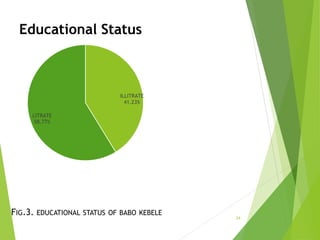
Educational Status
24
FIG.3. EDUCATIONAL STATUS OF BABO KEBELE
ILLITRATE
41.23%
LITRATE
58.77%
Marital Status
25FIG.4. MARITAL STATUS OF BABO KEBELE
Marital status Number Percentage %
Married 428 43.54
Single 549 55.85
Divorced 2 0.20
Widowed 4 0.41
Total 983 100
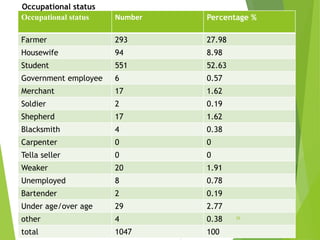
Occupational status Number Percentage %
Farmer 293 27.98
Housewife 94 8.98
Student 551 52.63
Government employee 6 0.57
Merchant 17 1.62
Soldier 2 0.19
Shepherd 17 1.62
Blacksmith 4 0.38
Carpenter 0 0
Tella seller 0 0
Weaker 20 1.91
Unemployed 8 0.78
Bartender 2 0.19
Under age/over age 29 2.77
other 4 0.38
total 1047 100
Occupational status
26
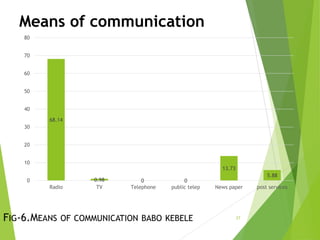
Means of communication
27FIG-6.MEANS OF COMMUNICATION BABO KEBELE
68.14
0.98 0 0
13.73
5.88
0
10
20
30
40
50
60
70
80
Radio TV Telephone public telep News paper post services
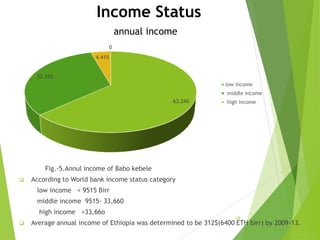
Income Status
annual income
Fig.-5.Annul income of Babo kebele
 According to World bank income status category
low income < 9515 Birr
middle income 9515- 33,660
high income >33,66o
 Average annual income of Ethiopia was determined to be 312$(6400 ETH birr) by 2009-13.
28
63.24%
32.35%
4.41%
0
low income
middle income
high income
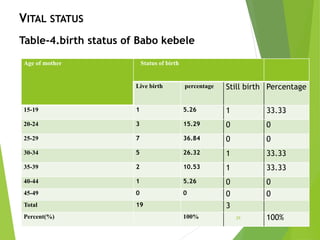
Table-4.birth status of Babo kebele
Age of mother Status of birth
Live birth percentage Still birth Percentage
15-19 1 5.26 1 33.33
20-24 3 15.29 0 0
25-29 7 36.84 0 0
30-34 5 26.32 1 33.33
35-39 2 10.53 1 33.33
40-44 1 5.26 0 0
45-49 0 0 0 0
Total 19 3
Percent(%) 100% 100%29
VITAL STATUS
30
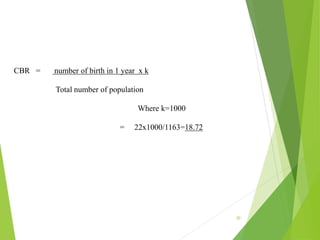
CBR = number of birth in 1 year x k
Total number of population
Where k=1000
= 22x1000/1163=18.72
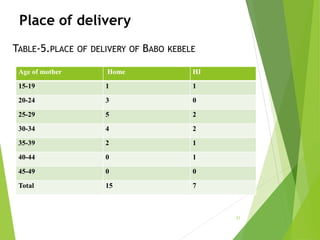
Place of delivery
Age of mother Home HI
15-19 1 1
20-24 3 0
25-29 5 2
30-34 4 2
35-39 2 1
40-44 0 1
45-49 0 0
Total 15 7
31
TABLE-5.PLACE OF DELIVERY OF BABO KEBELE
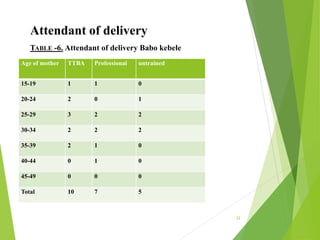
Attendant of delivery
Age of mother TTBA Professional untrained
15-19 1 1 0
20-24 2 0 1
25-29 3 2 2
30-34 2 2 2
35-39 2 1 0
40-44 0 1 0
45-49 0 0 0
Total 10 7 5
32
TABLE -6. Attendant of delivery Babo kebele
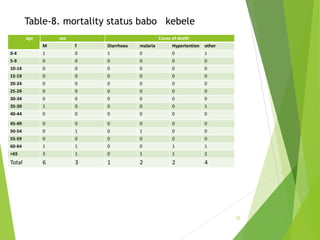
Table-8. mortality status babo kebele
age sex Couse of death
M f Diarrhoea malaria Hypertention other
0-4 1 0 1 0 0 1
5-9 0 0 0 0 0 0
10-14 0 0 0 0 0 0
15-19 0 0 0 0 0 0
20-24 0 0 0 0 0 0
25-29 0 0 0 0 0 0
30-34 0 0 0 0 0 0
35-39 1 0 0 0 0 1
40-44 0 0 0 0 0 0
45-49 0 0 0 0 0 0
50-54 0 1 0 1 0 0
55-59 0 0 0 0 0 0
60-64 1 1 0 0 1 1
>65 3 1 0 1 1 2
Total 6 3 1 2 2 4
33
34
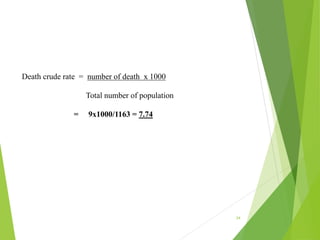
Death crude rate = number of death x 1000
Total number of population
= 9x1000/1163 = 7.74
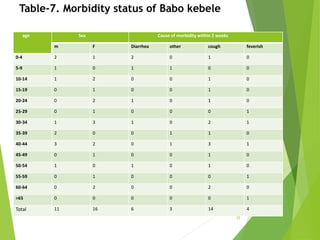
Table-7. Morbidity status of Babo kebele
age Sex Cause of morbidity within 2 weeks
m F Diarrhea other cough feverish
0-4 2 1 2 0 1 0
5-9 1 0 1 1 0 0
10-14 1 2 0 0 1 0
15-19 0 1 0 0 1 0
20-24 0 2 1 0 1 0
25-29 0 1 0 0 0 1
30-34 1 3 1 0 2 1
35-39 2 0 0 1 1 0
40-44 3 2 0 1 3 1
45-49 0 1 0 0 1 0
50-54 1 0 1 0 1 0
55-59 0 1 0 0 0 1
60-64 0 2 0 0 2 0
>65 0 0 0 0 0 1
Total 11 16 6 3 14 4
35
36
Discussion
When we compere our data collection with other data collection
of another kebele or with the same area we investigate the
following views;
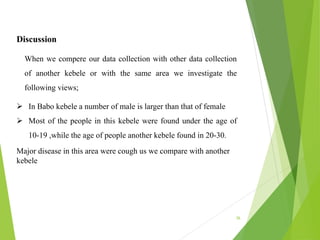
 In Babo kebele a number of male is larger than that of female
 Most of the people in this kebele were found under the age of
10-19 ,while the age of people another kebele found in 20-30.
Major disease in this area were cough us we compare with another
kebele
37
Conclusion
The current community based survey showed that
• The common means of communication that used by Babo kebele were radio.
• .Dominant religion in this kebele were Muslim.
• Almost all of Babo kebele community were Oromo ethnicity.
• The number of male is greater than female in this kebele.
• The most common disease in Babo kebele was cough disease.
• Under poverty, yet quite surprising number of people are middle class citizens.
.
RECOMMENDATION
We would like to recommend the following points to concerned body.
 We recommend to Jimma zone health offic, Oromiya health office
and to give attention to the Major health problems of the area.
 To Jimma university and CBE office to coordinate NGO’s to solve the problem
of Babo kebele.
38
Problem encountered
 Language barrier
 Misunderstanding on the side of respondents
Solution
 we tried to group students who speak A/Oromo
into groups.
 we tried to explain the objective of the study
to the community.
39
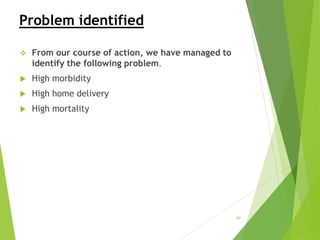
Problem identified
 From our course of action, we have managed to
identify the following problem.
 High morbidity
 High home delivery
 High mortality
40
41
Action Plan
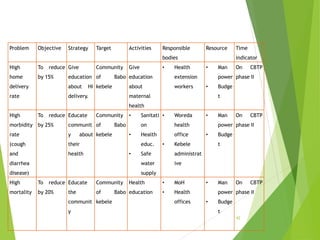
The following table consists our action plans we sure
are able to implement at community level.
For the sake of simplicity and to clearly show what
we do for the coming years, We put our action plan in
table form.
42
Problem Objective Strategy Target Activities Responsible
bodies
Resource Time
indicator
High
home
delivery
rate
To reduce
by 15%
Give
education
about HI
delivery.
Community
of Babo
kebele
Give
education
about
maternal
health
• Health
extension
workers
• Man
power
• Budge
t
On CBTP
phase II
High
morbidity
rate
(cough
and
diarrhea
disease)
To reduce
by 25%
Educate
communit
y about
their
health
Community
of Babo
kebele
• Sanitati
on
• Health
educ.
• Safe
water
supply
• Woreda
health
office
• Kebele
administrat
ive
• Man
power
• Budge
t
On CBTP
phase II
High
mortality
To reduce
by 20%
Educate
the
communit
y
Community
of Babo
kebele
Health
education
• MoH
• Health
offices
• Man
power
• Budge
t
On CBTP
phase II
Acknowledgement
 We team members of the CBTP would like to present our
thanks and appreciation to
• All group of instructors as team supervisors,
• Academician in CBE office
• Our respondents and their leaders in Babo Kebele.
43
References
 Central Statistical Agency (CSA) census (2014)
 WHO-World Report( of Ethiopia)-(2010)
 Ethiopian Demographic Survey-(2014)
 National Statistics Agency, EDHS 2014.
44
45

Cbtp p 1 finale edition

  • 1.
    CBTP phase onePRESENTATION By: BABO KABELE TEAM 1 Survey on socio-demographic, means of communication and basicvital statistics of Babo kebele.
  • 2.
    s.n o Name ID.NO s.NoName ID.NO 1 Misganaw Desta Ru 4664/07 10 Yamral Firew Ru 2 Fikadu Balcha Ru 2045/07 11 Mahamed Abdulahi Ru 3 Issa Haji 01448/06 12 Mastawash Birhanu Ru 4 Oumer Ahmed 02489/06 13 Sewda Herato 5 Uki aliyi Ru 2219/07 14 Minale Endalew 6 Ermias Yonas Ru 2038/07 15 Yohanis Solde 7 Aragaw Fiseha Ru 1950/07 16 Asna Said 8 Alan Abdulahi Ru 1930/07 17 Shemima Herato 9 Mihiret Shiferaw Ru 18 Gebre Ljalem 10 Etaferahu Mesfin Ru 4643/07 19 11 Mulunesh Ganasha Ru 20 2
  • 3.
    outline  Introduction  Background Objective  Materials and Methods  Significance of CBTP  Ethical consideration  Measurement of study variables  Result and Discussion  Conclusion  Recommendation  Problem identification and prioritization  Action plan  Acknowledgement  References 3
  • 4.
     Jimma Universityis Ethiopia’s first innovative community oriented educational institute of higher learning.  Community based Education (CBE) is a program through which students get practical problem solving skills.  CBE strategies  CBTP  TTP/DTTP  SRP  CBTP: - is one form of the strategies of CBE- with different phase. Each phase has specifically defined educational objectives. 4
  • 5.
    Significance of CBE CBEenables student  To acquire practical knowledge on their field of study.  To solve community problems with scientific method.  To be active learners  To implement the theoretical knowledge in solving community problem. 5
  • 6.
    BACKGROUND  Babo kabeleis one of the kabele found under Kersa woreda .  It is 20Km away from Jimma University on the way to addis abeba.  It is bounded by -Tekur Balto and Sarbo kebele in East -Girma kebele in north -Ankeso kebele in south -Merewa kebele in West o This kebele lies at 1500-1800 meter above sea level. o The kebele has two streams named as Kalacha and Birbirsa. 6
  • 7.
    Back ground con’t….  Thetotal population of Babo kebele is 2315 out of this 1178 are male where as 1137 are female.  Educational facilities in Babo kebele is as follows.  One kindergarten and one elementary school.  There are 5 mosques with no other religious institution.  In the kebele 78 hectares has been irrigated. 7
  • 8.
    Objectives General Objective To assessthe socio-demographic characters, vital statistics, means of communication, socio-economic status and morbidity of population of Babo kebele. 8
  • 9.
    Specific Objective  Todetermine the basic statistics of the socio- demographic status of Babo Kebele along with possible trends, patterns, anomalies and merits.  To determine the vital statistics of Bobo Kebele with regard to health related issues.  To assess socio-economic status of residents of Babo Kebele .  To determine the means of communications used in Babo Kebele . 9
  • 10.
    Martials and Method Study area Babo kebele found in Kersa woreda, 20Km away from JU main campus. Study period The study was conducted from July, 3 to July, 5, 2015. Study design Community based cross-sectional study was conducted. Source population All households of Babo kebele Study population All sampled households of Babo kebele 10
  • 11.
    Sample Size DeterminationAnd Sampling Technique n=(Za/2)2P(1-P) d2 where p=population proportion(50%) zα/2 = standard normal distribution (1.96) p = the health related things d= margin of error(0.05) α = 0.95 n= minimum sample size when we replace the values in the formula we get n= (1.96)2 0.5(1-0.5) (0.05)2 n = 384 11
  • 12.
     Since thepopulation studied is less than 10,000 we use the correction formula to determine the corrected sample size. where, Nf is corrected sample size n is calculated sample size N is total household when we repeal the values in the formula we get the corrected sample size to be 204   Systematic random sampling was used. 12 Nf = __n___ 1+n/N Nf = 384/(1+384/436)=204
  • 13.
    Study Variables  Meansof communication  Educational status  Income level  Vital statics  Age  Sex  Marital status  Ethnicity  Religion 13
  • 14.
     Data Collectiontechnique Face to face interview through pretested questionnaire.  Data Presentation Finding was presented by frequency distribution table ,percentage, Pie chart ,pyramid and diagrams. 14
  • 15.
    Data Quality control Before data collection problems have been solved. e.g. Language barrier  Discussed on the questionnaires.  Data was Analyzed and rechecked by supervisor. 15
  • 16.
    Materials used  Questionnaire Pen  Pencil  Computer  Chalk  Calculator  Mobile phone 16
  • 17.
    Operational Definitions  LITERATE:person who is able to read and write at a specified age and to use written languages as in understanding graphs, charts, tables, maps, symbols, and formulas.  ILLITERATE: Person who is not able to read and understand or use written languages in specified age and as in understanding graphs, charts, maps, symbols and formulas.  VITAL STATISTICS: is the statistics reacting to the numbers of birth, death, Marriage and health  STILL BIRTH: A birth in which the baby is born and dead.  LIVE BIRTH: A birth in which in the baby is born and alive.  MORBIDITY: state of being disease i.e the number of sick persons or cases of disease in relation ship to a specified population. 17
  • 18.
     SOCIO- DEMOGRAPHY:is the statically and quantitatively study of Characteristics of human population, size growth, density, age And sex distribution and vital statistics are included in the data.  OTHER RELATIVES: A person who is related in blood. Eg- son/ daughter of husband or wife  NON- RELATIVES: A person who is not related to husband or wife in blood. E.g workers.  UNDER AGE: child less than 10 years or who did not joined school and dependent on his family to live.  OVER AGE: Old peoples those above 65 years or dependent to live on others.  CROSS- SECTIONAL STUDY: is a type of studding of population in which data is collected in a given area in a short period of time.  INDEPENDENT VARIABLES: data variables which could not be measured e.g age, sex18
  • 19.
    Ethical consideration  Anofficial permission letter was written to the Keble before our data collection date.  The society norms, culture and values were made taken in to consideration by each member of our survey group.  During data collection all group members went throughout the kebele for interviewing politely. 19
  • 20.
    Result & Discussion 20FIG-1.AGE– SEX DISTRIBUTION OF POPULATION OF BABO KEBELE 1-Socio-demographic data AGE – SEX DISTRIBUTION OF POPULATION OF BABO KEBELE 150 100 50 0 50 100 150 0-4 year 5-9year 10-14year 15-19year 20-24year 25-29year 30-34year 35-39year 40-44year 45-49year 50-54year 55-59year 60-65year ≥65year MALE FEMALE
  • 21.
    21 relation ship tohead of house hold Frequency Percentage (%) Head 204 17.54 Spouse 198 17.02 Son/daughter 751 64.57 Other relative 8 0.69 Non-relative 2 0.18 Total 1163 100 Table.1.Relation ship to head of household Babo kebele July ,3-5,2015
  • 22.
    Ethnicity 22 FIG.2. ETHNICITY OFBABO KEBELE 98.37 0 1.63 00 0 0 00 0 0 0 0 20 40 60 80 100 120 oromo amhara tigre other
  • 23.
     Religion The almostall of the population of Babo kebele are muslim. Table-1 Religious status of Babo kebele 23 Religion Number Persentage % Muslim 1135 97.59 Orthodox 28 2.41 Protestant 0 0 other 0 0 total 1163 100
  • 24.
    Educational Status 24 FIG.3. EDUCATIONALSTATUS OF BABO KEBELE ILLITRATE 41.23% LITRATE 58.77%
  • 25.
    Marital Status 25FIG.4. MARITALSTATUS OF BABO KEBELE Marital status Number Percentage % Married 428 43.54 Single 549 55.85 Divorced 2 0.20 Widowed 4 0.41 Total 983 100
  • 26.
    Occupational status NumberPercentage % Farmer 293 27.98 Housewife 94 8.98 Student 551 52.63 Government employee 6 0.57 Merchant 17 1.62 Soldier 2 0.19 Shepherd 17 1.62 Blacksmith 4 0.38 Carpenter 0 0 Tella seller 0 0 Weaker 20 1.91 Unemployed 8 0.78 Bartender 2 0.19 Under age/over age 29 2.77 other 4 0.38 total 1047 100 Occupational status 26
  • 27.
    Means of communication 27FIG-6.MEANSOF COMMUNICATION BABO KEBELE 68.14 0.98 0 0 13.73 5.88 0 10 20 30 40 50 60 70 80 Radio TV Telephone public telep News paper post services
  • 28.
    Income Status annual income Fig.-5.Annulincome of Babo kebele  According to World bank income status category low income < 9515 Birr middle income 9515- 33,660 high income >33,66o  Average annual income of Ethiopia was determined to be 312$(6400 ETH birr) by 2009-13. 28 63.24% 32.35% 4.41% 0 low income middle income high income
  • 29.
    Table-4.birth status ofBabo kebele Age of mother Status of birth Live birth percentage Still birth Percentage 15-19 1 5.26 1 33.33 20-24 3 15.29 0 0 25-29 7 36.84 0 0 30-34 5 26.32 1 33.33 35-39 2 10.53 1 33.33 40-44 1 5.26 0 0 45-49 0 0 0 0 Total 19 3 Percent(%) 100% 100%29 VITAL STATUS
  • 30.
    30 CBR = numberof birth in 1 year x k Total number of population Where k=1000 = 22x1000/1163=18.72
  • 31.
    Place of delivery Ageof mother Home HI 15-19 1 1 20-24 3 0 25-29 5 2 30-34 4 2 35-39 2 1 40-44 0 1 45-49 0 0 Total 15 7 31 TABLE-5.PLACE OF DELIVERY OF BABO KEBELE
  • 32.
    Attendant of delivery Ageof mother TTBA Professional untrained 15-19 1 1 0 20-24 2 0 1 25-29 3 2 2 30-34 2 2 2 35-39 2 1 0 40-44 0 1 0 45-49 0 0 0 Total 10 7 5 32 TABLE -6. Attendant of delivery Babo kebele
  • 33.
    Table-8. mortality statusbabo kebele age sex Couse of death M f Diarrhoea malaria Hypertention other 0-4 1 0 1 0 0 1 5-9 0 0 0 0 0 0 10-14 0 0 0 0 0 0 15-19 0 0 0 0 0 0 20-24 0 0 0 0 0 0 25-29 0 0 0 0 0 0 30-34 0 0 0 0 0 0 35-39 1 0 0 0 0 1 40-44 0 0 0 0 0 0 45-49 0 0 0 0 0 0 50-54 0 1 0 1 0 0 55-59 0 0 0 0 0 0 60-64 1 1 0 0 1 1 >65 3 1 0 1 1 2 Total 6 3 1 2 2 4 33
  • 34.
    34 Death crude rate= number of death x 1000 Total number of population = 9x1000/1163 = 7.74
  • 35.
    Table-7. Morbidity statusof Babo kebele age Sex Cause of morbidity within 2 weeks m F Diarrhea other cough feverish 0-4 2 1 2 0 1 0 5-9 1 0 1 1 0 0 10-14 1 2 0 0 1 0 15-19 0 1 0 0 1 0 20-24 0 2 1 0 1 0 25-29 0 1 0 0 0 1 30-34 1 3 1 0 2 1 35-39 2 0 0 1 1 0 40-44 3 2 0 1 3 1 45-49 0 1 0 0 1 0 50-54 1 0 1 0 1 0 55-59 0 1 0 0 0 1 60-64 0 2 0 0 2 0 >65 0 0 0 0 0 1 Total 11 16 6 3 14 4 35
  • 36.
    36 Discussion When we compereour data collection with other data collection of another kebele or with the same area we investigate the following views;  In Babo kebele a number of male is larger than that of female  Most of the people in this kebele were found under the age of 10-19 ,while the age of people another kebele found in 20-30. Major disease in this area were cough us we compare with another kebele
  • 37.
    37 Conclusion The current communitybased survey showed that • The common means of communication that used by Babo kebele were radio. • .Dominant religion in this kebele were Muslim. • Almost all of Babo kebele community were Oromo ethnicity. • The number of male is greater than female in this kebele. • The most common disease in Babo kebele was cough disease. • Under poverty, yet quite surprising number of people are middle class citizens. .
  • 38.
    RECOMMENDATION We would liketo recommend the following points to concerned body.  We recommend to Jimma zone health offic, Oromiya health office and to give attention to the Major health problems of the area.  To Jimma university and CBE office to coordinate NGO’s to solve the problem of Babo kebele. 38
  • 39.
    Problem encountered  Languagebarrier  Misunderstanding on the side of respondents Solution  we tried to group students who speak A/Oromo into groups.  we tried to explain the objective of the study to the community. 39
  • 40.
    Problem identified  Fromour course of action, we have managed to identify the following problem.  High morbidity  High home delivery  High mortality 40
  • 41.
    41 Action Plan The followingtable consists our action plans we sure are able to implement at community level. For the sake of simplicity and to clearly show what we do for the coming years, We put our action plan in table form.
  • 42.
    42 Problem Objective StrategyTarget Activities Responsible bodies Resource Time indicator High home delivery rate To reduce by 15% Give education about HI delivery. Community of Babo kebele Give education about maternal health • Health extension workers • Man power • Budge t On CBTP phase II High morbidity rate (cough and diarrhea disease) To reduce by 25% Educate communit y about their health Community of Babo kebele • Sanitati on • Health educ. • Safe water supply • Woreda health office • Kebele administrat ive • Man power • Budge t On CBTP phase II High mortality To reduce by 20% Educate the communit y Community of Babo kebele Health education • MoH • Health offices • Man power • Budge t On CBTP phase II
  • 43.
    Acknowledgement  We teammembers of the CBTP would like to present our thanks and appreciation to • All group of instructors as team supervisors, • Academician in CBE office • Our respondents and their leaders in Babo Kebele. 43
  • 44.
    References  Central StatisticalAgency (CSA) census (2014)  WHO-World Report( of Ethiopia)-(2010)  Ethiopian Demographic Survey-(2014)  National Statistics Agency, EDHS 2014. 44
  • 45.