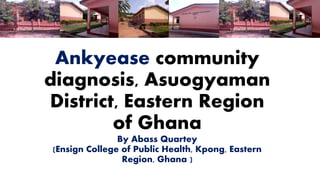
Ankyease community
diagnosis, Asuogyaman
District, Eastern Region
of Ghana
By Abass Quartey
(Ensign College of Public Health, Kpong, Eastern
Region, Ghana )
OUTLINE
Definitions
Introduction
Problem Statement
Objectives
Community Entry
Methodology
Findings
Conclusion
. . .
DEFINITIONS
COMMUNITY
A cluster of people with at least one common characteristic
(geographic location, occupation, ethnicity, housing condition,
etc)
A group of people with a common characteristic or interest living
together within a larger society
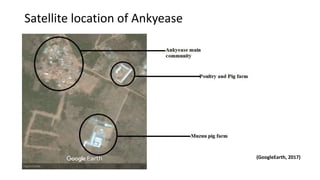
Satellite location of Ankyease
(GoogleEarth, 2017)
. . .
COMMUNITY DIAGNOSIS
It is “a quantitative and qualitative description of
the health of citizens and the factors which
influence their health. It identifies problems,
proposes areas for improvement and stimulates
action”.
. . .
COMMUNITY DIAGNOSIS
Community diagnosis is the comprehensive
assessment of the health state of an entire
community in relation to its social, physical and
biological environment.
INTRODUCTION
BRIEF HISTORY
USED TO BE CALLED AHIAGBATUKOPE,
AFTER AHIAGBATU THE FIRST PERSON TO SETTLE AT THE
PLACE
NANA DADE KOFI GAVE HIM THE LAND
HE MIGRATED FROM SUIPE, DZOLOSHIE, IN THE AKATSI
DISTRICT (VOLTA), 1930
HE WENT BACK TO BRING HIS BROTHER APEDO AZUMAH
WHO WAS GIVEN ALONG PARCEL LAND BY NANA
BAMFRO (THE FIRST)
THEY WERE MAINLY FARMERS AND HUNTERS
BELONG TO THE ANLO ETHNIC GROUP
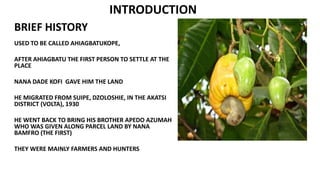
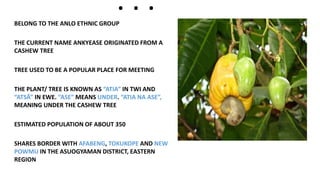
THE CURRENT NAME ANKYEASE ORIGINATED FROM A
CASHEW TREE
TREE USED TO BE A POPULAR PLACE FOR MEETING
THE PLANT/ TREE IS KNOWN AS “ATIA” IN TWI AND
“ATSÔ IN EWE. “ASE” MEANS UNDER. “ATIA NA ASE”,
MEANING UNDER THE CASHEW TREE
ESTIMATED POPULATION OF ABOUT 350
SHARES BORDER WITH AFABENG, TOKUKOPE AND NEW
POWMU IN THE ASUOGYAMAN DISTRICT, EASTERN
REGION
. . .
TRADITIONAL AUTHORITY
Chief of Ankyease and it Environs, Nana Bamfro
Former Odikro-Nicholas Atsitsosgbui
Headman for Ankyease-Christopher Dzamade
. . .
Taboos
No farming on Mondays and Thursdays
River Ayimesu not visited by women in their menses
Pot are not sent to the river
Occupation
Farming (Maize, Cassava)
As a result of clearing of land for farming they are
involved in firewood business
. . .
 Teenage pregnancy
 Health-care accessibility
 Toilet facility/ Sanitation
 Health seeking behaviours
 Prevalence of chronic conditions and infectious
diseases
PROBLEM STATEMENT
General objective.
 To carry out the community diagnosis of Ankyease
community.
Specific objectives.
 To determine social demographic characteristics of
the community.
 To assess the nutrition status of the community
OBJECTIVES
 To assess the sanitation and hygiene.
 To identify the commonest diseases.
 To assess the health seeking behavior of the people
in the community.
 To assess the health service delivery system in this
community
. . .
The research will seek the following:
 Will sex education and contraceptive use reduce the
incidence of teenage pregnancy within the
community?
 How does the community/ study area impact on the
health of the community?
 How does nutrition, sanitation, and housing in
Ankyease community influence their health status?
RESEARCH QUESTION
 Do the study area reveal positive or negative
impact on the health of the community?
 What are the possible solutions to the negative
impact on the community?
. . .
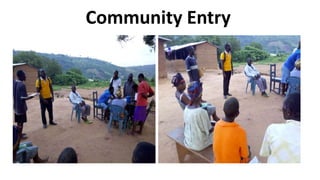
Community Entry
STUDY DESIGN
A descriptive cross-sectional survey
Primary data was sourced through interview of one
member of the household.
STUDY POPULATION
50 Households and their environment within the
community.
METHOD
SAMPLE SIZE
The study involved 50 households sampled from within
the community.
SAMPLE TECHNIQUES
Convenient sampling
Reason
Closeness of households
To avoid cross-contamination
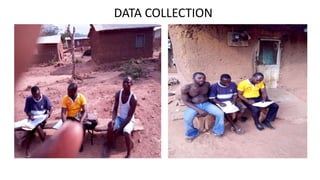
DATA COLLECTION TECHNIQUES.
Primary data was collected using semi-structured
questionnaire and checklist.
Observations
DATA ENTRY
Data entry forms were created and data entered using
Epi-Info 7.
Data was exported to excel for cleaning and then to
Stata 14 for analysis. Microsoft excel and Epi-Info 7
were used for analysis.
ETHICAL CONSIDERATION
A standard questionnaire.
The consent of the respondent was sought before the
interview.
The researcher explained the purpose of the study and
the benefit thereof to the prospective respondent and
the community.
The prospective respondent is made to decide if
he/she want to undertake the survey or not by way or
yes or no question which was part of the
questionnaire.
No names were requested or recorded in order to
ensure strict confidentiality.
. . .
A volunteer who was known in the community and
could properly explain the question on the
questionnaires from English to Ewe and vice versa was
acquired for the study.
The researcher took the volunteer through the
questionnaire prior to the commencement of the
interview of the households
. . .
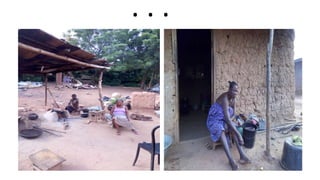
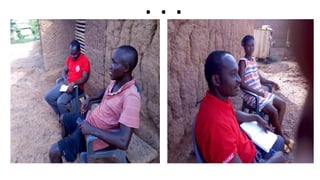
DATA COLLECTION
. . .
. . .
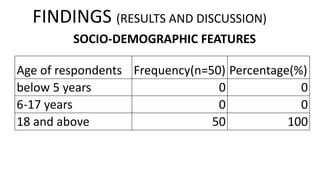
FINDINGS (RESULTS AND DISCUSSION)
Age of respondents Frequency(n=50) Percentage(%)
below 5 years 0 0
6-17 years 0 0
18 and above 50 100
SOCIO-DEMOGRAPHIC FEATURES
VALIDITY
All the respondents were above 18 years, thereby
enhancing the strength of the information received
and also makes it more reliable.
. . .
. . .
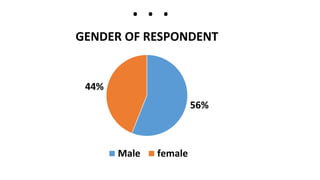
56%
44%
GENDER OF RESPONDENT
Male female
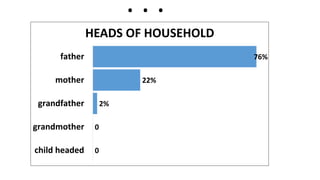
76%
22%
2%
0
0
father
mother
grandfather
grandmother
child headed
HEADS OF HOUSEHOLD
. . .
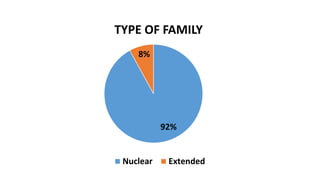
92%
8%
TYPE OF FAMILY
Nuclear Extended
98%
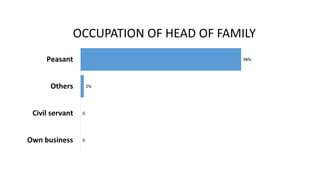
2%
0
0
Peasant
Others
Civil servant
Own business
OCCUPATION OF HEAD OF FAMILY
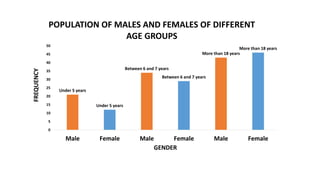
Under 5 years
Under 5 years
Between 6 and 7 years
More than 18 years
More than 18 years
0
5
10
15
20
25
30
35
40
45
50
Male Female Male Female Male Female
FREQUENCY
GENDER
POPULATION OF MALES AND FEMALES OF DIFFERENT
AGE GROUPS
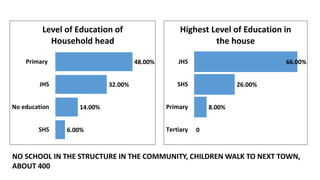
66.00%
26.00%
8.00%
0
JHS
SHS
Primary
Tertiary
Highest Level of Education in
the house
48.00%
32.00%
14.00%
6.00%
Primary
JHS
No education
SHS
Level of Education of
Household head
NO SCHOOL IN THE STRUCTURE IN THE COMMUNITY, CHILDREN WALK TO NEXT TOWN,
ABOUT 400
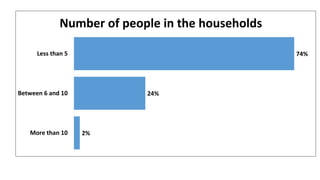
74%
24%
2%
Less than 5
Between 6 and 10
More than 10
Number of people in the households
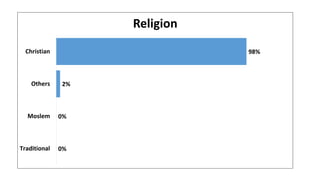
98%
2%
0%
0%
Christian
Others
Moslem
Traditional
Religion
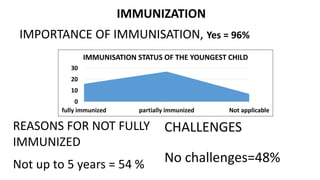
IMMUNIZATION
IMPORTANCE OF IMMUNISATION, Yes = 96%
0
10
20
30
fully immunized partially immunized Not applicable
IMMUNISATION STATUS OF THE YOUNGEST CHILD
REASONS FOR NOT FULLY
IMMUNIZED
Not up to 5 years = 54 %
CHALLENGES
No challenges=48%
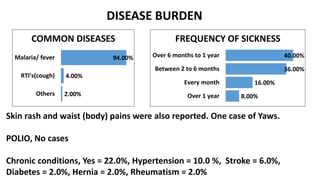
DISEASE BURDEN
94.00%
4.00%
2.00%
Malaria/ fever
RTI's(cough)
Others
COMMON DISEASES
40.00%
36.00%
16.00%
8.00%
Over 6 months to 1 year
Between 2 to 6 months
Every month
Over 1 year
FREQUENCY OF SICKNESS
Skin rash and waist (body) pains were also reported. One case of Yaws.
POLIO, No cases
Chronic conditions, Yes = 22.0%, Hypertension = 10.0 %, Stroke = 6.0%,
Diabetes = 2.0%, Hernia = 2.0%, Rheumatism = 2.0%
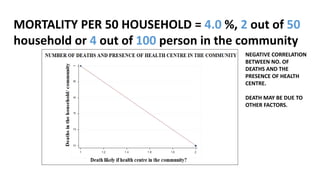
MORTALITY PER 50 HOUSEHOLD = 4.0 %, 2 out of 50
household or 4 out of 100 person in the community
NEGATIVE CORRELATION
BETWEEN NO. OF
DEATHS AND THE
PRESENCE OF HEALTH
CENTRE.
DEATH MAY BE DUE TO
OTHER FACTORS.
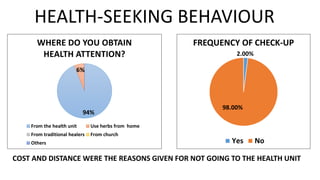
HEALTH-SEEKING BEHAVIOUR
94%
6%
WHERE DO YOU OBTAIN
HEALTH ATTENTION?
From the health unit Use herbs from home
From traditional healers From church
Others
2.00%
98.00%
FREQUENCY OF CHECK-UP
Yes No
COST AND DISTANCE WERE THE REASONS GIVEN FOR NOT GOING TO THE HEALTH UNIT
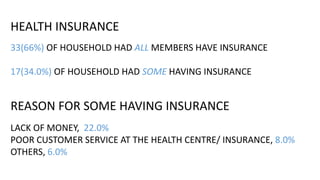
HEALTH INSURANCE
33(66%) OF HOUSEHOLD HAD ALL MEMBERS HAVE INSURANCE
17(34.0%) OF HOUSEHOLD HAD SOME HAVING INSURANCE
REASON FOR SOME HAVING INSURANCE
LACK OF MONEY, 22.0%
POOR CUSTOMER SERVICE AT THE HEALTH CENTRE/ INSURANCE, 8.0%
OTHERS, 6.0%
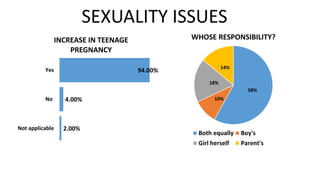
SEXUALITY ISSUES
94.00%
4.00%
2.00%
Yes
No
Not applicable
INCREASE IN TEENAGE
PREGNANCY
58%
10%
18%
14%
WHOSE RESPONSIBILITY?
Both equally Boy's
Girl herself Parent's
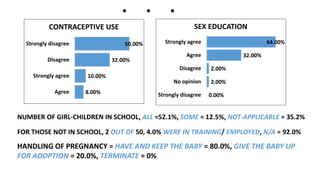
50.00%
32.00%
10.00%
8.00%
Strongly disagree
Disagree
Strongly agree
Agree
CONTRACEPTIVE USE
64.00%
32.00%
2.00%
2.00%
0.00%
Strongly agree
Agree
Disagree
No opinion
Strongly disagree
SEX EDUCATION
. . .
NUMBER OF GIRL-CHILDREN IN SCHOOL, ALL =52.1%, SOME = 12.5%, NOT-APPLICABLE = 35.2%
FOR THOSE NOT IN SCHOOL, 2 OUT OF 50, 4.0% WERE IN TRAINING/ EMPLOYED, N/A = 92.0%
HANDLING OF PREGNANCY = HAVE AND KEEP THE BABY = 80.0%, GIVE THE BABY UP
FOR ADOPTION = 20.0%, TERMINATE = 0%
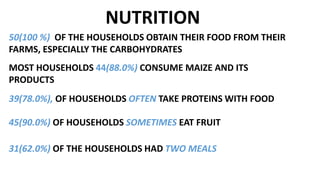
NUTRITION
50(100 %) OF THE HOUSEHOLDS OBTAIN THEIR FOOD FROM THEIR
FARMS, ESPECIALLY THE CARBOHYDRATES
MOST HOUSEHOLDS 44(88.0%) CONSUME MAIZE AND ITS
PRODUCTS
39(78.0%), OF HOUSEHOLDS OFTEN TAKE PROTEINS WITH FOOD
45(90.0%) OF HOUSEHOLDS SOMETIMES EAT FRUIT
31(62.0%) OF THE HOUSEHOLDS HAD TWO MEALS
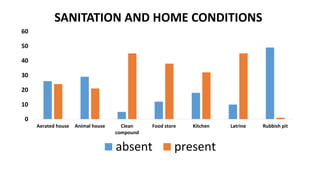
0
10
20
30
40
50
60
Aerated house Animal house Clean
compound
Food store Kitchen Latrine Rubbish pit
SANITATION AND HOME CONDITIONS
absent present
CONCLUSIONS
POSITIVES OR STRENGTHS:
• Pipe-borne/ potable water available including river
• Food security
• Communication and political leadership available
• Good health seeking behaviour
• Good nutrition
WEAKNESS/ NEGATIVE ATTRIBUTE OF THE COMMUNITY:
• Open pit-latrine
• Unavailability of rubbish pit or containers
• Food insecurity may be threatened by army worms infestation
• Goat, Sheep and animal droppings
• Poor mobile phone network and road network
• Poor transport facilities available, save motors
• Poor housing facilities, most are poorly ventilated.
• Inadequate mosquito nets and bushes around
homes
. . .
• Community health and Public health workers must heighten sex
education and find innovative ways to increase the uptake of
contraceptives
• The leaders of the community should engage the community
members with the supports of other stakeholders to build public
toilets for the community
• Schools and health centres should be built within the community,
not wholly for the usual purpose but teachers, nurses, other
health workers to stay in the community and serve as role models
for the young ones especially the girls
RECOMMENDATION
• Education on proper nutrition should be inculcated
in all health programs in order to enhance the
health of the members of the community especially,
children.
• Alternative livelihood should be seriously pursued
by the district chief executive within the community
to enhance the economic status of the members of
the community
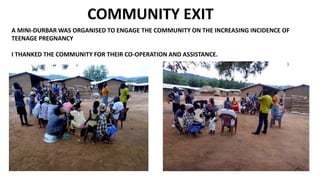
COMMUNITY EXIT
A MINI-DURBAR WAS ORGANISED TO ENGAGE THE COMMUNITY ON THE INCREASING INCIDENCE OF
TEENAGE PREGNANCY
I THANKED THE COMMUNITY FOR THEIR CO-OPERATION AND ASSISTANCE.
REFERENCE
Ahmed-Refat, R. ‘emusirepresentation-160630092540’.
‘ASOUGYAMAN DISTRICT ASSEMBLY 2011 ANNUAL PROGRESS REPORT’ (2012). Available
at: https://s3.amazonaws.com/ndpc-static/pubication/ER-+Asuogyaman_2011_APR.pdf
(Accessed: 3 September 2017).
Chicken and Cashew Nut Rice | Tes at Home (no date). Available at:
http://tesathome.com/2011/02/25/chicken-and-cashew-nut-rice/ (Accessed: 3
September 2017).
Ghana News Agency (no date) Ankyease residents laud government | Ghana News
Agency (GNA). Available at: http://www.ghananewsagency.org/politics/ankyease-
residents-laud-government-47844 (Accessed: 3 September 2017).
Patidar, J. ‘communitydiagnosis-130502005610-phpapp01’.
Salama, R. (2000) ‘Community Diagnosis’, Arch Gen Psychiatry, 57, pp. 223–224.
When ‘i’ is replace by ‘we’
even ‘illness’ becomes
‘wellness’
THANK YOU

Ankyease community diagnosis

  • 1.
    Ankyease community diagnosis, Asuogyaman District,Eastern Region of Ghana By Abass Quartey (Ensign College of Public Health, Kpong, Eastern Region, Ghana )
  • 2.
  • 3.
  • 4.
    DEFINITIONS COMMUNITY A cluster ofpeople with at least one common characteristic (geographic location, occupation, ethnicity, housing condition, etc) A group of people with a common characteristic or interest living together within a larger society
  • 5.
    Satellite location ofAnkyease (GoogleEarth, 2017)
  • 6.
    . . . COMMUNITYDIAGNOSIS It is “a quantitative and qualitative description of the health of citizens and the factors which influence their health. It identifies problems, proposes areas for improvement and stimulates action”.
  • 7.
    . . . COMMUNITYDIAGNOSIS Community diagnosis is the comprehensive assessment of the health state of an entire community in relation to its social, physical and biological environment.
  • 8.
    INTRODUCTION BRIEF HISTORY USED TOBE CALLED AHIAGBATUKOPE, AFTER AHIAGBATU THE FIRST PERSON TO SETTLE AT THE PLACE NANA DADE KOFI GAVE HIM THE LAND HE MIGRATED FROM SUIPE, DZOLOSHIE, IN THE AKATSI DISTRICT (VOLTA), 1930 HE WENT BACK TO BRING HIS BROTHER APEDO AZUMAH WHO WAS GIVEN ALONG PARCEL LAND BY NANA BAMFRO (THE FIRST) THEY WERE MAINLY FARMERS AND HUNTERS
  • 9.
    BELONG TO THEANLO ETHNIC GROUP THE CURRENT NAME ANKYEASE ORIGINATED FROM A CASHEW TREE TREE USED TO BE A POPULAR PLACE FOR MEETING THE PLANT/ TREE IS KNOWN AS “ATIA” IN TWI AND “ATSÔ IN EWE. “ASE” MEANS UNDER. “ATIA NA ASE”, MEANING UNDER THE CASHEW TREE ESTIMATED POPULATION OF ABOUT 350 SHARES BORDER WITH AFABENG, TOKUKOPE AND NEW POWMU IN THE ASUOGYAMAN DISTRICT, EASTERN REGION . . .
  • 10.
    TRADITIONAL AUTHORITY Chief ofAnkyease and it Environs, Nana Bamfro Former Odikro-Nicholas Atsitsosgbui Headman for Ankyease-Christopher Dzamade . . .
  • 11.
    Taboos No farming onMondays and Thursdays River Ayimesu not visited by women in their menses Pot are not sent to the river Occupation Farming (Maize, Cassava) As a result of clearing of land for farming they are involved in firewood business . . .
  • 12.
     Teenage pregnancy Health-care accessibility  Toilet facility/ Sanitation  Health seeking behaviours  Prevalence of chronic conditions and infectious diseases PROBLEM STATEMENT
  • 13.
    General objective.  Tocarry out the community diagnosis of Ankyease community. Specific objectives.  To determine social demographic characteristics of the community.  To assess the nutrition status of the community OBJECTIVES
  • 14.
     To assessthe sanitation and hygiene.  To identify the commonest diseases.  To assess the health seeking behavior of the people in the community.  To assess the health service delivery system in this community . . .
  • 15.
    The research willseek the following:  Will sex education and contraceptive use reduce the incidence of teenage pregnancy within the community?  How does the community/ study area impact on the health of the community?  How does nutrition, sanitation, and housing in Ankyease community influence their health status? RESEARCH QUESTION
  • 16.
     Do thestudy area reveal positive or negative impact on the health of the community?  What are the possible solutions to the negative impact on the community? . . .
  • 17.
  • 18.
    STUDY DESIGN A descriptivecross-sectional survey Primary data was sourced through interview of one member of the household. STUDY POPULATION 50 Households and their environment within the community. METHOD
  • 19.
    SAMPLE SIZE The studyinvolved 50 households sampled from within the community. SAMPLE TECHNIQUES Convenient sampling Reason Closeness of households To avoid cross-contamination
  • 20.
    DATA COLLECTION TECHNIQUES. Primarydata was collected using semi-structured questionnaire and checklist. Observations
  • 21.
    DATA ENTRY Data entryforms were created and data entered using Epi-Info 7. Data was exported to excel for cleaning and then to Stata 14 for analysis. Microsoft excel and Epi-Info 7 were used for analysis.
  • 22.
    ETHICAL CONSIDERATION A standardquestionnaire. The consent of the respondent was sought before the interview. The researcher explained the purpose of the study and the benefit thereof to the prospective respondent and the community.
  • 23.
    The prospective respondentis made to decide if he/she want to undertake the survey or not by way or yes or no question which was part of the questionnaire. No names were requested or recorded in order to ensure strict confidentiality. . . .
  • 24.
    A volunteer whowas known in the community and could properly explain the question on the questionnaires from English to Ewe and vice versa was acquired for the study. The researcher took the volunteer through the questionnaire prior to the commencement of the interview of the households . . .
  • 25.
  • 26.
  • 27.
  • 28.
    FINDINGS (RESULTS ANDDISCUSSION) Age of respondents Frequency(n=50) Percentage(%) below 5 years 0 0 6-17 years 0 0 18 and above 50 100 SOCIO-DEMOGRAPHIC FEATURES
  • 29.
    VALIDITY All the respondentswere above 18 years, thereby enhancing the strength of the information received and also makes it more reliable. . . .
  • 30.
    . . . 56% 44% GENDEROF RESPONDENT Male female
  • 31.
  • 32.
  • 33.
  • 34.
    Under 5 years Under5 years Between 6 and 7 years Between 6 and 7 years More than 18 years More than 18 years 0 5 10 15 20 25 30 35 40 45 50 Male Female Male Female Male Female FREQUENCY GENDER POPULATION OF MALES AND FEMALES OF DIFFERENT AGE GROUPS
  • 35.
    66.00% 26.00% 8.00% 0 JHS SHS Primary Tertiary Highest Level ofEducation in the house 48.00% 32.00% 14.00% 6.00% Primary JHS No education SHS Level of Education of Household head NO SCHOOL IN THE STRUCTURE IN THE COMMUNITY, CHILDREN WALK TO NEXT TOWN, ABOUT 400
  • 36.
    74% 24% 2% Less than 5 Between6 and 10 More than 10 Number of people in the households
  • 37.
  • 38.
    IMMUNIZATION IMPORTANCE OF IMMUNISATION,Yes = 96% 0 10 20 30 fully immunized partially immunized Not applicable IMMUNISATION STATUS OF THE YOUNGEST CHILD REASONS FOR NOT FULLY IMMUNIZED Not up to 5 years = 54 % CHALLENGES No challenges=48%
  • 39.
    DISEASE BURDEN 94.00% 4.00% 2.00% Malaria/ fever RTI's(cough) Others COMMONDISEASES 40.00% 36.00% 16.00% 8.00% Over 6 months to 1 year Between 2 to 6 months Every month Over 1 year FREQUENCY OF SICKNESS Skin rash and waist (body) pains were also reported. One case of Yaws. POLIO, No cases Chronic conditions, Yes = 22.0%, Hypertension = 10.0 %, Stroke = 6.0%, Diabetes = 2.0%, Hernia = 2.0%, Rheumatism = 2.0%
  • 40.
    MORTALITY PER 50HOUSEHOLD = 4.0 %, 2 out of 50 household or 4 out of 100 person in the community NEGATIVE CORRELATION BETWEEN NO. OF DEATHS AND THE PRESENCE OF HEALTH CENTRE. DEATH MAY BE DUE TO OTHER FACTORS.
  • 41.
    HEALTH-SEEKING BEHAVIOUR 94% 6% WHERE DOYOU OBTAIN HEALTH ATTENTION? From the health unit Use herbs from home From traditional healers From church Others 2.00% 98.00% FREQUENCY OF CHECK-UP Yes No COST AND DISTANCE WERE THE REASONS GIVEN FOR NOT GOING TO THE HEALTH UNIT
  • 42.
    HEALTH INSURANCE 33(66%) OFHOUSEHOLD HAD ALL MEMBERS HAVE INSURANCE 17(34.0%) OF HOUSEHOLD HAD SOME HAVING INSURANCE REASON FOR SOME HAVING INSURANCE LACK OF MONEY, 22.0% POOR CUSTOMER SERVICE AT THE HEALTH CENTRE/ INSURANCE, 8.0% OTHERS, 6.0%
  • 43.
    SEXUALITY ISSUES 94.00% 4.00% 2.00% Yes No Not applicable INCREASEIN TEENAGE PREGNANCY 58% 10% 18% 14% WHOSE RESPONSIBILITY? Both equally Boy's Girl herself Parent's
  • 44.
    50.00% 32.00% 10.00% 8.00% Strongly disagree Disagree Strongly agree Agree CONTRACEPTIVEUSE 64.00% 32.00% 2.00% 2.00% 0.00% Strongly agree Agree Disagree No opinion Strongly disagree SEX EDUCATION . . . NUMBER OF GIRL-CHILDREN IN SCHOOL, ALL =52.1%, SOME = 12.5%, NOT-APPLICABLE = 35.2% FOR THOSE NOT IN SCHOOL, 2 OUT OF 50, 4.0% WERE IN TRAINING/ EMPLOYED, N/A = 92.0% HANDLING OF PREGNANCY = HAVE AND KEEP THE BABY = 80.0%, GIVE THE BABY UP FOR ADOPTION = 20.0%, TERMINATE = 0%
  • 45.
    NUTRITION 50(100 %) OFTHE HOUSEHOLDS OBTAIN THEIR FOOD FROM THEIR FARMS, ESPECIALLY THE CARBOHYDRATES MOST HOUSEHOLDS 44(88.0%) CONSUME MAIZE AND ITS PRODUCTS 39(78.0%), OF HOUSEHOLDS OFTEN TAKE PROTEINS WITH FOOD 45(90.0%) OF HOUSEHOLDS SOMETIMES EAT FRUIT 31(62.0%) OF THE HOUSEHOLDS HAD TWO MEALS
  • 46.
    0 10 20 30 40 50 60 Aerated house Animalhouse Clean compound Food store Kitchen Latrine Rubbish pit SANITATION AND HOME CONDITIONS absent present
  • 47.
    CONCLUSIONS POSITIVES OR STRENGTHS: •Pipe-borne/ potable water available including river • Food security • Communication and political leadership available • Good health seeking behaviour • Good nutrition
  • 48.
    WEAKNESS/ NEGATIVE ATTRIBUTEOF THE COMMUNITY: • Open pit-latrine • Unavailability of rubbish pit or containers • Food insecurity may be threatened by army worms infestation • Goat, Sheep and animal droppings • Poor mobile phone network and road network
  • 49.
    • Poor transportfacilities available, save motors • Poor housing facilities, most are poorly ventilated. • Inadequate mosquito nets and bushes around homes . . .
  • 50.
    • Community healthand Public health workers must heighten sex education and find innovative ways to increase the uptake of contraceptives • The leaders of the community should engage the community members with the supports of other stakeholders to build public toilets for the community • Schools and health centres should be built within the community, not wholly for the usual purpose but teachers, nurses, other health workers to stay in the community and serve as role models for the young ones especially the girls RECOMMENDATION
  • 51.
    • Education onproper nutrition should be inculcated in all health programs in order to enhance the health of the members of the community especially, children. • Alternative livelihood should be seriously pursued by the district chief executive within the community to enhance the economic status of the members of the community
  • 52.
    COMMUNITY EXIT A MINI-DURBARWAS ORGANISED TO ENGAGE THE COMMUNITY ON THE INCREASING INCIDENCE OF TEENAGE PREGNANCY I THANKED THE COMMUNITY FOR THEIR CO-OPERATION AND ASSISTANCE.
  • 53.
    REFERENCE Ahmed-Refat, R. ‘emusirepresentation-160630092540’. ‘ASOUGYAMANDISTRICT ASSEMBLY 2011 ANNUAL PROGRESS REPORT’ (2012). Available at: https://s3.amazonaws.com/ndpc-static/pubication/ER-+Asuogyaman_2011_APR.pdf (Accessed: 3 September 2017). Chicken and Cashew Nut Rice | Tes at Home (no date). Available at: http://tesathome.com/2011/02/25/chicken-and-cashew-nut-rice/ (Accessed: 3 September 2017). Ghana News Agency (no date) Ankyease residents laud government | Ghana News Agency (GNA). Available at: http://www.ghananewsagency.org/politics/ankyease- residents-laud-government-47844 (Accessed: 3 September 2017). Patidar, J. ‘communitydiagnosis-130502005610-phpapp01’. Salama, R. (2000) ‘Community Diagnosis’, Arch Gen Psychiatry, 57, pp. 223–224.
  • 54.
    When ‘i’ isreplace by ‘we’ even ‘illness’ becomes ‘wellness’ THANK YOU