Maternal Death Surveillance
and Response
Dr. Mitasha Singh
Contents
• Definitions
• Global and Indian scenario
• Future target to reduce maternal deaths
• Causes and barriers
• Method of estimation
• MDSR-goals and objective
• Steps of MDSR
• MDSR Implementation plan
• Women in reproductive age group (15-49 year
age group) constitute 55.1% of total
population.
• Maternal health refers to the health of women
during pregnancy, childbirth and the
postpartum period.
Maternal death
• Definition
• Maternal death is the death of a woman while
pregnant or within 42 days of termination of
pregnancy, irrespective of the duration and site of the
pregnancy, from any cause related to or aggravated by
the pregnancy or its management but not from
accidental or incidental causes.
Maternal Mortality Ratio
• The maternal mortality ratio represents the risk
associated with each pregnancy, i.e. the
obstetric risk.
• It is also a MDG indicator.
• The MMR is defined as the number of
maternal deaths during a given time period per
100,000 live births during the same time
period.
Maternal mortality rate
(MMRate)
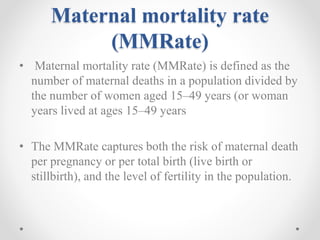
• Maternal mortality rate (MMRate) is defined as the
number of maternal deaths in a population divided by
the number of women aged 15–49 years (or woman
years lived at ages 15–49 years
• The MMRate captures both the risk of maternal death
per pregnancy or per total birth (live birth or
stillbirth), and the level of fertility in the population.
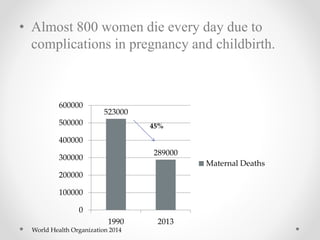
• Almost 800 women die every day due to
complications in pregnancy and childbirth.
523000
289000
0
100000
200000
300000
400000
500000
600000
1990 2013
Maternal Deaths
45%
World Health Organization 2014
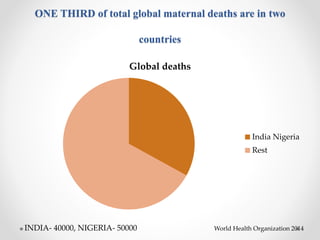
ONE THIRD of total global maternal deaths are in two
countries
Global deaths
India Nigeria
Rest
INDIA- 40000, NIGERIA- 50000 World Health Organization 2014
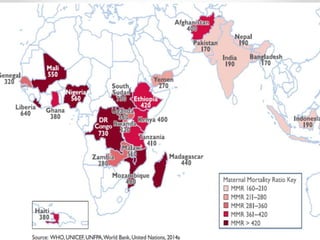
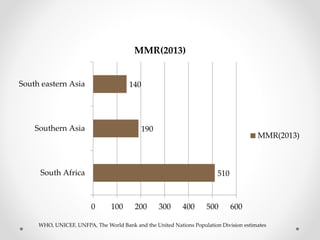
510
190
140
0 100 200 300 400 500 600
South Africa
Southern Asia
South eastern Asia
MMR(2013)
MMR(2013)
WHO, UNICEF, UNFPA, The World Bank and the United Nations Population Division estimates
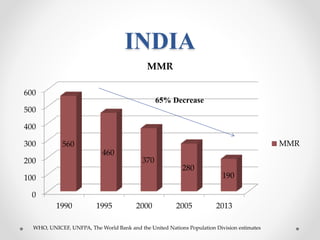
INDIA
0
100
200
300
400
500
600
1990 1995 2000 2005 2013
560
460
370
280
190
MMR
MMR
65% Decrease
WHO, UNICEF, UNFPA, The World Bank and the United Nations Population Division estimates
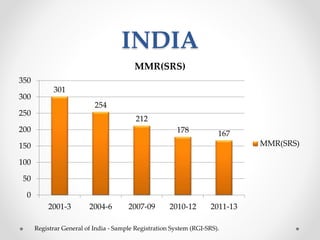
INDIA
301
254
212
178 167
0
50
100
150
200
250
300
350
2001-3 2004-6 2007-09 2010-12 2011-13
MMR(SRS)
MMR(SRS)
Registrar General of India - Sample Registration System (RGI-SRS).
MDG 5: Improve maternal health
• Target 5.A. Reduce by three quarters, between 1990
and 2015, the maternal mortality ratio
• maternal mortality has fallen by 45 percent over the past 2
decades.
• Target 5.B. Achieve, by 2015, universal access to
reproductive health
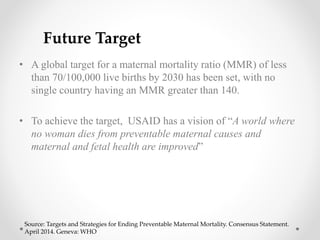
• A global target for a maternal mortality ratio (MMR) of less
than 70/100,000 live births by 2030 has been set, with no
single country having an MMR greater than 140.
• To achieve the target, USAID has a vision of “A world where
no woman dies from preventable maternal causes and
maternal and fetal health are improved”
Source: Targets and Strategies for Ending Preventable Maternal Mortality. Consensus Statement.
April 2014. Geneva: WHO
Future Target
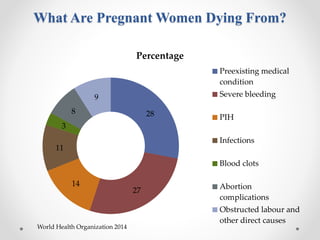
What Are Pregnant Women Dying From?
28
27
14
11
3
8
9
Percentage
Preexisting medical
condition
Severe bleeding
PIH
Infections
Blood clots
Abortion
complications
Obstructed labour and
other direct causes
World Health Organization 2014
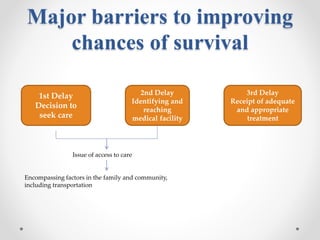
Major barriers to improving
chances of survival
1st Delay
Decision to
seek care
2nd Delay
Identifying and
reaching
medical facility
3rd Delay
Receipt of adequate
and appropriate
treatment
Issue of access to care
Encompassing factors in the family and community,
including transportation
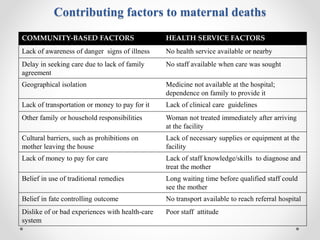
Contributing factors to maternal deaths
COMMUNITY-BASED FACTORS HEALTH SERVICE FACTORS
Lack of awareness of danger signs of illness No health service available or nearby
Delay in seeking care due to lack of family
agreement
No staff available when care was sought
Geographical isolation Medicine not available at the hospital;
dependence on family to provide it
Lack of transportation or money to pay for it Lack of clinical care guidelines
Other family or household responsibilities Woman not treated immediately after arriving
at the facility
Cultural barriers, such as prohibitions on
mother leaving the house
Lack of necessary supplies or equipment at the
facility
Lack of money to pay for care Lack of staff knowledge/skills to diagnose and
treat the mother
Belief in use of traditional remedies Long waiting time before qualified staff could
see the mother
Belief in fate controlling outcome No transport available to reach referral hospital
Dislike of or bad experiences with health-care
system
Poor staff attitude
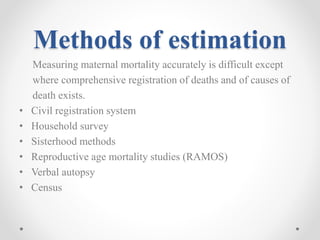
Methods of estimation
Measuring maternal mortality accurately is difficult except
where comprehensive registration of deaths and of causes of
death exists.
• Civil registration system
• Household survey
• Sisterhood methods
• Reproductive age mortality studies (RAMOS)
• Verbal autopsy
• Census
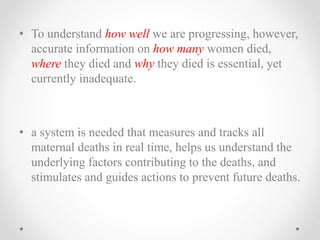
• To understand how well we are progressing, however,
accurate information on how many women died,
where they died and why they died is essential, yet
currently inadequate.
• a system is needed that measures and tracks all
maternal deaths in real time, helps us understand the
underlying factors contributing to the deaths, and
stimulates and guides actions to prevent future deaths.
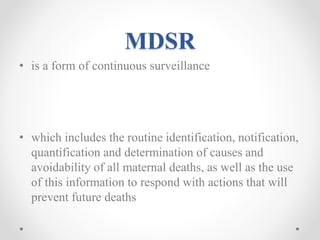
MDSR
• is a form of continuous surveillance
• which includes the routine identification, notification,
quantification and determination of causes and
avoidability of all maternal deaths, as well as the use
of this information to respond with actions that will
prevent future deaths
• The primary goal of MDSR is to eliminate
preventable maternal mortality.
• Because each death provides information that, if
acted on, can prevent future deaths.
• emphasizes the link between information and
response.
• the measurement of maternal mortality ratios and the
real-time monitoring of trends that provide countries
with evidence about the effectiveness of
interventions.
• The overall objectives of MDSR are
• to provide information that effectively guides immediate as
well as longer term actions to reduce maternal mortality; and
• to count every maternal death, permitting an assessment of the
true magnitude of maternal mortality and the impact of actions
to reduce it.
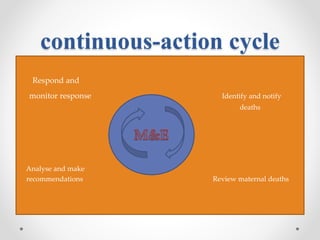
continuous-action cycle
Respond and
monitor response Identify and notify
deaths
Analyse and make
recommendations Review maternal deaths
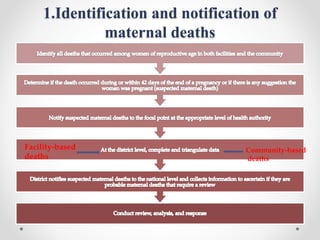
1.Identification and notification of
maternal deaths
Facility-based
deaths
Community-based
deaths
Maternal death – a notifiable event
• classifying an event or disease as notifiable means it
must be reported to the authorities within 24 hours
and followed up by a more thorough report of
medical causes and contributing factors.
• Notification should be systematic, including absence
of cases (“zero reporting”).
Sources of information
• Healthcare facilities (where women give birth and
are attended when they have pregnancy
complications) and
• communities (when women give birth at home or on
the way to a health-care facility or die during
pregnancy without receiving medical care).
Identification and notification of suspected and probable
maternal deaths in health facilities
• usually easier to identify
• to ensure that none are missed- someone should have a daily
responsibility to check death logs and other records from the
previous 24 hours and collect a line listing of deaths of all
WRA.
• Any death of a WRA should trigger a review of her medical
record to look for evidence that she could have been pregnant
or within 42 days of the end of a pregnancy.
Identification and notification of suspected
maternal deaths in the community
• by community health workers (CHW) or, in their
absence, by other community representatives.
• This process is more complicated than reporting from
health facilities for several reasons:
• 1) Deaths are far less frequent, and communities will need periodic
reminders about their importance and the reporting process;
• 2) supervising every single community is difficult, especially if there are no
CHWs; and
• 3) there may be no way to report quickly.
Innovative uses of technology for
maternal death notification
• Personal digital assistant devices and tablet
computers are becoming more affordable and offer
additional benefits to data collection.
• Programmes such as mHealth and Epi Info 7.0 offer
options for data collection and entry on mobile
devices, including touch-screen questionnaires,
photographs, and GIS coordinates
2.Maternal death review
• World Health Organization’s publication of Beyond the
Numbers (BTN) in 2004, defined MDR as “qualitative, in-
depth investigation of the causes of, and circumstances
surrounding, maternal deaths” and includes methods designed
for reviewing deaths that occur in both health-care facilities
and communities.
• Implemented and institutionalized by all states of India as a
policy since 2010.
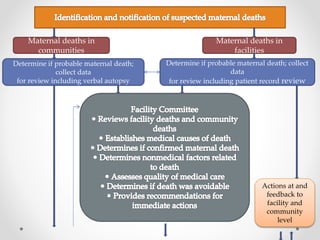
Maternal deaths in
communities
Maternal deaths in
facilities
Determine if probable maternal death;
collect data
for review including verbal autopsy
Determine if probable maternal death; collect
data
for review including patient record review
Actions at and
feedback to
facility and
community
level
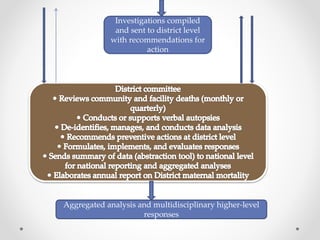
Investigations compiled
and sent to district level
with recommendations for
action
Aggregated analysis and multidisciplinary higher-level
responses
Tamil Nadu
• Tamil Nadu initiated identification and compulsory reporting
of maternal deaths in 1994.
• It was mandated that each and every maternal death be
reported by the Village Health Nurse working at the level of
the Health Sub-Centre, the medical officers of primary health
centers, first referral unit (FRU) and non-FRU government
hospitals, district public health nurses, and Deputy Directors of
Health Services.
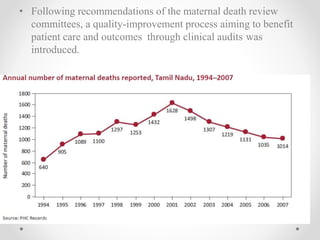
• Following recommendations of the maternal death review
committees, a quality-improvement process aiming to benefit
patient care and outcomes through clinical audits was
introduced.
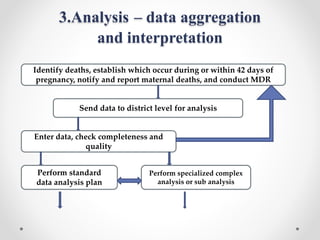
3.Analysis – data aggregation
and interpretation
Identify deaths, establish which occur during or within 42 days of
pregnancy, notify and report maternal deaths, and conduct MDR
Send data to district level for analysis
Enter data, check completeness and
quality
Perform standard
data analysis plan
Perform specialized complex
analysis or sub analysis
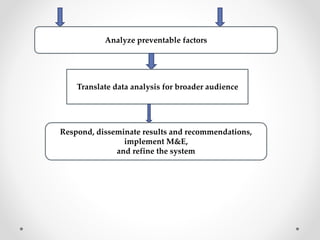
Analyze preventable factors
Translate data analysis for broader audience
Respond, disseminate results and recommendations,
implement M&E,
and refine the system
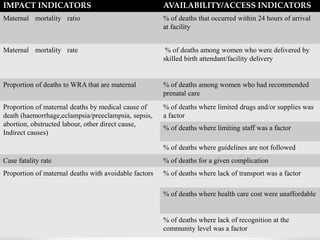
IMPACT INDICATORS AVAILABILITY/ACCESS INDICATORS
Maternal mortality ratio % of deaths that occurred within 24 hours of arrival
at facility
Maternal mortality rate % of deaths among women who were delivered by
skilled birth attendant/facility delivery
Proportion of deaths to WRA that are maternal % of deaths among women who had recommended
prenatal care
Proportion of maternal deaths by medical cause of
death (haemorrhage,eclampsia/preeclampsia, sepsis,
abortion, obstructed labour, other direct cause,
Indirect causes)
% of deaths where limited drugs and/or supplies was
a factor
% of deaths where limiting staff was a factor
% of deaths where guidelines are not followed
Case fatality rate % of deaths for a given complication
Proportion of maternal deaths with avoidable factors % of deaths where lack of transport was a factor
% of deaths where health care cost were unaffordable
% of deaths where lack of recognition at the
community level was a factor
Descriptive analysis of maternal deaths
• Women: Age group, race/ethnicity, gravidity/parity, gestational age at time of death,
pregnancy outcome (undelivered, stillbirth, live birth), socioeconomic status of family,
education
• Place: Where family lived (urban or rural, district/sub-district, town or village); where
woman died
• Time: Date of death (day, month, year), time of day when death occurred, weekday or
weekend, season when death occurred
• ANC: Week or month of pregnancy when the woman first attended antenatal care, how many
visits, type of care provider and type of place, distance of facility from place of residence
• Delivery: Date and time of birth, day of the week, season, place of delivery, type of place,
type of delivery attendant, type of delivery (vaginal, forceps, caesarean)
• Data source: Notification only, facility-based review, verbal autopsy
• Medical cause of death
• Contributing factors and preventability
4.Response
• types of responses that may be needed to address the
problems found by MDSR and discusses criteria that
can be used to prioritize recommendations for action,
the primary MDSR objective.
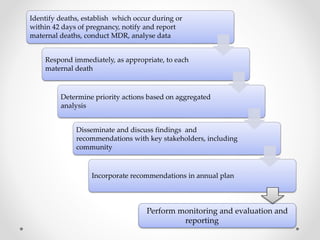
Identify deaths, establish which occur during or
within 42 days of pregnancy, notify and report
maternal deaths, conduct MDR, analyse data
Respond immediately, as appropriate, to each
maternal death
Determine priority actions based on aggregated
analysis
Disseminate and discuss findings and
recommendations with key stakeholders, including
community
Incorporate recommendations in annual plan
Perform monitoring and evaluation and
reporting
Guiding principles for response
• Start with the avoidable factors identified during the review
process
• Use evidence-based approaches
• Prioritize (based on prevalence, feasibility, costs, resources,
health-system readiness, health impact)
• Establish a timeline (immediate or short-, medium-, or long-
term)
• Decide how to monitor progress, effectiveness, impact
• Integrate recommendations within annual health plans and
health-system packages
• Monitor to ensure that recommendations are being
implemented
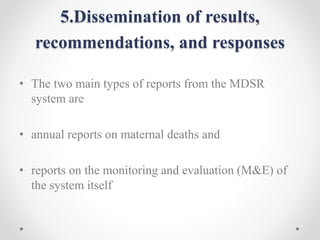
5.Dissemination of results,
recommendations, and responses
• The two main types of reports from the MDSR
system are
• annual reports on maternal deaths and
• reports on the monitoring and evaluation (M&E) of
the system itself
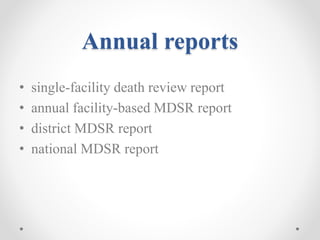
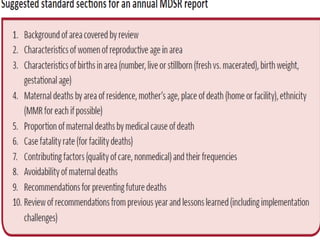
Annual reports
• single-facility death review report
• annual facility-based MDSR report
• district MDSR report
• national MDSR report
Whom to inform of the results
The general principle is to get the key messages to those who can
implement the findings and make a real difference towards saving
mothers’ lives. They may include:
• Ministries of Health;
• local, regional, or national health-care planners, policy-makers, and
politicians;
• professional organizations and their members, including obstetricians,
midwives, pediatricians, general physicians, anesthetists, and pathologists
who are involved at each level;
• medical directors and chief executive officers;
• leaders in other health-care systems, such as social security and the private
sector;
• health promotion and education experts;
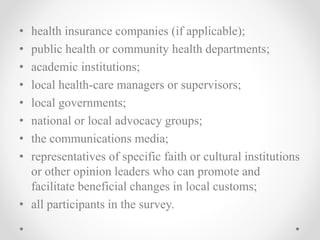
• health insurance companies (if applicable);
• public health or community health departments;
• academic institutions;
• local health-care managers or supervisors;
• local governments;
• national or local advocacy groups;
• the communications media;
• representatives of specific faith or cultural institutions
or other opinion leaders who can promote and
facilitate beneficial changes in local customs;
• all participants in the survey.
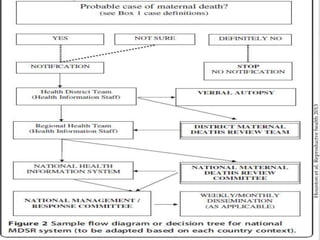
Hountonetal.Reproductvehealth2013
6.Monitoring and Evaluation of the MDSR
system
• A periodic evaluation should examine how efficient the system
is.
• This includes an assessment of its key processes: identification
and notification, review, analysis, reporting and response, and
whether there are barriers to their operation that should be
addressed.
• Evaluation of effectiveness determines if the correct
recommendations for action have been implemented, if they
are achieving the desired results and, if not, where any
problems may lie.
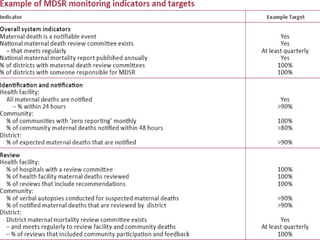
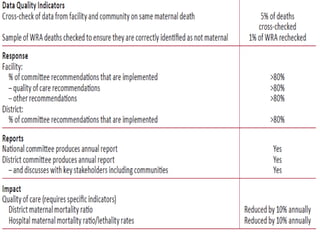
• A monitoring framework with indicators should be agreed to
and indicators assessed annually. A sample framework, with
indicators, is shown in next slide.
Development of an MDSR
implementation plan
• The final structure and scope of MDSR will differ
according to the local context and challenges.
• A classic approach in planning a standard public health
surveillance system is illustrated below
• 1.Establish objectives
• 2.Develop case definitions
• 3.Determine data sources and the data-collection mechanism
• 4.Determine data-collection instruments
• 5.Field-test methods
• 6.Develop and test analytical approach
• 7.Identify dissemination mechanisms
• 8.Assure use of analysis and interpretation
“women are not dying of diseases we cannot treat … they are dying
because societies have yet to make the decision that their lives are worth
saving.” – Mahmoud Fathalla
Thank You

Mdsr final

  • 1.
    Maternal Death Surveillance andResponse Dr. Mitasha Singh
  • 2.
    Contents • Definitions • Globaland Indian scenario • Future target to reduce maternal deaths • Causes and barriers • Method of estimation • MDSR-goals and objective • Steps of MDSR • MDSR Implementation plan
  • 3.
    • Women inreproductive age group (15-49 year age group) constitute 55.1% of total population. • Maternal health refers to the health of women during pregnancy, childbirth and the postpartum period.
  • 4.
    Maternal death • Definition •Maternal death is the death of a woman while pregnant or within 42 days of termination of pregnancy, irrespective of the duration and site of the pregnancy, from any cause related to or aggravated by the pregnancy or its management but not from accidental or incidental causes.
  • 5.
    Maternal Mortality Ratio •The maternal mortality ratio represents the risk associated with each pregnancy, i.e. the obstetric risk. • It is also a MDG indicator. • The MMR is defined as the number of maternal deaths during a given time period per 100,000 live births during the same time period.
  • 6.
    Maternal mortality rate (MMRate) •Maternal mortality rate (MMRate) is defined as the number of maternal deaths in a population divided by the number of women aged 15–49 years (or woman years lived at ages 15–49 years • The MMRate captures both the risk of maternal death per pregnancy or per total birth (live birth or stillbirth), and the level of fertility in the population.
  • 7.
    • Almost 800women die every day due to complications in pregnancy and childbirth. 523000 289000 0 100000 200000 300000 400000 500000 600000 1990 2013 Maternal Deaths 45% World Health Organization 2014
  • 8.
    ONE THIRD oftotal global maternal deaths are in two countries Global deaths India Nigeria Rest INDIA- 40000, NIGERIA- 50000 World Health Organization 2014
  • 10.
    510 190 140 0 100 200300 400 500 600 South Africa Southern Asia South eastern Asia MMR(2013) MMR(2013) WHO, UNICEF, UNFPA, The World Bank and the United Nations Population Division estimates
  • 11.
    INDIA 0 100 200 300 400 500 600 1990 1995 20002005 2013 560 460 370 280 190 MMR MMR 65% Decrease WHO, UNICEF, UNFPA, The World Bank and the United Nations Population Division estimates
  • 12.
    INDIA 301 254 212 178 167 0 50 100 150 200 250 300 350 2001-3 2004-62007-09 2010-12 2011-13 MMR(SRS) MMR(SRS) Registrar General of India - Sample Registration System (RGI-SRS).
  • 14.
    MDG 5: Improvematernal health • Target 5.A. Reduce by three quarters, between 1990 and 2015, the maternal mortality ratio • maternal mortality has fallen by 45 percent over the past 2 decades. • Target 5.B. Achieve, by 2015, universal access to reproductive health
  • 15.
    • A globaltarget for a maternal mortality ratio (MMR) of less than 70/100,000 live births by 2030 has been set, with no single country having an MMR greater than 140. • To achieve the target, USAID has a vision of “A world where no woman dies from preventable maternal causes and maternal and fetal health are improved” Source: Targets and Strategies for Ending Preventable Maternal Mortality. Consensus Statement. April 2014. Geneva: WHO Future Target
  • 16.
    What Are PregnantWomen Dying From? 28 27 14 11 3 8 9 Percentage Preexisting medical condition Severe bleeding PIH Infections Blood clots Abortion complications Obstructed labour and other direct causes World Health Organization 2014
  • 18.
    Major barriers toimproving chances of survival 1st Delay Decision to seek care 2nd Delay Identifying and reaching medical facility 3rd Delay Receipt of adequate and appropriate treatment Issue of access to care Encompassing factors in the family and community, including transportation
  • 19.
    Contributing factors tomaternal deaths COMMUNITY-BASED FACTORS HEALTH SERVICE FACTORS Lack of awareness of danger signs of illness No health service available or nearby Delay in seeking care due to lack of family agreement No staff available when care was sought Geographical isolation Medicine not available at the hospital; dependence on family to provide it Lack of transportation or money to pay for it Lack of clinical care guidelines Other family or household responsibilities Woman not treated immediately after arriving at the facility Cultural barriers, such as prohibitions on mother leaving the house Lack of necessary supplies or equipment at the facility Lack of money to pay for care Lack of staff knowledge/skills to diagnose and treat the mother Belief in use of traditional remedies Long waiting time before qualified staff could see the mother Belief in fate controlling outcome No transport available to reach referral hospital Dislike of or bad experiences with health-care system Poor staff attitude
  • 20.
    Methods of estimation Measuringmaternal mortality accurately is difficult except where comprehensive registration of deaths and of causes of death exists. • Civil registration system • Household survey • Sisterhood methods • Reproductive age mortality studies (RAMOS) • Verbal autopsy • Census
  • 21.
    • To understandhow well we are progressing, however, accurate information on how many women died, where they died and why they died is essential, yet currently inadequate. • a system is needed that measures and tracks all maternal deaths in real time, helps us understand the underlying factors contributing to the deaths, and stimulates and guides actions to prevent future deaths.
  • 22.
    MDSR • is aform of continuous surveillance • which includes the routine identification, notification, quantification and determination of causes and avoidability of all maternal deaths, as well as the use of this information to respond with actions that will prevent future deaths
  • 23.
    • The primarygoal of MDSR is to eliminate preventable maternal mortality. • Because each death provides information that, if acted on, can prevent future deaths. • emphasizes the link between information and response. • the measurement of maternal mortality ratios and the real-time monitoring of trends that provide countries with evidence about the effectiveness of interventions.
  • 24.
    • The overallobjectives of MDSR are • to provide information that effectively guides immediate as well as longer term actions to reduce maternal mortality; and • to count every maternal death, permitting an assessment of the true magnitude of maternal mortality and the impact of actions to reduce it.
  • 25.
    continuous-action cycle Respond and monitorresponse Identify and notify deaths Analyse and make recommendations Review maternal deaths
  • 26.
    1.Identification and notificationof maternal deaths Facility-based deaths Community-based deaths
  • 27.
    Maternal death –a notifiable event • classifying an event or disease as notifiable means it must be reported to the authorities within 24 hours and followed up by a more thorough report of medical causes and contributing factors. • Notification should be systematic, including absence of cases (“zero reporting”).
  • 28.
    Sources of information •Healthcare facilities (where women give birth and are attended when they have pregnancy complications) and • communities (when women give birth at home or on the way to a health-care facility or die during pregnancy without receiving medical care).
  • 29.
    Identification and notificationof suspected and probable maternal deaths in health facilities • usually easier to identify • to ensure that none are missed- someone should have a daily responsibility to check death logs and other records from the previous 24 hours and collect a line listing of deaths of all WRA. • Any death of a WRA should trigger a review of her medical record to look for evidence that she could have been pregnant or within 42 days of the end of a pregnancy.
  • 30.
    Identification and notificationof suspected maternal deaths in the community • by community health workers (CHW) or, in their absence, by other community representatives. • This process is more complicated than reporting from health facilities for several reasons: • 1) Deaths are far less frequent, and communities will need periodic reminders about their importance and the reporting process; • 2) supervising every single community is difficult, especially if there are no CHWs; and • 3) there may be no way to report quickly.
  • 31.
    Innovative uses oftechnology for maternal death notification • Personal digital assistant devices and tablet computers are becoming more affordable and offer additional benefits to data collection. • Programmes such as mHealth and Epi Info 7.0 offer options for data collection and entry on mobile devices, including touch-screen questionnaires, photographs, and GIS coordinates
  • 32.
    2.Maternal death review •World Health Organization’s publication of Beyond the Numbers (BTN) in 2004, defined MDR as “qualitative, in- depth investigation of the causes of, and circumstances surrounding, maternal deaths” and includes methods designed for reviewing deaths that occur in both health-care facilities and communities. • Implemented and institutionalized by all states of India as a policy since 2010.
  • 33.
    Maternal deaths in communities Maternaldeaths in facilities Determine if probable maternal death; collect data for review including verbal autopsy Determine if probable maternal death; collect data for review including patient record review Actions at and feedback to facility and community level
  • 34.
    Investigations compiled and sentto district level with recommendations for action Aggregated analysis and multidisciplinary higher-level responses
  • 35.
    Tamil Nadu • TamilNadu initiated identification and compulsory reporting of maternal deaths in 1994. • It was mandated that each and every maternal death be reported by the Village Health Nurse working at the level of the Health Sub-Centre, the medical officers of primary health centers, first referral unit (FRU) and non-FRU government hospitals, district public health nurses, and Deputy Directors of Health Services.
  • 36.
    • Following recommendationsof the maternal death review committees, a quality-improvement process aiming to benefit patient care and outcomes through clinical audits was introduced.
  • 37.
    3.Analysis – dataaggregation and interpretation Identify deaths, establish which occur during or within 42 days of pregnancy, notify and report maternal deaths, and conduct MDR Send data to district level for analysis Enter data, check completeness and quality Perform standard data analysis plan Perform specialized complex analysis or sub analysis
  • 38.
    Analyze preventable factors Translatedata analysis for broader audience Respond, disseminate results and recommendations, implement M&E, and refine the system
  • 39.
    IMPACT INDICATORS AVAILABILITY/ACCESSINDICATORS Maternal mortality ratio % of deaths that occurred within 24 hours of arrival at facility Maternal mortality rate % of deaths among women who were delivered by skilled birth attendant/facility delivery Proportion of deaths to WRA that are maternal % of deaths among women who had recommended prenatal care Proportion of maternal deaths by medical cause of death (haemorrhage,eclampsia/preeclampsia, sepsis, abortion, obstructed labour, other direct cause, Indirect causes) % of deaths where limited drugs and/or supplies was a factor % of deaths where limiting staff was a factor % of deaths where guidelines are not followed Case fatality rate % of deaths for a given complication Proportion of maternal deaths with avoidable factors % of deaths where lack of transport was a factor % of deaths where health care cost were unaffordable % of deaths where lack of recognition at the community level was a factor
  • 40.
    Descriptive analysis ofmaternal deaths • Women: Age group, race/ethnicity, gravidity/parity, gestational age at time of death, pregnancy outcome (undelivered, stillbirth, live birth), socioeconomic status of family, education • Place: Where family lived (urban or rural, district/sub-district, town or village); where woman died • Time: Date of death (day, month, year), time of day when death occurred, weekday or weekend, season when death occurred • ANC: Week or month of pregnancy when the woman first attended antenatal care, how many visits, type of care provider and type of place, distance of facility from place of residence • Delivery: Date and time of birth, day of the week, season, place of delivery, type of place, type of delivery attendant, type of delivery (vaginal, forceps, caesarean) • Data source: Notification only, facility-based review, verbal autopsy • Medical cause of death • Contributing factors and preventability
  • 41.
    4.Response • types ofresponses that may be needed to address the problems found by MDSR and discusses criteria that can be used to prioritize recommendations for action, the primary MDSR objective.
  • 42.
    Identify deaths, establishwhich occur during or within 42 days of pregnancy, notify and report maternal deaths, conduct MDR, analyse data Respond immediately, as appropriate, to each maternal death Determine priority actions based on aggregated analysis Disseminate and discuss findings and recommendations with key stakeholders, including community Incorporate recommendations in annual plan Perform monitoring and evaluation and reporting
  • 43.
    Guiding principles forresponse • Start with the avoidable factors identified during the review process • Use evidence-based approaches • Prioritize (based on prevalence, feasibility, costs, resources, health-system readiness, health impact) • Establish a timeline (immediate or short-, medium-, or long- term) • Decide how to monitor progress, effectiveness, impact • Integrate recommendations within annual health plans and health-system packages • Monitor to ensure that recommendations are being implemented
  • 44.
    5.Dissemination of results, recommendations,and responses • The two main types of reports from the MDSR system are • annual reports on maternal deaths and • reports on the monitoring and evaluation (M&E) of the system itself
  • 45.
    Annual reports • single-facilitydeath review report • annual facility-based MDSR report • district MDSR report • national MDSR report
  • 47.
    Whom to informof the results The general principle is to get the key messages to those who can implement the findings and make a real difference towards saving mothers’ lives. They may include: • Ministries of Health; • local, regional, or national health-care planners, policy-makers, and politicians; • professional organizations and their members, including obstetricians, midwives, pediatricians, general physicians, anesthetists, and pathologists who are involved at each level; • medical directors and chief executive officers; • leaders in other health-care systems, such as social security and the private sector; • health promotion and education experts;
  • 48.
    • health insurancecompanies (if applicable); • public health or community health departments; • academic institutions; • local health-care managers or supervisors; • local governments; • national or local advocacy groups; • the communications media; • representatives of specific faith or cultural institutions or other opinion leaders who can promote and facilitate beneficial changes in local customs; • all participants in the survey.
  • 49.
  • 50.
    6.Monitoring and Evaluationof the MDSR system • A periodic evaluation should examine how efficient the system is. • This includes an assessment of its key processes: identification and notification, review, analysis, reporting and response, and whether there are barriers to their operation that should be addressed.
  • 51.
    • Evaluation ofeffectiveness determines if the correct recommendations for action have been implemented, if they are achieving the desired results and, if not, where any problems may lie. • A monitoring framework with indicators should be agreed to and indicators assessed annually. A sample framework, with indicators, is shown in next slide.
  • 54.
    Development of anMDSR implementation plan • The final structure and scope of MDSR will differ according to the local context and challenges. • A classic approach in planning a standard public health surveillance system is illustrated below • 1.Establish objectives • 2.Develop case definitions • 3.Determine data sources and the data-collection mechanism • 4.Determine data-collection instruments • 5.Field-test methods • 6.Develop and test analytical approach • 7.Identify dissemination mechanisms • 8.Assure use of analysis and interpretation
  • 55.
    “women are notdying of diseases we cannot treat … they are dying because societies have yet to make the decision that their lives are worth saving.” – Mahmoud Fathalla Thank You

Editor's Notes

  • #16 In April 2014, the World Health Organization, Maternal Health Task Force, United Nations Population Fund, USAID and the Maternal Child Health Integrated Program, and representatives from 30 countries agreed on
  • #19 Delay in deciding to seek care and delay in reaching appropriate care relate directly to the issue of access to care, encompassing factors in the family and the community, including transportation. The third delay (delay in receiving care) relates to factors in the healthcare facility, which is the most critical for programmes to address.
  • #20 Documenting the frequency of health service and nonmedical factors that have contributed to the maternal deaths is a priority in MDSR analysis
  • #26 Monitoring and evaluation of the MDSR system takes place to improve the quality and completeness of information.
  • #27 Triangulation of data between sources using personal identifiers helps ensure each death is reported only once. Designating a focal point, usually someone at the sub-district or district, can ensure there is no duplication.
  • #34 MDR processes within MDSR Deaths among women of reproductive age, not clearly due to incidental or accidental causes, constitute probable maternal deaths, and should be submitted to the maternal death review committee for review.
  • #37 The apparent increase in the number of maternal deaths between 1994 and 2001 seen in the graph reflects improvements in reporting due to a better surveillance system.
  • #40 MDSR indicators
  • #41 As in other mortality surveillance systems, MDSR should include basic descriptive analyses by person, place, and time.