DR MONIKA KHURANA ARTWANI
17 January 2023 | Presentation
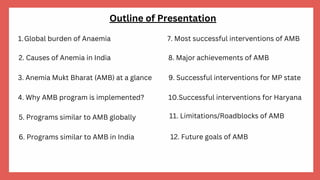
Outline of Presentation
Global burden of Anaemia
1.
2. Causes of Anemia in India
3. Anemia Mukt Bharat (AMB) at a glance
4. Why AMB program is implemented?
5. Programs similar to AMB globally
6. Programs similar to AMB in India
11. Limitations/Roadblocks of AMB
7. Most successful interventions of AMB
9. Successful interventions for MP state
10.Successful interventions for Haryana
8. Major achievements of AMB
12. Future goals of AMB
Global burden of Anemia
Anemia affecting around 1.9 billion people worldwide.[1]
90% of cases are in developing countries [2]
Africa and Asia accounts for 85% of anaemia cases [2]
James, Spencer L., et al. "Global, regional, and national incidence, prevalence, and years lived with disability for 354 diseases and injuries for 195 countries and territories, 1990–2017: a systematic analysis for the Global Burden of Disease
Study 2017." The Lancet 392.10159 (2018): 1789-1858.
De Benoist, Bruno, et al. "Worldwide prevalence of anaemia 1993-2005; WHO global database of anaemia." (2008).
Reference:
1.
2.
According to WHO Anaemia is a condition in which the number of red
blood cells or the haemoglobin concentration within them is lower than
normal.
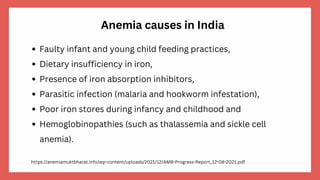
Anemia causes in India
Faulty infant and young child feeding practices,
Dietary insufficiency in iron,
Presence of iron absorption inhibitors,
Parasitic infection (malaria and hookworm infestation),
Poor iron stores during infancy and childhood and
Hemoglobinopathies (such as thalassemia and sickle cell
anemia).
https://anemiamuktbharat.info/wp-content/uploads/2021/12/AMB-Progress-Report_12-08-2021.pdf
Anemia Mukt Bharat at a glance
Program launched in 2018
Also known as INTENSIFIED NATIONAL IRON PLUS INITIATIVE (I-NIPI)
Complying with targets of POSHAN abhiyaan and National Nutrition Strategy
set by NITI Aayog
Main objective: Reduce the prevalence of anemia by 3% points per year
among children, adolescents and women in the reproductive age group(15–
49 years).
Why AMB program is implemented at National Level?
Anaemia & Sustainable development goals 2030
SDG Goal 1: No poverty
Anemia is estimated to contribute to 17% lower productivity in
heavy manual labour and 5% lower productivity in other manual
labors.
SDG Goal 2: Zero hunger
Anemia is part of "all forms of malnutrition" which is committed
to be end by 2030 and addressing, by 2025, the nutritional needs
of adolescents girls, pregnant and lactating women. (Target 2.2)
https://journals.plos.org/plosone/article?id=10.1371/journal.pone.0136581
SDG Goal 3: Good Health & Well being
Target 3.1 (maternal mortality): Iron reduces maternal
anemia, 20% of maternal deaths are due to anemia, iron
prevents maternal deaths during prenatal period.
Target 3.2 (child mortality): Iron prevents intrauterine
growth retardation, low birth weight, and prematurity. Iron
enhances immunity, reduces frequency and severity of
infections and decreases childhood mortality & morbidity.
Target 3.3 (malaria): Malaria causes hemolysis & anemia
Anaemia & Sustainable development goals 2030
SDG Goal 5: Gender Equality
Anemia is more severe in girls than in boys. Iron improves
women's health, increase work performance & productivity.
SDG Goal 4: Quality education
Iron enhances immunity, reduces frequency and severity of
infections and decreases childhood mortality & morbidity.
Improves school attendance, retention, learning capacity, &
school achievement
Anemia Mukt Bharat at a glance
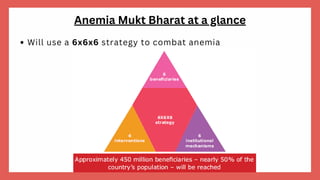
Will use a 6x6x6 strategy to combat anemia
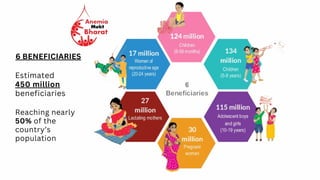
6 BENEFICIARIES
Estimated
450 million
beneficiaries
Reaching nearly
50% of the
country’s
population
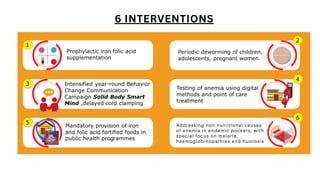
Addressing non-nutritional causes
of anemia in endemic pockets, with
special focus on malaria,
haemoglobinopathies and fluorosis
6 INTERVENTIONS
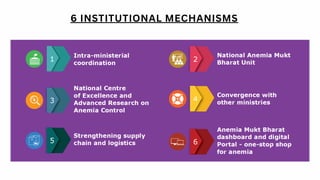
6 INSTITUTIONAL MECHANISMS
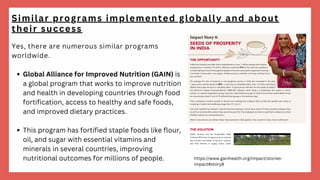
Global Alliance for Improved Nutrition (GAIN) is
a global program that works to improve nutrition
and health in developing countries through food
fortification, access to healthy and safe foods,
and improved dietary practices.
This program has fortified staple foods like flour,
oil, and sugar with essential vitamins and
minerals in several countries, improving
nutritional outcomes for millions of people.
Yes, there are numerous similar programs
worldwide.
Similar programs implemented globally and about
their success
https://www.gainhealth.org/impact/stories-
impact#story8
Other programs are USAID-funded Enhancing Child Survival and Health
Program and World Health Organization's Micronutrient Initiative
USAID-funded Enhancing Child Survival and Health Program has provided
millions of children in India with access to daily multivitamins that have
improved their nutrition and health outcomes.
USAID is promoting integrated health and nutrition approaches to anemia,
including antenatal iron/folate supplementation, antimalarials, and
antihelmintics.
Fortification of staple foods, e.g., wheat and maize flours, with iron and B-
vitamins
Similar programs implemented globally and about their success
National Nutritional Anemia Control Program (NNACP),
Weekly Iron and Folic Acid Supplementation (WIFS),
National Iron plus Initiative (NIPI) etc.
Since 1970s, the government has devised several programs to reduce the
prevalence of anemia in India like
Similar programs implemented in India
An intensified NIPI program referred to as the Anemia Mukt Bharat strategy
Most successful interventions of AMB
1.Nutrition Education and Promotion: Education and promotion of a
balanced diet that is rich in iron and other essential vitamins and minerals
can help reduce anemia prevalence in India.
2. Access to Iron Supplementation: Access to iron supplementation can help reduce
anemia prevalence in India, as it allows individuals to increase their iron intake.
3. Improved Sanitation and Hygiene: Poor sanitation and hygiene practices can lead to
increased prevalence of anemia, and improving these practices can help reduce anemia
prevalence in India.
4. Food Fortification: Fortifying foods with iron can help increase iron intake for
individuals and reduce anemia prevalence in India.
5. Mass Drug Administration: Mass drug administration of iron supplements has been
found to be an effective intervention for reducing anemia prevalence in India.
• The states that have been successful in reducing the prevalence of anemia in
India under the AMB are Gujarat, Karnataka, Madhya Pradesh, Maharashtra,
Odisha, Rajasthan, Telangana, Uttar Pradesh, and West Bengal.
• Over 4.2 crore children aged 0-19 years have been tested and diagnosed for
anemia.
• Over 2.5 crore adolescent girls have been tested and diagnosed for anemia.
• Over 3.2 crore pregnant women have been tested and diagnosed for anemia.
Major achievements of AMB
• Over 1.6 crore lactating mothers have been tested and diagnosed for
anemia.
• Over 3.2 lakh anemia awareness camps have been organized in rural and
urban areas to spread awareness about the importance of anemia prevention
and control.
• Over 5.6 lakh health workers have been trained on anemia management and
diagnosis.
Major achievements of AMB
Limitation of AMB
There is a significant gap seen in the dissemination & implementation of
AMB strategy at the district-level.
The use of AMB Communication Package had been extremely low in States
with only 5-6 States which have printed and distributed to health facilities
In 2019, only 18 States had made allocation for all four IFA categories. This
is just 50% States making allocation for all target beneficiaries.
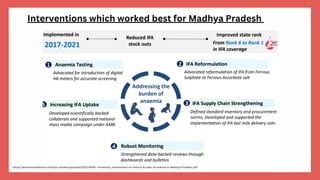
Interventions worked best for Madhya Pradesh
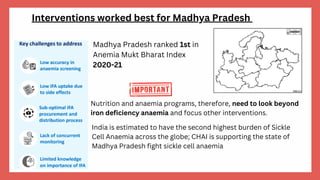
Madhya Pradesh ranked 1st in
Anemia Mukt Bharat Index
2020-21
Nutrition and anaemia programs, therefore, need to look beyond
iron deficiency anaemia and focus other interventions.
India is estimated to have the second highest burden of Sickle
Cell Anaemia across the globe; CHAI is supporting the state of
Madhya Pradesh fight sickle cell anaemia
Interventions which worked best for Madhya Pradesh
https://anemiamuktbharat.info/wp-content/uploads/2022/04/Mr.-Himanshu_Intervention-to-reduce-burden-of-anemia-in-Madhya-Pradesh.pdf
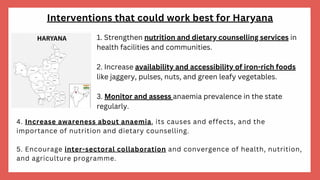
1. Strengthen nutrition and dietary counselling services in
health facilities and communities.
2. Increase availability and accessibility of iron-rich foods
like jaggery, pulses, nuts, and green leafy vegetables.
3. Monitor and assess anaemia prevalence in the state
regularly.
Interventions that could work best for Haryana
4. Increase awareness about anaemia, its causes and effects, and the
importance of nutrition and dietary counselling.
5. Encourage inter-sectoral collaboration and convergence of health, nutrition,
and agriculture programme.
Interventions that could work best for Haryana
6. Provide iron and folic acid supplementation to pregnant and lactating women and
children.
7. Provide nutrition education and counselling to pregnant and lactating women and
children.
8. Strengthen the capacity of frontline health workers to detect, diagnose, and treat
anaemia (TTT strategy).
9. Implement evidence-based approaches to anaemia prevention, such as food
fortification and biofortification.
Continue to focus on improving maternal and infant health outcomes, as well as
addressing anemia at the individual, family, and community levels.
Program plans to roll out interventions targeting high-risk subgroups,
Develop the program's digital platform,
Ensure consistent service delivery & continuous impact monitoring.
Scaling-up nutrition-sensitive interventions, and
working with partners to further support and strengthen the program.
The ultimate goal of the program is to make India anemia-free by
2030.
Future Goals
Let us make India Anemia-Free
References
https://anemiamuktbharat.info/wp-content/uploads/2021/12/AMB-Progress-Report_12-08-
2021.pdf
https://anemiamuktbharat.info/wp-content/uploads/2022/04/MP.pdf
https://anemiamuktbharat.info/wp-content/uploads/2022/04/Mr.-
Himanshu_Intervention-to-reduce-burden-of-anemia-in-Madhya-Pradesh.pdf
Presentation on Anemia Mukt Bharat

Presentation on Anemia Mukt Bharat

  • 1.
    DR MONIKA KHURANAARTWANI 17 January 2023 | Presentation
  • 2.
    Outline of Presentation Globalburden of Anaemia 1. 2. Causes of Anemia in India 3. Anemia Mukt Bharat (AMB) at a glance 4. Why AMB program is implemented? 5. Programs similar to AMB globally 6. Programs similar to AMB in India 11. Limitations/Roadblocks of AMB 7. Most successful interventions of AMB 9. Successful interventions for MP state 10.Successful interventions for Haryana 8. Major achievements of AMB 12. Future goals of AMB
  • 3.
    Global burden ofAnemia Anemia affecting around 1.9 billion people worldwide.[1] 90% of cases are in developing countries [2] Africa and Asia accounts for 85% of anaemia cases [2] James, Spencer L., et al. "Global, regional, and national incidence, prevalence, and years lived with disability for 354 diseases and injuries for 195 countries and territories, 1990–2017: a systematic analysis for the Global Burden of Disease Study 2017." The Lancet 392.10159 (2018): 1789-1858. De Benoist, Bruno, et al. "Worldwide prevalence of anaemia 1993-2005; WHO global database of anaemia." (2008). Reference: 1. 2. According to WHO Anaemia is a condition in which the number of red blood cells or the haemoglobin concentration within them is lower than normal.
  • 4.
    Anemia causes inIndia Faulty infant and young child feeding practices, Dietary insufficiency in iron, Presence of iron absorption inhibitors, Parasitic infection (malaria and hookworm infestation), Poor iron stores during infancy and childhood and Hemoglobinopathies (such as thalassemia and sickle cell anemia). https://anemiamuktbharat.info/wp-content/uploads/2021/12/AMB-Progress-Report_12-08-2021.pdf
  • 5.
    Anemia Mukt Bharatat a glance Program launched in 2018 Also known as INTENSIFIED NATIONAL IRON PLUS INITIATIVE (I-NIPI) Complying with targets of POSHAN abhiyaan and National Nutrition Strategy set by NITI Aayog Main objective: Reduce the prevalence of anemia by 3% points per year among children, adolescents and women in the reproductive age group(15– 49 years).
  • 6.
    Why AMB programis implemented at National Level? Anaemia & Sustainable development goals 2030 SDG Goal 1: No poverty Anemia is estimated to contribute to 17% lower productivity in heavy manual labour and 5% lower productivity in other manual labors. SDG Goal 2: Zero hunger Anemia is part of "all forms of malnutrition" which is committed to be end by 2030 and addressing, by 2025, the nutritional needs of adolescents girls, pregnant and lactating women. (Target 2.2) https://journals.plos.org/plosone/article?id=10.1371/journal.pone.0136581
  • 7.
    SDG Goal 3:Good Health & Well being Target 3.1 (maternal mortality): Iron reduces maternal anemia, 20% of maternal deaths are due to anemia, iron prevents maternal deaths during prenatal period. Target 3.2 (child mortality): Iron prevents intrauterine growth retardation, low birth weight, and prematurity. Iron enhances immunity, reduces frequency and severity of infections and decreases childhood mortality & morbidity. Target 3.3 (malaria): Malaria causes hemolysis & anemia Anaemia & Sustainable development goals 2030
  • 8.
    Anaemia & Sustainabledevelopment goals 2030 SDG Goal 5: Gender Equality Anemia is more severe in girls than in boys. Iron improves women's health, increase work performance & productivity. SDG Goal 4: Quality education Iron enhances immunity, reduces frequency and severity of infections and decreases childhood mortality & morbidity. Improves school attendance, retention, learning capacity, & school achievement
  • 9.
    Anemia Mukt Bharatat a glance Will use a 6x6x6 strategy to combat anemia
  • 10.
    6 BENEFICIARIES Estimated 450 million beneficiaries Reachingnearly 50% of the country’s population
  • 11.
    Addressing non-nutritional causes ofanemia in endemic pockets, with special focus on malaria, haemoglobinopathies and fluorosis 6 INTERVENTIONS
  • 12.
  • 13.
    Global Alliance forImproved Nutrition (GAIN) is a global program that works to improve nutrition and health in developing countries through food fortification, access to healthy and safe foods, and improved dietary practices. This program has fortified staple foods like flour, oil, and sugar with essential vitamins and minerals in several countries, improving nutritional outcomes for millions of people. Yes, there are numerous similar programs worldwide. Similar programs implemented globally and about their success https://www.gainhealth.org/impact/stories- impact#story8
  • 14.
    Other programs areUSAID-funded Enhancing Child Survival and Health Program and World Health Organization's Micronutrient Initiative USAID-funded Enhancing Child Survival and Health Program has provided millions of children in India with access to daily multivitamins that have improved their nutrition and health outcomes. USAID is promoting integrated health and nutrition approaches to anemia, including antenatal iron/folate supplementation, antimalarials, and antihelmintics. Fortification of staple foods, e.g., wheat and maize flours, with iron and B- vitamins Similar programs implemented globally and about their success
  • 15.
    National Nutritional AnemiaControl Program (NNACP), Weekly Iron and Folic Acid Supplementation (WIFS), National Iron plus Initiative (NIPI) etc. Since 1970s, the government has devised several programs to reduce the prevalence of anemia in India like Similar programs implemented in India An intensified NIPI program referred to as the Anemia Mukt Bharat strategy
  • 16.
    Most successful interventionsof AMB 1.Nutrition Education and Promotion: Education and promotion of a balanced diet that is rich in iron and other essential vitamins and minerals can help reduce anemia prevalence in India. 2. Access to Iron Supplementation: Access to iron supplementation can help reduce anemia prevalence in India, as it allows individuals to increase their iron intake. 3. Improved Sanitation and Hygiene: Poor sanitation and hygiene practices can lead to increased prevalence of anemia, and improving these practices can help reduce anemia prevalence in India. 4. Food Fortification: Fortifying foods with iron can help increase iron intake for individuals and reduce anemia prevalence in India. 5. Mass Drug Administration: Mass drug administration of iron supplements has been found to be an effective intervention for reducing anemia prevalence in India.
  • 17.
    • The statesthat have been successful in reducing the prevalence of anemia in India under the AMB are Gujarat, Karnataka, Madhya Pradesh, Maharashtra, Odisha, Rajasthan, Telangana, Uttar Pradesh, and West Bengal. • Over 4.2 crore children aged 0-19 years have been tested and diagnosed for anemia. • Over 2.5 crore adolescent girls have been tested and diagnosed for anemia. • Over 3.2 crore pregnant women have been tested and diagnosed for anemia. Major achievements of AMB
  • 18.
    • Over 1.6crore lactating mothers have been tested and diagnosed for anemia. • Over 3.2 lakh anemia awareness camps have been organized in rural and urban areas to spread awareness about the importance of anemia prevention and control. • Over 5.6 lakh health workers have been trained on anemia management and diagnosis. Major achievements of AMB
  • 19.
    Limitation of AMB Thereis a significant gap seen in the dissemination & implementation of AMB strategy at the district-level. The use of AMB Communication Package had been extremely low in States with only 5-6 States which have printed and distributed to health facilities In 2019, only 18 States had made allocation for all four IFA categories. This is just 50% States making allocation for all target beneficiaries.
  • 20.
    Interventions worked bestfor Madhya Pradesh Madhya Pradesh ranked 1st in Anemia Mukt Bharat Index 2020-21 Nutrition and anaemia programs, therefore, need to look beyond iron deficiency anaemia and focus other interventions. India is estimated to have the second highest burden of Sickle Cell Anaemia across the globe; CHAI is supporting the state of Madhya Pradesh fight sickle cell anaemia
  • 21.
    Interventions which workedbest for Madhya Pradesh https://anemiamuktbharat.info/wp-content/uploads/2022/04/Mr.-Himanshu_Intervention-to-reduce-burden-of-anemia-in-Madhya-Pradesh.pdf
  • 22.
    1. Strengthen nutritionand dietary counselling services in health facilities and communities. 2. Increase availability and accessibility of iron-rich foods like jaggery, pulses, nuts, and green leafy vegetables. 3. Monitor and assess anaemia prevalence in the state regularly. Interventions that could work best for Haryana 4. Increase awareness about anaemia, its causes and effects, and the importance of nutrition and dietary counselling. 5. Encourage inter-sectoral collaboration and convergence of health, nutrition, and agriculture programme.
  • 23.
    Interventions that couldwork best for Haryana 6. Provide iron and folic acid supplementation to pregnant and lactating women and children. 7. Provide nutrition education and counselling to pregnant and lactating women and children. 8. Strengthen the capacity of frontline health workers to detect, diagnose, and treat anaemia (TTT strategy). 9. Implement evidence-based approaches to anaemia prevention, such as food fortification and biofortification.
  • 24.
    Continue to focuson improving maternal and infant health outcomes, as well as addressing anemia at the individual, family, and community levels. Program plans to roll out interventions targeting high-risk subgroups, Develop the program's digital platform, Ensure consistent service delivery & continuous impact monitoring. Scaling-up nutrition-sensitive interventions, and working with partners to further support and strengthen the program. The ultimate goal of the program is to make India anemia-free by 2030. Future Goals
  • 25.
    Let us makeIndia Anemia-Free
  • 26.