Electrostatics - MCQ (Class-XII)
By
Dr M. Arunachalam
Head, Department of Physics (Rtd.)
Sri SRNM College, Sattur
MCQ in Electrostatics
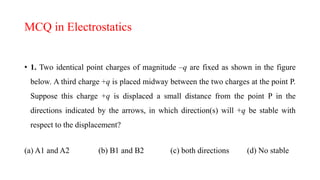
• 1. Two identical point charges of magnitude –q are fixed as shown in the figure
below. A third charge +q is placed midway between the two charges at the point P.
Suppose this charge +q is displaced a small distance from the point P in the
directions indicated by the arrows, in which direction(s) will +q be stable with
respect to the displacement?
(a) A1 and A2 (b) B1 and B2 (c) both directions (d) No stable
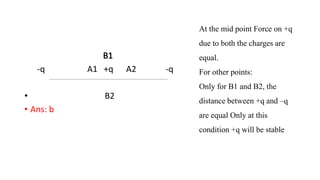
-q A1 +q A2 -q
• B2
• Ans: b
At the mid point Force on +q
due to both the charges are
equal.
For other points:
Only for B1 and B2, the
distance between +q and –q
are equal Only at this
condition +q will be stable
2. Which charge configuration produces a uniform electric field?
• (a) point charge
(b) uniformly charged infinite line
(c) uniformly charged infinite plane
(d) uniformly charged spherical shell
• Ans: c (E = σ/2ε0 independent of the distance)
For others: E depends on the distance
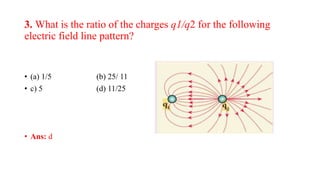
3. What is the ratio of the charges q1/q2 for the following
electric field line pattern?
• (a) 1/5 (b) 25/ 11
• c) 5 (d) 11/25
• Ans: d
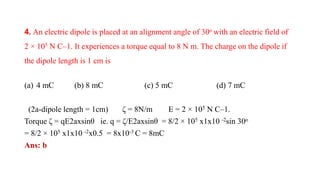
4. An electric dipole is placed at an alignment angle of 30o with an electric field of
2 × 10⁵ N C–1. It experiences a torque equal to 8 N m. The charge on the dipole if
the dipole length is 1 cm is
(a) 4 mC (b) 8 mC (c) 5 mC (d) 7 mC
(2a-dipole length = 1cm) ζ = 8N/m E = 2 × 10⁵ N C–1.
Torque ζ = qE2axsinθ ie. q = ζ/E2axsinθ = 8/2 × 105 x1x10 -2sin 30o
= 8/2 × 105 x1x10 -2x0.5 = 8x10⁻³ C = 8mC
Ans: b
5. Four Gaussian surfaces are given below with charges inside each Gaussian
surface. Rank the electric flux through each Gaussian surface in increasing order.
• (a) D < C < B < A
• (b) A < B = C < D
• (c) C < A = B < D
• (d) D > C > B > A
• Ans: a [φ = q/ε0] ie. Electric flus is directly
• proportional to net charge in the gaussian surface
• D has charge –q, C has 0,
• B has 0 and A has 2q]
A
B
+2q
+q
-q
C
D
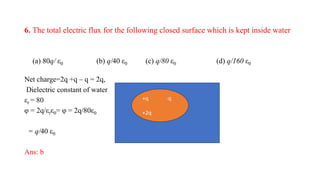
6. The total electric flux for the following closed surface which is kept inside water
(a) 80q/ ε0 (b) q/40 ε0 (c) q/80 ε0 (d) q/160 ε0
Net charge=2q +q – q = 2q,
Dielectric constant of water
εr = 80
φ = 2q/εrε0= φ = 2q/80ε0
= q/40 ε0
Ans: b
-q +q
+q -q
+2q
7. Two identical conducting balls having positive charges q1 and q2 are separated by
a centre to centre distance r. If they are made to touch each other and then separated
to the same distance, the force between them will be
(a) less than before (b) same as before (c) more than before (d) zero
Ans: c
See explanation next
Explanation
Before touching: F = kq1q2/r2
After touching due to transfer charges, charges on each side will be
equal ie. (q1+q2)/2
Now force F’ = k[(q1+q2)/2]2
r2
we can say that F′>F Hence the answer is c
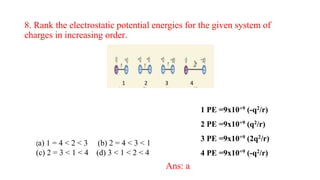
8. Rank the electrostatic potential energies for the given system of
charges in increasing order.
(a) 1 = 4 < 2 < 3 (b) 2 = 4 < 3 < 1
(c) 2 = 3 < 1 < 4 (d) 3 < 1 < 2 < 4
Ans: a
1 2 3 4
1 PE =9x10+9 (-q2/r)
2 PE =9x10+9 (q2/r)
3 PE =9x10+9 (2q2/r)
4 PE =9x10+9 (-q2/r)
9. An electric field E =10 xi exists in a certain region of space. Then the
potential difference V = V0 – VA, where Vo is the potential at the origin and VA is the
potential at x = 2 m is:
(a) 10 V (b) –20 V (c) +20 V (d) –10 V
dV = - Edx = -10xi = -10 [x] Here x = 2m ie dV = -20 Volt. When we find the PE we move
from ∞ to the point. But here we move from the origin. Hence the answer is + 20 Volt.
Ans: c
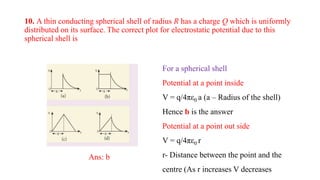
10. A thin conducting spherical shell of radius R has a charge Q which is uniformly
distributed on its surface. The correct plot for electrostatic potential due to this
spherical shell is
Ans: b
For a spherical shell
Potential at a point inside
V = q/4πε0 a (a – Radius of the shell)
Hence b is the answer
Potential at a point out side
V = q/4πε0 r
r- Distance between the point and the
centre (As r increases V decreases
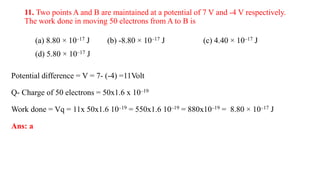
11. Two points A and B are maintained at a potential of 7 V and -4 V respectively.
The work done in moving 50 electrons from A to B is
(a) 8.80 × 10⁻¹⁷ J (b) -8.80 × 10⁻¹⁷ J (c) 4.40 × 10⁻¹⁷ J
(d) 5.80 × 10⁻¹⁷ J
Potential difference = V = 7- (-4) =11Volt
Q- Charge of 50 electrons = 50x1.6 x 10–19
Work done = Vq = 11x 50x1.6 10–19 = 550x1.6 10–19 = 880x10–19 = 8.80 × 10⁻¹⁷ J
Ans: a
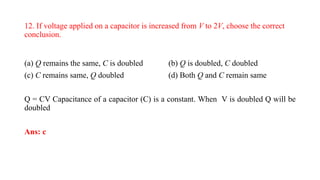
12. If voltage applied on a capacitor is increased from V to 2V, choose the correct
conclusion.
(a) Q remains the same, C is doubled (b) Q is doubled, C doubled
(c) C remains same, Q doubled (d) Both Q and C remain same
Q = CV Capacitance of a capacitor (C) is a constant. When V is doubled Q will be
doubled
Ans: c
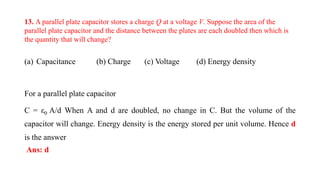
13. A parallel plate capacitor stores a charge Q at a voltage V. Suppose the area of the
parallel plate capacitor and the distance between the plates are each doubled then which is
the quantity that will change?
(a) Capacitance (b) Charge (c) Voltage (d) Energy density
For a parallel plate capacitor
C = ε0 A/d When A and d are doubled, no change in C. But the volume of the
capacitor will change. Energy density is the energy stored per unit volume. Hence d
is the answer
Ans: d
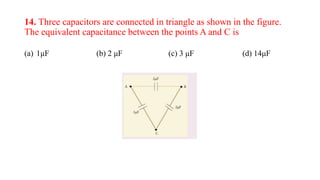
14. Three capacitors are connected in triangle as shown in the figure.
The equivalent capacitance between the points A and C is
(a) 1μF (b) 2 μF (c) 3 μF (d) 14μF
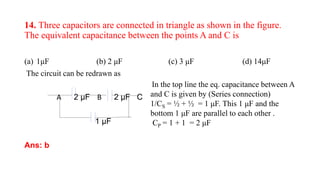
14. Three capacitors are connected in triangle as shown in the figure.
The equivalent capacitance between the points A and C is
(a) 1μF (b) 2 μF (c) 3 μF (d) 14μF
The circuit can be redrawn as
A 2 μF B 2 μF C
1 μF
Ans: b
In the top line the eq. capacitance between A
and C is given by (Series connection)
1/CS = ½ + ½ = 1 μF. This 1 μF and the
bottom 1 μF are parallel to each other .
CP = 1 + 1 = 2 μF
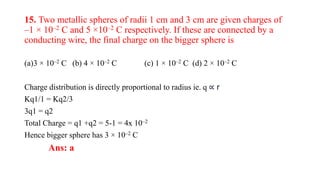
15. Two metallic spheres of radii 1 cm and 3 cm are given charges of
–1 × 10⁻² C and 5 ×10⁻² C respectively. If these are connected by a
conducting wire, the final charge on the bigger sphere is
(a)3 × 10⁻² C (b) 4 × 10⁻² C (c) 1 × 10⁻² C (d) 2 × 10⁻² C
Charge distribution is directly proportional to radius ie. q ∝ r
Kq1/1 = Kq2/3
3q1 = q2
Total Charge = q1 +q2 = 5-1 = 4x 10⁻²
Hence bigger sphere has 3 × 10⁻² C
Ans: a
Thank you

MCQ in Electrostatics. for class XII pptx

  • 1.
    Electrostatics - MCQ(Class-XII) By Dr M. Arunachalam Head, Department of Physics (Rtd.) Sri SRNM College, Sattur
  • 2.
    MCQ in Electrostatics •1. Two identical point charges of magnitude –q are fixed as shown in the figure below. A third charge +q is placed midway between the two charges at the point P. Suppose this charge +q is displaced a small distance from the point P in the directions indicated by the arrows, in which direction(s) will +q be stable with respect to the displacement? (a) A1 and A2 (b) B1 and B2 (c) both directions (d) No stable
  • 3.
    -q A1 +qA2 -q • B2 • Ans: b At the mid point Force on +q due to both the charges are equal. For other points: Only for B1 and B2, the distance between +q and –q are equal Only at this condition +q will be stable
  • 4.
    2. Which chargeconfiguration produces a uniform electric field? • (a) point charge (b) uniformly charged infinite line (c) uniformly charged infinite plane (d) uniformly charged spherical shell • Ans: c (E = σ/2ε0 independent of the distance) For others: E depends on the distance
  • 5.
    3. What isthe ratio of the charges q1/q2 for the following electric field line pattern? • (a) 1/5 (b) 25/ 11 • c) 5 (d) 11/25 • Ans: d
  • 6.
    4. An electricdipole is placed at an alignment angle of 30o with an electric field of 2 × 10⁵ N C–1. It experiences a torque equal to 8 N m. The charge on the dipole if the dipole length is 1 cm is (a) 4 mC (b) 8 mC (c) 5 mC (d) 7 mC (2a-dipole length = 1cm) ζ = 8N/m E = 2 × 10⁵ N C–1. Torque ζ = qE2axsinθ ie. q = ζ/E2axsinθ = 8/2 × 105 x1x10 -2sin 30o = 8/2 × 105 x1x10 -2x0.5 = 8x10⁻³ C = 8mC Ans: b
  • 7.
    5. Four Gaussiansurfaces are given below with charges inside each Gaussian surface. Rank the electric flux through each Gaussian surface in increasing order. • (a) D < C < B < A • (b) A < B = C < D • (c) C < A = B < D • (d) D > C > B > A • Ans: a [φ = q/ε0] ie. Electric flus is directly • proportional to net charge in the gaussian surface • D has charge –q, C has 0, • B has 0 and A has 2q] A B +2q +q -q C D
  • 8.
    6. The totalelectric flux for the following closed surface which is kept inside water (a) 80q/ ε0 (b) q/40 ε0 (c) q/80 ε0 (d) q/160 ε0 Net charge=2q +q – q = 2q, Dielectric constant of water εr = 80 φ = 2q/εrε0= φ = 2q/80ε0 = q/40 ε0 Ans: b -q +q +q -q +2q
  • 9.
    7. Two identicalconducting balls having positive charges q1 and q2 are separated by a centre to centre distance r. If they are made to touch each other and then separated to the same distance, the force between them will be (a) less than before (b) same as before (c) more than before (d) zero Ans: c See explanation next
  • 10.
    Explanation Before touching: F= kq1q2/r2 After touching due to transfer charges, charges on each side will be equal ie. (q1+q2)/2 Now force F’ = k[(q1+q2)/2]2 r2 we can say that F′>F Hence the answer is c
  • 11.
    8. Rank theelectrostatic potential energies for the given system of charges in increasing order. (a) 1 = 4 < 2 < 3 (b) 2 = 4 < 3 < 1 (c) 2 = 3 < 1 < 4 (d) 3 < 1 < 2 < 4 Ans: a 1 2 3 4 1 PE =9x10+9 (-q2/r) 2 PE =9x10+9 (q2/r) 3 PE =9x10+9 (2q2/r) 4 PE =9x10+9 (-q2/r)
  • 12.
    9. An electricfield E =10 xi exists in a certain region of space. Then the potential difference V = V0 – VA, where Vo is the potential at the origin and VA is the potential at x = 2 m is: (a) 10 V (b) –20 V (c) +20 V (d) –10 V dV = - Edx = -10xi = -10 [x] Here x = 2m ie dV = -20 Volt. When we find the PE we move from ∞ to the point. But here we move from the origin. Hence the answer is + 20 Volt. Ans: c
  • 13.
    10. A thinconducting spherical shell of radius R has a charge Q which is uniformly distributed on its surface. The correct plot for electrostatic potential due to this spherical shell is Ans: b For a spherical shell Potential at a point inside V = q/4πε0 a (a – Radius of the shell) Hence b is the answer Potential at a point out side V = q/4πε0 r r- Distance between the point and the centre (As r increases V decreases
  • 14.
    11. Two pointsA and B are maintained at a potential of 7 V and -4 V respectively. The work done in moving 50 electrons from A to B is (a) 8.80 × 10⁻¹⁷ J (b) -8.80 × 10⁻¹⁷ J (c) 4.40 × 10⁻¹⁷ J (d) 5.80 × 10⁻¹⁷ J Potential difference = V = 7- (-4) =11Volt Q- Charge of 50 electrons = 50x1.6 x 10–19 Work done = Vq = 11x 50x1.6 10–19 = 550x1.6 10–19 = 880x10–19 = 8.80 × 10⁻¹⁷ J Ans: a
  • 15.
    12. If voltageapplied on a capacitor is increased from V to 2V, choose the correct conclusion. (a) Q remains the same, C is doubled (b) Q is doubled, C doubled (c) C remains same, Q doubled (d) Both Q and C remain same Q = CV Capacitance of a capacitor (C) is a constant. When V is doubled Q will be doubled Ans: c
  • 16.
    13. A parallelplate capacitor stores a charge Q at a voltage V. Suppose the area of the parallel plate capacitor and the distance between the plates are each doubled then which is the quantity that will change? (a) Capacitance (b) Charge (c) Voltage (d) Energy density For a parallel plate capacitor C = ε0 A/d When A and d are doubled, no change in C. But the volume of the capacitor will change. Energy density is the energy stored per unit volume. Hence d is the answer Ans: d
  • 17.
    14. Three capacitorsare connected in triangle as shown in the figure. The equivalent capacitance between the points A and C is (a) 1μF (b) 2 μF (c) 3 μF (d) 14μF
  • 18.
    14. Three capacitorsare connected in triangle as shown in the figure. The equivalent capacitance between the points A and C is (a) 1μF (b) 2 μF (c) 3 μF (d) 14μF The circuit can be redrawn as A 2 μF B 2 μF C 1 μF Ans: b In the top line the eq. capacitance between A and C is given by (Series connection) 1/CS = ½ + ½ = 1 μF. This 1 μF and the bottom 1 μF are parallel to each other . CP = 1 + 1 = 2 μF
  • 19.
    15. Two metallicspheres of radii 1 cm and 3 cm are given charges of –1 × 10⁻² C and 5 ×10⁻² C respectively. If these are connected by a conducting wire, the final charge on the bigger sphere is (a)3 × 10⁻² C (b) 4 × 10⁻² C (c) 1 × 10⁻² C (d) 2 × 10⁻² C Charge distribution is directly proportional to radius ie. q ∝ r Kq1/1 = Kq2/3 3q1 = q2 Total Charge = q1 +q2 = 5-1 = 4x 10⁻² Hence bigger sphere has 3 × 10⁻² C Ans: a
  • 20.