Government engineering
college Bhuj
Topic :- Highway Materials
Branch :- CIVIL ( 5th
)
Subject :- Transportation
Engineering ( 3150611)
Guide by :- devang sir
Present by :- GANATRA RAJ
( 23053106013 )
GARVA MEET
( 230153106014 )
INDEX
• Components Of highway
• Materials for Highway
• Desirable soil properties
• Index properties of soil
• Sub grade soil Strength
• Evaluation of soil Strength
• California bearing ratio
• Bearing capacity Of soil
• plat load test
• K- value test
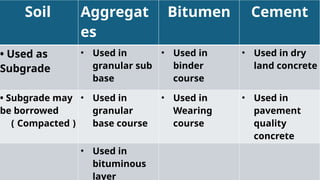
Soil Aggregat
es
Bitumen Cement
• Used as
Subgrade
• Used in
granular sub
base
• Used in
binder
course
• Used in dry
land concrete
• Subgrade may
be borrowed
( Compacted )
• Used in
granular
base course
• Used in
Wearing
course
• Used in
pavement
quality
concrete
• Used in
bituminous
layer
Desirable Soil Properties
The desirable soil properties as a highway material are:
1. Stability
2. Incompressibility
3. Strength
4. Minimum volume changes
5. Stability under adverse condition of weather and ground water.
6. Good drainage
7. Ease of compaction
Index properties of soil
The wide range of soil types available as
highway construction materials have made it
obligatory on the part. of the highway engineer
to identify and classify the different soil. The soil
properties on which their identification and
classification are based are known as index
properties
The following index properties are used
for classification of soil.
1. Grain size distribution
2. Liquid limit (Wl)
3. Plasticity index (lp)
4. Shrinkage limit (ws)
5. Field moisture equivalent
6. Compacted dry density
Plasticity index (lp)
Subgrade soil strength
The factors on which the strength characteristics of soil depend
are :
1. Type of soil
2. Moisture content
3. Dry density
4. Internal structure of the soil
5. The type and mode of stress application
• The shear strength (S) of a soil at a point on particular
plane was expressed by coulomb as liner function of the
normal stress on that plane as
Cohesion C is the resistance of soil grains to displacement by bond
developed at the surface of contact by very fine grained soils as a
result of intermolecular and electrochemical forces of attraction.
The value of C depends on,
• The type of clay mineral
• Size of clay mineral
• The surface charges
• The proportion of the clay
• Water content etc.
EVALUATION OF SOIL STRENGTH
The tests used to evaluate the strength properties of soil may be
broadly classified into three groups.
→ Bearing tests
→ Shear tests
→ Penetration tests
→ Bearing tests :
Bearing tests are loading tests carried out on subgrade soil in-
situ with load bearing area. Plate load test is very popular bearing
test to determine the bearing capacity of soils.
Shear tests :
Shear test are usually carried out on relatively
small soil sample in the laboratory. The commonly
known she has test are,
→ Direct shear test
→ Triaxial compression test
→ Unconfined compression test
→ Vane shear test
Penetration test :
Penetration tests may be considered as a
small scale bearing tests in which the size of loaded
area is relatively small. These test are carried out in
the field or in the laboratory.
The commonly known penetration test are,
→ The California bearing ratio test
→ Cone penetration test
California bearing ratio (CBR) test
• CBR test is the measure of resistance of material to
penetration of standard plunger under controlled density
and moisture condition.
• It was developed by the California state highway
department.
• Developed for classifying and evaluating soil-subgrade
and base course material for flexible payment.
• CBR test may be conducted in remolded or undisturbed
sample.
• Test consists of causing a cylindrical plunger of 50 mm
diameter to penetrate a pavement component material at
1.25 mm/minute.
• The loads for 2.5 mm and 5 mm are recorded.
• This load is expressed as a percentage of standard load
value at a respective deformation level to obtain CBR value.
California bearing ratio test on subgrade soil
• The aim of this test is the determination of California
bearing ratio value of subgrade soil.
Apparatus for CBR test
• Loading machine - any compression machine can operate
at constant rate of 1.25 mm per minute can be used.
• Cylindrical moulds - mould of 150 mm diameter and 175
mm height provided with a coller of about 50 mm length
and detachable perforated base.
• Compaction rammer,
• Surcharge weight- annular weight each of 2.5 kg and 147
mm diameter.
• IS sieve 20 mm,
• Course filter paper,
• Balance etc.
Procedure of California bearing ratio
test
• Sieve this sample through 20 mm IS sieve.
• Take a 5 kg of the sample of soil specimen.
• Add a water to the soil in the quantity such that optimum
moisture content or field moisture content is reached.
• Then soil and water are mixed throughly.
• Spacer disc is placed over the bese plate at the bottom of
mould and a course filter paper is placed over the spacer disc.
• The prepared soil water mix is divided into five.
• The mould is cleaned and oil is applied.
• Then fill one fifth of the mould with the prepred soil.
• That Layer is compacted by giving 56 evenly distributed
blouse using a hammer of weight 4.89 kg.
• The top layer of the compacted soil is scratched.
• Again second layer is filled and process is repeated.
• After 3rd layer, coller is also attached to the mould and process is
continued.
• After 5th layer, coller is removed and excess soil is struck off.
• Remove bese plate and invert the mould. Then it is clamped to
baseplate.
• Surcharge weight of 2.5 kg is placed on top surface of soil.
• Mould containing specimen is placed in position on the testing machine.
• The penetration plunger is brought in contact with the soil and a load of
4 kg (seating load) is applied so that contact between soil and plunger is
established. Then dial reading are adjust to zero.
• Load is applied such that penetration rate is 1.25 mm per minute.
• Load at penetration of 0.5,1,1.5,2,2.5,3,4,5,7.5,10 and 12.5 mm are
noted.
Standard load value for CBR test
Penetration (mm) Standard load (kg) Unit standard load
(kg/cm2)
2.5 1370 70
5 2055 105
7.5 2630 134
10 3180 162
12.5 3600 183
Result of California bearing ratio test
1. California bearing ratio at 2.5 mm penetration =
2. California Beijing ratio at 5 mm penetration=
3. California bearing ratio of subgrade soil=

Transportation engineering highway component

  • 1.
    Government engineering college Bhuj Topic:- Highway Materials Branch :- CIVIL ( 5th ) Subject :- Transportation Engineering ( 3150611) Guide by :- devang sir Present by :- GANATRA RAJ ( 23053106013 ) GARVA MEET ( 230153106014 )
  • 2.
    INDEX • Components Ofhighway • Materials for Highway • Desirable soil properties • Index properties of soil • Sub grade soil Strength • Evaluation of soil Strength • California bearing ratio • Bearing capacity Of soil • plat load test • K- value test
  • 8.
    Soil Aggregat es Bitumen Cement •Used as Subgrade • Used in granular sub base • Used in binder course • Used in dry land concrete • Subgrade may be borrowed ( Compacted ) • Used in granular base course • Used in Wearing course • Used in pavement quality concrete • Used in bituminous layer
  • 9.
    Desirable Soil Properties Thedesirable soil properties as a highway material are: 1. Stability 2. Incompressibility 3. Strength 4. Minimum volume changes 5. Stability under adverse condition of weather and ground water. 6. Good drainage 7. Ease of compaction
  • 10.
    Index properties ofsoil The wide range of soil types available as highway construction materials have made it obligatory on the part. of the highway engineer to identify and classify the different soil. The soil properties on which their identification and classification are based are known as index properties
  • 11.
    The following indexproperties are used for classification of soil. 1. Grain size distribution 2. Liquid limit (Wl) 3. Plasticity index (lp) 4. Shrinkage limit (ws) 5. Field moisture equivalent 6. Compacted dry density
  • 12.
  • 14.
    Subgrade soil strength Thefactors on which the strength characteristics of soil depend are : 1. Type of soil 2. Moisture content 3. Dry density 4. Internal structure of the soil 5. The type and mode of stress application
  • 15.
    • The shearstrength (S) of a soil at a point on particular plane was expressed by coulomb as liner function of the normal stress on that plane as
  • 16.
    Cohesion C isthe resistance of soil grains to displacement by bond developed at the surface of contact by very fine grained soils as a result of intermolecular and electrochemical forces of attraction. The value of C depends on, • The type of clay mineral • Size of clay mineral • The surface charges • The proportion of the clay • Water content etc.
  • 17.
    EVALUATION OF SOILSTRENGTH The tests used to evaluate the strength properties of soil may be broadly classified into three groups. → Bearing tests → Shear tests → Penetration tests → Bearing tests : Bearing tests are loading tests carried out on subgrade soil in- situ with load bearing area. Plate load test is very popular bearing test to determine the bearing capacity of soils.
  • 18.
    Shear tests : Sheartest are usually carried out on relatively small soil sample in the laboratory. The commonly known she has test are, → Direct shear test → Triaxial compression test → Unconfined compression test → Vane shear test
  • 19.
    Penetration test : Penetrationtests may be considered as a small scale bearing tests in which the size of loaded area is relatively small. These test are carried out in the field or in the laboratory. The commonly known penetration test are, → The California bearing ratio test → Cone penetration test
  • 20.
    California bearing ratio(CBR) test • CBR test is the measure of resistance of material to penetration of standard plunger under controlled density and moisture condition. • It was developed by the California state highway department. • Developed for classifying and evaluating soil-subgrade and base course material for flexible payment.
  • 21.
    • CBR testmay be conducted in remolded or undisturbed sample. • Test consists of causing a cylindrical plunger of 50 mm diameter to penetrate a pavement component material at 1.25 mm/minute. • The loads for 2.5 mm and 5 mm are recorded. • This load is expressed as a percentage of standard load value at a respective deformation level to obtain CBR value.
  • 22.
    California bearing ratiotest on subgrade soil • The aim of this test is the determination of California bearing ratio value of subgrade soil. Apparatus for CBR test • Loading machine - any compression machine can operate at constant rate of 1.25 mm per minute can be used. • Cylindrical moulds - mould of 150 mm diameter and 175 mm height provided with a coller of about 50 mm length and detachable perforated base. • Compaction rammer, • Surcharge weight- annular weight each of 2.5 kg and 147 mm diameter. • IS sieve 20 mm, • Course filter paper, • Balance etc.
  • 23.
    Procedure of Californiabearing ratio test • Sieve this sample through 20 mm IS sieve. • Take a 5 kg of the sample of soil specimen. • Add a water to the soil in the quantity such that optimum moisture content or field moisture content is reached. • Then soil and water are mixed throughly. • Spacer disc is placed over the bese plate at the bottom of mould and a course filter paper is placed over the spacer disc. • The prepared soil water mix is divided into five. • The mould is cleaned and oil is applied. • Then fill one fifth of the mould with the prepred soil. • That Layer is compacted by giving 56 evenly distributed blouse using a hammer of weight 4.89 kg.
  • 24.
    • The toplayer of the compacted soil is scratched. • Again second layer is filled and process is repeated. • After 3rd layer, coller is also attached to the mould and process is continued. • After 5th layer, coller is removed and excess soil is struck off. • Remove bese plate and invert the mould. Then it is clamped to baseplate. • Surcharge weight of 2.5 kg is placed on top surface of soil. • Mould containing specimen is placed in position on the testing machine. • The penetration plunger is brought in contact with the soil and a load of 4 kg (seating load) is applied so that contact between soil and plunger is established. Then dial reading are adjust to zero. • Load is applied such that penetration rate is 1.25 mm per minute. • Load at penetration of 0.5,1,1.5,2,2.5,3,4,5,7.5,10 and 12.5 mm are noted.
  • 25.
    Standard load valuefor CBR test Penetration (mm) Standard load (kg) Unit standard load (kg/cm2) 2.5 1370 70 5 2055 105 7.5 2630 134 10 3180 162 12.5 3600 183
  • 26.
    Result of Californiabearing ratio test 1. California bearing ratio at 2.5 mm penetration = 2. California Beijing ratio at 5 mm penetration= 3. California bearing ratio of subgrade soil=