Klaudia Kiss
Student Nr: 76131346
How Consumers Use Technology
And
Its Impact On Their Lives
Internet Evolution
…………………………………………………………….……………………………..…
From its beginnings as a research project, to the global
network that connects billions of people worldwide
today, the Internet has revolutionized the way we
communicate, access information, and interact with the
world around us.
Initially used by academics and researchers, the
Internet has become accessible to all kind of people.
From young children to elders, individuals of all ages
and backgrounds now use the Internet for different
purposes, from socializing and entertainment to
education, shopping, or work.
1969 1995 2020
2004
1989 2007
Birth of ARPANET Invention of the WWW
Commercialization of
the dot.com boom
Launch of Facebook Introduction of the iPhone
COVID-19 pandemic
accelerates the digital
transformation
Introduction
Fig. 1. TimeLine (2024) ‘The history of Internet: A timeline’ [video]
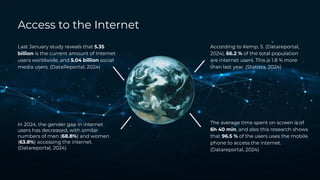
According to Kemp, S. (Datareportal,
2024), 66.2 % of the total population
are internet users. This is 1.8 % more
than last year. (Statista, 2024)
The average time spent on screen is of
6h 40 min, and also this research shows
that 96.5 % of the users uses the mobile
phone to access the internet.
(Datareportal, 2024)
In 2024, the gender gap in internet
users has decreased, with similar
numbers of men (68.8%) and women
(63.8%) accessing the internet.
(Datareportal, 2024)
Last January study reveals that 5.35
billion is the current amount of Internet
users worldwide, and 5.04 billion social
media users. (DataReportal, 2024)
Access to the Internet
Researches show that we’re far from
reaching the UN goal of achieving global
connectivity by 2030. Current growth rates
make it unlikely we will get there.
(Datareportal, 2024)
In 2023, the more connected countries were those in the
developed continents. The map below represents the
billions of internet users worldwide.
The countries in more developed continents are better
connected compared to those in Africa and Asia, where
limited resources contribute to a limited internet access.
96.8%
82.5%
32.1%
94.5%
76.1%
76.8%
77.5%
51.5%
67.8%
73.1%
Fig. 2. Kemp, S. (2024) Datareportal ‘Internet use in 2024’ [photograph]
Web browsing has changed over years. At first, Google let the way with its search engine and
then with Google Chrome. Meanwhile, Internet Explorer was once the top browser but has
decline in use as people switched to alternatives such as Chrome, Firefox and Safari for better
features and compatibility. Internet Explorer’s decline in Europe is dramatic: from 46% in 2009
to 0.1% in 2023 (Statista, 2024)
Fig. 3. Kemp, S. (2024) Datareportal ‘Internet use in 2024’ [online]
OOKLA’s data shows that mobile users in the United
Arab Emirates enjoyed the fastest median mobile
connections in the world in November 2023, with the
typical connection delivering downloads speeds of
almost 325 Mbps. It also shows that the typical mobile
connection in Cuba would be just 3.9 Mbps in November
2023. (Datareportal, 2024)
Fig. 4. Kemp, S. (2024) Datareportal ‘Internet use in 2024’ [photograph]
Mobile internet connection speed have increased
significantly over time, with advances in technology
enabling faster and more reliable connections globally.
While some countries like UAE or Qatar boast high
speed internet, others like African and Asian countries
lag behind due to geographical factors or
infrastructure limitations. (Datareportal, 2024)
Digital devices used by audiences
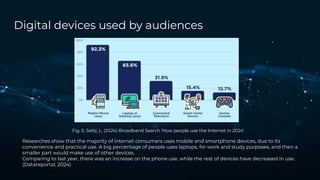
Researches show that the majority of internet consumers uses mobile and smartphone devices, due to its
convenience and practical use. A big percentage of people uses laptops, for work and study purposes, and then a
smaller part would make use of other devices.
Comparing to last year, there was an increase on the phone use, while the rest of devices have decreased in use.
(Datareportal, 2024)
Fig. 5. Seitz, L. (2024) Broadband Search ‘How people use the Internet in 2024’
How customers search for information
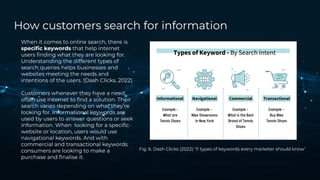
When it comes to online search, there is
specific keywords that help internet
users finding what they are looking for.
Understanding the different types of
search queries helps businesses and
websites meeting the needs and
intentions of the users. (Dash Clicks, 2022)
Customers whenever they have a need,
often use internet to find a solution. Their
search varies depending on what they’re
looking for. Informational keywords are
used by users to answer questions or seek
information. When looking for a specific
website or location, users would use
navigational keywords. And with
commercial and transactional keywords
consumers are looking to make a
purchase and finalise it.
Fig. 6. Dash Clicks (2022) ‘11 types of keywords every marketer should know’
How customers search for information
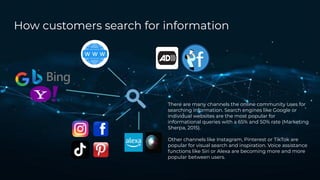
There are many channels the online community uses for
searching information. Search engines like Google or
individual websites are the most popular for
informational queries with a 65% and 50% rate (Marketing
Sherpa, 2015).
Other channels like Instagram, Pinterest or TikTok are
popular for visual search and inspiration. Voice assistance
functions like Siri or Alexa are becoming more and more
popular between users.
What customers buy online
Online shopping has increased its
popularity over last years, and
especially during the COVID-19
global pandemic. Some of the
advantages are the wide selection of
the products, easy price comparison
and no opening hours limitation. This
allows shoppers to avoid crowds and
shop anytime and anywhere. (Forbes,
2024)
However, online shopping has
security risks as the process involves
sharing personal and financial
information, which puts customers in
the risk of a fraud transaction, scams
or identity theft. In addition to this,
online consumers face problems like
data protection and privacy, as many
websites collect and store personal
information such as browse history
or contact details, which can be sold
without the customer’s consent.
Fig. 7. Creative Marketing (2024) [photograph] ‘20 ecommerce statistics of 2024’
Statistics have revealed that food and clothing are the items that consumers
search for the most. It’s an easy way for the customers to get food delivered
without the effort of going out, and to find fashion trends and great deals
without leaving home.
Online video consumption
According to recent studies, over 80% of
the internet traffic is video content. Online
video consumption has considerably grown
last years, due to factors like the internet
high speed improvements, apparition of
streaming platforms or social media reels
feature. (Social Pilot, 2024). The COVID-19
pandemic has greatly influenced people in
video consumption, for inspiration and
convenience.
Users today prefer anytime and anywhere
access, facilitated by the use of
smartphones and tablets.
Overall, this trends show no sign of slowing
down, indicating a continue evolution over
how users engage with content. Fig. 8. Oberlo (2023) n/a [graph]
Users consume music videos and fun viral content the most, and then live
videos and educational videos.
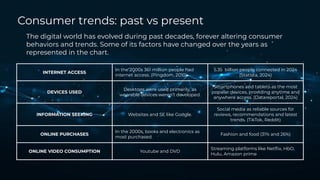
Consumer trends: past vs present
INTERNET ACCESS
In the 2000s 361 million people had
internet access. (Pingdom, 2010)
5.35 billion people connected in 2024
(Statista, 2024)
DEVICES USED
Desktops were used primarily, as
wearable devices weren’t developed.
Smartphones and tablets as the most
popular devices, providing anytime and
anywhere access. (Datareportal, 2024)
INFORMATION SEEKING Websites and SE like Google.
Social media as reliable sources for
reviews, recommendations and latest
trends. (TikTok, Reddit)
ONLINE PURCHASES
In the 2000s, books and electronics as
most purchased.
Fashion and food (31% and 26%)
ONLINE VIDEO CONSUMPTION Youtube and DVD
Streaming platforms like Netflix, HbO,
Hulu, Amazon prime
The digital world has evolved during past decades, forever altering consumer
behaviors and trends. Some of its factors have changed over the years as
represented in the chart.
Consumer trends: future
According to consumer trend forecasting, AI uses will be
increasing, as we already see personified chatbots on online
shopping websites. (Salsify, 2023)
Fig. 9. Transcom (2022) n/a [photograph] ‘AI chatbot vs
traditional chatbot: everything you need to know.’
Instagram photos are slowly absorbed by reels, shopping
features and ad tools for businesses,for instance, Instagram
checkout, TikTok shop or Pinterest product catalogues.
(Salsify, 2023)
Fig. 10. EmbedSocial (2023) Bojkov, N [photograph] ‘How to
use Instagram checkout and product tags to sell more’
Users also look for a more personalised experience.
According to studies, 43% of consumers believe that
personalisation is a basic requirement for online
shopping, and 60% say they are more likely to become
repeat consumers after (Twilio Segments, 2021)
Fig. 11. nocode.ai (2023) Ruiz, A. [photograph] ‘AI for
personalised shopping experiences’
Consumers also seek sustainable products, due to the
environmental and ethical problems surrounding fast
fashion. Shoppers now prioritize eco friendly packaging,
ethical production, price transparency and circular
practices like recycling or secondhand sourcing. (Salsify,
2023)
Fig. 12. Tariemi, O (2022) [photograph] ‘Go green with
this 7 sustainable shopping tips’
Summary
The Internet has transformed society, improving communication and access to information. Comparing to
6.7% in the 2000s, now it’s over 60% of world population.
Online video consumption and social media platforms goals have changed, with new e-commerce
opportunities. Innovative features such as voice assistance or AI, as well as wearable devices appeared to
make our lives easier, specially to disadvantaged communities. Society seems to be increasingly moving
forward to a technology adapted lifestyle in the next decades.
However, long term online addiction and social alienation are some of the challenges that our society is
facing nowadays. Apps to limit screen time, awareness campaigns or community engagement groups are
some of the solutions to avoid technology to be harmful to our health.
In today’s super fast paced tech world, it is also essential that we adapt. New trends appear overnight, and
keeping up can be tough. While younger generations often adjust easier to new technologies, elder
communities find it overwhelming, feeling left out.
To ensure that we all benefit from internet use, regardless age or background, keep learning is the key.
Addressing these kind of problems is essential for the society to get the best benefit from Internet use.
Reference list
Bojkov, N (2023) ‘How to use Instagram checkout and product tags to sell more’ [photograph] EmbedSocial. Available at:
https://embedsocial.com/blog/instagram-checkout/ [Accessed 2024 May]
DashClicks team (2022) ‘11 types of keywords every marketer should know’ [photography] DashClicks. Available at:
https://www.dashclicks.com/blog/types-of-keywords [Accessed 24 May 2024]
Gabbert, E. (2023) ‘The 3 types of search queries and how you should target them’ [online] Available at:
https://www.wordstream.com/blog/ws/2012/12/10/three-types-of-search-queries#:~:text=What%20Is%20a%H%20Search,bar%20or%2
0using%20a%20bookmark. [Accessed 12 May]
Hillyer, M (2020) ‘How has technology changed - and changed us - in the last 20 years?’ [photograph] Weforum. Available at:
https://www.weforum.org/agenda/2020/11/heres-how-technology-has-changed-and-changed-us-over-the-past-20-years/ [Accessed
24 May]
Ihtsham, A (2023) ‘History of Internet’ [photography] LinkedIn. Available at:
https://www.linkedin.com/pulse/history-internet-ali-ihtsham [Accessed 06 May]
Javed, K. (2024) ‘20 ecommerce statistics of 2024’ [photograph] CreativeMarket. Available at:
https://www.creativemarketingltd.co.uk/blog/20-ecommerce-statistics/ [Accesssed 24 May 2024]
Kemp, S. (2024) ‘Internet use in 2024’ [photograph] Datareportal. Available at:
https://datareportal.com/reports/digital-2024-deep-dive-the-state-of-internet-adoption?rq=internet
https://datareportal.com/reports/digital-2024-deep-dive-how-the-world-goes-online [Accessed 31 May 2024]
Koufogazos, M. (2023) ‘Trend forecasting: Top 10 consumer trends to watch in 2024’ [online] Salsify. Available at:
https://www.salsify.com/blog/top-10-consumer-trends-in-2024#:~:text=In%202024%2C%20you%20can%20expect,to%2Dconsumer%
20(DTC). [Accessed 24 May
Maheshwari, R. (2023) ‘Online shopping and its advantages’ [online] Forbes. Available at:
https://www.forbes.com/advisor/in/credit-card/advantages-of-online-shopping/ [Accessed 24 May 2024]
n/a (2024) ‘Online video consumption statistics’ [graphic] Oberlo. Available at:
https://www.oberlo.com/statistics/online-video-consumption-statistics [Accessed 24 May 2024]
n/a (2022) ‘AI Chatbot vs traditional chatbot: all you need to know’ [photograph] Transcom. Available at:
https://transcom.com/blog/ai-chatbot-vs-traditional-chatbot/ [Accessed 24 May]
n/a (2010) ‘The incredible growth of the internet since 2000’ [online] Pingdom. Available at:
https://www.pingdom.com/blog/incredible-growth-of-the-internet-since-2000/#:~:text=Here%20is%20how%20much%20the,2000%2C%
20in%20the%20entire%20world. [Accessed 24 May 2024]
Ruiz, A. (2023) ‘AI for personalised shopping experiences’ [photograph] Nocode. AI. Available at:
https://www.nocode.ai/the-power-of-personalized-shopping-experiences/ [Available 24 May]
Tariemi, O. (2022) ‘Go green with these 7 sustainable shopping tops’ [photograph] Available at:
https://guardian.ng/life/go-green-with-these-7-sustainable-shopping-tips/
Seitz, L. (2024) Broadband Search ‘How people use the Internet in 2024’ [photograph] Available at:
https://www.broadbandsearch.net/blog/how-people-use-the-internet [Accessed 12 May]
Singh, C. (2024) ‘100+ surprising video marketing statistics you should know in 2024’ [online] Available at:
https://www.socialpilot.co/blog/video-marketing-statistics [Accessed 24 May]
TimeLine (2024) ‘The history of Internet: A timeline’ [video] Available at:
https://www.youtube.com/watch?app=desktop&v=M-01ii4zX_k&ab_channel=TimeLime [Accessed 24 May 2024]
Vailshery, L.S. (2024) ‘Market share held by the leading internet browsers in Europe from 2009 to 2023’ [online] Statista. Available at:
https://www.statista.com/statistics/269881/market-share-held-by-internet-browsers-in-europe/ [Accessed 24 May 2024]
Wozniak, S (2022) ‘How technology has changed over the last decade’ [photograph] Woz. Available at:
https://woz-u.com/blog/technology-changed-last-decade/ [Accessed 24 May 2024]

Assignment 2 Task 1: Digital Marketing Course

  • 1.
    Klaudia Kiss Student Nr:76131346 How Consumers Use Technology And Its Impact On Their Lives Internet Evolution
  • 2.
    …………………………………………………………….……………………………..… From its beginningsas a research project, to the global network that connects billions of people worldwide today, the Internet has revolutionized the way we communicate, access information, and interact with the world around us. Initially used by academics and researchers, the Internet has become accessible to all kind of people. From young children to elders, individuals of all ages and backgrounds now use the Internet for different purposes, from socializing and entertainment to education, shopping, or work. 1969 1995 2020 2004 1989 2007 Birth of ARPANET Invention of the WWW Commercialization of the dot.com boom Launch of Facebook Introduction of the iPhone COVID-19 pandemic accelerates the digital transformation Introduction Fig. 1. TimeLine (2024) ‘The history of Internet: A timeline’ [video]
  • 3.
    According to Kemp,S. (Datareportal, 2024), 66.2 % of the total population are internet users. This is 1.8 % more than last year. (Statista, 2024) The average time spent on screen is of 6h 40 min, and also this research shows that 96.5 % of the users uses the mobile phone to access the internet. (Datareportal, 2024) In 2024, the gender gap in internet users has decreased, with similar numbers of men (68.8%) and women (63.8%) accessing the internet. (Datareportal, 2024) Last January study reveals that 5.35 billion is the current amount of Internet users worldwide, and 5.04 billion social media users. (DataReportal, 2024) Access to the Internet
  • 4.
    Researches show thatwe’re far from reaching the UN goal of achieving global connectivity by 2030. Current growth rates make it unlikely we will get there. (Datareportal, 2024) In 2023, the more connected countries were those in the developed continents. The map below represents the billions of internet users worldwide. The countries in more developed continents are better connected compared to those in Africa and Asia, where limited resources contribute to a limited internet access. 96.8% 82.5% 32.1% 94.5% 76.1% 76.8% 77.5% 51.5% 67.8% 73.1% Fig. 2. Kemp, S. (2024) Datareportal ‘Internet use in 2024’ [photograph]
  • 5.
    Web browsing haschanged over years. At first, Google let the way with its search engine and then with Google Chrome. Meanwhile, Internet Explorer was once the top browser but has decline in use as people switched to alternatives such as Chrome, Firefox and Safari for better features and compatibility. Internet Explorer’s decline in Europe is dramatic: from 46% in 2009 to 0.1% in 2023 (Statista, 2024) Fig. 3. Kemp, S. (2024) Datareportal ‘Internet use in 2024’ [online]
  • 6.
    OOKLA’s data showsthat mobile users in the United Arab Emirates enjoyed the fastest median mobile connections in the world in November 2023, with the typical connection delivering downloads speeds of almost 325 Mbps. It also shows that the typical mobile connection in Cuba would be just 3.9 Mbps in November 2023. (Datareportal, 2024) Fig. 4. Kemp, S. (2024) Datareportal ‘Internet use in 2024’ [photograph] Mobile internet connection speed have increased significantly over time, with advances in technology enabling faster and more reliable connections globally. While some countries like UAE or Qatar boast high speed internet, others like African and Asian countries lag behind due to geographical factors or infrastructure limitations. (Datareportal, 2024)
  • 7.
    Digital devices usedby audiences Researches show that the majority of internet consumers uses mobile and smartphone devices, due to its convenience and practical use. A big percentage of people uses laptops, for work and study purposes, and then a smaller part would make use of other devices. Comparing to last year, there was an increase on the phone use, while the rest of devices have decreased in use. (Datareportal, 2024) Fig. 5. Seitz, L. (2024) Broadband Search ‘How people use the Internet in 2024’
  • 8.
    How customers searchfor information When it comes to online search, there is specific keywords that help internet users finding what they are looking for. Understanding the different types of search queries helps businesses and websites meeting the needs and intentions of the users. (Dash Clicks, 2022) Customers whenever they have a need, often use internet to find a solution. Their search varies depending on what they’re looking for. Informational keywords are used by users to answer questions or seek information. When looking for a specific website or location, users would use navigational keywords. And with commercial and transactional keywords consumers are looking to make a purchase and finalise it. Fig. 6. Dash Clicks (2022) ‘11 types of keywords every marketer should know’
  • 9.
    How customers searchfor information There are many channels the online community uses for searching information. Search engines like Google or individual websites are the most popular for informational queries with a 65% and 50% rate (Marketing Sherpa, 2015). Other channels like Instagram, Pinterest or TikTok are popular for visual search and inspiration. Voice assistance functions like Siri or Alexa are becoming more and more popular between users.
  • 10.
    What customers buyonline Online shopping has increased its popularity over last years, and especially during the COVID-19 global pandemic. Some of the advantages are the wide selection of the products, easy price comparison and no opening hours limitation. This allows shoppers to avoid crowds and shop anytime and anywhere. (Forbes, 2024) However, online shopping has security risks as the process involves sharing personal and financial information, which puts customers in the risk of a fraud transaction, scams or identity theft. In addition to this, online consumers face problems like data protection and privacy, as many websites collect and store personal information such as browse history or contact details, which can be sold without the customer’s consent. Fig. 7. Creative Marketing (2024) [photograph] ‘20 ecommerce statistics of 2024’ Statistics have revealed that food and clothing are the items that consumers search for the most. It’s an easy way for the customers to get food delivered without the effort of going out, and to find fashion trends and great deals without leaving home.
  • 11.
    Online video consumption Accordingto recent studies, over 80% of the internet traffic is video content. Online video consumption has considerably grown last years, due to factors like the internet high speed improvements, apparition of streaming platforms or social media reels feature. (Social Pilot, 2024). The COVID-19 pandemic has greatly influenced people in video consumption, for inspiration and convenience. Users today prefer anytime and anywhere access, facilitated by the use of smartphones and tablets. Overall, this trends show no sign of slowing down, indicating a continue evolution over how users engage with content. Fig. 8. Oberlo (2023) n/a [graph] Users consume music videos and fun viral content the most, and then live videos and educational videos.
  • 12.
    Consumer trends: pastvs present INTERNET ACCESS In the 2000s 361 million people had internet access. (Pingdom, 2010) 5.35 billion people connected in 2024 (Statista, 2024) DEVICES USED Desktops were used primarily, as wearable devices weren’t developed. Smartphones and tablets as the most popular devices, providing anytime and anywhere access. (Datareportal, 2024) INFORMATION SEEKING Websites and SE like Google. Social media as reliable sources for reviews, recommendations and latest trends. (TikTok, Reddit) ONLINE PURCHASES In the 2000s, books and electronics as most purchased. Fashion and food (31% and 26%) ONLINE VIDEO CONSUMPTION Youtube and DVD Streaming platforms like Netflix, HbO, Hulu, Amazon prime The digital world has evolved during past decades, forever altering consumer behaviors and trends. Some of its factors have changed over the years as represented in the chart.
  • 13.
    Consumer trends: future Accordingto consumer trend forecasting, AI uses will be increasing, as we already see personified chatbots on online shopping websites. (Salsify, 2023) Fig. 9. Transcom (2022) n/a [photograph] ‘AI chatbot vs traditional chatbot: everything you need to know.’ Instagram photos are slowly absorbed by reels, shopping features and ad tools for businesses,for instance, Instagram checkout, TikTok shop or Pinterest product catalogues. (Salsify, 2023) Fig. 10. EmbedSocial (2023) Bojkov, N [photograph] ‘How to use Instagram checkout and product tags to sell more’
  • 14.
    Users also lookfor a more personalised experience. According to studies, 43% of consumers believe that personalisation is a basic requirement for online shopping, and 60% say they are more likely to become repeat consumers after (Twilio Segments, 2021) Fig. 11. nocode.ai (2023) Ruiz, A. [photograph] ‘AI for personalised shopping experiences’ Consumers also seek sustainable products, due to the environmental and ethical problems surrounding fast fashion. Shoppers now prioritize eco friendly packaging, ethical production, price transparency and circular practices like recycling or secondhand sourcing. (Salsify, 2023) Fig. 12. Tariemi, O (2022) [photograph] ‘Go green with this 7 sustainable shopping tips’
  • 15.
    Summary The Internet hastransformed society, improving communication and access to information. Comparing to 6.7% in the 2000s, now it’s over 60% of world population. Online video consumption and social media platforms goals have changed, with new e-commerce opportunities. Innovative features such as voice assistance or AI, as well as wearable devices appeared to make our lives easier, specially to disadvantaged communities. Society seems to be increasingly moving forward to a technology adapted lifestyle in the next decades. However, long term online addiction and social alienation are some of the challenges that our society is facing nowadays. Apps to limit screen time, awareness campaigns or community engagement groups are some of the solutions to avoid technology to be harmful to our health. In today’s super fast paced tech world, it is also essential that we adapt. New trends appear overnight, and keeping up can be tough. While younger generations often adjust easier to new technologies, elder communities find it overwhelming, feeling left out. To ensure that we all benefit from internet use, regardless age or background, keep learning is the key. Addressing these kind of problems is essential for the society to get the best benefit from Internet use.
  • 16.
    Reference list Bojkov, N(2023) ‘How to use Instagram checkout and product tags to sell more’ [photograph] EmbedSocial. Available at: https://embedsocial.com/blog/instagram-checkout/ [Accessed 2024 May] DashClicks team (2022) ‘11 types of keywords every marketer should know’ [photography] DashClicks. Available at: https://www.dashclicks.com/blog/types-of-keywords [Accessed 24 May 2024] Gabbert, E. (2023) ‘The 3 types of search queries and how you should target them’ [online] Available at: https://www.wordstream.com/blog/ws/2012/12/10/three-types-of-search-queries#:~:text=What%20Is%20a%H%20Search,bar%20or%2 0using%20a%20bookmark. [Accessed 12 May] Hillyer, M (2020) ‘How has technology changed - and changed us - in the last 20 years?’ [photograph] Weforum. Available at: https://www.weforum.org/agenda/2020/11/heres-how-technology-has-changed-and-changed-us-over-the-past-20-years/ [Accessed 24 May] Ihtsham, A (2023) ‘History of Internet’ [photography] LinkedIn. Available at: https://www.linkedin.com/pulse/history-internet-ali-ihtsham [Accessed 06 May] Javed, K. (2024) ‘20 ecommerce statistics of 2024’ [photograph] CreativeMarket. Available at: https://www.creativemarketingltd.co.uk/blog/20-ecommerce-statistics/ [Accesssed 24 May 2024] Kemp, S. (2024) ‘Internet use in 2024’ [photograph] Datareportal. Available at: https://datareportal.com/reports/digital-2024-deep-dive-the-state-of-internet-adoption?rq=internet https://datareportal.com/reports/digital-2024-deep-dive-how-the-world-goes-online [Accessed 31 May 2024]
  • 17.
    Koufogazos, M. (2023)‘Trend forecasting: Top 10 consumer trends to watch in 2024’ [online] Salsify. Available at: https://www.salsify.com/blog/top-10-consumer-trends-in-2024#:~:text=In%202024%2C%20you%20can%20expect,to%2Dconsumer% 20(DTC). [Accessed 24 May Maheshwari, R. (2023) ‘Online shopping and its advantages’ [online] Forbes. Available at: https://www.forbes.com/advisor/in/credit-card/advantages-of-online-shopping/ [Accessed 24 May 2024] n/a (2024) ‘Online video consumption statistics’ [graphic] Oberlo. Available at: https://www.oberlo.com/statistics/online-video-consumption-statistics [Accessed 24 May 2024] n/a (2022) ‘AI Chatbot vs traditional chatbot: all you need to know’ [photograph] Transcom. Available at: https://transcom.com/blog/ai-chatbot-vs-traditional-chatbot/ [Accessed 24 May] n/a (2010) ‘The incredible growth of the internet since 2000’ [online] Pingdom. Available at: https://www.pingdom.com/blog/incredible-growth-of-the-internet-since-2000/#:~:text=Here%20is%20how%20much%20the,2000%2C% 20in%20the%20entire%20world. [Accessed 24 May 2024] Ruiz, A. (2023) ‘AI for personalised shopping experiences’ [photograph] Nocode. AI. Available at: https://www.nocode.ai/the-power-of-personalized-shopping-experiences/ [Available 24 May]
  • 18.
    Tariemi, O. (2022)‘Go green with these 7 sustainable shopping tops’ [photograph] Available at: https://guardian.ng/life/go-green-with-these-7-sustainable-shopping-tips/ Seitz, L. (2024) Broadband Search ‘How people use the Internet in 2024’ [photograph] Available at: https://www.broadbandsearch.net/blog/how-people-use-the-internet [Accessed 12 May] Singh, C. (2024) ‘100+ surprising video marketing statistics you should know in 2024’ [online] Available at: https://www.socialpilot.co/blog/video-marketing-statistics [Accessed 24 May] TimeLine (2024) ‘The history of Internet: A timeline’ [video] Available at: https://www.youtube.com/watch?app=desktop&v=M-01ii4zX_k&ab_channel=TimeLime [Accessed 24 May 2024] Vailshery, L.S. (2024) ‘Market share held by the leading internet browsers in Europe from 2009 to 2023’ [online] Statista. Available at: https://www.statista.com/statistics/269881/market-share-held-by-internet-browsers-in-europe/ [Accessed 24 May 2024] Wozniak, S (2022) ‘How technology has changed over the last decade’ [photograph] Woz. Available at: https://woz-u.com/blog/technology-changed-last-decade/ [Accessed 24 May 2024]